

Google Scholar to overshadow them all? Comparing the sizes of 12 academic search engines and bibliographic databases
Open accessThe DOI matches its Crossref record; 61 of the 62 references it cites were found in a registry or an index, and 1 are not checked yet.
Abstract
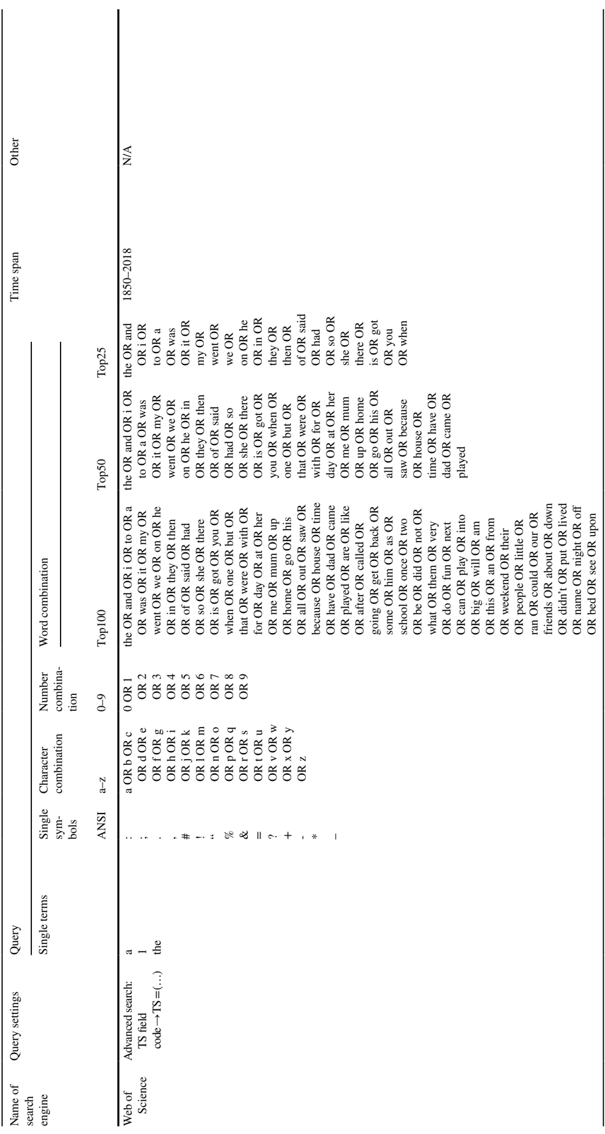
Information on the size of academic search engines and bibliographic databases (ASEBDs) is often outdated or entirely unavailable. Hence, it is difficult to assess the scope of specific databases, such as Google Scholar. While scientometric studies have estimated ASEBD sizes before, the methods employed were able to compare only a few databases. Consequently, there is no up-to-date comparative information on the sizes of popular ASEBDs. This study aims to fill this blind spot by providing a comparative picture of 12 of the most commonly used ASEBDs. In doing so, we build on and refine previous scientometric research by counting query hit data as an indicator of the number of accessible records. Iterative query optimization makes it possible to identify a maximum number of hits for most ASEBDs. The results were validated in terms of their capacity to assess database size by comparing them with official information on database sizes or previous scientometric studies. The queries used here are replicable, so size information can be updated quickly. The findings provide first-time size estimates of ProQuest and EbscoHost and indicate that Google Scholar’s size might have been underestimated so far by more than 50%. By our estimation Google Scholar, with 389 million records, is currently the most comprehensive academic search engine.
Overview
The claims and statistics of this paper haven’t been checked yet.
Free: it reads the open-access text and checks the first 5 claims that cite a source we can check. Create a free account to check every claim.
Integrity signals
Registry
Cites
Statistics
Figures
Verification
Claims the paper makes
The claims and statistics of this paper haven’t been checked yet.
Free: it reads the open-access text and checks the first 5 claims that cite a source we can check. Create a free account to check every claim.
Claims other papers make about this one
Each is checked against this paper’s own text: does it say what the citing paper says it does?
The source backs part of the claim, not all of it — or backs it for a different population, condition or comparison.
In the citing paper
“Unfortunately, the majority of DBs' end users are not usually aware of these limitations and how they can affect the accuracy, reliability, and reproducibility of their task's outcome [15,23].”
From Web of Science (WoS) and Scopus: The Titans of Bibliographic Information in Today’s Academic World (2021) · cites this paper as [23]
Experimental — accuracy not yet measuredThe source backs part of the claim, not all of it — or backs it for a different population, condition or comparison.
In the citing paper
“even when the dates of the last update are indicated to be very recent, the information provided is often clearly not the most recent one, especially regarding the numbers describing DBs coverage, which can confuse users in determining which information they can rely on”
From Web of Science (WoS) and Scopus: The Titans of Bibliographic Information in Today’s Academic World (2021) · cites this paper as [23]
Experimental — accuracy not yet measuredThe cited source says what the claim attributes to it.
In the citing paper
“These characteristics make it the most comprehensive academic search engine [28], removing the need to perform the search in each distinct reputable academic repository.”
From A Review of Design and Evaluation Practices in Mobile Text Entry for Visually Impaired and Blind Persons (2023) · cites this paper as [28]
The cited source says what the claim attributes to it.
In the citing paper
“1 Google Scholar was chosen because it is currently the most comprehensive academic search engine with 389 million records (Gusenbauer, 2019).”
From When Problem Solving Followed by Instruction Works: Evidence for Productive Failure (2021) · cites this paper as Gusenbauer, 2019
The cited source says what the claim attributes to it.
In the citing paper
“In these cases, the convenience and performance of the DB's web interface and provided additional functionalities may also greatly influence the preference of the DB [14,23,24].”
From Web of Science (WoS) and Scopus: The Titans of Bibliographic Information in Today’s Academic World (2021) · cites this paper as [23]
6 more claims about this paper
Create a free account to see every claim other papers make about this one.
Self-check
Percentages, sums and reported differences re-computed from the paper’s own numbers.
The self-check needs the paper’s full text.
Citations
Cites
Martín-Martín, A., Orduna-Malea, E., Thelwall, M., & Delgado López-Cózar, E. (2018) · Journal of Informetrics · doi:10.1016/j.joi.2018.09.002 · Cited by 1,990
Martín-Martín, A., Orduna-Malea, E., Thelwall, M., & López-Cózar, E. D. (2018) · doi:10.31235/osf.io/42nkm · Cited by 1,990
A Comparison between Two Main Academic Literature Collections: Web of Science and Scopus Databases
Chadegani, A. A., Salehi, H., Yunus, M. M., Farhadi, H., Fooladi, M., Farhadi, M., & Ebrahim, N. A. (2013) · Asian Social Science · doi:10.5539/ass.v9n5p18 · Cited by 1,925
Bornmann, L., & Mutz, R. (2015) · Journal of the Association for Information Science and Technology · doi:10.1002/asi.23329 · Cited by 1,576
Accessibility of information on the web
Lawrence, S., & Giles, C. L. (1999) · Nature · doi:10.1038/21987 · Cited by 1,349
The Literature of Bibliometrics, Scientometrics, and Informetrics
Hood, W. W., & Wilson, C. S. (2001) · Scientometrics · doi:10.1023/a:1017919924342 · Cited by 981
Meho, L. I., & Yang, K. (2007) · Journal of the American Society for Information Science and Technology · doi:10.1002/asi.20677 · Cited by 974 · cited 2×
“…have examined ASEBDs individually (Aguillo 2012; Halevi et al. 2017; Mayr and Walter 2007; Orduña-Malea et al. 2015; Hug and Braendle 2017; Harzing 2014) or compared them in pairs or multiples (Meho and Yang 2007; Shultz 2007; Chadegani et al. 2013; Khabsa and Giles 2014; de Winter et al. 2014).”
Search Engines: Information Retrieval in Practice
Croft, B. W., Metzler, D., & Strohman, T. (2009) · Medical Entomology and Zoology · Cited by 797
Online collaboration: Scientists and the social network
Van Noorden, R. (2014) · Nature · doi:10.1038/512126a · Cited by 654
Thelwall, M. (2008) · Journal of Information Science · doi:10.1177/0165551507087238 · Cited by 518 · cited 1×
“2015; Orduña-Malea and Delgado López-Cózar 2014; Hood and Wilson 2001; Thelwall 2008, 2009; Bar-Ilan 2008).”
Background
Research works printed but not linked: 6
- 13. Arts and Humanities Citation Index (1975-present) 4. Conference Proceedings Citation Index-Science (1990-present) 5. Conference Proceedings Citation Index-Social Science and Humanities (1990-pre- sent)
- 19. Data Citation Index (2010-present) 5. Derwent Innovations Index (2010-present) 6. KCI-Korean Journal Database (1980-present) 7. MEDLINE (1950-present)
- Ortega, J. L. (2014). Academic search engines: A quantitative outlook (Chandos information professional series). Oxford: Chandos Publishing.
- 63. Ortega, J. L. (2014). Academic search engines: A quantitative outlook (Chandos information professional series). Oxford: Chandos Publishing. Oxford University Press. (2008). Oxford wordlist. Oxford: Oxford University Press.
- 64. Pederson, J. P. (2001). International directory of company histories (International Directory of Company Histories Ser) (Vol. 40). Farmington Hills: Saint James Press. (Imprint); Cengage Gale.
- 69. Thelwall, M. (Ed.). (2009). Introduction to webometrics: Quantitative web research for the social sciences (Synthesis lectures on information concepts, retrieval, and services) (Vol. 4). San Francisco: Morgan & Claypool Publishers.
Cited by
Items 501–600 of 884
O Uso das evidências nas políticas brasileiras de ciência, tecnologia e inovação
Schmidt, F. D. H., Bin, A., Pinheiro, L. V., & Negri, F. D. (2022) · Instituto de Pesquisa Econômica Aplicada (Ipea) eBooks · doi:10.38116/978-65-5635-032-5/capitulo25 · Cited by 4
Climate Change Impacts on Non-human Primates: What Have We Modelled and What Do We Do Now?
Winder, I. C., Mace, B., & Korstjens, A. H. (2023) · Developments in primatology · doi:10.1007/978-3-031-11736-7_6 · Cited by 4
Common Risky Sexual Behaviours Among Men Who Have Sex with Men using A Modified Delphi Technique
Malefo, M. A., Mokgatle, M. M., & Ayo-Yusuf, O. A. (2022) · The Open Public Health Journal · doi:10.2174/18749445-v15-e221220-2022-72 · Cited by 4
Moloo, R. K. (2023) · IEEE Transactions on Learning Technologies · doi:10.1109/tlt.2023.3330529 · Cited by 4
“Thearticlestobeconsideredforthisreviewhavebeenselected based on some set inclusion and exclusion criteria as listed in Table I. the most comprehensive academic search engine [40] since it indexes articles from other scholarly publishers as well.”
BackgroundIndicator for formulating and measuring the Urban Sustainability Index: A Review
Baskaran, V., Velkennedy, R., Murugan, S., & Velmurugan, A. (2023) · Proceedings of International Exchange and Innovation Conference on Engineering & Sciences (IEICES) · doi:10.5109/7158038 · Cited by 4
Automated Bias and Indoctrination at Scale… Is All You Need
Atreides, K. (2024) · Studies in computational intelligence · doi:10.1007/978-3-031-50381-8_10 · Cited by 4
CS-Insights: A System for Analyzing Computer Science ResearchPreprint
Wahle, J. P., Ruas, T., Küll, L., Mohammad, S. M., & Gipp, B. (2023) · Authorea · doi:10.22541/au.167528154.49652998/v1 · Cited by 4
Buyuklieva, B., & Raimbault, J. (2023) · arXiv (Cornell University) · doi:10.48550/arxiv.2302.10791 · Cited by 4
“This paper presented a systematised review of the broad body of scholarship on migration and housing gathered using Google Scholar (GS) – the most extensive bibliographic database due to its inclusion of a range of sources (Gusenbauer, 2019; Martín-Martín, Thelwall and López-Cózar, 2020).”
Pereira, F. A. (2022) · Digital Library of Theses and Dissertations (Universidade de São Paulo) · doi:10.11606/d.27.2022.tde-12042023-125534 · Cited by 4
Soft skills : définition, conscientisation et impact dans un contexte de transformation
Marle, C. J.-L. (2022) · theses.fr (ABES) · doi:10.70675/bd38e330zad1bz4df2z91f7z4fd0683ab4d4 · Cited by 4
Ujah, E. (2023) · ScholarWorks (Walden University) · Cited by 4
Sjögårde, P. (2023) · Open Archive (Karolinska Institutet) · Cited by 4
Moncorps, F. (2023) · theses.fr (ABES) · doi:10.70675/af0da081z6a88z43f2z8930z8bea53fe3349 · Cited by 4
Trends in shoulder arthroplasty research over the decades
Dupley, L., Atwan, Y., & Viswanath, A. I. (2024) · Journal of Clinical Orthopaedics and Trauma · doi:10.1016/j.jcot.2024.102882 · Cited by 3
Khadka, A., & Sthapit, S. (2025) · Informatics · doi:10.3390/informatics12040108 · Cited by 3
“Similarly, a scientometric study estimated 389 million records as of 2018 [6].”
Bocharov, A. V. (2026) · Историческая информатика · doi:10.7256/2585-7797.2026.1.78969 · Cited by 3
Systematic mapping of blockchain-sustainability nexus and development of a holistic framework
Rahman, S. M. M., Masli, E. K., Le, V., & Saif, A. N. M. (2026) · Discover Sustainability · doi:10.1007/s43621-026-03609-8 · Cited by 3
“Compared to Web of Science or IEEE Xplore, which are not deep in social and economic sustainability, or Google Scholar, which contains non-peer-reviewed sources, Scopus has better metadata and indexing, which, in turn, makes it prone to bias [23, 40, 82].”
Explainable ensemble machine learning for WWTPs: A systematic review and compliance framework
Gegana, Y. T., Bokoro, P. N., & Paepae, T. (2026) · Results in Engineering · doi:10.1016/j.rineng.2026.112376 · Cited by 3
Nugraha, L. A., Kusmana, C., & Hartoyo, A. P. P. (2022) · IOP Conference Series Earth and Environmental Science · doi:10.1088/1755-1315/1109/1/012092 · Cited by 3
“Moreover, there is no limit to the language range, the keywords allowed per search, and the list of journals covered [17].”
BackgroundInfluence of the International Journal of Exercise Science
Knudson, D. V., & Burson, G. K. (2024) · International journal of exercise science · doi:10.70252/lsit5238 · Cited by 3
Auth4App: Streamlining authentication for integrated cyber–physical environments
Quincozes, V. E., Mansilha, R. B., Kreutz, D., Miers, C. C., & Immich, R. (2024) · Journal of Information Security and Applications · doi:10.1016/j.jisa.2024.103802 · Cited by 3
Comparative analysis of the capabilities of WoS and eLibrary for analyzing bibliographic networks
Maltseva, D., Pavlova, I. A., Kapustina, L., Vashchenko, V., & Fiala, D. (2024) · Sociology methodology methods mathematical modeling (Sociology 4M) · doi:10.19181/4m.2023.32.1.1 · Cited by 3
Chi, J., Kamarudin, S., & Rahman, S. N. A. (2024) · Environment and Social Psychology · doi:10.59429/esp.v9i9.3096 · Cited by 4
“Therefore, it is also recognized as the most comprehensive academic search engine [7] .”
BackgroundMethodInfluentialSERB: an interactive exploration mechanism for blind web users to explore web search content
Naseer, S., Rashid, U., Saddal, M., & Khan, A. R. (2025) · Universal Access in the Information Society · doi:10.1007/s10209-025-01199-2 · Cited by 3
“1 Visual representation of the existing accessibility tools: a [22], b [23], c [24], d [1], and e [25] and customization of the interface components according to BWUs’ interaction needs.”
InfluentialJones, M. L., Leonard, A. F. C., Bethel, A. C., Lamb, E., Gaze, W. H., Taylor, T., Singer, A. C., Ukoumunne, O. C., & Garside, R. (2025) · Environment International · doi:10.1016/j.envint.2025.109371 · Cited by 3
Exploring Gen Z Engagement: Key Factors Driving Involvement in Organisational Development Processes
Surugiu, C., Surugiu, M.-R., Grădinaru, C., & Grigore, A.-M. (2025) · Economic Insights – Trends and Challenges · doi:10.51865/eitc.2025.01.02 · Cited by 3
The Academic Midas Touch: A citation-based indicator of research excellence
Rosenfeld, A., Alexi, A., Mushiev, L., & Lazebnik, T. (2025) · Journal of Data and Information Science · doi:10.2478/jdis-2025-0038 · Cited by 3
“Note that DBLP is a bibliometric dataset that focuses on the computational domain (i.e., Mathematics, Computer Science, and Engineering) (Biryukov & Dong, 2010; Cavacini, 2015; Kim, 2018, 2019) and is considered by many as the state of the art in coverage and accuracy (Rosenfeld, 2023).”
Scholarly Journal Publishing Forums in Tanzania Universities: An Insight
Samzugi, A., & Kagugu, A. H. (2023) · University of Dar es Salaam Library Journal · doi:10.4314/udslj.v18i1.11 · Cited by 3
Peterson, B. E., & Lawrence, D. S. (2025) · Police Practice and Research · doi:10.1080/15614263.2025.2478851 · Cited by 3
“We chose to rely on Google Scholar, as it is recognized as the largest scholarly database, containing approximately 389 million records as of January 2018 (Gusenbauer, 2019).”
Information leakage in the practical linking of sensitive data: Parties, protocols, and adversaries
Christen, P., Schnell, R., & Vidanage, A. (2026) · Information Systems · doi:10.1016/j.is.2026.102720 · Cited by 3
Buhr, S. P. (2020) · Scholar Commons (University of South Carolina) · Cited by 3
Where to now? Searching beyond Medline
Holland, M., Dutton, M., & Glover, S. (2021) · Journal of Paramedic Practice · doi:10.12968/jpar.2021.13.2.81 · Cited by 3
Eaton, C., Banks, A., Weger, K., Mesmer, B. L., & Moreland, R. (2022) · Systems Research and Behavioral Science · doi:10.1002/sres.2883 · Cited by 3
BibRank: Automatic Keyphrase Extraction Platform Using Metadata
Eldallal, A., & Barbu, E. (2023) · Information · doi:10.3390/info14100549 · Cited by 3
“One study [1] reported that by the end of 2018, Google Scholar had indexed approximately 400 million articles.”
BackgroundUnderstanding the metrics used to assess the quality of journals
Pathak, V. K., & Mohan Kumar, M. (2019) · International Journal of Community Medicine and Public Health · doi:10.18203/2394-6040.ijcmph20195501 · Cited by 3
Misspelling of Delirium as “Delerium” in the Academic Literature
Reddin, C., Koay, W. J., Mulkerrin, E. C., & O’Keeffe, S. T. (2019) · Journal of the American Geriatrics Society · doi:10.1111/jgs.16289 · Cited by 3
Reyes-Mandujano, I. F., Fernández, F. J., Mercado, W., Goméz, L., & Oliva, R. D. P. (2020) · Economía Agraria y Recursos Naturales · doi:10.7201/earn.2020.01.03 · Cited by 3
“…o diversidad interespecífica (entre cultivos, número de especies ) e intraespecífica (dentro de un cultivo, variabilidad genotípica), también se consideró su funcionalidad (complementariedad funcional entre especies) como componentes o dimensiones de la biodiversidad (Gusenbauer, 2019).”
BackgroundTowards an Academic Abstract Sentence Classification System
Stead, C., Smith, S., Busch, P. A., & Vatanasakdakul, S. (2020) · Lecture notes in business information processing · doi:10.1007/978-3-030-50316-1_39 · Cited by 3
Stres Kepala Sekolah: Sumber dan Strategi Coping
Gaol, N. T. L. (2020) · Jurnal Psikologi Udayana · doi:10.24843/jpu.2020.v07.i02.p04 · Cited by 3
Hasan, S. K. (2020) · NVA (Nasjonalt vitenarkiv) · doi:10.13140/rg.2.2.23994.11205 · Cited by 3
Patent Citation Generation at the Triadic Offices: Mechanisms and Implications for AnalysisPreprint
Higham, K., & Yoshioka-Kobayashi, T. (2022) · SSRN Electronic Journal · doi:10.2139/ssrn.4022851 · Cited by 3
A large-scale, granular topic classification system for scientific documentsPreprint
Jenset, G. B., Bevan, P. J., & Jain, A. (2025) · Research Square · doi:10.21203/rs.3.rs-6529718/v1 · Cited by 3
Semantic Search to Foster Scientific Findability: A Systematic Literature Review
Gottardi, T., Medeiros, C. B., & dos Reis, J. C. (2021) · Journal of Information and Data Management · doi:10.5753/jidm.2021.1919 · Cited by 2
Systematic Literature Review on Factors Causing Secondary Students` Absenteeism
Othman, A. J. J. M. N. H. (2023) · International Journal of Education, Information Technology, and Others · doi:10.5281/zenodo.7884702 · Cited by 2
Mamedov, V. Y., Kovalevsky, D. A., Morozov, D. A., Stolyarov, S. S., & Ospichev, S. (2025) · Modeling and Analysis of Information Systems · doi:10.18255/1818-1015-2025-1-80-94 · Cited by 2
Following the beaten paths: a systematic literature review of followership behavior
Kugler, M., & Sims, R. (2025) · Journal of Management Development · doi:10.1108/jmd-10-2024-0359 · Cited by 2
Thaler, M., & Ocklenburg, S. (2025) · Brain Research Bulletin · doi:10.1016/j.brainresbull.2025.111435 · Cited by 2
Landicho, C. J. B. (2025) · Jurnal Penelitian Pendidikan IPA · doi:10.29303/jppipa.v11i5.10575 · Cited by 2
Maritime piracy bibliometric analysis: A literature overview and map review
Laso, P. M., & Salmon, L. (2025) · Journal of Navigation · doi:10.1017/s0373463325101094 · Cited by 2
“They include 389, 90, 95, 89 and 248 million works, respectively (Gusenbauer, 2019).”
Replication defines reliability – A meta-analysis of aerial insecticide effects on forest arthropods
Stein, F., Fischer, R., & Bräsicke, N. (2025) · Forest Ecology and Management · doi:10.1016/j.foreco.2025.123169 · Cited by 2
Paylı, M., & Çevik, O. (2025) · Kültürel Miras Araştırmaları · doi:10.59127/kulmira.1798570 · Cited by 2
Carol, N. (2025) · Lifespan development and mental health. · doi:10.70322/ldmh.2025.10018 · Cited by 2
TURISMO E PATRIMÔNIO CULTURAL NO MUNICÍPIO DE OURO PRETO/MG:: RELAÇÕES E CONTRADIÇÕES
Ferreira, E. A. M., Teixeira-da-Silva, R. H., & Amarante, F. (2023) · LA Referencia (Red Federada de Repositorios Institucionales de Publicaciones Científicas) · Cited by 2
Perspectives sur les besoins en compétences pour les usages de l’IA dans l’industrie 4.0 au Québec
Zinopoulos, C., Parent, S., Teyssier‐Roberge, G., Laflamme, A. S., Bruneault, F., Tremblay, S., & Marois, A. (2026) · Ad machina l avenir de l humain au travail · doi:10.1522/radm.no9.2035 · Cited by 2
Shah, H., Davies, H., Bastien, C., & Debnath, A. K. (2026) · Case Studies on Transport Policy · doi:10.1016/j.cstp.2026.101765 · Cited by 2
Mamedov, V. Y., Kovalevsky, D. A., Morozov, D. A., Stolyarov, S. S., & Ospichev, S. (2025) · Automatic Control and Computer Sciences · doi:10.3103/s0146411625700440 · Cited by 2
Ye, R., Sibia, N., Bernuy, A. Z., Zhu, T., Nobre, C., Pammer‐Schindler, V., & Liut, M. (2026) · ACM International Conference on Intelligent User Interfaces (IUI) · doi:10.1145/3742413.3789079 · Cited by 2
“To mitigate publisher bias and maximize search comprehensiveness [23], Arc integrates with multiple academic databases.”
Maiti, S., Panja, A., Deo, A., Bora, K., Garai, S., Shirsath, P., Rao, C. A. R., & Aggarwal, P. K. (2026) · Tropical Animal Health and Production · doi:10.1007/s11250-026-05030-9 · Cited by 2
Rami, A. A. M., Habibi, A., Ibrahim, A., & Manaf, N. A. (2026) · SAGE Open · doi:10.1177/21582440261433473 · Cited by 3
“…of coverage across education, psychology, and social sciences and Google Scholar was utilized to access valuable resources within publicly accessible archives, covering diverse disciplines and languages, and providing efficient and effective access to online scientific documents (Gusenbauer, 2019).”
Leveraging digital technology to improve hotel performance: a systematic literature review
Perera, A. G., Jiménez-Jiménez, A., & Nemer, R. (2026) · Information Technology & Tourism · doi:10.1007/s40558-026-00399-7 · Cited by 2
“…between technological innovation and organisational performance indicators, ensuring that the selected articles adhere to rigorous editorial and scientific quality standards (Gusenbauer 2019; Rousseau et al. 2018 ; Pranckutė 2021 ; Harzing and Alakangas 2016; Martin-Martin et al. 2018).”
ANALISIS SELF-CITATION PADA JURNAL TERAKREDITASI NASIONAL SINTA UIN ALAUDDIN MAKASSAR
Arifin, N., Iskandar, I., & Ahmad, L. O. I. (2021) · Jurnal Diskursus Islam · doi:10.24252/jdi.v9i1.25528 · Cited by 2
Wait! What? There’s stuff missing from the scholarly record?
Green, T. (2022) · Medical Writing · doi:10.56012/ajel9043 · Cited by 2
“21 Over the past two decades, publishers and librarians have been focussed on capturing research findings from the academy – mainly in books and journals – to create a digital scholarly record that’s overlaid with sophisticated discov ery systems for use by the academy.”
BackgroundTrevino, R., & Jochem, R. (2023) · Springer eBooks · doi:10.1007/978-3-658-40588-5_2 · Cited by 2
Malik, Z. A., Singh, A., Malik, B. A., Nautiyal, M. C., & Bussmann, R. W. (2023) · Ecological Frontiers · doi:10.1016/j.chnaes.2023.05.001 · Cited by 2
Kinesiology Review’s Scholarly Influence: An Audit of Its First Decade
Knudson, D. V. (2023) · Kinesiology Review · doi:10.1123/kr.2023-0014 · Cited by 2
Zhang, Y., & Yu, D. (2023) · Issues in Science and Technology Librarianship · doi:10.29173/istl2764 · Cited by 2
Ngoc, K. H. (2024) · Tuwhera (Auckland University of Technology) · Cited by 2
Desafios de Pesquisa em Arquiteturas para IoT social
Camargo, L., Pernas, A. M., Yamin, A., & Haertel, F. (2021) · doi:10.5753/sbcup.2021.15998 · Cited by 2
“Em pesquisa, 12 mecanismos de busca amplamente utilizados foram comparados, apontando que o Google Scholar oferece o maior volume de informações acadêmicas, ao manter cerca de 389 milhões de registros [Gusenbauer 2019].”
BackgroundTang, N., Zhang, W., Su, Y., Han, Z., Deng, L., Li, Y., Huang, T., & Li, C. (2021) · Orthopaedic Surgery · doi:10.1111/os.13037 · Cited by 2
How is the Development of Gender Study in The 21st-Century?: A Bibliometric Analysis
Kurniawan, C., & Wahyuni, F. (2022) · Advances in Social Science, Education and Humanities Research/Advances in social science, education and humanities research · doi:10.2991/assehr.k.220304.008 · Cited by 2
Drennan, M., & Pryce, J. (2022) · Journal of Resilient Economies · doi:10.25120/jre.2.1.2022.3908 · Cited by 2
“Articles were sourced from Google Scholar because it’s known for having the largest coverage of data (Gusenbauer, 2019).”
MethodMeasuring Research Productivity at Scale
Lindner, P. (2023) · Proceedings in adaptation, learning and optimization · doi:10.1007/978-3-031-21678-7_16 · Cited by 2
Lewandowski, D. (2023) · Springer eBooks · doi:10.1007/978-3-031-22789-9_6 · Cited by 2
The Next Evolution of Web Browser Execution Environment Performance
Toufie, Z., & Kabaso, B. (2023) · International Conference on Artificial Intelligence, Big Data, Computing and Data Communication Systems (icABCD) · doi:10.1109/icabcd59051.2023.10220564 · Cited by 2
“Table II and Table III summ arises the targetted publisher databases and search systems that were derived from [22], [24], [25].”
BackgroundRepresentation Theorems Obtained by Mining across Web Sources for Hints
Caminati, M. B., & Bowles, J. (2023) · International Conference on Information and Computer Technologies (ICICT) · doi:10.1109/icict58900.2023.00041 · Cited by 2
“In 2019, Google Scholar was estimated, with 389 million records, to be the largest bibliographic database [14]; by querying Google, we will have access to those records and many more.”
BackgroundNash, C. (2023) · Journal of Mental Health Disorders · doi:10.33696/mentalhealth.3.018 · Cited by 2
Functional Size Measurement With Conceptual Models: A Systematic Literature Review
Arman, A., Reto, E. D., Mecella, M., & Santucci, G. (2025) · Journal of Software Evolution and Process · doi:10.1002/smr.70030 · Cited by 2
“Moreover, it offers free access to various types of scholarly publications [25, 26].”
Nash, C. (2025) · Sports · doi:10.3390/sports13060161 · Cited by 2
“A search in Google Scholar—a supplementary database because the results are particular to the search date [73]—extrapolated the reach of the returns.”
Bibliographic Analysis of Operations Research Citation in the Environmental Domain
Keenan, P. (2020) · International Journal of Decision Support System Technology · doi:10.4018/ijdsst.2020040104 · Cited by 2
Identification of Technology-Relevant Entities Based on Trend Curves
Jung, S., Kandadi, R. R., Datta, R., Benton, R., & Segev, A. (2020) · doi:10.5121/csit.2020.100501 · Cited by 2
Ovwasa, D. E. (2020) · San José State University ScholarWorks (San Jose State University) · Cited by 2
Sardanelli, F., Leo, G. D., & Houssami, N. (2020) · Springer eBooks · doi:10.1007/978-3-030-41207-4_11 · Cited by 2
Growing New Scholarly Communication Infrastructures for Sharing, Reusing, and Synthesizing Knowledge
Chan, J., Lutters, W. G., Schneider, J., Kirsanow, K., Bessa, S., & Saunders, J. L. (2022) · ACM Conference on Computer Supported Cooperative Work (CSCW) · doi:10.1145/3500868.3559398 · Cited by 2
“Through this scholarly communication infrastructure, scholars have access to a vast and rapidly growing literature, across disciplines — on the order of hundreds of millions of documents accessible through just a few clicks and keystrokes from a single search engine [9] — from which they can draw to construct new know…”
BackgroundExtraversion in COVID-19 Coping and Actionable Insights from Considering Self-Directed Learning
Nash, C. (2023) · COVID · doi:10.3390/covid3060061 · Cited by 2
“Still, Google Scholar compares well with Scopus as a search engine, which has an estimated 12.6% duplicates to Google Scholar’s 10% [46].”
MethodInfluentialUMA ANÁLISE CIENCIOMÉTRICA E CONCEITUAL DOS VESTÍGIOS
Rodrigues, C. H. P., Mariotto, L. S., Sousa, M. D. D. C., Ortiz, R. S., Bruni, A. T., & Amaral, M. E. A. (2023) · Revista Ifes Ciência · doi:10.36524/ric.v9i3.2193 · Cited by 2
“No entanto, é importante salientar que, apesar das métricas de confiabilidade, os dados na plataforma Google Scholar podem ser sub ou superestimados devido ao formato de indexação (GUSENBAUER, 2019).”
BackgroundLesson study for the professional development of higher education faculty members
Hervas, G. (2020) · Dipòsit Digital de la Universitat de Barcelona (Universitat de Barcelona) · Cited by 2
Essays on trust and reputation portability in digital platform ecosystems
Hesse, M. (2021) · DepositOnce · doi:10.14279/depositonce-11679 · Cited by 2
Supplemental Instruction. Volume 3: Organisation and Leadership
:null (2021) · Waxmann Verlag GmbH eBooks · doi:10.31244/9783830993261 · Cited by 2
Rivendell: Project-Based Academic Search EnginePreprint
Lazebnik, T., Weitman, H., Goldberg, Y., & Kaminka, G. A. (2022) · arXiv (Cornell University) · doi:10.48550/arxiv.2206.12926 · Cited by 2
“Finding relevant research literature in a very large online databases is a well-known challenge [4, 3, 35, 18, 1, 14, 24, 40].”
BackgroundWhetstone, D. H. (2022) · MOspace Institutional Repository (University of Missouri) · doi:10.32469/10355/94266 · Cited by 2
Abuwala, H. S., Zhang, B., & Wang, M. (2023) · arXiv (Cornell University) · doi:10.48550/arxiv.2308.04524 · Cited by 2
“…paper has received, compared to Google Scholar(Without an open API) which is considered to be the world’s largest source of academic information [12]; 3) The classification process of categorizing papers into Academic, Industry and Hybrid are prone to errors because it involved an extensive…”
BackgroundArtificial Intelligence and Regulation: Total Quality Management for Mental Health ServicesPreprint
Danias, Ν., & Koukopoulos, A. (2023) · SSRN Electronic Journal · doi:10.2139/ssrn.4559787 · Cited by 2
The Origins of Gender, not Sex: Evolution and the Reproductive AxisPreprint
Woodhill, B. M., Samuels, C. A., & Jamieson, G. A. (2024) · doi:10.33774/coe-2020-k7gt1-v10 · Cited by 2
Essays on Technology Paternalism : Paternalistic Effects of Smart Technologies on User Behavior
Rochi, M. (2024) · doi:10.20378/irb-98474 · Cited by 2
Stofiana, T., Sunendar, D., Mulyati, Y., & Sastromiharjo, A. (2025) · Research Square · doi:10.21203/rs.3.rs-6580391/v1 · Cited by 2
Opening the Scope of Openness in AIPreprint
Paris, T., Moon, A., & Guo, J. (2025) · arXiv (Cornell University) · doi:10.48550/arxiv.2505.06464 · Cited by 2
“These databases include open-access and subscription-based publications, representing a broad disciplinary coverage such as science, engineering, medicine, and the humanities [24, 51, 52, 144, 169].”
Christian Ethical Guidelines to Artificial Intelligence and Technological Singularity
Van Heerden, E. (2024) · Boloka Institutional Repository (North-west University) · doi:10.13140/rg.2.2.36814.88648 · Cited by 2
Misol Gallego, A. (2023) · University of Valladolid Documentary Repository (University of Valladolid) · Cited by 2
Evaluación del uso de la asimetría fluctuante en anfibios como bioindicadores de cambios ambientales
Michel Varajão, G., Núbia Carla, S. M., & Miranda Melo, N. P. (2023) · LA Referencia (Red Federada de Repositorios Institucionales de Publicaciones Científicas) · Cited by 2
Periódicos científicos e mídias sociais : um estudo de caso
Ayres, L. M. G. (2022) · RIUnB Institutional Repository (University of Brasília) · doi:10.26512/2022.12.d.45888 · Cited by 2
Metadata
- Authors
- Gusenbauer, M.
- Affiliations
- Johannes Kepler University of Linz (AT)
- Corresponding author
- Gusenbauer, Michael
- ORCID
- Gusenbauer, Michael
- Venue
- Scientometrics
- Published
- 2018-11-10
- Volume
- 118
- Issue
- 1
- Pages
- 177-214
- ISSN
- 0138-9130 (ISSN-L)
- 1588-2861
- OpenAlex
- W2900201388
- Semantic Scholar
- ff5f86f2e54c356cec4b4004398f501776c29ffb
- Cited by
- 687
- References
- 60
- Citations by year
- 2026: 55 · 2025: 89 · 2024: 100 · 2023: 113 · 2022: 116 · 2021: 116 · 2020: 78 · 2019: 20
- FWCI
- 40.74
- Type
- journal article
- Language
- en
- Open access
- hybrid
- doi.org
- Licence
- cc-by
- creativecommons.org/licenses/by/4.0 (tdm)
- Locations
- Scientometrics (publishedVersion, cc-by)
- RePEc: Research Papers in Economics (submittedVersion)
- University Library Linz repository (Johannes Kepler Universitat Linz) (submittedVersion, cc-by)
- Topics
- Social Sciences › Library and Information Sciences › scientometrics and bibliometrics research
- Physical Sciences › Computer Science › Information Systems › Web visibility and informetrics
- Social Sciences › Library and Information Sciences › Library Science and Information
- Keywords
- academic search engines, bibliographic databases, Google Scholar, ProQuest, EBSCOhost
About these checks
Registry, retraction, Cites and statistics results are computed, not judged, with one exception: a printed reference that no index lists is read once by a model before it counts as a citation error. Claims are extracted by a model and kept only when their quote appears verbatim in the text; each cited source is then checked, with a model’s help, for whether it says what the claim relies on. Those verdicts can be wrong — read the claim’s quote and the cited source before relying on one.
Statistics and arithmetic are recomputed, not judged.
Confidence bands are shown only for fields calibrated on our annotated test set. None is calibrated yet, so no band is shown.
What counts as a claim ›How we measure confidence ›How we check this ›
Are you an author, or do you see a problem with this page? Request a review
Data sources
Bibliographic data: Semantic Scholar, OpenAlex, Crossref.
Contains information from the Semantic Scholar Academic Graph Datasets, made available under the ODC Attribution License (ODC-BY 1.0).
Semantic Scholar’s data is described in: Kinney, R., et al. (2023). The Semantic Scholar Open Data Platform. arXiv:2301.10140.
