

Google Scholar to overshadow them all? Comparing the sizes of 12 academic search engines and bibliographic databases
Open accessThe DOI matches its Crossref record; 60 of the 61 references it cites were found in a registry or an index, and 1 are not checked yet.
Abstract
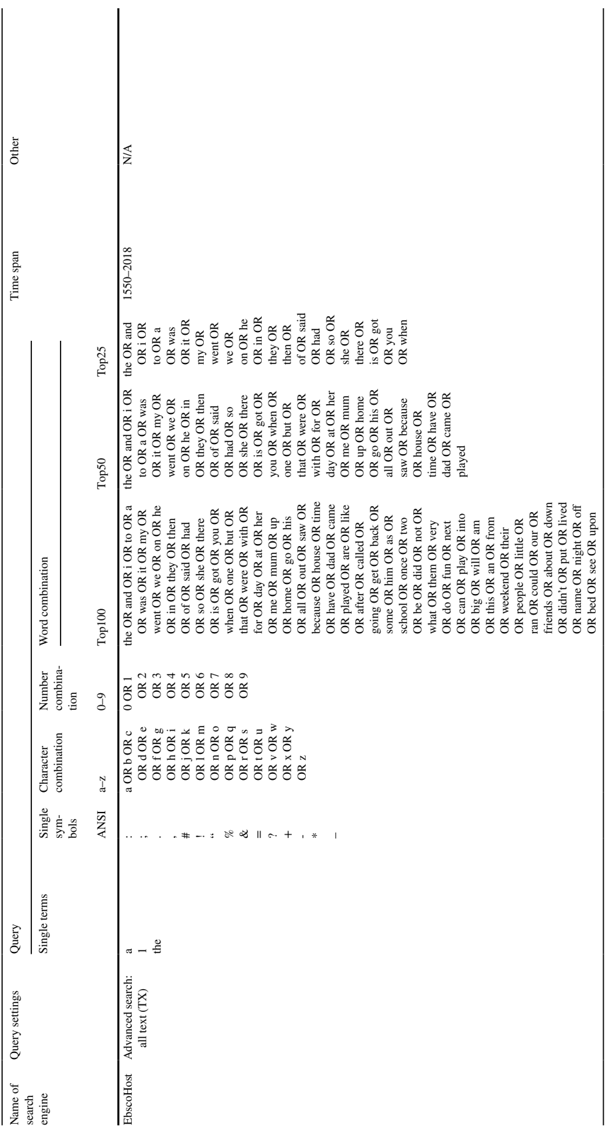
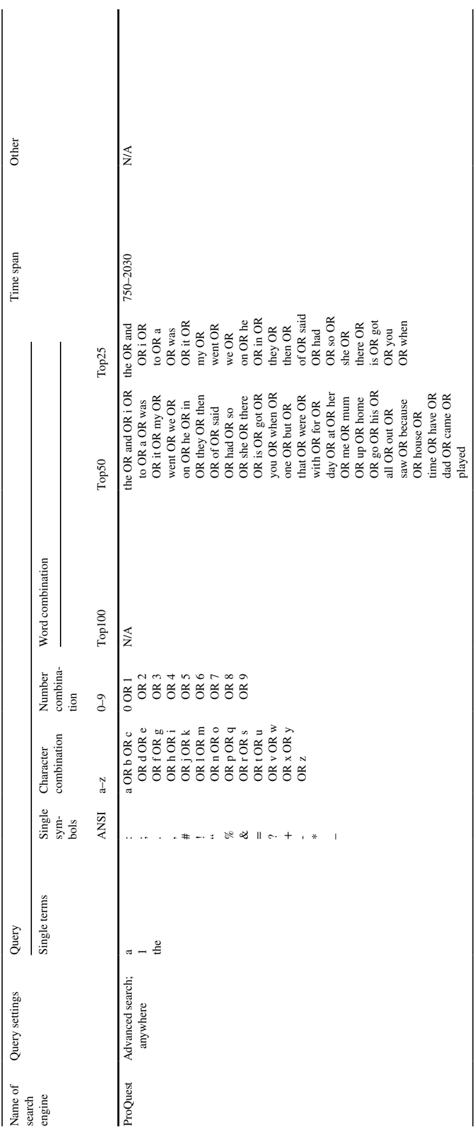
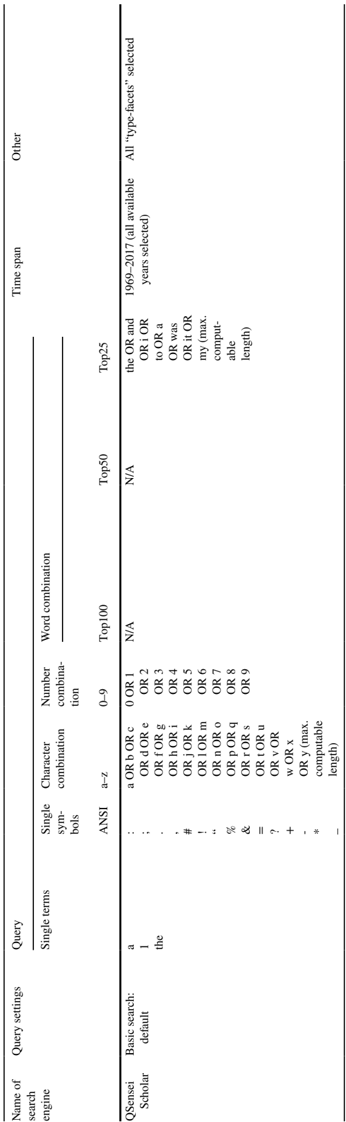
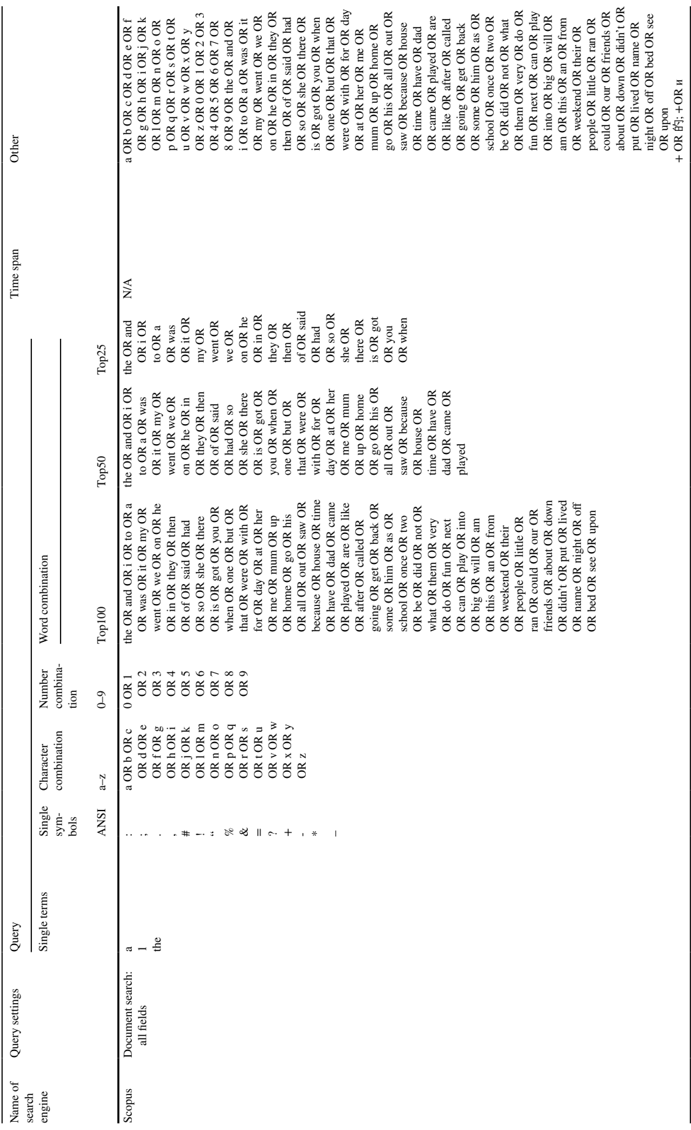
Information on the size of academic search engines and bibliographic databases (ASEBDs) is often outdated or entirely unavailable. Hence, it is difficult to assess the scope of specific databases, such as Google Scholar. While scientometric studies have estimated ASEBD sizes before, the methods employed were able to compare only a few databases. Consequently, there is no up-to-date comparative information on the sizes of popular ASEBDs. This study aims to fill this blind spot by providing a comparative picture of 12 of the most commonly used ASEBDs. In doing so, we build on and refine previous scientometric research by counting query hit data as an indicator of the number of accessible records. Iterative query optimization makes it possible to identify a maximum number of hits for most ASEBDs. The results were validated in terms of their capacity to assess database size by comparing them with official information on database sizes or previous scientometric studies. The queries used here are replicable, so size information can be updated quickly. The findings provide first-time size estimates of ProQuest and EbscoHost and indicate that Google Scholar’s size might have been underestimated so far by more than 50%. By our estimation Google Scholar, with 389 million records, is currently the most comprehensive academic search engine.
Overview
The claims and statistics of this paper haven’t been checked yet.
Free: it reads the open-access text and checks the first 5 claims that cite a source we can check. Create a free account to check every claim.
Integrity signals
Registry
Cites
Statistics
Figures
Verification
Claims the paper makes
The claims and statistics of this paper haven’t been checked yet.
Free: it reads the open-access text and checks the first 5 claims that cite a source we can check. Create a free account to check every claim.
Claims other papers make about this one
Each is checked against this paper’s own text: does it say what the citing paper says it does?
The source backs part of the claim, not all of it — or backs it for a different population, condition or comparison.
In the citing paper
“Unfortunately, the majority of DBs' end users are not usually aware of these limitations and how they can affect the accuracy, reliability, and reproducibility of their task's outcome [15,23].”
From Web of Science (WoS) and Scopus: The Titans of Bibliographic Information in Today’s Academic World (2021) · cites this paper as [23]
Experimental — accuracy not yet measuredThe source backs part of the claim, not all of it — or backs it for a different population, condition or comparison.
In the citing paper
“even when the dates of the last update are indicated to be very recent, the information provided is often clearly not the most recent one, especially regarding the numbers describing DBs coverage, which can confuse users in determining which information they can rely on”
From Web of Science (WoS) and Scopus: The Titans of Bibliographic Information in Today’s Academic World (2021) · cites this paper as [23]
Experimental — accuracy not yet measuredThe cited source says what the claim attributes to it.
In the citing paper
“These characteristics make it the most comprehensive academic search engine [28], removing the need to perform the search in each distinct reputable academic repository.”
From A Review of Design and Evaluation Practices in Mobile Text Entry for Visually Impaired and Blind Persons (2023) · cites this paper as [28]
The cited source says what the claim attributes to it.
In the citing paper
“1 Google Scholar was chosen because it is currently the most comprehensive academic search engine with 389 million records (Gusenbauer, 2019).”
From When Problem Solving Followed by Instruction Works: Evidence for Productive Failure (2021) · cites this paper as Gusenbauer, 2019
The cited source says what the claim attributes to it.
In the citing paper
“In these cases, the convenience and performance of the DB's web interface and provided additional functionalities may also greatly influence the preference of the DB [14,23,24].”
From Web of Science (WoS) and Scopus: The Titans of Bibliographic Information in Today’s Academic World (2021) · cites this paper as [23]
6 more claims about this paper
Create a free account to see every claim other papers make about this one.
Self-check
Percentages, sums and reported differences re-computed from the paper’s own numbers.
The self-check needs the paper’s full text.
Citations
Cites
Martín-Martín, A., Orduna-Malea, E., Thelwall, M., & Delgado López-Cózar, E. (2018) · Journal of Informetrics · doi:10.1016/j.joi.2018.09.002 · Cited by 1,990
Martín-Martín, A., Orduna-Malea, E., Thelwall, M., & López-Cózar, E. D. (2018) · doi:10.31235/osf.io/42nkm · Cited by 1,990
A Comparison between Two Main Academic Literature Collections: Web of Science and Scopus Databases
Chadegani, A. A., Salehi, H., Yunus, M. M., Farhadi, H., Fooladi, M., Farhadi, M., & Ebrahim, N. A. (2013) · Asian Social Science · doi:10.5539/ass.v9n5p18 · Cited by 1,925
Bornmann, L., & Mutz, R. (2015) · Journal of the Association for Information Science and Technology · doi:10.1002/asi.23329 · Cited by 1,576
Accessibility of information on the web
Lawrence, S., & Giles, C. L. (1999) · Nature · doi:10.1038/21987 · Cited by 1,349
The Literature of Bibliometrics, Scientometrics, and Informetrics
Hood, W. W., & Wilson, C. S. (2001) · Scientometrics · doi:10.1023/a:1017919924342 · Cited by 981
Meho, L. I., & Yang, K. (2007) · Journal of the American Society for Information Science and Technology · doi:10.1002/asi.20677 · Cited by 974 · cited 2×
“…have examined ASEBDs individually (Aguillo 2012; Halevi et al. 2017; Mayr and Walter 2007; Orduña-Malea et al. 2015; Hug and Braendle 2017; Harzing 2014) or compared them in pairs or multiples (Meho and Yang 2007; Shultz 2007; Chadegani et al. 2013; Khabsa and Giles 2014; de Winter et al. 2014).”
Search Engines: Information Retrieval in Practice
Croft, B. W., Metzler, D., & Strohman, T. (2009) · Medical Entomology and Zoology · Cited by 797
Online collaboration: Scientists and the social network
Van Noorden, R. (2014) · Nature · doi:10.1038/512126a · Cited by 654
Thelwall, M. (2008) · Journal of Information Science · doi:10.1177/0165551507087238 · Cited by 518 · cited 1×
“2015; Orduña-Malea and Delgado López-Cózar 2014; Hood and Wilson 2001; Thelwall 2008, 2009; Bar-Ilan 2008).”
Background
Research works printed but not linked: 6
- 13. Arts and Humanities Citation Index (1975-present) 4. Conference Proceedings Citation Index-Science (1990-present) 5. Conference Proceedings Citation Index-Social Science and Humanities (1990-pre- sent)
- 19. Data Citation Index (2010-present) 5. Derwent Innovations Index (2010-present) 6. KCI-Korean Journal Database (1980-present) 7. MEDLINE (1950-present)
- Ortega, J. L. (2014). Academic search engines: A quantitative outlook (Chandos information professional series). Oxford: Chandos Publishing.
- 63. Ortega, J. L. (2014). Academic search engines: A quantitative outlook (Chandos information professional series). Oxford: Chandos Publishing. Oxford University Press. (2008). Oxford wordlist. Oxford: Oxford University Press.
- 64. Pederson, J. P. (2001). International directory of company histories (International Directory of Company Histories Ser) (Vol. 40). Farmington Hills: Saint James Press. (Imprint); Cengage Gale.
- 69. Thelwall, M. (Ed.). (2009). Introduction to webometrics: Quantitative web research for the social sciences (Synthesis lectures on information concepts, retrieval, and services) (Vol. 4). San Francisco: Morgan & Claypool Publishers.
Cited by
Items 301–400 of 884
Leveraging AI to Enhance Marketing and Customer Engagement Strategies in the French Market
-, R. E. (2024) · International Journal For Multidisciplinary Research · doi:10.36948/ijfmr.2024.v06i03.23147 · Cited by 12
“The widespread usage of Google Scholar as a search engine for academic literature suggests that the papers referred to in a given study are more likely to be read and referenced [73].”
BackgroundZhong, T. C., Saad, M. I. M., & Ahmad, C. N. C. (2022) · Journal Of ICT In Education · doi:10.37134/jictie.vol9.1.8.2022 · Cited by 12
Zhang, Y., Angell, L., & Bao, S. (2021) · Transportation Research Interdisciplinary Perspectives · doi:10.1016/j.trip.2021.100337 · Cited by 12
Literature-based discovery approaches for evidence-based healthcare: a systematic review
Cheerkoot-Jalim, S., & Khedo, K. K. (2021) · Health and Technology · doi:10.1007/s12553-021-00605-y · Cited by 13
An Overview on the Explainability of Cyber-Physical Systems
Jha, S. S. (2022) · Proceedings of the ... International Florida Artificial Intelligence Research Society Conference · doi:10.32473/flairs.v35i.130646 · Cited by 12
“This search yielded 900 results for the years 2015-2022 on Google Scholar (comparatively more comprehensive academic search engine (Gusenbauer 2019)).”
BackgroundKatirai, A., Kogetsu, A., Kato, K., & Yamamoto, B. A. (2022) · Frontiers in Public Health · doi:10.3389/fpubh.2022.915438 · Cited by 12
Jimenez, W. P., Katz, I. M., & Liguori, E. A. (2022) · Occupational Health Science · doi:10.1007/s41542-022-00131-x · Cited by 12
Sinha, T., & Kapur, M. (2021) · EdArXiv (OSF Preprints) · doi:10.35542/osf.io/83p7e · Cited by 12
Vrontis, D., Hulland, J. S., Shaw, J. D., Gaur, A. S., Czinkota, M. R., & Christofi, M. (2022) · International Marketing Review · doi:10.1108/imr-09-2022-390 · Cited by 12
Modifying Social Vulnerability Indices to Complement Physical Exposure Risk Analyses
Wainger, L., Weber, M. A., & Price, E. W. (2024) · Natural Hazards Review · doi:10.1061/nhrefo.nheng-2237 · Cited by 11
Clothing Brands’ Sustainability Practices: A Bibliometric Approach
Hasan, M., Talukder, S. C., Lakner, Z., & Temesi, Á. (2025) · Administrative Sciences · doi:10.3390/admsci15060221 · Cited by 6
“…utilize various databases, including PubMed and Google Scholar; however, PubMed covers especially medical sciences and was unsuitable in this case (Gusenbauer, 2019; Martín-Martín et al., 2018), while Google scholar contains gray literature in addition to the accepted, peer-reviewed, high-quality…”
Feldhoff, K., Wiemer, H., Träger, P., Kühne, R., Zimmermann, M., & Ihlenfeldt, S. (2025) · Applied Sciences · doi:10.3390/app15179331 · Cited by 12
Screen Reader Accessibility Study of Interactive Maps
Hasan, S. K., & Gjøsæter, T. (2021) · Lecture notes in computer science · doi:10.1007/978-3-030-78092-0_15 · Cited by 11
Análisis de los perfiles de investigadores de Panamá e indicadores bibliométricos de Google Scholar
Murillo, D., Zapata, R., & López, O. R. (2023) · Revista española de Documentación Científica · doi:10.3989/redc.2023.1.1962 · Cited by 11
Lamichhane, Y. R. (2023) · E-Learning and Digital Media · doi:10.1177/20427530231160890 · Cited by 11
“A study by Gusenbauer (2019: 177) estimates that “ Google Scholar, with 389 million records, is currently the most comprehensive academic search engine ” .”
BackgroundMethodJudging Journals: How Impact Factor and Other Metrics Differ across Disciplines
Galbraith, Q., Carlile, A., & Cardon, C. (2023) · College & Research Libraries · doi:10.5860/crl.84.6.888 · Cited by 11
Baker-Médard, M., Concannon, K., Gantt, C., Moen, S., & White, E. R. (2024) · Sustainability · doi:10.3390/su16146078 · Cited by 11
Ranking ‘by Relevance’ in Academic Literature Searches: Prevalence, Definitions, and Implications
Jordan, K., & Tsai, S. P. (2024) · Postdigital Science and Education · doi:10.1007/s42438-024-00530-z · Cited by 11
“Google Scholar arguably promotes inclusivity by drawing upon a much wider pool of sources than traditional databases, including preprints and other online documents not formally ‘published’ (Gusenbauer 2019; Martín-Martín et al. 2021).”
The Effectiveness of Instagram Visual Campaigns on Brand Awareness Among Gen Z
Siregar, L. V. C., Situmorang, S. H., & Sembiring, B. K. F. (2024) · International Journal of Economics and Management Sciences · doi:10.61132/ijems.v2i1.392 · Cited by 11
Klopfenstein, D. V., & Dampier, W. (2020) · Research Synthesis Methods · doi:10.1002/jrsm.1456 · Cited by 12
“But when a query is run month to month in GS, numerous researchers have observed sudden jumps, both rising, and falling, with large numbers of previous results lost.(8,9,23)”
HCI Research in the Middle East and North Africa: A Bibliometric and Socioeconomic Overview
Mubin, O., Alnajjar, F., & Arsalan, M. H. (2021) · International Journal of Human-Computer Interaction · doi:10.1080/10447318.2021.2004701 · Cited by 11
“We selected Google Scholar’s conference ranking system as our choice of metric, considering Google Scholar’s coverage is termed as comprehensive (Gusenbauer, 2019).”
MethodImproving waste management by focussing on goals: A mini review of the publication sector
Brunner, P. H., Unterberger, A., & Fellner, J. (2023) · Waste Management & Research The Journal for a Sustainable Circular Economy · doi:10.1177/0734242x231172104 · Cited by 12
“To generate a more comprehensive and meaningful outcome, the same search was performed by applying the search engine Google Scholar on the Google database, which according to Gusenbauer (2018) holds 389,000,000 articles, and most likely more today.”
MethodEnhancing access to scholarly publications with surrogate resources
Sanyal, D. K., Bhowmick, P. K., Das, P. P., Chattopadhyay, S., & Santosh, T. Y. S. S. (2019) · Scientometrics · doi:10.1007/s11192-019-03227-4 · Cited by 11
“Google Scholar is used due to its comprehensive index of scholarly papers (Halevi et al. 2017; Gusenbauer 2019).”
MethodSuccess Factors for European Commercial Activities in NewSpace: An Integrative Literature ReviewPreprint
Madan, B., & Halkias, D. (2020) · SSRN Electronic Journal · doi:10.2139/ssrn.3802541 · Cited by 11
Esmaeilzadeh, S., Ranjbar, M. S., & Jandaghı, G. (2024) · Management Review Quarterly · doi:10.1007/s11301-024-00406-3 · Cited by 10
“Firstly, Web of Science is a multidisciplinary bibliographic database that provides a structured and well-organized collection of articles, making it an ideal resource for our review (Gusenbauer 2019).”
Liu, X. C., Ta, W., & Wong, K. Y. (2024) · SAGE Open · doi:10.1177/21582440241297265 · Cited by 10
“Consequently, Google Scholar served as a foundational resource, providing broad access to the literature relevant to our research queries (Gusenbauer 2019).”
Google Scholar as a Resource for Systematic Reviews in Clinical Medicine
Falagas, M. E., Paliogianni, P. M., Kontogiannis, D. S., Ragias, D., & Johnson, E. O. (2025) · Journal of Evaluation in Clinical Practice · doi:10.1111/jep.70206 · Cited by 10
Contemporary Fairy Tales: Narrating Women Academics Through Metaphors
Moratti, S. (2021) · Feminist Encounters A Journal of Critical Studies in Culture and Politics · doi:10.20897/femenc/11157 · Cited by 10
“I opted for qualitative text mining using Google Scholar, currently the most comprehensive academic search engine (Gusenbauer, 2019).”
MethodMethod to Address Complexity in Organizations Based on a Comprehensive Overview
Revina, A., Aksu, Ü., & Meister, V. G. (2021) · Information · doi:10.3390/info12100423 · Cited by 10
“Firstly, Google Scholar is the world’s largest academic search engine and provides an integrated search environment [54] by encompassing other academic databases, like ACM Digital Library and IEEE Xplore, Scopus, and Web of Science.”
BackgroundMansour, M. M., Ibrahim, M. G. E., Fujii, M., & Nasr, M. (2022) · Advanced engineering forum · doi:10.4028/p-03z404 · Cited by 10
What has been the focus of Rooibos health research? A bibliometric overview
Abdul, N. S., & Marnewick, J. L. (2022) · Journal of Herbal Medicine · doi:10.1016/j.hermed.2022.100615 · Cited by 10
Trends and Factors Affecting Self-Efficacy among Teachers: A Systematic Literature Review
Shukri, M. H. A., & Matore, M. E. E. M. (2023) · International Journal of Academic Research in Business and Social Sciences · doi:10.6007/ijarbss/v13-i2/16148 · Cited by 10
“Meanwhile, Google Scholar was chosen because it is able to develop an important resource for publicly available documents covering various languages and disciplines where it can provide excellent publications online efficiently and effectively (Gusenbauer, 2019).”
BackgroundIslamic banking spin-offs decision: A bibliometric review
Pambuko, Z. B., & Sriyana, J. (2023) · Cogent Business & Management · doi:10.1080/23311975.2023.2212497 · Cited by 10
Porwal, P., & Devare, M. H. (2023) · Multimedia Tools and Applications · doi:10.1007/s11042-023-16957-8 · Cited by 10
A systematic review of chinese culture and heritage in interior design practices
Rui, L., & Aziz, M. F. A. (2023) · Multidisciplinary Reviews · doi:10.31893/multirev.2023038 · Cited by 10
“Google scholar is a free academic tool that is used by researchers all over the world to look for relevant academic and literary content (Gusenbauer, 2019; Rovira et al 2019).”
MethodHairudin, S. N., Ariffin, K., Ibrahim, M. N. A., Mello, G. D., Husin, M. S., Omar, N. H., & Ishak, N. B. (2023) · Asian Journal of University Education · doi:10.24191/ajue.v19i4.24623 · Cited by 10
The scientometrics and reciprocality underlying co-authorship panels in Google Scholar profiles
Alexi, A., Lazebnik, T., & Rosenfeld, A. (2024) · Scientometrics · doi:10.1007/s11192-024-05026-y · Cited by 10
A Systematic Literature Review of Islamic Inheritance in Malaysia
Ibrahim, N. (2024) · Islamiyyat · doi:10.17576/islamiyyat-2024-4601-09 · Cited by 10
Comprehensiveness and uniqueness of commercial databases and open access systems
Tsay, M.-Y., Tseng, Y.-W., & Wu, T.-L. (2019) · Scientometrics · doi:10.1007/s11192-019-03252-3 · Cited by 10
“Apart from comparing the completeness and overlap of databases and systems, Gusenbauer (2019) consulted 12 of the most popular academic search engines and bibliographic databases (ASEBDs) to compare the information on the number of records between them.”
MethodWhat drives citations of frontier application publications?
Djokoto, J. G., Agyei-Henaku, K. A. A.-O., Afrane-Arthur, A. A., Badu-Prah, C., Gidiglo, F. K., & Srofenyoh, F. Y. (2020) · Heliyon · doi:10.1016/j.heliyon.2020.e05428 · Cited by 10
“With 389 million records, GS is currently the most comprehensive academic search engine (Gusenbauer, 2019).”
BackgroundTop Google Scholar Citations to Kinesiology-Related Terms
Knudson, D. V. (2022) · International Journal of Kinesiology in Higher Education · doi:10.1080/24711616.2022.2111284 · Cited by 10
“Google Scholar (GS) is the most comprehensive bibliometric database service in the world, covering substantially more peer-reviewed publications than subscription databases (Delgado-Lopez-Cozar & Cabezas-Clavjo, 2013; Gusenbauer, 2019; Halevi et al., 2017: Harzing & Alakanagas, 2016; Martin-Martin et al., 2018, 2021;…”
BackgroundEffects of Artificial Electromagnetic Fields on Bees: A Global Review
Reátegui-Inga, M., Rojas, E. M., Tineo, D., iacut, M. A., Valdiviezo, W. A., Escalante, C. A., & Castr, S. R. (2023) · Pakistan Journal of Biological Sciences · doi:10.3923/pjbs.2023.23.32 · Cited by 10
Clift, S. M., Grebosz‐Haring, K., Thun‐Hohenstein, L., Schuchter-Wiegand, A. K., Bathke, A. C., & Kaasgaard, M. (2024) · Arts & Health · doi:10.1080/17533015.2023.2290075 · Cited by 12
Historical Bibliometrics Using Google Scholar: The Case of Roman Law, 1727–2016
Pölönen, J., & Hammarfelt, B. (2020) · Journal of Data and Information Science · doi:10.2478/jdis-2020-0024 · Cited by 10
Cortés-Sánchez, J. D., Lin, X., & Xun, X. (2021) · Chinese Economy · doi:10.1080/10971475.2021.1958451 · Cited by 10
“Both are considered complementary and alternative tools for bibliometric and scientometric studies (Aguillo, 2012; Gusenbauer, 2019; Hook et al., 2018; Hug & Br€andle, 2017; Mart ın-Mart ın et al., 2018; Thelwall, 2018).”
BackgroundMethodAjam, G., Rodríguez, C., & Benatallah, B. (2021) · CLEI electronic journal · doi:10.19153/cleiej.24.2.5 · Cited by 10
“The latter is used to complement and improve coverage of our search [49, 50] (we considered only the first 100 results, because advancing beyond this did not produce relevant results for our search).”
BackgroundMethodFarah, B., Elias, R., Aguilera, R. V., & Saad, E. A. (2021) · SSRN Electronic Journal · doi:10.2139/ssrn.3882886 · Cited by 10
Burghardt, K. J., Howlett, B. H., Khoury, A. S., Fern, S. M., & Burghardt, P. R. (2020) · Publications · doi:10.3390/publications8020018 · Cited by 9
Pires, C. M. B. F. (2024) · Pharmacy · doi:10.3390/pharmacy12060178 · Cited by 9
Khorram‐Manesh, A., Johannessen, M. R., Nielsen, L. R., Carlström, E., Berntzen, L., Sandberg, L., & Sørensen, J. L. (2025) · Online Journal of Public Health Informatics · doi:10.2196/75404 · Cited by 9
“In contrast, specialized scientific databases offer greater precision through curated, peer-reviewed content, controlled vocabularies, and advanced filters [33].”
CONTENT VALIDITY OF RESEARCH INSTRUMENTS: ASSESSING DOMESTIC ECOTOURISM IN PROTECTED AREAS
Nordin, M. R., Jamal, S. A., & Anuar, N. A. M. (2022) · ENLIGHTENING TOURISM A PATHMAKING JOURNAL · doi:10.33776/et.v12i2.7123 · Cited by 10
O’Boyle, E. H., Götz, M., & Zivic, D. C. (2023) · Journal of Business and Psychology · doi:10.1007/s10869-023-09890-y · Cited by 9
“1 3 academic search engine with a scope1 of an estimated 389 million records (Delgado López-Cózar et al., 2019; Gusenbauer, 2019).”
BackgroundThe top 100 cited articles in menstrual health among adolescent girls: a citation analysis
Alekhya, G., Sahu, D. P., & Behera, P. (2023) · Reproductive Health · doi:10.1186/s12978-023-01656-2 · Cited by 9
“Results showed that Google Scholar is currently the most comprehensive academic search engine that provides scholarly information with access to peer-reviewed academic journals and grey literature [23].”
BackgroundSoft skills’ infusion in tourism curricula: scale development and validation
Pranić, L., Pivac, S., & Mandić, A. (2024) · Anatolia · doi:10.1080/13032917.2024.2363804 · Cited by 9
“…mining process was conducted using Google Scholar, which is widely considered as the most comprehensive data source across various subject areas (Gusenbauer, 2019; Martín-Martín et al., 2021; Martín-Martín, Orduna-Malea, & Delgado López-Cózar, 2018; Martín-Martín, Orduna-Malea, Thelwall, et…”
Basumatary, B., & Verma, M. K. (2024) · Global Knowledge, Memory and Communication · doi:10.1108/gkmc-04-2024-0228 · Cited by 9
Scholarly Productivity of School Psychology Faculty 2016–2020
Hulac, D., Aspiranti, K. B., & Nyberg, J. (2024) · Psychology in the Schools · doi:10.1002/pits.23348 · Cited by 9
Intelligent Semantic Search for Academic Journals Using AI and NLP Techniques
Malo, S. F. (2025) · Journal of Information Systems Engineering & Management · doi:10.52783/jisem.v10i41s.7884 · Cited by 9
The state of the art in measurement-based experiments on the mobile web
de Munk, O., Scoccia, G. L., & Malavolta, I. (2022) · Information and Software Technology · doi:10.1016/j.infsof.2022.106944 · Cited by 9
Schema.org for Research Data Managers: A Primer
Payne, K. L., & Verhey, C. (2022) · International Journal of Big Data Management · doi:10.1504/ijbdm.2022.128449 · Cited by 9
Bridging the Gap: Enhancing Prominence and Provenance of NASA Datasets in Research Publications
Gerasimov, I. V., Savtchenko, A., Alfred, J., Acker, J. G., Wei, J., & Kc, B. (2024) · Data Science Journal · doi:10.5334/dsj-2024-001 · Cited by 9
In the Public Administration, What Is Researched? A Review
Hernández, A. B. (2022) · Open Journal of Social Sciences · doi:10.4236/jss.2022.105008 · Cited by 9
Knudson, D. V. (2023) · Biomedical Human Kinetics · doi:10.2478/bhk-2023-0008 · Cited by 10
Luppichini, M., Capolongo, D., Scardino, G., Scicchitano, G., & Bini, M. (2025) · Geosciences · doi:10.3390/geosciences15090331 · Cited by 8
Bhutto, M. H., Dineva, D., Mero, J., & Karjaluoto, H. (2026) · International Journal of Consumer Studies · doi:10.1111/ijcs.70180 · Cited by 8
“Although the Web of Science is often recommended in systematic reviews, we did not include it because its coverage is narrower in management and service research than other sources, and it would not have substantially expanded the pool of relevant studies (Gusenbauer 2019).”
Journal of Economic Literature Codes Classification System (JEL)
Heikkilä, J. (2022) · KNOWLEDGE ORGANIZATION · doi:10.5771/0943-7444-2022-5-352 · Cited by 8
“Full-text searches in search engines have become increasingly available (Hjørland 2012), and the size of academic search engines, some of which are open-access, has grown tremendously (Gusenbauer 2019).”
Understanding School Dropouts Phenomenon among Youths through Behavioural Trends
Faisal, N. N. M., Rahim, P. R. M. A., Kaeni, N. F., & Bakar, A. H. A. (2023) · Environment-Behaviour Proceedings Journal · doi:10.21834/ebpj.v8i23.4474 · Cited by 8
Wilson, A. (2023) · Criminal Justice Review · doi:10.1177/07340168231170335 · Cited by 8
“The literature search was conducted using Google Scholar, 1 as recent research suggests that this search engine provides more comprehensive results than several of the top databases, to include EBSCO and ProQuest (Gusenbauer, 2019).”
Dhakal, T., Kim, T.-S., Kim, S., Tiwari, S., Kim, J., Jang, G., & Lee, D. (2023) · Scientific Reports · doi:10.1038/s41598-023-45845-2 · Cited by 8
Cornelius-Hernandez, T., & Clarke, A. C. (2024) · Equality Diversity and Inclusion An International Journal · doi:10.1108/edi-04-2023-0134 · Cited by 8
AI-Based Electroencephalogram Analysis in Rodent Models of Epilepsy: A Systematic Review
Edoho, M. E., Mooney, C., & Wei, L. (2024) · Applied Sciences · doi:10.3390/app14167398 · Cited by 8
Nash, C. (2025) · Journal of Clinical Medicine · doi:10.3390/jcm14031035 · Cited by 8
Sani, A. A., Wahab, M. M. A., Shafiq, N., Usman, N., Bustani, S. A., Adebanjo, A. U., & Tafida, A. (2025) · Journal of Pipeline Science and Engineering · doi:10.1016/j.jpse.2025.100307 · Cited by 8
Narcissism and mindfulness: A preregistered systematic review and three-level meta-analysis
Ganster, F. M., Schwartz, K., Voracek, M., & Tran, U. S. (2025) · Personality and Individual Differences · doi:10.1016/j.paid.2025.113299 · Cited by 8
Visual Exploration of Literature with Argo Scholar
Li, K., Yang, H., Montoya, E., Upadhayay, A., Zhou, Z., Saad-Falcon, J., & Chau, D. H. (2022) · ACM International Conference on Information and Knowledge Management (CIKM) · doi:10.1145/3511808.3557177 · Cited by 8
“Academic search engines [2, 19] are common starting point [6, 12]; however, keyword searching does not provide users with all relevant papers [26], so incremental exploration, a common and effective method where users iterate from familiar (identified via search engines) to novel works while filtering based on paper a…”
BackgroundUse of inactive Cochrane reviews in academia: A citation analysis
Hoffmeyer, B., Fonnes, S., Andresen, K., & Rosenberg, J. (2023) · Scientometrics · doi:10.1007/s11192-023-04691-9 · Cited by 8
“Citations can be assessed through different sources (Anker et al. 2019; Gusenbauer, 2019) including The Lens (Lens Version 8.”
BackgroundMethodInfluentialDICE: A Generic Model for the Design Process of Serious Games
Djaouti, D. (2020) · International Journal of Game-Based Learning · doi:10.4018/ijgbl.2020040103 · Cited by 8
A Systematic Review on the Sufficiency of PubMed and Google Scholar for Biosciences
Teo, Y. H., & Ling, M. H. (2020) · Acta Scientific Medical Sciences · doi:10.31080/asms.2020.04.0786 · Cited by 8
Authors’ perception on abstracting and indexing databases in different subject domains
Wijewickrema, M. (2021) · Scientometrics · doi:10.1007/s11192-021-03896-0 · Cited by 8
“Gusenbauer (2019) has compared the sizes of 12 distinct bibliographic databases and search engines.”
BackgroundFowler, D. S., Cheraghi, F., & Valverde, B. (2022) · Menadzment u hotelijerstvu i turizmu · doi:10.5937/menhottur2202121f · Cited by 8
The Development and Prospect of Code ClonePreprint
Zhang, X., Wang, T., Yu, Y., Zhang, Y., Zhong, Y., & Wang, H. (2022) · arXiv (Cornell University) · doi:10.48550/arxiv.2202.08497 · Cited by 8
“” For the Google Scholar search, the maximum number of results returned is 1000 at a time [22, 25].”
BackgroundThe role of online search platforms in scientific diffusion
Drivas, K. (2024) · Journal of the Association for Information Science and Technology · doi:10.1002/asi.24959 · Cited by 7
“The coverage of information, while not as clear when compared with other search platforms, is considered to be extensive covering an immense scope of scholarly and non-scholarly work and an unprecedent, in terms of years, coverage of articles (Gusenbauer, 2019).”
Understanding AI Agents—A Data-Driven Literature Review
Stübinger, J., & Metz, F. (2026) · Mathematics · doi:10.3390/math14091478 · Cited by 7
Cortés-Sánchez, J. D., & Andrade, D. A. (2022) · Humanities and Social Sciences Communications · doi:10.1057/s41599-022-01241-1 · Cited by 7
“…et al., 2020; Kosmulski, 2020); gender bias (Lunnemann et al., 2019); and the appearance on the Nobel podium of scientists from the developing world (Heinze et al., 2019) Related research on scientific elites, focused on identifying elite scientists outside the US (i.e., Canada) (Larivière et al.,…”
BackgroundA Systematic Review of Adaptation of IR 4.0 during COVID-19 Pandemic among Global SMEs
(2024) · Journal of Logistics Informatics and Service Science · doi:10.33168/jliss.2024.0205 · Cited by 7
biblioverlap: an R package for document matching across bibliographic datasets
Vieira, G. A., & Leta, J. (2024) · Scientometrics · doi:10.1007/s11192-024-05065-5 · Cited by 7
“Such assessments typically occur at journal (Grindlay et al., 2012; Mongeon & Paul-Hus, 2016; Singh et al., 2021) or document level (Gusenbauer, 2019, 2022; Huang et al., 2020; Martín-Martín et al., 2021; Visser et al., 2021).”
A Review of Government Incentives and Policies to Promote Green Building in Africa
Ntombela, T. T., & Okoro, C. S. (2024) · Springer eBooks · doi:10.1007/978-3-031-65369-8_9 · Cited by 7
van den Akker, O. R., Thibault, R. T., Ioannidis, J. P. A., Schorr, S. G., & Strech, D. (2025) · Royal Society Open Science · doi:10.1098/rsos.241364 · Cited by 7
“We decided to include Google Scholar despite the disadvantage of irreproducibility because it is the most comprehensive [40,41] and most used [42,43] source of scientific literature.”
Research entity information and coverage in eight free access scholarly databases
Delgado‐Quirós, L., & Ortega, J. L. (2025) · Online Information Review · doi:10.1108/oir-03-2024-0131 · Cited by 7
Collateral Damage from Offensive Cyber Operations—A Systematic Literature Review
Larsson, E. (2025) · Journal of Cybersecurity and Privacy · doi:10.3390/jcp5020035 · Cited by 7
Bauer, L., Follert, F., & Stöckl, S. (2025) · Management Review Quarterly · doi:10.1007/s11301-025-00541-5 · Cited by 7
“We conduct the SLR on EBSCOhost (EBSCO), a broadly accessible database for researchers (Ternenge and Kashimana 2019) that offers a variety of filter mechanisms to allow precise searches for peer reviewed journals (Gusenbauer 2019).”
Data Science Tools for Monitoring the Global Repository Eco-System and its Lines of Evolution
Summann, F., Czerniak, A., Schirrwagen, J., & Pieper, D. (2020) · Publications · doi:10.3390/publications8020035 · Cited by 7
“repository network environment from the beginning [10].”
BackgroundSalgado-Orellana, N., de Luna, E. B., & Gutiérrez-Braojos, C. (2020) · Scientometrics · doi:10.1007/s11192-020-03723-y · Cited by 7
Aproximações entre as metodologias ativas e as teorias da aprendizagem
Nascimento, T. J., & Paim, M. M. W. (2022) · Revista Pesquisa e Debate em Educação · doi:10.34019/2237-9444.2022.v12.34655 · Cited by 7
Schwartz, K., Ganster, F. M., Voracek, M., & Tran, U. S. (2025) · Psychosomatic Medicine · doi:10.1097/psy.0000000000001381 · Cited by 8
“In line with the recommendations of Haddaway et al 47 (see also Gusenbauer 48 for more information on Google Scholar), the fi rst 300 hits in Google Scholar (sorted by relevance) were screened for eligibility.”
Lazebnik, T., & Rosenfeld, A. (2025) · Scientometrics · doi:10.1007/s11192-025-05332-z · Cited by 8
“In fact, several prior works have highlighted the dominance and advantages of GS compared to its alternatives (Gusenbauer, 2019; Martín-Martín et al., (1) (2) LW ( s ) ∶ = {∀ x ∈ [ 0, ..., t ] ∶ LS ( s , w ) ≥ c } 2018).”
RESGATE CONCEITUAL DE ACCOUNTABILITY: PROPOSTA DE CATEGORIZAÇÃO A PARTIR DE ESTUDO BIBLIOMÉTRICO
Duarte, A. L. F., & Zouain, D. M. (2019) · Revista Gestão Organizacional · doi:10.22277/rgo.v12i2.4720 · Cited by 8
Wadhwa, V., Vilanilam, G. K., & Chick, J. F. B. (2020) · CardioVascular and Interventional Radiology · doi:10.1007/s00270-020-02535-0 · Cited by 7
Oosthuizen, L., Kock, I. D., & Musango, J. K. (2020) · The South African Journal of Industrial Engineering · doi:10.7166/31-3-2421 · Cited by 7
SEforRA: A Bibliometrics-ready Academic Digital Library Search Engine Alternative
Sidiq, M., Hanafi, I., & Ekaputra, F. J. (2020) · KnE Social Sciences · doi:10.18502/kss.v4i14.7877 · Cited by 7
“Google Scholar is currently still the most widely used academic search engine for searching scientific publications [32].”
BackgroundCitation Metrics in Psychological Science
Radošić, N., & Diener, E. (2021) · Perspectives on Psychological Science · doi:10.1177/1745691620964128 · Cited by 7
“In a recent article, Gusenbauer (2019) compared 12 citation search engines and found that Google Scholar was the most comprehensive academic search platform.”
Background
Metadata
- Authors
- Gusenbauer, M.
- Affiliations
- Johannes Kepler University of Linz (AT)
- Corresponding author
- Gusenbauer, Michael
- ORCID
- Gusenbauer, Michael
- Venue
- Scientometrics
- Published
- 2018-11-10
- Volume
- 118
- Issue
- 1
- Pages
- 177-214
- ISSN
- 0138-9130 (ISSN-L)
- 1588-2861
- OpenAlex
- W2900201388
- Cited by
- 687
- References
- 60
- Citations by year
- 2026: 55 · 2025: 89 · 2024: 100 · 2023: 113 · 2022: 116 · 2021: 116 · 2020: 78 · 2019: 20
- FWCI
- 40.74
- Type
- journal article
- Language
- en
- Open access
- hybrid
- doi.org
- Licence
- cc-by
- creativecommons.org/licenses/by/4.0 (tdm)
- Locations
- Scientometrics (publishedVersion, cc-by)
- RePEc: Research Papers in Economics (submittedVersion)
- University Library Linz repository (Johannes Kepler Universitat Linz) (submittedVersion, cc-by)
- Topics
- Social Sciences › Library and Information Sciences › scientometrics and bibliometrics research
- Physical Sciences › Computer Science › Information Systems › Web visibility and informetrics
- Social Sciences › Library and Information Sciences › Library Science and Information
- Keywords
- academic search engines, bibliographic databases, Google Scholar, ProQuest, EBSCOhost
About these checks
Registry, retraction, Cites and statistics results are computed, not judged, with one exception: a printed reference that no index lists is read once by a model before it counts as a citation error. Claims are extracted by a model and kept only when their quote appears verbatim in the text; each cited source is then checked, with a model’s help, for whether it says what the claim relies on. Those verdicts can be wrong — read the claim’s quote and the cited source before relying on one.
Statistics and arithmetic are recomputed, not judged.
Confidence bands are shown only for fields calibrated on our annotated test set. None is calibrated yet, so no band is shown.
What counts as a claim ›How we measure confidence ›How we check this ›
Are you an author, or do you see a problem with this page? Request a review
Data sources
Bibliographic data: Semantic Scholar, OpenAlex, Crossref.
Contains information from the Semantic Scholar Academic Graph Datasets, made available under the ODC Attribution License (ODC-BY 1.0).
Semantic Scholar’s data is described in: Kinney, R., et al. (2023). The Semantic Scholar Open Data Platform. arXiv:2301.10140.
