

Deep Learning for Generic Object Detection: A Survey
Open accessThe DOI matches its Crossref record; 367 of the 370 references it cites were found in a registry or an index; 17 of the 301 sources its claims cite were checked for support.
Abstract
Object detection, one of the most fundamental and challenging problems in computer vision, seeks to locate object instances from a large number of predefined categories in natural images. Deep learning techniques have emerged as a powerful strategy for learning feature representations directly from data and have led to remarkable breakthroughs in the field of generic object detection. Given this period of rapid evolution, the goal of this paper is to provide a comprehensive survey of the recent achievements in this field brought about by deep learning techniques. More than 300 research contributions are included in this survey, covering many aspects of generic object detection: detection frameworks, object feature representation, object proposal generation, context modeling, training strategies, and evaluation metrics. We finish the survey by identifying promising directions for future research.
Overview
CoChat Summary
TL;DR
This survey reviews deep learning for generic object detection, covering more than 300 research contributions across detection frameworks, feature representation, proposal generation, context modeling, training strategies, and evaluation metrics. It organizes the field into two-stage and one-stage detectors, summarizes datasets and benchmarks, and identifies open challenges such as small-object detection, context reasoning, weak/few-shot learning, and open-world detection.
Key findings
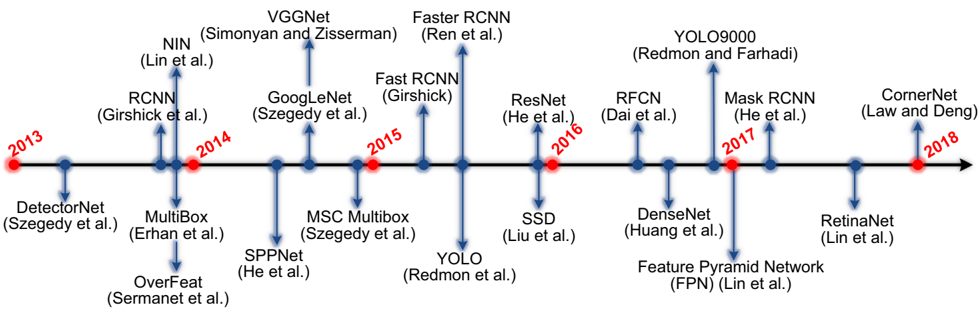
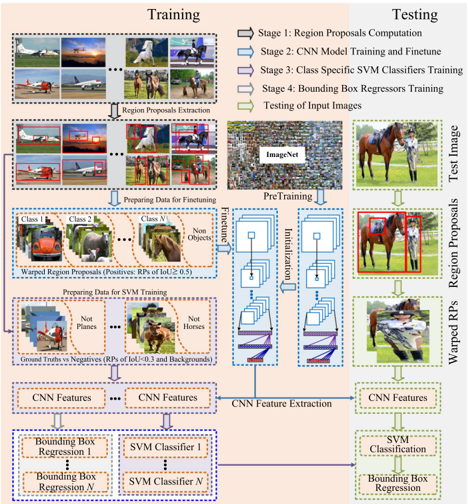
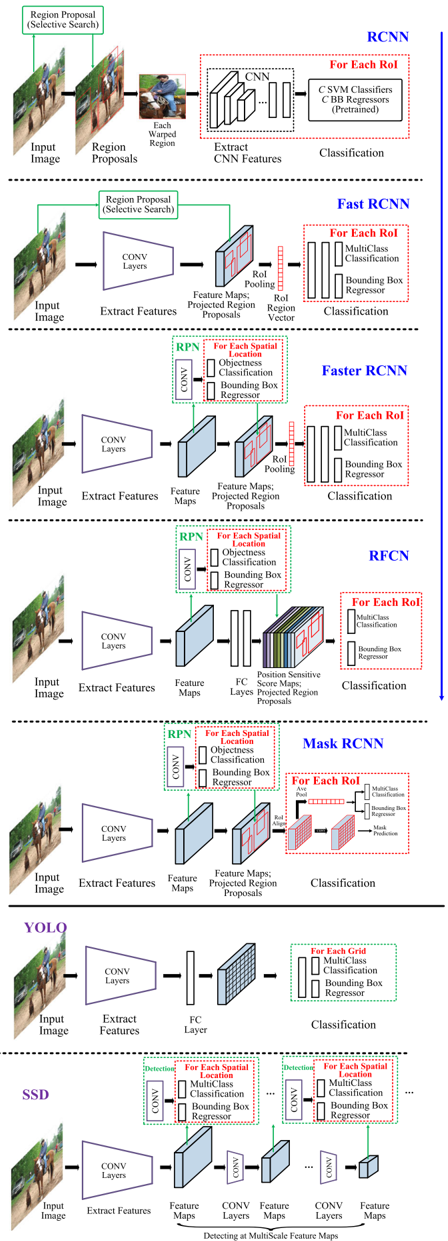
- The survey provides a taxonomy of deep learning based generic object detection, including region-based/two-stage frameworks (RCNN, Fast RCNN, Faster RCNN, RFCN, Mask RCNN) and unified/one-stage frameworks (YOLO, SSD), plus backbone CNN architectures, multiscale feature fusion, context modeling, detection proposals, and training strategies.
- Two-stage detectors generally achieve higher accuracy when large computation is allowed, while one-stage detectors are generally faster but weaker on small objects; for example, SSD achieves 74.3% mAP on VOC2007 test at 59 FPS versus Faster RCNN at 7 FPS / 73.2% mAP and YOLO at 45 FPS / 63.4% mAP. YOLO runs at 45 FPS and Fast YOLO at 155 FPS.
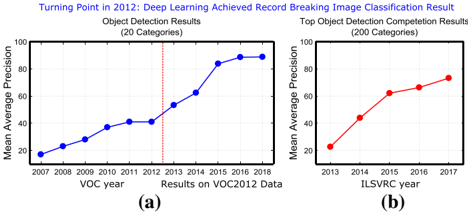
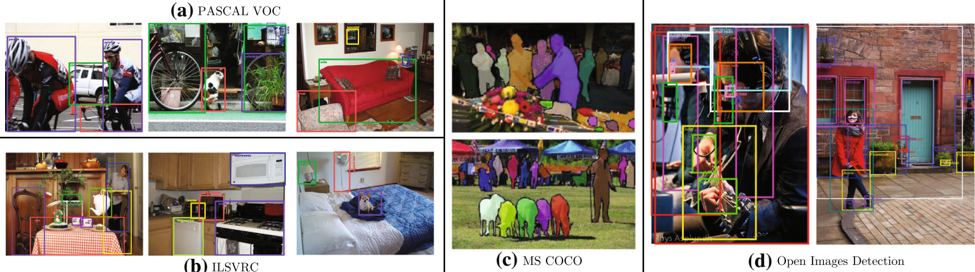
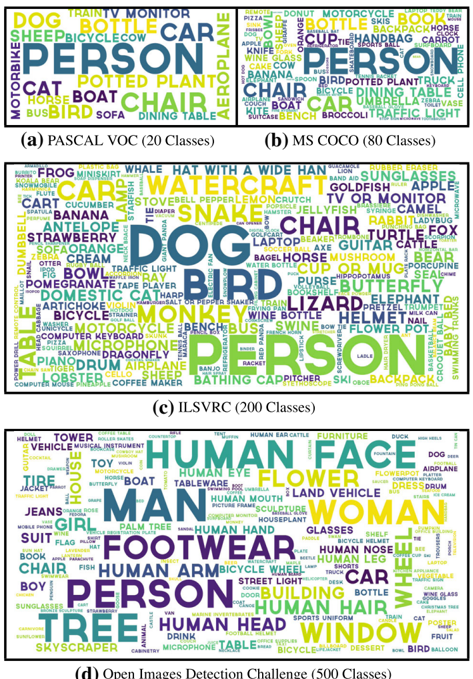
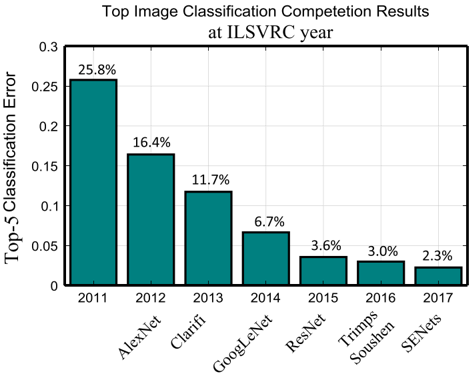
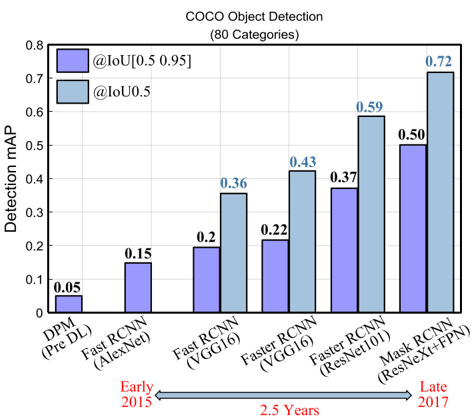
- The main datasets are PASCAL VOC, ImageNet/ILSVRC, MS COCO, and Open Images; COCO contains 41% small and 24% large objects, and the best COCO detector trained on 80 classes reaches only 73% mAP even at 0.5 IoU, while ImageNet Top-5 classification error dropped from 16% to 2% in less than five years. The Open Images challenge winner achieved 61.71% mAP on the public leaderboard and 58.66% mAP on the private leaderboard.
- Future directions include open-world learning, better and more efficient detection frameworks, compact CNN features, automatic neural architecture search, object instance segmentation, weakly supervised detection, few/zero-shot detection, other modalities, and universal object detection.
Methods
- Design: a comprehensive literature survey of deep learning based generic object detection, focusing on major progress of the last 5 years, restricted to still pictures and to top journal and conference papers, with more than 300 research contributions included.
- Organization: the survey presents a taxonomy covering detection frameworks, object feature representation, object proposal generation, context modeling, training strategies, and evaluation metrics, and summarizes popular datasets and evaluation criteria such as AP/mAP and IOU thresholds.
- Analysis: no new experiments are reported; the paper synthesizes and compares reported results across PASCAL VOC, ILSVRC, MS COCO, and Open Images, and discusses representative methods in tables and figures.
Limitations
- Stated: the survey limits its focus to top journal and conference papers, covers mainly the last 5 years, restricts attention to still pictures, and leaves video object detection for separate future consideration; the authors apologize to authors whose works are not included.
- Stated: comparing detectors by their originally reported performance may be misleading because methods differ in meta-frameworks, backbone networks, pretraining datasets, proposal methods, augmentation, and ensembling; there has been very limited unified comparison work.
- Evident: the survey is not exhaustive given the breadth of the field, and it excludes extensive work on specific object detection such as face, pedestrian, vehicle, and traffic sign detection; the provided text also contains fragmented tables and figures, which limits some detail.
Model-written summary. Check it against the paper before relying on it.
Integrity signals
Registry
Cites
Statistics
Figures



Verification
Claims the paper makes
14 Valid · 16 Not valid · 154 Not checked · 108 Own results and interpretations
The cited sources support only part of this claim — read each source’s verdict below.
In the paper
“To the best of our knowledge, for the evaluation of generic object detection algorithms, it is bounding boxes which are most widely used in the current literature (Everingham et al. 2010;Russakovsky et al. 2015), and therefore this is also the approach we adopt in this survey.”
§ Deep Learning for Generic Object Detection: A Survey > 2.1 The Problem
What the sources say
- Partly supportedcites Everingham et al. 2010 matched to “The pascal visual object classes (VOC) challenge” (2010) sourceExperimental — accuracy not yet measured
Section 2.2 (Detection) and “Bounding box evaluation” show that the VOC challenge evaluated object detections using predicted bounding boxes and their overlap with ground truth. The paper does not establish the broader comparative claim that bounding boxes were the most widely used evaluation approach in the literature. (LLM, conf=0.84)
- Not checked yetcites Russakovsky et al. 2015 matched to “ImageNet Large Scale Visual Recognition Challenge” (2015) source
hedged- Asserted: passes — The authors put it forward as true.
- Checkable: passes — It can be checked against evidence.
- Load-bearing: passes — The paper’s conclusions depend on it.
- Based: passes — The paper gives a reason why it holds.
- Partly supported
The sources with a verdict support this claim; the rest weren’t checked yet, have no full text we could read, or their verdicts aren’t rated yet.
In the paper
“In practice, current detectors focus mainly on structured object categories, such as the 20, 200 and 91 object classes in PASCAL VOC (Everingham et al. 2010), ILSVRC (Russakovsky et al. 2015) and MS COCO (Lin et al. 2014) respectively.”
§ Deep Learning for Generic Object Detection: A Survey > 2.2.1 Accuracy Related Challenges
What the sources say
- Supportedcites Everingham et al. 2010 matched to “The pascal visual object classes (VOC) challenge” (2010) source
The citation is offered for the identification of PASCAL VOC as the benchmark with 20 object classes. Our copy states this repeatedly: Sect. 3.2 'Choice of Classes' says 'Fig. 2 shows the 20 classes selected for annotation in the VOC2007 dataset' and that the count rose from 4 (VOC2005) to 10 (VOC2006) to 20 (VOC2007); Sect. 3.1 refers to 'each of the 20 object classes to be annotated'; Sect. 3.5 notes 'the number of classes doubled from 10 to 20'. The surrounding framing about detectors focusing on structured categories is the citing authors' own conclusion, not attributed to this source. (LLM, conf=0.90)
- Not checked yetcites Russakovsky et al. 2015 matched to “ImageNet Large Scale Visual Recognition Challenge” (2015) source
- Not checked yetcites Lin et al. 2014
plain- Asserted: passes — The authors put it forward as true.
- Checkable: passes — It can be checked against evidence.
- Load-bearing: unclear — It is unclear whether the paper’s conclusions depend on it.
- Based: passes — The paper gives a reason why it holds.
- Supported
The sources with a verdict support this claim; the rest weren’t checked yet, have no full text we could read, or their verdicts aren’t rated yet.
In the paper
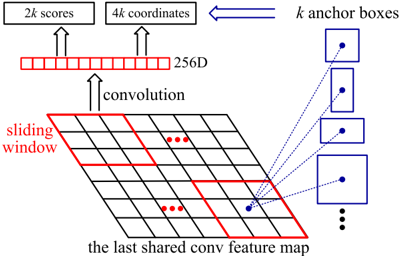
“The Faster RCNN framework proposed by Ren et al. (2015Ren et al. ( , 2017) ) offered an efficient and accurate Region Proposal Network (RPN) for generating region proposals.”
§ Deep Learning for Generic Object Detection: A Survey > 5.1 Region Based (Two Stage) Frameworks
What the sources say
- Not checked yetcites Ren et al. 2015
- Supportedcites Ren et al. 2017 matched to “Faster R-CNN: Towards Real-Time Object Detection with Region Proposal Networks” (2017) source
The Abstract (p. 1) states the paper introduces an RPN that shares full-image convolutional features, enabling 'nearly cost-free region proposals' trained end-to-end 'to generate high-quality region proposals', and the Introduction (p. 1) gives the marginal cost as ~10ms per image. Efficiency and accuracy are both borne out: Section 3 (p. 3) defines the RPN as the proposal module of Faster R-CNN, and p. 2 reports it beats the Selective Search baseline in detection accuracy while waiving nearly all of its computational burden. The paraphrase matches the source at the same level of specificity. (LLM, conf=0.92)
plain- Asserted: passes — The authors put it forward as true.
- Checkable: passes — It can be checked against evidence.
- Load-bearing: unclear — It is unclear whether the paper’s conclusions depend on it.
- Based: passes — The paper gives a reason why it holds.
The sources with a verdict support this claim; the rest weren’t checked yet, have no full text we could read, or their verdicts aren’t rated yet.
In the paper
“In contrast, deep learning methods (especially deep CNNs) can learn powerful feature representations with multiple levels of abstraction directly from raw images (Bengio et al. 2013;LeCun et al. 2015).”
§ Deep Learning for Generic Object Detection: A Survey > 6 Object Representation
What the sources say
- Supportedcites Bengio et al. 2013 matched to “Representation Learning: A Review and New Perspectives” (2013) source
Section 3.4 (pp. 4-5) states that deep architectures 'can potentially lead to progressively more abstract features at higher layers' and that in the convolutional neural network this abstraction is built in explicitly via pooling, making representations 'generally highly non-linear functions of the raw input'. The Introduction (p. 1) frames the whole point as reducing dependence on labor-intensive feature engineering so that algorithms can extract discriminative information from low-level sensory data, and Section 11.2 (p. 24) applies this to the 2D layout of pixels in images via local receptive fields, convolution and pooling. Section 10.1 (p. 22-23) reinforces the 'powerful' element with the ImageNet deep convolutional result. Together these support the paraphrased claim, including the CNN emphasis and the multiple-levels-of-abstraction-from-raw-images core. (LLM, conf=0.90)
- Not checked yetcites LeCun et al. 2015 matched to “Deep learning” (2015) source
plainstates a cause- Asserted: passes — The authors put it forward as true.
- Checkable: passes — It can be checked against evidence.
- Load-bearing: passes — The paper’s conclusions depend on it.
- Based: passes — The paper gives a reason why it holds.
- Supported
The cited sources support only part of this claim — read each source’s verdict below.
In the paper
“Furthermore, the relationship between the source and target datasets plays a critical role, for example that ImageNet based CNN features show better performance for object detection than for human action (Zhou et al. 2015;Azizpour et al. 2016).”
§ Deep Learning for Generic Object Detection: A Survey > 6.1 Popular CNN Architectures
What the sources say
- Not checked yetcites Zhou et al. 2015
- Partly supportedcites Azizpour et al. 2016 matched to “Factors of Transferability for a Generic ConvNet Representation” (2016) sourceExperimental — accuracy not yet measured
The Introduction (p. 2) and Table I say that optimal transfer settings depend on the distance between the ImageNet source task and the target task, supporting the general point. The paper does not establish the citing sentence’s specific comparison that ImageNet-based features perform better for object detection than for human action recognition; its discussion of object detection in the Closing Discussion (p. 11) does not make that comparison. (LLM, conf=0.84)
plainstates an association- Asserted: passes — The authors put it forward as true.
- Checkable: passes — It can be checked against evidence.
- Load-bearing: unclear — It is unclear whether the paper’s conclusions depend on it.
- Based: passes — The paper gives a reason why it holds.
98 more claims · 5 with their cited sources checked
Create a free account to see all 292 claims and to verify the 284 references still open.
- Probably not a substantial claim. 108
- It may state two separate claims as one. 121
- The quote only partly states this claim. 2
Claims other papers make about this one
Each is checked against this paper’s own text: does it say what the citing paper says it does?
The cited source says what the claim attributes to it.
In the citing paper
“Modern object detectors employ many hand-crafted components (Liu et al., 2020), e.g., anchor generation, rule-based training target assignment, non-maximum suppression (NMS) post-processing.”
From Deformable DETR: Deformable Transformers for End-to-End Object Detection (2020) · cites this paper as Liu et al., 2020
The check wasn’t confident either way, so it gives no verdict — never disputed.
In the citing paper
“Over the last few decades, most deep learning-based object tracking systems have been based on CNN architectures [84, 139].”
From A survey on deep multimodal learning for computer vision: advances, trends, applications, and datasets (2022) · cites this paper as [84]
Experimental — accuracy not yet measuredIn the citing paper
“Fortunately, advanced imaging techniques and emerging machine learning methods jointly resist the challenges of unsatisfactory imaging environments and quasi real-time requirements [5], forcefully driving the progress of defect recognition, especially in learning classification [8].”
From Automated Visual Defect Classification for Flat Steel Surface: A Survey (2020) · cites this paper as [8]
Self-check
Percentages, sums and reported differences re-computed from the paper’s own numbers.
Rated minor: it would not touch a result — a value no result rests on, a p-value that stays on the same side of the significance level, or a conflict that is clerical, resolved elsewhere in the paper, or outside its own findings.
In the paper
“| VOC10 | 20 | 4998 | 5105 | 9637 | 11,577(13,339) 11,797(13,352) 10,103 | 23,374 | 2.4 | | |”
§ Deep Learning for Generic Object Detection: A Survey > 10.3 Research Directions
Reported 2.4 · recomputed 2.31357
Rated minor: it would not touch a result — a value no result rests on, a p-value that stays on the same side of the significance level, or a conflict that is clerical, resolved elsewhere in the paper, or outside its own findings.
In the paper
“| VOC09 | 20 | 3473 | 3581 | 6650 | 8505(9760) | 8713(9779) | 7054 | 17,218 | 2.3 |”
§ Deep Learning for Generic Object Detection: A Survey > 10.3 Research Directions
Reported 2.3 · recomputed 2.440885
Citations
Cites
Deep Residual Learning for Image Recognition
He, K., Zhang, X., Ren, S., & Sun, J. (2016) · 2016 IEEE Conference on Computer Vision and Pattern Recognition (CVPR) · doi:10.1109/cvpr.2016.90 · Cited by 235,474 · cited 5×
“GNet. Similarly, ResNet demonstrated the effectiveness of skip connections for learning extremely deep networks with hundreds of layers, winning the ILSVRC 2015 classification task. Inspired by ResNet [101], InceptionResNets [265] combined the Inception networks with shortcut connections, on the basis that shortcut con…”
BackgroundMethodInfluentialVaswani, A., Shazeer, N., Parmar, N., Uszkoreit, J., Jones, L., Gomez, A. N., Kaiser, L., & Polosukhin, I. (2017) · arXiv · doi:10.48550/arxiv.1706.03762 · Cited by 120,404 · cited 1×
“ning architecture where image and memory are processed in parallel to obtain detections which further update memory. Inspired by the recent success of attention modules in natural language processing [274], ORN processes a set of objects simultaneously through the interaction between their appearance 22 Li Liu et al.…”
BackgroundVery Deep Convolutional Networks for Large-Scale Image Recognition
Simonyan, K., & Zisserman, A. (2014) · arXiv · doi:10.48550/arxiv.1409.1556 · Cited by 114,148 · cited 1×
“including the following choices: Meta detection frameworks, such as RCNN [85], Fast RCNN [84], Faster RCNN [229], RFCN [50], Mask RCNN [102], YOLO [227] and SSD [175]; Backbone networks such as VGG [248], Inception [263,125, 264], ResNet [101], ResNeXt [291], and Xception [45] etc. listed in Table6; Innovations such a…”
MethodImageNet classification with deep convolutional neural networks
Krizhevsky, A., Sutskever, I., & Hinton, G. E. (2017) · Communications of the ACM · doi:10.1145/3065386 · Cited by 112,155
Hochreiter, S., & Schmidhuber, J. (1997) · Neural Computation · doi:10.1162/neco.1997.9.8.1735 · Cited by 102,318 · cited 1×
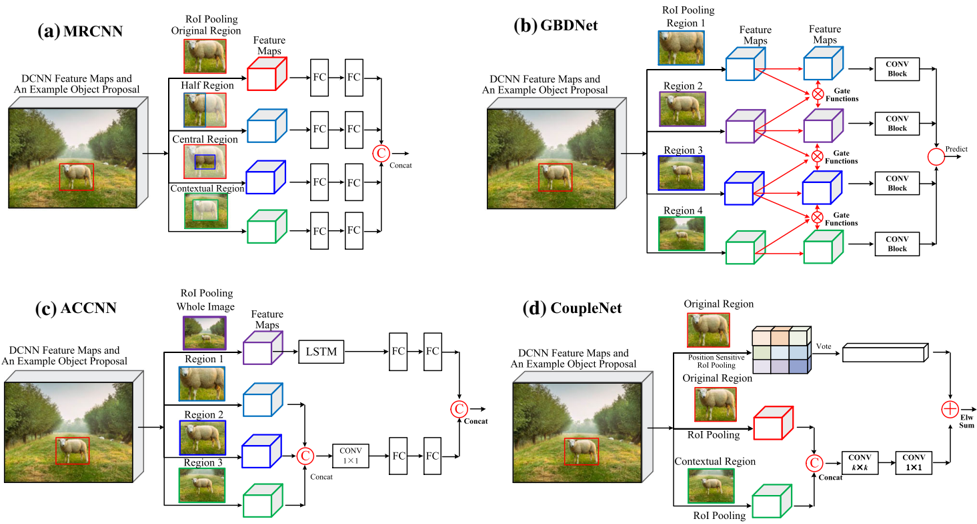
“Noting that message passing is not always helpful but dependent on individual samples, Zeng et al. used gated functions to control message transmission, like in Long Short Term Memory (LSTM) networks [83]. Concurrent with GBDNet, Li et al. [123] presented ACCNN (Fig.13(c)) to utilize both global and local contextual i…”
MethodLeCun, Y., Bengio, Y., & Hinton, G. (2015) · Nature · doi:10.1038/nature14539 · Cited by 84,126
Faster R-CNN: Towards Real-Time Object Detection with Region Proposal Networks
Ren, S., He, K., Girshick, R., & Sun, J. (2017) · IEEE Transactions on Pattern Analysis and Machine Intelligence · doi:10.1109/tpami.2016.2577031 · Cited by 73,472 · cited 5×
“Ren ら [229, 230] により提案された Faster RCNN フ レームワークは,物体領域候補(領域提案)生成用に効率的で Input Image Region Proposals Extract CNN Features Each Warped Region”
InfluentialFaster R-CNN: Towards Real-Time Object Detection with Region Proposal Networks
Ren, S., He, K., Girshick, R., & Sun, J. (2015) · arXiv · doi:10.48550/arxiv.1506.01497 · Cited by 70,812 · cited 5×
“Ren ら [229, 230] により提案された Faster RCNN フ レームワークは,物体領域候補(領域提案)生成用に効率的で Input Image Region Proposals Extract CNN Features Each Warped Region”
InfluentialImageNet: A large-scale hierarchical image database
Deng, J., Dong, W., Socher, R., Li, L.-J., Li, K., & Fei-Fei, L. (2009) · 2009 IEEE Conference on Computer Vision and Pattern Recognition · doi:10.1109/cvpr.2009.5206848 · Cited by 65,333 · cited 4×
“pretrained network is typically finetuned11 on a given detection dataset [58,83,85]. Several large scale image classification datasets are used for CNN pretraining. Among them the ImageNet1000 dataset [52,230] with 1.2 million images of 1000 object categories, or the Places dataset [311] which is much larger than ImageN…”
BackgroundMethodInfluentialGradient-based learning applied to document recognition
Lecun, Y., Bottou, L., Bengio, Y., & Haffner, P. (1998) · Proceedings of the IEEE · doi:10.1109/5.726791 · Cited by 58,805
Research works printed but not linked: 9
- 16. Biederman, I. (1987b). Recognition by components: A theory of human image understanding. Psychological Review, 94(2), 115. · DOI · Paper page
- 29. Chen, G., Choi, W., Yu, X., Han, T., & Chandraker M. (2017a). Learning efficient object detection models with knowledge distillation. In NIPS.
- 65. Endres, I., & Hoiem, D. (2010). Category independent object propos- als. In K. Daniilidis, P. Maragos, & N. Paragios (Eds.), European Conference on Computer Vision (pp. 575-588). Berlin: Springer.
- 128. Jaderberg, M., Simonyan, K., Zisserman, A., et al. (2015). Spatial trans- former networks. In NIPS (pp. 2017-2025).
- 143. Krizhevsky, A., Sutskever, I., & Hinton, G. (2012b). ImageNet clas- sification with deep convolutional neural networks. In NIPS (pp. 1097-1105).
- 195. Murase, H., & Nayar, S. (1995b). Visual learning and recognition of 3d objects from appearance. IJCV, 14(1), 5-24. · DOI · Paper page
- 231. Ren, M., Triantafillou, E., Ravi, S., Snell, J., Swersky, K., Tenenbaum, J. B., Larochelle, H., & Zemel R. S. (2018). Meta learning for semisupervised few shot classification. In ICLR.
- 279. Wan, L., Eigen, D., & Fergus, R. (2015). End to end integration of a convolution network, deformable parts model and nonmaximum suppression. In CVPR (pp. 851-859).
- 298. Yosinski, J., Clune, J., Bengio, Y., & Lipson, H. (2014). How trans- ferable are features in deep neural networks? In NIPS (pp. 3320-3328).
Cited by
Items 901–1,000 of 1,005
Wind turbine blade damage identification using lightweight YOLO11 with multi-scale dilated attention
Xu, W., Yao, J., Wang, Y., Liu, C., Liu, X., & Jiang, D. (2025) · Applied Soft Computing · doi:10.1016/j.asoc.2025.114042 · Cited by 22
Self-citationA Specially Optimized One-Stage Network for Object Detection in Remote Sensing Images
Qin, H., Li, Y., Lei, J., Xie, W., & Wang, Z. (2020) · IEEE Geoscience and Remote Sensing Letters · doi:10.1109/lgrs.2020.2975086 · Cited by 18
“2975086 neural network especially convolutional neural network (CNN) have achieved great success in general object detection [3].”
BackgroundObject Detection in Rural Roads Through SSD and YOLO Framework
Barba-Guamán, L., Naranjo, J. E., Ortiz, A., & Gonzalez, J. G. P. (2021) · Advances in intelligent systems and computing · doi:10.1007/978-3-030-72657-7_17 · Cited by 20
Probabilistic Selective Encryption of Convolutional Neural Networks for Hierarchical Services
Tian, J., Zhou, J., & Duan, J. (2021) · IEEE Computer Society Conference on Computer Vision and Pattern Recognition/Proceedings - IEEE Computer Society Conference on Computer Vision and Pattern Recognition/Proceedings · doi:10.1109/cvpr46437.2021.00224 · Cited by 25
“Convolutional Neural Network (CNN) has been used to achieve unparalleled results across various tasks such as object detection [5, 10, 20], super-resolution reconstruction [9, 13, 15], and image inpainting [36, 37, 38].”
MethodAn Expert Eye for Identifying Shoplifters in Mega Stores
Ansari, M. A., & Singh, D. K. (2021) · Advances in intelligent systems and computing · doi:10.1007/978-981-16-3071-2_10 · Cited by 17
Wu, C., Sun, H., Lin, S., & Gao, S. (2021) · Eksploatacja i Niezawodnosc - Maintenance and Reliability · doi:10.17531/ein.2021.4.11 · Cited by 17
Group channel pruning and spatial attention distilling for object detection
Chu, Y., Li, P., Bai, Y., Hu, Z., Chen, Y., & Lü, J. (2022) · Applied Intelligence · doi:10.1007/s10489-022-03293-x · Cited by 21
“In recent years, CNNs (Convolutional Neural Networks) have become the dominant methods for various computer vision tasks, such as image classification [1], object detection [2], and segmentation [3].”
ALGAN: Anomaly Detection by Generating Pseudo Anomalous Data via Latent Variables
Murase, H., & Fukumizu, K. (2022) · IEEE Access · doi:10.1109/access.2022.3169594 · Cited by 21
“Considering the fast prediction of ALGAN-image, it can be applied to expensive tasks such as real-time prediction with a large number of bounding boxes obtained from object detection (Liu et al. 2020).”
MethodAirport UAV and birds detection based on deformable DETR
Liu, S., Li, Y., Qu, J., & Renbiao, W. (2022) · Journal of Physics Conference Series · doi:10.1088/1742-6596/2253/1/012024 · Cited by 19
Barbu, T. (2022) · Discrete and Continuous Dynamical Systems - S · doi:10.3934/dcdss.2022083 · Cited by 23
A Variable Attention Nested UNet++ Network-Based NDT X-ray Image Defect Segmentation Method
Liu, J., & Kim, J. H. (2022) · Coatings · doi:10.3390/coatings12050634 · Cited by 18
“A recent review of deep learning for general object detection can be found in [16], where the authors provide a comprehensive survey of the recent achievements about deep learning for generic object detection.”
BackgroundMethodExploiting key points supervision and grouped feature fusion for multiview pedestrian detection
Gao, X., Xiong, Y., Zhang, G., Deng, H., & Kou, K. (2022) · Pattern Recognition · doi:10.1016/j.patcog.2022.108866 · Cited by 19
Automatic Defect Description of Railway Track Line Image Based on Dense Captioning
Wei, D., Wei, X., & Jia, L. (2022) · Sensors · doi:10.3390/s22176419 · Cited by 17
“Moreover, recent results show that one-stage methods can achieve a balance of speed and accuracy [47], which presents an opportunity for reconstructing RTLCap to further improve performance.”
ResultRodent hole detection in a typical steppe ecosystem using UAS and deep learning
Du, M., Wang, D., Liu, S., Lv, C., & Zhu, Y. (2022) · Frontiers in Plant Science · doi:10.3389/fpls.2022.992789 · Cited by 17
“Deep learning (DL) shows great potential in BV hole detection, benefiting from the application of automatic deep convolutional feature extraction (LeCun et al., 2015; Mountrakis et al., 2018; Liu et al., 2020).”
BackgroundFew-shot Adaptive Object Detection with Cross-Domain CutMix
Nakamura, Y., Ishii, Y., Maruyama, Y., & Yamashita, T. (2023) · Lecture notes in computer science · doi:10.1007/978-3-031-26351-4_45 · Cited by 25
Guo, C., Zhengqing, L., & Jie, S. (2023) · Journal of Cloud Computing Advances Systems and Applications · doi:10.1186/s13677-023-00404-y · Cited by 21
“As the widespread deep learning, deep neural networks (DNNs) have achieved state-of-the-art performance in various research fields, such as image classification [1], object detection [2] and natural language processing [3] etc.”
BackgroundRefining Noisy Labels With Label Reliability Perception for Person Re-Identification
Chen, Y., Liu, M., Wang, X., Wang, F., Liu, A.-A., & Wang, Y. (2023) · IEEE Transactions on Multimedia · doi:10.1109/tmm.2023.3253391 · Cited by 20
“Owing to the rapid development of convolutional neural network (CNN) [25], [55], remarkable achievements have been obtained in per-son Re-ID.”
BackgroundSelf-citationVideo Anomaly Detection via Visual Cloze Tests
Yu, G. W., Wang, S., Cai, Z., Liu, X., Zhu, E., & Yin, J. (2023) · IEEE Transactions on Information Forensics and Security · doi:10.1109/tifs.2023.3300094 · Cited by 26
Self-citationAutomated detection of airfield pavement damages: an efficient light-weight algorithm
Liang, H., Gong, H., Cong, L., Zhang, M., Tao, Z., Liu, S., & Shi, J. (2023) · International Journal of Pavement Engineering · doi:10.1080/10298436.2023.2247135 · Cited by 19
“The goal of object detection is to determine whether there are any instances of objects from given categories to return the spatial location and extent of each object instance, which provides a promising way for automating the detection of airport damage (Liu et al. 2020).”
BackgroundSimultaneous Object Detection and Distance Estimation for Indoor Autonomous Vehicles
Azurmendi, I., Zulueta, E., López-Guede, J. M., & González, M. (2023) · Electronics · doi:10.3390/electronics12234719 · Cited by 25
UniMod1K: Towards a More Universal Large-Scale Dataset and Benchmark for Multi-modal Learning
Zhu, X., Xu, T., Liu, Z., Tang, Z., Wu, X., & Kittler, J. (2024) · International Journal of Computer Vision · doi:10.1007/s11263-024-01999-8 · Cited by 25
“…have shown state-of-the-art performance in various fields of computer vision, including classification (Masana et al., 2022; He et al., 2022), localisation (Liu et al., 2020; Marvasti-Zadeh et al., 2021; Xu et al., 2023), segmentation (Minaee et al., 2021), and generation (Xia et al., 2022).”
Coordinate-aligned multi-camera collaboration for active multi-object tracking
Fang, Z., Zhao, J., Yang, M., Lu, Z., Zhou, W., & Li, H. (2024) · Multimedia Systems · doi:10.1007/s00530-024-01420-x · Cited by 31
“Moreover, cameras are assumed to have direct access to the targets’ location, which is unrealistic.”
EF-RT-DETR: a efficient focused real-time DETR model for pavement distress detection
Han, T., Hou, S., Gao, C., Xu, S., Pang, J., Gu, H., & Huang, Y. (2025) · Journal of Real-Time Image Processing · doi:10.1007/s11554-025-01641-x · Cited by 22
Deep Compression: A Compression Technology for Apron Surveillance Video
Lyu, Z., & Xu, X. (2019) · IEEE Access · doi:10.1109/access.2019.2940252 · Cited by 17
“greatly reduces the time consumption of convolution calculation and thereby greatly increasing the calculation speed [8].”
BackgroundCappelletti, L., Fontana, T., Donato, G. W. D., Tucci, L. D., Casiraghi, E., & Valentini, G. (2020) · Computers · doi:10.3390/computers9020037 · Cited by 17
“The recent usage of ML techniques for imputing missing complex data is not surprising, since in the past two decades ML has been the main actor in applications producing astonishing results when dealing with complex problems where human skill and know-how are not able to provide precise and repeatable solutions [24],…”
BackgroundID-Net: an improved mask R-CNN model for intrusion detection under power grid surveillance
Gao, F., Ji, S., Guo, J., Li, Q., Ji, Y., Liu, Y., Feng, S., Wei, H., Wang, N., & Yang, B. (2021) · Neural Computing and Applications · doi:10.1007/s00521-021-05688-2 · Cited by 19
Object detection through region proposal based techniques
Prakash, S. R., & Singh, P. N. (2021) · Materials Today Proceedings · doi:10.1016/j.matpr.2021.02.533 · Cited by 17
Boosting CNN Learning by Ensemble Image Preprocessing Methods for Cervical Cancer Segmentation
Bnouni, N., Amor, H. B., Rekik, I., Rhim, M. S., Solaiman, B., & Amara, N. E. B. (2021) · International Multi-Conference on Systems, Signals & Devices (SSD) · doi:10.1109/ssd52085.2021.9429422 · Cited by 23
“…processing techniques for the MR cervical cancer images are In fact, the scientific community have been recently increasingly interested in the CNNs for solving computer vision tasks such as object detection [17, 18], image classification [19] and patch-based methods or semantic segmentation [20].”
MethodAn Interconnected Feature Pyramid Networks for object detection
Wang, Q., Zhou, L., Yao, Y., Wang, Y., Li, J., & Yang, W. (2021) · Journal of Visual Communication and Image Representation · doi:10.1016/j.jvcir.2021.103260 · Cited by 17
Liu, X., Yang, Z.-X., Hou, J. C., & Huang, W. (2022) · IEEE Transactions on Geoscience and Remote Sensing · doi:10.1109/tgrs.2022.3184962 · Cited by 18
“Then, a breakthrough method was put forward in Fast R-CNN, which combines the classification and bounding box together [30], [31].”
MethodSelf-citationSmart City Intersections: Intelligence Nodes for Future Metropolises
Kostić, Z., Angus, A., Yang, Z., Duan, Z., Seskar, I., Zussman, G., & Raychaudhuri, D. (2022) · Computer · doi:10.1109/mc.2022.3206273 · Cited by 21
“Networks (CNN) [8] and Vision Transformers [9].”
A Systematic Investigation on end-to-end Deep Recognition of Grocery Products in the Wild
Leo, M., Carcagnì, P., & Distante, C. (2021) · Proceedings - International Conference on Pattern Recognition/Proceedings/International Conference on Pattern Recognition · doi:10.1109/icpr48806.2021.9413250 · Cited by 17
“a hot topic in image processing (sometimes referred also as object detection) and then there is a huge literature about it and very outstanding survey papers have been recently published to summarize it [11] [12].”
BackgroundScalable object detection pipeline for traffic cameras: Application to Tfl JamCams
Gan, H. M., Fernando, S., & Molina-Solana, M. (2021) · Expert Systems with Applications · doi:10.1016/j.eswa.2021.115154 · Cited by 19
Algorithm for Predicting Pedestrian Behavior on Public Roads
Moseva, M. S., Polyantseva, K. A., Gorodnichev, M. G., & Pavlikov, A. (2023) · Systems of Signals Generating and Processing in the Field of on Board Communications · doi:10.1109/ieeeconf56737.2023.10091967 · Cited by 16
Guo, Z., Xue, Y., Wang, C., Geng, Y., Lu, R., Li, H., Sun, D., Lou, Z., Chen, T., Shi, J., et al. (2024) · Computers and Electronics in Agriculture · doi:10.1016/j.compag.2024.109707 · Cited by 23
Saeedizadeh, N., Jalali, S. M. J., Khan, B., & Mohamed, S. M. K. (2025) · Expert Systems · doi:10.1111/exsy.70020 · Cited by 21
“Provides a detailed analysis of sub-problems in designing object detectors and future research directions Deep Learning for Object Detection: A Survey (Wang et al. 2021a) –”
Kamal, M. M., Abideen, S. Z. U., Al‐Khasawneh, M. A., Momani, A. M., Mostafa, H., Atoum, M. S., Ullah, S., Alsayaydeh, J. A. J., Yusof, M. F., & Najib, S. B. M. (2025) · Computer Modeling in Engineering & Sciences · doi:10.32604/cmes.2025.067430 · Cited by 20
Single Shot Multibox Detector With Deconvolutional Region Magnification Procedure
Wang, Y., Niu, P., Guo, X., Yang, G., & Chen, J. (2021) · IEEE Access · doi:10.1109/access.2021.3068486 · Cited by 18
“For extensive reviews, see [15], [16].”
Self-citationRetinal Glaucoma Public Datasets: What Do We Have and What Is Missing?
Camara, J., Rezende, R., Pires, I. M., & Cunha, A. M. T. D. S. (2022) · Journal of Clinical Medicine · doi:10.3390/jcm11133850 · Cited by 21
“Sensitivity and specificity [13,24,26,47,49,50] are also used in different studies to complement AUC in driving binary classification results.”
MethodBisht, A., Ravani, K., Chaturvedi, M., Kumar, N., & Tiwari, S. (2022) · Computers & Industrial Engineering · doi:10.1016/j.cie.2022.108503 · Cited by 16
Li, G., Fan, W., Xie, H., & Qu, X. (2022) · IEEE Sensors Journal · doi:10.1109/jsen.2022.3219884 · Cited by 18
“With the advances of deep learning over the past 20 years [9], [21], [25], [26], deep-learning-based road object detection approaches have shown remarkable superior performance on large-scale and variable traffic scenes.”
BackgroundCooktop Sensing Based on a YOLO Object Detection Algorithm
Azurmendi, I., Zulueta, E., López-Guede, J. M., Azkarate, J., & González, M. (2023) · Sensors · doi:10.3390/s23052780 · Cited by 22
“As referenced by Li Liu et al. [26], datasets have played a critical role in the history of deep learning research, not only as a common ground for measuring and comparing the performance of different competing algorithms, but also for pushing the field toward increasingly complex and challenging…”
InfluentialAcharya, P., Burgers, T., & Nguyen, K. (2023) · Scientific Reports · doi:10.1038/s41598-023-34320-7 · Cited by 19
Oh, J.-H., Kim, H., & Lee, K. M. (2023) · Korean Journal of Radiology · doi:10.3348/kjr.2022.0765 · Cited by 16
“Object Detection Networks Object detection architectures have been continuously developed, and several review papers have described their progress from early models to state-of-the-art technologies [56-58].”
BackgroundZhang, Y., Wurll, C., & Hein, B. (2023) · Proceedings - IEEE International Conference on Robotics and Automation/Proceedings · doi:10.1109/icra48891.2023.10160632 · Cited by 30
“In order for the robot to operate autonomously and skillfully, various state-of-the-art techniques are used for object recognition [1], localization [2], and grasping [3], which require different types of resources, such as CPU/GPU for computation or memory (RAM) or storage for data handling.”
MethodTokuda, T., & Nagao, H. (2023) · Geophysical Journal International · doi:10.1093/gji/ggad270 · Cited by 21
“Conventional CNN-based deep learning is supposed to capture contextual information implicitly with multiple levels of abstraction [28], but it can potentially overlook local details [8, 60].”
BackgroundSemisupervised Deep Neural Network-Based Cross-Frequency Ground-Penetrating Radar Data Inversion
Liu, H., Wang, J., Zhang, J., Jiang, H., Xu, J., Jiang, P., Zhang, F., Sui, Q., & Wang, Z. (2023) · IEEE Transactions on Geoscience and Remote Sensing · doi:10.1109/tgrs.2023.3316153 · Cited by 16
“Recently, deep learning technology has seen extensive use recently in image classification [22], [23], semantic segmentation [24], [25], and object detection [26], [27].”
BackgroundUnraveling Scientific Evolutionary Paths: An Embedding-Based Topic Analysis
Jin, Q., Chen, H., Zhang, Y., Wang, X., & Zhu, D. (2023) · IEEE Transactions on Engineering Management · doi:10.1109/tem.2023.3312923 · Cited by 17
“Object detection aims to provide a semantic understanding of images and videos, and has been widely studied to support face recognition, autonomous driving, human behavior analysis, etc. [63].”
BackgroundMethodInfluentialSelf-citationReal-Moreno, O., Rodriguez-Quinonez, J. C., Flores‐Fuentes, W., Sergiyenko, O., Miranda-Vega, J. E., Trujillo‐Hernández, G., & Balbuena, D. H. (2023) · Optics and Lasers in Engineering · doi:10.1016/j.optlaseng.2023.107932 · Cited by 18
A detection algorithm based on improved YOLOv5 for coarse-fine variety fruits
Fan, Y., Cai, Y., & Yang, H. (2023) · Journal of Food Measurement & Characterization · doi:10.1007/s11694-023-02274-z · Cited by 20
“Since 2014, the advanced development in deep learning technology, particularly of convolutional neural networks (CNN), has significantly improved the state of the art in object detection [4].”
Optimal azimuth angle selection for limited SAR vehicle target recognition
Zhang, L., Leng, X., Feng, S., Ma, X., Ji, K., Kuang, G., & Liu, L. (2024) · International Journal of Applied Earth Observation and Geoinformation · doi:10.1016/j.jag.2024.103707 · Cited by 22
Self-citationPerformance evaluation of semi-supervised learning frameworks for multi-class weed detection
Li, J., Chen, D., Yin, X., & Li, Z. (2024) · Frontiers in Plant Science · doi:10.3389/fpls.2024.1396568 · Cited by 32
“…predict class probabilities and bounding box offsets from full images using a single feed-forward CNN without necessitating the generation of region proposals or subsequent classi fi cation/ feature resampling, thereby encapsulating all computation within a single network (Liu et al., 2020).”
MethodEfficient Detection of Apparent Defects in Subway Tunnel Linings Based on Deep Learning Methods
Zheng, A., Qi, S., Cheng, Y., Wu, D., & Zhu, J. (2024) · Applied Sciences · doi:10.3390/app14177824 · Cited by 19
Yu, Y., Yang, X., Li, Y., Han, Z., Da, F., & Yan, J. (2025) · IEEE Transactions on Pattern Analysis and Machine Intelligence · doi:10.1109/tpami.2025.3542542 · Cited by 26
“Diverging from traditional detection [26], oriented detection introduces rotated bounding boxes that align with the orientation of objects, thereby capturing a more precise depiction.”
AF-EMS Detector: Improve the Multi-Scale Detection Performance of the Anchor-Free Detector
Yan, J., Zhao, L., Diao, W., Wang, H., & Sun, X. (2021) · Remote Sensing · doi:10.3390/rs13020160 · Cited by 17
“More details about these two common datasets can be seen in the review paper [4].”
BackgroundTwo-Stage Merging Network for Describing Traffic Scenes in Intelligent Vehicle Driving System
Song, H., Zhu, J., & Jiang, Y. (2021) · IEEE Transactions on Intelligent Transportation Systems · doi:10.1109/tits.2021.3083656 · Cited by 17
“Compared with object detection [13], [14] and visual tracking [15], [16], automatically describing traffic scenes is a more complicated task.”
BackgroundA Scalable Reasoning and Learning Approach for Neural-Symbolic Stream Fusion
Le-Phuoc, D., Eiter, T., & Le-Tuan, A. (2021) · Proceedings of the AAAI Conference on Artificial Intelligence · doi:10.1609/aaai.v35i6.16633 · Cited by 29
“In particular, many DNN models for object detection (Liu et al. 2019) and tracking (Ciaparrone et al.”
BackgroundMethodFFANet: Feature fusion attention network to medical image segmentation
Yu, J., Yang, D., & Zhao, H. (2021) · Biomedical Signal Processing and Control · doi:10.1016/j.bspc.2021.102912 · Cited by 18
Attention-Guided Siamese Fusion Network for Change Detection of Remote Sensing Images
Chen, P., Guo, L., Zhang, X., Qin, K., Ma, W., & Jiao, L. (2021) · Remote Sensing · doi:10.3390/rs13224597 · Cited by 18
Overview of YOLO Object Detection Algorithm
Wan, C., Pang, Y., & Lan, S. (2022) · International Journal of Computing and Information Technology · doi:10.56028/ijcit.1.2.11 · Cited by 16
R-TOSS: A Framework for Real-Time Object Detection using Semi-Structured Pruning
Balasubramaniam, A., Sunny, F., & Pasricha, S. (2023) · ACM/IEEE Design Automation Conference (DAC) · doi:10.1109/dac56929.2023.10247917 · Cited by 25
“Unfortunately, even single-stage detectors are compute and memory intensive, so deploying and executing them on embedded and IoT boards in AVs remains a bottleneck [12].”
BackgroundWei, C. (2020) · Remote Sensing · doi:10.3390/rs12244172 · Cited by 16
“These DL-based neural network models have emerged as powerful methods for learning feature representations automatically from image data [35,36].”
MethodSeeing isn't Believing: Practical Adversarial Attack Against Object DetectorsPreprint
Zhao, Y., Zhu, H. G., Liang, R., Shen, Q., Zhang, S., & Chen, K. (2018) · arXiv (Cornell University) · doi:10.48550/arxiv.1812.10217 · Cited by 36
“It has been widely applied in many fields including face detection [45] [18], object tracking [18], and even in safety critical tasks such as autonomous driving [26] and intelligent video surveillance [27].”
BackgroundMethodA Comparative Review of Recent Few-Shot Object Detection AlgorithmsPreprint
Leng, J., Taiyue, C., Gao, X., Yu, Y., Wang, Y., Gao, F., & Wang, Y. (2021) · arXiv (Cornell University) · doi:10.48550/arxiv.2111.00201 · Cited by 26
Improving single-stage object detectors for nighttime pedestrian detection
Devi, S., Thopalli, K., Malarvezhi, P., & Thiagarajan, J. J. (2022) · International Journal of Pattern Recognition and Artificial Intelligence · doi:10.1142/s0218001422500343 · Cited by 15
Automating container damage detection with the YOLO-NAS deep learning model
Phuong, T. N. T., Cho, G.-S., & Chatterjee, I. (2025) · Science Progress · doi:10.1177/00368504251314084 · Cited by 26
Wu, S., & Liu, Y. (2025) · Remote Sensing · doi:10.3390/rs17071314 · Cited by 19
Wang, C., Song, C., Xu, T., & Jiang, R. (2025) · Agriculture · doi:10.3390/agriculture15111213 · Cited by 22
“The input layer of CNN [40] receives image data, and the image enters the network in the form of a matrix.”
DGSS-YOLOv8s: A Real-Time Model for Small and Complex Object Detection in Autonomous Vehicles
Cheng, S., Chen, L., & Yang, K. (2025) · Algorithms · doi:10.3390/a18060358 · Cited by 21
Han, Z., Xu, Y., Li, J., Plaza, J., Plaza, A., Wei, Z., & Wu, Z. (2025) · IEEE Transactions on Geoscience and Remote Sensing · doi:10.1109/tgrs.2025.3614370 · Cited by 26
“…include two-stage detectors like Faster R-CNN [5], which prioritize accuracy but with a higher computational cost; one-stage detectors such as YOLO [6] and RetinaNet [7], optimized for real-time processing but often struggling with small object precision [8]; and Transformer-based architectures.”
Omran, A. H., Said, D. M., Hussin, S. M., Abdulhussain, S. H., & Samet, H. (2021) · Computers & Electrical Engineering · doi:10.1016/j.compeleceng.2021.107478 · Cited by 15
Guo, S., Wang, D., Feng, Z., & Guo, W. (2021) · IEEE Transactions on Automation Science and Engineering · doi:10.1109/tase.2021.3116040 · Cited by 17
“Due to the above characteristics of IR images in TMPs in automotive manufacturing, generic OD [7] is needed for part extraction.”
BackgroundMethodInfluentialPSNet: Perspective-sensitive convolutional network for object detection
Zhang, X., Liu, Y., Huo, C., Xu, N., Wang, L., & Pan, C. (2021) · Neurocomputing · doi:10.1016/j.neucom.2021.10.068 · Cited by 17
Ghaffarian, H., Lemaire, P., Zhi, Z., Tougne, L., MacVicar, B., & Piégay, H. (2021) · Earth Surface Dynamics · doi:10.5194/esurf-9-519-2021 · Cited by 22
Vardakis, G., Tsamis, G., Koutsaki, E., Kondylakis, H., & Papadakis, N. (2022) · Electronics · doi:10.3390/electronics11101622 · Cited by 18
Lee, J., Cho, H., Pyun, Y. J., Kang, S., & Nam, H. (2022) · IEEE Access · doi:10.1109/access.2022.3184453 · Cited by 19
T$^{3}$SR: Texture Transfer Transformer for Remote Sensing Image Superresolution
Cai, D., & Zhang, P. (2022) · IEEE Journal of Selected Topics in Applied Earth Observations and Remote Sensing · doi:10.1109/jstars.2022.3198557 · Cited by 16
“To date, it has been widely used for common vision tasks, like object classification [21], [22], [23], [24], [25], [26], [27], object detection [24], [28], [29], [30], and semantic segmentation [23], [24], [31], [32].”
MethodMobileDenseNet: A new approach to object detection on mobile devices
Hajizadeh, M., Sabokrou, M., & Rahmani, A. (2022) · Expert Systems with Applications · doi:10.1016/j.eswa.2022.119348 · Cited by 20
A One‐Stage Deep Learning Model for Industrial Defect Detection
Li, Z., Wei, X., Hassaballah, M., & Jiang, X. (2023) · Advanced Theory and Simulations · doi:10.1002/adts.202200853 · Cited by 16
A Framework to Estimate the Key Point Within an Object Based on a Deep Learning Object Detection
Kurdthongmee, W., Suwannarat, K., & Wattanapanich, C. (2023) · HighTech and Innovation Journal · doi:10.28991/hij-2023-04-01-08 · Cited by 18
Kumar, A. S. S., & Mahesh, K. (2023) · International Conference on Edge Computing and Applications (ICECAA) · doi:10.1109/icecaa58104.2023.10212307 · Cited by 16
“Based on the results obtained it can be concluded that CNN depends on several parameters such as IoU threshold, backbone CNN utilized, GPU capabilities and number of training iterations performed [24].”
BackgroundBioDrone: A Bionic Drone-Based Single Object Tracking Benchmark for Robust Vision
Zhao, X., Hu, S., Wang, Y., Zhang, J., Hu, Y., Liu, R., Ling, H., Li, Y., Li, R., Liu, K., et al. (2023) · International Journal of Computer Vision · doi:10.1007/s11263-023-01937-0 · Cited by 26
“Object detection (Liu et al. 2020) aims to accurately determine the category and location of targets, which can be further divided into image object detection (DET Rus-sakovsky et al. 2015) and video object detection (VID Han et al. 2021).”
A Double-Head Global Reasoning Network for Object Detection of Remote Sensing Images
Shi, J., Zhi, R., Zhao, J., Hou, Y., Zhao, Z., Wu, J., & Liu, J. (2023) · IEEE Transactions on Geoscience and Remote Sensing · doi:10.1109/tgrs.2023.3347798 · Cited by 16
“In the era of deep learning, object detection [21] can be grouped into two genres: region-based (two-stage) frameworks and unified (one-stage) frameworks [22], where the former frames the detection as a “coarse-to-fine” process while the later frames it as to “complete in one step.””
BackgroundKim, B. S., Cho, M., Chung, G. E., Lee, J., Kang, H. Y., Yoon, D., Cho, W. S., Lee, J. C., Bae, J. H., Kong, H., et al. (2024) · Scientific Reports · doi:10.1038/s41598-023-51056-6 · Cited by 18
“This threshold aligns with the True Positive criterion commonly adopted in most deeplearning based decision making tasks 34,35 .”
BackgroundIdentification of Systematic Errors of Image Classifiers on Rare Subgroups
Metzen, J. H., Hutmacher, R., Hua, N. G., Boreiko, V., & Zhang, D. (2023) · IEEE/CVF International Conference on Computer Vision (ICCV) · doi:10.1109/iccv51070.2023.00467 · Cited by 23
“Deep learning based approaches have revolutionized many fields of computer vision [31, 37] and are increasingly applied in safety-critical applications such as automated driving [20].”
He, X., Jin, J., Chen, D., & Feng, Y. (2024) · Journal of Manufacturing Processes · doi:10.1016/j.jmapro.2024.02.006 · Cited by 16
Spatial Transformer Network YOLO Model for Agricultural Object Detection
Zambre, Y. V., Rajkitkul, E., Mohan, A., & Peeples, J. (2024) · International Conference on Machine Learning and Applications · doi:10.1109/icmla61862.2024.00022 · Cited by 20
A systematic review: object detection
Guleria, A., Varshney, K., Garima, G., & Jindal, S. (2025) · AI & Society · doi:10.1007/s00146-025-02372-0 · Cited by 21
“Such algorithms include R-CNN, Fast R-CNN, and YOLO, all of which were reviewed comprehensively by Liu et al. (2020) who also established that these were more generic algorithms for object detection.”
A Face Detection Method Based on Cascade Convolutional Neural Network
Yang, W., Zhou, L., Li, T., & Wang, H. (2019) · Multimedia Tools and Applications · doi:10.1007/s11042-018-6995-0 · Cited by 16
“image classification [11], objection detection [6, 7, 15, 19] and image retrieval [17, 21, 22].”
BackgroundPrecise Ship Location With CNN Filter Selection From Optical Aerial Images
Alashhab, S., Gallego, A., Pertusa, A., & Gil, P. (2019) · IEEE Access · doi:10.1109/access.2019.2929080 · Cited by 15
Evaluation of Deep Learning Accelerators for Object Detection at the Edge
Puchtler, P., & Peinl, R. (2020) · Lecture notes in computer science · doi:10.1007/978-3-030-58285-2_29 · Cited by 23
Kang, K., Chen, D., Peng, C., Koo, D. D., Kang, T. W., & Kim, J. (2020) · Remote Sensing · doi:10.3390/rs12223837 · Cited by 15
“When the feature extraction step is completed, feature maps are used for multi-scale object detection.”
BackgroundMethodGuo, Y., Lu, Y., Guo, Y., Liu, R. W., & Chui, K. T. (2021) · Journal of Advanced Transportation · doi:10.1155/2021/9470895 · Cited by 16
“Current studies have demonstrated that two-stage detectors could produce higher detection accuracy compared with traditional onestage detectors [49].”
BackgroundPerformance evaluation of salient object detection techniques
Ahmed, K., Gad, M. A., & Aboutabl, A. E. (2022) · Multimedia Tools and Applications · doi:10.1007/s11042-022-12567-y · Cited by 20
“FCN models is the one-stage object detection models such as OverFeat [145], You Only Look Once (YOLO) [146], YOLO V2 [147], YOLO V3 [148, 149] and edge guidance network (EGNet) [150].”
MethodPattern Recognition Method for Detecting Engineering Errors on Technical Drawings
Джусупова, Р., Banotra, R., Bosch, J., & Olsson, H. H. (2022) · IEEE World AI IoT Congress (AIIoT) · doi:10.1109/aiiot54504.2022.9817294 · Cited by 21
Progress in small object detection for remote sensing images
Yuan, X., Cheng, G., Li, G., Dai, W., Yin, W., Feng, Y., Yao, X., Huang, Z., Sun, X., & Han, J. (2023) · Journal of Image and Graphics · doi:10.11834/jig.221202 · Cited by 21
Backward Compatible Object Detection Using HDR Image Content
Mukherjee, R., Melo, M., Filipe, V. M. D. J., Chalmers, A. G., & Bessa, M. (2020) · IEEE Access · doi:10.1109/access.2020.3010340 · Cited by 16
“This is in accordance with the results presented in [35].”
ResultShin, Y. J., Shin, W., Taniguchi, T., Watanabe, K., Kim, P., & Bae, S.-H. (2020) · 2D Materials · doi:10.1088/2053-1583/abd72c · Cited by 19
Mask Wearing Detection Algorithm Based on Improved Tiny YOLOv3
Liu, G., & Zhang, Q. (2021) · International Journal of Pattern Recognition and Artificial Intelligence · doi:10.1142/s0218001421550077 · Cited by 15
Understanding How Blind Users Handle Object Recognition Errors: Strategies and Challenges
Hong, J., & Kacorri, H. (2024) · The 26th International ACM SIGACCESS Conference on Computers and Accessibility · doi:10.1145/3663548.3675635 · Cited by 14
“On the other hand, image classification aims to determine whether certain objects, belonging to predefined classes, are present within an image or not [48, 57].”
Background
Metadata
- Authors
- Liu, L., Ouyang, W., Wang, X., Fieguth, P., Chen, J., Liu, X., & Pietikäinen, M.
- Affiliations
- National University of Defense Technology (CN)
- The University of Sydney (AU)
- Chinese University of Hong Kong (HK)
- University of Waterloo (CA)
- University of Oulu (FI)
- Corresponding author
- Liu, Li
- Venue
- International Journal of Computer Vision
- Published
- 2019-10-31
- Volume
- 128
- Issue
- 2
- Pages
- 261-318
- ISSN
- 0920-5691 (ISSN-L)
- 1573-1405
- OpenAlex
- W2988916019
- Cited by
- 2,965
- References
- 349
- Citations by year
- 2026: 217 · 2025: 362 · 2024: 396 · 2023: 485 · 2022: 538 · 2021: 544 · 2020: 319 · 2019: 92
- FWCI
- 166.93
- Type
- journal article
- Language
- en
- Open access
- hybrid
- doi.org
- Licence
- cc-by
- creativecommons.org/licenses/by/4.0 (tdm)
- creativecommons.org/licenses/by/4.0 (vor)
- Locations
- International Journal of Computer Vision (publishedVersion, cc-by)
- arXiv (Cornell University) (submittedVersion)
- arXiv (Cornell University)
- Funders
- NSFC China (61872379)
- Topics
- Physical Sciences › Computer Science › Computer Vision and Pattern Recognition › Advanced Neural Network Applications
- Physical Sciences › Computer Science › Computer Vision and Pattern Recognition › Advanced Image and Video Retrieval Techniques
- Physical Sciences › Computer Science › Computer Vision and Pattern Recognition › Visual Attention and Saliency Detection
- Keywords
- generic object detection, instance segmentation, object proposal generation, context modeling, training strategies, evaluation metrics, detection framework, deep learning
About these checks
Registry, retraction, Cites and statistics results are computed, not judged, with one exception: a printed reference that no index lists is read once by a model before it counts as a citation error. Claims are extracted by a model and kept only when their quote appears verbatim in the text; each cited source is then checked, with a model’s help, for whether it says what the claim relies on. Those verdicts can be wrong — read the claim’s quote and the cited source before relying on one.
The claim verdicts this report counts are experimental: their accuracy is not yet measured.
A language model drew the claims from the paper on 2026-09-28, under version 3 of the claim definition (prompt extract-v3).
A second model labelled each claim on 2026-09-28 (model jev-1.13-20260917, definition revision gold-guideline-v0.2).
Cited sources are checked with a language model’s help (gpt-6-sol and qwen3.8-omni-flash).
Statistics and arithmetic are recomputed, not judged.
Confidence bands are shown only for fields calibrated on our annotated test set. None is calibrated yet, so no band is shown.
What counts as a claim ›How we measure confidence ›How we check this ›
Are you an author, or do you see a problem with this page? Request a review
Data sources
Bibliographic data: Semantic Scholar, OpenAlex, Crossref.
Contains information from the Semantic Scholar Academic Graph Datasets, made available under the ODC Attribution License (ODC-BY 1.0).
Semantic Scholar’s data is described in: Kinney, R., et al. (2023). The Semantic Scholar Open Data Platform. arXiv:2301.10140.
