

Deep Learning for Generic Object Detection: A Survey
Open accessThe DOI matches its Crossref record; 367 of the 370 references it cites were found in a registry or an index; 17 of the 301 sources its claims cite were checked for support.
Abstract
Object detection, one of the most fundamental and challenging problems in computer vision, seeks to locate object instances from a large number of predefined categories in natural images. Deep learning techniques have emerged as a powerful strategy for learning feature representations directly from data and have led to remarkable breakthroughs in the field of generic object detection. Given this period of rapid evolution, the goal of this paper is to provide a comprehensive survey of the recent achievements in this field brought about by deep learning techniques. More than 300 research contributions are included in this survey, covering many aspects of generic object detection: detection frameworks, object feature representation, object proposal generation, context modeling, training strategies, and evaluation metrics. We finish the survey by identifying promising directions for future research.
Overview
CoChat Summary
TL;DR
This survey reviews deep learning for generic object detection, covering more than 300 research contributions across detection frameworks, feature representation, proposal generation, context modeling, training strategies, and evaluation metrics. It organizes the field into two-stage and one-stage detectors, summarizes datasets and benchmarks, and identifies open challenges such as small-object detection, context reasoning, weak/few-shot learning, and open-world detection.
Key findings
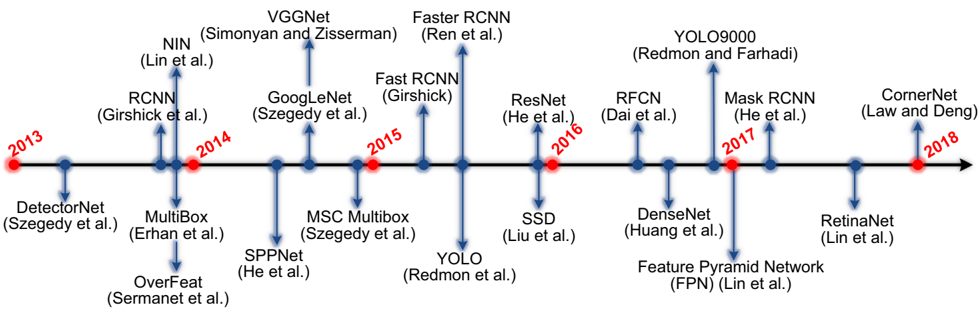
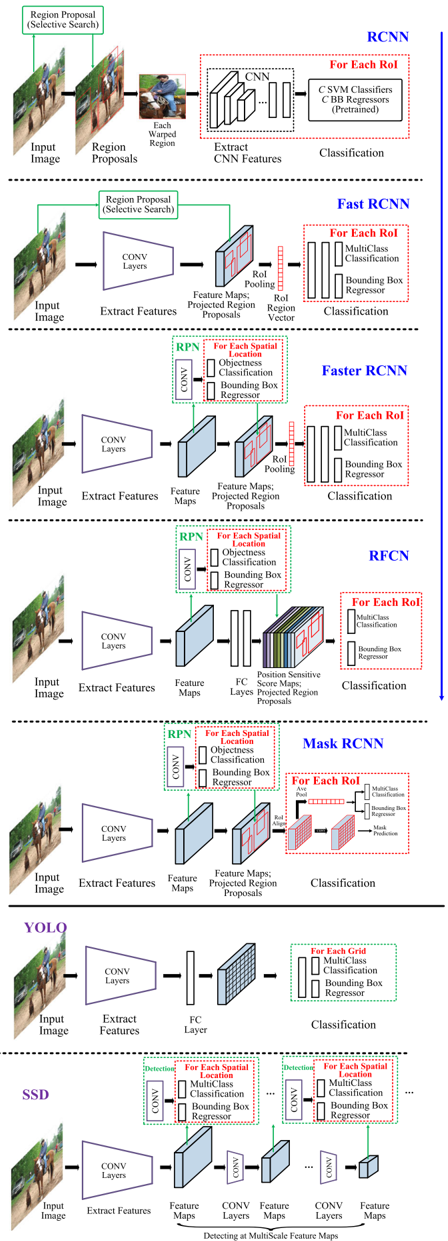
- The survey provides a taxonomy of deep learning based generic object detection, including region-based/two-stage frameworks (RCNN, Fast RCNN, Faster RCNN, RFCN, Mask RCNN) and unified/one-stage frameworks (YOLO, SSD), plus backbone CNN architectures, multiscale feature fusion, context modeling, detection proposals, and training strategies.
- Two-stage detectors generally achieve higher accuracy when large computation is allowed, while one-stage detectors are generally faster but weaker on small objects; for example, SSD achieves 74.3% mAP on VOC2007 test at 59 FPS versus Faster RCNN at 7 FPS / 73.2% mAP and YOLO at 45 FPS / 63.4% mAP. YOLO runs at 45 FPS and Fast YOLO at 155 FPS.
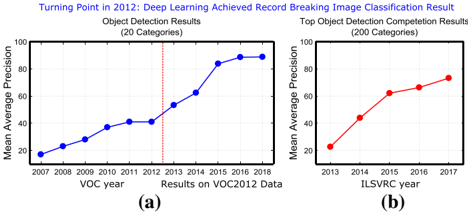
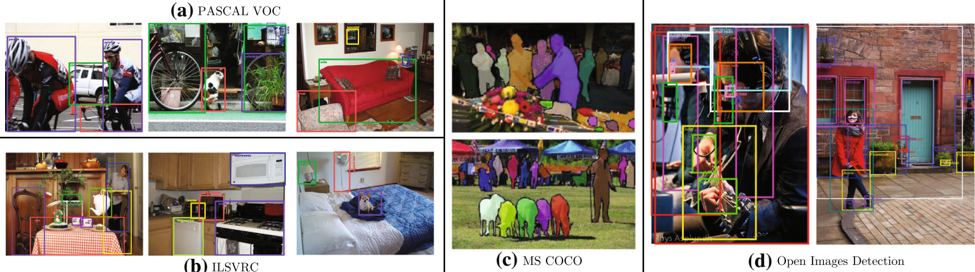
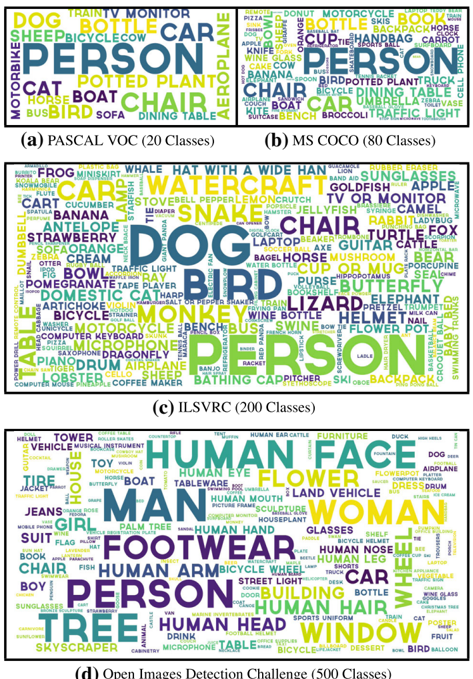
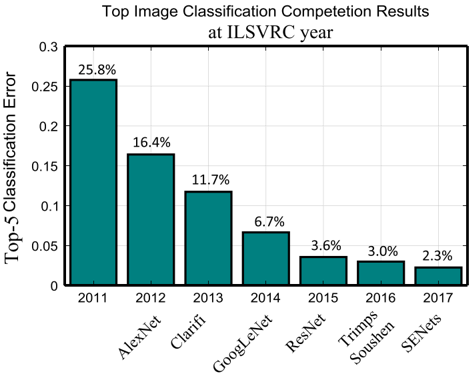
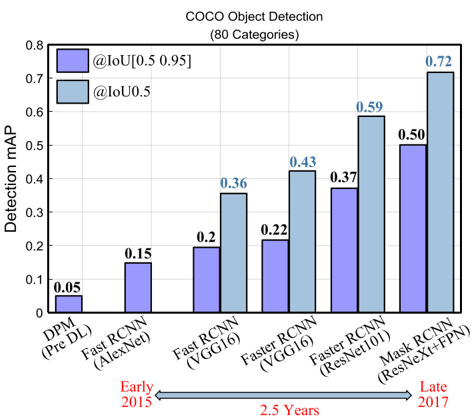
- The main datasets are PASCAL VOC, ImageNet/ILSVRC, MS COCO, and Open Images; COCO contains 41% small and 24% large objects, and the best COCO detector trained on 80 classes reaches only 73% mAP even at 0.5 IoU, while ImageNet Top-5 classification error dropped from 16% to 2% in less than five years. The Open Images challenge winner achieved 61.71% mAP on the public leaderboard and 58.66% mAP on the private leaderboard.
- Future directions include open-world learning, better and more efficient detection frameworks, compact CNN features, automatic neural architecture search, object instance segmentation, weakly supervised detection, few/zero-shot detection, other modalities, and universal object detection.
Methods
- Design: a comprehensive literature survey of deep learning based generic object detection, focusing on major progress of the last 5 years, restricted to still pictures and to top journal and conference papers, with more than 300 research contributions included.
- Organization: the survey presents a taxonomy covering detection frameworks, object feature representation, object proposal generation, context modeling, training strategies, and evaluation metrics, and summarizes popular datasets and evaluation criteria such as AP/mAP and IOU thresholds.
- Analysis: no new experiments are reported; the paper synthesizes and compares reported results across PASCAL VOC, ILSVRC, MS COCO, and Open Images, and discusses representative methods in tables and figures.
Limitations
- Stated: the survey limits its focus to top journal and conference papers, covers mainly the last 5 years, restricts attention to still pictures, and leaves video object detection for separate future consideration; the authors apologize to authors whose works are not included.
- Stated: comparing detectors by their originally reported performance may be misleading because methods differ in meta-frameworks, backbone networks, pretraining datasets, proposal methods, augmentation, and ensembling; there has been very limited unified comparison work.
- Evident: the survey is not exhaustive given the breadth of the field, and it excludes extensive work on specific object detection such as face, pedestrian, vehicle, and traffic sign detection; the provided text also contains fragmented tables and figures, which limits some detail.
Model-written summary. Check it against the paper before relying on it.
Integrity signals
Registry
Cites
Statistics
Figures


Verification
Claims the paper makes
14 Valid · 16 Not valid · 154 Not checked · 108 Own results and interpretations
The cited sources support only part of this claim — read each source’s verdict below.
In the paper
“To the best of our knowledge, for the evaluation of generic object detection algorithms, it is bounding boxes which are most widely used in the current literature (Everingham et al. 2010;Russakovsky et al. 2015), and therefore this is also the approach we adopt in this survey.”
§ Deep Learning for Generic Object Detection: A Survey > 2.1 The Problem
What the sources say
- Partly supportedcites Everingham et al. 2010 matched to “The pascal visual object classes (VOC) challenge” (2010) sourceExperimental — accuracy not yet measured
Section 2.2 (Detection) and “Bounding box evaluation” show that the VOC challenge evaluated object detections using predicted bounding boxes and their overlap with ground truth. The paper does not establish the broader comparative claim that bounding boxes were the most widely used evaluation approach in the literature. (LLM, conf=0.84)
- Not checked yetcites Russakovsky et al. 2015 matched to “ImageNet Large Scale Visual Recognition Challenge” (2015) source
hedged- Asserted: passes — The authors put it forward as true.
- Checkable: passes — It can be checked against evidence.
- Load-bearing: passes — The paper’s conclusions depend on it.
- Based: passes — The paper gives a reason why it holds.
- Partly supported
The sources with a verdict support this claim; the rest weren’t checked yet, have no full text we could read, or their verdicts aren’t rated yet.
In the paper
“In practice, current detectors focus mainly on structured object categories, such as the 20, 200 and 91 object classes in PASCAL VOC (Everingham et al. 2010), ILSVRC (Russakovsky et al. 2015) and MS COCO (Lin et al. 2014) respectively.”
§ Deep Learning for Generic Object Detection: A Survey > 2.2.1 Accuracy Related Challenges
What the sources say
- Supportedcites Everingham et al. 2010 matched to “The pascal visual object classes (VOC) challenge” (2010) source
The citation is offered for the identification of PASCAL VOC as the benchmark with 20 object classes. Our copy states this repeatedly: Sect. 3.2 'Choice of Classes' says 'Fig. 2 shows the 20 classes selected for annotation in the VOC2007 dataset' and that the count rose from 4 (VOC2005) to 10 (VOC2006) to 20 (VOC2007); Sect. 3.1 refers to 'each of the 20 object classes to be annotated'; Sect. 3.5 notes 'the number of classes doubled from 10 to 20'. The surrounding framing about detectors focusing on structured categories is the citing authors' own conclusion, not attributed to this source. (LLM, conf=0.90)
- Not checked yetcites Russakovsky et al. 2015 matched to “ImageNet Large Scale Visual Recognition Challenge” (2015) source
- Not checked yetcites Lin et al. 2014
plain- Asserted: passes — The authors put it forward as true.
- Checkable: passes — It can be checked against evidence.
- Load-bearing: unclear — It is unclear whether the paper’s conclusions depend on it.
- Based: passes — The paper gives a reason why it holds.
- Supported
The sources with a verdict support this claim; the rest weren’t checked yet, have no full text we could read, or their verdicts aren’t rated yet.
In the paper
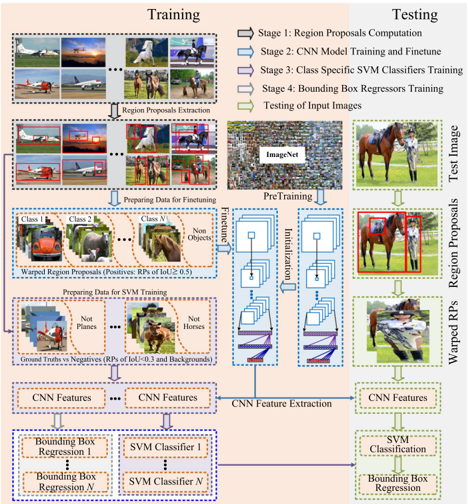
“The Faster RCNN framework proposed by Ren et al. (2015Ren et al. ( , 2017) ) offered an efficient and accurate Region Proposal Network (RPN) for generating region proposals.”
§ Deep Learning for Generic Object Detection: A Survey > 5.1 Region Based (Two Stage) Frameworks
What the sources say
- Not checked yetcites Ren et al. 2015
- Supportedcites Ren et al. 2017 matched to “Faster R-CNN: Towards Real-Time Object Detection with Region Proposal Networks” (2017) source
The Abstract (p. 1) states the paper introduces an RPN that shares full-image convolutional features, enabling 'nearly cost-free region proposals' trained end-to-end 'to generate high-quality region proposals', and the Introduction (p. 1) gives the marginal cost as ~10ms per image. Efficiency and accuracy are both borne out: Section 3 (p. 3) defines the RPN as the proposal module of Faster R-CNN, and p. 2 reports it beats the Selective Search baseline in detection accuracy while waiving nearly all of its computational burden. The paraphrase matches the source at the same level of specificity. (LLM, conf=0.92)
plain- Asserted: passes — The authors put it forward as true.
- Checkable: passes — It can be checked against evidence.
- Load-bearing: unclear — It is unclear whether the paper’s conclusions depend on it.
- Based: passes — The paper gives a reason why it holds.
The sources with a verdict support this claim; the rest weren’t checked yet, have no full text we could read, or their verdicts aren’t rated yet.
In the paper
“In contrast, deep learning methods (especially deep CNNs) can learn powerful feature representations with multiple levels of abstraction directly from raw images (Bengio et al. 2013;LeCun et al. 2015).”
§ Deep Learning for Generic Object Detection: A Survey > 6 Object Representation
What the sources say
- Supportedcites Bengio et al. 2013 matched to “Representation Learning: A Review and New Perspectives” (2013) source
Section 3.4 (pp. 4-5) states that deep architectures 'can potentially lead to progressively more abstract features at higher layers' and that in the convolutional neural network this abstraction is built in explicitly via pooling, making representations 'generally highly non-linear functions of the raw input'. The Introduction (p. 1) frames the whole point as reducing dependence on labor-intensive feature engineering so that algorithms can extract discriminative information from low-level sensory data, and Section 11.2 (p. 24) applies this to the 2D layout of pixels in images via local receptive fields, convolution and pooling. Section 10.1 (p. 22-23) reinforces the 'powerful' element with the ImageNet deep convolutional result. Together these support the paraphrased claim, including the CNN emphasis and the multiple-levels-of-abstraction-from-raw-images core. (LLM, conf=0.90)
- Not checked yetcites LeCun et al. 2015 matched to “Deep learning” (2015) source
plainstates a cause- Asserted: passes — The authors put it forward as true.
- Checkable: passes — It can be checked against evidence.
- Load-bearing: passes — The paper’s conclusions depend on it.
- Based: passes — The paper gives a reason why it holds.
- Supported
The cited sources support only part of this claim — read each source’s verdict below.
In the paper
“Furthermore, the relationship between the source and target datasets plays a critical role, for example that ImageNet based CNN features show better performance for object detection than for human action (Zhou et al. 2015;Azizpour et al. 2016).”
§ Deep Learning for Generic Object Detection: A Survey > 6.1 Popular CNN Architectures
What the sources say
- Not checked yetcites Zhou et al. 2015
- Partly supportedcites Azizpour et al. 2016 matched to “Factors of Transferability for a Generic ConvNet Representation” (2016) sourceExperimental — accuracy not yet measured
The Introduction (p. 2) and Table I say that optimal transfer settings depend on the distance between the ImageNet source task and the target task, supporting the general point. The paper does not establish the citing sentence’s specific comparison that ImageNet-based features perform better for object detection than for human action recognition; its discussion of object detection in the Closing Discussion (p. 11) does not make that comparison. (LLM, conf=0.84)
plainstates an association- Asserted: passes — The authors put it forward as true.
- Checkable: passes — It can be checked against evidence.
- Load-bearing: unclear — It is unclear whether the paper’s conclusions depend on it.
- Based: passes — The paper gives a reason why it holds.
98 more claims · 5 with their cited sources checked
Create a free account to see all 292 claims and to verify the 284 references still open.
- Probably not a substantial claim. 108
- It may state two separate claims as one. 121
- The quote only partly states this claim. 2
Claims other papers make about this one
Each is checked against this paper’s own text: does it say what the citing paper says it does?
The cited source says what the claim attributes to it.
In the citing paper
“Modern object detectors employ many hand-crafted components (Liu et al., 2020), e.g., anchor generation, rule-based training target assignment, non-maximum suppression (NMS) post-processing.”
From Deformable DETR: Deformable Transformers for End-to-End Object Detection (2020) · cites this paper as Liu et al., 2020
The check wasn’t confident either way, so it gives no verdict — never disputed.
In the citing paper
“Over the last few decades, most deep learning-based object tracking systems have been based on CNN architectures [84, 139].”
From A survey on deep multimodal learning for computer vision: advances, trends, applications, and datasets (2022) · cites this paper as [84]
Experimental — accuracy not yet measuredIn the citing paper
“Fortunately, advanced imaging techniques and emerging machine learning methods jointly resist the challenges of unsatisfactory imaging environments and quasi real-time requirements [5], forcefully driving the progress of defect recognition, especially in learning classification [8].”
From Automated Visual Defect Classification for Flat Steel Surface: A Survey (2020) · cites this paper as [8]
Self-check
Percentages, sums and reported differences re-computed from the paper’s own numbers.
Rated minor: it would not touch a result — a value no result rests on, a p-value that stays on the same side of the significance level, or a conflict that is clerical, resolved elsewhere in the paper, or outside its own findings.
In the paper
“| VOC10 | 20 | 4998 | 5105 | 9637 | 11,577(13,339) 11,797(13,352) 10,103 | 23,374 | 2.4 | | |”
§ Deep Learning for Generic Object Detection: A Survey > 10.3 Research Directions
Reported 2.4 · recomputed 2.31357
Rated minor: it would not touch a result — a value no result rests on, a p-value that stays on the same side of the significance level, or a conflict that is clerical, resolved elsewhere in the paper, or outside its own findings.
In the paper
“| VOC09 | 20 | 3473 | 3581 | 6650 | 8505(9760) | 8713(9779) | 7054 | 17,218 | 2.3 |”
§ Deep Learning for Generic Object Detection: A Survey > 10.3 Research Directions
Reported 2.3 · recomputed 2.440885
Citations
Cites
Deep Residual Learning for Image Recognition
He, K., Zhang, X., Ren, S., & Sun, J. (2016) · 2016 IEEE Conference on Computer Vision and Pattern Recognition (CVPR) · doi:10.1109/cvpr.2016.90 · Cited by 235,474 · cited 5×
“GNet. Similarly, ResNet demonstrated the effectiveness of skip connections for learning extremely deep networks with hundreds of layers, winning the ILSVRC 2015 classification task. Inspired by ResNet [101], InceptionResNets [265] combined the Inception networks with shortcut connections, on the basis that shortcut con…”
BackgroundMethodInfluentialVaswani, A., Shazeer, N., Parmar, N., Uszkoreit, J., Jones, L., Gomez, A. N., Kaiser, L., & Polosukhin, I. (2017) · arXiv · doi:10.48550/arxiv.1706.03762 · Cited by 120,404 · cited 1×
“ning architecture where image and memory are processed in parallel to obtain detections which further update memory. Inspired by the recent success of attention modules in natural language processing [274], ORN processes a set of objects simultaneously through the interaction between their appearance 22 Li Liu et al.…”
BackgroundVery Deep Convolutional Networks for Large-Scale Image Recognition
Simonyan, K., & Zisserman, A. (2014) · arXiv · doi:10.48550/arxiv.1409.1556 · Cited by 114,148 · cited 1×
“including the following choices: Meta detection frameworks, such as RCNN [85], Fast RCNN [84], Faster RCNN [229], RFCN [50], Mask RCNN [102], YOLO [227] and SSD [175]; Backbone networks such as VGG [248], Inception [263,125, 264], ResNet [101], ResNeXt [291], and Xception [45] etc. listed in Table6; Innovations such a…”
MethodImageNet classification with deep convolutional neural networks
Krizhevsky, A., Sutskever, I., & Hinton, G. E. (2017) · Communications of the ACM · doi:10.1145/3065386 · Cited by 112,155
Hochreiter, S., & Schmidhuber, J. (1997) · Neural Computation · doi:10.1162/neco.1997.9.8.1735 · Cited by 102,318 · cited 1×
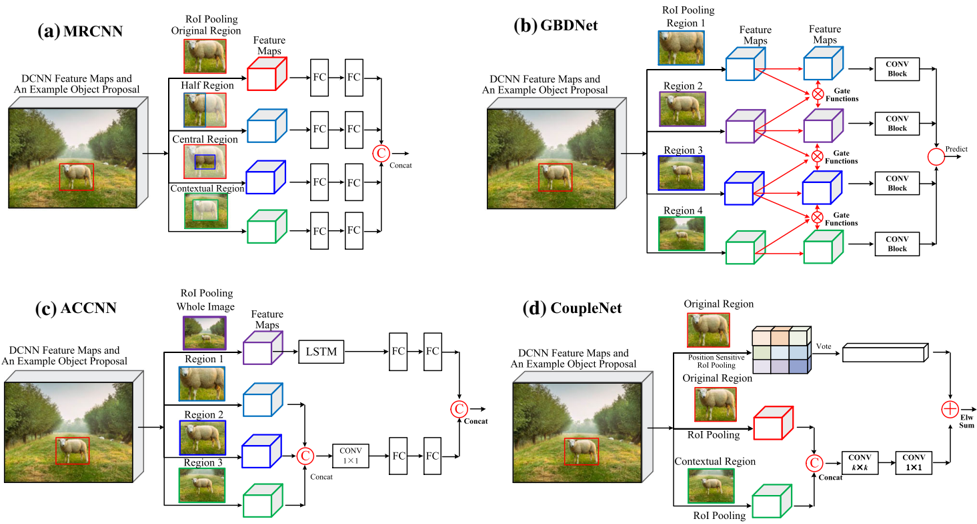
“Noting that message passing is not always helpful but dependent on individual samples, Zeng et al. used gated functions to control message transmission, like in Long Short Term Memory (LSTM) networks [83]. Concurrent with GBDNet, Li et al. [123] presented ACCNN (Fig.13(c)) to utilize both global and local contextual i…”
MethodLeCun, Y., Bengio, Y., & Hinton, G. (2015) · Nature · doi:10.1038/nature14539 · Cited by 84,126
Faster R-CNN: Towards Real-Time Object Detection with Region Proposal Networks
Ren, S., He, K., Girshick, R., & Sun, J. (2017) · IEEE Transactions on Pattern Analysis and Machine Intelligence · doi:10.1109/tpami.2016.2577031 · Cited by 73,472 · cited 5×
“Ren ら [229, 230] により提案された Faster RCNN フ レームワークは,物体領域候補(領域提案)生成用に効率的で Input Image Region Proposals Extract CNN Features Each Warped Region”
InfluentialFaster R-CNN: Towards Real-Time Object Detection with Region Proposal Networks
Ren, S., He, K., Girshick, R., & Sun, J. (2015) · arXiv · doi:10.48550/arxiv.1506.01497 · Cited by 70,812 · cited 5×
“Ren ら [229, 230] により提案された Faster RCNN フ レームワークは,物体領域候補(領域提案)生成用に効率的で Input Image Region Proposals Extract CNN Features Each Warped Region”
InfluentialImageNet: A large-scale hierarchical image database
Deng, J., Dong, W., Socher, R., Li, L.-J., Li, K., & Fei-Fei, L. (2009) · 2009 IEEE Conference on Computer Vision and Pattern Recognition · doi:10.1109/cvpr.2009.5206848 · Cited by 65,333 · cited 4×
“pretrained network is typically finetuned11 on a given detection dataset [58,83,85]. Several large scale image classification datasets are used for CNN pretraining. Among them the ImageNet1000 dataset [52,230] with 1.2 million images of 1000 object categories, or the Places dataset [311] which is much larger than ImageN…”
BackgroundMethodInfluentialGradient-based learning applied to document recognition
Lecun, Y., Bottou, L., Bengio, Y., & Haffner, P. (1998) · Proceedings of the IEEE · doi:10.1109/5.726791 · Cited by 58,805
Research works printed but not linked: 9
- 16. Biederman, I. (1987b). Recognition by components: A theory of human image understanding. Psychological Review, 94(2), 115. · DOI · Paper page
- 29. Chen, G., Choi, W., Yu, X., Han, T., & Chandraker M. (2017a). Learning efficient object detection models with knowledge distillation. In NIPS.
- 65. Endres, I., & Hoiem, D. (2010). Category independent object propos- als. In K. Daniilidis, P. Maragos, & N. Paragios (Eds.), European Conference on Computer Vision (pp. 575-588). Berlin: Springer.
- 128. Jaderberg, M., Simonyan, K., Zisserman, A., et al. (2015). Spatial trans- former networks. In NIPS (pp. 2017-2025).
- 143. Krizhevsky, A., Sutskever, I., & Hinton, G. (2012b). ImageNet clas- sification with deep convolutional neural networks. In NIPS (pp. 1097-1105).
- 195. Murase, H., & Nayar, S. (1995b). Visual learning and recognition of 3d objects from appearance. IJCV, 14(1), 5-24. · DOI · Paper page
- 231. Ren, M., Triantafillou, E., Ravi, S., Snell, J., Swersky, K., Tenenbaum, J. B., Larochelle, H., & Zemel R. S. (2018). Meta learning for semisupervised few shot classification. In ICLR.
- 279. Wan, L., Eigen, D., & Fergus, R. (2015). End to end integration of a convolution network, deformable parts model and nonmaximum suppression. In CVPR (pp. 851-859).
- 298. Yosinski, J., Clune, J., Bengio, Y., & Lipson, H. (2014). How trans- ferable are features in deep neural networks? In NIPS (pp. 3320-3328).
Cited by
Items 401–500 of 1,005
A Systematic Assessment of Embedded Neural Networks for Object Detection
Verucchi, M., Brilli, G., Sapienza, D., Verasani, M., Arena, M., Gatti, F., Capotondi, A., Cavicchioli, R., Bertogna, M., & Solieri, M. (2020) · IEEE International Conference on Emerging Technologies and Factory Automation (ETFA) · doi:10.1109/etfa46521.2020.9212130 · Cited by 67
“The mAP 0.5:0.95 is the “de facto” metric for object detection [42] [43] and depends on two thresholds: (i) confidence threshold t c , taking into account only BBs with a confidence score greater than t c ; and (ii) the IoU thresholds t IoU to discriminate two BBs representing the same object if…”
BackgroundInfluentialAutomated piglet tracking using a single convolutional neural network
Gan, H., Ou, M., Zhao, F., Xu, C., Li, S., Chen, C., & Xue, Y. (2021) · Biosystems Engineering · doi:10.1016/j.biosystemseng.2021.02.010 · Cited by 55
Zhu, J., Li, X., Zhang, C., & Shi, T. (2021) · Measurement · doi:10.1016/j.measurement.2021.109657 · Cited by 50
NeSF: Neural Semantic Fields for Generalizable Semantic Segmentation of 3D Scenes
Vora, S., Radwan, N., Greff, K., Meyer, H., Genova, K., Sajjadi, M. S. M., Pot, E., Tagliasacchi, A., & Duckworth, D. (2022) · Transactions on machine learning research · doi:10.48550/arxiv.2111.13260 · Cited by 134
“Well-studied tasks such as scene classification [72], object detection [81], semantic segmentation [75], and instance segmentation [49] infer semantic descriptions of scenes from RGB and other sensors and form the foundation for applications such as visual navigation [7] and robotic interaction [6].”
BackgroundMethodInfluentialFeedback-driven loss function for small object detection
Liu, G., Han, J., & Rong, W. (2021) · Image and Vision Computing · doi:10.1016/j.imavis.2021.104197 · Cited by 57
Attentional Feature Refinement and Alignment Network for Aircraft Detection in SAR Imagery
Zhao, Y., Zhao, L.-J., Liu, Z., Hu, D.-W., Kuang, G.-Y., & Liu, L. (2022) · IEEE Transactions on Geoscience and Remote Sensing · doi:10.1109/tgrs.2021.3139994 · Cited by 46
“Recently, convolutional neural networks (CNNs) have achieved remarkable success for object detection in optical imagery [17], [18] and also provide great opportunities for aircraft detection in SAR imagery [14], [19]–[22].”
BackgroundSelf-citationEC²Detect: Real-Time Online Video Object Detection in Edge-Cloud Collaborative IoT
Guo, S., Zhao, C., Wang, G., Yang, J., & Yang, S. (2022) · IEEE Internet of Things Journal · doi:10.1109/jiot.2022.3173685 · Cited by 52
“In particular, object detection [7] is one of the most critical video analytic techniques, aiming at localizing and identifying objects in video comprising consecutive frames.”
BackgroundAutomatic monitoring of flying vegetable insect pests using an RGB camera and YOLO-SIP detector
Guo, Q., Wang, C., Xiao, D., & Huang, Q. (2022) · Precision Agriculture · doi:10.1007/s11119-022-09952-w · Cited by 58
Nurkarim, W., & Wijayanto, A. W. (2022) · Earth Science Informatics · doi:10.1007/s12145-022-00895-4 · Cited by 55
A Novel Multi-Frequency Coordinated Module for SAR Ship Detection
Qiao, C., Shen, F., Wang, X., Wang, R., Cao, F., Zhao, S., & Li, C. (2022) · IEEE International Conference on Tools with Artificial Intelligence (ICTAI) · doi:10.1109/ictai56018.2022.00124 · Cited by 60
“, object detection [7], [8], object re-identification [9], and object tracking [10].”
BackgroundSelf-citationDisentangled Cross-Modal Transformer for RGB-D Salient Object Detection and Beyond
Chen, H., Shen, F., Ding, D., Deng, Y., & Li, C. (2024) · IEEE Transactions on Image Processing · doi:10.1109/tip.2024.3364022 · Cited by 65
“S ALIENT object detection (SOD), which aims to simulate human visual systems and identify the most attractive objects in a scene, has benefited a large variety of computer vision tasks, including image compression [1], detection [2], segmentation [3], [4] and tracking [5].”
BackgroundLearning Discriminative Representation for Fine-Grained Object Detection in Remote Sensing Images
Xie, X., Cheng, G., Li, W., Lang, C., Zhang, P., Yao, Y., & Han, J. (2025) · IEEE Transactions on Circuits and Systems for Video Technology · doi:10.1109/tcsvt.2025.3544741 · Cited by 60
“2) Evaluation Metric: Following previous studies [10], [23], [57], we utilize mean average precision (mAP) [60], [61] as the evaluation metric for fine-grained object detection in remote sensing images.”
Improved Handling of Motion Blur in Online Object Detection
Sayed, M., & Brostow, G. (2021) · IEEE Computer Society Conference on Computer Vision and Pattern Recognition/Proceedings - IEEE Computer Society Conference on Computer Vision and Pattern Recognition/Proceedings · doi:10.1109/cvpr46437.2021.00175 · Cited by 72
“While other models achieve better accuracy on the COCO minival set, we choose this framework for its accessibility and as a good baseline representation of a canonical detection framework with top-10 performance for the backbone’s size [21, 27].”
MethodDevelopments in Brain Tumor Segmentation Using MRI: Deep Learning Insights and Future Perspectives
Karim, S., Tong, G., Yu, Y., Laghari, A. A., Khan, A. A., Ibrar, M., & Mehmood, F. (2024) · IEEE Access · doi:10.1109/access.2024.3365048 · Cited by 61
“Image segmentation is one of computer vision’s basic and challenging tasks [1].”
BackgroundA Review of YOLO Algorithm and Its Applications in Autonomous Driving Object Detection
Wei, J., As’arry, A., Rezali, K. A. M., Yusoff, M. Z. M., Ma, H., & Zhang, K.-L. (2025) · IEEE Access · doi:10.1109/access.2025.3573376 · Cited by 92
“An integral part of computer vision systems, object detection can automatically find and mark things in pictures or video frames [5], [6], [7].”
Distributed and Efficient Object Detection via Interactions Among Devices, Edge, and Cloud
Guo, Y., Zou, B., Ren, J., Liu, Q., Zhang, D., & Zhang, Y. (2019) · IEEE Transactions on Multimedia · doi:10.1109/tmm.2019.2912703 · Cited by 52
“Since Faster R-CNN is the most famous architecture in recent years [38], we use it in our implementation and experiments.”
MethodAn Asphalt Damage Dataset and Detection System Based on RetinaNet for Road Conditions Assessment
Ochoa‐Ruiz, G., Angulo-Murillo, A. A., Ochoa, A., Aguilar-Lobo, L. M., Vega-Fernández, J. A., & Natraj, S. (2020) · Applied Sciences · doi:10.3390/app10113974 · Cited by 54
“Conversely, recent strides in deep learning techniques have enabled the deployment of very efficient and resource‐constrained object detection systems in mobile devices [19, 20] and have started to be deployed on road damage acquisition systems [21,22].”
BackgroundCarranza-García, M., Lara-Benítez, P., García–Gutiérrez, J., & Riquelme, J. C. (2021) · Neurocomputing · doi:10.1016/j.neucom.2021.04.001 · Cited by 53
“The goal of this detection task is to determine the presence of objects from given categories and return the spatial location of each instance through a bounding box [10].”
BackgroundDeep CNN models for predicting COVID-19 in CT and x-ray images
Chaddad, A., Hassan, L., & Desrosiers, C. (2021) · Journal of medical imaging · doi:10.1117/1.jmi.8.s1.014502 · Cited by 50
Chen, C., Li, J., Zhou, H.-Y., Han, X., Huang, Y., Ding, X., & Yu, Y. (2022) · IEEE Transactions on Pattern Analysis and Machine Intelligence · doi:10.1109/tpami.2022.3179445 · Cited by 77
Convolutional Neural Networks for vehicle damage detection
van Ruitenbeek, R. E., & Bhulai, S. (2022) · Machine Learning with Applications · doi:10.1016/j.mlwa.2022.100332 · Cited by 68
Deep active learning models for imbalanced image classification
Jin, Q., Yuan, M., Wang, H., Wang, M., & Song, Z. (2022) · Knowledge-Based Systems · doi:10.1016/j.knosys.2022.109817 · Cited by 62
Monitoring and Identification of Road Construction Safety Factors via UAV
Zhu, C., Zhu, J., Bu, T., & Gao, X. (2022) · Sensors · doi:10.3390/s22228797 · Cited by 61
“Anchor size Scale 1: [8, 29], [15, 27], [11, 43] Scale 2: [16, 51], [18, 68], [23, 64] Scale 3: [111, 77], [325, 157], [232, 325] Freeze training epochs 50 Unfreeze training epochs 250”
BackgroundDegradation-Aware Self-Attention Based Transformer for Blind Image Super-Resolution
Liu, Q., Gao, P., Han, K., Liu, N., & Xiang, W. (2024) · IEEE Transactions on Multimedia · doi:10.1109/tmm.2024.3368923 · Cited by 53
“Recently, Transformer models have been widely used in a variety of computer vision applications, such as object detection [12], [26], [27], segmentation [12], [28], [29], [30], and crowd counting [31], [32].”
MethodAutomatic identification of rock fractures based on deep learning
Ji, Y., Song, S., Zhang, W., Li, Y., Xue, J., & Chen, J. (2024) · Engineering Geology · doi:10.1016/j.enggeo.2024.107874 · Cited by 52
Self-citationProtopapa, C., Siamidi, A., Eneli, A. A., Elbadawi, M., & Vlachou, M. (2025) · The AAPS Journal · doi:10.1208/s12248-025-01101-1 · Cited by 58
Deep learning based HEp-2 image classification: A comprehensive review
Rahman, S., Wang, L., Sun, C., & Zhou, L. (2020) · Medical Image Analysis · doi:10.1016/j.media.2020.101764 · Cited by 55
A study on generic object detection with emphasis on future research directions
Arulprakash, E., & Aruldoss, M. (2021) · Journal of King Saud University - Computer and Information Sciences · doi:10.1016/j.jksuci.2021.08.001 · Cited by 61
“So the researcher has recommended other methods to handle this problem (Liu et al., 2020).”
InfluentialReal-time facial expression recognition using smoothed deep neural network ensemble
Benamara, N. K., Val-Calvo, M., Álvarez, J. R., Díaz‐Morcillo, A., Vicente, J. M. F., Fernández-Jover, E., & Stambouli, T. B. (2020) · Integrated Computer-Aided Engineering · doi:10.3233/ica-200643 · Cited by 52
“Overall, the one-shot based methods are faster compared to the region proposal based methods which are computationally expensive, since they use two stages for object detection [42].”
Gandor, T., & Nalepa, J. (2022) · Sensors · doi:10.3390/s22031104 · Cited by 65
“There is a plethora of datasets for object detection [23], such as PASCAL VOC, ImageNet, Open Images and MS COCO.”
BackgroundLiu, S., Sun, H., Zhang, Z., Li, Y., Zhong, R., Li, J., & Chen, S. (2022) · IEEE Transactions on Geoscience and Remote Sensing · doi:10.1109/tgrs.2022.3158660 · Cited by 66
“In recent years, with the development of artificial intelligence, deep learning models have shown significant advantages in image-based object detection and semantic segmentation [24]–[26].”
BackgroundStereo Vision Meta-Lens-Assisted Driving Vision
Liu, X., Li, W., Yamaguchi, T., Geng, Z., Tanaka, T., Tsai, D. P., & Chen, M. K. (2024) · ACS Photonics · doi:10.1021/acsphotonics.3c01594 · Cited by 52
Self-citationSynchronizing Object Detection: Applications, Advancements and Existing Challenges
Hosain, M. T., Zaman, A., Abir, M. R., Akter, S., Mursalin, S., & Khan, S. S. (2024) · IEEE Access · doi:10.1109/access.2024.3388889 · Cited by 71
Yu, Y., Yang, X., Li, Q., Da, F., Dai, Y., Qiao, Y., & Yan, J. (2024) · IEEE Computer Society Conference on Computer Vision and Pattern Recognition/Proceedings - IEEE Computer Society Conference on Computer Vision and Pattern Recognition/Proceedings · doi:10.1109/cvpr52733.2024.01588 · Cited by 75
“Beyond horizontal detection [24, 58], oriented object detection [38] has received extensive attention.”
BackgroundDeep Learning for Cross-Domain Few-Shot Visual Recognition: A Survey
Xu, H., Zhi, S., Sun, S., Patel, V. M., & Liu, L. (2025) · ACM Computing Surveys · doi:10.1145/3718362 · Cited by 69
“1 INTRODUCTION During the past decade, under the joint driving force of big image data and the availability of powerful computing hardware, Machine Learning techniques, in particular Deep Learning [44], have brought revolutionary progress for various computer vision tasks including fundamental ones like image classifi…”
Self-citationDetection and tracking for the awareness of surroundings of a ship based on deep learning
Lee, W.-J., Roh, M.-I., Lee, H.-W., Ha, J., Cho, Y.-M., Lee, S.-J., & Son, N.-S. (2021) · Journal of Computational Design and Engineering · doi:10.1093/jcde/qwab053 · Cited by 48
Rodríguez, I., Campos, C., & Fdez‐Riverola, F. (2021) · Neural Computing and Applications · doi:10.1007/s00521-021-06830-w · Cited by 62
“…topology-specific innovations for increasing the representational capacity of CNNs [64], (iii) challenges still pending in the field [60, 63], (iv) methodologies and strategies best suited for training [60, 63] (v) common use cases or application domains [61], and (vi) evaluation metrics [60, 63].”
BackgroundInfluentialSelf-Regulation for Semantic Segmentation
Zhang, D., Zhang, H., Tang, J., Hua, X., & Sun, Q. (2021) · IEEE/CVF International Conference on Computer Vision (ICCV) · doi:10.1109/iccv48922.2021.00687 · Cited by 56
“It computes a distillation loss between teacher and student, for which the implementation methods can be logits-based [26, 44], featurebased [34, 57], and hybrid [28, 56].”
BackgroundMethodDeep Neural Networks for Object Detection
You, J. (2022) · Highlights in Science, Engineering and Technology · doi:10.54097/hset.v17i.2576 · Cited by 46
“The object detection algorithm requires high resource consumption, such as GPU and CPU computing resources, but the computational resources of systems are limited [9].”
BackgroundWang, D., Wang, X., Ren, B., Wang, J., Zeng, T., Kang, D., & Wang, G. (2021) · Journal of Computing in Civil Engineering · doi:10.1061/(asce)cp.1943-5487.0000994 · Cited by 49
Self-citationUsing Deep Learning for Collecting Data about Museum Visitor Behavior
Ferrato, A., Limongelli, C., Mezzini, M., & Sansonetti, G. (2022) · Applied Sciences · doi:10.3390/app12020533 · Cited by 65
TOD-CNN: An effective convolutional neural network for tiny object detection in sperm videos
Zou, S., Li, C., Sun, H., Xu, P., Zhang, J., Ma, P., Yao, Y., Huang, X., & Grzegorzek, M. (2022) · Computers in Biology and Medicine · doi:10.1016/j.compbiomed.2022.105543 · Cited by 45
Ciarfuglia, T. A., Motoi, I. M., Saraceni, L., Fawakherji, M., Sanfeliu, A., & Nardi, D. (2023) · Computers and Electronics in Agriculture · doi:10.1016/j.compag.2023.107624 · Cited by 50
“It is well known ([18]) that SotA detection networks can be divided into two main categories: two stage and single stage.”
BackgroundAxford, D., Sohel, F. A., Vanderklift, M. A., & Hodgson, A. J. (2024) · Ecological Informatics · doi:10.1016/j.ecoinf.2024.102842 · Cited by 64
End-to-End Trainable One-Stage Parking Slot Detection Integrating Global and Local Information
Suhr, J. K., & Jung, H. G. (2021) · IEEE Transactions on Intelligent Transportation Systems · doi:10.1109/tits.2020.3046039 · Cited by 50
Recent advances in local feature detector and descriptor: a literature survey
Joshi, K., & Patel, M. I. (2020) · International Journal of Multimedia Information Retrieval · doi:10.1007/s13735-020-00200-3 · Cited by 54
Deep Learning for the Detection and Recognition of Rail Defects in Ultrasound B-Scan Images
Chen, Z., Wang, Q., Yang, K., Yu, T., Yao, J., Liu, Y., Wang, P., & He, Q. (2021) · Transportation Research Record Journal of the Transportation Research Board · doi:10.1177/03611981211021547 · Cited by 45
“In recent years, with the rapid development of artificial intelligence and deep learning, object detection technology based on deep learning has been successfully applied in the field of computer vision (2, 3).”
BackgroundYang, Y., Tan, Z.-C., Tiwari, P., Pandey, H. M., Wan, J., Lei, Z., Guo, G., & Li, S. (2021) · International Journal of Computer Vision · doi:10.1007/s11263-021-01499-z · Cited by 52
“Although the performance has been greatly improved owing to the success of deep learning [23,41,13, 12,17,15,31,56,39] especially the Convolutional Neural Network (CNN) [24], accurate recognition of pedestrian attributes remains a challenging task because of poor imaging quality (e.g., low…”
Zhang, T., Aftab, W., Mihaylova, L., Langran-Wheeler, C., Rigby, S. E., Fletcher, D. I., Maddock, S., & Bosworth, G. (2022) · Sensors · doi:10.3390/s22124324 · Cited by 57
Context Information Refinement for Few-Shot Object Detection in Remote Sensing Images
Wang, Y., Xu, C., Liu, C., & Li, Z. (2022) · Remote Sensing · doi:10.3390/rs14143255 · Cited by 52
Comparison of Deep Neural Networks in Detecting Field Grapevine Diseases Using Transfer Learning
Morellos, A., Pantazi, X. E., Paraskevas, C., & Moshou, D. (2022) · Remote Sensing · doi:10.3390/rs14184648 · Cited by 46
Uncertainty-Guided Semi-Supervised Few-Shot Class-Incremental Learning With Knowledge Distillation
Cui, Y., Deng, W., Xu, X., Liu, Z., Liu, Z., Pietikäinen, M., & Liu, L. (2023) · IEEE Transactions on Multimedia · doi:10.1109/tmm.2022.3208743 · Cited by 44
“I N THE past decade, deep learning has achieved startling progress in various computer vision tasks, such as image classification [1], [2], [3], object detection [4], face recognition [5], semantic segmentation [6], image synthesis [7], etc.”
BackgroundSelf-citationBrain-Inspired Remote Sensing Interpretation: A Comprehensive Survey
Jiao, L., Huang, Z., Liu, X., Yang, Y., Ma, M., Zhao, J., You, C., Hou, B., Yang, S., Liu, F., et al. (2023) · IEEE Journal of Selected Topics in Applied Earth Observations and Remote Sensing · doi:10.1109/jstars.2023.3247455 · Cited by 49
“Object detection focuses on whether there are object instances from a defined class given the input information, and if so, returns the spatial location, extent, and class of each object through a bounding box [195].”
BackgroundSelf-citationRecent Few-shot Object Detection Algorithms: A Survey with Performance Comparison
Liu, T., Zhang, L., Wang, Y., Guan, J., Fu, Y., Zhao, J., & Zhou, S. (2023) · ACM Transactions on Intelligent Systems and Technology · doi:10.1145/3593588 · Cited by 55
“As one of the most fundamental problems of computer vision, there is a variety of object detection approaches proposed every year, and various surveys have been published [62, 91, 106, 107, 126, 135, 174, 181].”
BackgroundFreitas, P., Vieira, G. T., Canário, J., Vincent, W. F., Pina, P., & Mora, C. (2024) · Remote Sensing of Environment · doi:10.1016/j.rse.2024.114047 · Cited by 48
Knowledge Graph-Based Image Classification Refinement
Zhang, D., Cui, M., Yang, Y., Yang, P., Xie, C., Liu, D., Yu, B., & Chen, Z. (2019) · IEEE Access · doi:10.1109/access.2019.2912627 · Cited by 47
SARD: Towards Scale-Aware Rotated Object Detection in Aerial Imagery
Wang, Y., Zhang, Y., Zhang, Y., Zhao, L., Sun, X., & Guo, Z. M. (2019) · IEEE Access · doi:10.1109/access.2019.2956569 · Cited by 45
Mani, V. R. S., Saravanaselvan, A., & Arumugam, N. (2021) · Microelectronics Journal · doi:10.1016/j.mejo.2021.105319 · Cited by 54
SpeeChin: A Smart Necklace for Silent Speech Recognition
Zhang, R., Chen, M., Steeper, B., Li, Y., Yan, Z., Chen, Y., Tao, S., Chen, T., Lim, H., & Zhang, C. (2021) · Proceedings of the ACM on Interactive Mobile Wearable and Ubiquitous Technologies · doi:10.1145/3494987 · Cited by 54
“Therefore, CNN is widely used in various vision tasks including image classification [26, 42, 60], object detection [44] and image segmentation [49].”
MethodJoint-attention feature fusion network and dual-adaptive NMS for object detection
Ma, W., Zhou, T., Qin, J., Zhou, Q., & Cai, Z. (2022) · Knowledge-Based Systems · doi:10.1016/j.knosys.2022.108213 · Cited by 50
Shen, W., Vaca, D., & Kumar, S. (2020) · Nanoscale and Microscale Thermophysical Engineering · doi:10.1080/15567265.2020.1807662 · Cited by 43
“Deep learning methods can serve as efficient tools to learn the pattern behind the data, and have demonstrated successes in many fields, such as object recognition [14, 15], and natural language processing [16].”
MethodA comprehensive overview of dynamic visual SLAM and deep learning: concepts, methods and challenges
Beghdadi, A., & Mallem, M. (2022) · Machine Vision and Applications · doi:10.1007/s00138-022-01306-w · Cited by 56
“Recent literature detailed the state-of-the-art of object detection methods [46,47].”
BackgroundMethodA Survey on Audio-Video Based Defect Detection Through Deep Learning in Railway Maintenance
Donato, L. D., Flammini, F., Marrone, S., Mazzariello, C., Nardone, R., Sansone, C., & Vittorini, V. (2022) · IEEE Access · doi:10.1109/access.2022.3183102 · Cited by 58
“…most used approaches are those belonging to the YOLO (mostly Yolov3) family, as they seem to be among the fastest architectures, and those belonging to the region-based CNN (mostly Faster R-CNN) family, which have been shown to be (generally) more precise even if less fast than the previous [172].”
MethodSensor-based human–robot collaboration for industrial tasks
Angleraud, A., Ekrekli, A., Samarawickrama, K., Sharma, G., & Pieters, R. (2023) · Robotics and Computer-Integrated Manufacturing · doi:10.1016/j.rcim.2023.102663 · Cited by 52
Zhang, J., Liang, X., Wang, M., Yang, L., & Zhuo, L. (2019) · Neurocomputing · doi:10.1016/j.neucom.2019.03.102 · Cited by 49
On-farm welfare monitoring system for goats based on Internet of Things and machine learning
Rao, Y., Jiang, M., Wang, W., Wu, Z., & Wang, R. (2020) · International Journal of Distributed Sensor Networks · doi:10.1177/1550147720944030 · Cited by 50
“Especially, there have been several good deep learningbased methods, such as Faster R-CNN, Single Shot MultiBox Detector (SSD), and YOLOv3 (You Only Look Once version 3).(19) When compared with the latter two methods, Faster R-CNN offers higher detection accuracy at the expense of computational cost.”
MethodZheng, Y., Sun, P., Zhou, Z., Xu, W., & Ren, Q. (2021) · Remote Sensing · doi:10.3390/rs13132623 · Cited by 47
“Much progress in general-purpose horizontal detectors has been achieved by advances in deep convolutional neural networks (DCNNs) and the emergence of large datasets [1].”
BackgroundMeta-UDA: Unsupervised Domain Adaptive Thermal Object Detection using Meta-Learning
Vibashan, V. S., Poster, D., You, S. O., Hu, S., & Patel, V. M. (2022) · IEEE Winter Conference on Applications of Computer Vision · doi:10.1109/wacv51458.2022.00375 · Cited by 56
Monna, F., Rolland, T., Denaire, A., Navarro, N., Granjon, L., Barbé, R., & Chateau‐Smith, C. (2021) · Journal of Cultural Heritage · doi:10.1016/j.culher.2021.10.004 · Cited by 65
“Object detectors can be divided into two main categories, one-and two-stage detectors [40, 41].”
Li, S., Cui, X., Guo, L., Zhang, L., Chen, X., & Cao, X. (2022) · IEEE Transactions on Geoscience and Remote Sensing · doi:10.1109/tgrs.2022.3181202 · Cited by 61
“Large datasets enable researchers to find more realistic and complex problems from images with large intraclass differences or interclass similarities [58].”
BackgroundA Comprehensive Survey of Machine Learning Applied to Radar Signal ProcessingPreprint
Lang, P., Fu, X., Martorella, M., Dong, J., Qin, R., Meng, X., & Xie, M. (2020) · arXiv (Cornell University) · doi:10.48550/arxiv.2009.13702 · Cited by 81
“The authors in [42], [43] have studied the latest development of object detection in the past few years.”
BackgroundYOLOv10 to Its Genesis: A Decadal and Comprehensive Review of The You Only Look Once SeriesPreprint
Sapkota, R., Qureshi, R., Flores-Calero, M. J., Hussain, M., Badjugar, C., Nepal, U., Poulose, A., Zeno, P. J., Vaddevolu, U. B. P., Yan, H., et al. (2024) · Preprints.org · doi:10.20944/preprints202406.1366.v1 · Cited by 47
Investigating bias in deep face analysis: The KANFace dataset and empirical study
Georgopoulos, M., Panagakis, Y., & Pantic, M. (2020) · Image and Vision Computing · doi:10.1016/j.imavis.2020.103954 · Cited by 42
Jacobs, R. M., Shen, M., Liu, Y., Wei, H., Li, X., He, R., Greaves, J. R. C., Wang, D., Xie, Z., Huang, Z., et al. (2022) · Cell Reports Physical Science · doi:10.1016/j.xcrp.2022.100876 · Cited by 58
Few-Shot Learning for Plant-Disease Recognition in the Frequency Domain
Lin, H., Tse, R. T., Tang, S.-K., Qiang, Z., & Pau, G. (2022) · Plants · doi:10.3390/plants11212814 · Cited by 46
“In computer vision, most of the existing studies of classification [22], segmentation [23], object detection [24] etc., are focused on the spatial domain.”
BackgroundObject Detection with Convolutional Neural Networks
Li, K., Ma, W., Sajid, U., Wu, Y., & Wang, G. (2020) · CRC Press eBooks · doi:10.1201/9781351003827-2 · Cited by 48
From leaf to label: A robust automated workflow for stomata detection
Meeus, S., den Bulcke, J. V., & wyffels, F. (2020) · Ecology and Evolution · doi:10.1002/ece3.6571 · Cited by 47
“While this task can be broadened to a generic object detection task for which multiple efficient methodologies were proposed (see Liu, Ouyang, et al., 2018, for an extensive review), we focus on a simple methodology across multiple species which models the stomata detection task as classification…”
MethodPolitikos, D. V., Adamopoulou, A., Petasis, G. C., & Galgani, F. (2022) · Ocean & Coastal Management · doi:10.1016/j.ocecoaman.2022.106466 · Cited by 48
Adaptive Smooth L1 Loss: A Better Way to Regress Scene Texts with Extreme Aspect Ratios
Liu, C., Yu, S., Yu, M., Wei, B., Li, B., Li, G., & Huang, W. (2021) · IEEE Symposium on Computers and Communications (ISCC) · doi:10.1109/iscc53001.2021.9631466 · Cited by 46
Object Detection in Hyperspectral Image via Unified Spectral–Spatial Feature Aggregation
He, X., Tang, C., Liu, X., Zhang, W., Sun, K., & Xu, J. (2023) · IEEE Transactions on Geoscience and Remote Sensing · doi:10.1109/tgrs.2023.3307288 · Cited by 61
“detection process reduces the speed of object detection [29].”
BackgroundSelf-citationChen, F., Deng, M., Gao, H., Yang, X., & Zhang, D. (2024) · IET Image Processing · doi:10.1049/ipr2.13073 · Cited by 48
Allmendinger, A., Saltık, A. O., Peteinatos, G. G., Stein, A., & Gerhards, R. (2025) · Precision Agriculture · doi:10.1007/s11119-025-10246-0 · Cited by 65
“Two major object detection approaches exist: two-stage and one-stage detectors (Liu et al., 2020 ).”
Object Detection for Smart Factory Processes by Machine Learning
Malburg, L., Rieder, M.-P., Seiger, R., Klein, P., & Bergmann, R. (2021) · Procedia Computer Science · doi:10.1016/j.procs.2021.04.009 · Cited by 53
“In DL based systems mainly Convolutional Neural Networks (CNNs) [15] are used as backbone , which have been typically pre-trained for image classification to learn meaningful general features (e. g., edges, lines, etc.), modified for OD, and then retrained to detect specific objects.”
BackgroundMethodDesign, Detection, and Tracking of Customized Fiducial Markers
Jurado-Rodríguez, D., Muñoz‐Salinas, R., Garrido-Jurado, S., & Medina-Carnicer, R. (2021) · IEEE Access · doi:10.1109/access.2021.3118049 · Cited by 43
“CNNs have been successfully applied to many computer vision tasks in the last years [21].”
MethodReal-Time Detectionand Identification of Plant Leaf Diseases using YOLOv4-tiny
Mohandas, A., Anjali, M. S., & Varma, U. R. (2021) · International Conference on Computing, Communication and Networking Technologies (ICCCNT) · doi:10.1109/icccnt51525.2021.9579783 · Cited by 44
Soliman, M. S. A., Fatnassi, T., Elgammal, I., & Figueiredo, R. (2023) · Big Data and Cognitive Computing · doi:10.3390/bdcc7010012 · Cited by 50
Gray whale detection in satellite imagery using deep learning
Green, K. M., Virdee, M. K., Cubaynes, H. C., Avilés-Rivero, A. I., Fretwell, P. T., Gray, P. C., Johnston, D. W., Schönlieb, C., Torres, L. G., & Jackson, J. A. (2023) · Remote Sensing in Ecology and Conservation · doi:10.1002/rse2.352 · Cited by 45
“Object detection is a task within the field of computer vision: a bounding box is specified around each object of interest and labelled by the class it belongs to (Liu et al., 2020; Zou et al., 2023).”
BackgroundJiang, Z., Bi, Y., Zhou, M., Hu, Y., Burke, M. G., & Navab, N. (2024) · The International Journal of Robotics Research · doi:10.1177/02783649231223547 · Cited by 60
“Recent developments of deep neural networks (DNNs) demonstrated expert-level accuracy in a broad range of computer vision tasks like image segmentation (Minaee et al. 2021), object detection (Liu et al. 2020) and classification(Russakovsky et al. 2015).”
BackgroundThammasanya, T., Pat-Iam, S., Rodcharoen, E., & Chotikarn, P. (2024) · Scientific Reports · doi:10.1038/s41598-024-53251-5 · Cited by 52
“Mean average precision is the average precision (AP) of all microplastics averaged 38 .”
BackgroundRecursive Context Routing for Object Detection
Chen, Z., Zhang, J., & Tao, D. (2020) · International Journal of Computer Vision · doi:10.1007/s11263-020-01370-7 · Cited by 43
A Multimodal Memes Classification: A Survey and Open Research Issues
Afridi, T. H., Alam, A., Khan, M. N., Khan, J., & Lee, Y.-K. (2020) · Innovations in Smart Cities Applications Volume 4 · doi:10.1007/978-3-030-66840-2_109 · Cited by 45
Capacitivo: Contact-Based Object Recognition on Interactive Fabrics using Capacitive Sensing
Wu, T.-Y., Tan, L., Zhang, Y., Seyed, T., & Yang, X.-D. (2020) · ACM Symposium on User Interface Software and Technology (UIST) · doi:10.1145/3379337.3415829 · Cited by 52
“using GPS or motion sensors on a smartphone [12], millimeter wave radar [45], computer vision [20], acoustics for objects that emit a sound [15], electromagnetic noises in the environment [17], and contact vibrations when people use their hands [16].”
MethodSmallMitosis: Small Size Mitotic Cells Detection in Breast Histopathology Images
Kausar, T., Wang, M., Ashraf, M. A., & Kausar, A. (2020) · IEEE Access · doi:10.1109/access.2020.3044625 · Cited by 41
“In medical image analysis, CNN based techniques also achieved excellent performance [17]–[30].”
MethodA Survey on Automatic Inspections of Overhead Contact Lines by Computer Vision
Yu, L., Gao, S., Zhang, D., Kang, G., Zhan, D., & Roberts, C. (2021) · IEEE Transactions on Intelligent Transportation Systems · doi:10.1109/tits.2021.3119023 · Cited by 46
RDFNet: A Fast Caries Detection Method Incorporating Transformer Mechanism
Jiang, H., Zhang, P., Che, C., & Jin, B. (2021) · Computational and Mathematical Methods in Medicine · doi:10.1155/2021/9773917 · Cited by 48
“, people, buildings, or cars) in images and videos, which has promising applications in areas such as video security and autonomous driving, among others [6].”
BackgroundLarge-scale underwater fish recognition via deep adversarial learning
Zhang, Z., Du, X., Jin, L., Wang, S., Wang, L., & Liu, X. (2022) · Knowledge and Information Systems · doi:10.1007/s10115-021-01643-8 · Cited by 43
“Recent years have witnessed the great success of deep convolutions networks (CNNs) in standard computer vision tasks such as image classification [13] and object detection [36].”
BackgroundSelf-citationPrasitpuriprecha, C., Jantama, S. S., Preeprem, T., Pitakaso, R., Srichok, T., Khonjun, S., Weerayuth, N., Gonwirat, S., Enkvetchakul, P., Kaewta, C., et al. (2022) · Pharmaceuticals · doi:10.3390/ph16010013 · Cited by 47
“types, including object recognition [79], semantic segmentation [80], and image categori‐ zation [81].”
BackgroundMethodHan, W., Fan, R., Wang, L., Feng, R., Li, F., Deng, Z., & Chen, X. (2020) · IEEE Transactions on Geoscience and Remote Sensing · doi:10.1109/tgrs.2020.3038803 · Cited by 39
“The DL-based detectors can be categorized into two classes according to the presence or absence of a proposal generation stage: two-stage frameworks and one-stage frameworks [56], [57].”
BackgroundIn-Cabin Monitoring System for Autonomous Vehicles
Mishra, A., Lee, S.-H., Kim, D., & Kim, S. (2022) · Sensors · doi:10.3390/s22124360 · Cited by 52
Uncertainty-Aware Distillation for Semi-Supervised Few-Shot Class-Incremental Learning
Cui, Y., Deng, W., Chen, H., & Liu, L. (2024) · IEEE Transactions on Neural Networks and Learning Systems · doi:10.1109/tnnls.2023.3277018 · Cited by 39
“Deep learning has been successfully applied to a broad range of computer vision tasks, such as image classification [1], [2], [3], object detection [4], [5], [6] and scene segmentation [7], [8], etc.”
BackgroundSelf-citation
Metadata
- Authors
- Liu, L., Ouyang, W., Wang, X., Fieguth, P., Chen, J., Liu, X., & Pietikäinen, M.
- Affiliations
- National University of Defense Technology (CN)
- The University of Sydney (AU)
- Chinese University of Hong Kong (HK)
- University of Waterloo (CA)
- University of Oulu (FI)
- Corresponding author
- Liu, Li
- Venue
- International Journal of Computer Vision
- Published
- 2019-10-31
- Volume
- 128
- Issue
- 2
- Pages
- 261-318
- ISSN
- 0920-5691 (ISSN-L)
- 1573-1405
- OpenAlex
- W2988916019
- Cited by
- 2,965
- References
- 349
- Citations by year
- 2026: 217 · 2025: 362 · 2024: 396 · 2023: 485 · 2022: 538 · 2021: 544 · 2020: 319 · 2019: 92
- FWCI
- 166.93
- Type
- journal article
- Language
- en
- Open access
- hybrid
- doi.org
- Licence
- cc-by
- creativecommons.org/licenses/by/4.0 (tdm)
- creativecommons.org/licenses/by/4.0 (vor)
- Locations
- International Journal of Computer Vision (publishedVersion, cc-by)
- arXiv (Cornell University) (submittedVersion)
- arXiv (Cornell University)
- Funders
- NSFC China (61872379)
- Topics
- Physical Sciences › Computer Science › Computer Vision and Pattern Recognition › Advanced Neural Network Applications
- Physical Sciences › Computer Science › Computer Vision and Pattern Recognition › Advanced Image and Video Retrieval Techniques
- Physical Sciences › Computer Science › Computer Vision and Pattern Recognition › Visual Attention and Saliency Detection
- Keywords
- generic object detection, instance segmentation, object proposal generation, context modeling, training strategies, evaluation metrics, detection framework, deep learning
About these checks
Registry, retraction, Cites and statistics results are computed, not judged, with one exception: a printed reference that no index lists is read once by a model before it counts as a citation error. Claims are extracted by a model and kept only when their quote appears verbatim in the text; each cited source is then checked, with a model’s help, for whether it says what the claim relies on. Those verdicts can be wrong — read the claim’s quote and the cited source before relying on one.
The claim verdicts this report counts are experimental: their accuracy is not yet measured.
A language model drew the claims from the paper on 2026-09-28, under version 3 of the claim definition (prompt extract-v3).
A second model labelled each claim on 2026-09-28 (model jev-1.13-20260917, definition revision gold-guideline-v0.2).
Cited sources are checked with a language model’s help (gpt-6-sol and qwen3.8-omni-flash).
Statistics and arithmetic are recomputed, not judged.
Confidence bands are shown only for fields calibrated on our annotated test set. None is calibrated yet, so no band is shown.
What counts as a claim ›How we measure confidence ›How we check this ›
Are you an author, or do you see a problem with this page? Request a review
Data sources
Bibliographic data: Semantic Scholar, OpenAlex, Crossref.
Contains information from the Semantic Scholar Academic Graph Datasets, made available under the ODC Attribution License (ODC-BY 1.0).
Semantic Scholar’s data is described in: Kinney, R., et al. (2023). The Semantic Scholar Open Data Platform. arXiv:2301.10140.
