

Understanding heterogeneity of responses to, and optimizing clinical efficacy of, exercise training in older adults: NIH NIA Workshop summary
Open accessThe DOI matches its Crossref record; 133 of the 133 references it cites were found in a registry or an index.
Abstract
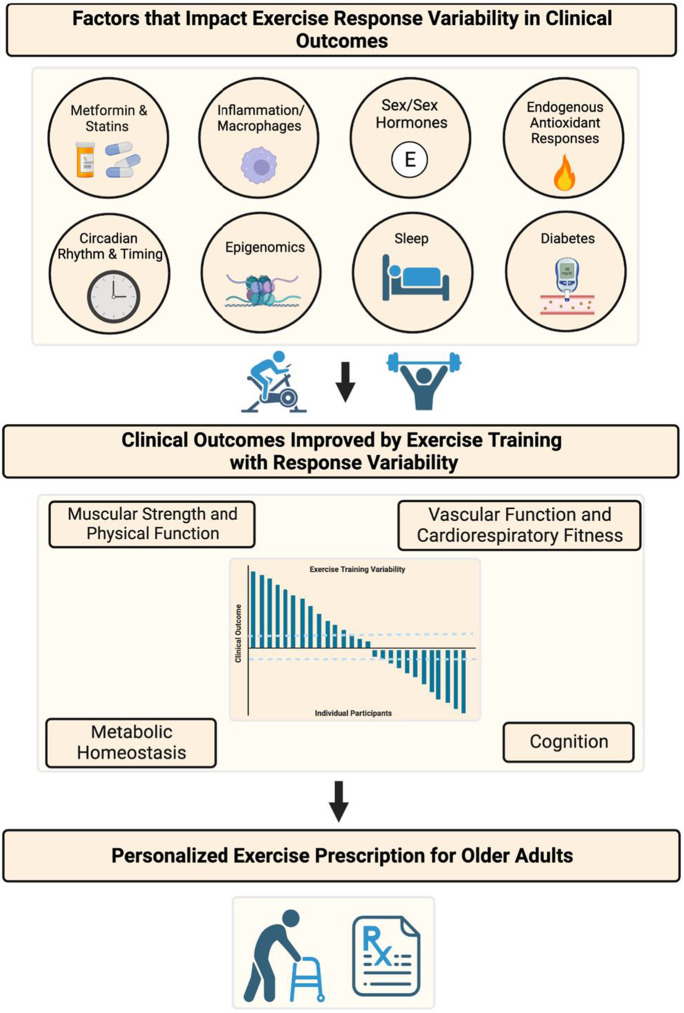
Exercise is a cornerstone of preventive medicine and a promising strategy to intervene on the biology of aging. Variation in the response to exercise is a widely accepted concept that dates back to the 1980s with classic genetic studies identifying sequence variations as modifiers of the VO 2 max response to training. Since that time, the literature of exercise response variance has been populated with retrospective analyses of existing datasets that are limited by a lack of statistical power from technical error of the measurements and small sample sizes, as well as diffuse outcomes, very few of which have included older adults. Prospective studies that are appropriately designed to interrogate exercise response variation in key outcomes identified a priori and inclusive of individuals over the age of 70 are long overdue. Understanding the underlying intrinsic (e.g., genetics and epigenetics) and extrinsic (e.g., medication use, diet, chronic disease) factors that determine robust versus poor responses to various exercise factors will be used to improve exercise prescription to target the pillars of aging and optimize the clinical efficacy of exercise training in older adults. This review summarizes the proceedings of the NIA-sponsored workshop entitled, “Understanding Heterogeneity of Responses to, and Optimizing Clinical Efficacy of, Exercise Training in Older Adults” and highlights the importance and current state of exercise response variation research, particularly in older adults, prevailing challenges, and future directions.
Overview
The claims and statistics of this paper haven’t been checked yet.
Free: it reads the open-access text and checks the first 5 claims that cite a source we can check. Create a free account to check every claim.
Integrity signals
Registry
Cites
Statistics
Figures
Verification
Claims the paper makes
The claims and statistics of this paper haven’t been checked yet.
Free: it reads the open-access text and checks the first 5 claims that cite a source we can check. Create a free account to check every claim.
Claims other papers make about this one
Each is checked against this paper’s own text: does it say what the citing paper says it does?
The source backs part of the claim, not all of it — or backs it for a different population, condition or comparison.
In the citing paper
“Physiological adaptations to chronic exercise have been shown to enhance several age-related health outcomes, demonstrating a positive impact of exercise on the fundamental biology of aging [598,599].”
From Global consensus on optimal exercise recommendations for enhancing healthy longevity in older adults (ICFSR) (2025) · cites this paper as [598]
Experimental — accuracy not yet measuredIn the citing paper
“Physiological adaptations to chronic exercise have been shown to enhance several age-related health outcomes, demonstrating a positive impact of exercise on the fundamental biology of aging [598,599].”
From Global consensus on optimal exercise recommendations for enhancing healthy longevity in older adults (ICFSR) (2025) · cites this paper as [598]
Self-check
Percentages, sums and reported differences re-computed from the paper’s own numbers.
The self-check needs the paper’s full text.
Citations
Cites
Heart disease and stroke statistics-2018 update: a report from the american heart association
Benjamin, E. J., Virani, S. S., Callaway, C. W., Chamberlain, A. M., Chang, A. R., Cheng, S., Chiuve, S. E., Cushman, M., Delling, F. N., Deo, R., et al. (2018) · Circulation · doi:10.1161/cir.0000000000000558 · Cited by 7,146 · cited 7×
“Advancing age is the greatest risk factor for CVD [49].”
BackgroundInfluentialGeroscience: Linking Aging to Chronic Disease
Kennedy, B. K., Berger, S. L., Brunet, A., Campisi, J., Cuervo, A. M., Epel, E. S., Franceschi, C., Lithgow, G. J., Morimoto, R. I., Pessin, J. E., et al. (2014) · Cell · doi:10.1016/j.cell.2014.10.039 · Cited by 2,764
2020 Alzheimer's disease facts and figures
(2020) · Alzheimer's & Dementia · doi:10.1002/alz.12068 · Cited by 2,353
OWEN, M. R., DORAN, E., & HALESTRAP, A. P. (2000) · Biochemical Journal · doi:10.1042/bj3480607 · Cited by 2,157
Sutton, E. F., Beyl, R., Early, K. S., Cefalu, W. T., Ravussin, E., & Peterson, C. M. (2018) · Cell Metabolism · doi:10.1016/j.cmet.2018.04.010 · Cited by 1,531 · cited 1×
“Front-loading calories to earlier in the day has been shown to improve weight loss and indices of cardiometabolic health, including insulin sensitivity [81, 82].”
BackgroundSelf-citationPahor, M., Guralnik, J. M., Ambrosius, W. T., Blair, S., Bonds, D. E., Church, T. S., Espeland, M. A., Fielding, R. A., Gill, T. M., Groessl, E. J., et al. (2014) · JAMA · doi:10.1001/jama.2014.5616 · Cited by 1,427
El-Mir, M.-Y., Nogueira, V., Fontaine, E., Avéret, N., Rigoulet, M., & Leverve, X. (2000) · Journal of Biological Chemistry · doi:10.1074/jbc.275.1.223 · Cited by 1,399
Ageing, fitness and neurocognitive function
Kramer, A. F., Hahn, S., Cohen, N. J., Banich, M. T., McAuley, E., Harrison, C. R., Chason, J., Vakil, E., Bardell, L., Boileau, R. A., et al. (1999) · Nature · doi:10.1038/22682 · Cited by 1,394
KANALEY, J. A., COLBERG, S. R., CORCORAN, M. H., MALIN, S. K., RODRIGUEZ, N. R., CRESPO, C. J., KIRWAN, J. P., & ZIERATH, J. R. (2022) · Medicine & Science in Sports & Exercise · doi:10.1249/mss.0000000000002800 · Cited by 931 · cited 1×
“Exercise is a well-accepted strategy to improve glycemic control in people with T2D [64].”
BackgroundSelf-citationExercise alters gut microbiota composition and function in lean and obese humans
ALLEN, J. M., MAILING, L. J., NIEMIRO, G. M., MOORE, R., COOK, M. D., WHITE, B. A., HOLSCHER, H. D., & WOODS, J. A. (2018) · Medicine & Science in Sports & Exercise · doi:10.1249/mss.0000000000001495 · Cited by 820 · cited 1×
“Meanwhile, other studies have shown that obese individuals exhibit blunted shifts in fecal SCFA compared to their lean counterparts in response to a 6-week aerobic exercise training intervention [96].”
Self-citation
Cited by
Izquierdo, M., de Souto Barreto, P., Arai, H., Bischoff-Ferrari, H. A., Cadore, E. L., Cesari, M., Chen, L.-K., Coen, P. M., Courneya, K. S., Duque, G., et al. (2025) · The Journal of nutrition, health and aging · doi:10.1016/j.jnha.2024.100401 · Cited by 273
Noone, J., Mucinski, J. M., DeLany, J. P., Sparks, L. M., & Goodpaster, B. H. (2024) · Cell Metabolism · doi:10.1016/j.cmet.2023.12.025 · Cited by 128
Self-citationEffects of regular exercise on vascular function with aging: Does sex matter?
Moreau, K. L., Clayton, Z. S., DuBose, L. E., Rosenberry, R., & Seals, D. R. (2023) · American Journal of Physiology-Heart and Circulatory Physiology · doi:10.1152/ajpheart.00392.2023 · Cited by 61
Self-citationCao, X., & Thyfault, J. P. (2023) · Experimental Gerontology · doi:10.1016/j.exger.2023.112178 · Cited by 25
Self-citationHydrogen sulfide ameliorates endothelial dysfunction in aging arteries by regulating ferroptosis
Miao, Y., Zhang, S., Liang, Z., Wang, Y., Tian, D., Jin, S., Guo, Q., Xue, H., Teng, X., Xiao, L., et al. (2023) · Nitric Oxide · doi:10.1016/j.niox.2023.10.002 · Cited by 17
McAdam, J. S., Craig, M. P., Graham, Z., Peoples, B., Tuggle, S. C., Seay, R. S., Lavin, K. M., Gargus, A. B., O’Bryan, S. M., Yang, S., et al. (2025) · Physiological Genomics · doi:10.1152/physiolgenomics.00068.2025 · Cited by 16
“There has been a growing focus on understanding the significant variation in the individual response to exercise, with the goal of developing personalized exercise prescriptions to maximize health benefits and optimize individualized rehabilitation (50, 51).”
Underpowered studies in muscle metabolism research: Determinants and considerations
Houtvast, D. C. J., Betz, M. W., Hooren, B. V., Vanbelle, S., Verdijk, L. B., van Loon, L. J. C., & Trommelen, J. (2024) · Clinical Nutrition ESPEN · doi:10.1016/j.clnesp.2024.10.152 · Cited by 14
Motl, R. W., & Pilutti, L. A. (2024) · Neurology and Therapy · doi:10.1007/s40120-024-00656-z · Cited by 14
Song, J., Dong, H., Wang, C., Zheng, Y., Huang, Y., Wei, Y., Zhang, K., Qing, H., Xiong, Z., Pan, Y., et al. (2026) · BMC Medicine · doi:10.1186/s12916-026-04682-6 · Cited by 12
Nylén, E. (2024) · Reviews in Cardiovascular Medicine · doi:10.31083/j.rcm2507263 · Cited by 7
“Exercise is thus a very promising approach to inter-vene in the aging process as CRF is causal and partly mediated by the effect of fitness on insulin resistance [12,15,16].”
BackgroundRandomized controlled trial of resistance exercise and brain aging clocks
González-Gómez, R., Demnitz, N., Coronel, C., Gates, A. T., Kjær, M., Siebner, H. R., Boraxbekk, C., & Ibáñez, A. M. (2026) · GeroScience · doi:10.1007/s11357-026-02141-x · Cited by 11
Characteristics of the differential response to exercise in adults with restless legs syndrome
Cederberg, K. L. J., Mejia, G. R., Sikes, E. M., & Mignot, E. J.-M. (2024) · Sleep Medicine · doi:10.1016/j.sleep.2024.11.037 · Cited by 6
McAdam, J. S., Craig, M. P., Graham, Z., Peoples, B., Tuggle, S. C., Seay, R. S., Lavin, K. M., Gargus, A. B., O’Bryan, S. M., Yang, S., et al. (2025) · medRxiv · doi:10.1101/2025.01.20.25320845 · Cited by 5
Mitochondrial haplotype and sex modulate responses to endurance exercise training
Ahn, B., Wei, T., Pettit‐Mee, R. J., Kim, E., Musci, R. V., Wanagat, J., Nguyen, H. V. M., Richardson, A. G., & Kim, H. (2025) · The Journal of Physiology · doi:10.1113/jp288330 · Cited by 4
Graham, Z., Bubak, M. P., Raymond‐Pope, C. J., Cutter, G., McAdam, J. S., Tuggle, S. C., Siedlik, J. A., de Sousa, L. G. O., Chappe, E., Meece, K., et al. (2025) · Journal of Applied Physiology · doi:10.1152/japplphysiol.00486.2025 · Cited by 4
“A workshop organized by the National Institute on Aging (NIA) led to a white paper 25 summarizing the potential underlying and intersecting multi-domain mechanisms that affect IRH.”
Self-citationRecommendations for Advancing the Resistance Exercise Overtraining Research
Bell, L., Ruddock, A. D., Maden‐Wilkinson, T., & Rogerson, D. (2022) · Applied Sciences · doi:10.3390/app122412509 · Cited by 7
LEAP! Rx: A randomized trial of a pragmatic approach to lifestyle medicine
Watts, A. S., Szabo‐Reed, A. N., Baker, J., Morris, J. K., Vacek, J. L., Clutton, J. E., Mahnken, J. D., Key, M. N., Vidoni, E. D., & Burns, J. M. (2024) · Alzheimer s & Dementia · doi:10.1002/alz.14265 · Cited by 5
“55,56 Personalized exercise regimens may be a key strategy for mitigating cognitive decline and enhancing overall health in older populations.”
Ghram, A., Diaz, J. L., Raghavan, P., Hautala, A. J., Kaddoura, R., Laukkanen, J. A., Kunutsor, S. K., Elrayess, M. A., Knechtle, B., Weiss, K., et al. (2026) · Sports Medicine · doi:10.1007/s40279-026-02453-0 · Cited by 4
Prefrontal Cortex Oxygenation During Exercise in Older Adults with Motoric Cognitive Risk Syndrome
da Costa, K. G., Fontes, E. B., Menta, A., Kramer, A. F., Fielding, R. A., Verghese, J., Kowaleski, C., Ward, N., & Reid, K. F. (2024) · Advanced Biology · doi:10.1002/adbi.202400231 · Cited by 5
Randomized Controlled Trials of Rehabilitation in Multiple Sclerosis: Barriers and Unmet Needs
Motl, R. W. (2024) · Multiple Sclerosis Journal · doi:10.1177/13524585241292950 · Cited by 3
“13 The heterogeneity of changes with an intervention may be explainable by other factors, and this may support the consideration of precision medicine in MS.”
Prognostic Factors of Physical Function Decline Among Middle-Aged Adults With HIV
Kulik, G. L., Umbleja, T., Brown, T., Ribaudo, H. J., Grinspoon, S. K., Schrack, J. A., Zanni, M. V., Diggs, M. R., Aberg, J. A., Fichtenbaum, C. J., et al. (2025) · Open Forum Infectious Diseases · doi:10.1093/ofid/ofaf311 · Cited by 4
“Similarly, earlier detection can guide preventative strategies to maximize function [5].”
Motl, R. W. (2025) · Kinesiology Review · doi:10.1123/kr.2024-0076 · Cited by 3
Association of Timing of Physical Activity with Physical Frailty Incidence in Older Adults
Morikawa, M., Harada, K., Kurita, S., Nishijima, C., Fujii, K., Kakita, D., Yamashiro, Y., Takayanagi, N., Sudo, M., & Shimada, H. (2025) · Gerontology · doi:10.1159/000543283 · Cited by 3
Liu, R., Qin, J., Zhang, X., Wang, F., & Xue, W. (2025) · Frontiers in Physiology · doi:10.3389/fphys.2025.1427629 · Cited by 3
Duan, Y., Li, S., Su, Q., Xu, S., & Lu, G. (2024) · Medicine · doi:10.1097/md.0000000000038167 · Cited by 2
“[35,36] 48] In order to further objectively analyzed the effect of exercise intervention, the e.g. was higher than the CG in the improvement of aerobic work capacity, muscle strength, muscle endurance and flexibility in terms of physical indexes.”
BackgroundKing, A. C., Villalobos, C., Vosti, P. D., & Jensen, C. D. (2024) · Healthcare · doi:10.3390/healthcare12151528 · Cited by 4
Kulik, G. L., Wilson, M. P., Jankowski, C. M., Fourman, L. T., & Erlandson, K. M. (2025) · Journal of Aging Research · doi:10.1155/jare/6952002 · Cited by 2
Zumbro, E. L., Baptista, L. C. P., Taylor, T. L., Hernandez, A., Banerjee, A., Sun, Y., Yang, Y., Li, Q., & Buford, T. W. (2026) · Experimental Physiology · doi:10.1113/ep092318 · Cited by 1
Self-citationKang, N., Zhang, C., Mei, D., Huang, Q., & Wang, D. (2026) · Frontiers in Public Health · doi:10.3389/fpubh.2026.1877023 · Cited by 1
“However, as a practical intervention goal, it can obscure heterogeneity in later life (9).”
Rodríguez, M. Á., Crespo, I., Guerra, B., del Valle, M., & Olmedillas, H. (2024) · Current Sports Medicine Reports · doi:10.1249/jsr.0000000000001129 · Cited by 1
“…care physicians have started to prescribe exercise only recently, but there is still a long way ahead to establish and strengthen multidisciplinary teamwork with exercise professionals (personal trainers, exercise instructors, and exercise physiologists) to optimize its clinical efficacy (17).”
BackgroundHazen, E. M., Bartsch, B. L., & Billinger, S. A. (2024) · Frontiers in Stroke · doi:10.3389/fstro.2024.1425385 · Cited by 1
“Recognizing exercise as “one of the most promising interventions to delay physiological decline and extend the health span,” it is important to fully understand the associated costs of conducting exercise-based clinical trials (Erickson et al., 2023).”
Motl, R. W., Sandroff, B. M., Hernandez, R. S., Amato, M. P., Brichetto, G., Chataway, J., Chiaravalloti, N. D., Cutter, G., Dalgas, U., DeLuca, J., et al. (2024) · Multiple Sclerosis Journal - Experimental Translational and Clinical · doi:10.1177/20552173241301030 · Cited by 2
Hazen, E. M., Bartsch, B. L., & Billinger, S. A. (2023) · medRxiv · doi:10.1101/2023.12.20.23300342 · Cited by 1
Youngstedt, S. D., Passos, G. S., Falck, R. S., & Santana, M. G. (2025) · SLEEP · doi:10.1093/sleep/zsaf016 · Cited by 1
Self-citationGraham, Z., Bubak, M. P., Raymond‐Pope, C. J., Cutter, G., McAdam, J. S., Tuggle, S. C., Siedlik, J. A., de Sousa, L. G. O., Chappe, E., Meece, K., et al. (2025) · medRxiv · doi:10.1101/2025.05.27.25328425
“A workshop organized by the National Institute on Aging (NIA) led to a white paper 25 summarizing the potential underlying and intersecting multi-domain mechanisms that affect IRH.”
Self-citationStatistical Methods in Aging Research: Improving Current Practices and Embracing Emerging Approaches
Thapa, D. K., Parker, E. S., Kandukuri, M., Wang, X. (., Mokalla, T. R., Robertson, O. C., Najam, W., Teschendorff, A. E., Brown, A. W., Speakman, J. R., et al. (2025) · Annual Review of Statistics and Its Application · doi:10.1146/annurev-statistics-042324-060005
Gavras, A., Memili, A., Lynch, D. H., Spangler, H., Cook, S. B., MacKenzie, T. A., Gross, D. C., & Batsis, J. A. (2026) · Current Developments in Nutrition · doi:10.1016/j.cdnut.2026.107649 · Cited by 1
“This variability in exercise response is hypothesized to be a consequence of heterogeneity of aging [24].”
Almuraikhy, S., Sellami, M., Haddad, M., Anwardeen, N. R., Al-Mohannadi, M., & Elrayess, M. A. (2026) · Biomedicines · doi:10.3390/biomedicines14030575 · Cited by 1
Ryan, A. S., Marconi, V. C., Briggs, B. C., Lozano, A. J., Oursler, K. K., FITVET Project Team, Alvarez, A., Brent, C., Clark-Stuart, T., Coulter, M. M., et al. (2026) · Open Forum Infectious Diseases · doi:10.1093/ofid/ofag145 · Cited by 1
Master, H., Petersen, M. A., Bynum, L. G., Donnelly, R. J., & Batsis, J. A. (2026) · Current Geriatrics Reports · doi:10.1007/s13670-026-00462-5
Tang, Y., Shi, J., Meng, Z., & Zhang, Y. (2026) · Healthcare · doi:10.3390/healthcare14142187
Dominteanu, T., Stan, A. E., & Voinea, A. (2026) · International Journal of Molecular Sciences · doi:10.3390/ijms27198811
“Baseline biology : Initial fitness level, sex hormone milieu, and age jointly shift the amplitude and kinetics of the adaptive response [69–71].”
Physical activity and exercise in dementia: clinical relevance and emerging insights
Pramodkumar, T. A., & Mohan, V. (2026) · Frontiers in Dementia · doi:10.3389/frdem.2026.1843904
“One of the recurring challenges in interpreting the literature on exercise and dementia is the considerable heterogeneity across studies (Erickson et al., 2023).”
Ji, Y., Liang, M., & He, W. (2026) · Journal of Diabetes & Metabolic Disorders · doi:10.1007/s40200-026-02025-z
“Second, although exercise treatments have been shown to enhance neuromuscular activation and proprioception [16], its therapeutic efficacy is not determined by a single factor but depends on a mixture of multiple aspects [69].”
Gao, J., Xu, Y., Jiang, W., Wang, Z., Wang, L., & Zhang, H. (2026) · International Journal of Biological Macromolecules · doi:10.1016/j.ijbiomac.2026.153885 · Cited by 1
Trujillo-Rivera, J. F., Gutiérrez‐Valencia, M., Galbete, A., Chenhuichen, C., Zambom-Ferraresi, F., & Martínez‐Velilla, N. (2026) · European Geriatric Medicine · doi:10.1007/s41999-026-01615-7
Exploring Health Biomarker Patterns Using Clustering and Post-Clustering Analysis of Smoking Status
Ghifari, N. T. A., Dhafa, M., & Arifah, L. (2026) · Conference on Bioinformatics, Biomedical Engineering, and Biotechnology Exploring New Frontiers in Healthcare (BIOXPLORE) · doi:10.1109/bioxplore68070.2026.11709956
“These biomarkers are commonly used as early indicators of organ function disorders and the risk of chronic diseases [8].”
Influential
Metadata
- Authors
- Erickson, M. L., Allen, J. M., Beavers, D. P., Collins, L. M., Davidson, K. W., Erickson, K. I., Esser, K. A., Hesselink, M. K. C., Moreau, K. L., Laber, E. B., Peterson, C. A., Peterson, C. M., Reusch, J. E., Thyfault, J. P., Youngstedt, S. D., Zierath, J. R., Goodpaster, B. H., LeBrasseur, N. K., Buford, T. W., & Sparks, L. M.
- Affiliations
- AdventHealth (US)
- University of Illinois Urbana-Champaign (US)
- Wake Forest University (US)
- New York University (US)
- Northwell Health (US)
- University of Florida (US)
- Maastricht University (NL)
- University of Colorado Anschutz (US)
- Duke University (US)
- University of Kentucky (US)
- University of Kansas Medical Center (US)
- Arizona State University (US)
- Karolinska Institutet (SE)
- Mayo Clinic (US)
- University of Alabama at Birmingham (US)
- Corresponding author
- Buford, Thomas W.
- Sparks, Lauren M.
- ORCID
- Erickson, Melissa L.
- Allen, Jacob M.
- Beavers, Daniel P.
- Collins, Linda M.
- Davidson, Karina W.
- Erickson, Kirk I.
- Esser, Karyn A.
- Hesselink, Matthijs K. C.
- Moreau, Kerrie L.
- Laber, Eric B.
- Peterson, Charlotte A.
- Peterson, Courtney M.
- Reusch, Jane E.
- Thyfault, John P.
- Zierath, Juleen R.
- Goodpaster, Bret H.
- LeBrasseur, Nathan K.
- Buford, Thomas W.
- Sparks, Lauren M.
- Venue
- GeroScience
- Published
- 2022-10-15
- Volume
- 45
- Issue
- 1
- Pages
- 569-589
- ISSN
- 2152-4041 (ISSN-L)
- 2509-2715
- 2509-2723
- PMC
- PMC9886780
- OpenAlex
- W4306292525
- Cited by
- 47
- References
- 133
- Citations by year
- 2026: 16 · 2025: 12 · 2024: 14 · 2023: 4 · 2022: 1
- FWCI
- 8.10
- Type
- journal article
- Language
- en
- Open access
- hybrid
- doi.org
- Licence
- cc-by
- creativecommons.org/licenses/by/4.0 (tdm)
- creativecommons.org/licenses/by/4.0 (vor)
- Locations
- GeroScience (publishedVersion, cc-by)
- PubMed Central (publishedVersion, cc-by)
- PubMed (publishedVersion)
- Research Publications (Maastricht University) (publishedVersion, cc-by)
- Research Publications (Maastricht University) (submittedVersion, cc-by)
- Funders
- Foundation for the National Institutes of Health (NIH NIA Division of Geriatrics, Clinical Gerontology Program supported by Lyndon Joseph, Ph.D.)
- Topics
- Health Sciences › Medicine › Physiology (medical) › Cardiovascular and exercise physiology
- Health Sciences › Medicine › Public Health, Environmental and Occupational Health › Physical Activity and Health
- Life Sciences › Biochemistry, Genetics and Molecular Biology › Genetics › Genetics and Physical Performance
- Keywords
- older adults, exercise training, aging, VO2max, epigenetics, exercise prescription, chronic disease, medication use, diet, prospective study
- MeSH terms
- Aged, Exercise Therapy, Humans, Prospective Studies, Retrospective Studies, Exercise, Treatment Outcome
About these checks
Registry, retraction, Cites and statistics results are computed, not judged, with one exception: a printed reference that no index lists is read once by a model before it counts as a citation error. Claims are extracted by a model and kept only when their quote appears verbatim in the text; each cited source is then checked, with a model’s help, for whether it says what the claim relies on. Those verdicts can be wrong — read the claim’s quote and the cited source before relying on one.
Statistics and arithmetic are recomputed, not judged.
Confidence bands are shown only for fields calibrated on our annotated test set. None is calibrated yet, so no band is shown.
What counts as a claim ›How we measure confidence ›How we check this ›
Are you an author, or do you see a problem with this page? Request a review
Data sources
Bibliographic data: Semantic Scholar, OpenAlex, Crossref.
Contains information from the Semantic Scholar Academic Graph Datasets, made available under the ODC Attribution License (ODC-BY 1.0).
Semantic Scholar’s data is described in: Kinney, R., et al. (2023). The Semantic Scholar Open Data Platform. arXiv:2301.10140.
