

Environmental life cycle implications of upscaling lithium-ion battery production
Open accessThe DOI matches its Crossref record; 63 of the 63 references it cites were found in a registry or an index.
Abstract
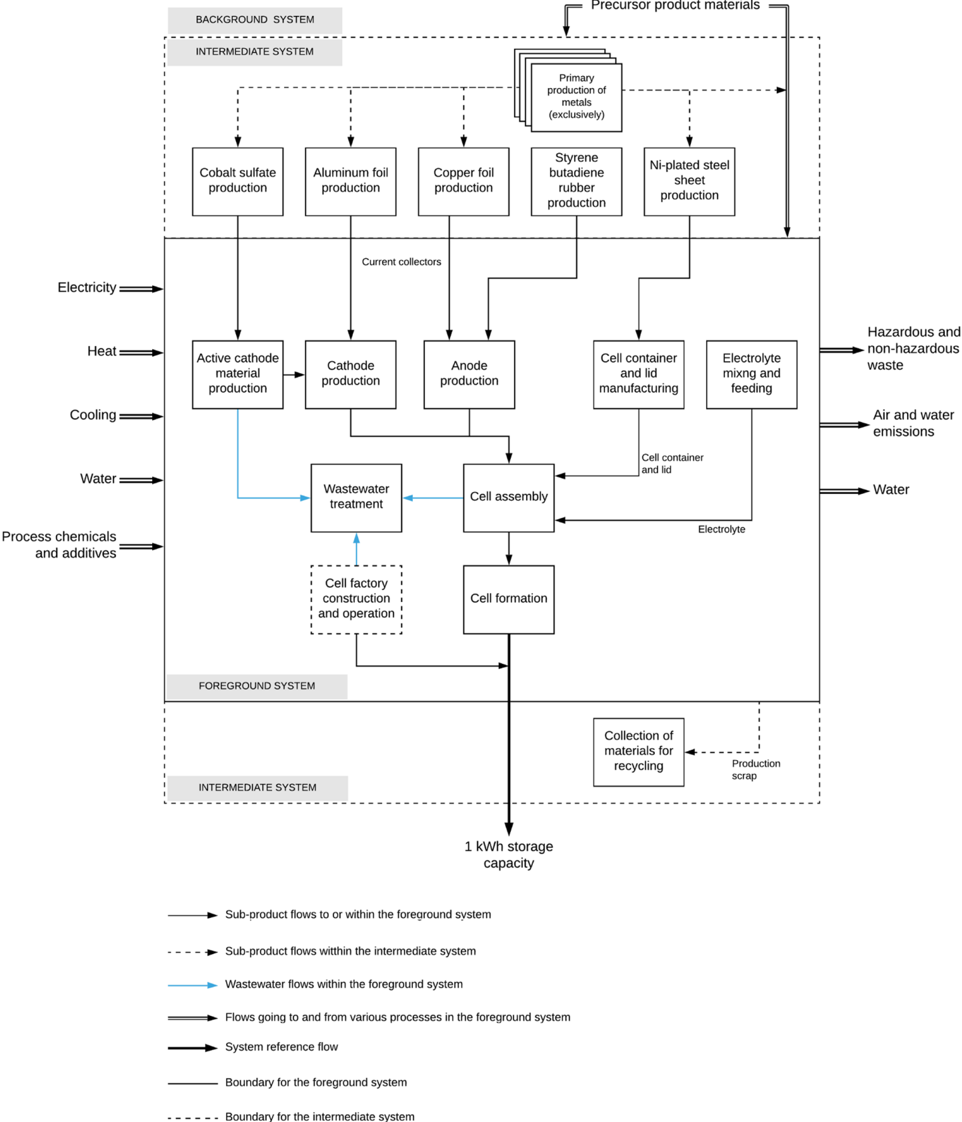
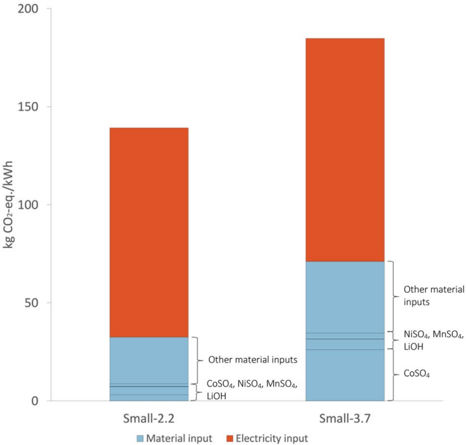
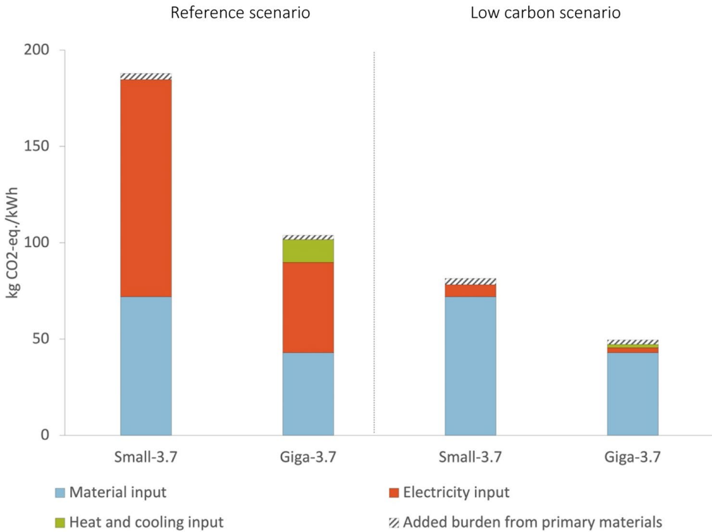
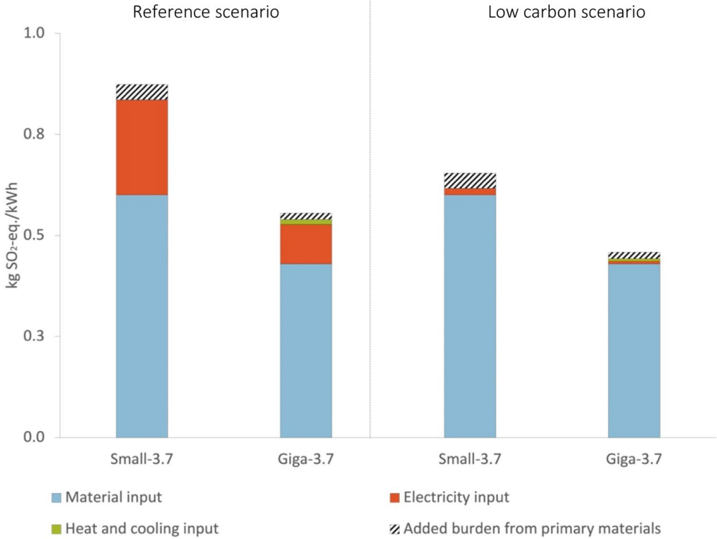
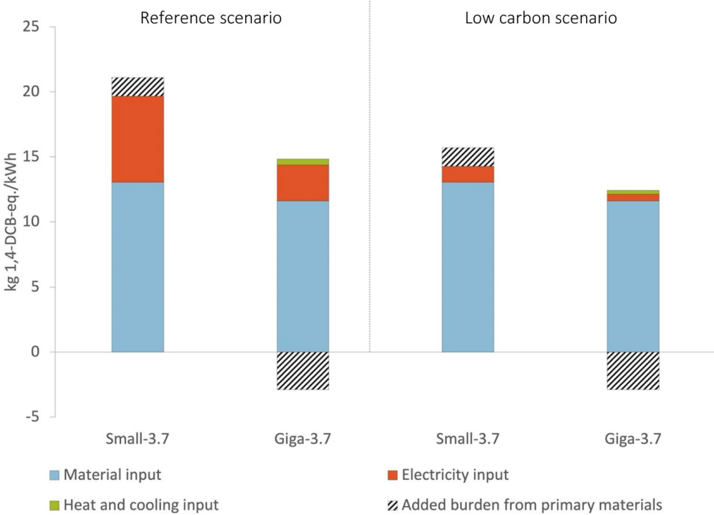
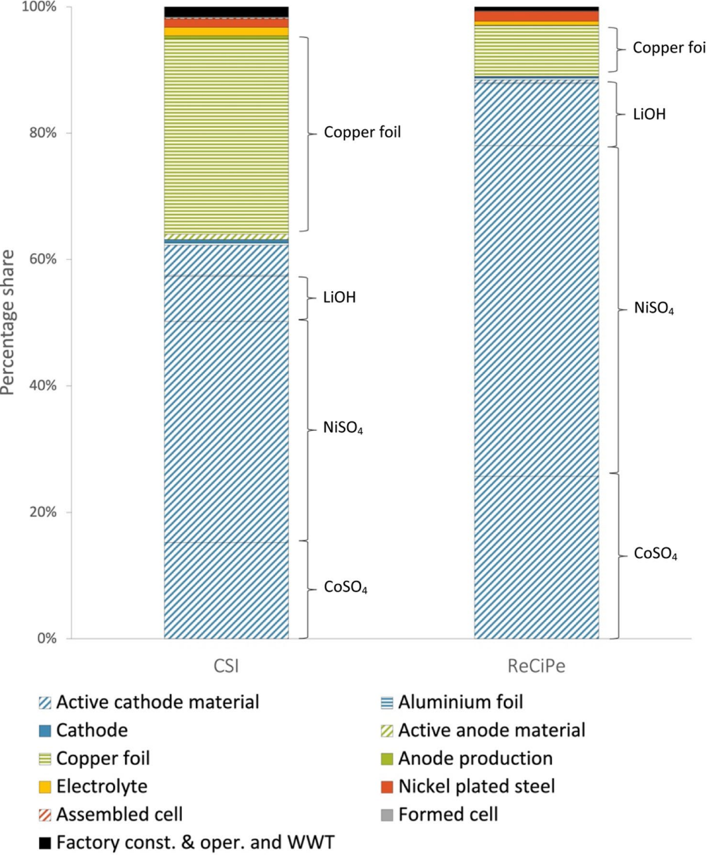
Purpose: Life cycle assessment (LCA) literature evaluating environmental burdens from lithium-ion battery (LIB) production facilities lacks an understanding of how environmental burdens have changed over time due to a transition to large-scale production. The purpose of this study is hence to examine the effect of upscaling LIB production using unique life cycle inventory data representative of large-scale production. A sub-goal of the study is to examine how changes in background datasets affect environmental impacts. Method: We remodel an often-cited study on small-scale battery production by Ellingsen et al. (2014), representative of operations in 2010, and couple it to updated Ecoinvent background data. Additionally, we use new inventory data to model LIB cell production in a large-scale facility representative of the latest technology in LIB production. The cell manufactured in the small-scale facility is an NMC-1:1:1 (nickel-manganese-cobalt) pouch cell, whereas in the large-scale facility, the cell produced in an NMC-8:1:1 cylindrical cell. We model production in varying carbon intensity scenarios using recycled and exclusively primary materials as input options. We assess environmental pollution–related impacts using ReCiPe midpoint indicators and resource use impacts using the surplus ore method (ReCiPe) and the crustal scarcity indicator. Results and discussion: Remodelling of the small-scale factory using updated background data showed a 34% increase in greenhouse gas emissions — linked to updated cobalt sulfate production data. Upscaling production reduced emissions by nearly 45% in the reference scenario (South Korean energy mix) due to a reduced energy demand in cell production. However, the emissions reduce by a further 55% if the energy is sourced from a low-carbon intensity source (Swedish energy mix), shifting almost all burden to upstream supply chain. Regional pollution impacts such as acidification and eutrophication show similar trends. Toxic emissions also reduce, but unlike other impacts, they were already occurring during mining and ore processing. Lastly, nickel, cobalt, and lithium use contribute considerably to resource impacts. From a long-term perspective, copper becomes important from a resource scarcity perspective. Conclusions: Upscaling LIB production shifts environmental burdens to upstream material extraction and production, irrespective of the carbon intensity of the energy source. Thus, a key message for the industry and policy makers is that further reductions in the climate impacts from LIB production are possible, only when the upstream LIB supply chain uses renewable energy source. An additional message to LCA practitioners is to examine the effect of changing background systems when evaluating maturing technologies.
Overview
The claims and statistics of this paper haven’t been checked yet.
Free: it reads the open-access text and checks the first 5 claims that cite a source we can check. Create a free account to check every claim.
Integrity signals
Registry
Cites
Statistics
Figures

Verification
Claims the paper makes
The claims and statistics of this paper haven’t been checked yet.
Free: it reads the open-access text and checks the first 5 claims that cite a source we can check. Create a free account to check every claim.
Claims other papers make about this one
Each is checked against this paper’s own text: does it say what the citing paper says it does?
The source backs part of the claim, not all of it — or backs it for a different population, condition or comparison.
In the citing paper
“Continued upscaling could lead to a 45-55% reduction in battery production emissions, with a significant impact on EV lifecycle emissions [68].”
From A National and Regional Greenhouse Gas Breakeven Assessment of EVs across North America (2023) · cites this paper as [68]
Experimental — accuracy not yet measuredIn the citing paper
“previously published evidence that has identified battery material production and large-scale LIB manufacturing as GHG emission hotspots in the battery life cycle (Chordia et al., 2021;Kallitsis, 2023;Peiseler et al., 2022).”
From Think global act local: The dependency of global lithium-ion battery emissions on production location and material sources (2024) · cites this paper as Chordia et al., 2021
In the citing paper
“The production CF of a LIB is primarily made up of energy contributions, traced to cathode active material production and cell manufacturing, and material contributions associated with upstream mining/refining of key battery materials (Chordia et al., 2021;Dai et al., 2019;Kallitsis et al., 2020).”
From Think global act local: The dependency of global lithium-ion battery emissions on production location and material sources (2024) · cites this paper as Chordia et al., 2021
In the citing paper
“Chordia et al. (2021) reported a cradle-to-gate CF of 104 kg CO 2 -eq kWh -1 for an NMC811 battery produced in South Korea, which falls towards the upper whisker values reported in Fig. 5.”
From Think global act local: The dependency of global lithium-ion battery emissions on production location and material sources (2024) · cites this paper as Chordia et al., 2021
Self-check
Percentages, sums and reported differences re-computed from the paper’s own numbers.
The self-check needs the paper’s full text.
Citations
Cites
The ecoinvent database version 3 (part I): overview and methodology
Wernet, G., Bauer, C., Steubing, B., Reinhard, J., Moreno-Ruiz, E., & Weidema, B. (2016) · The International Journal of Life Cycle Assessment · doi:10.1007/s11367-016-1087-8 · Cited by 5,564
ReCiPe2016: a harmonised life cycle impact assessment method at midpoint and endpoint level
Huijbregts, M. A. J., Steinmann, Z. J. N., Elshout, P. M. F., Stam, G., Verones, F., Vieira, M., Zijp, M., Hollander, A., & van Zelm, R. (2017) · The International Journal of Life Cycle Assessment · doi:10.1007/s11367-016-1246-y · Cited by 4,485
The development and future of lithium ion batteries
Blomgren, G. E. (2017) · Journal of The Electrochemical Society · doi:10.1149/2.0251701jes · Cited by 1,940 · cited 4×
“Using renewable energy to charge the batteries can lower the environmental impacts from EVs in their use phase (Holland et al.”
BackgroundInfluentialAn Outlook on Lithium Ion Battery Technology
Manthiram, A. (2017) · ACS Central Science · doi:10.1021/acscentsci.7b00288 · Cited by 1,771 · cited 1×
“This is due to advantages high nickel content chemistries offer in terms of energy capacity, energy density, power capability, and cost (Manthiram 2017).”
BackgroundHigh-nickel layered oxide cathodes for lithium-based automotive batteries
Li, W., Erickson, E. M., & Manthiram, A. (2020) · Nature Energy · doi:10.1038/s41560-019-0513-0 · Cited by 1,754
Olivetti, E. A., Ceder, G., Gaustad, G. G., & Fu, X. (2017) · Joule · doi:10.1016/j.joule.2017.08.019 · Cited by 1,572
Capacity Fade Mechanisms and Side Reactions in Lithium‐Ion Batteries
Arora, P., White, R. E., & Doyle, M. (1998) · Journal of The Electrochemical Society · doi:10.1149/1.1838857 · Cited by 1,408
Automotive Li-Ion Batteries: Current Status and Future Perspectives
Ding, Y., Cano, Z. P., Yu, A., Lu, J., & Chen, Z. (2019) · Electrochemical Energy Reviews · doi:10.1007/s41918-018-0022-z · Cited by 1,370
The environmental impact of Li-Ion batteries and the role of key parameters – A review
Peters, J. F., Baumann, M., Zimmermann, B., Braun, J., & Weil, M. (2017) · Renewable and Sustainable Energy Reviews · doi:10.1016/j.rser.2016.08.039 · Cited by 856
Prospects for reducing the processing cost of lithium ion batteries
Wood, D. L., Li, J., & Daniel, C. (2015) · Journal of Power Sources · doi:10.1016/j.jpowsour.2014.11.019 · Cited by 827
Research works printed but not linked: 3
- European Copper Institute (2012) The environmental profile of copper products. European Copper Institute, Brussels
- Lutsey N, Grant M, Wappelhorst S, Zhou H (2018) Power play: how governments are spurring the electric vehicle industry. Interna- tional Council for Clean Transportation, Washington
- Northvolt (2017) Northvolt Ett -Anläggning för storskalig produk- tion av litiumjonbatterier. Bergsbyns industriområde, Skellefteå: Northvolt AB Northvolt (2018) Teknisk beskrivning Northvolt Ett -Utökad anläg- gning för storskalig produktion av litiumjonbatterier. Bergsbyns industriområde, Skellefteå: Northvolt AB Northvolt (2019) Teknisk beskrivning Northvolt Ett -Utbyggnad av anläggning för storskalig tillverkning av batterier och ny anläggn- ing för återvinning av litiumjonbatterier, samt uttag av vatten från Skellefteälv. Bergsbyns industriområde, Skellefteå Northvolt (2020) Energieffektivisering enligt utredningsvillkor U4. Northvolt AB Olivetti EA, Ceder G, Gaustad GG, Fu X (2017) Lithium-ion battery supply chain considerations: Analysis of potential bottlenecks in critical metals. Joule 1(2):229-243
Cited by
Items 101–200 of 207
Toward robust electronic coupling predictions in redox-active TEMPO/TEMPO+ systems
Mitra, S., Zens, C., Kupfer, S., & Diddens, D. (2024) · The Journal of Chemical Physics · doi:10.1063/5.0221802 · Cited by 7
Asadollahfardi, G., Alipour, M., Panahandeh, A., & Ardestani, M. H. K. (2024) · Process Integration and Optimization for Sustainability · doi:10.1007/s41660-024-00411-9 · Cited by 6
“Valuable progress has recently been made in generating primary data (Chordia et al. 2021).”
Huber, D., van den Oever, A. E. M., Philippot, M. L., Costa, D., Coosemans, T., & Messagie, M. (2024) · Journal of Industrial Ecology · doi:10.1111/jiec.13566 · Cited by 6
“Containing 12 modules with cells manufactured in South Korea, the battery weights 284 kg. Life cycle inventories for the battery components originate from (Chordia et al., 2021), whereas the first usage is modeled using the cell datasheet (Lima, 2021).”
A Review of Computational Methods and Tools for Life Cycle Assessment of Traction Battery Systems
Innocenti, E., Guadagno, M., Berzi, L., Pierini, M., & Delogu, M. (2025) · Conference of the Italian Association for Stress Analysis (AIAS) · doi:10.3390/engproc2025085010 · Cited by 6
“Furthermore, Chordia et al. [15] delved into the significance of the geographical location and energy consumption of the battery manufacturing process.”
Kang, K. H., Chon, K., Lee, C.-K., Rho, H., & Kim, Y. S. (2026) · Desalination · doi:10.1016/j.desal.2026.119874 · Cited by 7
Assessing the critical role of graphite in the carbon footprint of lithium-ion battery production
Pushpendra, Vollert, E., Bresser, D., & Weil, M. (2026) · Journal of Energy Storage · doi:10.1016/j.est.2026.121887 · Cited by 6
“In contrast, cell manufacturing energy contributes less than 15% to the total, reflecting both lower energy requirements relative to earlier LCA studies [16 – 18, 21 , Earlier LCA studies [16,18,21,28,29,34] identified the cell manufacturing energy as the dominant hotspot for the LIB production.”
Energy storage supply chain modeling and optimization: A systematic review
Bamufleh, D., Wang, Y., Rammohan, A., & Yang, T. (2025) · Cleaner Energy Systems · doi:10.1016/j.cles.2025.100200 · Cited by 6
Maske, T., & Methekar, R. N. (2023) · JOM · doi:10.1007/s11837-023-05916-1 · Cited by 6
Chordia, M., Wikner, E., Nordelöf, A., Vaidya, K., & Arvidsson, R. (2025) · Journal of Industrial Ecology · doi:10.1111/jiec.70125 · Cited by 6
“Chordia et al. (2021) employed a top-down modeling approach, partitioning TABLE 1 List of nickel manganese cobalt oxide lithium-ion battery cells modeled.”
InfluentialSelf-citationIs incoherence required for sustainability?
Hamant, O. (2023) · The Anthropocene Review · doi:10.1177/20530196241249680 · Cited by 3
“…Certain parasites score an own goal when they are unable to maintain their host alive (Bayne et al., 2001) Renewable energy with lithium-based batteries serves a happy few to the detriment of more distant ecosystems and people, potentially weakening everyone in the end (Chordia et al., 2021)”
Ginster, R., Kieckhäfer, K., Thies, C., Runde, C., Wansart, J., & Spengler, T. S. (2025) · Journal of Industrial Ecology · doi:10.1111/jiec.70089 · Cited by 4
Vehicle-oriented and Sweden-framed life cycle assessment: Hydrogen for long-haul trucks
Vargas, J. E. V., Brynolf, S., Grahn, M., Rodriguez, F., & Blekhman, D. I. (2025) · iScience · doi:10.1016/j.isci.2025.113607 · Cited by 4
Life cycle assessment (LCA) of heavy vehicles used in the mining industry
(2023) · Acta Montanistica Slovaca · doi:10.46544/ams.v28i3.03 · Cited by 4
“Research on batteries used in vehicles in the context of LCA was also carried out by authors of works, e.g. (Chordia, Nordelöf, & Ellingsen, 2021; Davidson, Binks, & Gediga, 2016).”
MethodSu-Ungkavatin, P. (2022) · theses.fr (ABES) · doi:10.70675/121dffd8z81caz4a9aza9a0z63bb21d7250e · Cited by 4
Westman, K., Aitio, A., Nilsson, V., & Johansson, P. (2025) · Journal of Power Sources · doi:10.1016/j.jpowsour.2025.237538 · Cited by 3
A Comprehensive Analysis of Power Electromobility: Challenges from a PESTLE Perspective
Niño-Suarez, N. A., Flores-Herrera, L. A., Rivera-Blas, R., Calva-Yáñez, M. B., Niño-Suárez, P. A., Blas, E. Z. R., Hernández-Galindo, J. E., & Alvarez-Flores, O. A. (2025) · Energies · doi:10.3390/en18143632 · Cited by 3
Lain, M. J., Wu, Y., Smith, A., Bolloju, S., Coles, S. R., & Piper, L. F. J. (2025) · Sustainable materials and technologies · doi:10.1016/j.susmat.2025.e01609 · Cited by 3
Rejeb, A., Rejeb, K., Süle, E., Lahbib, M., & Simske, S. (2025) · Vehicles · doi:10.3390/vehicles8010001 · Cited by 3
“In addition, the rise of LCA (life cycle assessment) and LCSA (life cycle sustainability assessment) proves the increasing importance of analyzing the environmental and social impacts of EV battery production, uses, and recycling [71,82,83].”
The importance of chemical reagents for the electric vehicle battery supply chain
Istrate, I.-R., Peiseler, L., & Schenker, V. (2026) · Green Chemistry · doi:10.1039/d5gc05122c · Cited by 3
Magnusson, T., Kanda, W., Andersson, H., & Dahlgren, S. (2026) · Environmental Innovation and Societal Transitions · doi:10.1016/j.eist.2026.101124 · Cited by 3
Patil, V., Sarma, U., Verma, B., & Madabattula, G. (2026) · Journal of Energy Storage · doi:10.1016/j.est.2026.122811 · Cited by 3
Kaitouni, S. I., & Tribiche, A. (2026) · Energy · doi:10.1016/j.energy.2026.141688 · Cited by 3
A Lifetime Evaluation Method for Lithium-Sulfur Batteries
Okanishi, K., Hiraoka, K., Watanabe, M., & Seki, S. (2024) · Journal of The Electrochemical Society · doi:10.1149/1945-7111/ad92e4 · Cited by 3
Compagnoni, M., & Santini, É. (2025) · Ecological Economics · doi:10.1016/j.ecolecon.2025.108630 · Cited by 3
Life cycle sustainability assessment of batteries for electric vehicles
Philippot, M. L. (2024) · VUBIR (Vrije Universiteit Brussel) · Cited by 3
Journal of the Belarusian State University. Ecology.
(2022) · Journal of the Belarusian State University Ecology · doi:10.46646/2521-683x/2021-3 · Cited by 3
Footprint-aware Electric Vehicle Family Design
Clemente, M. (2025) · TU/e Research Portal · Cited by 3
Critical Minerals Life Cycle Assessment (LCA): Sustainable Mining Practices
Azmi, U., Murtiana, S., Sasongko, N. A., & Yanto, S. (2025) · Formosa Journal of Applied Sciences · doi:10.55927/fjas.v4i3.71 · Cited by 2
“Dalam ilmu keberlanjutan, kerentanan didefinisikan sebagai "sejauh mana sistem, subsistem, atau komponen sistem cenderung menimbulkan bahaya karena paparan bahaya, yang dapat bermanifestasi sebagai gangguan atau stres" (Binnemans et al., 2013; Chordia et al., 2021).”
Chen, A., Qiu, Y., Li, R., Zhuang, W., Li, Z., Xia, P. C., Yuan, B., Lü, G., Wang, Y., & Zhou, S. (2025) · Processes · doi:10.3390/pr13103360 · Cited by 3
“The energy consumed by lithium battery production primarily includes electricity and heat [9] along with cooling requirements and a certain amount of nitrogen used as a protective gas for the production line [10], making the energy supply system a typical IIES [11].”
Jamatia, T., Pechancová, V., Paul, D., Buchgeister, J., Baumann, M., Ersoy, H., Erakca, M., & Saha, P. (2026) · iScience · doi:10.1016/j.isci.2026.115110 · Cited by 2
“13,64,65 Consequently, company confidentiality policies limit the level of detail that could be disclosed in the published study.”
Petruzzelli, G., Pedron, F., Franchi, E., Fusini, D., & Barbafieri, M. (2026) · Environments · doi:10.3390/environments13030132 · Cited by 2
Zishan, S., Begum, S., Busaidi, A. S. A., Fazlizan, A., Khan, H., Khan, U., & Elkamchouchi, D. H. (2026) · The International Journal of Life Cycle Assessment · doi:10.1007/s11367-026-02586-4 · Cited by 2
Anode‐Free Solid‐State Batteries: From Materials Innovation to System‐Level Sustainability—A Review
Aga, W. S. (2026) · International Journal of Energy Research · doi:10.1155/er/8002610 · Cited by 2
A review on designing and managing lithium-ion batteries supply chains
Jamett, N., Herrera‐León, S., Miranda-Gonzalez, P. A., Tapia-Ubeda, F. J., Calisaya-Azpilcueta, D., Krasławski, A., & Bernal, P. (2026) · Clean Technologies and Environmental Policy · doi:10.1007/s10098-026-03527-3 · Cited by 2
“…et al. 2019, 2022; Wasesa et al. 2022; Zhou et al. 2025; Machala et al. 2025; Zhang et al. 2026) Global warming potential (Yan et al. 2020; Chordia et al. 2021; Kurz et al. 2022; Husmann et al. 2023, 2024; Zhang et al. 2025a, 2026; Zhai et al. 2025) Economic Revenue/Income/Prices (Liu et…”
Flexibility implications of optimal PV design: building vs. community scale
Li, Q., Vulic, N., Cai, H., & Heer, P. (2023) · Journal of Physics Conference Series · doi:10.1088/1742-6596/2600/8/082002 · Cited by 2
“…total greenhouse gas (GHG) emissions, considering the annual embodied emissions of rooftop and fa¸cade solar panels [15] and battery systems [16], the annual operational emissions due to the electricity imported from the grid, and annual offset emissions of exporting the excess on-site…”
BackgroundCoating strategies for enhancing cathode stability in lithium-sulfur batteries
Bhandari, R. (2025) · Critical reviews in solid state and materials sciences/CRC critical reviews in solid state and materials sciences · doi:10.1080/10408436.2025.2509647 · Cited by 2
Riondet, L. (2024) · theses.fr (ABES) · doi:10.70675/7b8302a0za795z4d5fzb778z0a8d7f74ac68 · Cited by 2
Domingo, J. L. (2024) · Journal of Environmental & Earth Sciences · doi:10.30564/jees.v6i2.6314 · Cited by 1
“Due to their high energy density and long cycle life, LIBs have been/are being widely used in communication, electronics, transportation, as well as in other fields, which play an important role in our advanced societies [75–78] .”
BackgroundPhilippot, M. L., Güney, E., Dammala, P. K., Dermenci, K. B., Yuca, N., Mierlo, J. V., Berecibar, M., & Messagie, M. (2024) · Journal of Cleaner Production · doi:10.1016/j.jclepro.2024.144645 · Cited by 1
E-retrofitting can accelerate Europe’s bus fleet electrification by 15 years
Desing, H. (2026) · Environmental Research Infrastructure and Sustainability · doi:10.1088/2634-4505/ae464b · Cited by 1
“The additional impacts come mainly from the production of the battery, yet with the rapid evolution of battery technologies [48, 49], learning in manufacturing [50, 51], and defos-silization of electricity mix used for production [52], this increase can be expected to get smaller.”
Hüllein, A. S., Ahmed, T., Jafarzadeh, S., & Utne, I. B. (2026) · Cleaner Environmental Systems · doi:10.1016/j.cesys.2026.100422 · Cited by 1
Screening for social risks of raw materials for sodium-ion batteries
Haruna, B. R., Jasper, F. B., Premathilake, D. S., Baumann, M., Peters, J. F., & Weil, M. (2026) · Discover Sustainability · doi:10.1007/s43621-026-02950-2 · Cited by 1
“[55,56] Table 3 shows the mass of material inputs required per 1 kWh of energy storage for the two batteries analysed.”
Wicke, T., Neef, C., & Tübke, J. (2026) · Journal of Power Sources Advances · doi:10.1016/j.powera.2026.100211 · Cited by 1
Schommer, A., Gutsch, M., & Leker, J. (2026) · Journal of Power Sources Advances · doi:10.1016/j.powera.2026.100213 · Cited by 1
Richter, J.-H., Gouverneur, M., Spikker, J., Herben, M., Thiede, S., & Lux, S. F. (2026) · RSC Sustainability · doi:10.1039/d6su00151c · Cited by 1
Shukla, S., Shen, K., Iyer, R. K., & Kelly, J. C. (2026) · Environmental Science Advances · doi:10.1039/d5va00190k · Cited by 1
Harmonisation of life cycle assessment practices in horizon Europe battery technology projects
Pinto, S. M., Soares, M., Lourenço, E. J., Glans, E., Zackrisson, M., Fransson, K., Mendoza, G., Ormazabal, G., Cerrillo, C., Ali, A.-R., et al. (2026) · Environmental Impact Assessment Review · doi:10.1016/j.eiar.2026.108574 · Cited by 1
Alam, Z., & Gheewala, S. H. (2026) · Resources Conservation and Recycling · doi:10.1016/j.resconrec.2026.109059 · Cited by 1
Wang, X., Hu, X., & Tao, X. (2026) · Sustainability · doi:10.3390/su18136802 · Cited by 1
Carvalho, M., Boleydei, H., Monteiro, M. I. L., Alves, R. F., Vaneeckhaute, C., & Abrahão, R. (2026) · Journal of environmental chemical engineering · doi:10.1016/j.jece.2026.124421 · Cited by 1
Batteries at Crossroads: Past, Present, and Future Environmental Impacts of Lithium-ion Batteries
Chordia, M. (2025) · Chalmers Research (Chalmers University of Technology) · Cited by 1
Self-citationThe Environmental Impact of Lithium-ion Batteries and Alternatives
Alkhatib, A. J. (2024) · International Journal of Alternative Fuels and Energy · Cited by 1
Chikova, T. S., Головатый, С. Е., & Маскевич, С. А. (2021) · Journal of the Belarusian State University Ecology · doi:10.46646/2521-683x/2021-4-4-19 · Cited by 1
On the Trade‐Off between Battery Size and Sustainability for a Fuel Cell Hybrid Electric Vehicle
Andrade, T. S., Zhou, S., Yang, J. D., Jervis, R., & Thiringer, T. (2025) · Energy Technology · doi:10.1002/ente.202402411 · Cited by 1
Environmental life cycle impacts of lithium-sulfur and sodium-ion batteries
Wickerts, S. (2024) · Chalmers Research (Chalmers University of Technology) · Cited by 1
A Review of the Risks of Copper Foil Manufacturing Plants. A New Facility in Catalonia, SpainPreprint
Domingo, J. L. (2024) · Qeios · doi:10.32388/feahy9.2 · Cited by 1
Univ. of Wisconsin, M., Kokjohn, S. L., Office of Sustainable Transportation. Vehicle Technologies Office (VTO) USDOE Office of Energy Efficiency and Renewable Energy (EERE), Mazenec, J., Rothamer, D. A., Ghandhi, J. B., Vang, N. S., Shaver, G. M., Qiu, W., Ashta, S., et al. (2024) · OSTI OAI (U.S. Department of Energy Office of Scientific and Technical Information) · doi:10.2172/2475126 · Cited by 1
Ecoconception appliquée aux systèmes batteries, une approche par intégration de modèles à l'ACV
Lavisse, T. (2024) · theses.fr (ABES) · doi:10.70675/3adc478ez7317z4627zb565zbfa9c05825ad · Cited by 1
ARTERIAL battery-cluster integration: declared scenario arithmetic and energy-boundary review
Glowalla, D. (2026) · Zenodo (CERN European Organization for Nuclear Research) · doi:10.5281/zenodo.23303622 · Cited by 1
Electron transfer in TEMPO-based organic radical batteries governed by electronic couplingPreprint
Mitra, S., Zens, C., Kupfer, S., & Diddens, D. (2023) · ChemRxiv · doi:10.26434/chemrxiv-2023-rn9bj
Calculations, organized according to chapter
Moore, A. (2024) · Oxford University Press eBooks · doi:10.1093/oso/9780197664834.005.0003
A Review of the Risks of Copper Foil Manufacturing Plants. A New Facility in Catalonia, SpainPreprint
Domingo, J. L. (2024) · Qeios · doi:10.32388/feahy9
Efficient Method for Achieving Electronic Coupling in TEMPO/TEMPO+ SystemPreprint
Mitra, S., Zens, C., Kupfer, S., & Diddens, D. (2024) · ChemRxiv · doi:10.26434/chemrxiv-2023-rn9bj-v2
Mazanec, J. (2024) · OSTI OAI (U.S. Department of Energy Office of Scientific and Technical Information)
A Systematic Literature Review of Methodologies for Assessing the Circularity of Electric Vehicles
Anari, F. P., Hargaden, V., Papakostas, N., & Ghadimi, P. (2025) · Applied Sciences · doi:10.3390/app151910622
Power play: A multi-criteria analysis of present and future battery technologies
Widayat, A. A., Offer, G. J., Edge, J. S., & Kallitsis, E. (2026) · Journal of Cleaner Production · doi:10.1016/j.jclepro.2026.149024
“Numerous studies have performed LCAs on LIBs (Chordia et al., 2021; Kallitsis et al., 2020, 2024; Peiseler et al., 2024) and on selected PLIB chemistries (Deng et al., 2017; Peters et al., 2016; Troy et al., 2016; Wickerts et al., 2023, 2024).”
Κατασκευή μπαταριών για ηλεκτροκίνητα οχήματα: ποιο το τίμημα εύρεσης των μετάλλων που απαιτούνται;
Τσαρτσάλης, Ι. Δ. (2023) · University of Thessaly Institutional Repository (University of Thessaly) · doi:10.26253/heal.uth.39854
Bautista, S. P., Baumann, M., & Weil, M. (2024) · Figshare · doi:10.6084/m9.figshare.26750909
Milieu- en economische evaluatie van innovatieve batterijtechnologieën
Abdelbaky, M. (2024) · Lirias
Söderberg, O. (2023) · DiVA (Digitala Vetenskapliga Arkivet)
Enabling collection of data – from lab to field – to forecast battery ageing
Westman, K. (2024) · Chalmers Research (Chalmers University of Technology)
Lentoliikenteen vaihtoehtoiset energialähteet
Räisänen, J. (2023) · LUTPub (LUT University)
Muhammad Rifqi (2024) · Repository at Universitas Pendidikan Indonesia (Universitas Pendidikan Indonesia)
Ahmadi, A. W., & Balkaya, N. (2025) · Quantum Journal of Engineering Science and Technology · doi:10.55197/qjoest.v6i4.229
Patent-Based Prospective Life Cycle Assessment and Eco-Design of Lithium–Sulfur Batteries
Ördek, B., & Spreafico, C. (2026) · Sustainability · doi:10.3390/su18020711
Jayadevan, A., Pulluru, M., Duggapogu, E., Madukkuri, S., Erabhoina, H., & Mandava, J. (2026) · Frontiers in Environmental Science · doi:10.3389/fenvs.2026.1630913
“5 ) lot of environmental and regulatory issues due to high consumption of water, electricity, impact natural habitation, air pollution and health and safety regulations of workers (Chordia et al., 2021).”
Flórez, L. N. P. (2024) · Universidad Industrial de Santander
Environmental impacts of NMC811 and LFP lithium‐ion batteries in I ndia's electric vehicle sector
Rathore, S., Patel, K., Kain, R., Singh, S. K., & Gupta, L. (2026) · Environmental Progress & Sustainable Energy · doi:10.1002/ep.70431 · Cited by 1
Pezzoli, S., Chiarello, G., & Trasatti, S. (2024) · Archivio Istituzionale della Ricerca (Universita Degli Studi Di Milano)
Recycled lithium carbonate as a sustainable lithium source for Li-ion batteries
Kim, D. W., Bae, J., Han, G., Lee, A. R., Hong, Y., Lee, G., Kim, J., & Kwon, E. E. (2026) · eTransportation · doi:10.1016/j.etran.2026.100597
Denis, D. K., Barret, T., Raaen, M., Vericel, L., Vanderbruggen, A., Pezzin, G., Blengini, G. A., Manzini, A., Porcher, W., & Chenevier, P. (2026) · EES batteries. · doi:10.1039/d6eb00002a
Future water constraints on United States lithium mining under climate change
Trost, J. N., Nassar, N. T., & Dunn, J. B. (2026) · Communications Earth & Environment · doi:10.1038/s43247-026-03643-4
“Producing lithium from hard-rock deposits consumes between 20 and 120 m 3 of freshwater per ton LCE 25,27 , depending on the processing route, with the majority of the water consumed during bene-fi ciation — the process in which raw ore undergoes crushing, grinding, and chemical processing to…”
Roy, S., Vaidya, K., Harvey, J., & Fradette, L. (2026) · The International Journal of Life Cycle Assessment · doi:10.1007/s11367-026-02658-5
“…is the main by-product of NMC precursor (pCAM) production — that is sulfuric acid dissolution of metal sulfates (NiSO 4 , MnSO 4 , CoSO 4 ) and preparation of metal hydroxides (NiMnCo(OH) 2 ) (Chordia et al. 2021) — and of hydromet-allurgical recycling of black mass (during LiOH precipitation).”
Wicke, T., Neef, C., & Tübke, J. (2026) · Repository KITopen (Karlsruhe Institute of Technology) · doi:10.5445/ir/1000194019
Gong, N., & Dunand, D. C. (2026) · Sustainable materials and technologies · doi:10.1016/j.susmat.2026.e02159
Cradle to gate life cycle assessment of NMC and LFP batteries for electric vehicle applications
Jeyanthi, S., & Kirupan, S. (2026) · Interactions · doi:10.1007/s10751-026-02635-2
“Chordia et al. [7 ] examined the influence of cathode chemistry on cradle-to-gate GWP using updated ecoinvent data, finding that NMC 811 — with its high nickel content — carries a substantially higher upstream burden than NMC 111 or LFP, reinforcing the need to specify NMC sub-chemistry in…”
Harun, M. H. Z. M., Azam, M. A., Zainuddin, M. I. F., & Allim, M. F. (2026) · Polymer Bulletin · doi:10.1007/s00289-026-06604-1
“Upscaling itself can reduce impacts by lowering per-unit energy demand, but the burden frequently shifts upstream to materials production, meaning “greener factories” alone have diminishing returns without cleaner supply chains [130].”
Hölting, F., Golomb, M., Junker, M. D., & Sauer, D. U. (2026) · SSRN Electronic Journal · doi:10.2139/ssrn.7176867
Drew, A., Burton, T. M., Senecal, K., Davy, M., & Leach, F. C. P. (2026) · SAE International Journal of Electrified Vehicles · doi:10.4271/14-15-03-0016
Khatami, A., Shalghooni, A. V., Shahverdian, M. H., & Sayyaadi, H. (2026) · Results in Engineering · doi:10.1016/j.rineng.2026.112278
Ravesio, E., Sumini, V., Genovese, L., Versaci, D., & Bodoardo, S. (2026) · SSRN Electronic Journal · doi:10.2139/ssrn.7353390
V. Rajashree, D. R. A., & G., A. R. H. (2026) · International Journal of Advanced Research in Science Communication and Technology · doi:10.48175/ijarsct-38146
Ferhati, L., Pastorelli, F., Laurent, A., & Marinelli, M. (2026) · SSRN Electronic Journal · doi:10.2139/ssrn.7411774
Grunditz, E. A., Wikner, E., Kanchiralla, F. M., Brynolf, S., Nordelöf, A., & Thiringer, T. (2024) · Chalmers Research (Chalmers University of Technology)
Self-citationUser-database-driven projection framework of mobile phone lithium-ion battery waste
Singh, U., Sharma, A., Rana, A., Garg, J., Jain, V. K., & Pant, D. (2026) · Journal of Environmental Engineering and Science · doi:10.1680/jenes.26.00065
Belay, N. C., & Fentaw, B. A. (2026) · Materials Today Communications · doi:10.1016/j.mtcomm.2026.116144
Mezni, N. E. H., Botta‐Genoulaz, V., Arbaoui, T., & Mangano, G. (2026) · IFIP advances in information and communication technology · doi:10.1007/978-3-032-38594-9_11
Life cycle assessment of lithium processing from hard-rock and spent battery materials
Lappalainen, H. (2026) · Aaltodoc (Aalto University)
Metadata
- Authors
- Chordia, M., Nordelöf, A., & Ellingsen, L. A.-W.
- Affiliations
- Chalmers University of Technology (SE)
- Institute of Transport Economics (NO)
- Corresponding author
- Chordia, Mudit
- Venue
- The International Journal of Life Cycle Assessment
- Published
- 2021-09-23
- Volume
- 26
- Issue
- 10
- Pages
- 2024-2039
- ISSN
- 0948-3349 (ISSN-L)
- 1614-7502
- OpenAlex
- W3204060200
- Cited by
- 169
- References
- 63
- Citations by year
- 2026: 42 · 2025: 29 · 2024: 46 · 2023: 30 · 2022: 19 · 2021: 3
- FWCI
- 7.93
- Type
- journal article
- Language
- en
- Update notices
- correction (2022-08-08)
- Open access
- hybrid
- doi.org
- Licence
- cc-by
- creativecommons.org/licenses/by/4.0 (tdm)
- creativecommons.org/licenses/by/4.0 (vor)
- Locations
- The International Journal of Life Cycle Assessment (publishedVersion, cc-by)
- KTH Publication Database DiVA (KTH Royal Institute of Technology) (submittedVersion, other-oa)
- Chalmers Research (Chalmers University of Technology) (submittedVersion)
- NORA - Norwegian Open Research Archives (submittedVersion, other-oa)
- Funders
- swedish electromobility centre
- Chalmers University of Technology
- Topics
- Physical Sciences › Environmental Science › Environmental Engineering › Environmental Impact and Sustainability
- Physical Sciences › Materials Science › Metals and Alloys › Extraction and Separation Processes
- Physical Sciences › Energy › Renewable Energy, Sustainability and the Environment › Photovoltaic Systems and Sustainability
- Keywords
- greenhouse gas emissions, energy mix, resource constraints, acidification, eutrophication, toxic emissions, recycled materials, NCM cathode, battery supply chain
About these checks
Registry, retraction, Cites and statistics results are computed, not judged, with one exception: a printed reference that no index lists is read once by a model before it counts as a citation error. Claims are extracted by a model and kept only when their quote appears verbatim in the text; each cited source is then checked, with a model’s help, for whether it says what the claim relies on. Those verdicts can be wrong — read the claim’s quote and the cited source before relying on one.
Statistics and arithmetic are recomputed, not judged.
Confidence bands are shown only for fields calibrated on our annotated test set. None is calibrated yet, so no band is shown.
What counts as a claim ›How we measure confidence ›How we check this ›
Are you an author, or do you see a problem with this page? Request a review
Data sources
Bibliographic data: Semantic Scholar, OpenAlex, Crossref.
Contains information from the Semantic Scholar Academic Graph Datasets, made available under the ODC Attribution License (ODC-BY 1.0).
Semantic Scholar’s data is described in: Kinney, R., et al. (2023). The Semantic Scholar Open Data Platform. arXiv:2301.10140.
