

Environmental life cycle implications of upscaling lithium-ion battery production
Open accessThe DOI matches its Crossref record; 63 of the 63 references it cites were found in a registry or an index.
Abstract
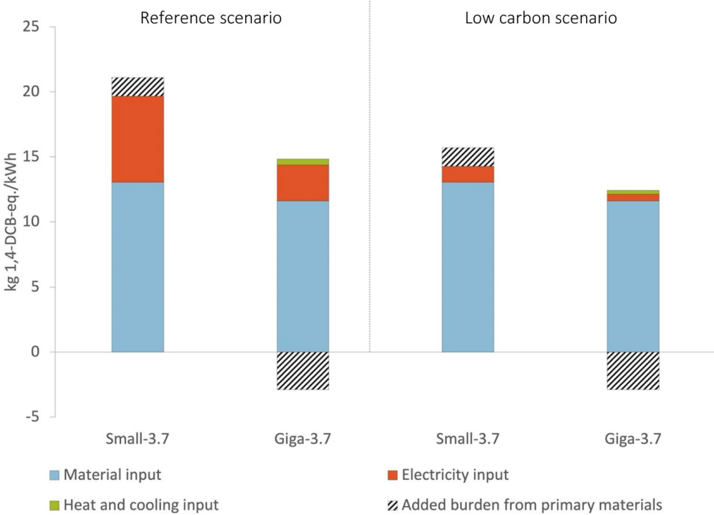
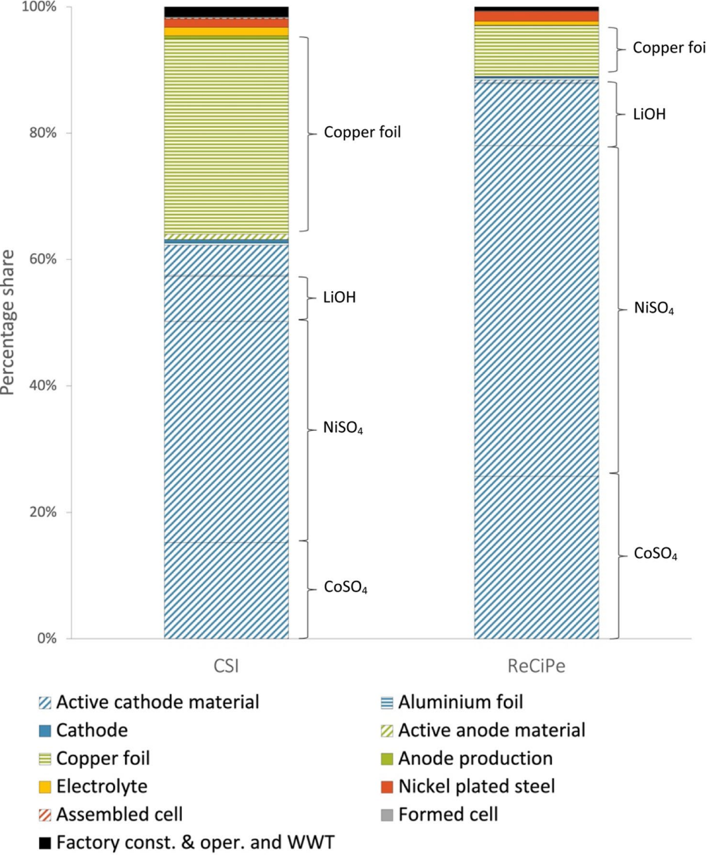
Purpose: Life cycle assessment (LCA) literature evaluating environmental burdens from lithium-ion battery (LIB) production facilities lacks an understanding of how environmental burdens have changed over time due to a transition to large-scale production. The purpose of this study is hence to examine the effect of upscaling LIB production using unique life cycle inventory data representative of large-scale production. A sub-goal of the study is to examine how changes in background datasets affect environmental impacts. Method: We remodel an often-cited study on small-scale battery production by Ellingsen et al. (2014), representative of operations in 2010, and couple it to updated Ecoinvent background data. Additionally, we use new inventory data to model LIB cell production in a large-scale facility representative of the latest technology in LIB production. The cell manufactured in the small-scale facility is an NMC-1:1:1 (nickel-manganese-cobalt) pouch cell, whereas in the large-scale facility, the cell produced in an NMC-8:1:1 cylindrical cell. We model production in varying carbon intensity scenarios using recycled and exclusively primary materials as input options. We assess environmental pollution–related impacts using ReCiPe midpoint indicators and resource use impacts using the surplus ore method (ReCiPe) and the crustal scarcity indicator. Results and discussion: Remodelling of the small-scale factory using updated background data showed a 34% increase in greenhouse gas emissions — linked to updated cobalt sulfate production data. Upscaling production reduced emissions by nearly 45% in the reference scenario (South Korean energy mix) due to a reduced energy demand in cell production. However, the emissions reduce by a further 55% if the energy is sourced from a low-carbon intensity source (Swedish energy mix), shifting almost all burden to upstream supply chain. Regional pollution impacts such as acidification and eutrophication show similar trends. Toxic emissions also reduce, but unlike other impacts, they were already occurring during mining and ore processing. Lastly, nickel, cobalt, and lithium use contribute considerably to resource impacts. From a long-term perspective, copper becomes important from a resource scarcity perspective. Conclusions: Upscaling LIB production shifts environmental burdens to upstream material extraction and production, irrespective of the carbon intensity of the energy source. Thus, a key message for the industry and policy makers is that further reductions in the climate impacts from LIB production are possible, only when the upstream LIB supply chain uses renewable energy source. An additional message to LCA practitioners is to examine the effect of changing background systems when evaluating maturing technologies.
Overview
The claims and statistics of this paper haven’t been checked yet.
Free: it reads the open-access text and checks the first 5 claims that cite a source we can check. Create a free account to check every claim.
Integrity signals
Registry
Cites
Statistics
Figures

Verification
Claims the paper makes
The claims and statistics of this paper haven’t been checked yet.
Free: it reads the open-access text and checks the first 5 claims that cite a source we can check. Create a free account to check every claim.
Claims other papers make about this one
Each is checked against this paper’s own text: does it say what the citing paper says it does?
The source backs part of the claim, not all of it — or backs it for a different population, condition or comparison.
In the citing paper
“Continued upscaling could lead to a 45-55% reduction in battery production emissions, with a significant impact on EV lifecycle emissions [68].”
From A National and Regional Greenhouse Gas Breakeven Assessment of EVs across North America (2023) · cites this paper as [68]
Experimental — accuracy not yet measuredIn the citing paper
“previously published evidence that has identified battery material production and large-scale LIB manufacturing as GHG emission hotspots in the battery life cycle (Chordia et al., 2021;Kallitsis, 2023;Peiseler et al., 2022).”
From Think global act local: The dependency of global lithium-ion battery emissions on production location and material sources (2024) · cites this paper as Chordia et al., 2021
In the citing paper
“The production CF of a LIB is primarily made up of energy contributions, traced to cathode active material production and cell manufacturing, and material contributions associated with upstream mining/refining of key battery materials (Chordia et al., 2021;Dai et al., 2019;Kallitsis et al., 2020).”
From Think global act local: The dependency of global lithium-ion battery emissions on production location and material sources (2024) · cites this paper as Chordia et al., 2021
In the citing paper
“Chordia et al. (2021) reported a cradle-to-gate CF of 104 kg CO 2 -eq kWh -1 for an NMC811 battery produced in South Korea, which falls towards the upper whisker values reported in Fig. 5.”
From Think global act local: The dependency of global lithium-ion battery emissions on production location and material sources (2024) · cites this paper as Chordia et al., 2021
Self-check
Percentages, sums and reported differences re-computed from the paper’s own numbers.
The self-check needs the paper’s full text.
Citations
Cites
The ecoinvent database version 3 (part I): overview and methodology
Wernet, G., Bauer, C., Steubing, B., Reinhard, J., Moreno-Ruiz, E., & Weidema, B. (2016) · The International Journal of Life Cycle Assessment · doi:10.1007/s11367-016-1087-8 · Cited by 5,564
ReCiPe2016: a harmonised life cycle impact assessment method at midpoint and endpoint level
Huijbregts, M. A. J., Steinmann, Z. J. N., Elshout, P. M. F., Stam, G., Verones, F., Vieira, M., Zijp, M., Hollander, A., & van Zelm, R. (2017) · The International Journal of Life Cycle Assessment · doi:10.1007/s11367-016-1246-y · Cited by 4,485
The development and future of lithium ion batteries
Blomgren, G. E. (2017) · Journal of The Electrochemical Society · doi:10.1149/2.0251701jes · Cited by 1,940 · cited 4×
“Using renewable energy to charge the batteries can lower the environmental impacts from EVs in their use phase (Holland et al.”
BackgroundInfluentialAn Outlook on Lithium Ion Battery Technology
Manthiram, A. (2017) · ACS Central Science · doi:10.1021/acscentsci.7b00288 · Cited by 1,771 · cited 1×
“This is due to advantages high nickel content chemistries offer in terms of energy capacity, energy density, power capability, and cost (Manthiram 2017).”
BackgroundHigh-nickel layered oxide cathodes for lithium-based automotive batteries
Li, W., Erickson, E. M., & Manthiram, A. (2020) · Nature Energy · doi:10.1038/s41560-019-0513-0 · Cited by 1,754
Olivetti, E. A., Ceder, G., Gaustad, G. G., & Fu, X. (2017) · Joule · doi:10.1016/j.joule.2017.08.019 · Cited by 1,572
Capacity Fade Mechanisms and Side Reactions in Lithium‐Ion Batteries
Arora, P., White, R. E., & Doyle, M. (1998) · Journal of The Electrochemical Society · doi:10.1149/1.1838857 · Cited by 1,408
Automotive Li-Ion Batteries: Current Status and Future Perspectives
Ding, Y., Cano, Z. P., Yu, A., Lu, J., & Chen, Z. (2019) · Electrochemical Energy Reviews · doi:10.1007/s41918-018-0022-z · Cited by 1,370
The environmental impact of Li-Ion batteries and the role of key parameters – A review
Peters, J. F., Baumann, M., Zimmermann, B., Braun, J., & Weil, M. (2017) · Renewable and Sustainable Energy Reviews · doi:10.1016/j.rser.2016.08.039 · Cited by 856
Prospects for reducing the processing cost of lithium ion batteries
Wood, D. L., Li, J., & Daniel, C. (2015) · Journal of Power Sources · doi:10.1016/j.jpowsour.2014.11.019 · Cited by 827
Mineral Commodity Summaries 1997
(1997) · doi:10.3133/mineral1997 · Cited by 807
Life cycle assessment of a lithium-ion battery vehicle pack
Ellingsen, L. A., Majeau‐Bettez, G., Singh, B., Srivastava, A. K., Valøen, L. O., & Strømman, A. H. (2014) · Journal of Industrial Ecology · doi:10.1111/jiec.12072 · Cited by 665
Self-citationMajeau-Bettez, G., Hawkins, T. R., & Strømman, A. H. (2011) · Environmental Science & Technology · doi:10.1021/es103607c · Cited by 662
Dunn, J. B., Gaines, L., Kelly, J. C., James, C., & Gallagher, K. G. (2015) · Energy & Environmental Science · doi:10.1039/c4ee03029j · Cited by 561
Life cycle assessment of lithium-ion batteries for plug-in hybrid electric vehicles–Critical issues
Zackrisson, M., Avellán, L., & Orlenius, J. (2010) · Journal of Cleaner Production · doi:10.1016/j.jclepro.2010.06.004 · Cited by 551
Nordelöf, A., Messagie, M., Tillman, A.-M., Ljunggren Söderman, M., & Van Mierlo, J. (2014) · The International Journal of Life Cycle Assessment · doi:10.1007/s11367-014-0788-0 · Cited by 543
Self-citationLife cycle analysis of lithium-ion batteries for automotive applications
Dai, Q., Kelly, J. C., Gaines, L., & Wang, M. (2019) · Batteries · doi:10.3390/batteries5020048 · Cited by 491 · cited 5×
“However, this implies that several LCA studies using the GREET model (Dai et al. 2019; Yuan et al. 2017; Wang et al. 2019; Deng et al. 2018; Kelly et al. 2019; Raugei and Winfield 2019) represent the same production facilities (and technical scopes) and rely on similar methodological assumptions.”
BackgroundMethodResultInfluentialExtractive Metallurgy of Nickel, Cobalt and Platinum Group Metals
(2011) · Elsevier eBooks · doi:10.1016/c2009-0-63541-8 · Cited by 489 · cited 1×
“Sulfur dioxide is formed due to oxidation of sulfur in the nickel concentrate (Moats and Davenport 2014; Crundwell et al. 2011).”
BackgroundAre There Environmental Benefits from Driving Electric Vehicles? The Importance of Local Factors
Holland, S. P., Mansur, E. T., Muller, N. Z., & Yates, A. J. (2016) · American Economic Review · doi:10.1257/aer.20150897 · Cited by 454
Onat, N. C., Kucukvar, M., & Tatari, O. (2015) · Applied Energy · doi:10.1016/j.apenergy.2015.04.001 · Cited by 370
The coming electric vehicle transformation
Crabtree, G. (2019) · Science · doi:10.1126/science.aax0704 · Cited by 342
Cradle-to-Gate Emissions from a Commercial Electric Vehicle Li-Ion Battery: A Comparative Analysis
Kim, H. C., Wallington, T. J., Arsenault, R., Bae, C., Ahn, S., & Lee, J. (2016) · Environmental Science & Technology · doi:10.1021/acs.est.6b00830 · Cited by 312
Recycling of End-of-Life Lithium Ion Batteries, Part I: Commercial Processes
Pinegar, H., & Smith, Y. R. (2019) · Journal of Sustainable Metallurgy · doi:10.1007/s40831-019-00235-9 · Cited by 287
Technical and economic analysis of solvent-based lithium-ion electrode drying with water and NMP
Wood, D. L., Quass, J. D., Li, J., Ahmed, S., Ventola, D., & Daniel, C. (2018) · Drying Technology · doi:10.1080/07373937.2017.1319855 · Cited by 286
Solvent-Free Manufacturing of Electrodes for Lithium-ion Batteries
Ludwig, B., Zheng, Z., Shou, W., Wang, Y., & Pan, H. (2016) · Scientific Reports · doi:10.1038/srep23150 · Cited by 280
A Bottom-Up Approach to Lithium-Ion Battery Cost Modeling with a Focus on Cathode Active Materials
Wentker, M., Greenwood, M., & Leker, J. (2019) · Energies · doi:10.3390/en12030504 · Cited by 268
Sun, X., Luo, X., Zhang, Z., Meng, F., & Yang, J. (2020) · Journal of Cleaner Production · doi:10.1016/j.jclepro.2020.123006 · Cited by 248 · cited 2×
“Several LCA studies on LIB production model heat demand through a combination of electricity, steam, and natural gas combustion (Dai et al. 2019; Dunn et al. 2015b; Sun et al. 2020; Wang et al. 2019; Deng et al. 2018; Yuan et al. 2017).”
BackgroundResultModeling the performance and cost of lithium-ion batteries for electric-drive vehicles.
Nelson, P., Gallagher, K., Bloom, I., & Dees, D. (2011) · doi:10.2172/1027714 · Cited by 238
Manufacturing energy analysis of lithium ion battery pack for electric vehicles
Yuan, C., Deng, Y., Li, T., & Yang, F. (2017) · CIRP Annals · doi:10.1016/j.cirp.2017.04.109 · Cited by 218
Energy Density of Cylindrical Li-Ion Cells: A Comparison of Commercial 18650 to the 21700 Cells
Quinn, J. B., Waldmann, T., Richter, K., Kasper, M., & Wohlfahrt-Mehrens, M. (2018) · Journal of The Electrochemical Society · doi:10.1149/2.0281814jes · Cited by 212
Ellingsen, L. A.-W., Hung, C. R., & Strømman, A. H. (2017) · Transportation Research Part D: Transport and Environment · doi:10.1016/j.trd.2017.06.028 · Cited by 205
Self-citationRaugei, M., & Winfield, P. (2019) · Journal of Cleaner Production · doi:10.1016/j.jclepro.2018.12.237 · Cited by 200
Attributional and Consequential Life Cycle Assessment
Ekvall, T. (2020) · IntechOpen eBooks · doi:10.5772/intechopen.89202 · Cited by 190
Providing a common base for life cycle assessments of Li-Ion batteries
Peters, J. F., & Weil, M. (2018) · Journal of Cleaner Production · doi:10.1016/j.jclepro.2017.10.016 · Cited by 189
Energy impact of cathode drying and solvent recovery during lithium-ion battery manufacturing
Ahmed, S., Nelson, P. A., Gallagher, K. G., & Dees, D. W. (2016) · Journal of Power Sources · doi:10.1016/j.jpowsour.2016.04.102 · Cited by 184
The ecoinvent database version 3 (part II): analyzing LCA results and comparison to version 2
Steubing, B., Wernet, G., Reinhard, J., Bauer, C., & Moreno-Ruiz, E. (2016) · The International Journal of Life Cycle Assessment · doi:10.1007/s11367-016-1109-6 · Cited by 181
Breaking Free from Cobalt Reliance in Lithium-Ion Batteries
Gourley, S., Or, T., & Chen, Z. (2020) · iScience · doi:10.1016/j.isci.2020.101505 · Cited by 175
Towards more environmentally and socially responsible batteries
Sharma, S. S., & Manthiram, A. (2020) · Energy & Environmental Science · doi:10.1039/d0ee02511a · Cited by 165
Recycling of Nickel, Cobalt and Platinum-Group Metals
Crundwell, F. K., Moats, M. S., Ramachandran, V., Robinson, T. G., & Davenport, W. G. (2011) · Extractive Metallurgy of Nickel, Cobalt and Platinum Group Metals · doi:10.1016/b978-0-08-096809-4.10038-3 · Cited by 164
Life cycle inventory analysis of the production of metals used in photovoltaics
Fthenakis, V. M., Wang, W., & Kim, H. C. (2008) · Renewable and Sustainable Energy Reviews · doi:10.1016/j.rser.2007.11.012 · Cited by 160
Life cycle assessment: a time-series analysis of copper
Memary, R., Giurco, D., Mudd, G. M., & Mason, L. (2012) · Journal of Cleaner Production · doi:10.1016/j.jclepro.2012.04.025 · Cited by 147
Philippot, M., Alvarez, G., Ayerbe, E., Van Mierlo, J., & Messagie, M. (2019) · Batteries · doi:10.3390/batteries5010023 · Cited by 143
Globally regional life cycle analysis of automotive lithium-ion nickel manganese cobalt batteries
Kelly, J. C., Dai, Q., & Wang, M. (2020) · Mitigation and Adaptation Strategies for Global Change · doi:10.1007/s11027-019-09869-2 · Cited by 134 · cited 1×
“This is an important long-term scarcity risk worth pointing out as copper is a highly relevant metal both in the context of batteries and in society in general due to its vast array of applications in the current industrial system (Kerr 2014).”
BackgroundLife cycle assessment of nickel products
Mistry, M., Gediga, J., & Boonzaier, S. (2016) · The International Journal of Life Cycle Assessment · doi:10.1007/s11367-016-1085-x · Cited by 122
Björkman, B., & Samuelsson, C. (2014) · Elsevier eBooks · doi:10.1016/b978-0-12-396459-5.00006-4 · Cited by 120
Environmental Life Cycle Impacts of Automotive Batteries Based on a Literature Review
Aichberger, C., & Jungmeier, G. (2020) · Energies · doi:10.3390/en13236345 · Cited by 116 · cited 2×
“Aichberger and Jungmeier (2020) compiled a literature review of 50 LCA studies and found the average greenhouse gas emissions for LIB production to be approximately 120 kg CO2-eq.”
BackgroundNelson, P., Ahmed, S., Gallagher, K., & Dees, D. (2019) · doi:10.2172/1503280 · Cited by 111
Towards more flexibility and transparency in life cycle inventories for Lithium-ion batteries
Crenna, E., Gauch, M., Widmer, R., Wäger, P., & Hischier, R. (2021) · Resources, Conservation and Recycling · doi:10.1016/j.resconrec.2021.105619 · Cited by 110
Life Cycle Assessment of Silicon-Nanotube-Based Lithium Ion Battery for Electric Vehicles
Deng, Y., Ma, L., Li, T., Li, J., & Yuan, C. Y. (2018) · ACS Sustainable Chemistry & Engineering · doi:10.1021/acssuschemeng.8b04136 · Cited by 100
Kerr, R. A. (2014) · Science · doi:10.1126/science.343.6172.722 · Cited by 93
A crustal scarcity indicator for long-term global elemental resource assessment in LCA
Arvidsson, R., Söderman, M. L., Sandén, B. A., Nordelöf, A., André, H., & Tillman, A. (2020) · The International Journal of Life Cycle Assessment · doi:10.1007/s11367-020-01781-1 · Cited by 88
Self-citationMoats, M. S., & Davenport, W. G. (2013) · Elsevier eBooks · doi:10.1016/b978-0-08-096988-6.00026-2 · Cited by 80
Environmental Assessment of Lightweight Electric Vehicles
Egede, P. (2016) · Sustainable production, life cycle engineering and management · doi:10.1007/978-3-319-40277-2 · Cited by 79 · cited 2×
“Using renewable energy to charge the batteries can lower the environmental impacts from EVs in their use phase (Holland et al. 2016; Onat et al. 2015; Egede 2017).”
BackgroundMaterial and Energy Flows in the Production of Cathode and Anode Materials for Lithium Ion Batteries
Dunn, J. B., James, C., Gaines, L., Gallagher, K., Dai, Q., & Kelly, J. C. (2015) · doi:10.2172/1224963 · Cited by 76
Smekens, J., Gopalakrishnan, R., Steen, N., Omar, N., Hegazy, O., Hubin, A., & Van Mierlo, J. (2016) · Energies · doi:10.3390/en9020104 · Cited by 73
Strauch, Y. (2019) · Energy Research & Social Science · doi:10.1016/j.erss.2019.101364 · Cited by 49 · cited 1×
“The increase in production capacity is due to commissioning of new production plants, upscaling of existing plants, maturing supply chains, and improvements in production technology (Strauch 2020).”
BackgroundSummary of Expansions and Updates in GREET® 2018
Argonne National Lab. (ANL), A., Wang, M., Bioenergy Technologies Office (EE-3B) USDOE Office of Energy Efficiency and Renewable Energy (EERE), Fuel Cell Technologies Office (EE-3F) USDOE Office of Energy Efficiency and Renewable Energy (EERE), Vehicle Technologies Office (EE-3V) USDOE Office of Energy Efficiency and Renewable Energy (EERE), Elgowainy, A., Benavides, P., Burnham, A., Cai, H., Dai, Q., et al. (2018) · doi:10.2172/1483843 · Cited by 32
Wang, F., Deng, Y., & Yuan, C. Y. (2019) · Procedia CIRP · doi:10.1016/j.procir.2019.01.004 · Cited by 24
Ellingsen, L. A., Majeau‐Bettez, G., & Strømman, A. H. (2015) · Journal of Industrial Ecology · doi:10.1111/jiec.12309 · Cited by 12
Self-citationBall, S. C., Clark, J., & Cookson, J. (2020) · Johnson Matthey Technology Review · doi:10.1595/205651320x15783059820413 · Cited by 10 · cited 1×
“The shift in share of production emissions to nickel sulfate from cobalt sulfate is an important observation from this study, as it is indicative of what can be expected from the ongoing transition towards nickelrich chemistries (Ball et al. 2020; Li et al. 2020).”
BackgroundImplementation of the crustal scarcity indicator into life cycle assessment software
Arvidsson, R., Chordia, M., Wickerts, S., & Nordelöf, A. (2020) · DiVA (Digitala Vetenskapliga Arkivet) · Cited by 5
Self-citation(2020) · Electric and Hybrid Vehicle Technology International · doi:10.12968/s1467-5560(23)60177-0 · Cited by 5
Transition from Petro‐Mobility to Electro‐Mobility
Greene, D. L., Liu, C., & Park, S. (2013) · Wiley eBooks · doi:10.1002/9783527673872.ch40 · Cited by 1
Research works printed but not linked: 3
- European Copper Institute (2012) The environmental profile of copper products. European Copper Institute, Brussels
- Lutsey N, Grant M, Wappelhorst S, Zhou H (2018) Power play: how governments are spurring the electric vehicle industry. Interna- tional Council for Clean Transportation, Washington
- Northvolt (2017) Northvolt Ett -Anläggning för storskalig produk- tion av litiumjonbatterier. Bergsbyns industriområde, Skellefteå: Northvolt AB Northvolt (2018) Teknisk beskrivning Northvolt Ett -Utökad anläg- gning för storskalig produktion av litiumjonbatterier. Bergsbyns industriområde, Skellefteå: Northvolt AB Northvolt (2019) Teknisk beskrivning Northvolt Ett -Utbyggnad av anläggning för storskalig tillverkning av batterier och ny anläggn- ing för återvinning av litiumjonbatterier, samt uttag av vatten från Skellefteälv. Bergsbyns industriområde, Skellefteå Northvolt (2020) Energieffektivisering enligt utredningsvillkor U4. Northvolt AB Olivetti EA, Ceder G, Gaustad GG, Fu X (2017) Lithium-ion battery supply chain considerations: Analysis of potential bottlenecks in critical metals. Joule 1(2):229-243
Cited by
Lai, X., Chen, Q., Tang, X., Zhou, Y., Gao, F., Guo, Y., Bhagat, R., & Zheng, Y. (2022) · eTransportation · doi:10.1016/j.etran.2022.100169 · Cited by 566
Gutsch, M., & Leker, J. (2024) · Applied Energy · doi:10.1016/j.apenergy.2023.122132 · Cited by 247
Charging sustainable batteries
Bauer, C., Burkhardt, S., Dasgupta, N. P., Ellingsen, L. A.-W., Gaines, L. L., Hao, H., Hischier, R., Hu, L., Huang, Y., Janek, J., et al. (2022) · Nature Sustainability · doi:10.1038/s41893-022-00864-1 · Cited by 216
Self-citationSu-ungkavatin, P., Tiruta-Barna, L., & Hamelin, L. (2023) · Progress in Energy and Combustion Science · doi:10.1016/j.pecs.2023.101073 · Cited by 189
Global warming potential of lithium-ion battery energy storage systems: A review
Gutsch, M., & Leker, J. (2022) · Journal of Energy Storage · doi:10.1016/j.est.2022.105030 · Cited by 188
Metadata
- Authors
- Chordia, M., Nordelöf, A., & Ellingsen, L. A.-W.
- Affiliations
- Chalmers University of Technology (SE)
- Institute of Transport Economics (NO)
- Corresponding author
- Chordia, Mudit
- Venue
- The International Journal of Life Cycle Assessment
- Published
- 2021-09-23
- Volume
- 26
- Issue
- 10
- Pages
- 2024-2039
- ISSN
- 0948-3349 (ISSN-L)
- 1614-7502
- OpenAlex
- W3204060200
- Cited by
- 169
- References
- 63
- Citations by year
- 2026: 42 · 2025: 29 · 2024: 46 · 2023: 30 · 2022: 19 · 2021: 3
- FWCI
- 7.93
- Type
- journal article
- Language
- en
- Update notices
- correction (2022-08-08)
- Open access
- hybrid
- doi.org
- Licence
- cc-by
- creativecommons.org/licenses/by/4.0 (tdm)
- creativecommons.org/licenses/by/4.0 (vor)
- Locations
- The International Journal of Life Cycle Assessment (publishedVersion, cc-by)
- KTH Publication Database DiVA (KTH Royal Institute of Technology) (submittedVersion, other-oa)
- Chalmers Research (Chalmers University of Technology) (submittedVersion)
- NORA - Norwegian Open Research Archives (submittedVersion, other-oa)
- Funders
- swedish electromobility centre
- Chalmers University of Technology
- Topics
- Physical Sciences › Environmental Science › Environmental Engineering › Environmental Impact and Sustainability
- Physical Sciences › Materials Science › Metals and Alloys › Extraction and Separation Processes
- Physical Sciences › Energy › Renewable Energy, Sustainability and the Environment › Photovoltaic Systems and Sustainability
- Keywords
- greenhouse gas emissions, energy mix, resource constraints, acidification, eutrophication, toxic emissions, recycled materials, NCM cathode, battery supply chain
About these checks
Registry, retraction, Cites and statistics results are computed, not judged, with one exception: a printed reference that no index lists is read once by a model before it counts as a citation error. Claims are extracted by a model and kept only when their quote appears verbatim in the text; each cited source is then checked, with a model’s help, for whether it says what the claim relies on. Those verdicts can be wrong — read the claim’s quote and the cited source before relying on one.
Statistics and arithmetic are recomputed, not judged.
Confidence bands are shown only for fields calibrated on our annotated test set. None is calibrated yet, so no band is shown.
What counts as a claim ›How we measure confidence ›How we check this ›
Are you an author, or do you see a problem with this page? Request a review
Data sources
Bibliographic data: Semantic Scholar, OpenAlex, Crossref.
Contains information from the Semantic Scholar Academic Graph Datasets, made available under the ODC Attribution License (ODC-BY 1.0).
Semantic Scholar’s data is described in: Kinney, R., et al. (2023). The Semantic Scholar Open Data Platform. arXiv:2301.10140.
