

Environmental life cycle implications of upscaling lithium-ion battery production
Open accessThe DOI matches its Crossref record; 63 of the 63 references it cites were found in a registry or an index.
Abstract
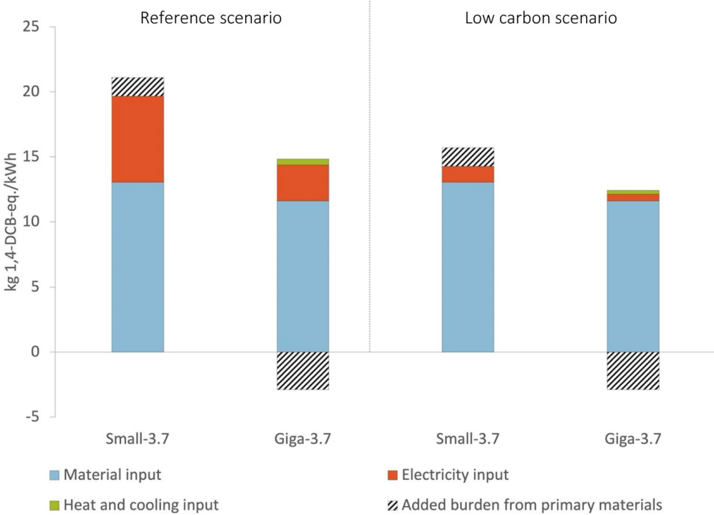
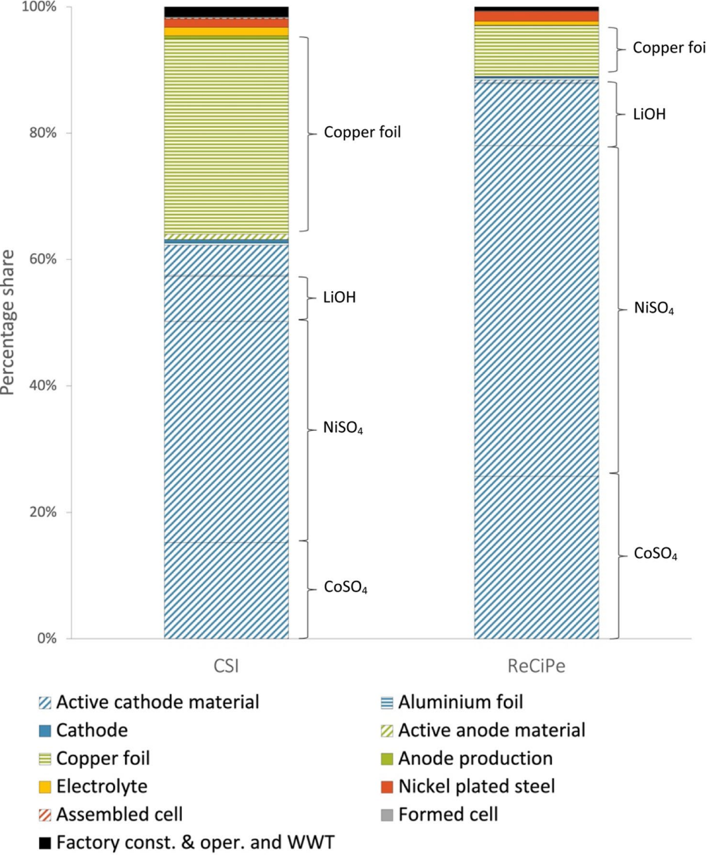
Purpose: Life cycle assessment (LCA) literature evaluating environmental burdens from lithium-ion battery (LIB) production facilities lacks an understanding of how environmental burdens have changed over time due to a transition to large-scale production. The purpose of this study is hence to examine the effect of upscaling LIB production using unique life cycle inventory data representative of large-scale production. A sub-goal of the study is to examine how changes in background datasets affect environmental impacts. Method: We remodel an often-cited study on small-scale battery production by Ellingsen et al. (2014), representative of operations in 2010, and couple it to updated Ecoinvent background data. Additionally, we use new inventory data to model LIB cell production in a large-scale facility representative of the latest technology in LIB production. The cell manufactured in the small-scale facility is an NMC-1:1:1 (nickel-manganese-cobalt) pouch cell, whereas in the large-scale facility, the cell produced in an NMC-8:1:1 cylindrical cell. We model production in varying carbon intensity scenarios using recycled and exclusively primary materials as input options. We assess environmental pollution–related impacts using ReCiPe midpoint indicators and resource use impacts using the surplus ore method (ReCiPe) and the crustal scarcity indicator. Results and discussion: Remodelling of the small-scale factory using updated background data showed a 34% increase in greenhouse gas emissions — linked to updated cobalt sulfate production data. Upscaling production reduced emissions by nearly 45% in the reference scenario (South Korean energy mix) due to a reduced energy demand in cell production. However, the emissions reduce by a further 55% if the energy is sourced from a low-carbon intensity source (Swedish energy mix), shifting almost all burden to upstream supply chain. Regional pollution impacts such as acidification and eutrophication show similar trends. Toxic emissions also reduce, but unlike other impacts, they were already occurring during mining and ore processing. Lastly, nickel, cobalt, and lithium use contribute considerably to resource impacts. From a long-term perspective, copper becomes important from a resource scarcity perspective. Conclusions: Upscaling LIB production shifts environmental burdens to upstream material extraction and production, irrespective of the carbon intensity of the energy source. Thus, a key message for the industry and policy makers is that further reductions in the climate impacts from LIB production are possible, only when the upstream LIB supply chain uses renewable energy source. An additional message to LCA practitioners is to examine the effect of changing background systems when evaluating maturing technologies.
Overview
The claims and statistics of this paper haven’t been checked yet.
Free: it reads the open-access text and checks the first 5 claims that cite a source we can check. Create a free account to check every claim.
Integrity signals
Registry
Cites
Statistics
Figures
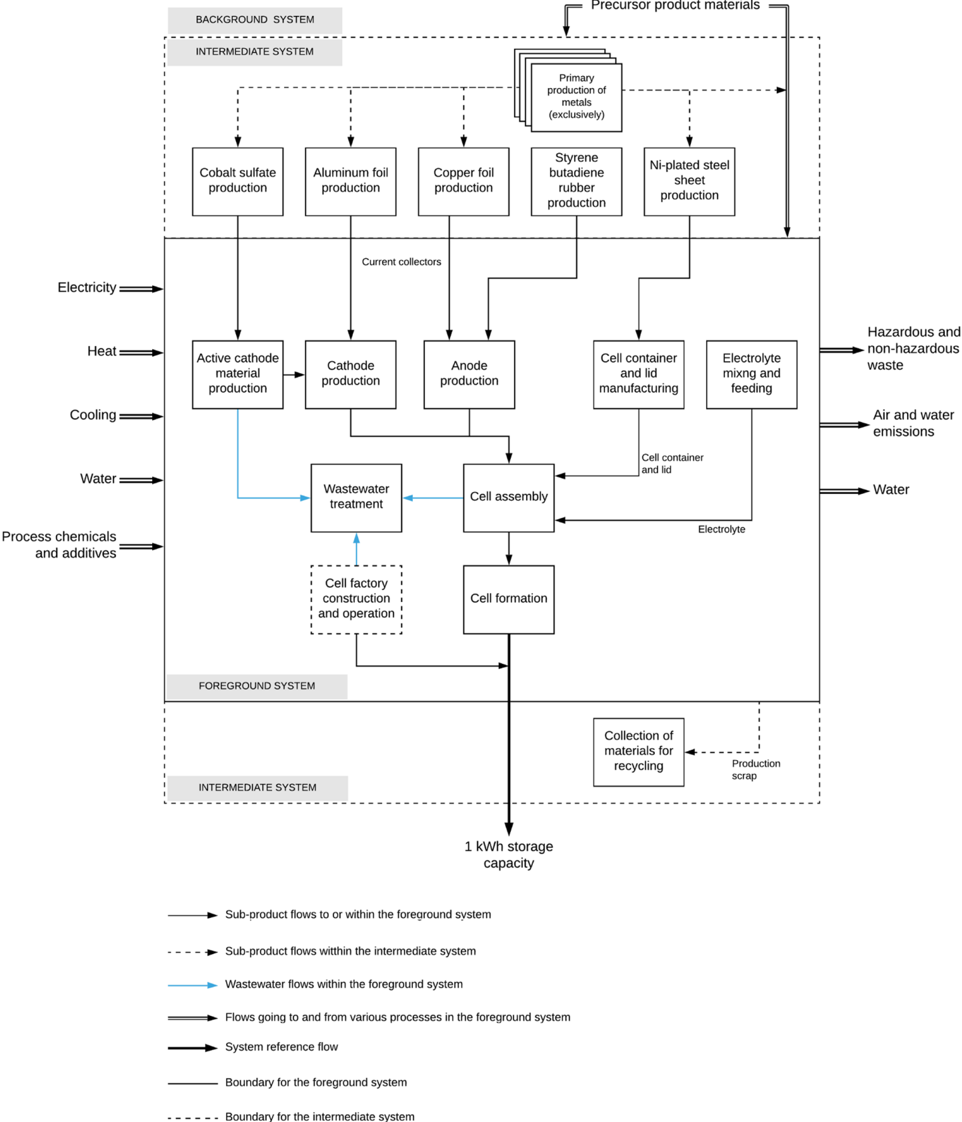
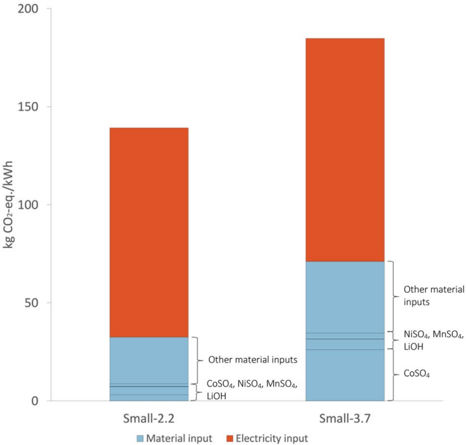
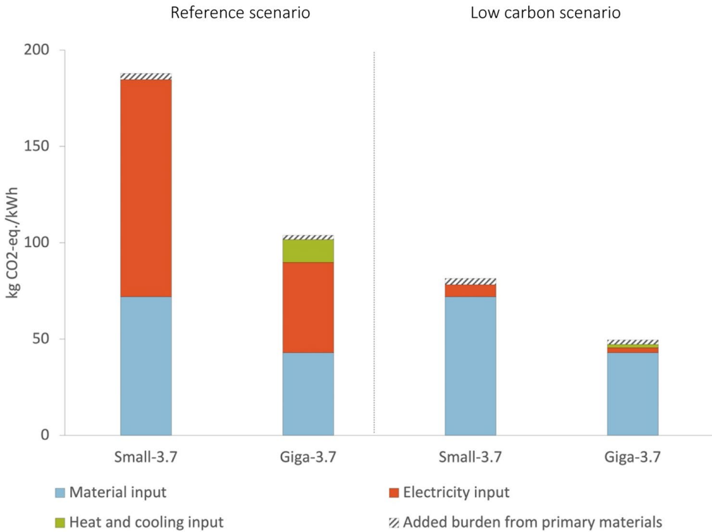
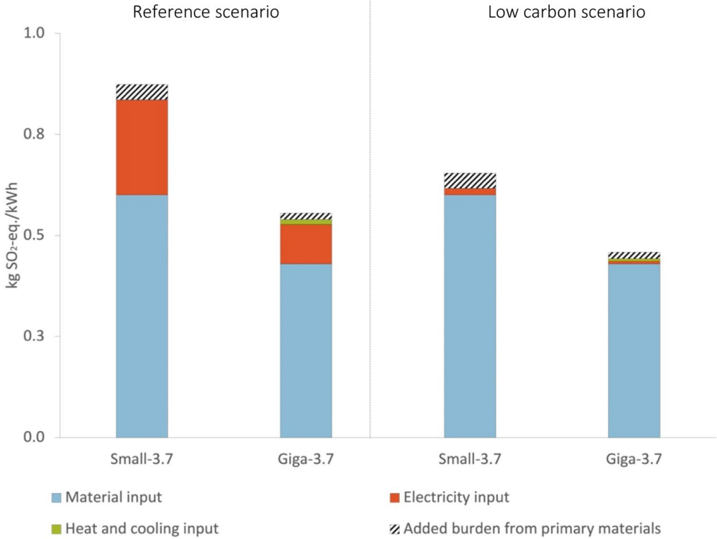

Verification
Claims the paper makes
The claims and statistics of this paper haven’t been checked yet.
Free: it reads the open-access text and checks the first 5 claims that cite a source we can check. Create a free account to check every claim.
Claims other papers make about this one
Each is checked against this paper’s own text: does it say what the citing paper says it does?
The source backs part of the claim, not all of it — or backs it for a different population, condition or comparison.
In the citing paper
“Continued upscaling could lead to a 45-55% reduction in battery production emissions, with a significant impact on EV lifecycle emissions [68].”
From A National and Regional Greenhouse Gas Breakeven Assessment of EVs across North America (2023) · cites this paper as [68]
Experimental — accuracy not yet measuredIn the citing paper
“previously published evidence that has identified battery material production and large-scale LIB manufacturing as GHG emission hotspots in the battery life cycle (Chordia et al., 2021;Kallitsis, 2023;Peiseler et al., 2022).”
From Think global act local: The dependency of global lithium-ion battery emissions on production location and material sources (2024) · cites this paper as Chordia et al., 2021
In the citing paper
“The production CF of a LIB is primarily made up of energy contributions, traced to cathode active material production and cell manufacturing, and material contributions associated with upstream mining/refining of key battery materials (Chordia et al., 2021;Dai et al., 2019;Kallitsis et al., 2020).”
From Think global act local: The dependency of global lithium-ion battery emissions on production location and material sources (2024) · cites this paper as Chordia et al., 2021
In the citing paper
“Chordia et al. (2021) reported a cradle-to-gate CF of 104 kg CO 2 -eq kWh -1 for an NMC811 battery produced in South Korea, which falls towards the upper whisker values reported in Fig. 5.”
From Think global act local: The dependency of global lithium-ion battery emissions on production location and material sources (2024) · cites this paper as Chordia et al., 2021
Self-check
Percentages, sums and reported differences re-computed from the paper’s own numbers.
The self-check needs the paper’s full text.
Citations
Cites
The ecoinvent database version 3 (part I): overview and methodology
Wernet, G., Bauer, C., Steubing, B., Reinhard, J., Moreno-Ruiz, E., & Weidema, B. (2016) · The International Journal of Life Cycle Assessment · doi:10.1007/s11367-016-1087-8 · Cited by 5,564
ReCiPe2016: a harmonised life cycle impact assessment method at midpoint and endpoint level
Huijbregts, M. A. J., Steinmann, Z. J. N., Elshout, P. M. F., Stam, G., Verones, F., Vieira, M., Zijp, M., Hollander, A., & van Zelm, R. (2017) · The International Journal of Life Cycle Assessment · doi:10.1007/s11367-016-1246-y · Cited by 4,485
The development and future of lithium ion batteries
Blomgren, G. E. (2017) · Journal of The Electrochemical Society · doi:10.1149/2.0251701jes · Cited by 1,940 · cited 4×
“Using renewable energy to charge the batteries can lower the environmental impacts from EVs in their use phase (Holland et al.”
BackgroundInfluentialAn Outlook on Lithium Ion Battery Technology
Manthiram, A. (2017) · ACS Central Science · doi:10.1021/acscentsci.7b00288 · Cited by 1,771 · cited 1×
“This is due to advantages high nickel content chemistries offer in terms of energy capacity, energy density, power capability, and cost (Manthiram 2017).”
BackgroundHigh-nickel layered oxide cathodes for lithium-based automotive batteries
Li, W., Erickson, E. M., & Manthiram, A. (2020) · Nature Energy · doi:10.1038/s41560-019-0513-0 · Cited by 1,754
Olivetti, E. A., Ceder, G., Gaustad, G. G., & Fu, X. (2017) · Joule · doi:10.1016/j.joule.2017.08.019 · Cited by 1,572
Capacity Fade Mechanisms and Side Reactions in Lithium‐Ion Batteries
Arora, P., White, R. E., & Doyle, M. (1998) · Journal of The Electrochemical Society · doi:10.1149/1.1838857 · Cited by 1,408
Automotive Li-Ion Batteries: Current Status and Future Perspectives
Ding, Y., Cano, Z. P., Yu, A., Lu, J., & Chen, Z. (2019) · Electrochemical Energy Reviews · doi:10.1007/s41918-018-0022-z · Cited by 1,370
The environmental impact of Li-Ion batteries and the role of key parameters – A review
Peters, J. F., Baumann, M., Zimmermann, B., Braun, J., & Weil, M. (2017) · Renewable and Sustainable Energy Reviews · doi:10.1016/j.rser.2016.08.039 · Cited by 856
Prospects for reducing the processing cost of lithium ion batteries
Wood, D. L., Li, J., & Daniel, C. (2015) · Journal of Power Sources · doi:10.1016/j.jpowsour.2014.11.019 · Cited by 827
Research works printed but not linked: 3
- European Copper Institute (2012) The environmental profile of copper products. European Copper Institute, Brussels
- Lutsey N, Grant M, Wappelhorst S, Zhou H (2018) Power play: how governments are spurring the electric vehicle industry. Interna- tional Council for Clean Transportation, Washington
- Northvolt (2017) Northvolt Ett -Anläggning för storskalig produk- tion av litiumjonbatterier. Bergsbyns industriområde, Skellefteå: Northvolt AB Northvolt (2018) Teknisk beskrivning Northvolt Ett -Utökad anläg- gning för storskalig produktion av litiumjonbatterier. Bergsbyns industriområde, Skellefteå: Northvolt AB Northvolt (2019) Teknisk beskrivning Northvolt Ett -Utbyggnad av anläggning för storskalig tillverkning av batterier och ny anläggn- ing för återvinning av litiumjonbatterier, samt uttag av vatten från Skellefteälv. Bergsbyns industriområde, Skellefteå Northvolt (2020) Energieffektivisering enligt utredningsvillkor U4. Northvolt AB Olivetti EA, Ceder G, Gaustad GG, Fu X (2017) Lithium-ion battery supply chain considerations: Analysis of potential bottlenecks in critical metals. Joule 1(2):229-243
Cited by
Lai, X., Chen, Q., Tang, X., Zhou, Y., Gao, F., Guo, Y., Bhagat, R., & Zheng, Y. (2022) · eTransportation · doi:10.1016/j.etran.2022.100169 · Cited by 566
Gutsch, M., & Leker, J. (2024) · Applied Energy · doi:10.1016/j.apenergy.2023.122132 · Cited by 247
Charging sustainable batteries
Bauer, C., Burkhardt, S., Dasgupta, N. P., Ellingsen, L. A.-W., Gaines, L. L., Hao, H., Hischier, R., Hu, L., Huang, Y., Janek, J., et al. (2022) · Nature Sustainability · doi:10.1038/s41893-022-00864-1 · Cited by 216
Self-citationSu-ungkavatin, P., Tiruta-Barna, L., & Hamelin, L. (2023) · Progress in Energy and Combustion Science · doi:10.1016/j.pecs.2023.101073 · Cited by 189
Global warming potential of lithium-ion battery energy storage systems: A review
Gutsch, M., & Leker, J. (2022) · Journal of Energy Storage · doi:10.1016/j.est.2022.105030 · Cited by 188
Life-Cycle Assessment and Costing of Fuels and Propulsion Systems in Future Fossil-Free Shipping
Kanchiralla, F. M., Brynolf, S., Malmgren, E., Hansson, J., & Grahn, M. (2022) · Environmental Science & Technology · doi:10.1021/acs.est.2c03016 · Cited by 184
“The material data is adopted from the LCA study on a Giga factory for battery manufacturing Chordia et al [39].”
Picatoste, A., Justel, D., & Mendoza, J. M. F. (2022) · Renewable and Sustainable Energy Reviews · doi:10.1016/j.rser.2022.112941 · Cited by 139
Lai, X., Gu, H., Chen, Q., Tang, X., Zhou, Y., Gao, F., Han, X., Guo, Y., Bhagat, R., & Zheng, Y. (2022) · Journal of Cleaner Production · doi:10.1016/j.jclepro.2022.133756 · Cited by 120
Review of life cycle assessment on lithium-ion batteries (LIBs) recycling
Domingues, A. M., & de Souza, R. G. (2024) · Next Sustainability · doi:10.1016/j.nxsust.2024.100032 · Cited by 117
Chordia, M., Wickerts, S., Nordelöf, A., & Arvidsson, R. (2022) · Resources, Conservation and Recycling · doi:10.1016/j.resconrec.2022.106634 · Cited by 114
Self-citationKanchiralla, F. M., Brynolf, S., Olsson, T., Ellis, J., Hansson, J., & Grahn, M. (2023) · Applied Energy · doi:10.1016/j.apenergy.2023.121773 · Cited by 111
Kanchiralla, F. M., Brynolf, S., & Mjelde, A. (2024) · Energy & Environmental Science · doi:10.1039/d4ee01641f · Cited by 109
Sofian, A. D. A. B. A., Imaduddin, I. S., Majid, S. R., Kurniawan, T. A., Chew, K. W., Lay, C., & Show, P. L. (2023) · Journal of Cleaner Production · doi:10.1016/j.jclepro.2023.140324 · Cited by 99
Engineering Dry Electrode Manufacturing for Sustainable Lithium-Ion Batteries
Bouguern, M. D., Reddy, A. K. M. R., Li, X., Deng, S., Laryea, H., & Zaghib, K. (2024) · Batteries · doi:10.3390/batteries10010039 · Cited by 101
Popien, J., Thies, C., Barke, A., & Spengler, T. (2023) · The International Journal of Life Cycle Assessment · doi:10.1007/s11367-023-02134-4 · Cited by 99
Assessing the feasibility of the Inflation Reduction Act’s EV critical mineral targets
Trost, J. N., & Dunn, J. B. (2023) · Nature Sustainability · doi:10.1038/s41893-023-01079-8 · Cited by 79
Dilshara, P., Abeysinghe, B., Premasiri, R., Dushyantha, N., Ratnayake, N. P., Senarath, S., Ratnayake, A. S., & Batapola, N. (2023) · Journal of Asian Earth Sciences · doi:10.1016/j.jseaes.2023.105912 · Cited by 96
Kallitsis, E., Lindsay, J. J., Chordia, M., Wu, B., Offer, G. J., & Edge, J. S. (2024) · Journal of Cleaner Production · doi:10.1016/j.jclepro.2024.141725 · Cited by 83
Self-citationFuture climate impacts of sodium-ion batteries
Zhang, S., Steubing, B. R. P., Karlsson, H., Hansson, P., & Nordberg, Å. (2023) · Resources Conservation and Recycling · doi:10.1016/j.resconrec.2023.107362 · Cited by 81
Life cycle assessment of battery electric buses
Ellingsen, L. A., Thorne, R. J., Wind, J., Figenbaum, E., Romare, M., & Nordelöf, A. (2022) · Transportation Research Part D Transport and Environment · doi:10.1016/j.trd.2022.103498 · Cited by 80
Self-citationProspective life cycle assessment of sodium‐ion batteries made from abundant elements
Wickerts, S., Arvidsson, R., Nordelöf, A., Svanström, M., & Johansson, P. (2023) · Journal of Industrial Ecology · doi:10.1111/jiec.13452 · Cited by 77
“For large-scale production of LIB cells, Chordia et al. (2021) reported the global warming of an NMC811 cell at approximately 110 kg CO 2 eq/kWh for South Korean electricity and 50 kg CO 2 eq/kWh for the Swedish electricity mix, similar to the range in Figure 3a.”
BackgroundMethodResultInfluentialSelf-citationGajdzik, B., Siwiec, D., Wolniak, R., & Pacana, A. (2024) · Journal of Open Innovation Technology Market and Complexity · doi:10.1016/j.joitmc.2024.100268 · Cited by 77
Hosamo, H., Coelho, G. B. A., Buvik, E., Drissi, S., & Kraniotis, D. (2024) · Building and Environment · doi:10.1016/j.buildenv.2024.111922 · Cited by 78
Closing gaps in LCA of lithium-ion batteries: LCA of lab-scale cell production with new primary data
Erakca, M., Bautista, S. P., Moghaddas, S., Baumann, M., Bauer, W., Leuthner, L., & Weil, M. (2022) · Journal of Cleaner Production · doi:10.1016/j.jclepro.2022.135510 · Cited by 74
Ali, A.-R., Bartie, N., Husmann, J., Cerdas, F., Schröder, D., & Herrmann, C. A. (2023) · Resources Conservation and Recycling · doi:10.1016/j.resconrec.2023.107384 · Cited by 74
“The data concerning cell and battery production are based on the literature (Chordia et al., 2021; Crenna et al., 2021; Dai et al., 2019).”
Life cycle assessment of a lithium-ion battery with a silicon anode for electric vehicles
Philippot, M. L., Costa, D., Cardellini, G., Sutter, L. D., Smekens, J., Mierlo, J. V., & Messagie, M. (2023) · Journal of Energy Storage · doi:10.1016/j.est.2023.106635 · Cited by 64
Are future recycling benefits misleading? Prospective life cycle assessment of lithium‐ion batteries
Šimaitis, J., Allen, S. R., & Vagg, C. (2023) · Journal of Industrial Ecology · doi:10.1111/jiec.13413 · Cited by 65
Wu, W., Cong, N., Zhang, X., Yue, Q., & Zhang, M. (2023) · The Science of The Total Environment · doi:10.1016/j.scitotenv.2023.166620 · Cited by 60
RetractedA comparative assessment of value chain criticality of lithium-ion battery cells
Manjong, N. B., Bach, V., Usai, L., Marinova, S., Burheim, O. S., Finkbeiner, M., & Strømman, A. H. (2023) · Sustainable materials and technologies · doi:10.1016/j.susmat.2023.e00614 · Cited by 62
Prospective Life Cycle Assessment of Lithium-Sulfur Batteries for Stationary Energy Storage
Wickerts, S., Arvidsson, R., Nordelöf, A., Svanström, M., & Johansson, P. (2023) · ACS Sustainable Chemistry & Engineering · doi:10.1021/acssuschemeng.3c00141 · Cited by 56
Self-citationSchreiber, A., Rosen, M., Waetzig, K., Nikolowski, K., Schiffmann, N., Wiggers, H., Küpers, M., Fattakhova‐Rohlfing, D., Kuckshinrichs, W., Guillon, O., et al. (2023) · Green Chemistry · doi:10.1039/d2gc03368b · Cited by 55
Quantifying the life-cycle health impacts of a cobalt-containing lithium-ion battery
Arvidsson, R., Chordia, M., & Nordelöf, A. (2022) · The International Journal of Life Cycle Assessment · doi:10.1007/s11367-022-02084-3 · Cited by 51
Self-citationDas, J., Kleiman, A., Rehman, A. U., Verma, R., & Young, M. H. (2024) · Sustainability · doi:10.3390/su16051910 · Cited by 53
Meta-analysis of life cycle assessments for Li-ion batteries production emissions
Clemente, M., Maharjan, P., Salazar, M., & Hofman, T. (2025) · The International Journal of Life Cycle Assessment · doi:10.1007/s11367-025-02541-9 · Cited by 51
“Although numerous authors have conducted LCAs of the battery supply chain (Chordia et al. 2021, Romare and Dahll¨of, 2017, Zhao et al. 2021), our approach not only aggregates results from multiple studies but also disaggregates the influence of several factors, allowing a clearer understanding of…”
Scheller, C., Schmidt, K., & Spengler, T. S. (2023) · International Journal of Production Economics · doi:10.1016/j.ijpe.2023.108892 · Cited by 46
Kim, H. C., Lee, S., & Wallington, T. J. (2023) · Environmental Science & Technology · doi:10.1021/acs.est.3c01346 · Cited by 43
Gutsch, M., & Leker, J. (2024) · Communications Engineering · doi:10.1038/s44172-023-00152-6 · Cited by 42
“A state-of-the-art LIB with NMC 811 as cathode material is selected due to its competitive price 45 and large-scale industrial production 46 .”
Wang, C., Yang, F.-C., Thi Minh Nhut, V. O., & Nguyễn, V. T. (2023) · Batteries · doi:10.3390/batteries9060317 · Cited by 41
“Besides that, lithium-ion batteries’ small size, excellent energy efficiency, and low price make them an attractive choice for various applications, including manufacturing, automobile, electronic devices, healthcare gadgets, telecommunication buildings, and other sectors [3,10,11].”
BackgroundBattery as a service: Analysing multiple reuse and recycling loops
Helander, H., & Söderman, M. L. (2023) · Resources Conservation and Recycling · doi:10.1016/j.resconrec.2023.107091 · Cited by 39
Holzer, A., Wiszniewski, L., Windisch, S., & Raupenstrauch, H. (2022) · Metals · doi:10.3390/met12101642 · Cited by 38
Manjong, N. B., Usai, L., Orangi, S., Clos, D. P., & Strømman, A. H. (2024) · Journal of Energy Storage · doi:10.1016/j.est.2024.113566 · Cited by 35
Meshram, P., Jaiswal, R. V., Abhilash, Chenthamara, B., & Gardas, R. L. (2024) · Journal of Molecular Liquids · doi:10.1016/j.molliq.2024.124594 · Cited by 35
Driving towards a just transition? The case of the European car industry
Szabó, J., & Newell, P. (2024) · Energy Research & Social Science · doi:10.1016/j.erss.2024.103649 · Cited by 36
Life cycle assessment of a two-seater all-electric aircraft
Arvidsson, R., Nordelöf, A., & Brynolf, S. (2023) · The International Journal of Life Cycle Assessment · doi:10.1007/s11367-023-02244-z · Cited by 33
“In this study, the cells were modelled as NMC811 21,700 cylindrical cells (based on Chordia et al. 2021).”
InfluentialSelf-citationTabrizi, M. K., Bonalumi, D., & Lozza, G. G. (2023) · Energy · doi:10.1016/j.energy.2023.129622 · Cited by 31
Second Life of Used Lithium-Ion Batteries from Electric Vehicles in the USA
Meegoda, J. N., Charbel, G., & Watts, D. J. (2024) · Environments · doi:10.3390/environments11050097 · Cited by 31
Ma, R., & Deng, Y. (2022) · The International Journal of Life Cycle Assessment · doi:10.1007/s11367-022-02026-z · Cited by 30
Ali, A.-R., Derin, D., Blömeke, S., & Herrmann, C. A. (2025) · Sustainable Production and Consumption · doi:10.1016/j.spc.2025.05.010 · Cited by 28
Comparison of lithium-ion battery supply chains – a life cycle sustainability assessment
Popien, J., Husmann, J., Barke, A., Thies, C., Cerdas, F., Herrmann, C. A., & Spengler, T. (2023) · Procedia CIRP · doi:10.1016/j.procir.2023.02.023 · Cited by 27
Jerome, A., Söderman, M. L., & Janssen, M. (2023) · Resources Conservation and Recycling · doi:10.1016/j.resconrec.2023.107038 · Cited by 27
On the energy use of battery Gigafactories
Kallitsis, E. (2022) · Journal of Cleaner Production · doi:10.1016/j.jclepro.2022.132573 · Cited by 25
Ali, A.-R., Castillo, M. S., Cerdas, F., & Herrmann, C. A. (2024) · CIRP Annals · doi:10.1016/j.cirp.2024.04.044 · Cited by 25
Carbone, C., Sanzò, N., Dorsini, R., Nigliaccio, G., Florio, G. D., Cigolotti, V., & Agostini, A. (2025) · Cleaner Environmental Systems · doi:10.1016/j.cesys.2024.100250 · Cited by 25
Water footprint of battery-grade lithium production in the Salar de Atacama, Chile
Marinova, S., Roche, L., Link, A., & Finkbeiner, M. (2025) · Journal of Cleaner Production · doi:10.1016/j.jclepro.2024.144635 · Cited by 24
End-of-life management of electric vehicle batteries utilizing the life cycle assessment
Chayutthanabun, A., Chinda, T., & Papong, S. (2024) · Journal of the Air & Waste Management Association · doi:10.1080/10962247.2024.2430325 · Cited by 24
Siwiec, D., Gajdzik, B., Pacana, A., & Wolniak, R. (2025) · Environmental Development · doi:10.1016/j.envdev.2025.101224 · Cited by 24
Kanchiralla, F. M., Grunditz, E. A., Nordelöf, A., Brynolf, S., & Wikner, E. (2025) · Applied Energy · doi:10.1016/j.apenergy.2025.126274 · Cited by 24
Self-citationShi-wei, D., Gao, F., Nie, Z., Liu, Y., Sun, B., & Gong, X. (2023) · Journal of Cleaner Production · doi:10.1016/j.jclepro.2023.138415 · Cited by 23
Siwiec, D., Frącz, W., Pacana, A., Janowski, G., & Bąk, Ł. (2024) · Sustainability · doi:10.3390/su16125005 · Cited by 23
“Chorida et al. [21] analyzed the environmental burden resulting from increased use of steel in battery production in terms of the life cycle.”
BackgroundCradle-to-gate life cycle assessment of cylindrical sulfide-based solid-state batteries
Rietdorf, C., de la Rúa, C., Kiemel, S., & Miehe, R. (2024) · The International Journal of Life Cycle Assessment · doi:10.1007/s11367-024-02355-1 · Cited by 21
“The LCI data of the cell casing, namely the steel container and the insulation ring, were taken from Chordia et al. (2021), who focused on cylindrical 21,700 LIB cells.”
Batteries and sustainability: the relevance of life cycle assessment
Barbosa, J. C., Pinto, R. S., Serra, J. P., Gonçalves, R., Lizundia, E., Costa, C. M., & Lanceros-Méndez, S. (2025) · Sustainable Energy Technologies and Assessments · doi:10.1016/j.seta.2025.104488 · Cited by 21
LCA for lithium battery recycling technology-recent progress
Li, J., Zhou, J., Wang, W., Chen, M., Zheng, W., Yang, W. B., Zou, H., & Chen, S. (2024) · Ionics · doi:10.1007/s11581-024-05640-z · Cited by 21
“In this article, we review the relevant LCA literatures on LIBs and find that a large proportion of researchers focus more on the cell production and use phases of LIBs [11–20], and few studies have analysed the environmental effect of recycling technology in a comprehensive way.”
Martínez, E., Peña, J. S., Adán, F. S., & Arancón, D. (2021) · Applied Sciences · doi:10.3390/app112110439 · Cited by 20
Bonalumi, D., & Tabrizi, M. K. (2022) · Energy & Fuels · doi:10.1021/acs.energyfuels.2c02204 · Cited by 19
Evaluating Carbon Emissions: A Lifecycle Comparison Between Electric and Conventional Vehicles
Malik, F. H., Ayadi, W., Hussain, G. A., Haider, Z. M., Alkhatib, F., & Lehtonen, M. (2025) · World Electric Vehicle Journal · doi:10.3390/wevj16050287 · Cited by 18
A National and Regional Greenhouse Gas Breakeven Assessment of EVs across North America
Rasbash, D., Dillman, K. J., Heinonen, J., & Ásgeirsson, E. I. (2023) · Sustainability · doi:10.3390/su15032181 · Cited by 17
“Historically, the literature on emissions from battery production has examined only small-scale production, ignoring developments in production technology [68].”
BackgroundEnvironmental impact of energy storage technologies and future renewable grids
Panesar, A. S., & Sampson, O. (2026) · Journal of Energy Storage · doi:10.1016/j.est.2026.120501 · Cited by 17
Prospective life cycle assessment of an electric vehicle equipped with a model magnesium battery
Bautista, S. P., Baumann, M., & Weil, M. (2024) · Energy Sustainability and Society · doi:10.1186/s13705-024-00475-y · Cited by 16
“S battery as well as that of a state-of-the-art LIB (NMC811) as described by Chordia et al. [48], which has been used as benchmark due to the availability of data sets that allow its modelling.”
MethodInfluentialSiwiec, D., & Pacana, A. (2024) · Materials · doi:10.3390/ma17040951 · Cited by 16
“According to data from the GREET model and according to the review of the literature on the subject [46,55,70–72], a list of energy consumption of lithium-ion batteries was developed, as shown in Table 6.”
MethodDesing, H., & Widmer, R. (2022) · Biophysical Economics and Sustainability · doi:10.1007/s41247-022-00097-y · Cited by 16
Evaluating the sustainability of a pilot-scale spent lithium-ion battery recycling process
Cornelio, A., Mousa, E. A., Ye, G., Yang, X. S., Zanoletti, A., & Bontempi, E. (2024) · Separation and Purification Technology · doi:10.1016/j.seppur.2024.130433 · Cited by 15
Ju, S., Xue, F., Qian, J., Chen, F., & Wang, B. (2022) · Separation Science and Technology · doi:10.1080/01496395.2022.2089586 · Cited by 15
“market demand for lithium resources continues to rise.([3,4]) There are two main types of lithium resources”
BackgroundMikheenkova, A., Schökel, A., Smith, A. J., Ahmed, I., Brant, W. R., Lacey, M. J., & Hahlin, M. (2024) · Journal of Power Sources · doi:10.1016/j.jpowsour.2024.234190 · Cited by 14
“With currently escalating battery demands, the production of LIBs also enhances the environmental impacts of the earlier stages of material extraction and production [5].”
BackgroundTeah, H. Y., Zhang, Q., Yasui, K., & Noda, S. (2024) · Sustainable Production and Consumption · doi:10.1016/j.spc.2024.05.022 · Cited by 14
Akbar, H., & Gheewala, S. H. (2025) · Renewable and Sustainable Energy Reviews · doi:10.1016/j.rser.2025.116389 · Cited by 14
Brodnicke, L., Ganter, A., Tröber, S., Sansavini, G., & Vulic, N. (2024) · Energy and Buildings · doi:10.1016/j.enbuild.2024.114772 · Cited by 13
Chavan, S., Son, S. E., Venkateswarlu, B., Joo, S. W., & Kim, S. C. (2024) · Case Studies in Thermal Engineering · doi:10.1016/j.csite.2024.105299 · Cited by 14
Challenges and perspectives of biochar anodes for lithium-ion batteries
Vernardou, D., Psaltakis, G., Tsubota, T., Katsarakis, N., & Kalderis, D. (2024) · Future Batteries · doi:10.1016/j.fub.2024.100011 · Cited by 13
Improving process granularity of life cycle inventories for battery grade nickel
Roy, S., Moustafa, H., Vaidya, K., Harvey, J., & Fradette, L. (2025) · npj Materials Sustainability · doi:10.1038/s44296-025-00059-7 · Cited by 13
Talwar, N., Huerta, Ó., Millán, D., Pávez, P., Isaacs, M. A., & Holden, N. M. (2025) · Cleaner Engineering and Technology · doi:10.1016/j.clet.2025.101063 · Cited by 13
Madhavi, R., & Indragandhi, V. (2024) · International Journal of Hydrogen Energy · doi:10.1016/j.ijhydene.2024.06.154 · Cited by 13
Pastor, M. C., Clemente, G., Fartdinov, D., Bañón, S., Muñoz, I., & Sanjuán, N. (2022) · Sustainability · doi:10.3390/su14031716 · Cited by 12
“Other studies [89,90] reveal similar results in which the use of renewable energy sources in the electricity background of future scenarios significantly lessens the environmental impacts.”
ResultErtelt, S.-M. (2024) · Energy Research & Social Science · doi:10.1016/j.erss.2024.103498 · Cited by 12
Pacana, A., Siwiec, D., Ulewicz, R., & Ulewicz, M. (2024) · Sustainability · doi:10.3390/su16177821 · Cited by 12
“It is a lithium-ion battery (LFP) weighing 25 kg [68–70] and a charger dedicated to this type of battery.”
Jakobsson, N., Sprei, F., & Karlsson, S. (2022) · Transportation Research Interdisciplinary Perspectives · doi:10.1016/j.trip.2022.100661 · Cited by 12
Green and economically viable dry-electrode manufacturing for high-energy-density lithium batteries
Cao, K., Ji, J., Zhao, Y., Wang, K., Zeng, L., Wang, L., & He, X. (2025) · Energy storage materials · doi:10.1016/j.ensm.2025.104649 · Cited by 11
Environmental impact assessment of material manufacturing for nickel-manganese-cobalt batteries
Skalba, A., & Panesar, A. (2025) · Sustainable materials and technologies · doi:10.1016/j.susmat.2025.e01790 · Cited by 11
Wigger, H., Draheim, P., Besner, R., Brand-Daniels, U., & Vogt, T. (2023) · Journal of Energy Storage · doi:10.1016/j.est.2023.107743 · Cited by 11
Muguruza, A., Sananes‐Israel, S., Moliner, E., Contreras, E., Landa‐Medrano, I., Palomares, V., & de Meatza, I. (2025) · Journal of Power Sources Advances · doi:10.1016/j.powera.2025.100191 · Cited by 10
Advancing sustainable energy through battery repurposing and micro recycling
Alex, Y., Divakaran, N., Srinivasan, P., Uthappa, U. T., Mubarak, S., Al-Harthi, M., & Dhamodharan, D. (2025) · Journal of Energy Storage · doi:10.1016/j.est.2025.119317 · Cited by 10
Transfer of Early-Stage Lithium Recovery from Laboratory-Scale Water Leaching to Upscale Challenges
Munchen, D. D., Neumann, K. M., Öner, İ. E., & Friedrich, B. G. (2024) · Metals · doi:10.3390/met14010067 · Cited by 10
The response of sea turtles to vocalizations opens new perspectives to reduce their bycatch
Chevallier, D., Maucourt, L., Charrier, I., Lelong, P., Gall, Y. L., Menut, E., Wallace, B. P., Delvenne, C., Vincze, O., Jeantet, L., et al. (2024) · Scientific Reports · doi:10.1038/s41598-024-67501-z · Cited by 10
“Furthermore, the primary batteries employed in these devices are Li-ion batteries, raising environmental concerns due to disposal of spent batteries and water-intensive lithium extraction, resulting in issues such as soil pollution and the depletion of water reserves 15–17 .”
BackgroundBenaabidate, S., Mounafia, N. E., Rahimpour, S., Fogarasi, S., Lasri, K., Wilson, B. P., Cormos, A., Taha, Y., Hakkou, R., Saadoune, I., et al. (2026) · Journal of Energy Storage · doi:10.1016/j.est.2026.120712 · Cited by 9
Early stage techno-economic and environmental analysis of aluminium batteries
Lindahl, N., & Johansson, P. (2023) · Energy Advances · doi:10.1039/d2ya00253a · Cited by 9
Non-linearity in Marginal LCA: Application of a Spatial Optimization Model
Qin, Y., Yang, Y., Cucurachi, S., & Suh, S. (2021) · Frontiers in Sustainability · doi:10.3389/frsus.2021.631080 · Cited by 9
Bouter, A., Scarlat, N., & Fontaras, G. (2026) · Journal of Cleaner Production · doi:10.1016/j.jclepro.2025.147412 · Cited by 8
A Study on the Cradle-to-Gate Environmental Impacts of Automotive Lithium-ion Batteries
Accardo, A., Dotelli, G., & Spessa, E. (2024) · Procedia CIRP · doi:10.1016/j.procir.2024.02.037 · Cited by 9
Development and Validation of Scalable Energy Models for Battery Cell Production Processes
Clos, D. P., Silva, G. V., Cerdas, F., Burheim, O. S., Herrmann, C. A., & Strømman, A. H. (2025) · Energy Technology · doi:10.1002/ente.202402114 · Cited by 8
Designing emerging technologies taking into account upscaling
Riondet, L., Rio, M., Bernardet, V. P., & Zwolinski, P. (2024) · Design Science · doi:10.1017/dsj.2024.33 · Cited by 8
Kim, H. S., Byun, J., Jeong, A., Kim, G., Lee, J., Hwang, T.-M., Park, Y.-G., & Park, K. (2025) · Desalination · doi:10.1016/j.desal.2025.119364 · Cited by 7
Metadata
- Authors
- Chordia, M., Nordelöf, A., & Ellingsen, L. A.-W.
- Affiliations
- Chalmers University of Technology (SE)
- Institute of Transport Economics (NO)
- Corresponding author
- Chordia, Mudit
- Venue
- The International Journal of Life Cycle Assessment
- Published
- 2021-09-23
- Volume
- 26
- Issue
- 10
- Pages
- 2024-2039
- ISSN
- 0948-3349 (ISSN-L)
- 1614-7502
- OpenAlex
- W3204060200
- Cited by
- 169
- References
- 63
- Citations by year
- 2026: 42 · 2025: 29 · 2024: 46 · 2023: 30 · 2022: 19 · 2021: 3
- FWCI
- 7.93
- Type
- journal article
- Language
- en
- Update notices
- correction (2022-08-08)
- Open access
- hybrid
- doi.org
- Licence
- cc-by
- creativecommons.org/licenses/by/4.0 (tdm)
- creativecommons.org/licenses/by/4.0 (vor)
- Locations
- The International Journal of Life Cycle Assessment (publishedVersion, cc-by)
- KTH Publication Database DiVA (KTH Royal Institute of Technology) (submittedVersion, other-oa)
- Chalmers Research (Chalmers University of Technology) (submittedVersion)
- NORA - Norwegian Open Research Archives (submittedVersion, other-oa)
- Funders
- swedish electromobility centre
- Chalmers University of Technology
- Topics
- Physical Sciences › Environmental Science › Environmental Engineering › Environmental Impact and Sustainability
- Physical Sciences › Materials Science › Metals and Alloys › Extraction and Separation Processes
- Physical Sciences › Energy › Renewable Energy, Sustainability and the Environment › Photovoltaic Systems and Sustainability
- Keywords
- greenhouse gas emissions, energy mix, resource constraints, acidification, eutrophication, toxic emissions, recycled materials, NCM cathode, battery supply chain
About these checks
Registry, retraction, Cites and statistics results are computed, not judged, with one exception: a printed reference that no index lists is read once by a model before it counts as a citation error. Claims are extracted by a model and kept only when their quote appears verbatim in the text; each cited source is then checked, with a model’s help, for whether it says what the claim relies on. Those verdicts can be wrong — read the claim’s quote and the cited source before relying on one.
Statistics and arithmetic are recomputed, not judged.
Confidence bands are shown only for fields calibrated on our annotated test set. None is calibrated yet, so no band is shown.
What counts as a claim ›How we measure confidence ›How we check this ›
Are you an author, or do you see a problem with this page? Request a review
Data sources
Bibliographic data: Semantic Scholar, OpenAlex, Crossref.
Contains information from the Semantic Scholar Academic Graph Datasets, made available under the ODC Attribution License (ODC-BY 1.0).
Semantic Scholar’s data is described in: Kinney, R., et al. (2023). The Semantic Scholar Open Data Platform. arXiv:2301.10140.
