

Intolerance of uncertainty and mental wellbeing: serial mediation by rumination and fear of COVID-19.
Open accessThe DOI matches its Crossref record, with a small difference in title or year; 44 of the 45 references it cites were found in a registry or an index.
Abstract
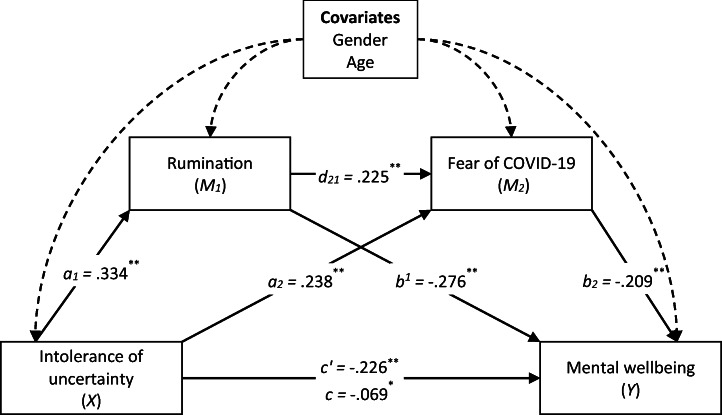
The novel coronavirus-2019 (COVID-19) pandemic has become globally widespread with millions of confirmed cases and many countries implementing various levels of quarantine. Therefore, it is important to investigate the psychological consequences of this process, given the unique situation that has been experienced globally. Therefore, the present study examined whether intolerance of uncertainty was related to mental wellbeing and whether this relationship was mediated by rumination and fear of COVID-19. The sample comprised 1772 Turkish individuals (aged between 18 and 73 years) from 79 of 81 cities in Turkey, who completed measures of mental wellbeing, intolerance of uncertainty, rumination, and fear of COVID-19. Results of serial mediation analyses showed that intolerance of uncertainty had a significant direct effect on mental wellbeing. Rumination and fear of COVID-19, in combination, serially mediated the association between intolerance of uncertainty and mental wellbeing. The findings are discussed within the framework of the psychological consequences of the COVID-19 pandemic and related literature.
Overview
The claims and statistics of this paper haven’t been checked yet.
Free: it reads the open-access text and checks the first 5 claims that cite a source we can check. Create a free account to check every claim.
Integrity signals
Registry
Cites
Statistics
Figures
Verification
Claims the paper makes
The claims and statistics of this paper haven’t been checked yet.
Free: it reads the open-access text and checks the first 5 claims that cite a source we can check. Create a free account to check every claim.
Claims other papers make about this one
Each is checked against this paper’s own text: does it say what the citing paper says it does?
The source backs part of the claim, not all of it — or backs it for a different population, condition or comparison.
In the citing paper
“This is due to the fact that people tend to be more anxious if they keep ruminating on a particular thought, given the fact that we conducted this study at the time when the entire country was under lockdown (Satici et al., 2020).”
From Knowledge of COVID-19 and Its Influence on Mindfulness, Cognitive Emotion Regulation and Psychological Flexibility in the Indian Community (2020) · cites this paper as Satici et al., 2020
Experimental — accuracy not yet measuredThe source backs part of the claim, not all of it — or backs it for a different population, condition or comparison.
In the citing paper
“It can be considered as a sub-trait of anxiety [44] (that is, in its turn, a facet of neuroticism), which has often been found in association with stress, distress, insomnia, psychosomatic symptoms, and other clinical conditions in several recent studies carried out on COVID-19 among the general population and HCWs (e.g., [45,51,52,53,54,55,56]).”
From Associations between Personality Traits, Intolerance of Uncertainty, Coping Strategies, and Stress in Italian Frontline and Non-Frontline HCWs during the COVID-19 Pandemic—A Multi-Group Path-Analysis (2021) · cites this paper as [54]
Experimental — accuracy not yet measuredThe source backs part of the claim, not all of it — or backs it for a different population, condition or comparison.
In the citing paper
“Uncertainty of disease condition [59], rapid changes of recommendations [60], and amplification of information during the pandemic could lead to confusion, which in turn results in lower satisfaction.”
From Digital health literacy, online information-seeking behaviour, and satisfaction of Covid-19 information among the university students of East and South-East Asia (2022) · cites this paper as [59]
Experimental — accuracy not yet measured
Self-check
Percentages, sums and reported differences re-computed from the paper’s own numbers.
The self-check needs the paper’s full text.
Citations
Cites
(2013) · Cited by 44,563
(2017) · Cited by 16,319
Nolen-Hoeksema, S., Wisco, B. E., & Lyubomirsky, S. (2008) · Perspectives on Psychological Science · doi:10.1111/j.1745-6924.2008.00088.x · Cited by 5,172
The Warwick-Edinburgh Mental Well-being Scale (WEMWBS): development and UK validation
Tennant, R., Hiller, L., Fishwick, R., Platt, S., Joseph, S., Weich, S., Parkinson, J., Secker, J., & Stewart-Brown, S. (2007) · Health and Quality of Life Outcomes · doi:10.1186/1477-7525-5-63 · Cited by 5,031
Responses to depression and their effects on the duration of depressive episodes
Nolen-Hoeksema, S. (1991) · Journal of Abnormal Psychology · doi:10.1037/0021-843x.100.4.569 · Cited by 4,529
The Fear of COVID-19 Scale: Development and Initial Validation
Ahorsu, D. K., Lin, C.-Y., Imani, V., Saffari, M., Griffiths, M. D., & Pakpour, A. H. (2022) · International Journal of Mental Health and Addiction · doi:10.1007/s11469-020-00270-8 · Cited by 4,332
Self-citationRumination reconsidered: a psychometric analysis.
Treynor, W., Gonzalez, R., & Nolen-Hoeksema, S. (2003) · Cognitive Therapy and Research · doi:10.1023/a:1023910315561 · Cited by 3,808
Fearing the unknown: A short version of the Intolerance of Uncertainty Scale
Carleton, R. N., Norton, M. A. P. J., & Asmundson, G. J. G. (2007) · Journal of Anxiety Disorders · doi:10.1016/j.janxdis.2006.03.014 · Cited by 2,288
Explaining the gender difference in depressive symptoms.
Nolen-Hoeksema, S., Larson, J., & Grayson, C. (1999) · Journal of Personality and Social Psychology · doi:10.1037/0022-3514.77.5.1061 · Cited by 1,543
Garfin, D. R., Silver, R. C., & Holman, E. A. (2020) · Health Psychology · doi:10.1037/hea0000875 · Cited by 1,270
Research works printed but not linked: 1
- Keldal G Turkish version of the Warwick-Edinburgh Mental Well-Being Scale: A validity and reliability study Journal of Happiness & Well-Being 2015 3 1 103 115
Cited by
Items 201–300 of 575
Jiwani, Z., Cadwell, O. G., Parnes, M. F., & Brown, A. D. (2021) · The Journal of Nervous and Mental Disease · doi:10.1097/nmd.0000000000001308 · Cited by 14
“Importantly, these findings converge with previous research showing that IU has been linked to anxiety and fear (Carleton et al., 2012; Mertens et al., 2020; Satici et al., 2020) Although findings would benefit from further assessments, these results have a number of implications.”
BackgroundResultInfluentialCovid-19 Korkusu ve Yaşam Doyum: Özel Yetenek Giriş Sınavlarına Katılan Öğrenciler Örneklemi
Aksoy, C., & Atılgan, D. (2021) · Akdeniz Spor Bilimleri Dergisi · doi:10.38021/asbid.887323 · Cited by 17
Happiness and Satisfaction after 1 Year of the COVID-19 Pandemic
Dwidienawati, D., Tjahjana, D., Gandasari, D., & Faisal, M. (2021) · Journal of Southwest Jiaotong University · doi:10.35741/issn.0258-2724.56.2.10 · Cited by 12
Şahin, E., Türk, F., & Hamamcı, Z. (2022) · Erciyes İletişim Dergisi · doi:10.17680/erciyesiletisim.1001102 · Cited by 18
shabani, M. J., Mohsenabadi, H., Gharraee, B., Shayanfar, F., Corcoran, V. P., & McKay, D. (2022) · International Journal of Cognitive Therapy · doi:10.1007/s41811-022-00152-y · Cited by 16
The self and our perception of its synchrony – Beyond internal and external cognition
Scalabrini, A., Amicis, M. D., Brugnera, A., Cavicchioli, M., Çatal, Y., Keskin, K., Gómez‐Pilar, J., Zhang, J., Osipova, B., Compare, A., et al. (2023) · Consciousness and Cognition · doi:10.1016/j.concog.2023.103600 · Cited by 15
“…of self, body, others and environment, in turn, seems to be associated with subclinical behavioral and psychological symptoms comprising Covid-related fear experience (Schimmenti et al., 2020), higher degree of emotion dysregulation (Siegel et al., 2021) and rumination (Satici et al., 2022).”
Duan, S., Exter, M., Newby, T. J., & Fa, B. (2021) · International Journal of Community Well-Being · doi:10.1007/s42413-021-00120-y · Cited by 14
Kahn, E. D., Sheldon, J. P., Carmichael, A., & Yashar, B. (2021) · Journal of Genetic Counseling · doi:10.1002/jgc4.1501 · Cited by 10
“…relationship between intolerance of uncertainty and psychological distress during the COVID- 19 pandemic have shown that both rumination (Rettie & Daniels, 2020) and poor coping strategies (Satici et al., 2020) mediate the relationship between intolerance of uncertainty and psychological health.”
BackgroundZemestani, M., Babamiri, M., Griffiths, M. D., & Didehban, R. (2021) · Journal of Addictive Diseases · doi:10.1080/10550887.2021.1889752 · Cited by 12
“Data from recent studies have shown that COVID19 is having a profound psychological impact.(9,10,42) It is vitally important to understand the psychosocial impact of COVID-19 and to identify evidence-based ways of addressing these issues.”
BackgroundSelf-citationSang, Z., Chen, H.-F., Yeung, J., & Xu, L. (2024) · Psychology Research and Behavior Management · doi:10.2147/prbm.s463399 · Cited by 11
“14 Individuals respond differently to the uncertainty of events, which manifests as the stable personality trait known as IU, defined as the tendency to react negatively to an uncertain event or situation independently of its probability of occurrence and its associated consequences.”
BackgroundPermana, A. Y., Mardiana, R., Dewi, N. I. K., Sumanta, R. V. V., Ezzaty, F. M., & Nareswari, P. A. (2022) · Journal of Southwest Jiaotong University · doi:10.35741/issn.0258-2724.57.2.11 · Cited by 10
Ogawa, T., Shiratori, Y., Midorikawa, H., Aiba, M., Sugawara, D., Kawakami, N., Arai, T., & Tachikawa, H. (2023) · COVID · doi:10.3390/covid3080082 · Cited by 14
“Rat Race” or “Lying Flat”? The effect of competition stress on psychological compensation
Wang, W., Yanxi, Y., 罗芷薇, & 厉杰 (2024) · Advances in Psychological Science · doi:10.3724/sp.j.1042.2024.01057 · Cited by 19
Hung, W.-L., & Liu, H.-T. (2022) · International Journal of Environmental Research and Public Health · doi:10.3390/ijerph191610374 · Cited by 10
Matos, R. A. D. C., Akutsu, R. D. C. C. D. A., Zandonadi, R. P., da Rocha, A. M. C. N., & Botelho, R. B. A. (2020) · International Journal of Environmental Research and Public Health · doi:10.3390/ijerph17155541 · Cited by 11
“In this sense, during the pandemic period, they may experience maladaptive psychological consequences of their jobs [5].”
BackgroundShrestha, C., Ghimire, C., Acharya, S., Prabhat, K. C., Singh, S., & Sharma, P. (2020) · Journal of Nepal Medical Association · doi:10.31729/jnma.5498 · Cited by 12
Gerdan, G., & Şalcıoğlu, E. (2025) · Clinical Psychology & Psychotherapy · doi:10.1002/cpp.70102 · Cited by 12
Consumers under pandemic anxiety: Suppressors, intensifiers, and resilients
Mittal, B. (2022) · International Journal of Consumer Studies · doi:10.1111/ijcs.12851 · Cited by 12
Shahnawaz, M., Nabi, W., Nabi, S., Afaq, M., Paul, M. A., War, F. A., & Shah, N. N. (2022) · Current Psychology · doi:10.1007/s12144-022-03577-y · Cited by 16
“Disruption of our daily activities, social isolation and loss of perceived control due to Covid-19 fueled uncertainty among people (Satici et al., 2020).”
Abuhmaid, A. M., & Jarrah, H. Y. (2022) · NURTURE · doi:10.55951/nurture.v16i2.127 · Cited by 11
“Due to the high risk of spreading coronavirus, lockdowns and restrictions have been imposed in order to stop the spread of the virus which has moved university education worldwide largely from campuses to homes (Satici et al., 2020; Tang et al., 2020; Yeasmin et al., 2020; Zubascu, 2020).”
BackgroundA confirmatory factor analysis of a cognitive model of COVID-19 related anxiety and depression
Delz, L. A. K., Gaynor, K., O'Connor, R., Schmieder, L., & Somers, E. (2023) · Acta Psychologica · doi:10.1016/j.actpsy.2023.103861 · Cited by 11
Li, L., Liu, L., Niu, Z., Zhong, H., Mei, S., & Griffiths, M. D. (2023) · Frontiers in Psychiatry · doi:10.3389/fpsyt.2023.1108016 · Cited by 12
“In addition, rumination and fear of COVID-19 were found to mediate the association between intolerance of uncertainty and mental well-being (16).”
BackgroundSelf-citationIqbal, J., Shagirbasha, S., & Madhan, K. (2023) · International Journal of Hospitality Management · doi:10.1016/j.ijhm.2023.103570 · Cited by 13
Einarsdottir, T. S., Ásgeirsdóttir, B. B., Sigurvinsdóttir, R., Ullman, S. E., & Guðmundsdóttir, B. (2023) · Scandinavian Journal of Public Health · doi:10.1177/14034948231217019 · Cited by 10
“Moreover, researchers have suggested that living with the chronic threat of disaster has a negative effect on mental health [19]. yet, others suggest that such exposure can enhance resilience [20]. geographically, Iceland is relatively young and is located on two tectonic plates.”
Dilmaç, B., Karababa, A., Seki, T., Şimşir, Z., & Kurnaz, M. F. (2021) · Journal of Family Issues · doi:10.1177/0192513x211055513 · Cited by 10
Resilience, Intolerance of Uncertainty, Future Anxiety and Mental Well Being among Young Researchers
Satıcı, S. A., Kütük, H., Okur, S., Demırcı, İ., Deniz, M. E., Satıcı, B., Kayiş, A. R., Aksu, M., Körün, A. B., Okur, E., et al. (2025) · Psychiatric Quarterly · doi:10.1007/s11126-025-10192-0 · Cited by 12
Waite, S., Hyland, P., Bennett, K. M., Bentall, R. P., & Shevlin, M. E. (2022) · Acta Psychologica · doi:10.1016/j.actpsy.2022.103539 · Cited by 13
Fear of COVID-19 and secondary trauma: Moderating role of self-efficacy
Li, Y., Abbas, Q., Manthar, S., Hameed, A., & Asad, Z. (2022) · Frontiers in Psychology · doi:10.3389/fpsyg.2022.838451 · Cited by 13
“, 2021), intolerance and uncertainty (Satici et al., 2020b), depression, anxiety and stress (Bakioglu et al.”
BackgroundKlein, G., & Delegach, M. (2023) · Journal of Leadership & Organizational Studies · doi:10.1177/15480518231176231 · Cited by 21
The new dynamics of career self-management: a study with remote workers
Sotto-Mayor, J. D., Simão, C., & Pinto, J. C. (2023) · International Journal for Educational and Vocational Guidance · doi:10.1007/s10775-023-09611-0 · Cited by 21
“However, it is crucial to comprehend the challenges faced by workers in this particular circumstance (Satici et al., 2020).”
Trends of Anger and Physical Aggression in Russian Women During COVID-19 Lockdown
Klimovich-Mickael, A., Kubick, N., Milanesi, E., Dobre, M., Łazarczyk, M., Wijas, B., Sacharczuk, M., & Mickael, M. (2021) · Frontiers in Global Women s Health · doi:10.3389/fgwh.2021.698151 · Cited by 9
Kim, W., Ju, Y. J., & Lee, S. Y. (2022) · Epidemiology and Health · doi:10.4178/epih.e2022004 · Cited by 9
“However, widespread, excessive, or chronic fear impacted by disruptions in daily routines may impair psychological well-being and quality of life [13].”
BackgroundMaftei, A., & Lăzărescu, G. (2022) · Frontiers in Psychology · doi:10.3389/fpsyg.2022.915524 · Cited by 16
Links between rational and irrational beliefs, trait anxiety and fear of COVID 19
Landsheer, C. D., & Walburg, V. (2022) · Psychologie Française · doi:10.1016/j.psfr.2022.06.005 · Cited by 9
“Moreover, perceived fear of COVID-19 was associated with poorer mental health (Ornell et al., 2020; Satici et al., 2020).”
Intolerance of Uncertainty-Related Aspects of Planning for the Future During the Pandemic
Hromova, H. (2022) · Journal of Education Culture and Society · doi:10.15503/jecs2022.1.257.269 · Cited by 11
Gao, Z.-H., & Li, J. (2024) · PLoS ONE · doi:10.1371/journal.pone.0298044 · Cited by 8
Positive personality resources as buffers against psychological reactions to uncertainty
Leontiev, D. A., Никитична, М. А., & Осин, Е. Н. (2022) · Current Psychology · doi:10.1007/s12144-022-03879-1 · Cited by 15
“Two studies in Turkish samples have confirmed the negative associations of intolerance of uncertainty with mental well-being and found they were explained by rumination and fear of COVID-19 (Satici et al., 2020; Deniz, 2021).”
Psikolojik Sağlamlık ile COVID-19 Fobisi Arasındaki İlişkide Ruminatif Düşüncenin Aracı Etkisi
Özmen, A., Coşkun, M., & Er, E. (2023) · MANAS Sosyal Araştırmalar Dergisi · doi:10.33206/mjss.1289562 · Cited by 8
Atan, G. (2023) · Epilepsy & Behavior · doi:10.1016/j.yebeh.2023.109401 · Cited by 11
Scalabrini, A., Palladini, M., Mazza, M. G., Mucci, C., Northoff, G., & Benedetti, F. (2023) · PubMed Central · doi:10.36131/cnfioritieditore20230414 · Cited by 12
“…by the COVID-19 pandemic leading to clinical and subclinical behavioral and psychological symptoms comprising COVID-related fear experience (Schimmenti et al., 2020), higher degree of emotion dysregulation (Siegel et al., 2021) and rumination (Benedetti et al., 2022; Satici et al., 2022).”
BackgroundThe impact of COVID‐19 on equine veterinary practice and mental wellbeing
Mair, T. S., & Lockett, E. (2020) · Equine Veterinary Education · doi:10.1111/eve.13416 · Cited by 10
“The pandemic has changed how individuals live their day-to-day lives due to the lockdown restrictions, requirements for quarantine and self-isolation, and social distancing measures implemented by most governments to minimise the spread of the virus (Pakpour and Griffiths 2020; Satici et al. 2020).”
BackgroundParlak, A. G., & Şahin, Z. A. (2021) · Samsun Sağlık Bilimleri Dergisi · doi:10.47115/jshs.882164 · Cited by 10
Chen, Q., Lu, L., Huang, H., & Fang, Y. (2022) · Journal of Health Psychology · doi:10.1177/13591053221116678 · Cited by 8
“Some studies (Millroth and Frey, 2021; Satici et al., 2020; Voitsidis et al., 2021) suggest that the impact of IU on individuals is mediated by the fear of COVID.”
BackgroundShacham, M., Hamama‐Raz, Y., Ben‐Ezra, M., & Levin, Y. (2023) · Vaccines · doi:10.3390/vaccines11020403 · Cited by 8
“Such results were previously demonstrated in the COVID-19 pandemic [22,23,25,27].”
Charbonnier, É., Vigouroux, S. L., Puechlong, C., Montalescot, L., Goncalves, A., Baussard, L., Gisclard, B., Philippe, A. G., & Lespiau, F. (2023) · INQUIRY The Journal of Health Care Organization Provision and Financing · doi:10.1177/00469580231159962 · Cited by 17
The Anxiety and Hope Levels of Adolescents for the Future in the COVID-19 Outbreak
Cihanyurdu, İ., İlbasmış, Ç., Aksoy, A. T., Ünver, H., & Arman, A. R. (2021) · Çocuk ve Gençlik Ruh Sağlığı Dergisi / Turkish Journal of Child and Adolescent Mental Health · doi:10.4274/tjcamh.galenos.2020.68552 · Cited by 10
El-Azzab, S., & El-Nady, M. T. (2021) · Egyptian Journal of Health Care · doi:10.21608/ejhc.2021.173651 · Cited by 8
“It was suggested that COVID-19 stress can trigger mild to severe levels of psychosocial problems, such as depression, and anxiety (Arslan & Yıldırım, 2020; Bao et al., 2020; Bhuiyan et al., 2020; Çiçek et al., 2020; Gunnell et al., 2020; Satici et al., 2020; Wang et al., 2020).”
BackgroundPsychological well-being of students in conditions of high uncertainty of the future
Tikhomirova, E. V., Samokhvalova, A. G., & Vishnevskaya, O. N. (2021) · Yaroslavl Pedagogical Bulletin · doi:10.20323/1813-145x-2021-4-121-88-96 · Cited by 23
Richaud, M. C., Eidman, L., Rubilar, J. A. V., Lemos, V., Mesurado, B., Klos, M. C., de Behrends, M. R., & Muzio, R. N. (2022) · Frontiers in Psychology · doi:10.3389/fpsyg.2022.742810 · Cited by 11
Huang, F., & Guo, W. (2023) · SAGE Open · doi:10.1177/21582440231219589 · Cited by 10
“Several studies noted that uncertainty or intolerance of uncertainty would increase fear of the pandemic (Deniz, 2021; Satici et al., 2022).”
BackgroundHow COVID-19 lockdown affected physical activity levels and wellbeing: an Italian Survey
Cerea, S., Pecunioso, A., Casali, N., Moro, T., Paoli, A., & Ghisi, M. (2022) · International Journal of Sport and Exercise Psychology · doi:10.1080/1612197x.2022.2098358 · Cited by 10
“Consequently, di ffi culties in tolerating this situation of uncertainty may have increased anxiety and depressive symptoms (Satici et al., 2020).”
BackgroundInfluentialKwon, M., & Oh, J. (2023) · Medicina · doi:10.3390/medicina59020416 · Cited by 8
“One of the effects of COVID-19 is uncertainty, which has been shown in previous studies to increase individual intolerance of uncertainty [14,16].”
BackgroundResultInfluentialKim, Y. J., Aslam, M. S., Deng, R., Leghari, Q. A., Naseem, S., Hassan, M. M. U., Nadeem, E., Qian, L., & Lkhagvasuren, D. (2023) · Heliyon · doi:10.1016/j.heliyon.2023.e16636 · Cited by 12
“Another potential reason that fails our hypothesis regarding the relationship between IOU and emotional distress (anxiety, depression, and stress) could be the lack of mediators, such as the perceived threat of COVID-19 [15] and fear of COVID-19 [17,18].”
BackgroundFear of COVID-19 and future anxiety among Polish university students during a pandemic
Guszkowska, M., & Bodasińska, A. (2023) · Health Psychology Report · doi:10.5114/hpr/165874 · Cited by 10
“The COVID-19 pandemic is a powerful stressor with many negative mental health consequences (Liu et al., 2020; Satici et al., 2022).”
BackgroundGenç, A. B. (2024) · Türk Psikolojik Danışma ve Rehberlik Dergisi · doi:10.17066/tpdrd.1311383_7 · Cited by 7
Jarego, M., Ferreira-Valente, A., Sánchez‐Rodríguez, E., Miró, J., Costa, P., & Ribeiro, J. L. P. (2024) · Current Psychology · doi:10.1007/s12144-024-06553-w · Cited by 7
Погорільська, Н., Synelnykov, R. Y., Palamar, B. I., Тукаєв, С., & Nezhyva, L. L. (2021) · Wiadomości Lekarskie · doi:10.36740/wlek202106104 · Cited by 8
“Intolerance of uncertainty arises from negative perceptions of uncertainty and its consequences [5].”
BackgroundÇelik, E., Biçener, E., Bayın, Ü., & Uğur, E. (2022) · Anales de Psicología · doi:10.6018/analesps.469511 · Cited by 11
Ong, L. D., & Khan, F. A. B. S. (2022) · International Journal of Learning Teaching and Educational Research · doi:10.26803/ijlter.21.1.8 · Cited by 15
“Recent research has demonstrated that fear of COVID-19 has a detrimental impact on employees’ mental health and well-being (Bakioğlu http://ijlter.org/index.php/ijlter et al., 2021; Satici et al., 2020).”
BackgroundPan, X., & Yi-qun, L. (2022) · Current Psychology · doi:10.1007/s12144-022-03238-0 · Cited by 13
Leisure Attitude, Anxiety, and Mental Well-Being in Turkey: The Case of COVID-19
Yurcu, G. (2021) · European journal of tourism, hospitality and recreation · doi:10.2478/ejthr-2021-0017 · Cited by 9
Gray, E., Evans, A., & Reimondos, A. (2022) · Australian Population Studies · doi:10.37970/aps.v6i1.101 · Cited by 9
Cho, I., Ahmed, O., Lee, D., Cho, E., Chung, S., & Günlü, A. (2022) · Psychiatry Investigation · doi:10.30773/pi.2022.0124 · Cited by 10
Ide, K., Asami, T., Suda, A., Yoshimi, A., Fujita, J., Shiraishi, Y., Nomoto, M., Miyauchi, M., Roppongi, T., Furuno, T., et al. (2022) · PLoS ONE · doi:10.1371/journal.pone.0277174 · Cited by 10
Morandé, S., Tewari, V., & Gul, K. (2023) · IntechOpen eBooks · doi:10.5772/intechopen.108272 · Cited by 7
HARMANCI, H., & Akdeniz, S. (2022) · Psychological Reports · doi:10.1177/00332941221149173 · Cited by 10
“Studies report that COVID-19 stress can trigger other mental complaints, especially depression, anxiety and suicidal thoughts (Bhuiyan et al., 2020; Gunnell et al., 2020; Satici et al., 2022).”
BackgroundDIRECT AND INDIRECT EFFECT OF INTOLERANCE OF UNCERTAINTY ON DISTRESS DURING THE COVID-19 PANDEMIC
Blanuša, J., Barzut, V., & Knežević, J. (1970) · Primenjena psihologija · doi:10.19090/pp.20.4.473-487 · Cited by 8
“In fact, Satici et al. (2020) confirmed association between IUS and coronarelated fear.”
BackgroundResultInfluentialPredicting COVID: Understanding audience responses to predictive journalism via online comments
Allaham, M., & Diakopoulos, N. A. (2022) · New Media & Society · doi:10.1177/14614448221135632 · Cited by 11
“The intolerance of uncertainty about the future paired with the fear of COVID-19 appears to have an effect on peoples’ mental well-being (Satici et al., 2022).”
Dutta, T., Chhajer, R., Nag, S., & Dhir, S. (2023) · IIMB Management Review · doi:10.1016/j.iimb.2023.07.004 · Cited by 11
Bok, S., Shum, J., & Lee, M. (2024) · Heliyon · doi:10.1016/j.heliyon.2024.e25889 · Cited by 7
“An intolerance to uncertainty related to greater rumination and fear of COVID-19 [89].”
BackgroundWan, P., Hu, J., Su, C., & Li, Q. (2024) · INQUIRY The Journal of Health Care Organization Provision and Financing · doi:10.1177/00469580241273119 · Cited by 12
Akkoç, İ., Dığrak, E., Yavan, T., & Öğce, F. (2025) · Current Psychology · doi:10.1007/s12144-025-07937-2 · Cited by 15
Adamczyk, J., & Adamczyk-Kowalczuk, M. (2022) · Sustainability · doi:10.3390/su142315551 · Cited by 14
Self-harm and suicidal ideation during the COVID-19 outbreak in Lebanon: a preliminary study
Maatouk, I., Assi, M., & Jaspal, R. (2021) · Journal of Health Research · doi:10.1108/jhr-01-2021-0029 · Cited by 6
Effects of COVID-19 Pandemic and Earthquake on the Mental Health of Adults in Croatia
Vukelić, D. J., Brajković, L., & Kopilaš, V. (2022) · American Journal of Applied Psychology · doi:10.11648/j.ajap.20221102.13 · Cited by 7
Zhang, W., You, Y., Wang, L., Liu, W., & Zhang, X. (2022) · Stress and Health · doi:10.1002/smi.3203 · Cited by 8
Veronese, G., Cavazzoni, F., & Pepe, A. (2023) · Journal of Public Health · doi:10.1007/s10389-023-01913-5 · Cited by 7
“…feelings of anger and confusion, panic attacks, emotional exhaustion, and post-traumatic stress reactions (Asmundson and Taylor 2020; Belen 2021; Bhuiyan et al. 2020; Cavazzoni et al. 2022; Meda et al. 2021; Maniaci et al. 2022; Reznik et al. 2020; Satici et al. 2020a, b; Veronese et al. 2021).”
Appel, H., & Sanatkar, S. (2023) · Journal of Clinical Psychology in Medical Settings · doi:10.1007/s10880-023-09974-0 · Cited by 9
“For example, in samples from the general population, IU has been associated with COVID-19-specific distress (Taylor et al., 2020) and general well-being and mental health (Rettie & Daniels, 2021; Satici et al., 2022), a pattern already found for other pandemics like H1N1 (Taha et al., 2014).”
BackgroundTransformational Leadership in a Digital Era
Matsunaga, M. (2024) · Future of business and finance · doi:10.1007/978-981-99-8409-1_3 · Cited by 24
COVID-19 anxiety and its relation to anxiety-related disorder symptoms and mechanisms
Byam, L. J., & Penney, A. M. (2024) · Acta Psychologica · doi:10.1016/j.actpsy.2024.104179 · Cited by 7
Merino, M. D., Hernández, C. O., Pérez, M. D. V., & Rodríguez, I. M. (2020) · International Journal of Environmental Research and Public Health · doi:10.3390/ijerph17239087 · Cited by 6
“[8], the relationship between intolerance of uncertainty and mental well-being was studied, and they found this to be mediated by rumination and fear of getting COVID-19.”
BackgroundFitzgerald, H. E., Parsons, E. M., Indriolo, T., Taghian, N. R., Gold, A. K., Hoyt, D. L., Milligan, M. A., Zvolensky, M. J., & Otto, M. W. (2022) · Cognitive Therapy and Research · doi:10.1007/s10608-022-10321-0 · Cited by 8
“…vigilance (Fedorenko et al., 2021) and is associated with fear of COVID-19 (Akbari et al., 2021; Bakioglu et al., 2020; Deniz, 2021; Mertens et al., 2020; Millroth & Frey, 2021; Paluszek et al., 2021; Satici et al., 2020; Voitsidis et al., 2020; but see Sauer et al., 2020 for a dissenting finding).”
BackgroundBapayeva, S. T., Tarman, B., Kassymzhanova, A. A., Hananyan, A., & Kudaibergenova, S. K. (2024) · Humanities and Social Sciences Communications · doi:10.1057/s41599-024-04079-x · Cited by 11
“According to Satici et al. (2020), the sheer unpredictability surrounding these issues represents one of the most signi fi cant stress-inducing elements of the pandemic.”
Maral, S., Bilmez, H., & Satıcı, S. A. (2025) · Psychiatric Quarterly · doi:10.1007/s11126-025-10184-0 · Cited by 13
“Stronger environmental identity may help individuals better cope with uncertainty, mitigating its negative effects on mental well-being [13, 75].”
Larose, S., Bureau, J. S., Cellard, C., Janosz, M., Beaulieu, C., Châteauvert, G. B., & Girard-Lamontagne, A. (2023) · Research in Higher Education · doi:10.1007/s11162-023-09756-5 · Cited by 11
“This could lessen their feelings of autonomy and empowerment, setting off a cascade of stress that would ultimately affect their mental health (Satici et al., 2020).”
Does Worker Well‐Being Adapt to a Pandemic? An Event Study Based on High‐Frequency Panel Data
Schmidtke, J., Hetschko, C., Schöb, R., Stephan, G., Eid, M., & Lawes, M. (2021) · Review of Income and Wealth · doi:10.1111/roiw.12668 · Cited by 35
Bican, B., Başar-Gençer, D., & Satıcı, S. A. (2025) · Current Psychology · doi:10.1007/s12144-024-07173-0 · Cited by 6
“Consistent findings from earlier studies have demonstrated the influence of IU on individu - als’ well-being (Deniz, 2021 ; Gençgin & Sahranç, 2017; Kahneman & Tversky, 1979; Ladouceur et al., 2000; Satici et al., 2022).”
Interrelation between intolerance of uncertainty and the time perspective profile in the military
Hromova, H. (2022) · Current Issues in Personality Psychology · doi:10.5114/cipp.2021.111984 · Cited by 10
“According to clinical disorder prevalence statistics by Veterans Health Administration (USA), depression and PTSD rank, respectively, first and second in frequency of manifestations in the military (Trivedi et al., 2015). As there are no official statistics available in Ukraine, we will focus on international data, as…”
BackgroundKARDUZ, F. F. A., & KELEŞOĞLU, F. (2022) · Cumhuriyet International Journal of Education · doi:10.30703/cije.1003610 · Cited by 6
Burnout Experience among Iranian Teachers during the COVID-19 Pandemic
Mota, A. I., & Alaghband‐Rad, J. (2023) · Higher Education Studies · doi:10.5539/hes.v13n1p50 · Cited by 7
“Since the beginning of the pandemic, few studies have already showed the emotional and psychological impact brought by the restriction of affections and loss of freedom: rumination, fear, uncertainty and boredom (Brooks et al., 2020; Pakpour & Griffiths, 2020; Satici et al., 2020).”
BackgroundFear of Covid-19 and perceived academic safety: the buffering role of personal resources
Azila-Gbettor, E. M., Mensah, C., & Agbodza, M. (2023) · International Journal of Educational Management · doi:10.1108/ijem-04-2022-0159 · Cited by 6
Dorčić, T. M., Živčić–Bećirević, I., & Smojver‐Ažić, S. (2023) · European Journal of Psychology Open · doi:10.1024/2673-8627/a000035 · Cited by 12
Rogers, M. L., Cao, E., Richards, J. A., Mitelman, A. M., Barzilay, S., Blum, Y., Chistopolskaya, K. A., Çinka, E., Dudeck, M., Husain, M. I., et al. (2023) · Clinical Psychological Science · doi:10.1177/21677026221148732 · Cited by 5
“Pandemic-related stressors, such as financial strains and health concerns, have also been linked to elevated feelings of fear, wor-risome thoughts, and emotional distress (Myers, 2000; Satici et al., 2022).”
BackgroundPSYCHOLOGICAL WELL-BEING OF UKRAINIANS AT THE BEGINNING OF THE FULL-SCALE RUSSIAN INVASION
Коваленко, А., & Yatsenko, A. O. (2022) · Ukrainian Psychological Journal · doi:10.17721/upj.2022.2(18).5 · Cited by 5
Radell, M. L., & McGuire, B. M. (2021) · Discover Psychology · doi:10.1007/s44202-021-00010-6 · Cited by 5
“We considered age and gender because they were already known to predict fear of the virus [5, 6].”
BackgroundMethodInfluentialMurashcenkova, N. V. (2022) · Social Psychology and Society · doi:10.17759/sps.2022130207 · Cited by 5
Büyükkayhan, D., & Ozden-Yıldırım, M. S. (2021) · International Journal of Emerging Trends in Health Sciences · doi:10.18844/ijeths.v5i3.7330 · Cited by 5
Üniversite Öğrencilerinde Covid-19 Korkusunun Yordayıcısı Olarak Belirsizliğe Tahammülsüzlük
ÇARKIT, E. (2021) · Maarif Mektepleri Uluslararası Eğitim Bilimleri Dergisi · doi:10.46762/mamulebd.934997 · Cited by 8
Negri, O., Horesh, D., Gordon, I., & Hasson-Ohayon, I. (2022) · Journal of Nervous & Mental Disease · doi:10.1097/nmd.0000000000001518 · Cited by 3
Understanding Responses to Conflicting Advice on COVID-19
Zhou, Y., & Farrell, E. L. (2023) · Health Communication · doi:10.1080/10410236.2023.2227429 · Cited by 4
“Conflicting advice from personal sources, on the other hand, is associated with uncertainty and confusion, which may pose a threat to mental well-being (Satici et al., 2022).”
Background
Metadata
- Authors
- Satici, B., Saricali, M., Satici, S. A., & Griffiths, M. D.
- Affiliations
- Nottingham Trent University (GB)
- Corresponding author
- Griffiths, Mark D.
- Venue
- International Journal of Mental Health and Addiction
- Published
- 2020-05-15
- Volume
- 20
- Issue
- 5
- Pages
- 2731-2742
- ISSN
- 1557-1874 (ISSN-L)
- 1557-1882
- PMC
- PMC7228430
- OpenAlex
- W3025803203
- Semantic Scholar
- 47d73c74b97d9824ebc7ec0042ecd2a8fc0cbf27
- Cited by
- 580
- References
- 45
- Citations by year
- 2026: 21 · 2025: 37 · 2024: 73 · 2023: 100 · 2022: 163 · 2021: 141 · 2020: 40
- FWCI
- 44.44
- Type
- journal article
- Language
- en
- Open access
- hybrid
- doi.org
- Licence
- cc-by
- creativecommons.org/licenses/by/4.0 (tdm)
- creativecommons.org/licenses/by/4.0 (vor)
- Locations
- International Journal of Mental Health and Addiction (publishedVersion, cc-by)
- PubMed Central (publishedVersion, cc-by)
- PubMed (publishedVersion)
- Nottingham Trent University's Institutional Repository (Nottingham Trent Repository) (acceptedVersion)
- Yildiz Technical University - AVESIS (submittedVersion, cc-by-nc-nd)
- Funders
- Nottingham Trent University
- Topics
- Social Sciences › Psychology › Clinical Psychology › COVID-19 and Mental Health
- Social Sciences › Psychology › Experimental and Cognitive Psychology › Anxiety, Depression, Psychometrics, Treatment, Cognitive Processes
- Social Sciences › Psychology › Clinical Psychology › Mindfulness and Compassion Interventions
- Keywords
- intolerance of uncertainty, psychological well-being, rumination, fear of COVID-19, COVID-19 pandemic, serial mediation, Turkish adults
About these checks
Registry, retraction, Cites and statistics results are computed, not judged, with one exception: a printed reference that no index lists is read once by a model before it counts as a citation error. Claims are extracted by a model and kept only when their quote appears verbatim in the text; each cited source is then checked, with a model’s help, for whether it says what the claim relies on. Those verdicts can be wrong — read the claim’s quote and the cited source before relying on one.
Statistics and arithmetic are recomputed, not judged.
Confidence bands are shown only for fields calibrated on our annotated test set. None is calibrated yet, so no band is shown.
What counts as a claim ›How we measure confidence ›How we check this ›
Are you an author, or do you see a problem with this page? Request a review
Data sources
Bibliographic data: Semantic Scholar, OpenAlex, Crossref.
Contains information from the Semantic Scholar Academic Graph Datasets, made available under the ODC Attribution License (ODC-BY 1.0).
Semantic Scholar’s data is described in: Kinney, R., et al. (2023). The Semantic Scholar Open Data Platform. arXiv:2301.10140.
