

Intolerance of uncertainty and mental wellbeing: serial mediation by rumination and fear of COVID-19.
Open accessThe DOI matches its Crossref record, with a small difference in title or year; 44 of the 45 references it cites were found in a registry or an index.
Abstract
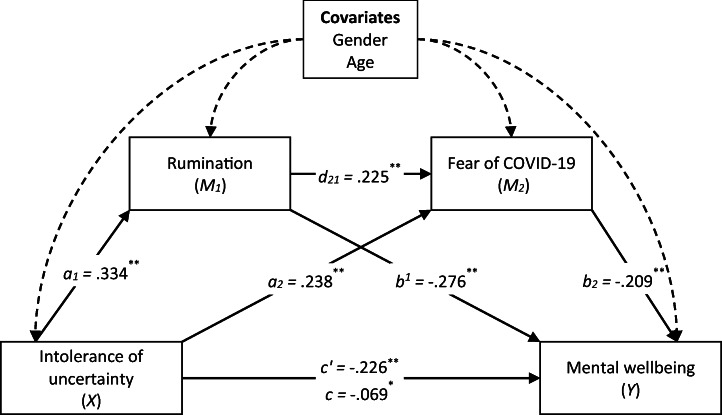
The novel coronavirus-2019 (COVID-19) pandemic has become globally widespread with millions of confirmed cases and many countries implementing various levels of quarantine. Therefore, it is important to investigate the psychological consequences of this process, given the unique situation that has been experienced globally. Therefore, the present study examined whether intolerance of uncertainty was related to mental wellbeing and whether this relationship was mediated by rumination and fear of COVID-19. The sample comprised 1772 Turkish individuals (aged between 18 and 73 years) from 79 of 81 cities in Turkey, who completed measures of mental wellbeing, intolerance of uncertainty, rumination, and fear of COVID-19. Results of serial mediation analyses showed that intolerance of uncertainty had a significant direct effect on mental wellbeing. Rumination and fear of COVID-19, in combination, serially mediated the association between intolerance of uncertainty and mental wellbeing. The findings are discussed within the framework of the psychological consequences of the COVID-19 pandemic and related literature.
Overview
The claims and statistics of this paper haven’t been checked yet.
Free: it reads the open-access text and checks the first 5 claims that cite a source we can check. Create a free account to check every claim.
Integrity signals
Registry
Cites
Statistics
Figures
Verification
Claims the paper makes
The claims and statistics of this paper haven’t been checked yet.
Free: it reads the open-access text and checks the first 5 claims that cite a source we can check. Create a free account to check every claim.
Claims other papers make about this one
Each is checked against this paper’s own text: does it say what the citing paper says it does?
The source backs part of the claim, not all of it — or backs it for a different population, condition or comparison.
In the citing paper
“This is due to the fact that people tend to be more anxious if they keep ruminating on a particular thought, given the fact that we conducted this study at the time when the entire country was under lockdown (Satici et al., 2020).”
From Knowledge of COVID-19 and Its Influence on Mindfulness, Cognitive Emotion Regulation and Psychological Flexibility in the Indian Community (2020) · cites this paper as Satici et al., 2020
Experimental — accuracy not yet measuredThe source backs part of the claim, not all of it — or backs it for a different population, condition or comparison.
In the citing paper
“It can be considered as a sub-trait of anxiety [44] (that is, in its turn, a facet of neuroticism), which has often been found in association with stress, distress, insomnia, psychosomatic symptoms, and other clinical conditions in several recent studies carried out on COVID-19 among the general population and HCWs (e.g., [45,51,52,53,54,55,56]).”
From Associations between Personality Traits, Intolerance of Uncertainty, Coping Strategies, and Stress in Italian Frontline and Non-Frontline HCWs during the COVID-19 Pandemic—A Multi-Group Path-Analysis (2021) · cites this paper as [54]
Experimental — accuracy not yet measuredThe source backs part of the claim, not all of it — or backs it for a different population, condition or comparison.
In the citing paper
“Uncertainty of disease condition [59], rapid changes of recommendations [60], and amplification of information during the pandemic could lead to confusion, which in turn results in lower satisfaction.”
From Digital health literacy, online information-seeking behaviour, and satisfaction of Covid-19 information among the university students of East and South-East Asia (2022) · cites this paper as [59]
Experimental — accuracy not yet measured
Self-check
Percentages, sums and reported differences re-computed from the paper’s own numbers.
The self-check needs the paper’s full text.
Citations
Cites
(2013) · Cited by 44,563
(2017) · Cited by 16,319
Nolen-Hoeksema, S., Wisco, B. E., & Lyubomirsky, S. (2008) · Perspectives on Psychological Science · doi:10.1111/j.1745-6924.2008.00088.x · Cited by 5,172
The Warwick-Edinburgh Mental Well-being Scale (WEMWBS): development and UK validation
Tennant, R., Hiller, L., Fishwick, R., Platt, S., Joseph, S., Weich, S., Parkinson, J., Secker, J., & Stewart-Brown, S. (2007) · Health and Quality of Life Outcomes · doi:10.1186/1477-7525-5-63 · Cited by 5,031
Responses to depression and their effects on the duration of depressive episodes
Nolen-Hoeksema, S. (1991) · Journal of Abnormal Psychology · doi:10.1037/0021-843x.100.4.569 · Cited by 4,529
The Fear of COVID-19 Scale: Development and Initial Validation
Ahorsu, D. K., Lin, C.-Y., Imani, V., Saffari, M., Griffiths, M. D., & Pakpour, A. H. (2022) · International Journal of Mental Health and Addiction · doi:10.1007/s11469-020-00270-8 · Cited by 4,332
Self-citationRumination reconsidered: a psychometric analysis.
Treynor, W., Gonzalez, R., & Nolen-Hoeksema, S. (2003) · Cognitive Therapy and Research · doi:10.1023/a:1023910315561 · Cited by 3,808
Fearing the unknown: A short version of the Intolerance of Uncertainty Scale
Carleton, R. N., Norton, M. A. P. J., & Asmundson, G. J. G. (2007) · Journal of Anxiety Disorders · doi:10.1016/j.janxdis.2006.03.014 · Cited by 2,288
Explaining the gender difference in depressive symptoms.
Nolen-Hoeksema, S., Larson, J., & Grayson, C. (1999) · Journal of Personality and Social Psychology · doi:10.1037/0022-3514.77.5.1061 · Cited by 1,543
Garfin, D. R., Silver, R. C., & Holman, E. A. (2020) · Health Psychology · doi:10.1037/hea0000875 · Cited by 1,270
Research works printed but not linked: 1
- Keldal G Turkish version of the Warwick-Edinburgh Mental Well-Being Scale: A validity and reliability study Journal of Happiness & Well-Being 2015 3 1 103 115
Cited by
Items 101–200 of 575
Sahib, A., Chen, J., Cárdenas, D., Calear, A. L., & Wilson, C. (2024) · Journal of Affective Disorders · doi:10.1016/j.jad.2024.08.056 · Cited by 34
The imprinting effect of SARS experience on the fear of COVID-19: The role of AI and big data
Yao, H., Liu, W., Wu, C., & Yuan, Y. (2021) · Socio-Economic Planning Sciences · doi:10.1016/j.seps.2021.101086 · Cited by 30
“For example, Satici, Saricali [16] found that the fear of COVID-19 was positively associated with the intolerance of uncertainty, but negatively associated with mental health.”
BackgroundLee, A., & Jung, E. (2021) · Sustainability · doi:10.3390/su13137099 · Cited by 49
“Various studies have examined intolerance of uncertainty in relation to loneliness [22], mental wellbeing [23], and positivity [24].”
BackgroundResultUncertainty, Stress, and Resilience During the COVID-19 Pandemic in Greece
Nikopoulou, V. A., Gliatas, I., Blekas, A., Parlapani, E., Holeva, V., Tsipropoulou, V., Karamouzi, P., Godosidis, A., & Diakogiannis, I. (2022) · The Journal of Nervous and Mental Disease · doi:10.1097/nmd.0000000000001491 · Cited by 35
“As a construct, IU is involved in anxiety andmood-related disorders (Rosser, 2019), and specifically, during the COVID-19 outbreak, recent research has shown that IU was linked to adverse psychological outcomes (Parlapani et al., 2020a; Satici et al., 2020).”
BackgroundRaja, U., Jahanzeb, S., Malik, M. A. R., & Baig, M. U. A. (2022) · Applied Psychology · doi:10.1111/apps.12417 · Cited by 38
“Control variables Research suggests that age and gender can affect the variables under examination (Bajrami et al., 2020; Satici et al., 2020; Volk et al., 2021).”
Backgroundde Sousa, A. R., Teixeira, J. R. B., Palma, E. M. S., Moreira, W. C., Santos, M. B., de Carvalho, H. E. F., Almeida, É. S., Florêncio, R. M. S., de Queiroz, A. M., das Mercês, M. C., et al. (2021) · International Journal of Environmental Research and Public Health · doi:10.3390/ijerph19010350 · Cited by 32
“Thus, intolerance to uncertainty is considered as one of the main underlying components of anxiety disorders [22], obsessive compulsive disorder (OCD) [23], post-traumatic stress disorder in depression [24], depression [25], and panic disorder [26].”
BackgroundDai, W., Meng, G., Zheng, Y., Li, Q., Dai, B., & Liu, X. (2021) · International Journal of Environmental Research and Public Health · doi:10.3390/ijerph18084189 · Cited by 37
“The level of IU was positively associated with the level of negative emotions, such as fear [9], anxiety [10] and depression [11].”
BackgroundZhou, T., Bao, Y., Guo, D., Bai, Y., Wang, R., Cao, X., Li, H., & Hua, Y. (2022) · Frontiers in Public Health · doi:10.3389/fpubh.2022.1015446 · Cited by 52
Sfeir, M., Akel, M., Hallit, S. R., & Obeïd, S. (2022) · Current Psychology · doi:10.1007/s12144-021-02549-y · Cited by 30
The Fear of COVID-19 Scale adaptation and validation
Faro, A., Silva, L. D. S., Nunes, D., & Feitosa, A. L. B. (2022) · Estudos de Psicologia (Campinas) · doi:10.1590/1982-0275202239e200121 · Cited by 43
Prudenzi, A., Graham, C. D., Rogerson, O., & O’Connor, D. B. (2023) · Psychology & Health · doi:10.1080/08870446.2021.2020272 · Cited by 27
“Our results for life satisfaction are in line with emerging (Satici et al., 2020) and previous studies (e.g. Yu et al., 2005; Cheng & Tang, 2004) showing that the pandemic may be a significant threat for different aspects of wellbeing.”
BackgroundResultLi, J., Zheng, W., Liu, L., & Li, S. (2022) · Acta Psychologica · doi:10.1016/j.actpsy.2022.103605 · Cited by 31
Psychological Effects of Covid-19 Epidemic and Quarantine
ÖZTÜRK, İ., AKALIN, S., DOKUZLU, İ. Ö., & Şakiroğlu, M. (2020) · Journal of Turkish Studies · doi:10.7827/turkishstudies.44885 · Cited by 38
Fear of COVID-19 scale: Psychometric properties, reliability and validity in Egyptian population
El‐Bardan, M. F., & Lathabhavan, R. (2021) · Diabetes & Metabolic Syndrome Clinical Research & Reviews · doi:10.1016/j.dsx.2021.05.026 · Cited by 32
Oral, M., & Karakurt, N. (2022) · Journal of Community Psychology · doi:10.1002/jcop.22856 · Cited by 40
Effects of Negative Emotions and Cognitive Characteristics on Impulse Buying During COVID-19
Yu, Y. (2022) · Frontiers in Psychology · doi:10.3389/fpsyg.2022.848256 · Cited by 47
“It has been demonstrated that anxiety and depression felt in the face of uncertainty may result in maladaptive behaviors such as impulsive decision making (Satici et al., 2020).”
BackgroundValidity and Reliability of the Spanish Version of Fear of COVID-19 Scale in Colombian Physicians
Mercado-Lara, M. F., Campo‐Arias, A., & Monterrosa-Castro, Á. D. J. (2021) · International Journal of Mental Health and Addiction · doi:10.1007/s11469-020-00430-w · Cited by 28
“…they diverge from previous research carried out in the general population, whose internal consistencies ranged from 0.83 to 0.88 (Alyami et al. 2020; Haktanir et al. 2020; Perz et al. 2020; Sakib et al. 2020; Satici et al. 2020; Soraci et al. 2020; Tzur Bitan et al. 2020; Winter et al. 2020).”
InfluentialTripathi, C. M., & Singh, T. (2021) · Journal of Global Mobility The Home of Expatriate Management Research · doi:10.1108/jgm-03-2021-0034 · Cited by 35
Bırni, G., Deniz, M. E., Karaağaç, Z. G., Erişen, Y., Kaya, Y., & Satıcı, S. A. (2023) · Death Studies · doi:10.1080/07481187.2023.2241401 · Cited by 30
“Rumination can stimulate negative feelings that might impair an individual ’ s wellbeing when they are recovering from trauma (Satici et al., 2022).”
BackgroundSchmidtke, J. L., Hetschko, C., Schöb, R., Stephan, G., Eid, M., & Lawes, M. (2021) · Social Science Research Network · doi:10.2139/ssrn.3905073 · Cited by 19
“The fact that indicators of affective well-being and mental health start to respond to rising infection rates before restrictions are introduced point to the role of anxiety about the future in mediating the pandemic’s impact on well-being (see also Satici et al., 2020).”
BackgroundRipoll, J., Contreras-Martos, S., Esteva, M., Soler, A., & Serrano-Ripoll, M. J. (2021) · Journal of Clinical Medicine · doi:10.3390/jcm10143191 · Cited by 25
“17), had large confidence intervals, and there was a high level of heterogeneity, which the authors attribute to some of the methodological factors of the studies they considered [38].”
BackgroundPsychometric properties of the Brazilian version of the fear of COVID-19 scale (FCV-19S)
de Medeiros, É. D., Reis, L. M., Guimarães, C. L. C., da Silva, P. G. N., Monteiro, R. P., Coelho, G. L. D. H., Guimarães, C. M. C., Martins, E. R. D. S., & de França, L. L. A. (2021) · Current Psychology · doi:10.1007/s12144-021-01476-2 · Cited by 30
“Therefore, considering the chaotic situation in the context, it is essential to have measures to assess the effects of fear of COVID-19 on mental health (Satici et al., 2020a, b), since this global reality will still be present for a long time.”
BackgroundMethodResultInfluentialCharbonnier, É., Vigouroux, S. L., & Goncalves, A. (2021) · International Journal of Environmental Research and Public Health · doi:10.3390/ijerph18189699 · Cited by 35
“[42] showed that an inability to tolerate uncertainty can precipitate fear of the virus and impact negatively on psychological wellbeing.”
BackgroundLiu, N., & Ma, Z. (2022) · Journal of Psychiatric Research · doi:10.1016/j.jpsychires.2022.03.036 · Cited by 28
Syed, N. K., & Griffiths, M. D. (2020) · Journal of Psychiatric Research · doi:10.1016/j.jpsychires.2020.08.021 · Cited by 24
Self-citationIntolerance of uncertainty and mental wellbeing: the mediating and moderating role of doomscrolling
Kaya, B., & Griffiths, M. D. (2024) · Behaviour and Information Technology · doi:10.1080/0144929x.2024.2314747 · Cited by 32
Self-citationNicklin, L. L., Wilsdon, L., Chadwick, D. D., Rhoden, L., Ormerod, D., Allen, D., Witton, G., & Lloyd, J. (2022) · Education and Information Technologies · doi:10.1007/s10639-022-10899-8 · Cited by 36
“A common stressor for students was feeling a lack of control over their learning experience, and uncertainty about when it would revert to the status quo, consistent with findings that intolerance of uncertainty is associated with poorer wellbeing during the pandemic (Satici et al., 2020).”
BackgroundKim, B., & Kang, H. S. (2021) · Personality and Individual Differences · doi:10.1016/j.paid.2021.111169 · Cited by 31
“Therefore, previous investigations that did not distinguish the subtypes of rumination when examining its mediating role were limited in the above regards (Satici et al., 2020; Zheng et al., 2019).”
BackgroundResultCovid-19 Effects on Psychological Outcomes: How Do Gender Responses Differ?
Lathabhavan, R. (2021) · Psychological Reports · doi:10.1177/00332941211040428 · Cited by 26
“COVID-19 fear affects mental health of individuals, which results in effects on daily life activities and life satisfaction (Ahuja et al., 2020; Satici et al., 2020).”
BackgroundResultInfluentialFear of COVID-19: stress and job satisfaction among Polish doctors during the pandemic
Dymecka, J., Filipkowski, J., & Machnik-Czerwik, A. (2021) · Postępy Psychiatrii i Neurologii · doi:10.5114/ppn.2021.111935 · Cited by 31
“between stress-related uncertainty and well-being [24] or between perceived risk and welfare [25].”
BackgroundDeng, Y., Ye, B., & Yang, Q. (2022) · Nature and Science of Sleep · doi:10.2147/nss.s371292 · Cited by 24
“Studies have reported that COVID-19 related emotional stress can trigger mild to severe levels of psychosocial issues, such as depression, anxiety, and somatization.(20,22,37,38) From the perspective of the stress response mechanism, individuals stimulated by stress may elicit relevant emotional responses.”
BackgroundGender implications of the Fear of COVID-19 Scale in the Spanish population: A validation study.
Sánchez‐Teruel, D., Bello, M. A. R., Lara‐Cabrera, M. L., & Naranjo, N. V. (2022) · Psychological Trauma Theory Research Practice and Policy · doi:10.1037/tra0001062 · Cited by 27
İnözü, M., Gök, B. G., Tüzün, D., & Hacıömeroğlu, A. B. (2022) · Current Psychology · doi:10.1007/s12144-021-02450-8 · Cited by 35
Cavazzoni, F., Pancake, R., & Veronese, G. (2022) · Psychological Reports · doi:10.1177/00332941211066259 · Cited by 24
“…of extreme fear (coronaphobia), problems with insomnia, irritability, distress, and emotional exhaustion (Asmundson & Taylor, 2020; Belen, 2021; Bhuiyan et al., 2020; Brooks et al., 2020; Murphy & Moret-Tatay, 2021; Pfefferbaum & North, 2020; Reznik et al., 2020; Satici et al., 2020a).”
BackgroundDaimer, S., Mihatsch, L. L., Neufeld, S. A., Murray, G. K., & Knolle, F. (2022) · eLife · doi:10.7554/elife.75893 · Cited by 21
“, 2020), or perpetuate the sense of constant threat, which may lead to increased anxiety (Garfin et al., 2020; Satici et al., 2020).”
BackgroundBroche‐Pérez, Y., Fernández-Fleites, Z., Castillo, E. F., Jiménez-Puig, E., Vizcaíno-Escobar, A. E., Ferrer-Lozano, D. M., Rodríguez, L. M., & Martín-González, R. (2021) · Frontiers in Global Women s Health · doi:10.3389/fgwh.2021.634088 · Cited by 30
Aydın, A., & Özcan, B. E. (2021) · Çukurova medical journal (Online)/Çukurova medical journal · doi:10.17826/cumj.925771 · Cited by 31
Understanding relational resilience of married adults in quarantine days
Aydoğan, D., Kara, E., & Kalkan, E. (2021) · Current Psychology · doi:10.1007/s12144-021-02224-2 · Cited by 28
“…a matter of this fact, studies conducted on Turkish individuals have shown that the pandemic increases the risk of mental health problems (Ozdin & Bayrak Ozdin, 2020; Yilmaz & Eskici, 2020), and that intolerance to uncertainty has a significant direct effect on mental health (Satici et al., 2020).”
BackgroundRambod, M., Pasyar, N., Mazarei, Z., & Soltanian, M. (2023) · BMC Pediatrics · doi:10.1186/s12887-023-04420-4 · Cited by 29
“As a result, it is possible to regard intolerance for uncertainty in the pres-ent as a significant risk factor for affecting psychological well-being [47].”
BackgroundÇELİK, D., Alpay, E. H., Celebi, B., & Türkeli, A. (2021) · European Journal of Psychotraumatology · doi:10.1080/20008198.2021.1953790 · Cited by 27
“Bootstrap sample size = 5000. rumination between IU and anxiety (Taha et al., 2014) as well as mental well-being (Satici et al., 2020) in global health crises.”
BackgroundHu, X., & Subramony, M. V. (2022) · Stress and Health · doi:10.1002/smi.3146 · Cited by 26
KARDAŞ, F. (2021) · Studia Psychologica · doi:10.31577/sp.2021.03.828 · Cited by 22
“Satici et al. (2020) investigated the relationship between intolerance of uncertainty, fear of COVID-19, rumination and mental well-being.”
Mindfulness and subjective happiness during the pandemic: Longitudinal mediation effect of hope
Satıcı, B., & Satıcı, S. A. (2022) · Personality and Individual Differences · doi:10.1016/j.paid.2022.111781 · Cited by 24
Asanjarani, F., Aneesh Kumar, P., & Kalani, S. (2022) · Child Indicators Research · doi:10.1007/s12187-022-09963-z · Cited by 32
“Recent studies show that conditions related to the Covid pandemic (e.g., social distancing, isolation, insecurity, and anxiety) exacerbate stress-related symptoms and affect mental health (Duan & Zhu, 2020; Satici et al., 2020).”
BackgroundImpact of COVID-19 outbreak on the mental health in sports: a review
Shukla, A., Dogra, D. K., Bhattacharya, D., Gulia, S., & Sharma, R. (2023) · Sport Sciences for Health · doi:10.1007/s11332-023-01063-x · Cited by 27
Identity Threat and Coping Among British South Asian Gay Men During the COVID-19 Lockdown
Jaspal, R. (2021) · Sexuality & Culture · doi:10.1007/s12119-021-09817-w · Cited by 24
Kovács, L. N., Baksa, D., Dobos, D., Eszlári, N., Gecse, K., Kocsel, N., Juhász, G., & Kökönyei, G. (2021) · BMC Psychology · doi:10.1186/s40359-021-00549-y · Cited by 23
“One possible explanation is that many migraineurs experience more frequent migraine attacks not during the times of heightened level of stress, but when stress decreases [51].”
BackgroundKlümper, L., & Sürth, S. (2021) · Current Psychology · doi:10.1007/s12144-021-01951-w · Cited by 25
“…this link by showing that intolerance of uncertainty is associated with higher fear of COVID-19 and a higher emotional perception of the pandemic (Satici et al., 2020), whereas lower intolerance of uncertainty buffers the effects of social isolation on psychological distress (Smith et al., 2020).”
BackgroundSica, C., Perkins, E. R., Latzman, R. D., Caudek, C., Colpizzi, I., Bottesi, G., Caruso, M., Giulini, P., Cerea, S., & Patrick, C. J. (2021) · Personality and Individual Differences · doi:10.1016/j.paid.2021.110770 · Cited by 20
Arachchi, H. A. D. M., Weerasiri, R. A. S., & Mendis, T. (2022) · South Asian Journal of Marketing · doi:10.1108/sajm-10-2021-0117 · Cited by 25
RetractedSilla, J. M. P., Luque-García, A., Soriano, A., & Martínez‐Tur, V. (2022) · International Journal of Clinical and Health Psychology · doi:10.1016/j.ijchp.2022.100361 · Cited by 20
“Satici et al. (2020) found that ruminations were signi fi cantly correlated with intolerance of uncertainty and Covid-19 fear.”
Xu, C. L., Lin, N., Shen, Z., Xie, Z., Xu, D., Fu, J., & Yan, W. (2024) · BMC Public Health · doi:10.1186/s12889-024-18019-6 · Cited by 28
Labad, J., González-Rodríguez, A., Cobo, J., Puntí, J., & Farré, J. M. (2021) · PeerJ · doi:10.7717/peerj.10771 · Cited by 22
Hill, E. M., Frost, A., & Martin, J. D. (2021) · Journal of Psychosocial Oncology · doi:10.1080/07347332.2021.1880524 · Cited by 21
“Subsequent research has reported similar findings; FCOV has been linked to depressive symptoms and anxiety in other research,16,17 as well as decreased physical and environmental quality of life.18 Furthermore, research supports the notion that a greater FCOV is associated with more public health-compliant behaviors s…”
BackgroundMethodInfluentialThygesen, H., Bonsaksen, T., Schoultz, M., Ruffolo, M. C., Leung, J., Price, D., & Geirdal, A. Ø. (2021) · Health and Technology · doi:10.1007/s12553-021-00595-x · Cited by 27
Bredemeier, K., Church, L. D., Bounoua, N., Feler, B., & Spielberg, J. M. (2023) · Journal of Anxiety Disorders · doi:10.1016/j.janxdis.2022.102660 · Cited by 18
“…& Marks, 2021), including health anxiety (Bottesi et al., 2021; Rettie & Daniels, 2021; Sohrabzadeh-Fard et al., 2021; Tull et al., 2020) and fear of COVID (Baerg & Bruchmann, 2022; Bakio ˘ glu et al., 2021; Çelik et al., 2022; Mertens et al., 2020; Satici, Saricali, Satici, & Griffiths, 2020).”
Shin, D. D. (2024) · Educational Psychology · doi:10.1080/01443410.2024.2372302 · Cited by 28
“Satici et al. (2022) observed that individuals’ intolerance of uncertainty during the pandemic was linked to poorer mental well-being because of greater rumination and fear.”
Sanwald, S., Widenhorn‐Müller, K., Gahr, M., Kammer, T., Schönfeldt‐Lecuona, C., Montag, C., & Kiefer, M. (2022) · BMC Psychiatry · doi:10.1186/s12888-021-03677-2 · Cited by 22
“There have been reports showing that “intolerance of uncertainty” can be a predictor of fear of COVID-19 as well as for mental-wellbeing and psychological distress [82, 83].”
BackgroundArt therapists’ fear of COVID-19, subjective well-being, and mindfulness
Jue, J., & Ha, J. H. (2022) · The Arts in Psychotherapy · doi:10.1016/j.aip.2022.101881 · Cited by 23
When Italians Follow the Rules against COVID Infection: A Psychological Profile for Compliance
Duradoni, M., Fiorenza, M. M., & Guazzini, A. (2021) · COVID · doi:10.3390/covid1010020 · Cited by 17
Bulut, M. B. (2023) · Current Psychology · doi:10.1007/s12144-022-03281-x · Cited by 17
Tao, X., Yip, T., & Fisher, C. B. (2022) · Journal of Racial and Ethnic Health Disparities · doi:10.1007/s40615-022-01497-y · Cited by 23
Phillips, T., Wells, N. M., Brown, A. H., Tralins, J., & Bonter, D. N. (2023) · People and Nature · doi:10.1002/pan3.10433 · Cited by 25
Sagone, E., & Indiana, M. L. (2023) · Education Sciences · doi:10.3390/educsci13050476 · Cited by 39
A Psychometric Analysis of Fear of COVID-19 Scale in India
Lathabhavan, R. (2021) · International Journal of Mental Health and Addiction · doi:10.1007/s11469-021-00657-1 · Cited by 17
Stress, Anxiety, and Depression for Chinese Residents in Japan during the COVID-19 Pandemic
Hu, Q., & Umeda, M. (2021) · International Journal of Environmental Research and Public Health · doi:10.3390/ijerph18094958 · Cited by 20
“Fear of an uncertain future disaster imposes constant pressure and psychological distress, as it has in the case of COVID-19 [29].”
BackgroundFunkhouser, C. J., Klemballa, D. M., & Shankman, S. A. (2022) · PsyArXiv (OSF Preprints) · doi:10.1016/j.brat.2022.104082 · Cited by 20
“…anxiety, pandemic-related anxiety, appraisals of pandemic-related threat severity, use of maladaptive emotion-focused coping strategies, and conspiratorial thinking (Larsen, Donaldson, Liew, & Mohanty, 2021; Mertens et al., 2020; Satici, Saricali, Satici, & Griffiths, 2020; Tull et al., 2020).”
McCarty, R. J., Downing, S. T., Daley, M. L., McNamara, J. P. H., & Guastello, A. D. (2023) · Anxiety, Stress, & Coping · doi:10.1080/10615806.2022.2075855 · Cited by 16
“…with greater generalized anxiety, depression, health anxiety, rumination, and COVID-19 distress, and lower positivity and mental well-being (Bakioğlu et al., 2021; Rettie & Daniels, 2021; Satici et al., 2020; Sauer et al., 2020; Smith et al., 2020; Tull et al., 2020; Wheaton et al., 2021).”
BackgroundDaşcı, E., Salihoğlu, K., & Daşcı, E. (2023) · Frontiers in Psychology · doi:10.3389/fpsyg.2023.1272205 · Cited by 21
Vally, Z., & Alowais, A. (2021) · PLoS ONE · doi:10.1371/journal.pone.0260355 · Cited by 16
Padmanabhanunni, A., Pretorius, T. B., Bouchard, J., & Stiegler, N. (2022) · Annales Médico-psychologiques revue psychiatrique · doi:10.1016/j.amp.2022.05.001 · Cited by 25
Su, W., Sun, X., Guo, X., Zhang, W., & Li, G. (2022) · Frontiers in Psychology · doi:10.3389/fpsyg.2022.952485 · Cited by 18
“First, it has been defined as a major crisis event because of its widespread impact and dire consequences (Satici et al., 2020; Bakioglu et al., 2021).”
BackgroundMendes, R., Baccon, W. C., & Laranjeira, C. (2023) · International Journal of Environmental Research and Public Health · doi:10.3390/ijerph20085510 · Cited by 23
“[56] confirmed that the unreadiness to handle ambiguity and uncertainty is connected to pandemic-related fears through perseverative cognition (rumination) and that the dominant negative mood harmed well-being.”
BackgroundSocio-emotional strengths against psychopathology and suicidal ideation in fear of COVID-19
Soto‐Sanz, V., Falcó, R., Marzo, J. C., Piqueras, J. A., PSICO-RECURSOS COVID-19 study group, López-Núñez, A., Martínez‐González, A. E., Mateu‐Martínez, O., Moreno-Amador, B., Pineda, D., et al. (2021) · Current Psychology · doi:10.1007/s12144-021-02185-6 · Cited by 18
“…has been associated with suicide (Dsouza, Quadros, Hyderabdwala, & Mamun, 2020; Goyal, Chauhan, Chhikara, Gupta, & Singh, 2020; Mamun & Griffiths, 2020) and symptoms of anxiety and depression (e.g., Fitzpatrick, Harri,s & Dawve, 2020; Harper, Satchell, Fido, & Latzman, 2020; Satici et al., 2020b).”
BackgroundCoping Strategies in the Spanish Population: The Role in Consequences of COVID-19 on Mental Health
Jurado, M. D. M. M., Fuentes, M. D. C. P., Fernández‐Martínez, E., Martínez, Á. M., & Linares, J. J. G. (2021) · Frontiers in Psychiatry · doi:10.3389/fpsyt.2021.606621 · Cited by 18
Syed, N. K., Alqahtani, S. S., Meraya, A. M., Elnaem, M. H., Albarraq, A. A., Syed, M. H., Ahmed, R. A., & Griffiths, M. D. (2022) · Current Psychology · doi:10.1007/s12144-022-02892-8 · Cited by 19
Self-citationBüyükçolpan, H., & Özdemir, N. K. (2022) · Current Psychology · doi:10.1007/s12144-022-03548-3 · Cited by 20
Distinct neural dynamics underlying risk and ambiguity during valued‐based decision making
Deng, L., Li, Q., Zhang, M., Shi, P., & Zheng, Y. (2022) · Psychophysiology · doi:10.1111/psyp.14201 · Cited by 15
Yang, H., Zhao, X., Fang, J., & Elhai, J. D. (2021) · Current Psychology · doi:10.1007/s12144-021-02195-4 · Cited by 15
“It may be the reason why rumination has often been studied as a mediator of various kinds of mental disorders or abnormal behaviors (Berset et al., 2011; Borawski, 2019; Cox et al., 2001; Raes, 2010; Satici et al., 2020).”
BackgroundDevelopment and Validation of the Robust - Pandemic Coping Scale (R-PCS)
Burro, R., Vicentini, G., Rocca, E., Barnaba, V., Hall, R., & Raccanello, D. (2021) · Frontiers in Psychology · doi:10.3389/fpsyg.2021.725344 · Cited by 16
Zhao, S., Ye, B., Wang, W., & Zeng, Y. (2022) · Frontiers in Psychology · doi:10.3389/fpsyg.2022.807331 · Cited by 19
Yıldırım, M., Çağış, Z. G., & Gómez-Salgado, J. C. (2024) · International Journal of Public Health · doi:10.3389/ijph.2024.1607127 · Cited by 22
Problem gambling during Covid-19
Frisone, F., Alibrandi, A., & Settineri, S. (2020) · Mediterranean Journal of Clinical Psychology · doi:10.6092/2282-1619/mjcp-2457 · Cited by 32
Hein, G., Gamer, M., Gall, D., Gründahl, M., Domschke, K., Andreatta, M., Wieser, M. J., & Pauli, P. (2021) · Preventive Medicine Reports · doi:10.1016/j.pmedr.2021.101559 · Cited by 15
“…such as COVID-19-related fear, depression, and traumati-zation (Cao et al., 2020), which have been shown to be related to individual differences in trait anxiety (Jungmann and Witth ¨ oft, 2020), uncertainty (Rettie and Daniels, 2020; Satici et al., 2020), and social factors (Qi et al., 2020).”
(2021) · Cyprus Turkish Journal of Psychiatry & Psychology · doi:10.35365/ctjpp.21.2.12 · Cited by 14
Casali, N., Ghisi, M., & Meneghetti, C. (2022) · Education Sciences · doi:10.3390/educsci12020101 · Cited by 20
Ye, B., Wang, R., Liu, M., Wang, X., & Yang, Q. (2021) · Journal of Eating Disorders · doi:10.1186/s40337-021-00514-5 · Cited by 14
Yang, L., Yang, Z., & Xia, Y. (2022) · Frontiers in Psychiatry · doi:10.3389/fpsyt.2022.994685 · Cited by 17
The impact of COVID-19 on hand therapy practice
Ivy, C. C., Doerrer, S. B., Naughton, N., & Priganc, V. W. (2021) · Journal of Hand Therapy · doi:10.1016/j.jht.2021.01.007 · Cited by 15
Foláyan, M. O., Ibigbami, O. I., Brown, B. J., Tantawi, M. E., Aly, N. M., Ezechi, O., Abeldaño, G. F., Ara, E., Ayanore, M. A., Ellakany, P., et al. (2022) · Frontiers in Public Health · doi:10.3389/fpubh.2022.779498 · Cited by 15
“Fear of these threats is often learned, irrespective of the probability of its occurrence, and results from the inability to tolerate uncertainty (7).”
BackgroundBoysan, M., Eşkısu, M., & Çam, Z. (2022) · Scandinavian Journal of Psychology · doi:10.1111/sjop.12822 · Cited by 17
Kim, J., Moon, K., Lee, J., Jeong, Y., Lee, S., & Young-gun, K. (2022) · Frontiers in Psychology · doi:10.3389/fpsyg.2022.932777 · Cited by 16
“The COVID-19 pandemic has not only aggravated mental illness but also reduced mental well-being (Gray et al., 2020; Satici et al., 2020; Copeland et al., 2021).”
BackgroundEşkısu, M., Çam, Z., & Boysan, M. (2023) · Journal of Rational-Emotive & Cognitive-Behavior Therapy · doi:10.1007/s10942-022-00495-7 · Cited by 16
“Due to the high incidence and mortality of COVID-19 disease, it is identified as a significant threat to mental health and psychological well-being of people all around the world (Dsouza et al., 2020; Niederkrotenthaler et al., 2020; Satici et al., 2020).”
She, R., Luo, S., Lau, M. M. C., & Lau, J. T. F. (2021) · Journal of Health Psychology · doi:10.1177/13591053211008217 · Cited by 15
“…natural disaster or a devastating emerging infectious disease such as SARS and COVID-19) (Riaz et al., 2020); one study found that ruminating participants were more likely than others to perceive threat and fear due to the COVID-19 pandemic, which resulted in mental distress (Satici et al., 2020).”
BackgroundCOVID-19 associated psychological symptoms in Turkish population: A path model
Batıgün, A. D., & Ertürk, İ. Ş. (2021) · Current Psychology · doi:10.1007/s12144-021-02026-6 · Cited by 16
“For instance, in a recent study done by Satici et al. (2020), while a negative relationship was found between the fear of COVID19 and mental wellbeing, a positive relationship was found between the fear of COVID-19 and intolerance of uncertainty.”
BackgroundErgül‐Topçu, A., Yasak, Y., Kalafat, T., & Altınoğlu‐Dikmeer, İ. (2021) · Eğitimde Kuram ve Uygulama · doi:10.17244/eku.926595 · Cited by 16
Duan, S., Exter, M., & Newby, T. J. (2022) · TechTrends · doi:10.1007/s11528-022-00696-y · Cited by 17
“…the pandemic for the following reasons: 1) The intolerance of uncertainty under pandemic conditions are negatively associated with well-being (Satici et al., 2020); 2) Future-oriented planning interventions might make people feel worse under the conditions of the pandemic (Zacher & Rudolph,…”
BackgroundGraffeo, M. T., Albano, G., Salerno, L., Blasi, M. D., & Coco, G. L. (2022) · Psych · doi:10.3390/psych4020023 · Cited by 13
“For example, Satici and colleagues [20] found that the relationship between IU and mental well-being was mediated by the fear of COVID-19, whereas Voitsidis and colleagues [18] found that fear of COVID-19 influenced the association between IU and depression.”
BackgroundGulliver, A., Banfield, M., Batterham, P. J., Calear, A. L., Farrer, L. M., Dawel, A., McCallum, S. M., Murray, K., & Morse, A. R. (2021) · BJPsych Open · doi:10.1192/bjo.2020.170 · Cited by 15
“36,37 Previous studies have found that mindfulness mediates the relationship between intolerance of uncertainty and the experience of anxiety and depression.”
Zhao, S., Yi, W., Ye, B., Zeng, Y., & Yang, Y. (2023) · Journal of Career Development · doi:10.1177/08948453231213634 · Cited by 33
“Previous studies suggest that intolerance of uncertainty includes destructive evaluations and irrational perceptions (Bakio ˘ glu et al., 2021; Satici et al., 2022).”
Background
Metadata
- Authors
- Satici, B., Saricali, M., Satici, S. A., & Griffiths, M. D.
- Affiliations
- Nottingham Trent University (GB)
- Corresponding author
- Griffiths, Mark D.
- Venue
- International Journal of Mental Health and Addiction
- Published
- 2020-05-15
- Volume
- 20
- Issue
- 5
- Pages
- 2731-2742
- ISSN
- 1557-1874 (ISSN-L)
- 1557-1882
- PMC
- PMC7228430
- OpenAlex
- W3025803203
- Semantic Scholar
- 47d73c74b97d9824ebc7ec0042ecd2a8fc0cbf27
- Cited by
- 580
- References
- 45
- Citations by year
- 2026: 21 · 2025: 37 · 2024: 73 · 2023: 100 · 2022: 163 · 2021: 141 · 2020: 40
- FWCI
- 44.44
- Type
- journal article
- Language
- en
- Open access
- hybrid
- doi.org
- Licence
- cc-by
- creativecommons.org/licenses/by/4.0 (tdm)
- creativecommons.org/licenses/by/4.0 (vor)
- Locations
- International Journal of Mental Health and Addiction (publishedVersion, cc-by)
- PubMed Central (publishedVersion, cc-by)
- PubMed (publishedVersion)
- Nottingham Trent University's Institutional Repository (Nottingham Trent Repository) (acceptedVersion)
- Yildiz Technical University - AVESIS (submittedVersion, cc-by-nc-nd)
- Funders
- Nottingham Trent University
- Topics
- Social Sciences › Psychology › Clinical Psychology › COVID-19 and Mental Health
- Social Sciences › Psychology › Experimental and Cognitive Psychology › Anxiety, Depression, Psychometrics, Treatment, Cognitive Processes
- Social Sciences › Psychology › Clinical Psychology › Mindfulness and Compassion Interventions
- Keywords
- intolerance of uncertainty, psychological well-being, rumination, fear of COVID-19, COVID-19 pandemic, serial mediation, Turkish adults
About these checks
Registry, retraction, Cites and statistics results are computed, not judged, with one exception: a printed reference that no index lists is read once by a model before it counts as a citation error. Claims are extracted by a model and kept only when their quote appears verbatim in the text; each cited source is then checked, with a model’s help, for whether it says what the claim relies on. Those verdicts can be wrong — read the claim’s quote and the cited source before relying on one.
Statistics and arithmetic are recomputed, not judged.
Confidence bands are shown only for fields calibrated on our annotated test set. None is calibrated yet, so no band is shown.
What counts as a claim ›How we measure confidence ›How we check this ›
Are you an author, or do you see a problem with this page? Request a review
Data sources
Bibliographic data: Semantic Scholar, OpenAlex, Crossref.
Contains information from the Semantic Scholar Academic Graph Datasets, made available under the ODC Attribution License (ODC-BY 1.0).
Semantic Scholar’s data is described in: Kinney, R., et al. (2023). The Semantic Scholar Open Data Platform. arXiv:2301.10140.
