

Intolerance of uncertainty and mental wellbeing: serial mediation by rumination and fear of COVID-19.
Open accessThe DOI matches its Crossref record, with a small difference in title or year; 44 of the 45 references it cites were found in a registry or an index.
Abstract
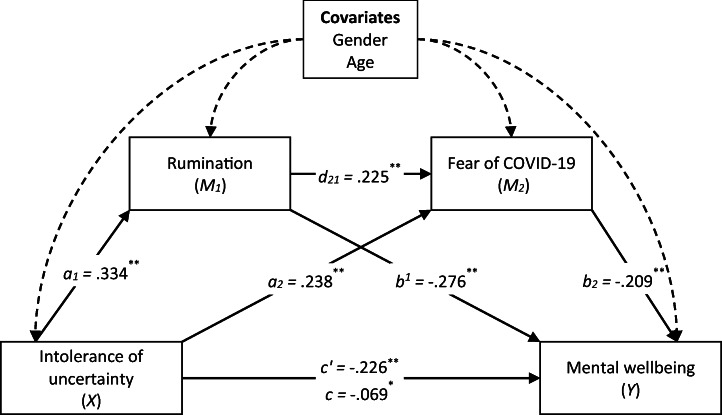
The novel coronavirus-2019 (COVID-19) pandemic has become globally widespread with millions of confirmed cases and many countries implementing various levels of quarantine. Therefore, it is important to investigate the psychological consequences of this process, given the unique situation that has been experienced globally. Therefore, the present study examined whether intolerance of uncertainty was related to mental wellbeing and whether this relationship was mediated by rumination and fear of COVID-19. The sample comprised 1772 Turkish individuals (aged between 18 and 73 years) from 79 of 81 cities in Turkey, who completed measures of mental wellbeing, intolerance of uncertainty, rumination, and fear of COVID-19. Results of serial mediation analyses showed that intolerance of uncertainty had a significant direct effect on mental wellbeing. Rumination and fear of COVID-19, in combination, serially mediated the association between intolerance of uncertainty and mental wellbeing. The findings are discussed within the framework of the psychological consequences of the COVID-19 pandemic and related literature.
Overview
The claims and statistics of this paper haven’t been checked yet.
Free: it reads the open-access text and checks the first 5 claims that cite a source we can check. Create a free account to check every claim.
Integrity signals
Registry
Cites
Statistics
Figures
Verification
Claims the paper makes
The claims and statistics of this paper haven’t been checked yet.
Free: it reads the open-access text and checks the first 5 claims that cite a source we can check. Create a free account to check every claim.
Claims other papers make about this one
Each is checked against this paper’s own text: does it say what the citing paper says it does?
The source backs part of the claim, not all of it — or backs it for a different population, condition or comparison.
In the citing paper
“This is due to the fact that people tend to be more anxious if they keep ruminating on a particular thought, given the fact that we conducted this study at the time when the entire country was under lockdown (Satici et al., 2020).”
From Knowledge of COVID-19 and Its Influence on Mindfulness, Cognitive Emotion Regulation and Psychological Flexibility in the Indian Community (2020) · cites this paper as Satici et al., 2020
Experimental — accuracy not yet measuredThe source backs part of the claim, not all of it — or backs it for a different population, condition or comparison.
In the citing paper
“It can be considered as a sub-trait of anxiety [44] (that is, in its turn, a facet of neuroticism), which has often been found in association with stress, distress, insomnia, psychosomatic symptoms, and other clinical conditions in several recent studies carried out on COVID-19 among the general population and HCWs (e.g., [45,51,52,53,54,55,56]).”
From Associations between Personality Traits, Intolerance of Uncertainty, Coping Strategies, and Stress in Italian Frontline and Non-Frontline HCWs during the COVID-19 Pandemic—A Multi-Group Path-Analysis (2021) · cites this paper as [54]
Experimental — accuracy not yet measuredThe source backs part of the claim, not all of it — or backs it for a different population, condition or comparison.
In the citing paper
“Uncertainty of disease condition [59], rapid changes of recommendations [60], and amplification of information during the pandemic could lead to confusion, which in turn results in lower satisfaction.”
From Digital health literacy, online information-seeking behaviour, and satisfaction of Covid-19 information among the university students of East and South-East Asia (2022) · cites this paper as [59]
Experimental — accuracy not yet measured
Self-check
Percentages, sums and reported differences re-computed from the paper’s own numbers.
The self-check needs the paper’s full text.
Citations
Cites
(2013) · Cited by 44,563
(2017) · Cited by 16,319
Nolen-Hoeksema, S., Wisco, B. E., & Lyubomirsky, S. (2008) · Perspectives on Psychological Science · doi:10.1111/j.1745-6924.2008.00088.x · Cited by 5,172
The Warwick-Edinburgh Mental Well-being Scale (WEMWBS): development and UK validation
Tennant, R., Hiller, L., Fishwick, R., Platt, S., Joseph, S., Weich, S., Parkinson, J., Secker, J., & Stewart-Brown, S. (2007) · Health and Quality of Life Outcomes · doi:10.1186/1477-7525-5-63 · Cited by 5,031
Responses to depression and their effects on the duration of depressive episodes
Nolen-Hoeksema, S. (1991) · Journal of Abnormal Psychology · doi:10.1037/0021-843x.100.4.569 · Cited by 4,529
The Fear of COVID-19 Scale: Development and Initial Validation
Ahorsu, D. K., Lin, C.-Y., Imani, V., Saffari, M., Griffiths, M. D., & Pakpour, A. H. (2022) · International Journal of Mental Health and Addiction · doi:10.1007/s11469-020-00270-8 · Cited by 4,332
Self-citationRumination reconsidered: a psychometric analysis.
Treynor, W., Gonzalez, R., & Nolen-Hoeksema, S. (2003) · Cognitive Therapy and Research · doi:10.1023/a:1023910315561 · Cited by 3,808
Fearing the unknown: A short version of the Intolerance of Uncertainty Scale
Carleton, R. N., Norton, M. A. P. J., & Asmundson, G. J. G. (2007) · Journal of Anxiety Disorders · doi:10.1016/j.janxdis.2006.03.014 · Cited by 2,288
Explaining the gender difference in depressive symptoms.
Nolen-Hoeksema, S., Larson, J., & Grayson, C. (1999) · Journal of Personality and Social Psychology · doi:10.1037/0022-3514.77.5.1061 · Cited by 1,543
Garfin, D. R., Silver, R. C., & Holman, E. A. (2020) · Health Psychology · doi:10.1037/hea0000875 · Cited by 1,270
Research works printed but not linked: 1
- Keldal G Turkish version of the Warwick-Edinburgh Mental Well-Being Scale: A validity and reliability study Journal of Happiness & Well-Being 2015 3 1 103 115
Cited by
Items 501–575 of 575
The Relationship Intolerance of Uncertainty with Gender, COVID-19 Attributions and COVID-19 Phobia
Kayaoğlu, A. (2023) · Cyprus Turkish Journal of Psychiatry and Psychology · doi:10.35365/ctjpp.23.3.04
Kopilaš, V., Nasadiuk, K., Martinelli, L., Lhotská, L., Todorović, Z., Vidmar, M., Machado, H., Svalastog, A. L., & Gajović, S. (2023) · JMIR Human Factors · doi:10.2196/44258 · Cited by 1
“This disease, caused by the SARS-CoV-2 virus, led to an unprecedented challenge for health institutions that required most countries to integrate their efforts to globally mitigate the spread of the disease [2-4].”
BackgroundThe Relationship Between Activity Deprivation and Fear of Covid-19 with Psychogical Healthiness
Özerk, H., Sapancı, A., & BOZANOĞLU, İ. (2023) · Journal of Turkish Studies · doi:10.7827/turkishstudies.70220
Physical and Psychological Reflections of the COVID-19 Pandemic on University Students
Göz, E., & Güç, E. (2023) · Humanistic Perspective · doi:10.47793/hp.1348661
منصور, م. ا., & سلام, د. ا. (2023) · مجلة مرکز الخدمة للاستشارات البحثية واللغات · doi:10.21608/jocr.2023.241310.1157
Katani, A. M., Yousefi, A., Naeimijoo, P., Karimi, R., & Arani, A. M. (2023) · Medical Science · doi:10.54905/disssi.v27i140.e366ms3227
Şimşek, M. K. (2023) · Acta Educationis Generalis · doi:10.2478/atd-2023-0024 · Cited by 2
Rahmati, M., Tarverdizadeh, H., & Koochakentezar, R. (2023) · مجله علمی دانشگاه علوم پزشکی رفسنجان · doi:10.61186/jrums.22.4.385
Veronese, G., El-Khodary, B., Diab, M., Mahamid, F., Bdier, D., Ismail, A., & Cavazzoni, F. (2023) · Journal of Public Health · doi:10.1007/s10389-023-02147-1
Welenc, U., & Hopper, L. (2023) · Research Square · doi:10.21203/rs.3.rs-3706187/v1
Atwa, S. A., Bassiony, M. M., Said, M., & Fouad, E. (2023) · Middle East Current Psychiatry · doi:10.1186/s43045-023-00379-1
Covid-19 Sıkıntısı ve Bilişsel Hatalar Arasındaki İlişkide Bilişsel Esneklik ve Kontrolün Aracı Rolü
Arıcan, H., & Kafadar, H. (2022) · Nesne Psikoloji Dergisi · doi:10.7816/nesne-10-26-02
THE RELATIONSHIP BETWEEN COVID-19 FEAR, DEPRESSION, AND SPIRITUAL WELL-BEING IN UNIVERSITY STUDENTS
KEREZ, M., & Okuyan, C. B. (2023) · GOBEKLITEPE Saglik Bilimleri Dergisi · doi:10.55433/gsbd.248
Sayar, G., & Arkan, B. (2024) · Uludağ Üniversitesi Tıp Fakültesi Dergisi · doi:10.32708/uutfd.1407256 · Cited by 1
Saputra, M. O., Putra, A. P., Iman, M. I. N., Saputri, A. D., Saptarini, C., & Farhanah, S. (2023) · Proceeding Conference On Psychology and Behavioral Sciences · doi:10.61994/cpbs.v2i1.69 · Cited by 2
Terzi, B., Azizoğlu, F., & Seven, Ç. (2023) · Makara Journal of Health Research · doi:10.7454/msk.v27i3.1513
COVID-19 Pandemisinin Hemşirelerin Belirsizliğe Tahammülsüzlük Düzeyine Etkisi
Erdoğan, E. G., & Kaya, Z. I. (2024) · Hacettepe Üniversitesi Hemşirelik Fakültesi Dergisi · doi:10.31125/hunhemsire.1358987 · Cited by 1
ALGILANAN BELİRSİZLİK VE PSİKOLOJİK SAĞLIK ARASINDAKİ İLİŞKİLER: KÜLTÜRLERARASI BİR İNCELEME
Çavdar, A., Boyacıoğlu, İ., & Lannegrand‐Willems, L. (2024) · Dokuz Eylül Üniversitesi Sosyal Bilimler Enstitüsü Dergisi · doi:10.16953/deusosbil.1376044
Psychological well-being among government pharmacy staff in Sarawak and the associating factors
Loo, S. C., Ting, C. Y., Said, L. N. B., Mohamad, N. B., & Jabar, A. H. A. A. (2024) · International Journal of Occupational Safety and Ergonomics · doi:10.1080/10803548.2024.2327221 · Cited by 1
“Intolerance to the uncertainties due to COVID-19 was also shown to be associated with lower psychological well-being and it was found that this was mediated by rumination and fear of the virus [18].”
UNCERTAINTY AND HOPE IN UKRAINIAN NARRATIVES IN SPRING 2022
Hromova, H. (2024) · Habitus · doi:10.32782/2663-5208.2024.57.34
Addictive behaviors among youth and adolescents in the digital age
(2024) · Frontiers research topics · doi:10.3389/978-2-8325-4853-0 · Cited by 2
Günaydın, N., & Demirel, S. (2024) · Ege Üniversitesi Hemşirelik Fakültesi Dergisi · doi:10.53490/egehemsire.1208756
Unable to Tolerate the Impact of Uncertainty on Sleep
胡, 耀. (2024) · Advances in Psychology · doi:10.12677/ap.2024.145359
Demirci, A., & Arslan, C. (2024) · Journal of Teacher Education and Lifelong Learning · doi:10.51535/tell.1479652
Ooi, P. B., Ho, M. C., Voon, S. P., Lee, K. W., Ang, C., Teng, H. J., Pang, K. Y., & Ching, S. M. (2024) · Counselling Psychology Quarterly · doi:10.1080/09515070.2024.2366859
“Satici, Saricali, Satici, and Griffiths (2022) investigated the serial mediation of intolerance of uncertainty and mental well-being by rumination and fear arising from COVID-19 among Turkish individuals.”
Özcan, A., Aydın, H., Baç, D. Z., Karaağaç, N., & Gültepe, B. (2024) · Kalem Uluslararasi Egitim ve Insan Bilimleri Dergisi · doi:10.23863/kalem.2024.290
Tiryaki, O., Tiryaki, E., & Demirbağ, B. C. (2024) · EKEV Akademi Dergisi · doi:10.17753/sosekev.1466673
Deledda, G., Poli, S., Giansante, M., Geccherle, E., Fantoni, G., Romaniello, I., Gabriella, F., Verzè, M., Nicolis, F., & Gori, S. (2024) · Cancer Medicine · doi:10.1002/cam4.7442
“29,30 Furthermore, angrier participants were at greater risk of feeling lonely and reported avoiding thinking about coronavirus more often.”
BackgroundKruger, F. P. (2024) · Stellenbosch Theological Journal · doi:10.17570/stj.2024.v10n2.2
COVID-19’s Psychological Threats and Future Career Anxiety among University Students
Abdelwahed, N. A. A., & Ramish, M. S. (2024) · OBM Neurobiology · doi:10.21926/obm.neurobiol.2403234 · Cited by 18
Mmohammadi, K., & Ghafari, M. (2023) · Journal of Health and Care · doi:10.61186/jhc.25.2.191
Rumination as a Transdiagnostic Risk Factor to Psychopathology
Kovács, L. N. (2023) · Eötvös Loránd Tudományegyetem · doi:10.15476/elte.2022.072
Low, G., AliSher, A. N., Morero, J. A. P., Gao, Z., GUTMAN, G. M., França, A. B., & von Humboldt, S. (2024) · Healthcare · doi:10.3390/healthcare12181837
“There is a good deal of literature suggesting that confronting reality and accepting one’s circumstances can diminish fear and anxiety [35,71–74].”
BackgroundCovid-19 Deneyiminde Bilişsel Çarpıtmalar Ve Yaşam Doyumunun İncelenmesi
Özkan, B., & Çetinkaya, B. (2024) · Afyon Kocatepe Üniversitesi Sosyal Bilimler Dergisi · doi:10.32709/akusosbil.1246115
Çağın, M., Dönmez, A., Baykara, C., & Onbaşı, S. İ. (2024) · Herkes için Spor ve Rekreasyon Dergisi · doi:10.56639/jsar.1519370
Does the COVID-19 pandemic have an impact on fears and concerns among pregnant women?
Zabochnicki, M., Wikarek, A., Pędrys, K., Pokora, K., Skulik, M., Zabochnicki, K., Wikarek, T., Lemm, M., & Nowosielski, K. (2024) · Annales Academiae Medicae Silesiensis · doi:10.18794/aams/192392
“Moreover, the fear of COVID-19 can influence one’s psychological well-being and their ability to deal with uncertainty [32].”
Farias, A. R., Rebordão, B., & Simão, C. (2024) · SAGE Open · doi:10.1177/21582440241292816
“It is crucial to be aware of the difficulties and challenges that employees faced (Satici et al., 2022).”
Siddique, M., Shinde, S., & Inamke, R. (2024) · Springer eBooks · doi:10.1007/978-3-658-39493-6_1
Kabadayı, F., & Mercan, O. (2024) · Buca eğitim fakültesi dergisi (Online)/Buca Eğitim Fakültesi dergisi · doi:10.53444/deubefd.kuz14216u
Yuan, C., Fan, Y., Wu, C., Hong, A., Ou, Y., & Wang, Z. (2025) · Journal of Affective Disorders · doi:10.1016/j.jad.2025.03.099
Lopez, A., Chien, L.-C., Chen, L. ‐. A., Coughenour, C., Marquez, E., & Lee, S. (2025) · International Journal of Environmental Research and Public Health · doi:10.3390/ijerph22070980
Attitudes to Uncertainty and Real-World Outcomes
Bavoľár, J. (2025) · Integrated science · doi:10.1007/978-3-031-88415-3_8
Evaluation of COVID-19 fear and sleep quality in individuals with epilepsy: a cross-sectional study
Polat, H., Bingöl, N., & Ay, E. (2025) · Frontiers in Neurology · doi:10.3389/fneur.2025.1576177
Vilaça, M., Carvalho, S., Leite, J., Leite, F., & Pereira, M. G. (2025) · Healthcare · doi:10.3390/healthcare13141655
“…as hospitalization due to COVID-19, may contribute to ruminative thoughts, i.e., repetitive and intrusive thoughts focused on negative experiences and emotions, which have been associated with depression and anxiety symptoms [17,18], being a significant predictor of PTSS in COVID-19 patients [17].”
Kim, J. G., Yang, H., Seo, D., Lee, G., Park, M., McReynolds, L. S., Amsel, L., Park, S. H., Hur, J., Kim, Y.-H., et al. (2025) · BMC Psychology · doi:10.1186/s40359-025-03027-x · Cited by 1
“During the COVID-19 pandemic, research further demonstrated that fear or worry related to the virus mediates the relationship between IU and various mental health outcomes, including depression, mental well-being, and emotional eating [29–31].”
Liu, Y., Duan, H., & Wu, J. (2025) · Stress and Health · doi:10.1002/smi.70086
Interdisciplinary Approaches to Challenges: Law Enforcement, Psychology and Security in Focus
Strzępek, K., Marschalkó, E. E., Miklósi, M., Muharemi, A., Pereira, T. N., Póka, T., Rácz, S., Regényi, K. M., Saganová, M., Silva, I., et al. (2025) · Ludovika Egyetemi Kiadó eBooks · doi:10.36250/01260_00
Predicting Fear of War: The Predictive Role of Transdiagnostic Vulnerability Factors
Kálcza-Jánosi, K., Kanyaró, K., Kotta, I., & Marschalkó, E. E. (2025) · Ludovika Egyetemi Kiadó eBooks · doi:10.36250/01260_03
Shamushaki, M. T. B., Sadeghi, E., & Rahmani, J. (2025) · BMC Infectious Diseases · doi:10.1186/s12879-025-11485-2
“This finding is in agreement with previous literature [3, 6, 29, 30], which indicates that fear of COVID-19 is more strongly associated with anxiety and stress and less so with depression [27].”
Zinchenko, Y. P., Morosanova, V. I., & Potanina, A. M. (2025) · Frontiers in Psychology · doi:10.3389/fpsyg.2025.1583172 · Cited by 1
Doddoli, A. B. (2025) · Universitas Psychologica · doi:10.11144/javeriana.upsy24.rfta
Tackling the Autonomy Paradox: A Team Perspective on the Individual Use of Time-Spatial Flexibility
Miriam, K. B., & Hartner‐Tiefenthaler, M. (2022) · Emerald Group Publishing Limited eBooks · doi:10.1108/979-8-88730-026-920251011 · Cited by 1
Lim, M. (2025) · SAGE Open · doi:10.1177/21582440251400529
“Therefore, being physically close to a group of people at potential risk of infection during an epidemic can cause maladaptive psychological consequences, such as anxiety (Satici et al., 2020).”
Dodiță, E.-D., Macovei, A., & Diaconu‐Gherasim, L. R. (2025) · Psychological Reports · doi:10.1177/00332941251414338 · Cited by 1
Kim, K. (2026) · Journal of Affective Disorders · doi:10.1016/j.jad.2026.121316
Lee, I. S., & Jeong, C. H. (2026) · Social Work With Groups · doi:10.1080/01609513.2026.2622707 · Cited by 1
“Longitudinal studies show that greater perceived social support is associated with decreases in pandemic-related anxiety and depressive symptoms over time (Liu et al., 2021; Satici et al., 2022).”
Intolerance of Uncertainty as a Predictor of Fear of Covid-19 in University Students
ÇARKIT, E. (2021) · Maarif Mektepleri Uluslararası Eğitim Bilimleri Dergisi · Cited by 1
Ergül‐Topçu, A., Yasak, Y., Kalafat, T., & Altınoğlu‐Dikmeer, İ. (2021) · DergiPark (Istanbul University)
Hildred, K., Piteira, M., Cervai, S., & Pinto, J. C. (2026) · Research Square · doi:10.21203/rs.3.rs-7771785/v1
Demirkol, S., & Kayım, F. (2026) · Çukurova Üniversitesi Sosyal Bilimler Enstitüsü Dergisi · doi:10.35379/cusosbil.1598579
Denny, K. S. (2024) · theses.fr (ABES) · doi:10.70675/d64595d4zdc4dz4663zb9a2z42f9f9f40429
Iwai, Y., & Gu, H. (2026) · The Professional Geographer · doi:10.1080/00330124.2026.2656679
“These included fear of the unknown, disgust toward infection, and a general sense of anxiety (Satici et al. 2022).”
Duan, S., McNary, S. W., Hsieh, C.-J., Dong, L., Watson, S. L., Jiang, S., Xu, F., & Yu, J. H. (2026) · Journal of American College Health · doi:10.1080/07448481.2026.2678239
“10,11 These mixed findings suggest that the efficiency of the BPS intervention is shaped by multiple interacting factors.”
Çelik, M., DÜZGÜN, M., & Gündüz, G. (2026) · Psychology Health & Medicine · doi:10.1080/13548506.2026.2684242
Salimian, M., Abdollahi, A., & Dehghanidowlatabadi, S. (2026) · Discover Psychology · doi:10.1007/s44202-026-00777-6
“This context is important, as the pandemic created substantial uncertainty across educational, health, and social domains, which has been shown to significantly affect mental health, particularly among university students [40, 50].”
Cake, A., Ramosacaj, E., Simaku, A., Bytyqi, A., & Zyberaj, F. (2026) · BMC Nursing · doi:10.1186/s12912-026-04939-8 · Cited by 1
Pirzadeh, M., Azizi, M., & Bastami, M. (2026) · international journal high risk behaviors & addiction · doi:10.5812/ijhrba-169977
“This result is consistent with the existing literature, which links this factor more closely to generalized anxiety, rumination, and cognitive avoidance than to direct aggressive behaviors (43-45).”
Bilgin, M. H., & Özdemir, P. G. (2026) · International Journal of Clinical Practice · doi:10.1155/ijcp/6865671
Hatun, O., Griffiths, M. D., & Kurtça, T. T. (2026) · Psychological Reports · doi:10.1177/00332941261473842
Self-citationKoochakzaei, M., & Ziraki, D. (2026) · Research Square · doi:10.21203/rs.3.rs-10218310/v1
Why and How Can Insights from History Help to Advance Human Development?
Conceição, P. (2026) · Understanding complex systems · doi:10.1007/978-3-032-24379-9_2
Tavaldieva, G. N., Teshabayeva, Z. S., Khamidovna, N. R., Okur, S., Abdugafurovna, K. N., Алимова, С. Г., & Satıcı, S. A. (2026) · Türk Psikolojik Danışma ve Rehberlik Dergisi · doi:10.17066/tpdrd.1943864
Linking Intolerance of Uncertainty and Doomscrolling: The Mediating Role of Anxiety in Young Adults
Baytemir, K., Kılıç, S., Tanrıöver, M., Özel, K., & Şen, G. (2026) · Journal of Rational-Emotive & Cognitive-Behavior Therapy · doi:10.1007/s10942-026-00693-7
“This interpretation is consistent with prior research connecting IU with scrolling-related behaviors (Satıcı et al., 2022), problematic social media use (Sun et al., 2022 ), and doomscrolling across different samples (Kaya & Griffiths, 2024 ; Türk-Kurtça & Kocatürk, 2025).”
Metadata
- Authors
- Satici, B., Saricali, M., Satici, S. A., & Griffiths, M. D.
- Affiliations
- Nottingham Trent University (GB)
- Corresponding author
- Griffiths, Mark D.
- Venue
- International Journal of Mental Health and Addiction
- Published
- 2020-05-15
- Volume
- 20
- Issue
- 5
- Pages
- 2731-2742
- ISSN
- 1557-1874 (ISSN-L)
- 1557-1882
- PMC
- PMC7228430
- OpenAlex
- W3025803203
- Semantic Scholar
- 47d73c74b97d9824ebc7ec0042ecd2a8fc0cbf27
- Cited by
- 580
- References
- 45
- Citations by year
- 2026: 21 · 2025: 37 · 2024: 73 · 2023: 100 · 2022: 163 · 2021: 141 · 2020: 40
- FWCI
- 44.44
- Type
- journal article
- Language
- en
- Open access
- hybrid
- doi.org
- Licence
- cc-by
- creativecommons.org/licenses/by/4.0 (tdm)
- creativecommons.org/licenses/by/4.0 (vor)
- Locations
- International Journal of Mental Health and Addiction (publishedVersion, cc-by)
- PubMed Central (publishedVersion, cc-by)
- PubMed (publishedVersion)
- Nottingham Trent University's Institutional Repository (Nottingham Trent Repository) (acceptedVersion)
- Yildiz Technical University - AVESIS (submittedVersion, cc-by-nc-nd)
- Funders
- Nottingham Trent University
- Topics
- Social Sciences › Psychology › Clinical Psychology › COVID-19 and Mental Health
- Social Sciences › Psychology › Experimental and Cognitive Psychology › Anxiety, Depression, Psychometrics, Treatment, Cognitive Processes
- Social Sciences › Psychology › Clinical Psychology › Mindfulness and Compassion Interventions
- Keywords
- intolerance of uncertainty, psychological well-being, rumination, fear of COVID-19, COVID-19 pandemic, serial mediation, Turkish adults
About these checks
Registry, retraction, Cites and statistics results are computed, not judged, with one exception: a printed reference that no index lists is read once by a model before it counts as a citation error. Claims are extracted by a model and kept only when their quote appears verbatim in the text; each cited source is then checked, with a model’s help, for whether it says what the claim relies on. Those verdicts can be wrong — read the claim’s quote and the cited source before relying on one.
Statistics and arithmetic are recomputed, not judged.
Confidence bands are shown only for fields calibrated on our annotated test set. None is calibrated yet, so no band is shown.
What counts as a claim ›How we measure confidence ›How we check this ›
Are you an author, or do you see a problem with this page? Request a review
Data sources
Bibliographic data: Semantic Scholar, OpenAlex, Crossref.
Contains information from the Semantic Scholar Academic Graph Datasets, made available under the ODC Attribution License (ODC-BY 1.0).
Semantic Scholar’s data is described in: Kinney, R., et al. (2023). The Semantic Scholar Open Data Platform. arXiv:2301.10140.
