

Intolerance of uncertainty and mental wellbeing: serial mediation by rumination and fear of COVID-19.
Open accessThe DOI matches its Crossref record, with a small difference in title or year; 44 of the 45 references it cites were found in a registry or an index.
Abstract
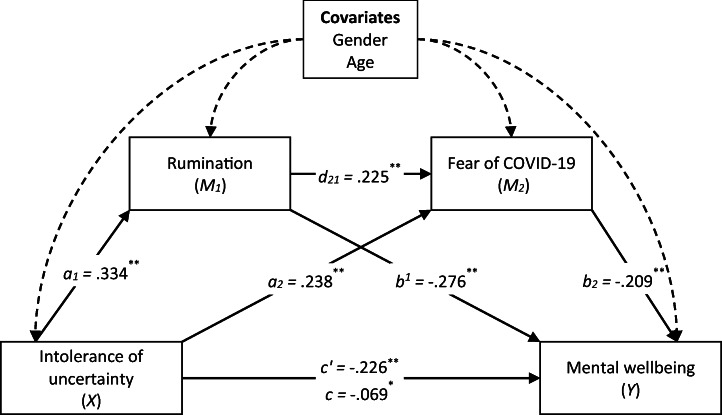
The novel coronavirus-2019 (COVID-19) pandemic has become globally widespread with millions of confirmed cases and many countries implementing various levels of quarantine. Therefore, it is important to investigate the psychological consequences of this process, given the unique situation that has been experienced globally. Therefore, the present study examined whether intolerance of uncertainty was related to mental wellbeing and whether this relationship was mediated by rumination and fear of COVID-19. The sample comprised 1772 Turkish individuals (aged between 18 and 73 years) from 79 of 81 cities in Turkey, who completed measures of mental wellbeing, intolerance of uncertainty, rumination, and fear of COVID-19. Results of serial mediation analyses showed that intolerance of uncertainty had a significant direct effect on mental wellbeing. Rumination and fear of COVID-19, in combination, serially mediated the association between intolerance of uncertainty and mental wellbeing. The findings are discussed within the framework of the psychological consequences of the COVID-19 pandemic and related literature.
Overview
The claims and statistics of this paper haven’t been checked yet.
Free: it reads the open-access text and checks the first 5 claims that cite a source we can check. Create a free account to check every claim.
Integrity signals
Registry
Cites
Statistics
Figures
Verification
Claims the paper makes
The claims and statistics of this paper haven’t been checked yet.
Free: it reads the open-access text and checks the first 5 claims that cite a source we can check. Create a free account to check every claim.
Claims other papers make about this one
Each is checked against this paper’s own text: does it say what the citing paper says it does?
The source backs part of the claim, not all of it — or backs it for a different population, condition or comparison.
In the citing paper
“This is due to the fact that people tend to be more anxious if they keep ruminating on a particular thought, given the fact that we conducted this study at the time when the entire country was under lockdown (Satici et al., 2020).”
From Knowledge of COVID-19 and Its Influence on Mindfulness, Cognitive Emotion Regulation and Psychological Flexibility in the Indian Community (2020) · cites this paper as Satici et al., 2020
Experimental — accuracy not yet measuredThe source backs part of the claim, not all of it — or backs it for a different population, condition or comparison.
In the citing paper
“It can be considered as a sub-trait of anxiety [44] (that is, in its turn, a facet of neuroticism), which has often been found in association with stress, distress, insomnia, psychosomatic symptoms, and other clinical conditions in several recent studies carried out on COVID-19 among the general population and HCWs (e.g., [45,51,52,53,54,55,56]).”
From Associations between Personality Traits, Intolerance of Uncertainty, Coping Strategies, and Stress in Italian Frontline and Non-Frontline HCWs during the COVID-19 Pandemic—A Multi-Group Path-Analysis (2021) · cites this paper as [54]
Experimental — accuracy not yet measuredThe source backs part of the claim, not all of it — or backs it for a different population, condition or comparison.
In the citing paper
“Uncertainty of disease condition [59], rapid changes of recommendations [60], and amplification of information during the pandemic could lead to confusion, which in turn results in lower satisfaction.”
From Digital health literacy, online information-seeking behaviour, and satisfaction of Covid-19 information among the university students of East and South-East Asia (2022) · cites this paper as [59]
Experimental — accuracy not yet measured
Self-check
Percentages, sums and reported differences re-computed from the paper’s own numbers.
The self-check needs the paper’s full text.
Citations
Cites
(2013) · Cited by 44,563
(2017) · Cited by 16,319
Nolen-Hoeksema, S., Wisco, B. E., & Lyubomirsky, S. (2008) · Perspectives on Psychological Science · doi:10.1111/j.1745-6924.2008.00088.x · Cited by 5,172
The Warwick-Edinburgh Mental Well-being Scale (WEMWBS): development and UK validation
Tennant, R., Hiller, L., Fishwick, R., Platt, S., Joseph, S., Weich, S., Parkinson, J., Secker, J., & Stewart-Brown, S. (2007) · Health and Quality of Life Outcomes · doi:10.1186/1477-7525-5-63 · Cited by 5,031
Responses to depression and their effects on the duration of depressive episodes
Nolen-Hoeksema, S. (1991) · Journal of Abnormal Psychology · doi:10.1037/0021-843x.100.4.569 · Cited by 4,529
The Fear of COVID-19 Scale: Development and Initial Validation
Ahorsu, D. K., Lin, C.-Y., Imani, V., Saffari, M., Griffiths, M. D., & Pakpour, A. H. (2022) · International Journal of Mental Health and Addiction · doi:10.1007/s11469-020-00270-8 · Cited by 4,332
Self-citationRumination reconsidered: a psychometric analysis.
Treynor, W., Gonzalez, R., & Nolen-Hoeksema, S. (2003) · Cognitive Therapy and Research · doi:10.1023/a:1023910315561 · Cited by 3,808
Fearing the unknown: A short version of the Intolerance of Uncertainty Scale
Carleton, R. N., Norton, M. A. P. J., & Asmundson, G. J. G. (2007) · Journal of Anxiety Disorders · doi:10.1016/j.janxdis.2006.03.014 · Cited by 2,288
Explaining the gender difference in depressive symptoms.
Nolen-Hoeksema, S., Larson, J., & Grayson, C. (1999) · Journal of Personality and Social Psychology · doi:10.1037/0022-3514.77.5.1061 · Cited by 1,543
Garfin, D. R., Silver, R. C., & Holman, E. A. (2020) · Health Psychology · doi:10.1037/hea0000875 · Cited by 1,270
Research works printed but not linked: 1
- Keldal G Turkish version of the Warwick-Edinburgh Mental Well-Being Scale: A validity and reliability study Journal of Happiness & Well-Being 2015 3 1 103 115
Cited by
Items 401–500 of 575
Mirzaee, M. J. (2026) · Journal of Social Sciences & Humanities · doi:10.62810/jssh.v3i1.222 · Cited by 1
“It is also consistent with evidence from non-Western cultures, which have also identified hope as an important factor of resilience (Satici et al., 2022).”
Trajectories of intolerance of uncertainty in adolescents: Associations with anxiety and depression
Ye, H., Wang, J., Zhang, J., Chen, D., Liu, K., Zhang, Y., Liu, Y., Yao, Y., Wang, D., & Fan, F. (2026) · Journal of Anxiety Disorders · doi:10.1016/j.janxdis.2026.103146 · Cited by 2
Tan, H. M., Lin, P. K. F., & Ramsay, J. E. (2025) · Mental Health Religion & Culture · doi:10.1080/13674676.2025.2584197 · Cited by 1
“This finding corresponds with previous research indicating that intolerance of uncertainty is negatively correlated with psychological well-being (Satici et al., 2022).”
Liang, J., & Zhou, Z. (2026) · Asia Pacific Journal of Tourism Research · doi:10.1080/10941665.2026.2639690 · Cited by 1
Seki, T., Gökalp, Z. Ş., Abdilamitova, Z., Küçükdere, R. T., & Bayat, A. (2026) · Research on Education and Psychology · doi:10.54535/rep.1886848 · Cited by 1
Homayoon, M. N., Damirchi, E. S., & Abdoli, A. (2026) · Journal of Affective Disorders Reports · doi:10.1016/j.jadr.2026.101137 · Cited by 1
Implicit/Explicit Beliefs About God, Uncertainty, and Anxiety
Aryeh, R., Pirutinsky, S., & Rosmarin, D. H. (2021) · The Journal of Nervous and Mental Disease · doi:10.1097/nmd.0000000000001298 · Cited by 3
“On the other hand, psychopathology such as generalized anxiety and IU, which involve mechanisms such as rumination and reparative negative thinking (Satici et al., 2020), may be more related to explicit beliefs.”
BackgroundArslan, Ü., Muyan, M., Bakalım, O., Uyar, B. B., & Sağlıklı, H. (2021) · Cukurova University Faculty of Education Journal · Cited by 10
Mukherjee, R. (2021) · Jurnal Litbang Edusaintech · doi:10.51402/jle.v2i2.19 · Cited by 1
“Anxiety, a feeling of tension and worriness for the future, stress (physical, mental and emotional tension) and depression associated with COVID-19 may contribute to chaotic psychological consequences affecting the overall wellbeing of an individual (Satici et al., 2020).”
BackgroundResultEfendi, D., Nofrima, S., & Saputra, H. A. (2022) · JHSS (JOURNAL OF HUMANITIES AND SOCIAL STUDIES) · doi:10.33751/jhss.v6i1.5303 · Cited by 1
Testing the Validity and Reliability of FCV-19 Scale in India: Validation Among Students in India
Tarab, S. (2022) · IIMS Journal of Management Science · doi:10.1177/0976030x221111618 · Cited by 2
“Different cultural versions of this scale have also been reported, for example, Turkish (Haktanir et al., 2020; Satici et al., 2020), Arabic (Alyami et al., 2020), Spanish (Martínez-Lorca et al., 2020), Japanese (Masuyama et al., 2020), Hebrew (Tzur Bitan et al., 2020), Bengali (Sakib et al., 2020)…”
Aksoy, A. T., Cihanyurdu, İ., İlbasmış, Ç., Ünver, H., & Aksoy, A. T. (2022) · Turkish Journal of Pediatric Disease · doi:10.12956/tchd.1047592 · Cited by 1
Impact of the COVID-19 Lockdown on Architecture Students' Well-Being
Mari, T., Gunasagaran, S., Lim, W. S., Lee, S.-E., & Jamal, K. A. A. (2022) · Advances in media, entertainment and the arts (AMEA) book series · doi:10.4018/978-1-6684-5119-9.ch016 · Cited by 1
The traumatic impact of the COVID-19 pandemic: the possible role of rumination and uncertainty
Yiğitoğlu, G. T., Keskin, G., & Köktaş, N. Ç. (2023) · Current Psychology · doi:10.1007/s12144-023-04379-6 · Cited by 3
“sense of uncertainty regarding people’s safety, view of the world, and financial situation, which may be difficult to bear for some individuals in Turkey as well as in the world (Ikizer et al., 2021; Satici et al., 2020).”
Sujan, M. S. H., Haghighathoseini, A., Tasnim, R., Ripon, R. K., Akter, M., Ripon, S. A., Hasan, M. M., Uddin, M. R., & Ferdous, M. Z. (2023) · Asian Journal of Health Sciences · doi:10.15419/ajhs.v9i1.521 · Cited by 4
Zamir, S., Sarwar, R., Naz, W., Sajid, F., Suffyan, M., Rashid, M. J., & Saleemi, M. A. (2023) · Journal of Sheikh Zayed Medical College · doi:10.47883/jszmc.v13i3.229 · Cited by 1
Ray, K. K. (2023) · Asian Social Work and Policy Review · doi:10.1111/aswp.12286 · Cited by 3
Individual differences in emotional reactions to bistable perception
Goodhew, S. C., & Edwards, M. (2023) · Journal of Personality · doi:10.1111/jopy.12861 · Cited by 1
Gündoğmuş, A. G., Doğu, S. E., & İspir, G. Z. (2023) · Journal of Public Health · doi:10.1007/s10389-023-02019-8 · Cited by 1
“Studies have observed that an increase in the fear of COVID-19 is associated with depression, anxiety, and stress levels and an inverse association between fear of COVID-19 and mental well-being and life satisfaction (Satici et al. 2020, 2021).”
Anxiety during the COVID-19 Pandemic: Prevalence, Effects and Predisposing Factors
Şebnem, A. K. A. N. (2024) · Psikiyatride Guncel Yaklasimlar - Current Approaches in Psychiatry · doi:10.18863/pgy.1263730 · Cited by 2
Remote work and the well-being of employees – the perspective of the IT industry in Poland
Gross-Gołacka, E., Szkudlarek, E., Brzegowy, A., & Zwolińska-Ligaj, M. (2023) · Nowoczesne Systemy Zarządzania · doi:10.37055/nsz/174980 · Cited by 2
Mert, U. S. T. A., ŞAFAK, M., YILDIZ, Z., & Başkurt, Z. (2024) · Ergoterapi ve Rehabilitasyon Dergisi · doi:10.30720/ered.1308585 · Cited by 1
Bienestar psicológico y agresión reactiva en Latinoamérica en tiempos del COVID-19
Cadena, C. H. G., Sierra, J. M. Q., Caycho‐Rodríguez, T., García, F. E., Pinales, Ó. M. L., Facultad de Psicología, U. A. D. N. L., Investigador Independiente, M., Facultad de Psicología, U. C. D. S., Facultad de Medicina Departamento de Psiquiatría y Salud Mental, U. D. C., & Facultad de Ingeniería Mecánica y Eléctrica, U. A. D. N. L. (2023) · Suma Psicológica · doi:10.14349/sumapsi.2023.v30.n2.3 · Cited by 2
Social and Psychological tools to promote healthy life style
Дворник, М. С., Громова, Г., Гундертайло, Ю. Д., Лазоренко, Б. П., Мирончак, К. В., Савінов, В. В., Титаренко, Т. М., & Чернявська, М. О. (2024) · doi:10.33120/sptphls-2024 · Cited by 3
Wang, S., Wang, X. L., & Dai, H. (2024) · Social Psychiatry and Psychiatric Epidemiology · doi:10.1007/s00127-024-02713-2 · Cited by 3
Mostafa, M., Ghaly, M. S., Sayed, H. H., & Elaziz, M. A. (2024) · Suez Canal University Medical Journal · doi:10.21608/scumj.2024.369042 · Cited by 1
Bustamante, R. S., Claderón, J. E. S., & Huaynalaya, D. M. (2024) · Persona · doi:10.26439/persona2024.n27(1).6819 · Cited by 1
“Es decir, el poco conocimiento sobre la enfermedad y su tratamiento podría haber generado un incremento del miedo en las personas, lo que ha propiciado un entorno estresante y la disminución del bienestar (Satici et al., 2020).”
BackgroundKim, J. (2024) · International Journal for Educational and Vocational Guidance · doi:10.1007/s10775-024-09688-1 · Cited by 2
Yılmaz, F. B., Satıcı, S. A., Okur, S., Kütük, H., & Karaağaç, Z. G. (2024) · Current Issues in Personality Psychology · doi:10.5114/cipp/190902 · Cited by 2
Laguerre, R. A., & Barnes-Farrell, J. L. (2024) · Work Aging and Retirement · doi:10.1093/workar/waae015 · Cited by 2
Körün, A. B., & Satıcı, S. A. (2025) · Psychiatric Quarterly · doi:10.1007/s11126-025-10157-3 · Cited by 2
“Being intolerant to uncertain situations may increase rumination [39].”
Jalalizadeh, B. (2022) · The Journal of Bahá’í Studies · doi:10.31581/jbs-31.1-2.297(2021 · Cited by 2
Evaluation of Coronavirus Phobia and Depression in Patients With Cardiovascular Disease
Cansel, N., Karaca, Y., & Yağın, F. H. (2022) · Kahramanmaraş Sütçü İmam Üniversitesi Tıp Fakültesi Dergisi · doi:10.17517/ksutfd.994994 · Cited by 1
Freeman, K. M., & McDermott, M. (2022) · Journal of Motivation Emotion and Personality Reversal Theory Studies · doi:10.12689/jmep.2022.1101 · Cited by 1
Приверженность соблюдению мер самоизоляции в период пандемии COVID-19
Кузнецова, Е., Karpova, E. B., Ковальчук, Ю., Николаева, Е., & Удалова, В. (2020) · Психологические исследования · doi:10.54359/ps.v13i73.171 · Cited by 1
Covid-19 Pandemic: A Qualitative Study on Adolescents’ Stress, Anxiety, and Family Communication
Çetin, Z., & Ata, S. (2022) · Pakistan Journal of Medical and Health Sciences · doi:10.53350/pjmhs22165352 · Cited by 2
TERKEŞ, N., & Ateş, M. (2022) · Turkiye Klinikleri Journal of Nursing Sciences · doi:10.5336/nurses.2021-85337 · Cited by 1
Ozden-Yıldırım, M. S. (2022) · Global Journal of Guidance and Counseling in Schools Current Perspectives · doi:10.18844/gjgc.v12i1.7053 · Cited by 1
Peran Intolerance of Uncertainty terhadap Depresi pada Individu Dewasa Awal
Aprodita, N. P. (2021) · Humanitas (Jurnal Psikologi) · doi:10.28932/humanitas.v5i2.3617 · Cited by 8
Муращенкова, Н. В. (2022) · Monitoring obŝestvennogo mneniâ: èkonomičeskie i socialʹnye peremeny · doi:10.14515/monitoring.2022.6.2261
Nurses’ COVID-19 fears and patient safety attitudes in the pandemic
Efıl, S., Türen, S., & Demir, E. (2023) · European Journal of Clinical and Experimental Medicine · doi:10.15584/ejcem.2023.1.3 · Cited by 2
Akcan, G., & Uğraş, S. (2023) · Global Journal of Psychology Research New Trends and Issues · doi:10.18844/gjpr.v13i1.8492 · Cited by 1
The Impact of Ruminative Thinking on Verbal and Visual Task Performance
Johnman, M. L., & Boschen, M. J. (2023) · Psychotherapy and Counselling Journal of Australia · doi:10.59158/001c.73835 · Cited by 1
Kukafka, R., Millery, M. P., Pan, S. M., Silverman, T. B., Zhang, T., McGuinness, J. E., Crew, K. D., & Aguirre, A. N. (2023) · Humanities and Social Sciences Communications · doi:10.1057/s41599-023-01679-x · Cited by 1
““ (Carleton, 2016; Satici et al., 2020) IU has been associated with increased anxiety and depression and therefore has a vital role in illuminating how people might respond to and cope during a pandemic (Voitsidis et al.”
Background(2023) · Pakistan Journal of Humanities and Social Sciences Research · doi:10.37605/pjhssr.v6i1.333
Optimism and Life Satisfaction of Poles during the Second and Fourth Waves of the COVID-19 pandemic
Biel, K., Twardowska-Staszek, E., & Rostek, I. (2023) · The Person and the Challenges. The Journal of Theology, Education, Canon Law and Social Studies Inspired by Pope John Paul II · doi:10.15633/pch.13115
Coping Strategies During the COVID-19 Pandemic and Self-Determination: A Review of Russian Studies
Kuznetsova, E. A., Moskvicheva, N., Zinovyeva, E. V., & Николаевна, К. С. (2023) · Psychology in Russia State of Art · doi:10.11621/pir.2023.0201 · Cited by 1
Satisfaction with Life Scale (SWLS)
Townshend, K. (2025) · Springer eBooks · doi:10.1007/978-3-031-47219-0_83 · Cited by 3
Pandemic-Induced Depression and Anxiety in Healthcare ProfessionalsPreprint
Weibelzahl, S., Reiter, J., & Duden, G. S. (2020) · PsyArXiv (OSF Preprints) · doi:10.31234/osf.io/5rehd · Cited by 1
The adverse impact of consecutive COVID-19 waves on mental healthPreprint
Novotný, J., Gonzalez-Rivas, J. P., Kunzová, Š., Skladaná, M., Pospíšilová, A., Polcrova, A. B., Vassilaki, M. E., Medina‐Inojosa, J. R., López-Jiménez, F. A., Geda, Y. E., et al. (2021) · medRxiv · doi:10.1101/2021.07.25.21261094 · Cited by 1
Morgül, E., Kallitsoglou, A., & Essau, C. A. (2022) · Research Square · doi:10.21203/rs.3.rs-1184183/v2 · Cited by 1
The Predictors of COVID-19 Vaccine Hesitancy among Turkish Cypriot ParentsPreprint
Varoglu, S., & Bayraktar, F. (2024) · Preprints.org · doi:10.20944/preprints202407.0716.v1
Trajectory of severe COVID anxiety and predictors for recovery in an 18-month cohortPreprint
King, J. D., McQuaid, A., Barnicot, K., Bassett, P., Leeson, V. C., Simplicio, M. C. D., Tyrer, P. J., Tyrer, H., Watt, R. G., & Crawford, M. (2024) · medRxiv · doi:10.1101/2024.07.22.24310664 · Cited by 1
Mayor, E., & Lieb, R. (2024) · PLoS ONE · doi:10.1371/journal.pone.0299593
“In [42], IU was associated with anxiety and perceived threat in relation to the pandemic and to wellbeing (negatively), and in [36], the link between IU and wellbeing during the pandemic was found to be serially mediated by both fear of COVID-19 and ruminative thoughts.”
Backgroundanuk, D. (2023) · Turkish Journal of Oncology · doi:10.5505/tjo.2023.3934
“[29] Satıcı et al.[54] emphasize that intolerance to uncertainty has a direct impact on mental health during the pandemic.”
BackgroundVocational School of Health Services, D. E. U., Acikgoz, A., Yoruk, S., School of Health, D. O. M., Toyran, N., Vocational School of Health Services, D. E. U., Guler, D. S., & Training And Research Hospital, S. U. (2023) · Psychiatria Danubina · doi:10.24869/psyd.2023.544
“In another study, a neg - ative relationship was found between fear of COVID-19 and mental well-being (Satici et al. 2020).”
Şahin, E. E., & DOBRUCALI, B. (2022) · Psikiyatride Guncel Yaklasimlar - Current Approaches in Psychiatry · doi:10.18863/pgy.1067626 · Cited by 9
The Impact of Covid- 19 Pandemic on Mental Well-Being of Health Care Workers: A Multicenter Study
Hassan, N., Memon, H. A., Hassan, N., Luxmi, S., & Sultana, F. (2020) · Journal of Business and Social Review in Emerging Economies · doi:10.26710/jbsee.v6i4.1426
Dymecka, J., Gerymski, R., Iszczuk, A., & Bidzan, M. (2021) · Research Square · doi:10.21203/rs.3.rs-418295/v1
“Several studies have also 241 shown that fear of COVID-19 can act as a mediator between intolerance to uncertainty and 242 psychological well-being [50] and between perceived health status and insomnia, mental health 243 and preventive behaviors [51].”
BackgroundTürkçapar, M. H., Kahya, Y., Taşkesen, T. Ç., & Işık, H. (2021) · TURKISH JOURNAL OF MEDICAL SCIENCES · doi:10.3906/sag-2106-175
“Different studies reported that intolerance to uncertainty was associated with the COVID-19 stress syndrome [59], reduced general well-being [78] and internalizing symptoms [6].”
BackgroundThe misuse of power by church wardens : a challenge to pastoral care
Mangqishi, M. O. L. (2011) · UpSpace Institutional Repository (University of Pretoria)
Environmental surveillance at Hanford for CY-1980. [Lead abstract]
Sula, M. J., & Blumer, P. J. (1981) · OSTI OAI (U.S. Department of Energy Office of Scientific and Technical Information)
Internet Humor During the Covid-19 Pandemic and Self-isolation – “Feast in Time of Plague”?
Владимировна, М. М. (2021) · Гуманитарно-педагогические исследования · doi:10.18503/2658-3186-2021-5-4-50-56
Morgül, E., Kallitsoglou, A., & Essau, C. A. (2021) · Research Square · doi:10.21203/rs.3.rs-1184183/v1
“…with research that shows that worry of COVID-19 infection is related to poor psychological wellbeing (Fitzpatrick et al., 2020; Kayis et al., 2021; Satici et al., 2020a) our ndings propose that public health strategies should aim to reduce worry and social panic in the face of imminent crisis.”
BackgroundPoczątek epidemii w oczach uczestników programu Erasmus+
Mirucka, M. (2021) · Kultura i Społeczeństwo · doi:10.35757/kis.2021.65.3.4
العزیز, ع. ا. م. ع. (2022) · المجلة المصرية للدراسات النفسية · doi:10.21608/ejcj.2022.212024
Siew, Y. H., Low, Y. L., Wong, C. L., T’ng, S. T., & Ho, K. H. (2021) · International Journal of Research in Counseling and Education · doi:10.24036/00446za0002
Fear of Corona and Depression in Graduate Students; Mediating Role of Stress and Anxiety.
Shahid, S., & Shahid, A. (2022) · Journal of Research in Psychology · doi:10.31580/jrp.v3i2.2345
Covid-19 Pandemic: A Qualitative Study on Adolescents’ Stress, Anxiety, and Family CommunicationPreprint
Çetin, Z., & Ata, S. (2022) · Research Square · doi:10.21203/rs.3.rs-1313696/v1
Emotional changes in people with disabilities during the COVID-19 pandemic
Ivić-Hofman, K. Š., Veseličić, B., & Jerković, I. S. (2022) · Specijalna edukacija i rehabilitacija · doi:10.5937/specedreh21-34554
“In addition to anxiety and depression, Qiu et al. (2020), mention an increased number of panic disorders, while other researchers also suggest moderate to severe symptoms of somatization caused by pandemic induced stress (Arslan & Yildirim, 2020; Satici et al., 2020).”
Background(2021) · PeerJ · doi:10.7287/peerj.10771v0.2/reviews/2
“…exploring the role of intolerance to uncertainty in mental 509 well-being associated with the COVID-19 pandemic have reported that the combination of 510 rumination and fear of COVID-19 mediates the association between intolerance to uncertainty 511 and mental well-being (Satici et al., 2020).”
BackgroundInfluentialSujan, M. S. H., Haghighathoseini, A., Tasnim, R., Ripon, R. K., Ripon, S. A., Hasan, M. M., Uddin, M. R., & Ferdous, M. Z. (2022) · medRxiv · doi:10.1101/2022.05.18.22275203
“…threat of COVID-19 has a negative impact on subjective mental well being (Meo et al., 2020; Paredes et al., 2021), serial mediation studies revealed that during COVID-19, intolerance, and uncertainty had a large direct effect on mental well-being and satisfaction with life (Satici et al., 2020).”
BackgroundCovid-19 Pandemic: A Qualitative Study on Adolescents’ Stress, Anxiety, and Family CommunicationPreprint
Çetin, Z. (2022) · Research Square · doi:10.21203/rs.3.rs-1313696/v2
Evli, M., Şimşek, N., & Ödek, Ö. (2022) · Black Sea Journal of Health Science · doi:10.19127/bshealthscience.1059377
(2022) · The Annals of Clinical and Analytical Medicine · doi:10.4328/acam.21108
Intolerance of uncertainty and psychological well-being of nurses during COVID-19 pandemic in Turkey
Dur, Ş., & Polat, S. (2022) · Progress in Health Sciences · doi:10.5604/01.3001.0015.8847
“The state of feeling stressed and anxious every day during the pandemic may have negative effects on psychological wellbeing as well [17,32,33].”
BackgroundTurkish Validity and Reliability Study of Questionnaire on Perception of Threat from COVID-19
Akgül, Ö., Tetik, M., & Aykaç, C. (2022) · Forbes Journal of Medicine · doi:10.4274/forbes.galenos.2022.73645
COVID-19 pandemic, family climate, and social media addiction among pharmacy faculty students
Ozden-Yıldırım, M. S. (2022) · International Journal of Emerging Trends in Health Sciences · doi:10.18844/ijeths.v6i1.7640
Batool, S., & Shuanghu, F. (2021) · American Journal of Psychology · doi:10.47672/ajp.711
Understanding work well-being during COVID-19 pandemic : A study in expatriates and non-expatriates
Biswas, T. (2022) · Personalmanagement und Arbeits- und Organisationspsychologie · doi:10.20378/irb-55775
E-Readiness of the Universities During the COVID-19 Pandemic: Evidence from Bahrain
Sarea, A. M. Y., & Taufiq-Hail, G. A.-M. (2022) · Springer eBooks · doi:10.1007/978-3-031-13351-0_12
Ogbeifo, S., & Enakpoya, E. E. (2022) · European Journal of Open Education and E-learning Studies · doi:10.46827/ejoe.v8i1.4601
ODNOS NEKIH ODREDNICA SUBJEKTIVNE DOBROBITI S BRIGOM ZBOG NOVOG VALA COVID19 PANDEMIJE
Kopilaš, V. (2022) · Zdravstveni glasnik · doi:10.47960/2303-8616.2022.15.24
“uključujući vjerojatnost zaraze i intenzitet promjena koje bolest uzrokuje u slučaju infekcije (35).”
BackgroundERGENLERDE GÖRÜLEN COVİD-19 FOBİSİNİN ANKSİYETE DÜZEYLERİNE ETKİSİ
GÜLEY, B. (2023) · Premium e-Journal of Social Science · doi:10.37242/pejoss.4358
How Covid 19 Fear Affected Nutritional Support in Healthcare Professionals
Döner, P., Aksoy, H., & Dirican, E. (2023) · Genel Tıp Dergisi · doi:10.54005/geneltip.1075733
متولي, ه. أ. ع. (2022) · مجلة كلية التربية جامعة بنها · doi:10.21608/jfeb.2022.288605
Fazit: New Ways of Working – Wie Nutzen maximieren und Gefahren reduzieren?
Hartner‐Tiefenthaler, M., Polic-Tögel, S., & Mayer, M. M. (2023) · Springer eBooks · doi:10.1007/978-3-662-63129-4_5
Barzut, V., Đurović, D., & Novakov, I. (2023) · Primenjena psihologija · doi:10.19090/pp.v16i1.2411 · Cited by 2
Okray, Z., ÖKE, D., Direktör, C., & Köroğlu, B. (2023) · Türk Psikolojik Danışma ve Rehberlik Dergisi · doi:10.17066/tpdrd.1209521zd · Cited by 1
STRATEGIC CAREER BEHAVIORS IN FLEXIBLE WORKING PATTERNS: A MEDIATION ANALYSIS
(2023) · Psychological applications and trends · doi:10.36315/2023inpact052
Metadata
- Authors
- Satici, B., Saricali, M., Satici, S. A., & Griffiths, M. D.
- Affiliations
- Nottingham Trent University (GB)
- Corresponding author
- Griffiths, Mark D.
- Venue
- International Journal of Mental Health and Addiction
- Published
- 2020-05-15
- Volume
- 20
- Issue
- 5
- Pages
- 2731-2742
- ISSN
- 1557-1874 (ISSN-L)
- 1557-1882
- PMC
- PMC7228430
- OpenAlex
- W3025803203
- Cited by
- 580
- References
- 45
- Citations by year
- 2026: 21 · 2025: 37 · 2024: 73 · 2023: 100 · 2022: 163 · 2021: 141 · 2020: 40
- FWCI
- 44.44
- Type
- journal article
- Language
- en
- Open access
- hybrid
- doi.org
- Licence
- cc-by
- creativecommons.org/licenses/by/4.0 (tdm)
- creativecommons.org/licenses/by/4.0 (vor)
- Locations
- International Journal of Mental Health and Addiction (publishedVersion, cc-by)
- PubMed Central (publishedVersion, cc-by)
- PubMed (publishedVersion)
- Nottingham Trent University's Institutional Repository (Nottingham Trent Repository) (acceptedVersion)
- Yildiz Technical University - AVESIS (submittedVersion, cc-by-nc-nd)
- Funders
- Nottingham Trent University
- Topics
- Social Sciences › Psychology › Clinical Psychology › COVID-19 and Mental Health
- Social Sciences › Psychology › Experimental and Cognitive Psychology › Anxiety, Depression, Psychometrics, Treatment, Cognitive Processes
- Social Sciences › Psychology › Clinical Psychology › Mindfulness and Compassion Interventions
- Keywords
- intolerance of uncertainty, psychological well-being, rumination, fear of COVID-19, COVID-19 pandemic, serial mediation, Turkish adults
About these checks
Registry, retraction, Cites and statistics results are computed, not judged, with one exception: a printed reference that no index lists is read once by a model before it counts as a citation error. Claims are extracted by a model and kept only when their quote appears verbatim in the text; each cited source is then checked, with a model’s help, for whether it says what the claim relies on. Those verdicts can be wrong — read the claim’s quote and the cited source before relying on one.
Statistics and arithmetic are recomputed, not judged.
Confidence bands are shown only for fields calibrated on our annotated test set. None is calibrated yet, so no band is shown.
What counts as a claim ›How we measure confidence ›How we check this ›
Are you an author, or do you see a problem with this page? Request a review
Data sources
Bibliographic data: Semantic Scholar, OpenAlex, Crossref.
Contains information from the Semantic Scholar Academic Graph Datasets, made available under the ODC Attribution License (ODC-BY 1.0).
Semantic Scholar’s data is described in: Kinney, R., et al. (2023). The Semantic Scholar Open Data Platform. arXiv:2301.10140.
