

Intolerance of uncertainty and mental wellbeing: serial mediation by rumination and fear of COVID-19.
Open accessThe DOI matches its Crossref record, with a small difference in title or year; 44 of the 45 references it cites were found in a registry or an index.
Abstract
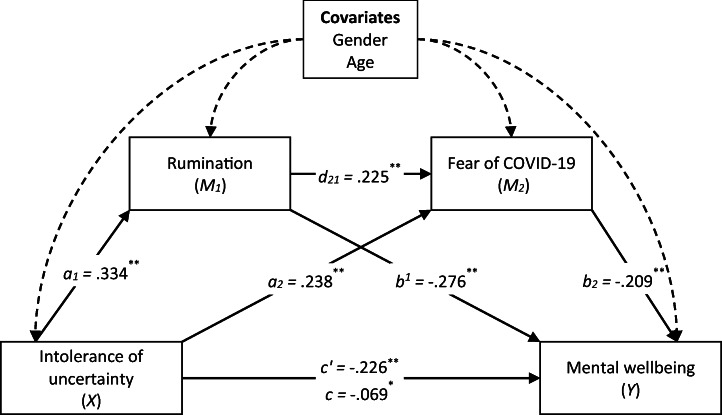
The novel coronavirus-2019 (COVID-19) pandemic has become globally widespread with millions of confirmed cases and many countries implementing various levels of quarantine. Therefore, it is important to investigate the psychological consequences of this process, given the unique situation that has been experienced globally. Therefore, the present study examined whether intolerance of uncertainty was related to mental wellbeing and whether this relationship was mediated by rumination and fear of COVID-19. The sample comprised 1772 Turkish individuals (aged between 18 and 73 years) from 79 of 81 cities in Turkey, who completed measures of mental wellbeing, intolerance of uncertainty, rumination, and fear of COVID-19. Results of serial mediation analyses showed that intolerance of uncertainty had a significant direct effect on mental wellbeing. Rumination and fear of COVID-19, in combination, serially mediated the association between intolerance of uncertainty and mental wellbeing. The findings are discussed within the framework of the psychological consequences of the COVID-19 pandemic and related literature.
Overview
The claims and statistics of this paper haven’t been checked yet.
Free: it reads the open-access text and checks the first 5 claims that cite a source we can check. Create a free account to check every claim.
Integrity signals
Registry
Cites
Statistics
Figures
Verification
Claims the paper makes
The claims and statistics of this paper haven’t been checked yet.
Free: it reads the open-access text and checks the first 5 claims that cite a source we can check. Create a free account to check every claim.
Claims other papers make about this one
Each is checked against this paper’s own text: does it say what the citing paper says it does?
The source backs part of the claim, not all of it — or backs it for a different population, condition or comparison.
In the citing paper
“This is due to the fact that people tend to be more anxious if they keep ruminating on a particular thought, given the fact that we conducted this study at the time when the entire country was under lockdown (Satici et al., 2020).”
From Knowledge of COVID-19 and Its Influence on Mindfulness, Cognitive Emotion Regulation and Psychological Flexibility in the Indian Community (2020) · cites this paper as Satici et al., 2020
Experimental — accuracy not yet measuredThe source backs part of the claim, not all of it — or backs it for a different population, condition or comparison.
In the citing paper
“It can be considered as a sub-trait of anxiety [44] (that is, in its turn, a facet of neuroticism), which has often been found in association with stress, distress, insomnia, psychosomatic symptoms, and other clinical conditions in several recent studies carried out on COVID-19 among the general population and HCWs (e.g., [45,51,52,53,54,55,56]).”
From Associations between Personality Traits, Intolerance of Uncertainty, Coping Strategies, and Stress in Italian Frontline and Non-Frontline HCWs during the COVID-19 Pandemic—A Multi-Group Path-Analysis (2021) · cites this paper as [54]
Experimental — accuracy not yet measuredThe source backs part of the claim, not all of it — or backs it for a different population, condition or comparison.
In the citing paper
“Uncertainty of disease condition [59], rapid changes of recommendations [60], and amplification of information during the pandemic could lead to confusion, which in turn results in lower satisfaction.”
From Digital health literacy, online information-seeking behaviour, and satisfaction of Covid-19 information among the university students of East and South-East Asia (2022) · cites this paper as [59]
Experimental — accuracy not yet measured
Self-check
Percentages, sums and reported differences re-computed from the paper’s own numbers.
The self-check needs the paper’s full text.
Citations
Cites
(2013) · Cited by 44,563
(2017) · Cited by 16,319
Nolen-Hoeksema, S., Wisco, B. E., & Lyubomirsky, S. (2008) · Perspectives on Psychological Science · doi:10.1111/j.1745-6924.2008.00088.x · Cited by 5,172
The Warwick-Edinburgh Mental Well-being Scale (WEMWBS): development and UK validation
Tennant, R., Hiller, L., Fishwick, R., Platt, S., Joseph, S., Weich, S., Parkinson, J., Secker, J., & Stewart-Brown, S. (2007) · Health and Quality of Life Outcomes · doi:10.1186/1477-7525-5-63 · Cited by 5,031
Responses to depression and their effects on the duration of depressive episodes
Nolen-Hoeksema, S. (1991) · Journal of Abnormal Psychology · doi:10.1037/0021-843x.100.4.569 · Cited by 4,529
The Fear of COVID-19 Scale: Development and Initial Validation
Ahorsu, D. K., Lin, C.-Y., Imani, V., Saffari, M., Griffiths, M. D., & Pakpour, A. H. (2022) · International Journal of Mental Health and Addiction · doi:10.1007/s11469-020-00270-8 · Cited by 4,332
Self-citationRumination reconsidered: a psychometric analysis.
Treynor, W., Gonzalez, R., & Nolen-Hoeksema, S. (2003) · Cognitive Therapy and Research · doi:10.1023/a:1023910315561 · Cited by 3,808
Fearing the unknown: A short version of the Intolerance of Uncertainty Scale
Carleton, R. N., Norton, M. A. P. J., & Asmundson, G. J. G. (2007) · Journal of Anxiety Disorders · doi:10.1016/j.janxdis.2006.03.014 · Cited by 2,288
Explaining the gender difference in depressive symptoms.
Nolen-Hoeksema, S., Larson, J., & Grayson, C. (1999) · Journal of Personality and Social Psychology · doi:10.1037/0022-3514.77.5.1061 · Cited by 1,543
Garfin, D. R., Silver, R. C., & Holman, E. A. (2020) · Health Psychology · doi:10.1037/hea0000875 · Cited by 1,270
Research works printed but not linked: 1
- Keldal G Turkish version of the Warwick-Edinburgh Mental Well-Being Scale: A validity and reliability study Journal of Happiness & Well-Being 2015 3 1 103 115
Cited by
Items 301–400 of 575
Intolerance of Uncertainty and Social Wellbeing: the Mediating Role of Emotional Experiences
Tu, S., He, J., Zhang, Y., Zhao, H., Liu, J., Turel, O., & He, Q. (2025) · Journal of Happiness Studies · doi:10.1007/s10902-025-00960-x · Cited by 6
Kaya, B., & Bağatarhan, T. (2025) · Journal of Rational-Emotive & Cognitive-Behavior Therapy · doi:10.1007/s10942-025-00625-x · Cited by 5
Li, F. S., & Ma, J. (2025) · International Journal of Tourism Research · doi:10.1002/jtr.70120 · Cited by 4
İrak, D. U., Dede, B., & Demir, N. (2024) · SAGE Open · doi:10.1177/21582440241251478 · Cited by 7
“Studies have shown that coping is associated with IU (Cai et al., 2020), even during the COVID-19 pandemic (Rettie & Daniels, 2021; Satici et al., 2022).”
Teachers’ worklife, mental health, and job burnout: Cases of Thailand and Indonesia
Piyakun, A., & Salim, H. (2023) · International Journal of Evaluation and Research in Education (IJERE) · doi:10.11591/ijere.v12i3.25077 · Cited by 18
“It is evident that most individuals do not desire to be aware of the hazards they may encounter in the future, but rather wish to be aware of and manage the threats they experience today [23].”
Cobos, P. L., Quintero, M. J., López, F. J., Luque, D., Ciria, L. F., & Morís, J. (2024) · PLoS ONE · doi:10.1371/journal.pone.0298503 · Cited by 10
Chan, B. M. C., Schouten, B. C., Boukes, M., Mansueto, A. C., & van Weert, J. C. M. (2024) · Journal of Health Communication · doi:10.1080/10810730.2024.2428973 · Cited by 6
“Although fear may harm mental wellbeing (Fofana et al., 2020; Satici et al., 2020), the Extended Parallel Process Model (EPPM) (Witte, 1992) proposes that fear appeals can have a positive impact on physical wellbeing (Pakpour & Griffiths, 2020; Wong & Sam, 2011) as it encourages compliance with…”
Menon, V., Padhy, S. K., & Pattnaik, J. I. (2020) · Asian Journal of Psychiatry · doi:10.1016/j.ajp.2020.102400 · Cited by 5
Bottaro, R., & Faraci, P. (2022) · Journal of American College Health · doi:10.1080/07448481.2022.2040516 · Cited by 4
“27 Indeed, during the coronavirus pandemic, students have faced different threats, such as fear due to their families’ lockdown situations, fear of education failure, and fear of losing social relationships.”
BackgroundWu, J., Zheng, Y., Xiong, S., Zhang, W., & Guo, S. (2022) · Frontiers in Psychiatry · doi:10.3389/fpsyt.2022.854698 · Cited by 6
Zhang, Y., & Chen, W. (2022) · Journal of Creativity in Mental Health · doi:10.1080/15401383.2022.2074591 · Cited by 5
“However, the fear of upcoming obstacles significantly increases depression, anxiety, and social dysfunction (Heath et al., 2020; Satici et al., 2020).”
BackgroundPractical and psychological challenges faced by Wuhan graduates after COVID-19 was controlled
Zhong, Q., Lei, G., Wu, H., Wang, Z., Zhang, Y., Zhang, J., Xu, F., Zhang, Z., Xiao, Q., Li, X., et al. (2022) · Journal of American College Health · doi:10.1080/07448481.2022.2068958 · Cited by 4
“31 Future development (delay, employment, further study, going abroad, and choosing a career independently), financial pressure, and graduation are the most difficult problems of graduates (Table 5).”
BackgroundGrossman‐Giron, A., Bitan, D. T., Mendlovic, S., Shemesh, S., & Bloch, Y. (2022) · International Journal of Public Health · doi:10.3389/ijph.2022.1604326 · Cited by 4
“Cross-sectional studies performed in normative populations have previously indicated that fear of COVID-19 is positively associated with anxiety, stress, and depression [21], exhaustion, loneliness, nervousness, and anger [34], and negatively associated with mental well-being [35].”
BackgroundKlee, L., Fabrice, A., Eisenburger, N., Feddern, S., Gabriel, C., Kossow, A., Nießen, J., Schmidt, N., Wiesmüller, G. A., Grüne, B., et al. (2022) · Public Health · doi:10.1016/j.puhe.2022.05.022 · Cited by 5
Cai, J., & Zhou, J. (2022) · Chaos Solitons & Fractals · doi:10.1016/j.chaos.2022.112630 · Cited by 4
Overconfidence at the time of COVID-19:Does it lead to laxer attitudes?
Piehlmaier, D., Stagno, E., & Nagy, A. (2023) · Social Science & Medicine · doi:10.1016/j.socscimed.2023.116000 · Cited by 4
“Although excessive fear of Covid can negatively impact one’s wellbeing (Satici et al., 2022), previous studies have shown that appropriate situational fear can encourage people to avoid threats and adopt self-preservatory behaviors (Rogers, 1975).”
Bozkurt, H. Ö. (2023) · Journal of Business Research - Turk · doi:10.20491/isarder.2023.1699 · Cited by 25
Chen, B., Xie, M., Zhang, Y., Zhang, H., Yu, N. X., & Lin, D. (2023) · Applied Psychology Health and Well-Being · doi:10.1111/aphw.12499 · Cited by 5
Investigating Employee Engagement: Will Occupational Health Safety Actually Impact Employee Loyalty?
Suardi, L. S., Putra, R. M., Agustin, P., & Maharani, A. (2022) · Jurnal Manajemen dan Organisasi · doi:10.29244/jmo.v13i1.34664 · Cited by 8
Klimochkina, A. Y., Nekhorosheva, E., & Kasatkina, D. A. (2022) · Psychology in Russia State of Art · doi:10.11621/pir.2022.0202 · Cited by 6
“Many scientists have stated that the COVID-19 pandemic, lockdown, and situational factors such as harsh security measures, self-isolation, fear of being infected, a lack of relevant information, loneliness, boredom, and financial troubles, negatively affected people’s mental health (Capuzzi et al., 2020; Newby et al.,…”
BackgroundAltıparmak, S., YILMAZ, A. N., & Derya, Y. A. (2021) · Journal of Basic and Clinical Health Sciences · doi:10.30621/jbachs.904429 · Cited by 6
Chiesi, F., Marunic, G., Tagliaferro, C., & Lau, C. (2022) · BMC Psychology · doi:10.1186/s40359-022-01023-z · Cited by 5
“The study aimed to explore the pattern of relationships between the I-PVDQ dimensions and psychological constructs linked to the pandemic, such as fear of COVID-19 [43], psychological inflexibility [44–46], intolerance to uncertainty [47, 48], resiliency [49–51], well-being [52, 53], and psychological distress (anxiet…”
BackgroundFeddes, A. R., Arjangi-Babetti, H. J., Bosdijk, S., Klawitter, L., Romers, A. H., Tsaousoglou, S., Doosje, B., Effting, M., & van Emmerik, A. (2024) · Group Processes & Intergroup Relations · doi:10.1177/13684302241248001 · Cited by 3
“Also, an abundance of research in the context of the COVID-19 pandemic has shown that prolonged stress-related negative emotions are related to lower mental well-being (e.g., Satici et al., 2022).”
Trait anxiety, dispositional hope and mental well-being: examining longitudinal mediation
Akat, M. (2025) · BMC Psychology · doi:10.1186/s40359-025-02864-0 · Cited by 4
Kayiş, A. R., & Akçaoğlu, M. Ö. (2022) · e-International Journal of Educational Research · doi:10.19160/e-ijer.1134080 · Cited by 4
Aprodita, N. P. (2022) · Jurnal Psikologi · doi:10.24014/jp.v18i2.16654 · Cited by 2
Satisfaction with Life Scale (SWLS)
Townshend, K. (2023) · Springer eBooks · doi:10.1007/978-3-030-77644-2_83-1 · Cited by 10
Financial crisis and its association with parental stress and children’s mental health in Lebanon
Nasr, R., Saab, S. A., Nasr, N., Haddad, C., Swaidan, E., Ibrahim, S. A., & Karam, J. (2025) · BMC Public Health · doi:10.1186/s12889-025-21398-z · Cited by 9
“Central to mental well-being is the balance between certainty and uncertainty, with financial insecurity posing a significant risk to mental health [2, 3].”
Comparison of İndividuals’ Fear of COVID-19 Pandemic and Perceived Control in Turkey
Altınayak, S. Ö., & Erkek, Z. Y. (2021) · Journal of Contemporary Medicine · doi:10.16899/jcm.940872 · Cited by 4
“[28,29] When the perceived control of the COVID-19 pandemic was evaluated, it was found that participants had a moderate sense of control.”
BackgroundIs fear of COVID-19 higher in individuals residing in more deprived areas? A nationwide study
Kim, W., Lee, S. Y., & Ju, Y. J. (2022) · Journal of Public Health · doi:10.1093/pubmed/fdac041 · Cited by 3
Carreño-Moreno, S., Chaparro-Díaz, L., & Mora, Y. Y. P. (2022) · Hacia la Promoción de la Salud · doi:10.17151/hpsal.2022.27.2.9 · Cited by 4
“118-129 otras, tal como es el caso del miedo y el estrés ante la COVID-19 (25,26).”
BackgroundFerdosipour, A., & Harami, T. (2022) · Global Journal of Guidance and Counseling in Schools Current Perspectives · doi:10.18844/gjgc.v12i2.6800 · Cited by 3
Intolerance to uncertainty and adult separation anxiety in relatives of COVID-19 inpatients
Romeo, A., NOVELLO, F., & Castelli, L. (2022) · Minerva Psychiatry · doi:10.23736/s2724-6612.22.02364-8 · Cited by 4
Abdul Hadi, A., Andresen, M., Barzantny, C., Bassetto, J., Biswas, T., Bozhinoska Lazarova, M., Dickmann, M. H., Enser, D., Escobar Borruel, I., Freitas Monteiro, T., et al. (2022) · Personalmanagement und Arbeits- und Organisationspsychologie · doi:10.20378/irb-55344 · Cited by 4
Increase in Linguistic Complexity in Older Adults During COVID-19
Karabin, M., Kyröläinen, A.-J., & Kuperman, V. (2023) · Experimental Aging Research · doi:10.1080/0361073x.2022.2163831 · Cited by 3
“…older adults greater stretches of alone time, leading both to increasing feelings of loneliness (Kyröläinen, Gillett, Karabin, Sonnadara, & Kuperman, 2022) and to more frequent and deeper introspection, reflection and rumination (Satici, Saricali, Satici, & Griffiths, 2020; Shigemoto, 2021).”
BackgroundBalogun, A. G., Agesin, B. E., Ayodele, I. O., & Olowodunoye, S. A. (2023) · Journal of Workplace Behavioral Health · doi:10.1080/15555240.2023.2220968 · Cited by 6
Murray, J., Dhami, M. K., McClatchey, K., Weiss-Cohen, L., & Ayton, P. (2023) · Europe's Journal of Psychology · doi:10.5964/ejop.7751 · Cited by 2
“Sibley et al. (2020), for instance, compared the mental and physical health and subjective wellbeing of a matched sample of adults in New Zealand a few months before the lockdown and during the first 18 days of lockdown in addition to conducting within-subjects analyses using data from the same participants a year ear…”
Cagaoan, M. S. F., Dayrit, A. C. D., Vega, A. C. R. D., & Flores, M. J. V. (2023) · Journal of Rural Community Nursing Practice · doi:10.58545/jrcnp.v1i2.119 · Cited by 15
Akgül, Ö., Uzgan, B. Ö., Tetik, M., & Aykaç, C. (2023) · Turkish Journal of Psychiatry · doi:10.5080/u27017 · Cited by 8
Maghool, A., Bakhshi, M., Rastaghi, S., & Rad, M. (2023) · Journal of Education and Health Promotion · doi:10.4103/jehp.jehp_1623_22 · Cited by 4
“[4] indicated that fear of corona can be considered as a mediator between intolerance of uncertainty and mental health, as this feeling increases negative psychological outcomes during the corona epidemic.”
BackgroundEmbodied Uncertainty and COVID-19: Social identity, stigma, trust and coping through the pandemic
Majumdar, S., & Tewatia, M. (2024) · Journal of Risk Research · doi:10.1080/13669877.2024.2340021 · Cited by 3
“Some studies have examined ‘intolerance of uncertainty’ which is the underlying fear accompanying cognitive and emotional dysfunctions when an individual perceives something as uncontrollable (Satici et al. 2020).”
BackgroundAkbari, M., Seydavi, M., Zamani, E., Jamshidi, S., & Freeston, M. H. (2024) · Clinical Psychology & Psychotherapy · doi:10.1002/cpp.3046 · Cited by 4
Harindranath, R. M., Johan, G. A., & Chavali, K. (2024) · Evidence-based HRM a Global Forum for Empirical Scholarship · doi:10.1108/ebhrm-12-2023-0342 · Cited by 3
Ozor, O. T., Ifeagwazi, C. M., Chukwuorji, J. C., Obi-keguna, C. N., Igwe, E. J., & Onu, D. U. (2025) · Journal of Health Psychology · doi:10.1177/13591053251317370 · Cited by 3
“…the key variables in the bivariate correlation analysis, and have been consistently controlled for in prior studies due to their potential impact on the relationships between self-compassion, fear of COVID-19, and HRQoL (see Deniz, 2021; Gutie´rrez-Herna´ndez et al., 2021; Satici et al., 2022).”
Improving Mental Wellbeing of Undergraduate Students During COVID-19 Pandemic
Sari, R., & Saleh, M. (2021) · Proceedings of the 4th International Conference on Sustainable Innovation 2020–Social, Humanity, and Education (ICoSIHESS 2020) · doi:10.2991/assehr.k.210120.110 · Cited by 1
“Mental wellbeing is influenced by direct and indirect trauma and perceptions of risk [14].”
BackgroundInfluentialCOVID-19-related anxiety: the role of intolerance to uncertainty and resilience
Vousoura, E., Makrygiorgos, N., Tsarpalis-Fragkoulidis, A., & Nega, C. (2022) · Psychology the Journal of the Hellenic Psychological Society · doi:10.12681/psy_hps.28862 · Cited by 9
Pandemi Sonrası Toplumda Belirsizliğe Tahammülsüzlüğün Psikolojik Etkileri
Sayıner, B. (2022) · İnsan ve İnsan Dergisi · doi:10.29224/insanveinsan.1188128 · Cited by 5
Xiong, R., Xia, Y., & Tian, B. (2022) · International Journal of Public Health · doi:10.3389/ijph.2022.1604742 · Cited by 3
Can, G., Candemir, G., & Satıcı, S. A. (2022) · Current Psychology · doi:10.1007/s12144-022-03771-y · Cited by 5
“Studies have confirmed that this epidemic and fear of COVID-19 have negative and destructive effects on indi - viduals’ mental health and well-being (Özmen et al., 2021; Satici et al., 2020; Wang et al., 2020).”
InfluentialMorgül, E., Kallitsoglou, A., & Essau, C. A. (2023) · Psychological Reports · doi:10.1177/00332941221149183 · Cited by 6
“Our study examined the difference in the impact of worry of infection and family co-existence dif fi culty on children ’ s emotional and behavior outcomes during the initial national lockdown in the UK and Turkey.”
InfluentialSeydavi, M., Troulli, M. D., Akbari, M., Nikčević, A. V., & Spada, M. M. (2023) · Clinical Psychology & Psychotherapy · doi:10.1002/cpp.2895 · Cited by 4
Antecedents of COVID ‐19 rumination: A three‐wave study
Caniëls, M. C. J., Nikolova, I., Hatak, I., & de Weerd-Nederhof, P. C. (2022) · Scandinavian Journal of Psychology · doi:10.1111/sjop.12832 · Cited by 6
Glowacz, F., Schmits, É., & Dziewa, A. (2021) · Research Square · doi:10.21203/rs.3.rs-418428/v1 · Cited by 3
THE PHENOMENON OF UNCERTAINTY IN SOMATIC DISEASES
Sirota, N. A., & Fetisov, B. A. (2024) · PERSONALITY IN A CHANGING WORLD HEALTH ADAPTATION DEVELOPMENT · doi:10.23888/humj202412169-83 · Cited by 7
ЗДОРОВИЙ СПОСІБ ЖИТТЯ УКРАЇНЦІВ ПІД ЧАС ВІЙНИ: ПЕРВИННИЙ АНАЛІЗ ДАНИХ ОПИТУВАННЯ
Дворник, М. С., Лазоренко, Б. П., Ларіна, Т. О., Громова, Г. М., Погорільська, Н., Савінов, В. В., Гундертайло, Ю. Д., & Гундертайло, Ю. Д. (2024) · Psychological Prospects Journal · doi:10.29038/2227-1376-2024-43-dvo · Cited by 15
Khoury, J. M. B., Teckchandani, T. A., Nisbet, J., Stewart, S. H., Asmundson, G. J. G., Afifi, T. O., McCarron, M. C. E., Krätzig, G. P., Sauer-Zavala, S. E., Neary, J. P., et al. (2024) · Cognitive Behaviour Therapy · doi:10.1080/16506073.2024.2420636 · Cited by 5
Ngwum, C. C., Igwe, E. J., & Onu, D. U. (2025) · Journal of Health Psychology · doi:10.1177/13591053251343021 · Cited by 3
KONTROL ODAĞI İLE DEPRESYON: STRESLE BAŞ ETME STRATEJİLERİNİN ÇOKLU ARACILIK ROLÜ
Kaşdarma, E., & Kantar, A. (2021) · Erzurum Teknik Universitesi Sosyal Bilimler Enstitusu Dergisi · doi:10.29157/etusbed.896708 · Cited by 2
Perception of Quality of Work Life in Employees in the Covid-19 Pandemic
Aytaç, S., & Kaya, Ö. (2022) · Pakistan Journal of Medical and Health Sciences · doi:10.53350/pjmhs22161511 · Cited by 2
Gebelerde Koronavirüs Anksiyetesi ve Belirsizliğe Tahammülsüzlük Düzeyi İlişkisi
SELİMOĞLU, D. E., & Beydağ, K. D. (2022) · Bandırma Onyedi Eylül Üniversitesi Sağlık Bilimleri ve Araştırmaları Dergisi · doi:10.46413/boneyusbad.1081578 · Cited by 2
Perception of Vulnerability and Ruminant Thoughts about COVID-19 in Spanish Students
Figueredo, J.-M., García‐Ael, C., & Topa, G. (2022) · European Journal of Investigation in Health Psychology and Education · doi:10.3390/ejihpe12100101 · Cited by 2
“In addition, rumination about COVID-19 is associated with the consequences of stress [29] and psychological distress [33], negatively influencing the mental well-being of university students [32].”
BackgroundRahman, F., & Nafisah, S. J. (2022) · Jurnal Consulenza Jurnal Bimbingan Konseling dan Psikologi · doi:10.56013/jcbkp.v5i2.1632 · Cited by 6
“Salah satu penyebab potensial mungkin adalah intoleransi ketidakpastian yang dikombinasikan dengan ketakutan akan COVID-19 (Satici et al., 2020).”
BackgroundBaranauskienė, I., Коваленко, А., Hryshchuk, E., & Rohal, N. (2022) · SOCIAL WELFARE INTERDISCIPLINARY APPROACH · doi:10.15388/sw.2022.12.11 · Cited by 4
Burlacu, C.-C., Chelaru, V.-F., Drugan, T., & Bădulescu, A.-V. (2023) · Medicine and Pharmacy Reports · doi:10.15386/mpr-2411 · Cited by 2
“, intolerance to uncertainty is the main predictive factor of mental health issues and indirect determinant of low mental wellbeing [9,24].”
BackgroundDevelopment of the Scale for Measuring Perceived Daily Life Disruption
Remr, J. (2023) · Healthcare · doi:10.3390/healthcare11060874 · Cited by 2
“The PDLD scale sensitively reflects the different experiences [23] that were directly reported by respondents in terms of the change in their everyday routines during the COVID-19 outbreak.”
BackgroundMohammadi, K., & Ghaffari, M. (2023) · Nursing and Midwifery Journal · doi:10.61186/unmf.21.1.37 · Cited by 3
Nuri, C., & İNSAN, F. (2023) · EKEV Akademi Dergisi · doi:10.17753/sosekev.1302424 · Cited by 2
Strategic career behaviours among hybrid workers: testing a general European model
Hildred, K., Piteira, M., Cervai, S., & Pinto, J. C. (2024) · Frontiers in Psychology · doi:10.3389/fpsyg.2024.1347352 · Cited by 4
“Hence, it is of particular importance to understand the specific challenges faced by those in hybrid and remote work (Satici et al., 2020), especially given that the ubiquity of this form of work may become a permanent feature of jobs in the future.”
BackgroundSundaray, B. K., Sarangi, P. P., & Patra, S. K. (2024) · South Asian Journal of Management · doi:10.62206/sajm.31.2.2024.112-129 · Cited by 2
El-Khodary, B., Diab, M., & Veronese, G. (2024) · SAGE Open · doi:10.1177/21582440241292962 · Cited by 3
“The fear of the unknown related to COVID-19 stems from the insecurity about the virus’s spread and the risk of infection across various populations (Satici et al., 2022).”
Bülbül, A. E., & Özbay, A. (2024) · Psychological Reports · doi:10.1177/00332941241308783 · Cited by 6
“For example, a study by Sat ı c ı et al. (2020) revealed the mediating role of ruminating in the association between intolerance of ambiguity and mental health, suggesting that rumination can mitigate the impact of speci fi c factors on psychological outcomes.”
Bulut, M. B., & Kaygas, Y. (2025) · Journal of Health Psychology · doi:10.1177/13591053251321774 · Cited by 2
“For example, IU significantly predicts well-being (Deniz, 2021; Satici et al., 2022), positivity (Bakio g˘ lu et al., 2021), and resilience (Karatas x and Tagay, 2021) negatively, while it positively predicts post-traumatic stress disorder (Oglesby et al., 2016).”
Waterworth, S., & Raphael, D. L. (2025) · Journal of research in nursing · doi:10.1177/17449871251342179 · Cited by 2
Kothari, R. (2021) · International Journal of Indian Psychology · doi:10.25215/0902.057 · Cited by 2
“A recent study has indicated that intolerance of uncertainty might be a significant factor related to the radical changes in one’s routine during the pandemic (Satici et al., 2020).”
BackgroundGüven, E., & Altay, B. (2022) · OMEGA - Journal of Death and Dying · doi:10.1177/00302228221103105 · Cited by 2
Psychiatric Evaluation of the Effects of COVID-19
López-Arteaga, T. (2021) · Journal of Clinical Medical Research · doi:10.46889/jcmr.2021.2203 · Cited by 1
Depressive and anxious symptomatology in a Lebanese sample during the COVID-19 outbreak
Assi, M., Maatouk, I., & Jaspal, R. (2021) · International Journal of Health Promotion and Education · doi:10.1080/14635240.2021.1950561 · Cited by 2
“During a pandemic, populations are exposed to multiple stressors that can increase the risk of depression and anxiety (Satici et al. 2020).”
BackgroundGross-Gołacka, E., Szkudlarek, E., Brzegowy, A., Kupczyk, T., & Ligaj, M. (2022) · EUROPEAN RESEARCH STUDIES JOURNAL · doi:10.35808/ersj/2917 · Cited by 5
Psychological reactions of different affective temperaments to the COVID-19 pandemic
Kefeli, M. C., & Şanlı, E. (2022) · Journal of Experimental and Clinical Medicine · doi:10.52142/omujecm.39.3.2 · Cited by 2
HYGIENE ANXIETY AND BRAND LOVE OF CONSUMERS: LESSONS FROM COVID-19 PANDEMIC
Aytaç, M. B., Akın, E., & Özal, H. (2023) · Kafkas Üniversitesi İktisadi ve İdari Bilimler Fakültesi Dergisi · doi:10.36543/kauiibfd.2023.028 · Cited by 3
Dukungan Sosial & Student Well-Being pada Siswa yang Menghadapi Pembelajaran Jarak Jauh
Pratama, R. I. (2021) · PAKAR Pendidikan · doi:10.24036/pakar.v18i2.196 · Cited by 8
Arslan, Ş., Delıce, O., Özpolat, G., & Omeroglu, M. (2021) · Minerva Psychiatry · doi:10.23736/s2724-6612.21.02183-7 · Cited by 2
Noethig, W., Klee, L., Fabrice, A., Eisenburger, N., Feddern, S., Kossow, A., Nießen, J., Schmidt, N., Wiesmüller, G. A., Grüne, B., et al. (2022) · Adolescents · doi:10.3390/adolescents2010011 · Cited by 2
“, ‘I know I will not be discouraged’) [31].”
Riva, G., Bernardelli, L., Castelnuovo, G., Clementi, A., Lernia, D. D., Pedroli, E., Malighetti, C., Sforza, F., Wiederhold, B. K., & Serino, S. (2021) · PsyArXiv (OSF Preprints) · doi:10.31234/osf.io/ekz2u · Cited by 2
Cobos, P. L., Quintero, M. J., López, F. J., Luque, D., Ciria, L. F., & Morís, J. (2024) · bioRxiv (Cold Spring Harbor Laboratory) · doi:10.1101/2024.01.29.577520 · Cited by 2
Platania, G. A., Varrasi, S., Guerrera, C. S., Boccaccio, F. M., Torre, V., Vezzosi, V. F., Pirrone, C., & Castellano, S. (2024) · International Journal of Environmental Research and Public Health · doi:10.3390/ijerph21030330 · Cited by 1
“This was one of the most stressful aspects and, along with misinformation and distorted news, it affected mental health [26,27].”
BackgroundSigmon, C. A. N., Bam, D., Moldow, E., Beary, S., Wakefield, K., & Boeldt, D. L. (2021) · Journal of Technology in Behavioral Science · doi:10.1007/s41347-021-00232-4 · Cited by 3
Murashcenkova, N. V. (2023) · Psychology in Russia State of Art · doi:10.11621/pir.2023.0103 · Cited by 1
“…it can manifest itself in the development of anxiety-related disorders, depression, suicidal thoughts, and post-traumatic stress (asmundson & Taylor, 2020; ornell et al., 2020; Satici et al., 2020). at the social level, panic and xenophobia may spread (Ren et al., 2020; Schimmenti et al., 2020).”
ALBAYRAK, İ. (2023) · Kuramsal Eğitimbilim · doi:10.30831/akukeg.1270675 · Cited by 4
Shao, M., Luo, S., Qian, H., Li, X., Wei, Z., Hong, M., Wang, J., Li, X., & Meng, J. (2024) · Heliyon · doi:10.1016/j.heliyon.2024.e26082 · Cited by 2
Engin, E., GÜLER, C., & Yaşar, S. (2024) · İzmir Katip Çelebi Üniversitesi Sağlık Bilimleri Fakültesi Dergisi · doi:10.61399/ikcusbfd.1355690 · Cited by 1
Erro‐Garcés, A., & Redín, C. I. (2024) · International journal of organizational analysis · doi:10.1108/ijoa-10-2023-4013 · Cited by 3
Duran, İ., & Altundağ, E. (2024) · Herkes için Spor ve Rekreasyon Dergisi · doi:10.56639/jsar.1541567 · Cited by 2
Ghassabei, S., Afifi, W. A., Afifi, T. D., & Petrowski, K. (2024) · BMC Psychology · doi:10.1186/s40359-024-02206-6 · Cited by 1
“The most commonly studied outcome is stress [4–6], but others include mental health deficits [7], depression [8], hopelessness [9], avoidance behavior (e.g., information-seeking avoidance [10], travel avoidance [11], and disease [12], among other negative states.”
Intervention Design Considerations for Countries in the Global North
Weber, P. C., Murias, R. G., Kounenou, K., Kourmousi, N., Ferrari, L., Andrei, A., Scoda, A.-D., Bacanlı, F., Özdemir, N. K., Park, C. M., et al. (2025) · Education science, evidence, and the public good · doi:10.1007/978-3-031-84591-8_11 · Cited by 1
The role of uncertainty in earthquake fear and well-being among seafarers
Toygar, A. (2025) · Work · doi:10.1177/10519815251346460 · Cited by 2
“These results emphasize the necessity of implementing strategies that target psychological determinants, EF, and IoU, with the objective of enhancing seafarers ’ overall MWB.”
InfluentialThe development and validation of the irrational beliefs scale for people living with HIV
Xie, L., Tian, M., Wei, W., Jianlan, R., Liu, Y., Yu, Z., & Chen, Y. (2025) · BMC Public Health · doi:10.1186/s12889-025-23611-5 · Cited by 2
“This uncertainty fosters profound fear, ongoing health anxiety, and a pes-simistic outlook, significantly impairing their physical and mental well-being and life quality [37].”
Khodary, B. E., Veronese, G., & Diab, M. (2025) · Journal of Muslim Mental Health · doi:10.3998/jmmh.2731 · Cited by 1
Szabo, Y. Z., Lantrip, C., McGuire, A. P., Coppin, J. D., Mendoza, C., & Creech, S. K. (2025) · Stress and Health · doi:10.1002/smi.70102 · Cited by 1
Akyıl, Y., Oral, T., & Erdinç, B. (2025) · Psychological Studies · doi:10.1007/s12646-025-00851-4 · Cited by 1
Metadata
- Authors
- Satici, B., Saricali, M., Satici, S. A., & Griffiths, M. D.
- Affiliations
- Nottingham Trent University (GB)
- Corresponding author
- Griffiths, Mark D.
- Venue
- International Journal of Mental Health and Addiction
- Published
- 2020-05-15
- Volume
- 20
- Issue
- 5
- Pages
- 2731-2742
- ISSN
- 1557-1874 (ISSN-L)
- 1557-1882
- PMC
- PMC7228430
- OpenAlex
- W3025803203
- Semantic Scholar
- 47d73c74b97d9824ebc7ec0042ecd2a8fc0cbf27
- Cited by
- 580
- References
- 45
- Citations by year
- 2026: 21 · 2025: 37 · 2024: 73 · 2023: 100 · 2022: 163 · 2021: 141 · 2020: 40
- FWCI
- 44.44
- Type
- journal article
- Language
- en
- Open access
- hybrid
- doi.org
- Licence
- cc-by
- creativecommons.org/licenses/by/4.0 (tdm)
- creativecommons.org/licenses/by/4.0 (vor)
- Locations
- International Journal of Mental Health and Addiction (publishedVersion, cc-by)
- PubMed Central (publishedVersion, cc-by)
- PubMed (publishedVersion)
- Nottingham Trent University's Institutional Repository (Nottingham Trent Repository) (acceptedVersion)
- Yildiz Technical University - AVESIS (submittedVersion, cc-by-nc-nd)
- Funders
- Nottingham Trent University
- Topics
- Social Sciences › Psychology › Clinical Psychology › COVID-19 and Mental Health
- Social Sciences › Psychology › Experimental and Cognitive Psychology › Anxiety, Depression, Psychometrics, Treatment, Cognitive Processes
- Social Sciences › Psychology › Clinical Psychology › Mindfulness and Compassion Interventions
- Keywords
- intolerance of uncertainty, psychological well-being, rumination, fear of COVID-19, COVID-19 pandemic, serial mediation, Turkish adults
About these checks
Registry, retraction, Cites and statistics results are computed, not judged, with one exception: a printed reference that no index lists is read once by a model before it counts as a citation error. Claims are extracted by a model and kept only when their quote appears verbatim in the text; each cited source is then checked, with a model’s help, for whether it says what the claim relies on. Those verdicts can be wrong — read the claim’s quote and the cited source before relying on one.
Statistics and arithmetic are recomputed, not judged.
Confidence bands are shown only for fields calibrated on our annotated test set. None is calibrated yet, so no band is shown.
What counts as a claim ›How we measure confidence ›How we check this ›
Are you an author, or do you see a problem with this page? Request a review
Data sources
Bibliographic data: Semantic Scholar, OpenAlex, Crossref.
Contains information from the Semantic Scholar Academic Graph Datasets, made available under the ODC Attribution License (ODC-BY 1.0).
Semantic Scholar’s data is described in: Kinney, R., et al. (2023). The Semantic Scholar Open Data Platform. arXiv:2301.10140.
