

Women, younger clinicians’, and caregivers’ experiences of burnout and well-being during COVID-19 in a US healthcare system.
Open accessThe DOI matches its Crossref record; 48 of the 48 references it cites were found in a registry or an index.
Abstract
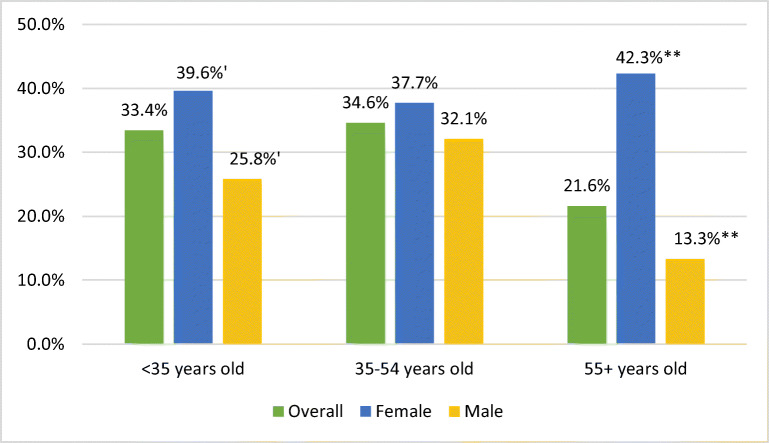
Background: The COVID-19 pandemic brought rapid changes to the work and personal lives of clinicians. Objective: To assess clinician burnout and well-being during the COVID-19 pandemic and guide healthcare system improvement efforts. Design: A survey asking about clinician burnout, well-being, and work experiences. Participants: Surveys distributed to 8141 clinicians from June to August 2020 in 9 medical groups and 17 hospitals at Sutter Health, a large healthcare system in Northern California. Main Measures: Burnout was the primary outcome, and other indicators of well-being and work experience were also measured. Descriptive statistics and multivariate logistic regression analyses were performed. All statistical inferences were based on weighted estimates adjusting for response bias. Key Results: A total of 3176 clinicians (39.0%) responded to the survey. Weighted results showed 29.2% reported burnout, and burnout was more common among women than among men (39.0% vs. 22.7%,p<0.01). In multivariate models, being a woman was associated with increased odds of reporting burnout (OR=2.19, 95% CI: 1.51–3.17) and being 55+ years old with lower odds (OR=0.54, 95% CI: 0.34–0.87). More women than men reported that childcare/caregiving was impacting work (32.9% vs. 19.0%,p<0.01). Even after controlling for age and gender, clinicians who reported childcare/caregiving responsibilities impacted their work had substantially higher odds of reporting burnout (OR=2.19, 95% CI: 1.54–3.11). Other factors associated with higher burnout included worrying about safety at work, being given additional work tasks, concern about losing one’s job, and working in emergency medicine or radiology. Protective factors included believing one’s concerns will be acted upon and feeling highly valued. Conclusions: This large survey found the pandemic disproportionally impacted women, younger clinicians, and those whose caregiving responsibilities impacted their work. These results highlight the need for a holistic and targeted strategy for improving clinician well-being that addresses the needs of women, younger clinicians, and those with caregiving responsibilities.
Overview
The claims and statistics of this paper haven’t been checked yet.
Free: it reads the open-access text and checks the first 5 claims that cite a source we can check. Create a free account to check every claim.
Integrity signals
Registry
Cites
Statistics
Figures
Verification
Claims the paper makes
The claims and statistics of this paper haven’t been checked yet.
Free: it reads the open-access text and checks the first 5 claims that cite a source we can check. Create a free account to check every claim.
Claims other papers make about this one
Each is checked against this paper’s own text: does it say what the citing paper says it does?
The cited source says what the claim attributes to it.
In the citing paper
“overall well-being has declined among physicians and advanced practice clinicians2,3”
From Evaluation of an Ambient Artificial Intelligence Documentation Platform for Clinicians (2025) · cites this paper as [3]
Experimental — accuracy not yet measuredIn the citing paper
“Given the serious toll of the COVID-19 pandemic on health-care workers,160”
From Digital health and telehealth in cancer care: A scoping review of reviews (2023) · cites this paper as [160]
Self-check
Percentages, sums and reported differences re-computed from the paper’s own numbers.
The self-check needs the paper’s full text.
Citations
Cites
The measurement of experienced burnout
Maslach, C., & Jackson, S. E. (1981) · Journal of Organizational Behavior · doi:10.1002/job.4030020205 · Cited by 14,496
PSYCHOLOGICAL CONDITIONS OF PERSONAL ENGAGEMENT AND DISENGAGEMENT AT WORK.
Kahn, W. A. (1990) · Academy of Management Journal · doi:10.2307/256287 · Cited by 10,975 · cited 1×
“Engagement and fulfillment at work are also important considerations in healthcare worker well-being.(39,40) Fewer clinicians in this survey reported burnout, 29%, compared to 49% in a larger national survey using the same burnout measure among various healthcare workers.”
ResultAustin, P. C., & Stuart, E. A. (2015) · Statistics in Medicine · doi:10.1002/sim.6607 · Cited by 4,495 · cited 1×
“Inferential statistics accounted for response bias using the inverse propensity weight method.(37,38) The propensity was estimated by a logistic regression model, where the dependent variable was survey response (yes/no) and predictors included age, gender, primary specialty, and job role (physician vs.”
MethodThe Second Shift: Working Families and the Revolution at Home
Hochschild, A. R., & Machung, A. (2012) · Medical Entomology and Zoology · Cited by 3,785
Shanafelt, T. D., Boone, S., Tan, L., Dyrbye, L. N., Sotile, W., Satele, D., West, C. P., Sloan, J., & Oreskovich, M. R. (2012) · Archives of Internal Medicine · doi:10.1001/archinternmed.2012.3199 · Cited by 3,439
Shanafelt, T. D., Hasan, O., Dyrbye, L. N., Sinsky, C., Satele, D., Sloan, J., & West, C. P. (2015) · Mayo Clinic Proceedings · doi:10.1016/j.mayocp.2015.08.023 · Cited by 2,885
Physician burnout: contributors, consequences and solutions
West, C. P., Dyrbye, L. N., & Shanafelt, T. D. (2018) · Journal of Internal Medicine · doi:10.1111/joim.12752 · Cited by 2,768
The Second Shift: Working Parents and the Revolution at Home
Brines, J., Hochschild, A., & Machung, A. (1990) · Journal of Marriage and the Family · doi:10.2307/352858 · Cited by 2,230
Shanafelt, T., Ripp, J., & Trockel, M. (2020) · JAMA · doi:10.1001/jama.2020.5893 · Cited by 1,956 · cited 1×
“Well-being during the pandemic is influenced by job stress, fear of infection, interpersonal and interprofessional relationships, adequacy of resources, caregiving obligations, and access to rapid testing.(25,26) A 2020 global study of intensive care unit specialists found burnout in North America in the 50–70% range,…”
BackgroundPrevalence of Burnout Among Physicians: A Systematic Review
Rotenstein, L. S., Torre, M., Ramos, M. A., Rosales, R. C., Guille, C., Sen, S., & Mata, D. A. (2018) · JAMA · doi:10.1001/jama.2018.12777 · Cited by 1,904
Executive Leadership and Physician Well-being
Shanafelt, T. D., & Noseworthy, J. H. (2017) · Mayo Clinic Proceedings · doi:10.1016/j.mayocp.2016.10.004 · Cited by 1,776
Shanafelt, T. D., West, C. P., Sinsky, C., Trockel, M., Tutty, M., Satele, D. V., Carlasare, L. E., & Dyrbye, L. N. (2019) · Mayo Clinic Proceedings · doi:10.1016/j.mayocp.2018.10.023 · Cited by 914
Depression, anxiety, stress levels of physicians and associated factors in Covid-19 pandemics
Elbay, R. Y., Kurtulmuş, A., Arpacıoğlu, S., & Karadere, E. (2020) · Psychiatry Research · doi:10.1016/j.psychres.2020.113130 · Cited by 845 · cited 1×
“Age also contributes to decreased well-being during the pandemic, with younger physicians reporting more depression, stress, anxiety, psychological burden, higher emotional exhaustion, and less personal accomplishment than their older counterparts.(31,32) This study investigates the relationships between burnout and g…”
BackgroundWomen’s and men’s work, housework and childcare, before and during COVID-19
Del Boca, D., Oggero, N., Profeta, P., & Rossi, M. (2020) · Review of Economics of the Household · doi:10.1007/s11150-020-09502-1 · Cited by 773
Clinic, M., Dyrbye, L. N., Shanafelt, T. D., Clinic, M., Sinsky, C. A., American Medical Association, Cipriano, P. F., American Nurses Association, Bhatt, J., American Hospital Association, et al. (2017) · NAM Perspectives · doi:10.31478/201707b · Cited by 709
Friedberg, M., Chen, P., Van Busum, K., Aunon, F., Pham, C., Caloyeras, J., Mattke, S., Pitchforth, E., Quigley, D., Brook, R., et al. (2014) · RAND Health Quarterly · doi:10.7249/rhq-03-04-01 · Cited by 707
Impact of Organizational Leadership on Physician Burnout and Satisfaction
Shanafelt, T. D., Gorringe, G., Menaker, R., Storz, K. A., Reeves, D., Buskirk, S. J., Sloan, J. A., & Swensen, S. J. (2015) · Mayo Clinic Proceedings · doi:10.1016/j.mayocp.2015.01.012 · Cited by 707
Morgantini, L. A., Naha, U., Wang, H., Francavilla, S., Acar, Ö., Flores, J. M., Crivellaro, S., Moreira, D., Abern, M., Eklund, M., et al. (2020) · PLOS ONE · doi:10.1371/journal.pone.0238217 · Cited by 682 · cited 1×
“Organizational factors are recognized as the largest drivers of burnout and well-being at work.(9,45) As found elsewhere, this analysis found feeling highly valued lowered the odds of burnout,(2) as did belief that one’s concerns would be acted upon, suggesting one mechanism by which leadership may influence burnout.”
BackgroundSex Differences in Physician Salary in US Public Medical Schools
Jena, A. B., Olenski, A. R., & Blumenthal, D. M. (2016) · JAMA Internal Medicine · doi:10.1001/jamainternmed.2016.3284 · Cited by 641
Trockel, M., Bohman, B., Lesure, E., Hamidi, M. S., Welle, D., Roberts, L., & Shanafelt, T. (2018) · Academic Psychiatry · doi:10.1007/s40596-017-0849-3 · Cited by 602 · cited 1×
“Engagement and fulfillment at work are also important considerations in healthcare worker well-being.(39,40) Fewer clinicians in this survey reported burnout, 29%, compared to 49% in a larger national survey using the same burnout measure among various healthcare workers.”
ResultUsing a Single Item to Measure Burnout in Primary Care Staff: A Psychometric Evaluation
Dolan, E. D., Mohr, D., Lempa, M., Joos, S., Fihn, S. D., Nelson, K. M., & Helfrich, C. D. (2015) · Journal of General Internal Medicine · doi:10.1007/s11606-014-3112-6 · Cited by 599
Prasad, K., McLoughlin, C., Stillman, M., Poplau, S., Goelz, E., Taylor, S., Nankivil, N., Brown, R., Linzer, M., Cappelucci, K., et al. (2021) · EClinicalMedicine · doi:10.1016/j.eclinm.2021.100879 · Cited by 541 · cited 5×
“5% in the other.(2,17) Having children at home and work-life integration are two factors commonly identified as contributing to burnout among female physicians, 18,19 causing women to be more likely to reduce work hours to manage caregiving responsibilities.”
BackgroundMethodResultInfluentialDewa, C. S., Loong, D., Bonato, S., & Trojanowski, L. (2017) · BMJ Open · doi:10.1136/bmjopen-2016-015141 · Cited by 526
Physician Burnout and Well-Being: A Systematic Review and Framework for Action
Rothenberger, D. A. (2017) · Diseases of the Colon & Rectum · doi:10.1097/dcr.0000000000000844 · Cited by 455 · cited 1×
“Organizational factors are recognized as the largest drivers of burnout and well-being at work.(9,45) As found elsewhere, this analysis found feeling highly valued lowered the odds of burnout,(2) as did belief that one’s concerns would be acted upon, suggesting one mechanism by which leadership may influence burnout.”
BackgroundIs happiness U-shaped everywhere? Age and subjective well-being in 145 countries
Blanchflower, D. G. (2021) · Journal of Population Economics · doi:10.1007/s00148-020-00797-z · Cited by 440
Shanafelt, T. D., West, C. P., Sinsky, C., Trockel, M., Tutty, M., Wang, H., Carlasare, L. E., & Dyrbye, L. N. (2022) · Mayo Clinic Proceedings · doi:10.1016/j.mayocp.2021.11.021 · Cited by 434
Symptoms of burnout in intensive care unit specialists facing the COVID-19 outbreak
Azoulay, E., De Waele, J., Ferrer, R., Staudinger, T., Borkowska, M., Povoa, P., Iliopoulou, K., Artigas, A., Schaller, S. J., Hari, M. S., et al. (2020) · Annals of Intensive Care · doi:10.1186/s13613-020-00722-3 · Cited by 388 · cited 1×
“A 2020 global study of intensive care unit specialists found burnout in North America in the 50–70% range, and that younger age and female sex were associated with severe burnout.(27) The pandemic may be widening gender inequalities with challenges for workingmothers’managing a “second shift” of caregiving, household…”
BackgroundHjálmsdóttir, A., & Bjarnadóttir, V. S. (2021) · Gender, Work & Organization · doi:10.1111/gwao.12552 · Cited by 384
An Introduction to the Augmented Inverse Propensity Weighted Estimator
Glynn, A. N., & Quinn, K. M. (2010) · Political Analysis · doi:10.1093/pan/mpp036 · Cited by 374 · cited 1×
“Inferential statistics accounted for response bias using the inverse propensity weight method.(37,38) The propensity was estimated by a logistic regression model, where the dependent variable was survey response (yes/no) and predictors included age, gender, primary specialty, and job role (physician vs.”
MethodWorklife and Wellness in Academic General Internal Medicine: Results from a National Survey
Linzer, M., Poplau, S., Babbott, S., Collins, T., Guzman-Corrales, L., Menk, J., Murphy, M. L., & Ovington, K. (2016) · Journal of General Internal Medicine · doi:10.1007/s11606-016-3720-4 · Cited by 254
Zhang, Y., Wang, C., Pan, W., Zheng, J., Gao, J., Huang, X., Cai, S., Zhai, Y., Latour, J. M., & Zhu, C. (2020) · Frontiers in Psychiatry · doi:10.3389/fpsyt.2020.565520 · Cited by 242
Accreditations Council for Graduate Medical Education, Brigham, T., Barden, C., American Association of Critical Care Nurses, Legreid Dopp, A., American Society of Health System Pharmacists, Hengerer, A., Federation of State Medical Boards, Kaplan, J., American College of Emergency Physicians, et al. (2018) · NAM Perspectives · doi:10.31478/201801b · Cited by 234
Tai-Seale, M., Dillon, E. C., Yang, Y., Nordgren, R., Steinberg, R. L., Nauenberg, T., Lee, T. C., Meehan, A., Li, J., Chan, A. S., et al. (2019) · Health Affairs · doi:10.1377/hlthaff.2018.05509 · Cited by 226 · cited 2×
“34 This single-item burnout measure has been widely used and validated against the Maslach Burnout Inventory.2,35 Burnout was defined as answering 3, 4, or 5 (i.e., “definitely burning out…,” “symptoms of burnout won’t go away,” or “I feel completely burned out…”).”
MethodSelf-citationGender-Based Differences in Burnout: Issues Faced by Women Physicians
Templeton, K., Bernstein, C. A., Sukhera, J., Nora, L. M., Newman, C., Burstin, H., Guille, C., Lynn, L., Schwarze, M. L., Sen, S., et al. (2019) · NAM Perspectives · doi:10.31478/201905a · Cited by 203
Morgantini, L. A., Naha, U., Heng, W., et al. (2020) · medRxiv · doi:10.1101/2020.05.17.20101915 · Cited by 190
The Problems With Burnout Research
Eckleberry-Hunt, J., Kirkpatrick, H., & Barbera, T. (2018) · Academic Medicine · doi:10.1097/acm.0000000000001890 · Cited by 173 · cited 1×
“While fewer clinicians in this survey reported burnout, the large number reporting decreased wellbeing highlights that measuring well-being requires a more holistic and encompassing measure than burnout alone.(33) Engagement and fulfillment at work are also important considerations in healthcare worker well-being.”
BackgroundPhysician mothers’ experience of workplace discrimination: a qualitative analysis
Halley, M. C., Rustagi, A. S., Torres, J. S., Linos, E., Plaut, V. C., Mangurian, C. V., Choo, E. K., & Linos, E. (2018) · BMJ · doi:10.1136/bmj.k4926 · Cited by 166
What Do We Mean by Physician Wellness? A Systematic Review of Its Definition and Measurement
Brady, K. J. S., Trockel, M. T., Khan, C. T., Raj, K. S., Murphy, M. L., Bohman, B., Frank, E., Louie, A. K., & Roberts, L. W. (2018) · Academic Psychiatry · doi:10.1007/s40596-017-0781-6 · Cited by 163
Algunmeeyn, A., El-Dahiyat, F., Altakhineh, M. M., Azab, M., & Babar, Z.-U.-D. (2020) · Journal of Pharmaceutical Policy and Practice · doi:10.1186/s40545-020-00262-y · Cited by 101
Dillon, E. C., Tai‐Seale, M., Meehan, A. E., Martin, V., Nordgren, R., Lee, T., Nauenberg, T., & Frosch, D. L. (2019) · Journal of General Internal Medicine · doi:10.1007/s11606-019-05381-0 · Cited by 92
Self-citationSandwich Generation Caregiving: A Complex and Dynamic Role
Steiner, A. M., & Fletcher, P. C. (2017) · Journal of Adult Development · doi:10.1007/s10804-016-9252-7 · Cited by 69 · cited 1×
“While many older clinicians may have fewer caregiving responsibilities and more financial security, some may be part of a “sandwich generation” simultaneously managing caregiving responsibilities for their children and parents.(41) The relationship between age and burnout may also be influenced by other life cycle(42)…”
BackgroundChung, S., Dillon, E. C., Meehan, A. E., Nordgren, R., & Frosch, D. L. (2020) · Journal of General Internal Medicine · doi:10.1007/s11606-020-05770-w · Cited by 69
Self-citationWilliams, V. N., Medina, J., Medina, A., & Clifton, S. C. (2016) · The American Journal of the Medical Sciences · doi:10.1016/j.amjms.2016.12.004 · Cited by 46 · cited 1×
“The relationship between age and burnout may also be influenced by other life cycle(42) and age cohort effects.(43) Protective factors included believing one’s concerns will be acted upon and feeling highly valued.”
BackgroundBurnout Among Family Physicians by Gender and Age
Eden, A. R., Jabbarpour, Y., Morgan, Z. J., Wilkinson, E. C., & Peterson, L. E. (2020) · The Journal of the American Board of Family Medicine · doi:10.3122/jabfm.2020.03.190319 · Cited by 25
The impact of gender and working hours on pulmonary physician burnout
Zhou, Y., Gu, W., Tao, R., & Chen, C. (2020) · Annals of Translational Medicine · doi:10.21037/atm-20-5827 · Cited by 16
CMS Innovation Center Health Care Innovation Awards: Evaluation Plan
Berry, S. H., Concannon, T. W., Morganti, K. G., Auerbach, D. I., Beckett, M. K., Chen, P. G., Farley, D. O., Han, B., Harris, K. M., Jones, S. S., et al. (2013) · Rand health quarterly · doi:10.7249/rhq-03-03-01 · Cited by 15
Optimizing Well‐being, Practice Culture, and Professional Thriving in an Era of Turbulence
Pierce, R. G., Diaz, M., & Kneeland, P. P. (2019) · Journal of Hospital Medicine · doi:10.12788/jhm.3101 · Cited by 5
Robinson, D., Korte, R., Balgopal, M., Han, H., & Maynard, T. (2019) · Digital Collections of Colorado (Colorado State University) · doi:10.25675/3.019676 · Cited by 2
Cited by
Shanafelt, T. D., West, C. P., Dyrbye, L. N., Trockel, M., Tutty, M., Wang, H., Carlasare, L. E., & Sinsky, C. (2022) · Mayo Clinic Proceedings · doi:10.1016/j.mayocp.2022.09.002 · Cited by 558
Digital health and telehealth in cancer care: A scoping review of reviews
Shaffer, K. M., Turner, K. L., Siwik, C., Gonzalez, B. D., Upasani, R., Glazer, J. V., Ferguson, R. J., Joshua, C., & Low, C. A. (2023) · The Lancet Digital Health · doi:10.1016/s2589-7500(23)00049-3 · Cited by 263
“Given the serious toll of the COVID-19 pandemic on health-care workers, 160 there is an opportunity to establish viable digital health and telehealth interventions to mitigate occupational-health effects under the ongoing pandemic conditions.”
Evaluation of an Ambient Artificial Intelligence Documentation Platform for Clinicians
Stults, C. D., Deng, S., Martinez, M. C., Wilcox, J., Szwerinski, N., Chen, K. H., Driscoll, S., Washburn, J., & Jones, V. G. (2025) · JAMA Network Open · doi:10.1001/jamanetworkopen.2025.8614 · Cited by 147
Self-citationOnline Well-Being Group Coaching Program for Women Physician Trainees: A Randomized Clinical Trial
Mann, A., Shah, A. N., Thibodeau, P. S., Dyrbye, L. N., Syed, A., Woodward, M. A., Thurmon, K., Jones, C. D., Dunbar, K. S., & Fainstad, T. L. (2023) · JAMA Network Open · doi:10.1001/jamanetworkopen.2023.35541 · Cited by 87
Gambaro, E., Gramaglia, C. M., Marangon, D., Probo, M., Rudoni, M., & Zeppegno, P. (2023) · International Journal of Environmental Research and Public Health · doi:10.3390/ijerph20126087 · Cited by 43
“In the current study, it was observed that individual factors related to work or extra work influenced the following (as was the case in [59]): in the first phase of the study [20], higher levels of burnout were observed in the female population, in participants under the age of 30, in those who changed their extra-wo…”
Result
Metadata
- Authors
- Dillon, E. C., Stults, C. D., Deng, S., Martinez, M., Szwerinski, N., Koenig, P. T., Gregg, L., Cobb, J. K., Mahler, E., Frosch, D. L., Le Sieur, S., Hanley, M., & Pertsch, S.
- Affiliations
- Sutter Health (US)
- Sutter Medical Center (US)
- John Muir Health (US)
- Palo Alto Medical Foundation (US)
- Corresponding author
- Dillon, Ellis C.
- Venue
- Journal of General Internal Medicine
- Published
- 2021-11-02
- Volume
- 37
- Issue
- 1
- Pages
- 145-153
- ISSN
- 0884-8734 (ISSN-L)
- 1525-1497
- PMC
- PMC8562379
- OpenAlex
- W3208210191
- Cited by
- 57
- References
- 47
- Citations by year
- 2026: 4 · 2025: 11 · 2024: 14 · 2023: 18 · 2022: 9 · 2021: 1
- FWCI
- 11.79
- Type
- journal article
- Language
- en
- Open access
- hybrid
- doi.org
- Licence
- cc-by
- creativecommons.org/licenses/by/4.0 (tdm)
- creativecommons.org/licenses/by/4.0 (vor)
- Locations
- Journal of General Internal Medicine (publishedVersion, cc-by)
- PubMed Central (publishedVersion, cc-by)
- PubMed (publishedVersion)
- Funders
- Palo Alto Medical Foundation (n/a)
- Sutter Health (n/a)
- Topics
- Health Sciences › Health Professions › General Health Professions › Healthcare professionals’ stress and burnout
- Social Sciences › Psychology › Clinical Psychology › COVID-19 and Mental Health
- Health Sciences › Medicine › Public Health, Environmental and Occupational Health › Occupational Health and Burnout
- Keywords
- clinician burnout, clinician well-being, COVID-19 pandemic, gender differences, caregiving responsibilities, child care, emergency medicine, radiology, job insecurity, occupational safety, feeling valued, healthcare workforce
- MeSH terms
- COVID-19, SARS-CoV-2, Burnout, Professional, Delivery of Health Care, Female, Humans, Male, Middle Aged, Surveys and Questionnaires, Caregivers, Pandemics
About these checks
Registry, retraction, Cites and statistics results are computed, not judged, with one exception: a printed reference that no index lists is read once by a model before it counts as a citation error. Claims are extracted by a model and kept only when their quote appears verbatim in the text; each cited source is then checked, with a model’s help, for whether it says what the claim relies on. Those verdicts can be wrong — read the claim’s quote and the cited source before relying on one.
Statistics and arithmetic are recomputed, not judged.
Confidence bands are shown only for fields calibrated on our annotated test set. None is calibrated yet, so no band is shown.
What counts as a claim ›How we measure confidence ›How we check this ›
Are you an author, or do you see a problem with this page? Request a review
Data sources
Bibliographic data: Semantic Scholar, OpenAlex, Crossref.
Contains information from the Semantic Scholar Academic Graph Datasets, made available under the ODC Attribution License (ODC-BY 1.0).
Semantic Scholar’s data is described in: Kinney, R., et al. (2023). The Semantic Scholar Open Data Platform. arXiv:2301.10140.
