

The DOI matches its Crossref record; 50 of the 50 references it cites were found in a registry or an index; none of the 12 sources its claims cite is checked for support yet.
Regulating the sharing economy: The effects of day caps on short- and long-term rental markets and stakeholder outcomes
Open accessAbstract
Home sharing platforms have experienced a rapid growth over the last decade. Following negative publicity, many cities have started regulating the short-term rental market. Regulations often involve a cap on the number of days a property can be rented out on a short-term basis. We draw on rich data for short-term rentals on Airbnb and for the long-term rental market to examine the impact of short-term rental regulations with a day cap on various stakeholders: hosts, guests, the platform provider, and residents. Based on a difference-in-differences design, we document a sizable drop in Airbnb activity. Interestingly, not only targeted hosts (i.e., hosts with reservation days larger than the day cap), but also non-targeted hosts reduce their Airbnb activity. The reservation days of non-targeted hosts decrease between 26.27% and 51.89% depending on the treatment. Targeted hosts experience a similar decline. There is, nevertheless, significant non-compliance: more than one third of hosts do not comply with enacted short-term rental regulations. Additional analyses show that few properties are redirected from short-term rental to long-term rental use and that there is no significant drop in long-term rents. Drawing on a theoretical model, we tie the estimated effects to changes in stakeholders’ welfare: Regulations significantly reduce the welfare of hosts, and the loss ranges between 46.30% and 9.02%. The welfare loss of the platform provider is proportional to the loss of the hosts. Welfare of guests decreases moderately ranging between 4.5% to 4.1%. The welfare of residents increases minimal. These results question the effectiveness and desirability of the studied short-term rental regulations.
Overview
CoChat Summary
TL;DR
This paper studies day-cap short-term rental regulations in Berlin, Hamburg, and Munich using Airbnb and long-term rental data. It finds sizable declines in Airbnb activity for both targeted and non-targeted hosts, substantial non-compliance, little redirection to long-term rentals, and welfare losses for hosts, guests, and the platform with minimal resident benefit.
Key findings
- Short-term rental regulations reduced Airbnb reservation days by 18.48%–49.77% for targeted hosts and by 26.27%–51.89% for non-targeted hosts; active properties declined by 25.19%–44.82% for targeted hosts and 45.19%–63.43% for non-targeted hosts.
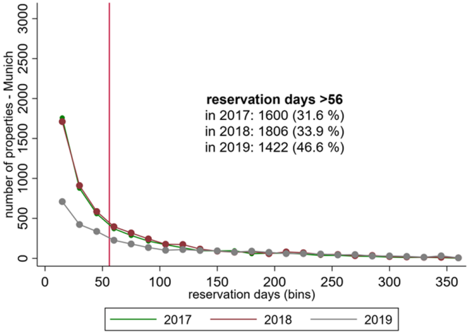
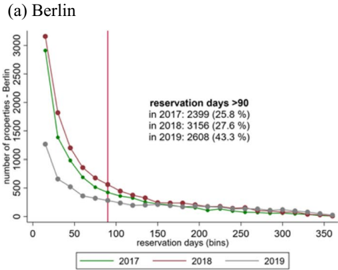
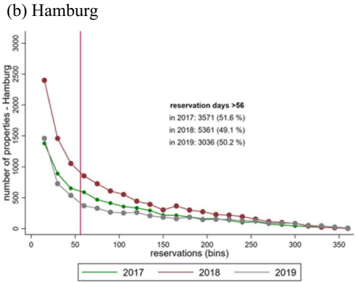
- Non-compliance was substantial: more than one third of hosts did not comply, and in Munich the share of properties rented out for more than 56 days increased to 46.6% in 2019.
- Only relatively few properties were redirected from short- to long-term rental use, ranging from 185 in Munich to 1,067 in Hamburg, and long-term rents showed no significant drop.
- Welfare losses were estimated at 46.30%–9.02% for hosts and 4.5%–4.1% for guests; platform provider welfare loss was proportional to host losses, while resident welfare increased minimally.
Methods
- The authors develop a theoretical model of monopolistic competition in short- and long-term rental markets to derive propositions and express stakeholder welfare changes as functions of observed market outcomes.
- Data cover all German Airbnb transactions from 2015–2019 from AirDNA for entire properties, plus long-term rental price data from RWI/Immoscout24; treated cities are Berlin, Hamburg, and Munich, with untreated German cities over 100,000 inhabitants as controls.
- The empirical design is a difference-in-differences model at the 1 km × 1 km grid-month level, estimated separately for reservation days, active properties, and prices, distinguishing targeted from non-targeted hosts and using wild bootstrap inference and robustness checks.
Limitations
- The paper states that more fine-grained data are needed to isolate individual regulation design elements and to better understand mechanisms, especially motivations of non-targeted hosts; it also notes that resident effects are studied only through the housing market, leaving other externality channels for future research.
- The text makes evident that the data lack detailed host background information and do not identify primary versus secondary residences, so Berlin and Hamburg non-compliance findings are interpreted cautiously; diversion to other platforms cannot be fully ruled out.
- Welfare estimates are described as upper bounds because outside options and unobserved profits are not observed, and the data frame ends in December 2019, excluding the Covid period.
Model-written summary. Check it against the paper before relying on it.
Integrity signals
Registry
Cites
Statistics
Figures

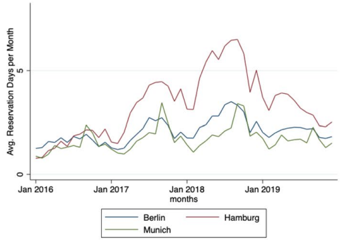

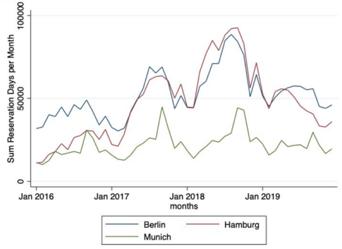
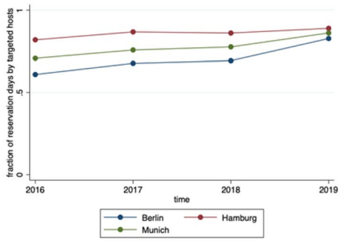
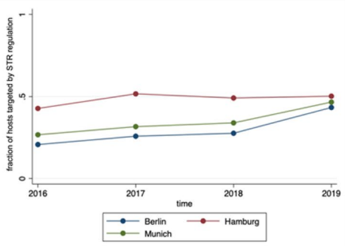

Verification
Claims the paper makes
0 Valid · 0 Not valid · 9 Not checked · 132 Own results and interpretations
A result the paper reports from its own data — it cites no other source for it, so there is none to check. The quote shows it is in the paper.
In the paper
“In robustness checks (cf.Online Appendix A.5.4), we show that our estimates remain robust when we restrict the set of control grids to those in the largest untreated German cities (i.e., Dusseldorf, Essen, Frankfurt, and Leipzig).”
§ Regulating the sharing economy: The effects of day caps on shortand long-term rental markets and stakeholder outcomes > Methodology
plain- Asserted: passes — The authors put it forward as true.
- Checkable: passes — It can be checked against evidence.
- Load-bearing: unclear — It is unclear whether the paper’s conclusions depend on it.
- Based: passes — The paper gives a reason why it holds.
- Rests on an assumption not shown here.
A result the paper reports from its own data — it cites no other source for it, so there is none to check. The quote shows it is in the paper.
In the paper
“Proposition P1, moreover, predicts that the number of active properties offered by targeted hosts declines.We also find support for this proposition (p = 0.000).”
§ Regulating the sharing economy: The effects of day caps on shortand long-term rental markets and stakeholder outcomes > Baseline findings
plainstates a cause- Asserted: passes — The authors put it forward as true.
- Checkable: passes — It can be checked against evidence.
- Load-bearing: passes — The paper’s conclusions depend on it.
- Based: passes — The paper gives a reason why it holds.
- Rests on an assumption not shown here.
A result the paper states — it cites no source for it, so there is none to check. The quote shows it is in the paper.
In the paper
“Comparing the treatments in the city of Hamburg and Munich, which both established a 56-day cap, shows-in relative terms-stronger effects for Hamburg, which additionally requires hosts to register with the city (Δ ATT_rel = + 10 p.p.).”
§ Regulating the sharing economy: The effects of day caps on shortand long-term rental markets and stakeholder outcomes > Baseline findings
plainstates a cause- Asserted: passes — The authors put it forward as true.
- Checkable: passes — It can be checked against evidence.
- Load-bearing: passes — The paper’s conclusions depend on it.
- Based: passes — The paper gives a reason why it holds.
- Rests on an assumption not shown here.
A result the paper reports from its own data — it cites no other source for it, so there is none to check. The quote shows it is in the paper.
In the paper
“In addition, we find at least some support for Proposition P5a that predicts that regulations with a registration requirement decrease the number of active properties offered by targeted hosts more than regulations without a registration requirement.”
§ Regulating the sharing economy: The effects of day caps on shortand long-term rental markets and stakeholder outcomes > Baseline findings
hedgedstates a cause- Asserted: passes — The authors put it forward as true.
- Checkable: passes — It can be checked against evidence.
- Load-bearing: passes — The paper’s conclusions depend on it.
- Based: passes — The paper gives a reason why it holds.
- Rests on an assumption not shown here.
A result the paper reports from its own data — it cites no other source for it, so there is none to check. The quote shows it is in the paper.
In the paper
“The point estimates are positive across all studied short-term rental regulations and point to a slight increase in short-term rental prices in response to the regulations (Table 5).”
§ Regulating the sharing economy: The effects of day caps on shortand long-term rental markets and stakeholder outcomes > Baseline findings
plainstates a cause- Asserted: passes — The authors put it forward as true.
- Checkable: passes — It can be checked against evidence.
- Load-bearing: passes — The paper’s conclusions depend on it.
- Based: passes — The paper gives a reason why it holds.
- Rests on an assumption not shown here.
99 more claims
Create a free account to see all 141 claims and to verify the 11 references still open.
- Probably not a substantial claim. 13
- It may state two separate claims as one. 21
- The quote only partly states this claim. 6
Self-check
Percentages, sums and reported differences re-computed from the paper’s own numbers.
Each contradiction between two passages listed here was confirmed by an independent check.
Rated minor: it would not touch a result — a value no result rests on, a p-value that stays on the same side of the significance level, or a conflict that is clerical, resolved elsewhere in the paper, or outside its own findings.
In the paper
§ Regulating the sharing economy: The effects of day caps on shortand long-term rental markets and stakeholder outcomes > Impact of regulations on long-term rental market
“The analysis draws on our estimates of the regulation-induced changes in the number of active Airbnb properties per gridwhich, in support of Proposition P2, suggest that the number of targeted properties declines in the wake of short-term rental regulations.”
§ Regulating the sharing economy: The effects of day caps on shortand long-term rental markets and stakeholder outcomes > P2 Short-term rental regulations that impose day caps result
“P2 Short-term rental regulations that impose day caps result in an increase in short-term rental prices.”
Rated minor: it would not touch a result — a value no result rests on, a p-value that stays on the same side of the significance level, or a conflict that is clerical, resolved elsewhere in the paper, or outside its own findings.
In the paper
§ Regulating the sharing economy: The effects of day caps on shortand long-term rental markets and stakeholder outcomes > Baseline findings
“Finally, we test Proposition P3, which proposes that the average short-term rental price increases in the wake of a short-term rental regulation.”
§ Regulating the sharing economy: The effects of day caps on shortand long-term rental markets and stakeholder outcomes > P2 Short-term rental regulations that impose day caps result
“P3 Short-term rental regulations that impose day caps result in an increase in the number of properties offered for long-term renting.”
Citations
Cites
How Much Should We Trust Differences-in-Differences Estimates?
Bertrand, M., Duflo, E., & Mullainathan, S. (2004) · The Quarterly Journal of Economics · doi:10.1162/003355304772839588 · Cited by 10,641
Difference-in-differences with variation in treatment timing
Goodman-Bacon, A. (2021) · Journal of Econometrics · doi:10.1016/j.jeconom.2021.03.014 · Cited by 8,046
Estimating dynamic treatment effects in event studies with heterogeneous treatment effects
Sun, L., & Abraham, S. (2021) · Journal of Econometrics · doi:10.1016/j.jeconom.2020.09.006 · Cited by 5,518
Selection on observed and unobserved variables: Assessing the effectiveness of Catholic schools
Altonji, J. G., Elder, T. E., & Taber, C. R. (2005) · Journal of Political Economy · doi:10.1086/426036 · Cited by 3,706
Causal Inference without Balance Checking: Coarsened Exact Matching
Iacus, S. M., King, G., & Porro, G. (2012) · Political Analysis · doi:10.1093/pan/mpr013 · Cited by 3,563
The Rise of the Sharing Economy: Estimating the Impact of Airbnb on the Hotel Industry
Zervas, G., Proserpio, D., & Byers, J. W. (2017) · Journal of Marketing Research · doi:10.1509/jmr.15.0204 · Cited by 2,376 · cited 2×
“Research, for example, suggests that local restaurants benefit (e.g., Basuroy et al., 2022; Farronato & Fradkin, 2022), whereas the traditional hotel industry suffers from the rise of short-term renting (e.g., Farronato & Fradkin, 2022; Li & Srinivasan, 2019; Zervas et al., 2017).”
Discrete Choice Theory of Product Differentiation
Anderson, S. P., de Palma, A., & Thisse, J.-F. (1992) · The MIT Press eBooks · doi:10.7551/mitpress/2450.001.0001 · Cited by 2,324
Causal Inference Using Potential Outcomes: Design, Modeling, Decisions
Rubin, D. B. (2005) · Journal of the American Statistical Association · doi:10.1198/016214504000001880 · Cited by 2,173
Cem: Coarsened Exact Matching in Stata
Blackwell, M., Iacus, S., King, G., & Porro, G. (2009) · The Stata Journal: Promoting communications on statistics and Stata · doi:10.1177/1536867x0900900402 · Cited by 1,689
Using Synthetic Controls: Feasibility, Data Requirements, and Methodological Aspects
Abadie, A. (2021) · Journal of Economic Literature · doi:10.1257/jel.20191450 · Cited by 1,486
Bernheim, B. D. (1994) · Journal of Political Economy · doi:10.1086/261957 · Cited by 1,304
Fast and wild: Bootstrap inference in Stata using boottest
Roodman, D., Nielsen, M. Ø., MacKinnon, J. G., & Webb, M. D. (2019) · The Stata Journal: Promoting communications on statistics and Stata · doi:10.1177/1536867x19830877 · Cited by 1,007
Mas-Colell, A., Whinston, M. D., & Green, J. R. (1995) · Cited by 688
A first look at online reputation on Airbnb, where every stay is above average
Zervas, G., Proserpio, D., & Byers, J. W. (2021) · Marketing Letters · doi:10.1007/s11002-020-09546-4 · Cited by 600
Is home sharing driving up rents? Evidence from Airbnb in Boston
Horn, K., & Merante, M. (2017) · Journal of Housing Economics · doi:10.1016/j.jhe.2017.08.002 · Cited by 412
Do short-term rental platforms affect housing markets? Evidence from Airbnb in Barcelona
Garcia-López, M.-À., Jofre-Monseny, J., Martínez-Mazza, R., & Segú, M. (2020) · Journal of Urban Economics · doi:10.1016/j.jue.2020.103278 · Cited by 367
Melitz, M. J., & Redding, S. J. (2014) · Handbook of International Economics · doi:10.1016/b978-0-444-54314-1.00001-x · Cited by 337
The Effect of Home-Sharing on House Prices and Rents: Evidence from Airbnb
Barron, K., Kung, E., & Proserpio, D. (2021) · Marketing Science · doi:10.1287/mksc.2020.1227 · Cited by 326
The wild bootstrap for few (treated) clusters
MacKinnon, J. G., & Webb, M. D. (2018) · The Econometrics Journal · doi:10.1111/ectj.12107 · Cited by 317
Enforcement of contribution norms in public good games with heterogeneous populations
Reuben, E., & Riedl, A. (2013) · Games and Economic Behavior · doi:10.1016/j.geb.2012.10.001 · Cited by 278
Learning from Data: An Empirics-First Approach to Relevant Knowledge Generation
Golder, P. N., Dekimpe, M. G., An, J., van Heerde, H. J., Kim, D. S. U., & Alba, J. W. (2022) · Journal of Marketing · doi:10.1177/00222429221129200 · Cited by 248
Progress on Airbnb: a literature review
Guttentag, D. (2019) · Journal of Hospitality and Tourism Technology · doi:10.1108/jhtt-08-2018-0075 · Cited by 241
Conducting Research in Marketing with Quasi-Experiments
Avi Goldfarb, B., Tucker, C. E., & Wang, Y. (2022) · Journal of Marketing · doi:10.1177/00222429221082977 · Cited by 205
Owning, Using, and Renting: Some Simple Economics of the "Sharing Economy"
Filippas, A., Horton, J. J., & Zeckhauser, R. J. (2020) · Management Sciences · doi:10.1287/mnsc.2019.3396 · Cited by 183
Short-term rentals and the housing market: Quasi-experimental evidence from Airbnb in Los Angeles
Koster, H., van Ommeren, J. V., & Volkhausen, N. (2018) · Journal of Urban Economics · doi:10.1016/j.jue.2021.103356 · Cited by 160
Competitive Dynamics in the Sharing Economy: An Analysis in the Context of Airbnb and Hotels
Li, H., & Srinivasan, K. (2019) · Marketing science (Providence, R.I.) · doi:10.1287/mksc.2018.1143 · Cited by 156
Poster child and guinea pig – insights from a structured literature review on Airbnb
Dann, D., Teubner, T., & Weinhardt, C. (2019) · International Journal of Contemporary Hospitality Management · doi:10.1108/ijchm-03-2018-0186 · Cited by 156
The evolution of Airbnb regulation - An international longitudinal investigation 2008–2020
von Briel, D., & Dolničar, S. (2020) · Annals of Tourism Research · doi:10.1016/j.annals.2020.102983 · Cited by 131
Schmidheiny, K., & Siegloch, S. (2019) · SSRN Electronic Journal · doi:10.2139/ssrn.3323194 · Cited by 118
Measuring the complexity of the law: the United States Code
Katz, D. M., & Bommarito, M. J. (2014) · Artificial Intelligence and Law · doi:10.1007/s10506-014-9160-8 · Cited by 117
Reviews and price on online platforms: Evidence from sentiment analysis of Airbnb reviews in Boston
Lawani, A., Reed, M. R., Mark, T., & Zheng, Y. (2019) · Regional Science and Urban Economics · doi:10.1016/j.regsciurbeco.2018.11.003 · Cited by 108
The Welfare Effects of Peer Entry: The Case of Airbnb and the Accommodation Industry
Farronato, C., & Fradkin, A. (2022) · American Economic Review · doi:10.1257/aer.20180260 · Cited by 108
You get what you give: theory and evidence of reciprocity in the sharing economy
Proserpio, D., Xu, W., & Zervas, G. (2018) · Quantitative Marketing and Economics · doi:10.1007/s11129-018-9201-9 · Cited by 106
Wild Bootstrap and Asymptotic Inference With Multiway Clustering
MacKinnon, J. G., Nielsen, M. Ø., & Webb, M. D. (2019) · Journal of Business and Economic Statistics · doi:10.1080/07350015.2019.1677473 · Cited by 69
The Battle for Homes: How Does Home Sharing Disrupt Local Residential Markets?
Chen, W., Wei, Z., & Xie, K. (2022) · Management Science · doi:10.1287/mnsc.2022.4299 · Cited by 63
Airbnb research: an analysis in tourism and hospitality journals
Andreu, L., Bigné, E., Amaro, S., & Palomo, J. (2020) · International Journal of Culture, Tourism and Hospitality Research · doi:10.1108/ijcthr-06-2019-0113 · Cited by 57
The Effect of Short-Term Rentals on Residential Investment
Bekkerman, R., Cohen, M. C., Kung, E., Maiden, J., & Proserpio, D. (2021) · Marketing Science · doi:10.1287/mksc.2022.1409 · Cited by 54
Regulating short‐term rental housing: Evidence from New Orleans
Valentin, M. (2020) · Real Estate Economics · doi:10.1111/1540-6229.12330 · Cited by 51
The Effect of Short-Term Rentals on Residential InvestmentPreprint
Bekkerman, R., Cohen, M. C., Kung, E., Maiden, J., & Proserpio, D. (2022) · ACM Conference on Economics and Computation · doi:10.2139/ssrn.3874207 · Cited by 36
Schmidheiny, K., & Siegloch, S. (2019) · SSRN Electronic Journal · doi:10.2139/ssrn.3338836 · Cited by 33
The impact of Airbnb on residential property values and rents: Evidence from Portugal
Franco, S. F., & Santos, C. (2021) · Regional Science and Urban Economics · doi:10.1016/j.regsciurbeco.2021.103667 · Cited by 32
Drafting “better regulation”: The economic cost of regulatory complexity
de Lucio, J., & Mora-Sanguinetti, J. S. (2022) · Journal of Policy Modeling · doi:10.1016/j.jpolmod.2021.10.003 · Cited by 29
Xu, M.-H., & Xu, Y. (2021) · Regional Science and Urban Economics · doi:10.1016/j.regsciurbeco.2021.103670 · Cited by 27
Monopolistic competition without apology
Thisse, J., & Ushchev, P. (2018) · Edward Elgar Publishing eBooks · doi:10.4337/9781785363283.00011 · Cited by 25
Competitive Dynamics in the Sharing Economy: An Analysis in the Context of Airbnb and HotelsPreprint
Li, H., & Srinivasan, K. (2018) · SSRN Electronic Journal · doi:10.2139/ssrn.3197969 · Cited by 11
Bibler, A. J., Teltser, K., & Tremblay, M. J. (2023) · SSRN Electronic Journal · doi:10.2139/ssrn.4390232 · Cited by 9
Airbnb and Rental Markets: Evidence from BerlinPreprint
Duso, T., Michelsen, C., Schäfer, M., & Tran, K. D. (2021) · SSRN Electronic Journal · doi:10.2139/ssrn.3849867 · Cited by 8
Do Short-Term Rental Platforms Affect Housing Markets? Evidence From Airbnb in Barcelona
Garcia-López, M.-À., Jofre-Monseny, J., Mazza, R. M., & Segú, M. (2019) · doi:10.2139/ssrn.3428237
Measuring the Complexity of the Law: The United States Code
Katz, D. M., & Bommarito, M. J. (2013) · doi:10.2139/ssrn.2307352
Research works printed but not linked: 3
- Basuroy S., Kim, Y., & Proserpio, D. (2022). Estimating the impact of Airbnb on the local economy: Evidence from the restaurant industry. Available at SSRN: https://ssrn.com/abstract=3516983.
- Lee, D. (2016). How Airbnb short-term rentals exacerbate Los Angeles’s affordable housing crisis: Analysis and policy recommendations. Harvard Law Policy Review, 10(1), 229–254.
- RWI (2020). RWI real estate data - Apartments for rent - suf. RWI-GEO- RED. Version: 1. RWI - Leibniz Institute for Economic Research. Dataset. https://doi.org/10.7807/immo:redwk:suf:v3.wk:suf:v3. · DOI
Cited by
The spatial effect of short-term rental regulations: The comparison between Barcelona and Paris
Bei, G. (2024) · Cities · doi:10.1016/j.cities.2024.105603 · Cited by 37
Data sharing and tax enforcement: Evidence from short-term rentals in Denmark
Garz, M., & Schneider, A. K. (2023) · Regional Science and Urban Economics · doi:10.1016/j.regsciurbeco.2023.103912 · Cited by 19
Self-citationTaxation of short-term rentals: Evidence from the introduction of the “Airbnb tax” in Norway
Garz, M., & Schneider, A. K. (2023) · Economics Letters · doi:10.1016/j.econlet.2023.111120 · Cited by 16
Self-citationSilva, R., & Gerwe, O. (2023) · Journal of Management Studies · doi:10.1111/joms.12987 · Cited by 13
The Impact of iBuyers on Housing Market Dynamics
Harrison, D. M., Seiler, M. J., & Yang, L. (2023) · The Journal of Real Estate Finance and Economics · doi:10.1007/s11146-023-09954-z · Cited by 12
Metadata
- Authors
- Gauß, P., Gensler, S., Kortenhaus, M., Riedel, N., & Schneider, A.
- Affiliations
- University of Münster (DE)
- Jönköping University (SE)
- Corresponding author
- Gensler, Sonja
- Venue
- Journal of the Academy of Marketing Science
- Published
- 2024-06-15
- Volume
- 52
- Issue
- 6
- Pages
- 1627-1650
- ISSN
- 0092-0703 (ISSN-L)
- 1552-7824
- OpenAlex
- W4399704749
- Cited by
- 25
- References
- 46
- Citations by year
- 2026: 10 · 2025: 7 · 2024: 4
- FWCI
- 5.05
- Type
- journal article
- Language
- en
- Open access
- hybrid
- doi.org
- Licence
- cc-by
- creativecommons.org/licenses/by/4.0 (tdm)
- creativecommons.org/licenses/by/4.0 (vor)
- Locations
- Journal of the Academy of Marketing Science (publishedVersion, cc-by)
- SSRN Electronic Journal (submittedVersion)
- Econstor (Econstor) (submittedVersion, cc-by)
- RePEc: Research Papers in Economics (submittedVersion)
- Funders
- Universität Münster
- Topics
- Social Sciences › Business, Management and Accounting › Marketing › Sharing Economy and Platforms
- Social Sciences › Economics, Econometrics and Finance › Economics and Econometrics › Housing Market and Economics
- Social Sciences › Business, Management and Accounting › Strategy and Management › Digital Platforms and Economics
- Keywords
- short-term rental regulation, home-sharing platforms, Airbnb, regulatory compliance, stakeholder well-being, housing market effects, sharing economy
About these checks
Registry, retraction, Cites and statistics results are computed, not judged, with one exception: a printed reference that no index lists is read once by a model before it counts as a citation error. Claims are extracted by a model and kept only when their quote appears verbatim in the text; each cited source is then checked, with a model’s help, for whether it says what the claim relies on. Those verdicts can be wrong — read the claim’s quote and the cited source before relying on one.
A language model drew the claims from the paper on 2026-11-13, under version 3 of the claim definition (model deepseek-v4.1-flash, prompt extract-v3).
A second model labelled each claim on 2026-11-13 (model jev-1.13-20260917, definition revision gold-guideline-v0.2).
Statistics and arithmetic are recomputed, not judged.
Confidence bands are shown only for fields calibrated on our annotated test set. None is calibrated yet, so no band is shown.
What counts as a claim ›How we measure confidence ›How we check this ›
Are you an author, or do you see a problem with this page? Request a review
Data sources
Bibliographic data: Semantic Scholar, OpenAlex, Crossref.
Contains information from the Semantic Scholar Academic Graph Datasets, made available under the ODC Attribution License (ODC-BY 1.0).
Semantic Scholar’s data is described in: Kinney, R., et al. (2023). The Semantic Scholar Open Data Platform. arXiv:2301.10140.
