

A Randomized Controlled Trial of Qigong Exercise on Fatigue Symptoms, Functioning, and Telomerase Activity in Persons with Chronic Fatigue or Chronic Fatigue Syndrome
Open accessThe DOI matches its Crossref record; 64 of the 64 references it cites were found in a registry or an index.
Abstract
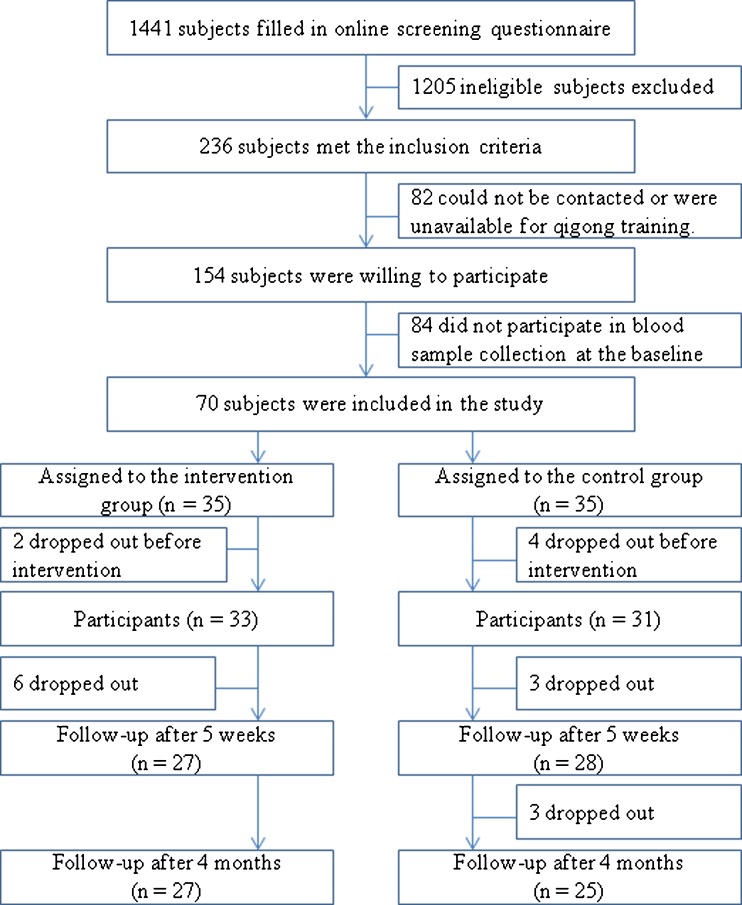
BACKGROUND: Chronic fatigue is common in the general population. Complementary therapies are often used by patients with chronic fatigue or chronic fatigue syndrome to manage their symptoms. PURPOSE: This study aimed to assess the effect of a 4-month qigong intervention program among patients with chronic fatigue or chronic fatigue syndrome. METHODS: Sixty-four participants were randomly assigned to either an intervention group or a wait list control group. Outcome measures included fatigue symptoms, physical functioning, mental functioning, and telomerase activity. RESULTS: Fatigue symptoms and mental functioning were significantly improved in the qigong group compared to controls. Telomerase activity increased in the qigong group from 0.102 to 0.178 arbitrary units (p < 0.05). The change was statistically significant when compared to the control group (p < 0.05). CONCLUSION: Qigong exercise may be used as an alternative and complementary therapy or rehabilitative program for chronic fatigue and chronic fatigue syndrome.
Overview
The claims and statistics of this paper haven’t been checked yet.
Free: it reads the open-access text and checks the first 5 claims that cite a source we can check. Create a free account to check every claim.
Integrity signals
Registry
Cites
Statistics
Figures
Verification
Claims the paper makes
The claims and statistics of this paper haven’t been checked yet.
Free: it reads the open-access text and checks the first 5 claims that cite a source we can check. Create a free account to check every claim.
Claims other papers make about this one
Each is checked against this paper’s own text: does it say what the citing paper says it does?
The source backs part of the claim, not all of it — or backs it for a different population, condition or comparison.
In the citing paper
“In comparison to the control group, quality of life improved in participants receiving Qigong exercise [41,70,71] and cognitive-behavioral stress management [45].”
From Systematic review of mind‐body interventions to treat myalgic encephalomyelitis/chronic fatigue syndrome (2021) · cites this paper as [70]
Experimental — accuracy not yet measured
Self-check
Percentages, sums and reported differences re-computed from the paper’s own numbers.
The self-check needs the paper’s full text.
Citations
Cites
1 retracted
Adams, D., Wu, T., Yang, X., Tai, S., & Vohra, S. (2009) · Cochrane Database of Systematic Reviews · doi:10.1002/14651858.cd006348.pub2 · Cited by 48
RetractedWARE, J. E., KOSINSKI, M., & KELLER, S. D. (1996) · Medical Care · doi:10.1097/00005650-199603000-00003 · Cited by 17,392 · cited 1×
“Physical functioning and mental functioning were assessed by the Chinese version of the Medical Outcomes Study 12Item Short-Form Health Survey [52, 53].”
MethodThe Chronic Fatigue Syndrome: A Comprehensive Approach to Its Definition and Study
Fukuda, K., Straus, S. E., Hickie, I., Sharpe, M. C., Dobbins, J. G., Komaroff, A., & and International Chronic Fatigue Syndrome Study Group. (1994) · Annals of Internal Medicine · doi:10.7326/0003-4819-121-12-199412150-00009 · Cited by 4,969
Structure and function of telomeres
Blackburn, E. H. (1991) · Nature · doi:10.1038/350569a0 · Cited by 3,596
Development of a fatigue scale
Chalder, T., Berelowitz, G., Pawlikowska, T., Watts, L., Wessely, S., Wright, D., & Wallace, E. P. (1993) · Journal of Psychosomatic Research · doi:10.1016/0022-3999(93)90081-p · Cited by 3,032 · cited 4×
“The total fatigue score is obtained by summing all of the items [50].”
MethodInfluentialAccelerated telomere shortening in response to life stress
Epel, E. S., Blackburn, E. H., Lin, J., Dhabhar, F. S., Adler, N. E., Morrow, J. D., & Cawthon, R. M. (2004) · Proceedings of the National Academy of Sciences · doi:10.1073/pnas.0407162101 · Cited by 3,002
Association between telomere length in blood and mortality in people aged 60 years or older
Cawthon, R. M., Smith, K. R., O'Brien, E., Sivatchenko, A., & Kerber, R. A. (2003) · The Lancet · doi:10.1016/s0140-6736(03)12384-7 · Cited by 1,761 · cited 1×
“sion, and premature mortality [37–39].”
A prospective randomized trial
(1995) · Nihon Gekakei Rengo Gakkaishi (Journal of Japanese College of Surgeons) · doi:10.4030/jjcs1979.20.2_191 · Cited by 1,619
Carruthers, B. M., Jain, A. K., De Meirleir, K. L., Peterson, D. L., Klimas, N. G., Lerner, A. M., Bested, A. C., Flor-Henry, P., Joshi, P., Powles, A. C. P., et al. (2003) · Journal of Chronic Fatigue Syndrome · doi:10.1300/j092v11n01_02 · Cited by 1,180 · cited 2×
“established in the USA [1] and Canada [2], chronic fatigue is severe fatigue that persists or relapses for at least 6 months, while chronic fatigue syndrome, which is distinguished from chronic fatigue by severity and chronicity [3], is defined as “medically unexplained” fatigue lasting for six or more months.”
BackgroundChronic Fatigue Syndrome: A Review
Afari, N., & Buchwald, D. (2003) · American Journal of Psychiatry · doi:10.1176/appi.ajp.160.2.221 · Cited by 687
Telomere length assessment: Biomarker of chronic oxidative stress?
Houben, J. M. J., Moonen, H. J. J., van Schooten, F. J., & Hageman, G. J. (2008) · Free Radical Biology and Medicine · doi:10.1016/j.freeradbiomed.2007.10.001 · Cited by 558
[Chronic fatigue syndrome: a review].
Carlo-Stella, N., Lorusso, L., Candura, S. M., & Cuccia, M. (2004) · PubMed · Cited by 551
Is the standard SF-12 Health Survey valid and equivalent for a Chinese population?
Lam, C. L. K., Tse, E. Y. Y., & Gandek, B. (2005) · Quality of Life Research · doi:10.1007/s11136-004-0704-3 · Cited by 547
Cognitive behaviour therapy for the chronic fatigue syndrome: a randomised controlled trial.
Sharpe, M., Hawton, K., Simkin, S., Surawy, C., Hackmann, A., Klimes, I., Peto, T., Warrell, D., & Seagroatt, V. (1996) · BMJ · doi:10.1136/bmj.312.7022.22 · Cited by 528
Simon, N. M., Smoller, J. W., McNamara, K. L., Maser, R. S., Zalta, A. K., Pollack, M. H., Nierenberg, A. A., Fava, M., & Wong, K.-K. (2006) · Biological Psychiatry · doi:10.1016/j.biopsych.2006.02.004 · Cited by 516 · cited 1×
“Previous studies have shown that both shortened telomere and lower telomerase activity are associated with chronic psychological distress such as chronic fatigue syndrome [40–43].”
BackgroundCognitive behavior therapy for chronic fatigue syndrome: a randomized controlled trial.
(1997) · American Journal of Psychiatry · doi:10.1176/ajp.154.3.408 · Cited by 491 · cited 1×
“The recruitment target of 30 participants per group was calculated on the basis of a similar number of referred subjects in two previous studies on chronic fatigue syndrome [48, 49].”
BackgroundTelomere length and risk of incident cancer and cancer mortality
Willeit, P., Willeit, J., Mayr, A., Weger, S., Oberhollenzer, F., Brandstätter, A., Kronenberg, F., & Kiechl, S. (2010) · JAMA · doi:10.1001/jama.2010.897 · Cited by 484 · cited 1×
“sion, and premature mortality [37–39].”
Intensive meditation training, immune cell telomerase activity, and psychological mediators
Jacobs, T. L., Epel, E. S., Lin, J., Blackburn, E. H., Wolkowitz, O. M., Bridwell, D. A., Zanesco, A. P., Aichele, S. R., Sahdra, B. K., MacLean, K. A., et al. (2011) · Psychoneuroendocrinology · doi:10.1016/j.psyneuen.2010.09.010 · Cited by 432 · cited 4×
“In a recent randomized controlled trial [44] of intensive meditation training among 60 healthy subjects, 46 (20 meditation retreat participants and 26 controls) participated in telomerase activity assessment and the results suggested greater telomerase activity in the retreat participants than in the control group aft…”
BackgroundResultInfluentialIncreased telomerase activity and comprehensive lifestyle changes: a pilot study
Ornish, D., Lin, J., Daubenmier, J., Weidner, G., Epel, E., Kemp, C., Magbanua, M. J. M., Marlin, R., Yglecias, L., Carroll, P. R., et al. (2008) · The Lancet Oncology · doi:10.1016/s1470-2045(08)70234-1 · Cited by 430 · cited 4×
“Recent findings suggest that telomerase activity may be improved by intensive meditation training [44], yogic meditation [45], physical exercise [46, 47], or comprehensive lifestyle changes [40].”
BackgroundResultInfluentialKennedy, G., Spence, V. A., McLaren, M., Hill, A., Underwood, C., & Belch, J. J. F. (2005) · Free Radical Biology and Medicine · doi:10.1016/j.freeradbiomed.2005.04.020 · Cited by 325
Lavretsky, H., Epel, E. S., Siddarth, P., Nazarian, N., Cyr, N. S., Khalsa, D. S., Lin, J., Blackburn, E., & Irwin, M. R. (2013) · International Journal of Geriatric Psychiatry · doi:10.1002/gps.3790 · Cited by 298
Unnebrink, K., & Windeler, J. (2001) · Statistics in Medicine · doi:10.1002/sim.1149 · Cited by 258
Nacul, L. C., Lacerda, E. M., Pheby, D., Campion, P., Molokhia, M., Fayyaz, S., Leite, J. C., Poland, F., Howe, A., & Drachler, M. L. (2011) · BMC Medicine · doi:10.1186/1741-7015-9-91 · Cited by 255 · cited 1×
“006 and 3 % of patients seeking medical care [4, 7–9].”
BackgroundThe persistence of fatigue in chronic fatigue syndrome and multiple sclerosis
Vercoulen, J. H. M. M., Swanink, C. M. A., Galama, J. M. D., Fennis, J. F. M., Jongen, P. J. H., Hommes, O. R., van der Meer, J. W. M., & Bleijenberg, G. (1998) · Journal of Psychosomatic Research · doi:10.1016/s0022-3999(98)00023-3 · Cited by 248
Werner, C., Hanhoun, M., Widmann, T., Kazakov, A., Semenov, A., Pöss, J., Bauersachs, J., Thum, T., Pfreundschuh, M., Müller, P., et al. (2008) · Journal of the American College of Cardiology · doi:10.1016/j.jacc.2008.04.034 · Cited by 239 · cited 3×
“Recent findings suggest that telomerase activity may be improved by intensive meditation training [44], yogic meditation [45], physical exercise [46, 47], or comprehensive lifestyle changes [40].”
BackgroundOh, B., Butow, P., Mullan, B., Clarke, S., Beale, P., Pavlakis, N., Kothe, E., Lam, L., & Rosenthal, D. (2010) · Annals of Oncology · doi:10.1093/annonc/mdp479 · Cited by 231
Relationship between Physical Activity Level, Telomere Length, and Telomerase Activity
LUDLOW, A. T., ZIMMERMAN, J. B., WITKOWSKI, S., HEARN, J. W., HATFIELD, B. D., & ROTH, S. M. (2008) · Medicine & Science in Sports & Exercise · doi:10.1249/mss.0b013e31817c92aa · Cited by 226
Heim, C., Wagner, D., Maloney, E., Papanicolaou, D. A., Solomon, L., Jones, J. F., Unger, E. R., & Reeves, W. C. (2006) · Archives of General Psychiatry · doi:10.1001/archpsyc.63.11.1258 · Cited by 220
Dynamics of telomerase activity in response to acute psychological stress
Epel, E. S., Lin, J., Dhabhar, F. S., Wolkowitz, O. M., Puterman, E., Karan, L., & Blackburn, E. H. (2010) · Brain, Behavior, and Immunity · doi:10.1016/j.bbi.2009.11.018 · Cited by 217
Lee, H.-J., Park, H.-J., Chae, Y., Kim, S.-Y., Kim, S.-N., Kim, S.-T., Kim, J.-H., Yin, C.-S., & Lee, H. (2009) · Clinical Rehabilitation · doi:10.1177/0269215508101746 · Cited by 150
Dinos, S., Khoshaba, B., Ashby, D., White, P. D., Nazroo, J., Wessely, S., & Bhui, K. S. (2009) · International Journal of Epidemiology · doi:10.1093/ije/dyp147 · Cited by 144
Maes, M., & Twisk, F. N. (2010) · BMC Medicine · doi:10.1186/1741-7015-8-35 · Cited by 131
Wolf, S. A., Melnik, A., & Kempermann, G. (2010) · Brain Behavior and Immunity · doi:10.1016/j.bbi.2010.10.014 · Cited by 130
Telomerase, mitochondria and oxidative stress
Saretzki, G. (2009) · Experimental Gerontology · doi:10.1016/j.exger.2009.05.004 · Cited by 128
Wolkowitz, O. M., Mellon, S. H., Epel, E. S., Lin, J., Reus, V. I., Rosser, R., Burke, H., Compagnone, M., Nelson, J. C., Dhabhar, F. S., et al. (2012) · Molecular Psychiatry · doi:10.1038/mp.2010.133 · Cited by 125
Houdenhove, B. V., Eede, F. V. D., & Luyten, P. (2009) · Medical Hypotheses · doi:10.1016/j.mehy.2008.11.044 · Cited by 121
The effect of Qigong on Fibromyalgia (FMS): A controlled randomized study
Haak, T., & Scott, B. (2008) · Disability and Rehabilitation · doi:10.1080/09638280701400540 · Cited by 107
Binz, N., Shalaby, T., Rivera, P., Shin‐ya, K., & Grotzer, M. A. (2005) · European Journal of Cancer · doi:10.1016/j.ejca.2005.08.025 · Cited by 99
Huibers, M. J. H., Beurskens, A. J. H. M., Van Schayck, C. P., Bazelmans, E., Metsemakers, J. F. M., Knottnerus, J. A., & Bleijenberg, G. (2004) · British Journal of Psychiatry · doi:10.1192/bjp.184.3.240 · Cited by 98 · cited 1×
“Because western treatments and medications are often associated with limited clinical benefits [21] and possible undesirable side effects [22], complementary and alternative therapies are often used by individuals with chronic fatigue or chronic fatigue syndrome to manage their symptoms [23, 24].”
BackgroundTelomeres in a Life-Span Perspective: A New “Psychobiomarker”?
Epel, E. S. (2009) · Current Directions in Psychological Science · doi:10.1111/j.1467-8721.2009.01596.x · Cited by 95
Porter, N. S., Jason, L. A., Boulton, A., Bothne, N., & Coleman, B. (2010) · The Journal of Alternative and Complementary Medicine · doi:10.1089/acm.2008.0376 · Cited by 91
Traditional Chinese Medicine for Chronic Fatigue Syndrome
Chen, R., Moriya, J., Yamakawa, J.-I., Takahashi, T., & Kanda, T. (2008) · Evidence-based Complementary and Alternative Medicine · doi:10.1093/ecam/nen017 · Cited by 84
Kim, C. H., Shin, H. C., & Won, C. W. (2005) · Journal of Korean Medical Science · doi:10.3346/jkms.2005.20.4.529 · Cited by 82
The epidemiology of chronic fatigue in the Swedish Twin Registry
EVENGÅRD, B., JACKS, A., PEDERSEN, N. L., & SULLIVAN, P. F. (2005) · Psychological Medicine · doi:10.1017/s0033291705005052 · Cited by 79
Construct validity of the Chinese version of the Chalder Fatigue Scale in a Chinese community sample
Wong, W. S., & Fielding, R. (2010) · Journal of Psychosomatic Research · doi:10.1016/j.jpsychores.2009.05.008 · Cited by 75 · cited 1×
“863) [51].”
Rendant, D., Pach, D., Lüdtke, R., Reisshauer, A., Mietzner, A., Willich, S. N., & Witt, C. M. (2011) · Spine · doi:10.1097/brs.0b013e3181d51fca · Cited by 75
Ng, B. H. P., Tsang, H. W. H., Jones, A. Y. M., So, C. T., & Mok, T. Y. W. (2011) · The Journal of Alternative and Complementary Medicine · doi:10.1089/acm.2010.0215 · Cited by 74
Lee, S., Yu, H., Wing, Y., Chan, C., Lee, A. M., Lee, D. T. S., Chen, C.-N., Lin, K., & Weiss, M. G. (2000) · American Journal of Psychiatry · doi:10.1176/appi.ajp.157.3.380 · Cited by 71
Self-citationNater, U. M., Lin, J.-M. S., Maloney, E. M., Jones, J. F., Tian, H., Boneva, R. S., Raison, C. L., Reeves, W. C., & Heim, C. (2009) · Psychosomatic Medicine · doi:10.1097/psy.0b013e31819ea179 · Cited by 70
Prevalence of chronic fatigue among Chinese adults in Hong Kong: A population-based study
Wong, W. S., & Fielding, R. (2010) · Journal of Affective Disorders · doi:10.1016/j.jad.2010.04.029 · Cited by 66
Chronic fatigue syndrome: identifying zebras amongst the horses
Harvey, S. B., & Wessely, S. (2009) · BMC Medicine · doi:10.1186/1741-7015-7-58 · Cited by 65
Cognitive performance and complaints of cognitive impairment in chronic fatigue syndrome (CFS)
WEARDEN, A., & APPLEBY, L. (1997) · Psychological Medicine · doi:10.1017/s0033291796004035 · Cited by 65
Qigong and Exercise Therapy in Patients With Long-term Neck Pain: A Prospective Randomized Trial
Lansinger, B., Larsson, E., Persson, L. C., & Carlsson, J. Y. (2007) · Spine · doi:10.1097/brs.0b013e3181573b4b · Cited by 59
Cumulative life stress in chronic fatigue syndrome
Nater, U. M., Maloney, E. M., Heim, C. C., & Reeves, W. C. (2011) · Psychiatry Research · doi:10.1016/j.psychres.2011.07.015 · Cited by 56
Cho, H. J., Menezes, P. R., Hotopf, M., Bhugra, D., & Wessely, S. (2009) · British Journal of Psychiatry · doi:10.1192/bjp.bp.108.051813 · Cited by 56
Psychological stress, telomeres, and telomerase
Kiecolt-Glaser, J. K., & Glaser, R. (2010) · Brain, Behavior, and Immunity · doi:10.1016/j.bbi.2010.02.002 · Cited by 49
Chronic fatigue syndrome: a stress disorder?
Cleare, A. J., & Wessely, S. C. (1996) · PubMed · Cited by 30
Stress as a Key Concept in Chronic Widespread Pain and Fatigue Disorders
Van Houdenhove, B., Luyten, P., & Tiber Egle, U. (2009) · Journal of Musculoskeletal Pain · doi:10.3109/10582450903284745 · Cited by 28
Masuda, A., Munemoto, T., Yamanaka, T., Takei, M., & Tei, C. (2002) · Journal of Behavioral Medicine · doi:10.1023/a:1020423124675 · Cited by 27
Qigong Ameliorates Symptoms of Chronic Fatigue: A Pilot Uncontrolled Study
Craske, N. J. M., Turner, W. A., Zammit-Maempe, J., & Lee, M. S. (2007) · Evidence-based Complementary and Alternative Medicine · doi:10.1093/ecam/nem088 · Cited by 27
Faulkner, S., & Smith, A. P. (2008) · British Journal of Health Psychology · doi:10.1348/135910706x171469 · Cited by 26
Use of alternative treatments by chronic fatigue syndrome discordant twins
Afari, N., Eisenberg, D. M., Herrell, R. K., Goldberg, J. H., Kleyman, E., Ashton, S., & Buchwald, D. (2000) · Integrative medicine · doi:10.1016/s1096-2190(99)00017-7 · Cited by 18
Howard, C. V., & Yanes, G. S. D. (2003) · The Lancet · doi:10.1016/s0140-6736(03)12929-7 · Cited by 9
Campbell, K. (2003) · The Lancet · doi:10.1016/s0140-6736(03)12930-3 · Cited by 1
Cited by
Lindqvist, D., Epel, E. S., Mellon, S. H., Penninx, B. W., Révész, D., Verhoeven, J. E., Reus, V. I., Lin, J., Mahan, L., Hough, C. M., et al. (2015) · Neuroscience & Biobehavioral Reviews · doi:10.1016/j.neubiorev.2015.05.007 · Cited by 285
Qigong and Tai-Chi for Mood Regulation
Yeung, A., Chan, J. S. M., Cheung, J. C., & Zou, L. (2018) · Focus · doi:10.1176/appi.focus.20170042 · Cited by 176
Self-citationFung, T. K. H., Lau, B. W. M., Ngai, S. P. C., & Tsang, H. W. H. (2021) · International Journal of Molecular Sciences · doi:10.3390/ijms22094844 · Cited by 171
“Whereas in human studies the severity of depression and anxiety can be assessed via questionnaires or interviews [77], the examination of depression- and anxiety-like state in animals requires standardised tests,”
BackgroundSelf-citationA meta-analytic review of the effects of mindfulness meditation on telomerase activity
Schutte, N. S., & Malouff, J. M. (2014) · Psychoneuroendocrinology · doi:10.1016/j.psyneuen.2013.12.017 · Cited by 171
Smith, M. E. B., Haney, E., McDonagh, M., Pappas, M., Daeges, M., Wasson, N., Fu, R., & Nelson, H. D. (2015) · Annals of Internal Medicine · doi:10.7326/m15-0114 · Cited by 142
“These included GET involving an exercise plan with structured incremental increases in exercise over time (23, 48, 50, 52, 53), qigong exercise (49, 51), and home orthostatic training (54).”
BackgroundMethod
Metadata
- Authors
- Ho, R. T. H., Chan, J. S. M., Wang, C.-W., Lau, B. W. M., So, K. F., Yuen, L. P., Sham, J. S. T., & Chan, C. L. W.
- Affiliations
- University of Hong Kong (HK)
- Venue
- Annals of Behavioral Medicine
- Publisher
- Oxford University Press (OUP)
- Published
- 2012-06-27
- Volume
- 44
- Issue
- 2
- Pages
- 160-170
- ISSN
- 0742-5554 (ISSN-L)
- 0883-6612
- 1532-4796
- PMC
- PMC3442161
- OpenAlex
- W2170909385
- Cited by
- 103
- References
- 64
- Citations by year
- 2026: 3 · 2025: 6 · 2024: 5 · 2023: 7 · 2022: 6 · 2021: 12 · 2020: 8 · 2019: 6 · 2018: 8 · 2017: 7 · 2016: 5 · 2015: 7 · 2014: 16 · 2013: 6 · 2012: 1
- FWCI
- 6.83
- Type
- journal article
- Language
- en
- Open access
- green
- www.ncbi.nlm.nih.gov
- Licence
- cc-by
- Locations
- Annals of Behavioral Medicine (publishedVersion)
- PubMed Central (publishedVersion, cc-by)
- PubMed (publishedVersion)
- The HKU Scholars Hub (University of Hong Kong) (submittedVersion, cc-by-nc-nd)
- Funders
- University of Hong Kong
- Topics
- Health Sciences › Medicine › Psychiatry and Mental health › Fibromyalgia and Chronic Fatigue Syndrome Research
- Health Sciences › Medicine › Complementary and alternative medicine › Biofield Effects and Biophysics
- Life Sciences › Biochemistry, Genetics and Molecular Biology › Molecular Biology › Coenzyme Q10 studies and effects
- Keywords
- qigong, chronic fatigue syndrome, chronic fatigue, complementary therapy, telomerase activity, fatigue symptoms, physical function, psychological functioning, exercise intervention
- MeSH terms
- Activities of Daily Living, Adult, Breathing Exercises, Fatigue, Female, Humans, Male, Middle Aged, Waiting Lists, Fatigue Syndrome, Chronic, Treatment Outcome, Telomerase
About these checks
Registry, retraction, Cites and statistics results are computed, not judged, with one exception: a printed reference that no index lists is read once by a model before it counts as a citation error. Claims are extracted by a model and kept only when their quote appears verbatim in the text; each cited source is then checked, with a model’s help, for whether it says what the claim relies on. Those verdicts can be wrong — read the claim’s quote and the cited source before relying on one.
Statistics and arithmetic are recomputed, not judged.
Confidence bands are shown only for fields calibrated on our annotated test set. None is calibrated yet, so no band is shown.
What counts as a claim ›How we measure confidence ›How we check this ›
Are you an author, or do you see a problem with this page? Request a review
Data sources
Bibliographic data: Semantic Scholar, OpenAlex, Crossref.
Contains information from the Semantic Scholar Academic Graph Datasets, made available under the ODC Attribution License (ODC-BY 1.0).
Semantic Scholar’s data is described in: Kinney, R., et al. (2023). The Semantic Scholar Open Data Platform. arXiv:2301.10140.
