

Sarcopenic-obesity and cardiovascular disease risk in the elderly
Open accessThe DOI matches its Crossref record; 42 of the 43 references it cites were found in a registry or an index, and 1 are not checked yet.
Abstract
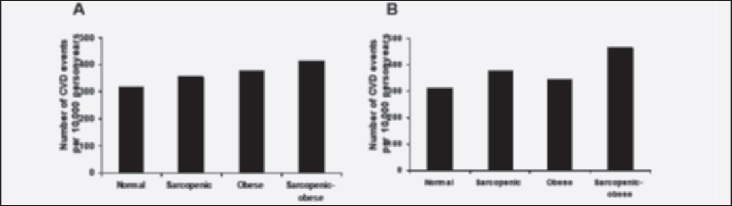
OBJECTIVES: To determine: 1) whether sarcopenic-obesity is a stronger predictor of cardiovascular disease (CVD) than either sarcopenia or obesity alone in the elderly, and 2) whether muscle mass or muscular strength is a stronger marker of CVD risk. DESIGN: Prospective cohort study. PARTICIPANTS: Participants included 3366 community-dwelling older (>or= 65 years) men and women who were free of CVD at baseline. MEASUREMENTS: Waist circumference (WC), bioimpedance analysis, and grip strength were used to measure abdominal obesity, whole-body muscle mass, and muscular strength, respectively. Subjects were classified as normal, sarcopenic, obese, or sarcopenic-obese based on measures of WC and either muscle mass or strength. Participants were followed for 8 years for CVD development and proportional hazard regression models were used to compare risk estimates for CVD in the four groups after adjusting for age, sex, race, income, smoking, alcohol, and cognitive status. RESULTS: Compared with the normal group, CVD risk was not significantly elevated within the obese, sarcopenic, or sarcopenic-obese groups as determined by WC and muscle mass. When determined by WC and muscle strength, CVD risk was not significantly increased in the sarcopenic or obese groups, but was increased by 23% (95% confidence interval: 0.99-1.54, P=0.06) within the sarcopenic-obese group. CONCLUSION: Sarcopenia and obesity alone were not sufficient to increase CVD risk. Sarcopenic-obesity, based on muscle strength but not muscle mass, was modestly associated with increased CVD risk. These findings imply that strength may be more important than muscle mass for CVD protection in old age.
Overview
The claims and statistics of this paper haven’t been checked yet.
Free: it reads the open-access text and checks the first 5 claims that cite a source we can check. Create a free account to check every claim.
Integrity signals
Registry
Cites
Statistics
Figures
Verification
Claims the paper makes
The claims and statistics of this paper haven’t been checked yet.
Free: it reads the open-access text and checks the first 5 claims that cite a source we can check. Create a free account to check every claim.
Claims other papers make about this one
Each is checked against this paper’s own text: does it say what the citing paper says it does?
The source backs part of the claim, not all of it — or backs it for a different population, condition or comparison.
In the citing paper
“The Cardiovascular Health Study, a large prospective study of 3,366 community-dwelling older individuals, demonstrated an association between dynapenic obesity (based on handgrip strength and WC) and the highest risk of CVD (105).”
From Health Consequences of Sarcopenic Obesity: A Narrative Review (2020) · cites this paper as [105]
Experimental — accuracy not yet measuredThe cited source says what the claim attributes to it.
In the citing paper
“Investigators from the Cardiovascular Health Study used low grip strength and high waist circumference to define low muscle strength and obesity. Rates approached 11.1%201, while data from FNIH classified 4.1% of men and 14.0% of women as having sarcopenic obesity using high BMI and low grip strength as measures of obesity and low muscle strength, respectively202.”
From Sarcopenic obesity in older adults: aetiology, epidemiology and treatment strategies (2018) · cites this paper as [201]
The cited source says what the claim attributes to it.
In the citing paper
“Recent cross-sectional and cohort studies suggest that sarcopenic obesity, as measured by muscle strength rather than muscle mass, is associated with increased risks of CVD (48) and cardiovascular mortality (39); however, this finding is challenged by certain studies that imply that sarcopenic obesity may have weak links to CVD (39, 49) or even no association with CVD, independent of sarcopenia or”
From Sarcopenic obesity: epidemiology, pathophysiology, cardiovascular disease, mortality, and management (2023) · cites this paper as [48]
In the citing paper
“In contrast, the risk of CVD was not significantly higher in the sarcopenic obesity group, when defined using BIA-measured muscle mass; thus, muscle strength may be more important predictor of CVD than muscle mass.”
From Health Consequences of Sarcopenic Obesity: A Narrative Review (2020) · cites this paper as [105]
In the citing paper
“Compared to that in participants without sarcopenia or obesity, the risk of CVD did not significantly increase in the dynapenia or obesity groups. However, the risk of CVD increased by 23% in the dynapenia and obesity groups.”
From Health Consequences of Sarcopenic Obesity: A Narrative Review (2020) · cites this paper as [105]
1 more claim about this paper
Create a free account to see every claim other papers make about this one.
Self-check
Percentages, sums and reported differences re-computed from the paper’s own numbers.
The self-check needs the paper’s full text.
Citations
Cites
Folstein, M. F., Folstein, S. E., & McHugh, P. R. (1975) · Journal of Psychiatric Research · doi:10.1016/0022-3956(75)90026-6 · Cited by 88,282 · cited 1×
“Cognitive Function. Cognitive function was measured using the 30-point Mini-Mental State Examination ( 22 ).”
Toprak, O., Kurt, H., Sarı, Y., Şarkış, C., Us, H., & Kırık, A. (2017) · Kidney and Blood Pressure Research · doi:10.1159/000468530 · Cited by 29,627
Grundy, S. M., Bilheimer, D. W., Chait, A., Clark, L. T., Denke, M. A., Havel, R. J., Hazzard, W. R., Hulley, S. B., Hunninghake, D. B., Kreisberg, R. A., et al. (1993) · JAMA · doi:10.1001/jama.269.23.3015 · Cited by 27,947
Expert Panel on Detection, E. (2001) · JAMA: The Journal of the American Medical Association · doi:10.1001/jama.285.19.2486 · Cited by 26,011
Chobanian, A. V. (2003) · JAMA · doi:10.1001/jama.289.19.2560 · Cited by 25,386
Hirono, N., Mori, E., Ikejiri, Y., Imamura, T., Shimomura, T., Hashimoto, M., Yamashita, H., & Ikeda, M. (1997) · Brain and nerve · Cited by 21,030
Kok, J. S., Berg, I. J., & Scherder, E. J. A. (2013) · Dementia and Geriatric Cognitive Disorders Extra · doi:10.1159/000353441 · Cited by 20,589
Older Adults' Reasons for Using Technology while Aging in Place
Peek, S. T. M., Luijkx, K. G., Rijnaard, M. D., Nieboer, M. E., van der Voort, C. S., Aarts, S., van Hoof, J., Vrijhoef, H. J. M., & Wouters, E. J. M. (2016) · Gerontology · doi:10.1159/000430949 · Cited by 19,690
Sensitivity and False Alarm Rate of a Fall Sensor in Long-Term Fall Detection in the Elderly
Kangas, M., Korpelainen, R., Vikman, I., Nyberg, L., & Jämsä, T. (2015) · Gerontology · doi:10.1159/000362720 · Cited by 18,909
Detection, evaluation, and treatment of high blood cholesterol in adults (Adult Treatment Panel III)
Grundy, S. M., Becker, D. M., Clark, L. T., Cooper, R., Denke, M. A., Howard, J. L., Hunninghake, D. B., Illingworth, D. R., Luepker, R. V., McBride, P. E., et al. (2002) · Civil War Book Review · Cited by 12,198
Pearson, T. A., Mensah, G. A., Alexander, R. W., Anderson, J. L., Cannon, R. O., Criqui, M., Fadl, Y. Y., Fortmann, S. P., Hong, Y., Myers, G. L., et al. (2003) · Circulation · doi:10.1161/01.cir.0000052939.59093.45 · Cited by 6,401 · cited 1×
“In support of the aforementioned notion, cross-sectional research in a sample of 871 sarcopenic-obese elderly demonstrated that abdominal obesity and low muscular strength are characterized by high circulating levels of proinflammatory cytokines (12), which are recognized risk factors for CVD (13).”
Ridker, P. M., Hennekens, C. H., Buring, J. E., & Rifai, N. (2000) · New England Journal of Medicine · doi:10.1056/nejm200003233421202 · Cited by 5,850 · cited 1×
“Other research has reported that these same proinflammatory cytokines are risk factors for CVD (33, 34).”
Inflammation, aspirin, and the risk of cardiovascular disease in apparently healthy men
Ridker, P. M., Cushman, M., Stampfer, M. J., Tracy, R. P., & Hennekens, C. H. (1997) · New England Journal of Medicine · doi:10.1056/nejm199704033361401 · Cited by 5,504 · cited 1×
“Other research has reported that these same proinflammatory cytokines are risk factors for CVD (33, 34 ).”
The Cardiovascular Health Study: design and rationale.
Fried, L. P., Borhani, N. O., Enright, P., Furberg, C. D., Gardin, J. M., Kronmal, R. A., Kuller, L. H., Manolio, T. A., Mittelmark, M. B., Newman, A., et al. (1991) · Annals of Epidemiology · doi:10.1016/1047-2797(91)90005-w · Cited by 3,652 · cited 3×
“The baseline and follow-up examinations consisted of a home or telephone interview and clinical examination (15).”
Assessment of fat-free mass using bioelectrical impedance measurements of the human body
Lukaski, H., Johnson, P., Bolonchuk, W., & Lykken, G. (1985) · The American Journal of Clinical Nutrition · doi:10.1093/ajcn/41.4.810 · Cited by 1,896 · cited 1×
“BIA resistance was obtained using a TVI-10 Body Composition Analyzer (Danninger Medical, Columbus, OH) (15) with measurements taken between the right wrist and ankle with the subject in a supine position after completion of an overnight fast (17).”
Estimation of skeletal muscle mass by bioelectrical impedance analysis
Janssen, I., Heymsfield, S. B., Baumgartner, R. N., & Ross, R. (2000) · Journal of Applied Physiology · doi:10.1152/jappl.2000.89.2.465 · Cited by 1,482 · cited 1×
“Skeletal muscle mass was calculated using the equation developed by Janssen and colleagues (18): Skeletal muscle mass (kg) = [Height 2 /R x 0.401) + (sex x 3.825) + (age x - 0.071)] + 5.102, where height is in cm; R is BIA resistance in ohms; for sex, women=0 and men=1; and age is in years.”
InfluentialSelf-citationRegional distribution of body fat, plasma lipoproteins, and cardiovascular disease.
Després, J. P., Moorjani, S., Lupien, P. J., Tremblay, A., Nadeau, A., & Bouchard, C. (1990) · Arteriosclerosis: An Official Journal of the American Heart Association, Inc. · doi:10.1161/01.atv.10.4.497 · Cited by 1,248 · cited 2×
“Within the elderly, obesity, particularly abdominal and visceral obesity, contributes to numerous cardiometabolic health problems such as insulin resistance (5), type 2 diabetes (6), dyslipidemia (7), and cardiovascular disease (CVD) (7, 8).”
Body Composition in Healthy Aging
BAUMGARTNER, R. N. (2000) · Annals of the New York Academy of Sciences · doi:10.1111/j.1749-6632.2000.tb06498.x · Cited by 1,078 · cited 2×
“Using these criteria, studies have identified an increased risk of physical disability and functional impairment in sarcopenic-obese persons (1, 2).”
Screening for type 2 diabetes.
Engelgau, M. M., Narayan, K. M., & Herman, W. H. (2000) · Diabetes Care · doi:10.2337/diacare.23.10.1563 · Cited by 1,027
Sarcopenic Obesity Predicts Instrumental Activities of Daily Living Disability in the Elderly
Baumgartner, R. N., Wayne, S. J., Waters, D. L., Janssen, I., Gallagher, D., & Morley, J. E. (2004) · Obesity Research · doi:10.1038/oby.2004.250 · Cited by 937 · cited 3×
“In the present study, WC was used instead of percent body fat and when a high WC was coupled with low grip strength, the pattern observed for CVD risk in this study were similar to those reported by Baumgartner and colleagues for physical disability (2).”
InfluentialSelf-citationJanssen, I., Heymsfield, S. B., Allison, D. B., Kotler, D. P., & Ross, R. (2002) · The American Journal of Clinical Nutrition · doi:10.1093/ajcn/75.4.683 · Cited by 714 · cited 1×
“Waist circumference is highly correlated to total (R 2 =0.68 in men, 0.87 in women), abdominal (R 2 =0.68 in men, 0.73 in women), and visceral (R 2 =0.55 in men, 0.76 in women) fat as determined by magnetic resonance imaging (16).”
InfluentialSelf-citationSurveillance and ascertainment of cardiovascular events
Ives, D. G., Fitzpatrick, A. L., Bild, D. E., Psaty, B. M., Kuller, L. H., Crowley, P. M., Cruise, R. G., & Theroux, S. (1995) · Annals of Epidemiology · doi:10.1016/1047-2797(94)00093-9 · Cited by 688
Sarcopenic obesity and inflammation in the InCHIANTI study
Schrager, M. A., Metter, E. J., Simonsick, E., Ble, A., Bandinelli, S., Lauretani, F., & Ferrucci, L. (2007) · Journal of Applied Physiology · doi:10.1152/japplphysiol.00627.2006 · Cited by 594
Villareal, D. T., Apovian, C. M., Kushner, R. F., & Klein, S. (2005) · Obesity Research · doi:10.1038/oby.2005.228 · Cited by 579
Visceral adiposity and risk of type 2 diabetes: a prospective study among Japanese Americans.
Boyko, E. J., Fujimoto, W. Y., Leonetti, D. L., & Newell-Morris, L. (2000) · Diabetes Care · doi:10.2337/diacare.23.4.465 · Cited by 579 · cited 1×
“Within the elderly, obesity, particularly abdominal and visceral obesity, contributes to numerous cardiometabolic health problems such as insulin resistance (5), type 2 diabetes (6), dyslipidemia (7), and cardiovascular disease (CVD) (7, 8).”
Management of dyslipidemia in children and adolescents with diabetes
American Diabetes Association (2003) · Diabetes Care · doi:10.2337/diacare.26.7.2194 · Cited by 438
Davison, K. K., Ford, E. S., Cogswell, M. E., & Dietz, W. H. (2002) · Journal of the American Geriatrics Society · doi:10.1046/j.1532-5415.2002.50508.x · Cited by 435 · cited 2×
“Some (1, 2) but not all (3, 4) studies indicate that sarcopenic-obesity, but not obesity or sarcopenia alone, is a risk factor for functional impairment.”
Zoico, E., Di Francesco, V, Guralnik, J. M., Mazzali, G., Bortolani, A., Guariento, S., Sergi, G., Bosello, O., & Zamboni, M. (2004) · International Journal of Obesity · doi:10.1038/sj.ijo.0802552 · Cited by 392 · cited 2×
“Some (1, 2) but not all (3, 4) studies indicate that sarcopenic-obesity, but not obesity or sarcopenia alone, is a risk factor for functional impairment.”
Association of Muscular Strength with Incidence of Metabolic Syndrome in Men
JURCA, R., LAMONTE, M. J., BARLOW, C. E., KAMPERT, J. B., CHURCH, T. S., & BLAIR, S. N. (2005) · Medicine & Science in Sports & Exercise · doi:10.1249/01.mss.0000175865.17614.74 · Cited by 371 · cited 2×
“Likewise, low muscle mass and strength are associated with CVD risk factors including arterial stiffness (9), glucose intolerance (10), and the metabolic syndrome (11).”
Strength Training in the Elderly: Effects on Risk Factors for Age-Related Diseases
Hurley, B. F., & Roth, S. M. (2000) · Sports Medicine · doi:10.2165/00007256-200030040-00002 · Cited by 324
Nicklas, B. J. (2004) · American Journal of Epidemiology · doi:10.1093/aje/kwh281 · Cited by 296 · cited 2×
“Within the elderly, obesity, particularly abdominal and visceral obesity, contributes to numerous cardiometabolic health problems such as insulin resistance (5), type 2 diabetes (6), dyslipidemia (7), and cardiovascular disease (CVD) (7, 8).”
American Diabetes Association (2003) · Diabetes Care · doi:10.2337/diacare.26.2007.s21 · Cited by 229
HURLEY, B. F., HAGBERG, J. M., GOLDBERG, A. P., SEALS, D. R., EHSANI, A. A., BRENNAN, R. E., & HOLLOSZY, J. O. (1988) · Medicine & Science in Sports & Exercise · doi:10.1249/00005768-198820020-00008 · Cited by 205 · cited 1×
“…the protective role of muscle strength as increases in strength have been associated with improvements in high-density lipoprotein cholesterol (28), blood pressure (29), and insulin sensitivity (30); although a literature review in this area (31) indicated that the effects of muscle…”
Tracy, R. P., Arnold, A. M., Ettinger, W., Fried, L., Meilahn, E., & Savage, P. (1999) · Arteriosclerosis, Thrombosis, and Vascular Biology · doi:10.1161/01.atv.19.7.1776 · Cited by 198 · cited 1×
“…study outcomes consisted of incident: 1) coronary heart disease (CHD) (first occurrence of myocardial infarction, silent myocardial infarction, angioplasty, or coronary artery bypass) (20), 2) congestive heart failure (CHF), 3) stroke, and 4) overall CVD (first occurrence of CHD, CHF, or stroke).”
Larger Thigh and Hip Circumferences Are Associated with Better Glucose Tolerance: The Hoorn Study
Snijder, M. B., Dekker, J. M., Visser, M., Yudkin, J. S., Stehouwer, C. D. A., Bouter, L. M., Heine, R. J., Nijpels, G., & Seidell, J. C. (2003) · Obesity Research · doi:10.1038/oby.2003.18 · Cited by 195 · cited 1×
“Likewise, low muscle mass and strength are associated with CVD risk factors including arterial stiffness (9), glucose intolerance (10), and the metabolic syndrome (11).”
Després, J., Lemieux, S., Lamarche, B., homme, D. P., Moorjani, S., Brun, L., Gagné, C., & Lupien, P. J. (1995) · PubMed · Cited by 178
Rantanen, T., Era, P., Kauppinen, M., & Heikkinen, E. (1994) · Journal of Aging and Physical Activity · doi:10.1123/japa.2.3.206 · Cited by 169 · cited 1×
“Furthermore, although related to more definitive measures of strength (19), hand grip strength is only a proxy of overall muscular strength.”
Siscovick, D. S., Fried, L., Mittelmark, M., Rutan, G., Bild, D., O'Leary, D. H., & Cardiovascular Health Study Research Group (1997) · American Journal of Epidemiology · doi:10.1093/oxfordjournals.aje.a009066 · Cited by 164
Effect of Sarcopenia on Cardiovascular Disease Risk Factors in Obese Postmenopausal Women
Aubertin‐Leheudre, M., Lord, C., Goulet, É. D. B., Khalil, A., & Dionne, I. J. (2006) · Obesity · doi:10.1038/oby.2006.267 · Cited by 151 · cited 2×
“Conversely, in a cross-sectional study of 22 obese postmenopausal women, the CVD risk factor profile was more favorable in sarcopenic-obese women than in obese women with a normal muscle mass (14).”
Reexamining the Sarcopenia Hypothesis: Muscle Mass versus Muscle Strength
VISSER, M., NEWMAN, A. B., NEVITT, M. C., KRITCHEVSKY, S. B., STAMM, E. B., GOODPASTER, B. H., HARRIS, T. B., & FOR THE HEALTH, A. (2000) · Annals of the New York Academy of Sciences · doi:10.1111/j.1749-6632.2000.tb06500.x · Cited by 141 · cited 1×
“Previous work demonstrated that only leg strength was independently associated with lower extremity functional performance when leg strength and leg muscle were considered in the same regression model (27).”
Regional body composition as a determinant of arterial stiffness in the elderly: The Hoorn Study
Snijder, M. B., Henry, R. M., Visser, M., Dekker, J. M., Seidell, J. C., Ferreira, I., Bouter, L. M., Yudkin, J. S., Westerhof, N., & Stehouwer, C. D. (2004) · Journal of Hypertension · doi:10.1097/00004872-200412000-00016 · Cited by 131 · cited 1×
“Likewise, low muscle mass and strength are associated with CVD risk factors including arterial stiffness (9), glucose intolerance (10), and the metabolic syndrome (11).”
Insulin Action After Resistive Training in Insulin Resistant Older Men and Women
Ryan, A. S., Hurlbut, D. E., Lott, M. E., Ivey, F. M., Fleg, J., Hurley, B. F., & Goldberg, A. P. (2001) · Journal of the American Geriatrics Society · doi:10.1046/j.1532-5415.2001.4930247.x · Cited by 122 · cited 1×
“…in strength have been associated with improvements in high-density lipoprotein cholesterol (28), blood pressure (29), and insulin sensitivity (30); although a literature review in this area (31) indicated that the effects of muscle strengthening activities on CVD risk factors is inconsistent.”
Martel, G. F., Hurlbut, D. E., Lott, M. E., Lemmer, J. T., Ivey, F. M., Roth, S. M., Rogers, M. A., Fleg, J. L., & Hurley, B. F. (1999) · Journal of the American Geriatrics Society · doi:10.1111/j.1532-5415.1999.tb05202.x · Cited by 90 · cited 1×
“…of muscle strength as increases in strength have been associated with improvements in high-density lipoprotein cholesterol (28), blood pressure (29), and insulin sensitivity (30); although a literature review in this area (31) indicated that the effects of muscle strengthening activities on…”
Cited by
Sarcopenic obesity in older adults: aetiology, epidemiology and treatment strategies
Batsis, J. A., & Villareal, D. T. (2018) · Nature Reviews Endocrinology · doi:10.1038/s41574-018-0062-9 · Cited by 1,382
Sarcopenia with limited mobility: an international consensus
Morley, J. E., Abbatecola, A. M., Argiles, J. M., Baracos, V., Bauer, J., Bhasin, S., Cederholm, T., Stewart Coats, A. J., Cummings, S. R., Evans, W. J., et al. (2011) · Journal of the American Medical Directors Association · doi:10.1016/j.jamda.2011.04.014 · Cited by 1,125
Sarcopenia and Cardiovascular Diseases
Damluji, A. A., Alfaraidhy, M., AlHajri, N., Rohant, N. N., Kumar, M., Al Malouf, C., Bahrainy, S., Ji Kwak, M., Batchelor, W. B., Forman, D. E., et al. (2023) · Circulation · doi:10.1161/circulationaha.123.064071 · Cited by 645
Srikanthan, P., Hevener, A. L., & Karlamangla, A. S. (2010) · PLoS ONE · doi:10.1371/journal.pone.0010805 · Cited by 600
“Consistent with this, Stephen et al. found a positive association between sarcopenic obesity and cardiovascular disease in the older adults from the Cardiovascular Health Study [8].”
BackgroundSarcopenic obesity: a critical appraisal of the current evidence
Prado, C. M. M., Wells, J. C. K., Smith, S. R., Stephan, B. C. M., & Siervo, M. (2012) · Clinical Nutrition · doi:10.1016/j.clnu.2012.06.010 · Cited by 589
Metadata
- Authors
- Stephen, W. C., & Janssen, I.
- Affiliations
- Queen's University (CA)
- Corresponding author
- Janssen, I.
- ORCID
- Janssen, I.
- Venue
- The Journal of nutrition, health and aging
- Publisher
- Elsevier BV
- Published
- 2009-05
- Volume
- 13
- Issue
- 5
- Pages
- 460-466
- ISSN
- 1279-7707 (ISSN-L)
- PMC
- PMC12880267
- OpenAlex
- W2079791223
- Cited by
- 301
- References
- 43
- Citations by year
- 2026: 8 · 2025: 21 · 2024: 16 · 2023: 28 · 2022: 20 · 2021: 22 · 2020: 18 · 2019: 14 · 2018: 19 · 2017: 10 · 2016: 23 · 2015: 23 · 2014: 19 · 2013: 11 · 2012: 25
- FWCI
- 10.60
- Type
- journal article
- Language
- en
- Open access
- hybrid
- doi.org
- Licence
- cc-by-nc-nd
- www.elsevier.com/tdm/userlicense/1.0/ (tdm)
- www.elsevier.com/legal/tdmrep-license (tdm)
- creativecommons.org/licenses/by-nc-nd/4.0/ (vor, 5349 d)
- Locations
- The journal of nutrition health & aging (publishedVersion, cc-by-nc-nd)
- Europe PMC (PubMed Central) (publishedVersion, cc-by-nc-nd)
- PubMed (publishedVersion)
- PubMed Central (publishedVersion, cc-by-nc-nd)
- Topics
- Health Sciences › Medicine › Physiology (medical) › Nutrition and Health in Aging
- Health Sciences › Medicine › Physiology (medical) › Body Composition Measurement Techniques
- Health Sciences › Medicine › Geriatrics and Gerontology › Frailty in Older Adults
- Keywords
- sarcopenic obesity, sarcopenia, obesity, cardiovascular risk, older adults, muscle strength, grip strength, muscle mass, waist circumference, abdominal obesity, bioelectrical impedance analysis
- MeSH terms
- Adipose Tissue, Aged, Aged, 80 and over, Body Composition, Cardiovascular Diseases, Female, Follow-Up Studies, Humans, Longitudinal Studies, Male, Muscular Atrophy, Obesity, Prospective Studies, Risk Factors, United States, Cohort Studies, Geriatric Assessment, Comorbidity, Electric Impedance, Age Distribution, Muscle, Skeletal, Hand Strength, Muscle Weakness, Waist Circumference
About these checks
Registry, retraction, Cites and statistics results are computed, not judged, with one exception: a printed reference that no index lists is read once by a model before it counts as a citation error. Claims are extracted by a model and kept only when their quote appears verbatim in the text; each cited source is then checked, with a model’s help, for whether it says what the claim relies on. Those verdicts can be wrong — read the claim’s quote and the cited source before relying on one.
Statistics and arithmetic are recomputed, not judged.
Confidence bands are shown only for fields calibrated on our annotated test set. None is calibrated yet, so no band is shown.
What counts as a claim ›How we measure confidence ›How we check this ›
Are you an author, or do you see a problem with this page? Request a review
Data sources
Bibliographic data: Semantic Scholar, OpenAlex, Crossref.
Contains information from the Semantic Scholar Academic Graph Datasets, made available under the ODC Attribution License (ODC-BY 1.0).
Semantic Scholar’s data is described in: Kinney, R., et al. (2023). The Semantic Scholar Open Data Platform. arXiv:2301.10140.
