

Efficacy of omega-3 polyunsaturated fatty acids supplementation in managing overweight and obesity: A meta-analysis of randomized clinical trials
Open accessThe DOI matches its Crossref record; 30 of the 30 references it cites were found in a registry or an index.
Abstract
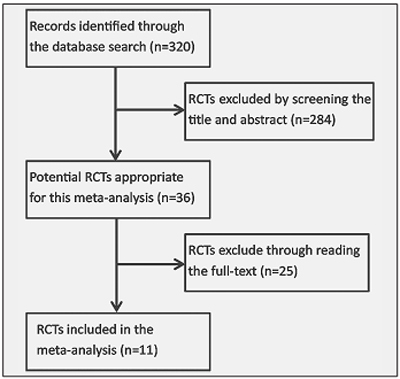
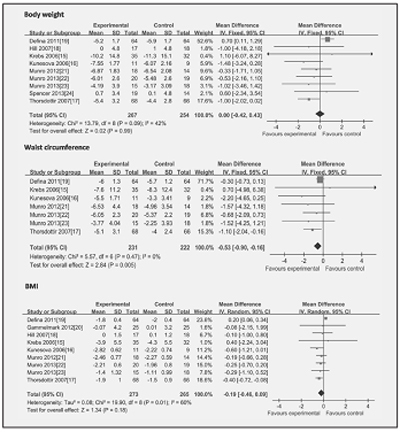
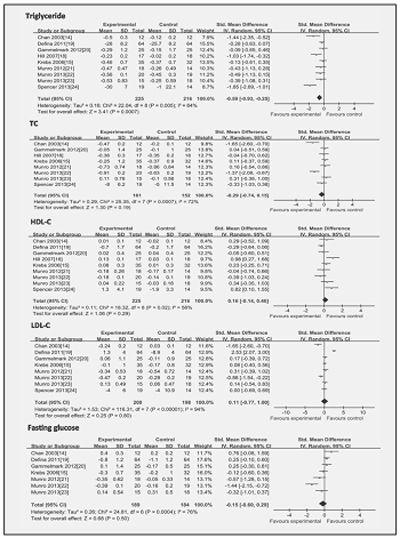
OBJECTIVE: Studies in rodents and humans have indicated that omega-3 polyunsaturated fatty acids (n-3 PUFA) may reduce weight. The aim of this meta-analysis was to evaluate evidence for the efficacy of n-3 PUFA in managing overweight and obesity. METHODS: We performed a systematic search of PubMed, Embase, and Cochrane Central Register of Controlled Trials until May 2015. Two reviewers independently determined the eligibility of studies and assessed the reporting quality of included randomized controlled trials (RCTs). RESULTS: A total of 11 RCTs involving 617 participants were included in this meta-analysis. Based on the meta-analysis of nine studies, a statistically nonsignificant difference was revealed in weight loss between n-3 PUFA and placebo (p=0.99; weighted mean difference [WMD]: 0.00; 95% confidence interval [CI] -0.42 to 0.43), whereas n-3 PUFA was superior to placebo in reducing serum triglyceride levels (p=0.0007; standard median difference [Std MD]: -0.59; 95% CI -0.93 to -0.25). Based on meta-analysis of seven studies, the analysis of aggregated data showed a significant reduction in waist circumference (p=0.005; WMD: -0.53; 95% CI -0.90 to -0.16). There were no significant differences in body mass index, total serum levels of cholesterol, low density lipoprotein cholesterol, high density lipoprotein cholesterol, and fasting glucose levels. CONCLUSIONS: The evidence from RCTs showed that n-3 PUFA might effectively reduce waist circumference and triglyceride levels in overweight and obese adults, but n-3 PUFA may not effectively reduce body weight. Given the small number and poor quality of RCTs included in the meta-analysis, these results are inconclusive. A large-scale, well-designed RCT is needed to further address this issue.
Overview
The claims and statistics of this paper haven’t been checked yet.
Free: it reads the open-access text and checks the first 5 claims that cite a source we can check. Create a free account to check every claim.
Integrity signals
Registry
Cites
Statistics
Figures
Verification
Claims the paper makes
The claims and statistics of this paper haven’t been checked yet.
Free: it reads the open-access text and checks the first 5 claims that cite a source we can check. Create a free account to check every claim.
Claims other papers make about this one
Each is checked against this paper’s own text: does it say what the citing paper says it does?
The cited source doesn’t support the claim as written.
In the citing paper
“In older adults, >2 g/day was associated with modest gains in muscle mass (0.67 kg) and improvements in walking speed, particularly after interventions > 6 months (1.78 m/s; 95% CI: 1.38-2.17)[190].”
From Nutritional Approaches to Enhance GLP-1 Analogue Therapy in Obesity: A Narrative Review (2025) · cites this paper as [190]
Checked by a reasoning model — may be wrong.
Experimental — accuracy not yet measuredThe source backs part of the claim, not all of it — or backs it for a different population, condition or comparison.
In the citing paper
“Evidence from preclinical and clinical studies indicates that omega-3 polyunsaturated fatty acids may enhance the metabolic benefits of GLP-1RAs and attenuate lean mass loss, primarily via anti-inflammatory pathways and modulation of protein synthesis”
From Nutritional Approaches to Enhance GLP-1 Analogue Therapy in Obesity: A Narrative Review (2025) · cites this paper as [190]
Experimental — accuracy not yet measuredIn the citing paper
“In older adults, >2 g/day was associated with modest gains in muscle mass (0.67 kg) and improvements in walking speed, particularly after interventions > 6 months (1.78 m/s; 95% CI: 1.38-2.17)[190].”
From Nutritional Approaches to Enhance GLP-1 Analogue Therapy in Obesity: A Narrative Review (2025) · cites this paper as [190]
Self-check
Percentages, sums and reported differences re-computed from the paper’s own numbers.
The self-check needs the paper’s full text.
Citations
Cites
The global obesity pandemic: shaped by global drivers and local environments
Swinburn, B. A., Sacks, G., Hall, K. D., McPherson, K., Finegood, D. T., Moodie, M. L., & Gortmaker, S. L. (2011) · The Lancet · doi:10.1016/s0140-6736(11)60813-1 · Cited by 4,888 · cited 1×
“In only the past few decades, the dramatic prevalence of the obesity epidemic has become a public health issue of worldwide importance (1).”
Graham (2007) · doi:10.1097/01.hjr.0000277983.23934.c9 · Cited by 1,647
Better Reporting of Harms in Randomized Trials: An Extension of the CONSORT Statement
Ioannidis, J. P. A., Evans, S. J. W., Gøtzsche, P. C., O'Neill, R. T., Altman, D. G., Schulz, K., Moher, D., & for the CONSORT Group* (2004) · Annals of Internal Medicine · doi:10.7326/0003-4819-141-10-200411160-00009 · Cited by 1,593 · cited 1×
“Thus, it is essential for investigators of future trials to incorporate surveillance time frames into the clinical trials to monitor any medium- and long-term adverse events associated with the use of n-3 PUFA (29).”
Adipose tissue dysfunction in obesity, diabetes, and vascular diseases
Hajer, G. R., van Haeften, T. W., & Visseren, F. L. J. (2008) · European Heart Journal · doi:10.1093/eurheartj/ehn387 · Cited by 1,410 · cited 4×
“Future studies may focus on the effect of n-3 PUFA on fat mass and inflammatory markers in overweight and obesity subjects, such as tumor necrosis factor-a and interleukin-6, C-reactive protein and leptin, because this might be a potential action point for prevention of CVD (26).”
InfluentialBurdge, G. C., & Wootton, S. A. (2002) · British Journal Of Nutrition · doi:10.1079/bjn2002689 · Cited by 812 · cited 1×
“This may partly be explained by the fact that women naturally lose less weight and are more responsive to n-3 PUFA metabolism than men (30).”
Omega-3 polyunsaturated fatty acids and cardiovascular diseases.
Lavie, C. J., Milani, R. V., Mehra, M. R., & Ventura, H. O. (2009) · Journal of the American College of Cardiology · doi:10.1016/j.jacc.2009.02.084 · Cited by 644 · cited 1×
“Most of the evidence of the benefits of n-3 PUFA has been obtained for long-chain fatty acids, eicosapentaenoic acid (EPA), and docosahexaenoic acid (DHA), the active components of fish oils (8).”
Kris-Etherton, P. M., Harris, W. S., & Appel, L. J. (2003) · Arteriosclerosis, Thrombosis, and Vascular Biology · doi:10.1161/01.atv.0000057393.97337.ae · Cited by 596 · cited 3×
“In accordance with these studies, the American and European Societies of Cardiology have recommended that all patients with CVD consume 1 g of n-3 PUFA daily (5, 7).”
Lifestyle modification for the management of obesity
Wadden, T. A., Butryn, M. L., & Wilson, C. (2007) · Gastroenterology · doi:10.1053/j.gastro.2007.03.051 · Cited by 406
Flachs, P., Horakova, O., Brauner, P., Rossmeisl, M., Pecina, P., Franssen-van Hal, N., Ruzickova, J., Sponarova, J., Drahota, Z., Vlcek, C., et al. (2005) · Diabetologia · doi:10.1007/s00125-005-1944-7 · Cited by 388
Ruzickova, J., Rossmeisl, M., Prazak, T., Flachs, P., Sponarova, J., Vecka, M., Tvrzicka, E., Bryhn, M., & Kopecky, J. (2004) · Lipids · doi:10.1007/s11745-004-1345-9 · Cited by 327 · cited 1×
“Some studies with rodents suggest that supplementation with n-3 PUFA may reduce weight or fat mass or protect against weight gain (9, 10), whereas other studies have shown no significant effects (11, 12).”
(1997) · PubMed · Cited by 302
Randomized trial of weight-loss-diets for young adults varying in fish and fish oil content
Thorsdottir, I., Tomasson, H., Gunnarsdottir, I., Gisladottir, E., Kiely, M., Parra, M. D., Bandarra, N. M., Schaafsma, G., & Martinéz, J. A. (2007) · International Journal of Obesity · doi:10.1038/sj.ijo.0803643 · Cited by 262 · cited 1×
“7 of 11 studies described the fat mass of subjects in the n-3 PUFA group in detail (15, 17-19, 21-23 21-23 ), which applied different kind of techniques such as dual X-ray X-ray absorptiometry and bioelectrical”
MAPT STUDY: A MULTIDOMAIN APPROACH FOR PREVENTING ALZHEIMER’S DISEASE: DESIGN AND BASELINE DATA
Vellas, B., Gillette-Guyonnet, S., Touchon, J., Dantoine, T., Dartigues, J. F., Cuffi, M. N., Bordes, S., Gasnier, Y., Robert, P., Bories, L., et al. (2014) · The Journal Of Prevention of Alzheimer's Disease · doi:10.14283/jpad.2014.34 · Cited by 255 · cited 1×
“Therefore, focusing on these supplementary clues may be useful in future research studies on the topic (28).”
Hill, A. M., Buckley, J. D., Murphy, K. J., & Howe, P. R. (2007) · The American Journal of Clinical Nutrition · doi:10.1093/ajcn/85.5.1267 · Cited by 237 · cited 17×
“Eight studies compared the effects of n-3 PUFA and placebo on TC levels (14, 15, 18, 20–24).”
InfluentialLong-Chain Omega-3 Polyunsaturated Fatty Acids May Be Beneficial for Reducing Obesity—A Review
Buckley, J. D., & Howe, P. R. C. (2010) · Nutrients · doi:10.3390/nu2121212 · Cited by 229 · cited 2×
“It is claimed that n-3 PUFA may also reduce obesity that accompanies appetite-suppressing effects (13, 25).”
Krebs, J. D., Browning, L. M., McLean, N. K., Rothwell, J. L., Mishra, G. D., Moore, C. S., & Jebb, S. A. (2006) · International Journal of Obesity · doi:10.1038/sj.ijo.0803309 · Cited by 221 · cited 8×
“Eight studies compared the effects of n-3 PUFA and placebo on TC levels (14, 15, 18, 20–24).”
InfluentialAnti‐obesity effects of long‐chain omega‐3 polyunsaturated fatty acids
Buckley, J. D., & Howe, P. R. C. (2009) · Obesity Reviews · doi:10.1111/j.1467-789x.2009.00584.x · Cited by 213 · cited 3×
“It is claimed that n-3 PUFA may also reduce obesity that accompanies appetite-suppressing effects (13, 25).”
Raclot, T., Groscolas, R., Langin, D., & Ferré, P. (1997) · Journal of Lipid Research · doi:10.1016/s0022-2275(20)37127-3 · Cited by 213
Chan, D. C., Watts, G. F., Mori, T. A., Barrett, P. H. R., Redgrave, T. G., & Beilin, L. J. (2003) · The American Journal of Clinical Nutrition · doi:10.1093/ajcn/77.2.300 · Cited by 185 · cited 13×
“Eight studies compared the effects of n-3 PUFA and placebo on TC levels (14, 15, 18, 20–24).”
InfluentialOmega-3 Fatty Acids Reduce Adipose Tissue Macrophages in Human Subjects With Insulin Resistance
Spencer, M., Finlin, B. S., Unal, R., Zhu, B., Morris, A. J., Shipp, L. R., Lee, J., Walton, R. G., Adu, A., Erfani, R., et al. (2013) · Diabetes · doi:10.2337/db12-1042 · Cited by 181 · cited 6×
“Eight studies compared the effects of n-3 PUFA and placebo on TC levels (14, 15, 18, 20–24).”
InfluentialKunešová, M., Braunerová, R., Hlavatý, P., Tvrzická, E., Staňková, B., Škrha, J., Hilgertová, J., Hill, M., Kopecký, J., Wagenknecht, M., et al. (2006) · Physiological Research · doi:10.33549/physiolres.930770 · Cited by 152
DeFina, L. F., Marcoux, L. G., Devers, S. M., Cleaver, J. P., & Willis, B. L. (2011) · The American Journal of Clinical Nutrition · doi:10.3945/ajcn.110.002741 · Cited by 89 · cited 6×
“ITT analysis was performed in only one study with patient withdrawals (19).”
InfluentialClinical Results and Nutritional Consequences of Biliopancreatic Diversion: Three Years of Follow-Up
de Luis, D. A., Pacheco, D., Izaola, O., Terroba, M. C., Cuellar, L., & Martin, T. (2008) · Annals of Nutrition and Metabolism · doi:10.1159/000185641 · Cited by 76 · cited 1×
“Therapeutic options for the treatment of obesity include dietary management (2), drug therapy, and bariatric surgery (3).”
Munro, I., & Garg, M. L. (2011) · Obesity Research & Clinical Practice · doi:10.1016/j.orcp.2011.11.001 · Cited by 72 · cited 4×
“7 of 11 studies described the fat mass of subjects in the n-3 PUFA group in detail (15, 17-19, 21-23 21-23 ), which applied different kind of techniques such as dual X-ray X-ray absorptiometry and bioelectrical”
InfluentialGammelmark, A., Madsen, T., Varming, K., Lundbye‐Christensen, S., & Schmidt, E. B. (2012) · Nutrition Research · doi:10.1016/j.nutres.2011.12.007 · Cited by 68 · cited 3×
“Eight studies compared the effects of n-3 PUFA and placebo on TC levels (14, 15, 18, 20–24).”
Munro, I. A., & Garg, M. L. (2012) · British Journal of Nutrition · doi:10.1017/s0007114511006817 · Cited by 66 · cited 5×
“Only three studies reported adequate randomization (21–23), and two of the studies reported adequate allocation concealment (21, 22).”
InfluentialMunro, I. A., & Garg, M. L. (2013) · Food & Function · doi:10.1039/c3fo60038f · Cited by 61 · cited 3×
“Allocation concealment was clearly described in only two studies (21, 22); hence, selective bias may have existed in the trials.”
Effects of a Low-Fat versus a Low-Carbohydrate Diet on Adipocytokines in Obese Adults
de Luis, D. A., Aller, R., Izaola, O., Gonzalez Sagrado, M., Bellioo, D., & Conde, R. (2007) · Hormone Research in Paediatrics · doi:10.1159/000099329 · Cited by 58 · cited 1×
“Therapeutic options for the treatment of obesity include dietary management (2), drug therapy, and bariatric surgery (3).”
Minami, A., Ishimura, N., Sakamoto, S., Takishita, E., Mawatari, K., Okada, K., & Nakaya, Y. (2002) · British Journal of Nutrition · doi:10.1079/bjn2001496 · Cited by 48 · cited 1×
“Some studies with rodents suggest that supplementation with n-3 PUFA may reduce weight or fat mass or protect against weight gain (9, 10), whereas other studies have shown no significant effects (11, 12).”
Pittaway, J. K., Chuang, L., Ahuja, K., Beckett, J. M., Glew, R. H., & Ball, M. J. (2015) · The journal of nutrition health & aging · doi:10.1007/s12603-015-0459-2 · Cited by 13 · cited 1×
“Humans acquire n-3 PUFA from fish oils, which are obtained from the human diet by eating oily fish, such as herring, mackerel, salmon, albacore tuna, and sardines, or by consuming fish oil supplements or cod liver oil (5, 6).”
Cited by
IOC Consensus Statement: Dietary Supplements and the High-performance Athlete
Maughan, R. J., Burke, L. M., Dvorak, J., Larson-Meyer, D. E., Peeling, P., Phillips, S. M., Rawson, E. S., Walsh, N. P., Garthe, I., Geyer, H., et al. (2018) · British Journal of Sports Medicine · doi:10.1136/bjsports-2018-099027 · Cited by 1,004
IOC Consensus Statement: Dietary Supplements and the High-Performance Athlete
Maughan, R. J., Burke, L. M., Dvorak, J., Larson-Meyer, D. E., Peeling, P., Phillips, S. M., Rawson, E. S., Walsh, N. P., Garthe, I., Geyer, H., et al. (2018) · International Journal of Sport Nutrition and Exercise Metabolism · doi:10.1123/ijsnem.2018-0020 · Cited by 540
“…fatty acids No clear role, but possible appetite suppression, improved blood flow, and/ or modulator of gene expression Small-to-trivial effect (Zhang et al., 2017) Chitosan Lipid-binding agent to reduce lipid absorption Small-to-trivial effect (Jull et al., 2008) *In combination with…”
BackgroundTherapeutic potential of ectopic olfactory and taste receptors
Lee, S.-J., Depoortere, I., & Hatt, H. (2019) · Nature Reviews Drug Discovery · doi:10.1038/s41573-018-0002-3 · Cited by 279
Inflammation and resolution in obesity
Soták, M., Clark, M., Suur, B. E., & Börgeson, E. (2025) · Nature Reviews Endocrinology · doi:10.1038/s41574-024-01047-y · Cited by 198
“Among individuals with obesity, ω-3 PUFA supplements decreased serum levels of triglycerides and leptin and reduced waist circumference without affecting total body weight 134,135 .”
Thota, R. N., Acharya, S. H., & Garg, M. L. (2019) · Lipids in Health and Disease · doi:10.1186/s12944-019-0967-x · Cited by 127
Metadata
- Authors
- Zhang, Y. Y., Liu, W., Zhao, T. Y., & Tian, H. M.
- Affiliations
- Sichuan University (CN)
- Corresponding author
- Tian, H.M.
- Venue
- The Journal of nutrition, health and aging
- Publisher
- Elsevier BV
- Published
- 2017-02
- Volume
- 21
- Issue
- 2
- Pages
- 187-192
- ISSN
- 1279-7707 (ISSN-L)
- PMC
- PMC12879820
- OpenAlex
- W2409758864
- Cited by
- 101
- References
- 30
- Citations by year
- 2026: 7 · 2025: 16 · 2024: 10 · 2023: 9 · 2022: 10 · 2021: 10 · 2020: 9 · 2019: 14 · 2018: 13 · 2017: 3
- FWCI
- 1.34
- Type
- journal article
- Language
- en
- Open access
- hybrid
- doi.org
- Licence
- cc-by-nc-nd
- www.elsevier.com/tdm/userlicense/1.0/ (tdm)
- www.elsevier.com/legal/tdmrep-license (tdm)
- creativecommons.org/licenses/by-nc-nd/4.0/ (vor, 2493 d)
- Locations
- The journal of nutrition health & aging (publishedVersion, cc-by-nc-nd)
- Europe PMC (PubMed Central) (publishedVersion, cc-by-nc-nd)
- PubMed (publishedVersion)
- PubMed Central (publishedVersion, cc-by-nc-nd)
- Topics
- Health Sciences › Nursing › Nutrition and Dietetics › Fatty Acid Research and Health
- Health Sciences › Medicine › Pharmacology (medical) › Pharmacology and Obesity Treatment
- Life Sciences › Agricultural and Biological Sciences › Aquatic Science › Aquaculture Nutrition and Growth
- Keywords
- omega-3 polyunsaturated fatty acids, overweight, obesity, weight loss, waist circumference, serum triglycerides, body mass index, cholesterol, fasting blood glucose, dietary supplementation
- MeSH terms
- Humans, Cholesterol, HDL, Cholesterol, LDL, Obesity, Triglycerides, Fatty Acids, Omega-3, Randomized Controlled Trials as Topic, Databases, Factual, Treatment Outcome, Dietary Supplements, Overweight
About these checks
Registry, retraction, Cites and statistics results are computed, not judged, with one exception: a printed reference that no index lists is read once by a model before it counts as a citation error. Claims are extracted by a model and kept only when their quote appears verbatim in the text; each cited source is then checked, with a model’s help, for whether it says what the claim relies on. Those verdicts can be wrong — read the claim’s quote and the cited source before relying on one.
Statistics and arithmetic are recomputed, not judged.
Confidence bands are shown only for fields calibrated on our annotated test set. None is calibrated yet, so no band is shown.
What counts as a claim ›How we measure confidence ›How we check this ›
Are you an author, or do you see a problem with this page? Request a review
Data sources
Bibliographic data: Semantic Scholar, OpenAlex, Crossref.
Contains information from the Semantic Scholar Academic Graph Datasets, made available under the ODC Attribution License (ODC-BY 1.0).
Semantic Scholar’s data is described in: Kinney, R., et al. (2023). The Semantic Scholar Open Data Platform. arXiv:2301.10140.
