

Impact of Social Isolation Due to COVID-19 on Health in Older People: Mental and Physical Effects and Recommendations
Open accessThe DOI matches its Crossref record; 85 of the 85 references it cites were found in a registry or an index; 26 of the 37 sources its claims cite were checked for support.
Abstract
To review the impact of social isolation during COVID-19 pandemic on mental and physical health of older people and the recommendations for patients, caregivers and health professionals. Narrative review. Non-institutionalized community-living people. 20.069 individuals from ten descriptive cross-sectional papers. Articles since 2019 to 2020 published on Pubmed, Scielo and Google Scholar databases with the following MeSh terms (‘COVID-19’, ‘coronavirus’, ‘aging’, ‘older people’, ‘elderly’, ‘social isolation’ and ‘quarantine’) in English, Spanish or Portuguese were included. The studies not including people over 60 were excluded. Guidelines, recommendations, and update documents from different international organizations related to mental and physical activity were also analysed. 41 documents have been included in this narrative review, involving a total of 20.069 individuals (58% women), from Asia, Europe and America. 31 articles included recommendations and 10 addressed the impact of social distancing on mental or physical health. The main outcomes reported were anxiety, depression, poor sleep quality and physical inactivity during the isolation period. Cognitive strategies and increasing physical activity levels using apps, online videos, telehealth, are the main international recommendations. Mental and physical health in older people are negatively affected during the social distancing for COVID-19. Therefore, a multicomponent program with exercise and psychological strategies are highly recommended for this population during the confinement. Future investigations are necessary in this field.
Overview
CoChat Summary
## TL;DR
This narrative review concludes that COVID-19-related social isolation negatively affected older adults’ mental and physical health, with anxiety, depression, poor sleep quality, and reduced physical activity most often reported. It also compiles expert and organizational recommendations emphasizing social connection, cognitive support, and home-based physical activity.
## Key findings
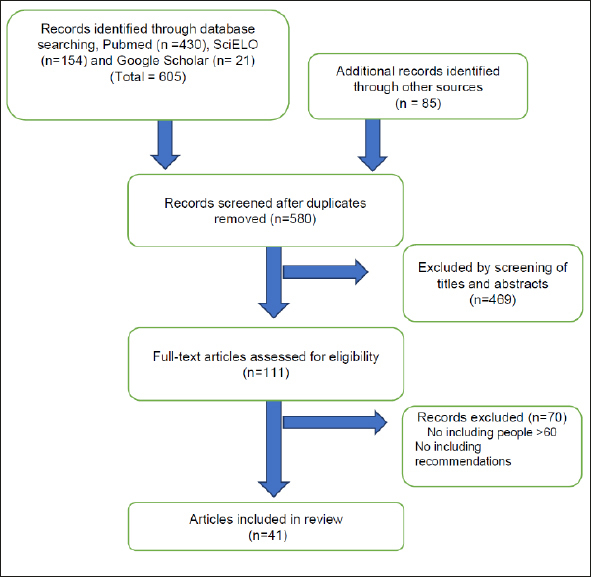
- The review included 41 documents in total, with 10 studies involving 20,069 participants (58% women) from Asia, Europe, and America; 9 were cross-sectional and 1 was qualitative, and all were descriptive studies.
- Across the mental-health studies, reported prevalence ranged from 8.3% to 49.7% for anxiety, 14.6% to 47.2% for depression, and sleep disturbances were reported in 18.2% and 36.4% of participants in two studies.
- The main mental and physical outcomes reported were anxiety, depression, poor sleep quality, and physical inactivity during isolation.
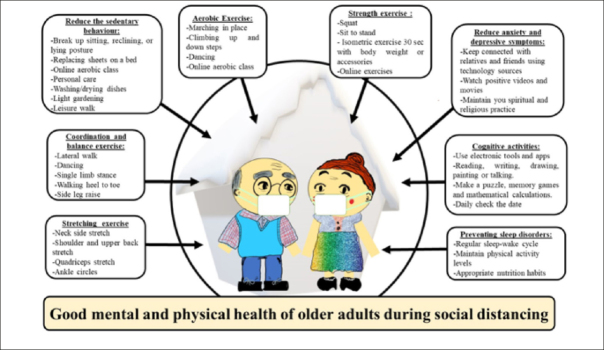
- The main international recommendations were cognitive strategies and increasing physical activity using apps, online videos, and telehealth; expert organizations and WHO recommended 150–300 minutes/week of moderate-intensity aerobic activity and two sessions/week of muscle-strength training.
## Methods
- Design: Narrative review.
- Data/sample: Searches were done in PubMed, SciELO, and Google Scholar for articles published from 2019 to May 20, 2020, in English, Spanish, or Portuguese; studies without participants over 60 years old were excluded. The review also included guidelines, recommendations, and update documents from international organizations.
- Main analysis: The authors screened records for duplicates, titles, and abstracts, then organized the review into two areas: effects of quarantine/social isolation on mental and physical health, and recommendations for mental and physical health during quarantine.
## Limitations
- The paper states that included studies were cross-sectional, not specific to elderly populations, and descriptive, with no control group used.
- The paper states there is a lack of evidence on the most appropriate psychological and physical recommendations, and that most suggested interventions are based on expert opinion rather than high-evidence studies.
- Evident from the text: the review is based on studies from an early stage of the pandemic and the authors note these findings should be taken with caution because data were collected very early.
Model-written summary. Check it against the paper before relying on it.
Integrity signals
Registry
Cites
Statistics
Figures
Verification
Claims the paper makes
15 Valid · 1 Not valid · 6 Not checked · 6 Own results and interpretations
The cited sources support only part of this claim — read each source’s verdict below.
In the paper
“The prevalence of anxiety ranged from 8.3%, 18.7% and 35.1% to 49.7% (36, 38)”
- Also stated in: § Mental health · plain
“having a wide range from 8.3% (36) to 49.7% (42) for anxiety”
§ Impact of Social Isolation Due to COVID-19 on Health in Older People: Mental and Physical Effects and Recommendations > Results > Effect of the reduction of social participation produced by quarantine for COVID-19 on mental and physical health in elderly people
What the sources say
- Supportedcites [36] Lei, 2020, Comparison of Prevalence and Associated Factors of Anxiety and Depression Among People Affected by versus People Unaffected by Quarantine During the COVID-19 Epidemic in Southwestern China, Med Sci Monit. source
The ‘Prevalence of anxiety and depression’ section reports anxiety in approximately 8.3% of the 1,593 participants in southwestern China. Because the citing sentence gives two references for a range across studies, this paper supports the 8.3% figure attributed to it. (LLM, conf=0.91)
- Partly supportedcites [38] Huang, 2020, Generalized anxiety disorder, depressive symptoms and sleep quality during COVID-19 outbreak in China: a web-based cross-sectional survey, Psychiatry Res. sourceExperimental — accuracy not yet measured
The Results section reports a 35.1% prevalence of generalized anxiety disorder in this study’s Chinese survey sample. It does not report the 8.3% or 49.7% figures or establish a prevalence range across studies, so it supports only one value in the citing sentence. No page number is available in our copy. (LLM, conf=0.86)
- Could not verifycites [42] Losada-Baltar A, Jimenez-Gonzalo L, Gallego-Alberto L, Pedrosos-Chaparro M del S, Fernades-Pires J, Marquez-Gonzáles M. “We're staying at home”. Association of self-perceptions of aging, personal and family resources and loneliness with psychological distress during the lock-down period of COVID- 19. J Gerontol B Psychol Sci Soc Sci. 2020:1–10. sourceExperimental — accuracy not yet measured
The Measures section mentions anxiety as one component of a psychological-distress scale, but gives no anxiety prevalence estimates. The Results section reports associations with distress rather than prevalence across studies; searches for 8.3%, 18.7%, 35.1%, 49.7%, and anxiety prevalence found no supporting passage in our copy. (LLM, conf=0.74)
plain- Asserted: passes — The authors put it forward as true.
- Checkable: passes — It can be checked against evidence.
- Load-bearing: unclear — It is unclear whether the paper’s conclusions depend on it.
- Based: passes — The paper gives a reason why it holds.
- Also stated in: § Mental health · plain
Every source the paper cites for this claim was checked and supports it.
In the paper
“Increased sedentary behavior has been associated with the prevalence of different comorbidities in elderly people (83).”
§ Impact of Social Isolation Due to COVID-19 on Health in Older People: Mental and Physical Effects and Recommendations > Discussion > Physical health
What the sources say
- Supportedcites [83] de Rezende, 2014, Sedentary behavior and health outcomes among older adults: a systematic review, BMC Public Heal. source
The Results sections on metabolic syndrome and overweight/obesity report associations between greater sedentary behavior and both conditions in older adults. This supports the broad claim that sedentary behavior has been associated with different comorbidities, without implying causation. (LLM, conf=0.89)
plainstates an association- Asserted: passes — The authors put it forward as true.
- Checkable: passes — It can be checked against evidence.
- Load-bearing: passes — The paper’s conclusions depend on it.
- Based: passes — The paper gives a reason why it holds.
- Supported
The cited sources support only part of this claim — read each source’s verdict below.
In the paper
“This review has reported that social distancing because of the COVID-19 pandemic could lead to negative consequences for the physical health of older adults. This is caused by the decrease of physical activity levels due to the total or partial restriction of social participation in community groups and family activities during the pandemic (42, 43, 44).”
§ Impact of Social Isolation Due to COVID-19 on Health in Older People: Mental and Physical Effects and Recommendations > Discussion > Physical health
What the sources say
- Could not verifycites [42] Losada-Baltar A, Jimenez-Gonzalo L, Gallego-Alberto L, Pedrosos-Chaparro M del S, Fernades-Pires J, Marquez-Gonzáles M. “We're staying at home”. Association of self-perceptions of aging, personal and family resources and loneliness with psychological distress during the lock-down period of COVID- 19. J Gerontol B Psychol Sci Soc Sci. 2020:1–10. sourceExperimental — accuracy not yet measured
The Introduction (page unavailable) suggests that lockdown may contribute to loneliness and psychological distress, and the Measures section assesses family contact. Our copy does not address the claimed decline in physical activity or a resulting effect on older adults’ physical health; searches for physical activity, exercise, social participation, and community groups found no supporting passage. (LLM, conf=0.76)
- Partly supportedcites [43] Goethals, 2020, Impact of home quarantine on physical activity among older adults living at home during the COVID-19 pandemic: Qualitative interview study, J Med Internet Res. sourceExperimental — accuracy not yet measured
The Discussion says quarantine and reduced social ties could decrease older adults’ physical activity, with possible consequences for physical functioning. The Results document reduced attendance and cancellation of group physical activity workshops. The paper does not specifically link restrictions on family activities to decreased physical activity. (LLM, conf=0.84)
- Partly supportedcites [44] Castañeda-babarro A. Impact of COVID-19 confinement on the time and intensity of physical activity in the Spanish population. Res Sq. 2020:1–14. doi:https://doi.org/10.21203/rs.3.rs-26074/vl. sourceExperimental — accuracy not yet measured
The cited preprint does support the general core: its Abstract and Discussion (Results, Conclusions) report that lockdown/social distancing during COVID-19 significantly reduced physical activity (vigorous −16.8%, walking −58.2%) and raised sedentary time (+23.8%), and the Discussion attributes part of this to 'forced sudden inaccessibility to community resources (e.g. sports facilities, urban trails, parks, green spaces)' and, via the socio-ecological model, to social isolation/loneliness (refs 18-20). However, the population is wrong: the study sampled 3800 healthy adults aged ≥18–≤64 residing in Spain (Abstract, Methods; Table 1 mean age 42.7), so it reports nothing about older adults, and its impact was greatest in men, young people, students and the very active. The specific causal attribution in the citing sentence — decreased activity due to 'total or partial restriction of social participation in community groups and family activities' — is also not stated in our copy, which instead cites prolonged stay at home, loss of active transport/work-related activity, e-learning/screen time and closure of fitness resources. (LLM, conf=0.78)
hedgedstates a possible cause- Asserted: passes — The authors put it forward as true.
- Checkable: passes — It can be checked against evidence.
- Load-bearing: passes — The paper’s conclusions depend on it.
- Based: passes — The paper gives a reason why it holds.
- Could not verify
The cited sources support only part of this claim — read each source’s verdict below.
In the paper
“Finally, sleep disturbances were observed in 18.2% (38) and 36.4% (37) among the participants.”
§ Impact of Social Isolation Due to COVID-19 on Health in Older People: Mental and Physical Effects and Recommendations > Results > Effect of the reduction of social participation produced by quarantine for COVID-19 on mental and physical health in elderly people
What the sources say
- Partly supportedcites [37] Yuan, 2020, Comparison of the Indicators of Psychological Stress in the Population of Hubei Province and Non-Endemic Provinces in China During Two Weeks During the Coronavirus Disease 2019 (COVID-19) Outbreak in February 2020, Med Sci Monit. sourceExperimental — accuracy not yet measured
Table 5 (Results; page not provided) reports that sleep quality worsened for 36.43% of the 527 participants included in that analysis, supporting the cited 36.4% figure. It excludes asymptomatic participants, however, and measures worsening sleep quality rather than the prevalence of sleep disturbances among all participants. The 18.2% figure is attached to a different citation and is not attributed to this paper. (LLM, conf=0.88)
- Supportedcites [38] Huang, 2020, Generalized anxiety disorder, depressive symptoms and sleep quality during COVID-19 outbreak in China: a web-based cross-sectional survey, Psychiatry Res. source
The Results (Table 4) report poor sleep quality in 1,317 of 7,236 participants (18.2%), supporting the figure attached to this source, citation (38). The 36.4% figure is attached to a different citation, (37), and is not assessed here. (LLM, conf=0.93)
plain- Asserted: passes — The authors put it forward as true.
- Checkable: passes — It can be checked against evidence.
- Load-bearing: unclear — It is unclear whether the paper’s conclusions depend on it.
- Based: passes — The paper gives a reason why it holds.
- Partly supported
The cited sources support only part of this claim — read each source’s verdict below.
In the paper
“Goethals et al (43) reported that COVID-19 pandemic has affected the number of seniors attending group physical activity programs.”
§ Impact of Social Isolation Due to COVID-19 on Health in Older People: Mental and Physical Effects and Recommendations > Results > Effect of the reduction of social participation produced by quarantine for COVID-19 on mental and physical health in elderly people
What the sources say
- Partly supportedcites [43] Goethals, 2020, Impact of home quarantine on physical activity among older adults living at home during the COVID-19 pandemic: Qualitative interview study, J Med Internet Res. sourceExperimental — accuracy not yet measured
The Discussion says the study suggests that the epidemic affected seniors’ attendance at group physical activity programs before quarantine in two study territories. The citing sentence presents that qualified finding as a general fact, without the study’s uncertainty or limits of place and time. (LLM, conf=0.82)
plainstates a cause- Asserted: passes — The authors put it forward as true.
- Checkable: passes — It can be checked against evidence.
- Load-bearing: unclear — It is unclear whether the paper’s conclusions depend on it.
- Based: passes — The paper gives a reason why it holds.
- Partly supported
12 more claims · 7 with their cited sources checked
Create a free account to see all 28 claims and to verify the 2 references still open.
- It may state two separate claims as one. 10
- Probably not a substantial claim. 2
Claims other papers make about this one
Each is checked against this paper’s own text: does it say what the citing paper says it does?
The source backs part of the claim, not all of it — or backs it for a different population, condition or comparison.
In the citing paper
“During 2021, older adults faced social isolation due to the COVID-19 pandemic, resulting in a surge in articles at that time.”
From Smart Speakers for Health and Well-Being of Older Adults: A Mixed-Methods Review (2025) · cites this paper as [38]
Experimental — accuracy not yet measured
Citations
Cites
The Psychological Impact of Quarantine and How to Reduce It: Rapid Review of the Evidence
Brooks, S. K., Webster, R. K., Smith, L. E., Woodland, L., Wessely, S., Greenberg, N., & Rubin, G. J. (2020) · doi:10.2139/ssrn.3532534 · Cited by 16,394
The psychological impact of quarantine and how to reduce it: Rapid review of the evidence
Brooks, S. K., Webster, R. K., Smith, L. E., Woodland, L., Wessely, S., Greenberg, N., & Rubin, G. J. (2020) · The Lancet · doi:10.1016/s0140-6736(20)30460-8 · Cited by 16,378
(1985) · Europe PMC (PubMed Central) · Cited by 9,143
Social Relationships and Mortality Risk: A Meta-analytic Review
Holt-Lunstad, J., Smith, T. B., & Layton, J. B. (2010) · PLoS Medicine · doi:10.1371/journal.pmed.1000316 · Cited by 7,272 · cited 1×
“Evidence has demonstrated a relationship between social isolation and loneliness with disability, chronic diseases, risk of mortality and physical inactivity in elderly population (9, 19, 75-79).”
Holmes, E. A., O'Connor, R. C., Perry, V. H., Tracey, I., Wessely, S., Arseneault, L., Ballard, C., Christensen, H., Cohen Silver, R., Everall, I., et al. (2020) · The Lancet Psychiatry · doi:10.1016/s2215-0366(20)30168-1 · Cited by 5,715
Sedentary Behavior Research Network (SBRN)—Terminology Consensus Project process and outcome
on behalf of SBRN Terminology Consensus Project Participants, Tremblay, M. S., Aubert, S., Barnes, J. D., Saunders, T. J., Carson, V., Latimer-Cheung, A. E., Chastin, S. F. M., Altenburg, T. M., & Chinapaw, M. J. M. (2017) · International Journal of Behavioral Nutrition and Physical Activity · doi:10.1186/s12966-017-0525-8 · Cited by 3,793 · cited 1×
“…as any body movement using skeletal muscle that results in energy expenditure > 1.5 metabolic equivalent of task (MET), while sedentary behavior is defined as any waking behavior characterized by an energy expenditure 1.5 or less MET while in a sitting, reclining or lying posture (81, 82).”
InfluentialInternational Classification of Functioning, Disability and Health
World Health Organization (2021) · PsycTESTS Dataset · doi:10.1037/t76403-000 · Cited by 3,751
Huang, Y., & Zhao, N. (2020) · Psychiatry Research · doi:10.1016/j.psychres.2020.112954 · Cited by 3,736 · cited 3×
“Being female (36, 39, 42), having a negative self-perception of aging (42), healthcare workers (38), family and personal resources (42), time devoted to COVID-19 information (42), having an acquaintance or a family member infected with COVID-19 or a previous history of medical problems (39) seem to…”
Influential(2020) · PubMed · doi:10.3760/cma.j.issn.0254-6450.2020.02.003 · Cited by 3,323
The World report on ageing and health: a policy framework for healthy ageing
Beard, J. R., Officer, A., de Carvalho, I. A., Sadana, R., Pot, A. M., Michel, J.-P., Lloyd-Sherlock, P., Epping-Jordan, J. E., Peeters, G. M. E. E. (., Mahanani, W. R., et al. (2016) · The Lancet · doi:10.1016/s0140-6736(15)00516-4 · Cited by 3,287
CDC Weekly, C., & The Novel Coronavirus Pneumonia Emergency Response Epidemiology Team (2020) · China CDC Weekly · doi:10.46234/ccdcw2020.032 · Cited by 2,889
CDC COVID-19 Response Team, CDC COVID-19 Response Team, Bialek, S., Boundy, E., Bowen, V., Chow, N., Cohn, A., Dowling, N., Ellington, S., Gierke, R., et al. (2020) · MMWR. Morbidity and Mortality Weekly Report · doi:10.15585/mmwr.mm6912e2 · Cited by 2,277
Valtorta, N. K., Kanaan, M., Gilbody, S., Ronzi, S., & Hanratty, B. (2016) · Heart · doi:10.1136/heartjnl-2015-308790 · Cited by 1,971
SARS control and psychological effects of quarantine, Toronto, Canada
Hawryluck, L., Gold, W. L., Robinson, S., Pogorski, S., Galea, S., & Styra, R. (2004) · Emerging Infectious Diseases · doi:10.3201/eid1007.030703 · Cited by 1,929
Mazza, C., Ricci, E., Biondi, S., Colasanti, M., Ferracuti, S., Napoli, C., & Roma, P. (2020) · International Journal of Environmental Research and Public Health · doi:10.3390/ijerph17093165 · Cited by 1,899 · cited 2×
“Being female (36, 39, 42), having a negative self-perception of aging (42), healthcare workers (38), family and personal resources (42), time devoted to COVID-19 information (42), having an acquaintance or a family member infected with COVID-19 or a previous history of medical problems (39) seem to…”
COVID-19 and the consequences of isolating the elderly
Armitage, R., & Nellums, L. B. (2020) · The Lancet Public Health · doi:10.1016/s2468-2667(20)30061-x · Cited by 1,597
Zhang, Y., & Ma, Z. F. (2020) · International Journal of Environmental Research and Public Health · doi:10.3390/ijerph17072381 · Cited by 1,477 · cited 3×
“…2A) such as strengthen social connections (43, 45-48) (using internet apps, video chat (45, 47)), telephone support lines or support groups (23, 35, 49), changes on lifestyle (regular sleep-wake up circle (50), physical activity and nutrition habits (37, 51)) and cognitive stimulation (using…”
Social isolation, loneliness and health in old age: a scoping review
Courtin, E., & Knapp, M. (2017) · Health & Social Care in the Community · doi:10.1111/hsc.12311 · Cited by 1,463
Seidel, M. (2005) · Der Nervenarzt · doi:10.1007/s00115-004-1855-8 · Cited by 1,256
Ozamiz-Etxebarria, N., Dosil-Santamaria, M., Picaza-Gorrochategui, M., & Idoiaga-Mondragon, N. (2020) · Cadernos de Saúde Pública · doi:10.1590/0102-311x00054020 · Cited by 892
The association between social support and physical activity in older adults: a systematic review
Lindsay Smith, G., Banting, L., Eime, R., O’Sullivan, G., & van Uffelen, J. G. Z. (2017) · International Journal of Behavioral Nutrition and Physical Activity · doi:10.1186/s12966-017-0509-8 · Cited by 889
Lei, L., Huang, X., Zhang, S., Yang, J., Yang, L., & Xu, M. (2020) · Medical Science Monitor · doi:10.12659/msm.924609 · Cited by 871
Jiménez-Pavón, D., Carbonell-Baeza, A., & Lavie, C. J. (2020) · Progress in Cardiovascular Diseases · doi:10.1016/j.pcad.2020.03.009 · Cited by 831 · cited 5×
“Finally, coordination, mobility and cognitive exercises are also necessary (63) (Table 2B).”
InfluentialSedentary behavior and health outcomes among older adults: a systematic review
Rezende, L. F. M. D., Rey-López, J. P., Matsudo, V. K. R., & Luiz, O. D. C. (2014) · BMC Public Health · doi:10.1186/1471-2458-14-333 · Cited by 685
Ozamiz-Etxebarria, N., Dosil-Santamaria, M., Picaza-Gorrochategui, M., & Idoiaga-Mondragon, N. (2021) · SciELO journals · doi:10.6084/m9.figshare.14280665 · Cited by 575
Wang, H., Li, T., Barbarino, P., Gauthier, S., Brodaty, H., Molinuevo, J. L., Xie, H., Sun, Y., Yu, E., Tang, Y., et al. (2020) · The Lancet · doi:10.1016/s0140-6736(20)30755-8 · Cited by 562
Losada-Baltar, A., Jiménez-Gonzalo, L., Gallego-Alberto, L., Pedroso-Chaparro, M. D. S., Fernandes-Pires, J., & Márquez-González, M. (2021) · The Journals of Gerontology: Series B · doi:10.1093/geronb/gbaa048 · Cited by 508
Schrempft, S., Jackowska, M., Hamer, M., & Steptoe, A. (2019) · BMC Public Health · doi:10.1186/s12889-019-6424-y · Cited by 502
Factors influencing compliance with quarantine in Toronto during the 2003 SARS outbreak
DiGiovanni, C., Conley, J., Chiu, D., & Zaborski, J. (2004) · Biosecurity and Bioterrorism: Biodefense Strategy, Practice, and Science · doi:10.1089/bsp.2004.2.265 · Cited by 483
Impact of Ebola experiences and risk perceptions on mental health in Sierra Leone, July 2015
Jalloh, M. F., Li, W., Bunnell, R. E., Ethier, K. A., O’Leary, A., Hageman, K. M., Sengeh, P., Jalloh, M. B., Morgan, O., Hersey, S., et al. (2018) · BMJ Global Health · doi:10.1136/bmjgh-2017-000471 · Cited by 433 · cited 2×
“After Ebola outbreak, people who knew someone quarantined due to Ebola or with any Ebola experience were at higher risk of anxiety, depression and post-traumatic stress disorder (68).”
Douglas, H., Georgiou, A., & Westbrook, J. (2017) · Australian Health Review · doi:10.1071/ah16038 · Cited by 401
History in a Crisis — Lessons for Covid-19
Jones, D. S. (2020) · New England Journal of Medicine · doi:10.1056/nejmp2004361 · Cited by 375
The experience of SARS-related stigma at Amoy Gardens
Lee, S., Chan, L. Y. Y., Chau, A. M. Y., Kwok, K. P. S., & Kleinman, A. (2005) · Social Science & Medicine · doi:10.1016/j.socscimed.2005.04.010 · Cited by 366
Yip, P. S. F., Cheung, Y. T., Chau, P. H., & Law, Y. W. (2010) · Crisis · doi:10.1027/0227-5910/a000015 · Cited by 363
Goethals, L., Barth, N., Guyot, J., Hupin, D., Celarier, T., & Bongue, B. (2020) · JMIR Aging · doi:10.2196/19007 · Cited by 360
Chiao, C., Weng, L.-J., & Botticello, A. L. (2011) · BMC Public Health · doi:10.1186/1471-2458-11-292 · Cited by 345
Social Participation and Depression in Old Age: A Fixed-Effects Analysis in 10 European Countries
Croezen, S., Avendano, M., Burdorf, A., & van Lenthe, F. J. (2015) · American Journal of Epidemiology · doi:10.1093/aje/kwv015 · Cited by 305
The International Classification of Functioning, Disability and Health
VanSant, A. F. (2006) · Pediatric Physical Therapy · doi:10.1097/01.pep.0000245823.21888.71 · Cited by 303
15 Smartphone apps for older adults to use while in isolation during the COVID-19 pandemic
Banskota, S., Healy, M., & Goldberg, E. (2020) · Western Journal of Emergency Medicine · doi:10.5811/westjem.2020.4.47372 · Cited by 266
Loneliness and risk of mortality: A longitudinal investigation in Alameda County, California
Patterson, A. C., & Veenstra, G. (2010) · Social Science & Medicine · doi:10.1016/j.socscimed.2010.03.024 · Cited by 258
Social participation and healthy ageing: An international comparison using SHARE data
Sirven, N., & Debrand, T. (2008) · Social Science & Medicine · doi:10.1016/j.socscimed.2008.09.056 · Cited by 240
Global physical activity levels - Need for intervention
Ozemek, C., Lavie, C. J., & Rognmo, Ø. (2019) · Progress in Cardiovascular Diseases · doi:10.1016/j.pcad.2019.02.004 · Cited by 240
Population-based post-crisis psychological distress: an example from the SARS outbreak in Taiwan
Peng, E. Y.-C., Lee, M.-B., Tsai, S.-T., Yang, C.-C., Morisky, D. E., Tsai, L.-T., Weng, Y.-L., & Lyu, S.-Y. (2010) · Journal of the Formosan Medical Association · doi:10.1016/s0929-6646(10)60087-3 · Cited by 227
Social capital and health among the aged: comparisons between the United States and Germany
Pollack, C. E., & von dem Knesebeck, O. (2004) · Health & Place · doi:10.1016/j.healthplace.2004.08.008 · Cited by 208
Ransing, R., Adiukwu, F., Pereira-Sanchez, V., Ramalho, R., Orsolini, L., Teixeira, A. L. S., Gonzalez-Diaz, J. M., Pinto da Costa, M., Soler-Vidal, J., Bytyçi, D. G., et al. (2020) · Asian Journal of Psychiatry · doi:10.1016/j.ajp.2020.102085 · Cited by 191
Yuan, S., Liao, Z., Huang, H., Jiang, B., Zhang, X., Wang, Y., & Zhao, M. (2020) · Medical Science Monitor · doi:10.12659/msm.923767 · Cited by 178
Combating physical inactivity during the COVID-19 pandemic
Pinto, A. J., Dunstan, D. W., Owen, N., Bonfá, E., & Gualano, B. (2020) · Nature Reviews Rheumatology · doi:10.1038/s41584-020-0427-z · Cited by 177 · cited 2×
“In those older adults with geriatrics syndromes or unstable chronic diseases, it is recommended the supervision of caregivers to avoid falls, exacerbations and injuries during the exercise (64).”
Wallace, L. M. K., Theou, O., Peña, F. G., Rockwood, K. J., & Andrew, M. K. (2014) · Aging Clinical and Experimental Research · doi:10.1007/s40520-014-0271-6 · Cited by 175
Morley, J. E., & Vellas, B. (2020) · The Journal of nutrition, health and aging · doi:10.1007/s12603-020-1349-9 · Cited by 173
COVID-19, Mental Health and Aging: A Need for New Knowledge to Bridge Science and Service
Vahia, I. V., Blazer, D. G., Smith, G. S., Karp, J. F., Steffens, D. C., Forester, B. P., Tampi, R., Agronin, M., Jeste, D. V., & Reynolds, C. F. (2020) · The American Journal of Geriatric Psychiatry · doi:10.1016/j.jagp.2020.03.007 · Cited by 170
Heffner, K. L., Waring, M. E., Roberts, M. B., Eaton, C. B., & Gramling, R. (2011) · Social Science & Medicine · doi:10.1016/j.socscimed.2011.03.016 · Cited by 159
Yoon, M.-K., Kim, S.-Y., Ko, H.-S., & Lee, M.-S. (2016) · International Journal of Mental Health Systems · doi:10.1186/s13033-016-0083-5 · Cited by 153 · cited 1×
“Several studies have described mental health consequences in previous quarantines, such as higher risk of depression (30), emotional disturbance (31) , stress (32), low mood (33), irritability (33), or insomnia (33), being also associated with higher rates of suicide in elderly population (34).”
“Social Distancing” Amid a Crisis in Social Isolation and Loneliness
Cudjoe, T., & Kotwal, A. (2020) · Journal of the American Geriatrics Society · doi:10.1111/jgs.16527 · Cited by 141
Charles, A., Buckinx, F., Locquet, M., Reginster, J.-Y., Petermans, J., Gruslin, B., & Bruyère, O. (2020) · The Journals of Gerontology: Series A · doi:10.1093/gerona/glz218 · Cited by 140 · cited 1×
“WHO defines the ‘intrinsic capacity’ as the ‘composite of all the physical, functional, and mental capacities of an individual’ (26-28), changing the focus from a negative aging (disability) towards a positive one (optimal aging), being related to the onset of autonomy decline, falls and death (27).”
COVID‐19 lockdown: A perfect storm for older people’s mental health
Webb, L. (2021) · Journal of Psychiatric and Mental Health Nursing · doi:10.1111/jpm.12644 · Cited by 132 · cited 1×
“Reinforcing that being quarantined is helping to keep others safe (23, 35, 46, 49), adopting inclusive language when talking about the elderly, valuing older people’s contributions and avoiding negative emphasis on risk (46) could increase also elderly’s resilience.”
Tomioka, K., Kurumatani, N., & Hosoi, H. (2017) · Journal of the American Geriatrics Society · doi:10.1111/jgs.14447 · Cited by 128
Dohrn, I.-M., Kwak, L., Oja, P., Sjostrom, M., & Hagstromer, M. (2018) · Clinical Epidemiology · doi:10.2147/clep.s151613 · Cited by 127
“The COVID-19 Generation”: A Cautionary Note
Rudolph, C. W., & Zacher, H. (2020) · Work Aging and Retirement · doi:10.1093/workar/waaa009 · Cited by 115
Bonten, T. N., Rauwerdink, A., Wyatt, J. C., Kasteleyn, M. J., Witkamp, L., Riper, H. M., van Gemert‐Pijnen, J. E. W. C., Cresswell, K. M., Sheikh, A., Schijven, M. P., et al. (2020) · Journal of Medical Internet Research · doi:10.2196/17774 · Cited by 101
Thiyagarajan, J. A., Araujo de Carvalho, I., Peña-Rosas, J. P., Chadha, S., Mariotti, S. P., Dua, T., Albanese, E., Bruyère, O., Cesari, M., Dangour, A., et al. (2019) · PLOS Medicine · doi:10.1371/journal.pmed.1002948 · Cited by 87 · cited 1×
“WHO defines the ‘intrinsic capacity’ as the ‘composite of all the physical, functional, and mental capacities of an individual’ (26-28), changing the focus from a negative aging (disability) towards a positive one (optimal aging), being related to the onset of autonomy decline, falls and death (27).”
Mañas, A., del Pozo-Cruz, B., Guadalupe-Grau, A., Marín-Puyalto, J., Alfaro-Acha, A., Rodríguez-Mañas, L., García-García, F. J., & Ara, I. (2018) · Journal of the American Medical Directors Association · doi:10.1016/j.jamda.2017.11.003 · Cited by 86
Self-citationPhysical Activity in Non-Frail and Frail Older Adults
Jansen, F. M., Prins, R. G., Etman, A., van der Ploeg, H. P., de Vries, S. I., van Lenthe, F. J., & Pierik, F. H. (2015) · PLOS ONE · doi:10.1371/journal.pone.0123168 · Cited by 79 · cited 1×
“Since a direct association has been reported between sedentary time and time spent at home in elderly people (84), recommendations have to be made to prevent health consequences in people with social isolation associated to the pandemic COVID-19.”
Depression, Anxiety, and Moods of Hospitalized Patients under Contact Precautions
Day, H., Perencevich, E. N., Harris, A. D., Gruber‐Baldini, A. L., Himelhoch, S. S., Brown, C. H., & Morgan, D. J. (2013) · Infection Control and Hospital Epidemiology · doi:10.1086/669526 · Cited by 73
Development of a telehealth geriatric assessment model in response to the COVID-19 pandemic
DiGiovanni, G., Mousaw, K., Lloyd, T., Dukelow, N., Fitzgerald, B., D'Aurizio, H., Loh, K. P., Mohile, S., Ramsdale, E., Maggiore, R., et al. (2020) · Journal of Geriatric Oncology · doi:10.1016/j.jgo.2020.04.007 · Cited by 70 · cited 3×
“During this COVID-19 crisis, healthcare system have had to change completely implementing virtual consultations and telemedicine (video-tools, telephone hotlines or online consultations (49), guaranteeing rapid access to health care (52, 56).”
Tomioka, K., Kurumatani, N., & Hosoi, H. (2015) · PLOS ONE · doi:10.1371/journal.pone.0139065 · Cited by 67
Ezeugwu, V. E., & Manns, P. J. (2018) · Archives of Physical Medicine and Rehabilitation · doi:10.1016/j.apmr.2018.06.014 · Cited by 64
(2015) · PubMed · doi:10.11236/jph.62.3_95 · Cited by 62
Étard, J.-F., Vanhems, P., Atlani-Duault, L., & Écochard, R. (2020) · Eurosurveillance · doi:10.2807/1560-7917.es.2020.25.15.2000448 · Cited by 61
Yazawa, A., Inoue, Y., Fujiwara, T., Stickley, A., Shirai, K., Amemiya, A., Kondo, N., Watanabe, C., & Kondo, K. (2016) · Hypertension Research · doi:10.1038/hr.2016.78 · Cited by 47
Saadatian-Elahi, M., Facy, F., Del Signore, C., & Vanhems, P. (2010) · BMC Public Health · doi:10.1186/1471-2458-10-191 · Cited by 45
Loyola, W. S., Camillo, C. A., Torres, C. V., & Probst, V. S. (2018) · Geriatrics & Gerontology International · doi:10.1111/ggi.13167 · Cited by 39 · cited 5×
“The social participation has been associated with a better quality of life, more muscle mass, balance, cognition and lower comorbidities and disability in older people (9, 13, 15-20).”
InfluentialReed, S. B., Crespo, C. J., Harvey, W., & Andersen, R. E. (2011) · European Journal of Sport Science · doi:10.1080/17461391.2010.521585 · Cited by 38
The level of physical activity affects the health of older adults despite being active
Fernandez-Alonso, L., Muñoz‐García, D., & Touche, R. L. (2016) · Journal of Exercise Rehabilitation · doi:10.12965/jer.1632566.283 · Cited by 30
Castañeda-Babarro, A., Arbillaga-Etxarri, A., Gutiérrez-Santamaria, B., & Coca, A. (2020) · doi:10.21203/rs.3.rs-26074/v1 · Cited by 29
Older people and epidemics: a call for empathy
Doraiswamy, S., Cheema, S., & Mamtani, R. (2020) · Age and Ageing · doi:10.1093/ageing/afaa060 · Cited by 27 · cited 2×
“Explaining clearly (55) or accompanying information with illustrations (53) may help, especially in people with cognitive impairment.”
Chan, Y., Millard, A. D., Wheatley, P. J., Holmes, A. B., Mohr, R., Whitworth, A. L., Mann, N. H., Larkum, A. W. D., Hess, W. R., Scanlan, D. J., et al. (2014) · Environmental Microbiology · doi:10.1111/1462-2920.12735 · Cited by 27
Social participation and self‐rated health among older male veterans and non‐veterans
Choi, N. G., DiNitto, D. M., & Marti, C. N. (2015) · Geriatrics and gerontology international/Geriatrics & gerontology international · doi:10.1111/ggi.12577 · Cited by 23
Sepúlveda-Loyola, W., Ganz, F., Maciel, R. P. T., Lopes, R. D. S., Negri, P. S., Solorza, E. M., Caro, H. G., & Probst, V. S. (2020) · Brazilian Journal of Development · doi:10.34117/bjdv6n4-299 · Cited by 19 · cited 5×
“Various studies have reported protective effects of social participation for the health of the elderly, being considered as a stimulus to increase the level of physical activity and cognitive functions (9, 13, 14).”
InfluentialSelf-citationSymptoms of Anxiety and depression during the outbreak of COVID-19 in Paraguay
Rios-González, C. M., & Palacios, J. M. (2020) · doi:10.1590/scielopreprints.152 · Cited by 18
ahmed, A. (2021) · International Egyptian Journal of Nursing Sciences and Research · doi:10.21608/ejnsr.2020.50998.1022 · Cited by 17
“The COVID-19 Generation”: A Cautionary NotePreprint
Rudolph, C. W., & Zacher, H. (2020) · doi:10.31234/osf.io/c7w3u · Cited by 16
Role of telehealth in outbreaks—Where the classical healthcare systems fail
Mahmoodpoor, A., Akbarzadeh, M. A., Sanaie, S., & Hosseini, M. (2020) · Infection Control and Hospital Epidemiology · doi:10.1017/ice.2020.120 · Cited by 14
Reiss, C. S. (2020) · DNA and Cell Biology · doi:10.1089/dna.2020.29015.csr · Cited by 8
Alzheimer′s, A. (2020) · Chin J Psychiatry · doi:10.3760/cma.j.cn.113661-20200225-00056 · Cited by 6
Martelli, A., Filho, A. J. O., Barbosa, P. H., Delbim, L. R., Samudio, E. M. M., & Zavarize, S. F. (2020) · Brazilian Journal of Development · doi:10.34117/bjdv6n4-035 · Cited by 5
Research works printed but not linked: 3
- Yazawa, 2016, Association between social participation and hypertension among older people in Japan: the JAGES Study, Hypertens Res., 39, 818, 10.1038/hr.2016.78 · DOI
- Holmes, 2020, Multidisciplinary research priorities for the COVID-19 pandemic: a call for action for mental health science, The Lancet Psychiatry., 0366, 1
- Arazi, 2018, Osteosarcopenia and Physical Activity, Ann Sport Med Res., 5, 3
Cited by
Onset and frequency of depression in post-COVID-19 syndrome: A systematic review
Renaud-Charest, O., Lui, L. M. W., Eskander, S., Ceban, F., Ho, R., Di Vincenzo, J. D., Rosenblat, J. D., Lee, Y., Subramaniapillai, M., & McIntyre, R. S. (2021) · Journal of Psychiatric Research · doi:10.1016/j.jpsychires.2021.09.054 · Cited by 374
Active Aging and Public Health: Evidence, Implications, and Opportunities
Dogra, S., Dunstan, D. W., Sugiyama, T., Stathi, A., Gardiner, P. A., & Owen, N. (2022) · Annual Review of Public Health · doi:10.1146/annurev-publhealth-052620-091107 · Cited by 334
“First, a shift away from cars to shared or public transport and active travel or electric-assisted micromobility may be invaluable for ensuring autonomy.”
BackgroundSayin Kasar, K., & Karaman, E. (2021) · Geriatric Nursing · doi:10.1016/j.gerinurse.2021.03.010 · Cited by 334
Su, Y., Rao, W., Li, M., Caron, G., D’Arcy, C., & Meng, X. (2023) · International Psychogeriatrics · doi:10.1017/s1041610222000199 · Cited by 275
“…of social isolation in part may be associated with social distancing which adds difficulties to connect others among the older population (Sepúlveda-Loyola et al., 2020), whereas loneliness may occur through pathways unrelated to the frequency of social network interaction, including…”
BackgroundAn overview of mental health during the COVID-19 pandemic
Chen, P. J., Pusica, Y., Sohaei, D., Prassas, I., & Diamandis, E. P. (2021) · Diagnosis · doi:10.1515/dx-2021-0046 · Cited by 159
Metadata
- Authors
- Sepúlveda-Loyola, W., Rodríguez-Sánchez, I., Pérez-Rodríguez, P., Ganz, F., Torralba, R., Oliveira, D. V., & Rodríguez-Mañas, L.
- Affiliations
- Complejo Hospitalario de Navarra (ES)
- Hospital Universitario La Paz (ES)
- University of Alberta (CA)
- Hospital General Universitario de Ciudad Real (ES)
- Venue
- The Journal of nutrition, health and aging
- Publisher
- Elsevier BV
- Published
- 2020-09
- Volume
- 24
- Issue
- 9
- Pages
- 938-947
- ISSN
- 1279-7707 (ISSN-L)
- PMC
- PMC7597423
- OpenAlex
- W4233641204
- Cited by
- 1,081
- References
- 85
- Citations by year
- 2026: 71 · 2025: 114 · 2024: 158 · 2023: 263 · 2022: 286 · 2021: 175 · 2020: 14
- FWCI
- 68.49
- Type
- journal article
- Language
- en
- Open access
- hybrid
- doi.org
- Licence
- cc-by-nc-nd
- www.elsevier.com/tdm/userlicense/1.0/ (tdm)
- www.elsevier.com/legal/tdmrep-license (tdm)
- creativecommons.org/licenses/by-nc-nd/4.0/ (vor, 1186 d)
- Locations
- The journal of nutrition health & aging (publishedVersion, cc-by-nc-nd)
- PubMed Central (publishedVersion)
- PubMed (publishedVersion)
- Topics
- Social Sciences › Psychology › Clinical Psychology › COVID-19 and Mental Health
- Health Sciences › Medicine › Public Health, Environmental and Occupational Health › Aging, Health, and Disability
- Health Sciences › Medicine › Public Health, Environmental and Occupational Health › Physical Activity and Health
- Keywords
- social isolation, COVID-19 pandemic, older adults, mental health, physical health, anxiety, depression, sleep quality, physical inactivity, social distancing, quarantine, telemedicine, exercise recommendations, community-dwelling older adults
- MeSH terms
- COVID-19, SARS-CoV-2, Age Factors, Aged, Aged, 80 and over, Americas, Anxiety, Asia, Mental Disorders, Cross-Sectional Studies, Depression, Europe, Female, Humans, Male, Middle Aged, Quarantine, Sleep Wake Disorders, Social Isolation, Exercise, Sedentary Behavior, Pandemics
About these checks
Registry, retraction, Cites and statistics results are computed, not judged, with one exception: a printed reference that no index lists is read once by a model before it counts as a citation error. Claims are extracted by a model and kept only when their quote appears verbatim in the text; each cited source is then checked, with a model’s help, for whether it says what the claim relies on. Those verdicts can be wrong — read the claim’s quote and the cited source before relying on one.
The claim verdicts this report counts are experimental: their accuracy is not yet measured.
A language model drew the claims from the paper on 2026-10-10, under version 3 of the claim definition (model deepseek-v4.1-flash, prompt extract-v3).
A second model labelled each claim on 2026-10-10 (model jev-1.13-20260917, definition revision gold-guideline-v0.2).
Cited sources are checked with a language model’s help (gpt-6-sol and qwen3.8-omni-flash).
Statistics and arithmetic are recomputed, not judged.
Confidence bands are shown only for fields calibrated on our annotated test set. None is calibrated yet, so no band is shown.
What counts as a claim ›How we measure confidence ›How we check this ›
Are you an author, or do you see a problem with this page? Request a review
Data sources
Bibliographic data: Semantic Scholar, OpenAlex, Crossref.
Contains information from the Semantic Scholar Academic Graph Datasets, made available under the ODC Attribution License (ODC-BY 1.0).
Semantic Scholar’s data is described in: Kinney, R., et al. (2023). The Semantic Scholar Open Data Platform. arXiv:2301.10140.
