

Conceptualising engagement with digital behaviour change interventions: a systematic review using principles from critical interpretive synthesis
Open accessThe DOI matches its Crossref record; 158 of the 160 references it cites were found in a registry or an index.
Abstract
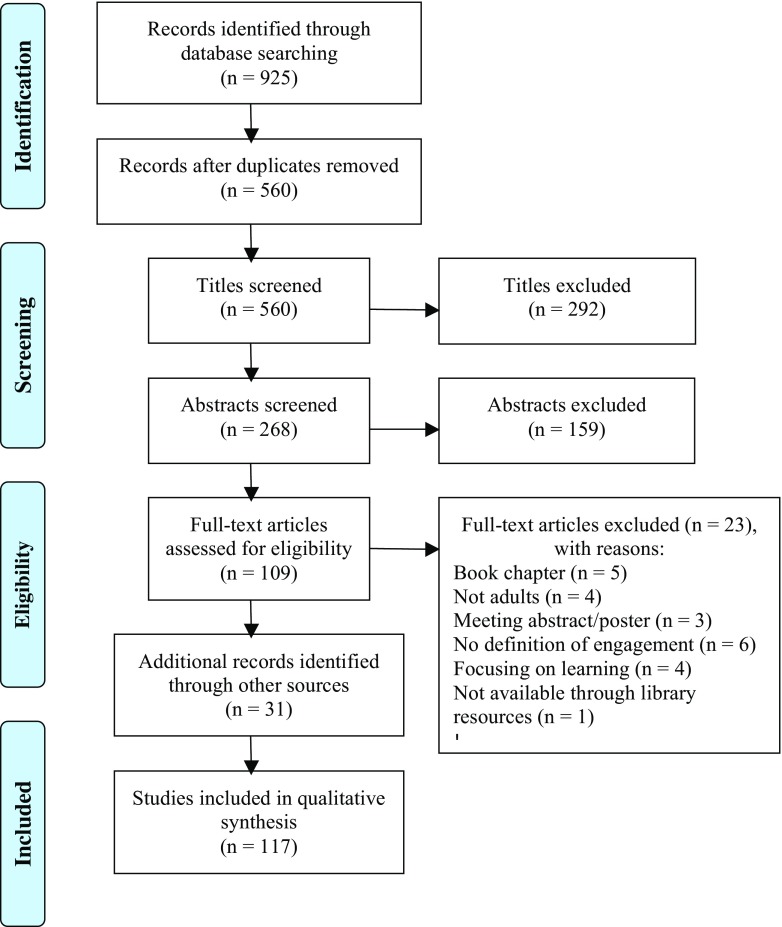
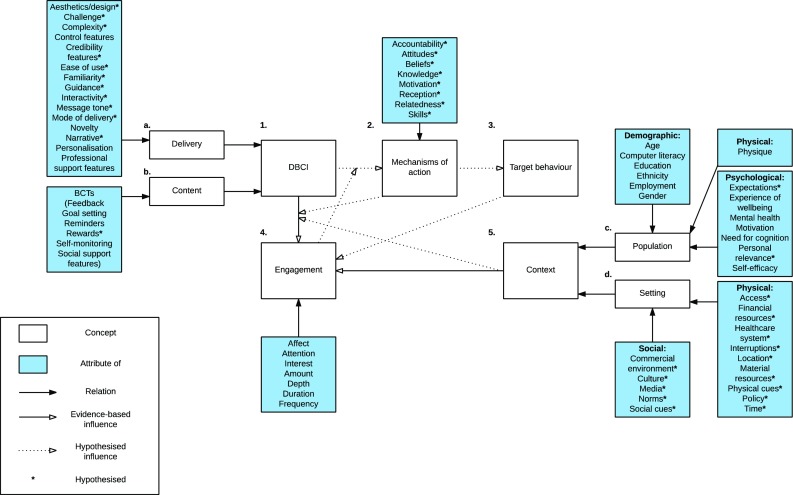
"Engagement" with digital behaviour change interventions (DBCIs) is considered important for their effectiveness. Evaluating engagement is therefore a priority; however, a shared understanding of how to usefully conceptualise engagement is lacking. This review aimed to synthesise literature on engagement to identify key conceptualisations and to develop an integrative conceptual framework involving potential direct and indirect influences on engagement and relationships between engagement and intervention effectiveness. Four electronic databases (Ovid MEDLINE, PsycINFO, ISI Web of Knowledge, ScienceDirect) were searched in November 2015. We identified 117 articles that met the inclusion criteria: studies employing experimental or non-experimental designs with adult participants explicitly or implicitly referring to engagement with DBCIs, digital games or technology. Data were synthesised using principles from critical interpretive synthesis. Engagement with DBCIs is conceptualised in terms of both experiential and behavioural aspects. A conceptual framework is proposed in which engagement with a DBCI is influenced by the DBCI itself (content and delivery), the context (the setting in which the DBCI is used and the population using it) and the behaviour that the DBCI is targeting. The context and "mechanisms of action" may moderate the influence of the DBCI on engagement. Engagement, in turn, moderates the influence of the DBCI on those mechanisms of action. In the research literature, engagement with DBCIs has been conceptualised in terms of both experience and behaviour and sits within a complex system involving the DBCI, the context of use, the mechanisms of action of the DBCI and the target behaviour.
Overview
The claims and statistics of this paper haven’t been checked yet.
Free: it reads the open-access text and checks the first 5 claims that cite a source we can check. Create a free account to check every claim.
Integrity signals
Registry
Cites
Statistics
Figures
Verification
Claims the paper makes
The claims and statistics of this paper haven’t been checked yet.
Free: it reads the open-access text and checks the first 5 claims that cite a source we can check. Create a free account to check every claim.
Claims other papers make about this one
Each is checked against this paper’s own text: does it say what the citing paper says it does?
The source backs part of the claim, not all of it — or backs it for a different population, condition or comparison.
In the citing paper
“In line with the emerging evidence from the human-computer interaction (HCI) literature, we found that an app coupled with human support [14,17] was likely to be more effective by increasing the intervention effectiveness and engagement [78,79].”
From Influences on the Uptake of and Engagement With Health and Well-Being Smartphone Apps: Systematic Review (2020) · cites this paper as [14]
Experimental — accuracy not yet measuredThe source backs part of the claim, not all of it — or backs it for a different population, condition or comparison.
In the citing paper
“In line with the findings of previous reviews, help with initial engagement could be achieved by improving the users’ app literacy skills and by providing knowledge [14,17].”
From Influences on the Uptake of and Engagement With Health and Well-Being Smartphone Apps: Systematic Review (2020) · cites this paper as [14]
Experimental — accuracy not yet measuredThe source backs part of the claim, not all of it — or backs it for a different population, condition or comparison.
In the citing paper
“Nonetheless, ECA use does decline over time, limiting long-term health effects [1,14-17].”
From Use and Effect of Embodied Conversational Agents for Improving Eating Behavior and Decreasing Loneliness Among Community-Dwelling Older Adults: Randomized Controlled Trial (2022) · cites this paper as [15]
Experimental — accuracy not yet measuredThe cited source says what the claim attributes to it.
In the citing paper
“A review based on experiential and behavioral perspectives conceptualized key factors that might affect engagement with digital behavior change interventions: the content (eg, behavior change techniques, social support, and reminders) and how the content is delivered (eg, professional support, personalization, and aesthetic features) [14].”
From Influences on the Uptake of and Engagement With Health and Well-Being Smartphone Apps: Systematic Review (2020) · cites this paper as [14]
The cited source says what the claim attributes to it.
In the citing paper
“Behavior change techniques, widely reported by others previously [14,17-19], were also identified as important factors to sustain engagement, including self-monitoring, feedback, goal setting, reminders, rewards, and social support.”
From Influences on the Uptake of and Engagement With Health and Well-Being Smartphone Apps: Systematic Review (2020) · cites this paper as [14]
5 more claims about this paper
Create a free account to see every claim other papers make about this one.
Self-check
Percentages, sums and reported differences re-computed from the paper’s own numbers.
The self-check needs the paper’s full text.
Citations
Cites
Preferred Reporting Items for Systematic Reviews and Meta-Analyses: the PRISMA statement
Moher, D., Liberati, A., Tetzlaff, J., Altman, D. G., & for the PRISMA Group (2009) · BMJ · doi:10.1136/bmj.b2535 · Cited by 83,823
Preferred Reporting Items for Systematic Reviews and Meta-Analyses: The PRISMA Statement
Moher, D., Liberati, A., Tetzlaff, J., Altman, D. G., & The PRISMA Group (2009) · PLoS Medicine · doi:10.1371/journal.pmed.1000097 · Cited by 64,042
Preferred reporting items for systematic reviews and meta-analyses: the PRISMA Statement.
(2009) · PubMed Central · Cited by 44,859
Wang, G., Ma, R., Qiao, G., Wada, K., Aizawa, Y., & Satoh, T. (2015) · Integrative Medicine International · doi:10.1159/000368408 · Cited by 18,657
Handbook of Qualitative Research
(1994) · Journal of Environmental Psychology · doi:10.1016/s0272-4944(05)80230-0 · Cited by 5,715
Data management and analysis methods.
Huberman, A. M., & Miles, M. B. (1994) · Cited by 3,400
Bellg, A. J., Treatment Fidelity Workgroup of the NIH Behavior Change Consortium, Borrelli, B., Resnick, B., Hecht, J., Minicucci, D. S., Ory, M., Ogedegbe, G., Orwig, D., Ernst, D., et al. (2004) · Health Psychology · doi:10.1037/0278-6133.23.5.443 · Cited by 2,620 · cited 1×
“A further distinction has been made between Bintervention receipt^, which refers to the extent to which participants understand and can perform the skills taught, and Benactment of intervention skills^, which refers to the extent to which participants use these skills [146, 147].”
BackgroundChecklists for improving rigour in qualitative research: a case of the tail wagging the dog?
Barbour, R. S. (2001) · BMJ · doi:10.1136/bmj.322.7294.1115 · Cited by 2,613 · cited 1×
“A subsample of codes was selected through random sequence generation (https://www.random.org/) for validation by an independent researcher to increase rigour [41].”
MethodEysenbach, G. (2005) · Journal of Medical Internet Research · doi:10.2196/jmir.7.1.e11 · Cited by 2,524 · cited 1×
“This kind of conceptualisation has emerged due to the observation that while many download and try DBCIs, sustained usage is typically low [21 – 24].”
BackgroundDixon-Woods, M., Cavers, D., Agarwal, S., Annandale, E., Arthur, A., Harvey, J., Hsu, R., Katbamna, S., Olsen, R., Smith, L., et al. (2006) · BMC Medical Research Methodology · doi:10.1186/1471-2288-6-35 · Cited by 2,289
Research works printed but not linked: 5
- 4. West R, Michie S. A Guide to Development and Evaluation of Digital Interventions in Healthcare. London: Silverback Publishing; 2016.
- 15. The Cochrane Collaboration. Cochrane Handbook for Systematic Reviews of Interventions Version 5.1.0. [Updated March 2011]. (J. Higgins & S. Green, Eds.) 2011 Retrieved from www.cochrane-handbook.org.
- 59. Chiang Y-T, Lin SSJ, Cheng C-Y, Liu EZ-F. Exploring online game players’ flow experiences and positive affect. The Turkish Online Journal of Educational Technology. 2011;10(1):106–114.
- 144. Miller AS, Cafazzo JA, Seto E. A game plan: gamification design principles in mHealth applications for chronic disease management. Health Informatics Journal. 2014 doi: 10.1177/1460458214537511. · DOI · Paper page
- 152. O’Brien HL, Toms EG. The development and evaluation of a survey to measure user engagement. Journal of the American Society for Information Science & Technology. 2010;61(1):50–69. doi: 10.1002/asi.21229. · DOI · Paper page
Cited by
Items 901–1,000 of 1,002
Gamification, Persuasive Techniques, and Nudging: What is the Impact on the User Experience?
Troyer, O. D. (2021) · RoCHI - International Conference on Human-Computer Interaction (RoCHI) · doi:10.37789/rochi.2021.1.1.1 · Cited by 3
Durneva, P., & LeRouge, C. (2022) · Hawaii International Conference on System Sciences (HICSS) · doi:10.24251/hicss.2022.466 · Cited by 1
Delestre, F., Picon, E., Mourah, F., Gicquel, A., Gounan, V., Goujon, G., Ouzaïd, I., Bresset, A., Kadouch, D., Roussel, R., et al. (2022) · Cahiers de Nutrition et de Diététique · doi:10.1016/j.cnd.2022.06.002 · Cited by 1
PENGGUNAAN MHEALTH PADA PASIEN PASCA RAWAT INAP PENYAKIT KRONIS: LITERATURE REVIEW
Febiarthy, A., & Martha, E. (2023) · Jurnal Riset Kesehatan Poltekkes Depkes Bandung · doi:10.34011/juriskesbdg.v15i2.2251 · Cited by 5
Digital Interventions for Nonsuicidal Self-Injury
Kruzan, K. P., & Whitlock, J. L. (2023) · Oxford University Press eBooks · doi:10.1093/oxfordhb/9780197611272.013.50 · Cited by 1
Phạm, Q. (2019) · TSpace (University of Toronto) · Cited by 3
An mHealth intervention for the dietary management of hemodialysis patients
Cosette, F. E. K. (2020) · Research Publications (Maastricht University) · doi:10.26481/dis.20200701cf · Cited by 1
Tahir, G. A., Loo, C. K., Moy, F. M., & Kong, N. (2020) · arXiv (Cornell University) · Cited by 1
Tahir, G. A., Loo, C. K., Moy, F. M., & Kong, N. (2020) · arXiv (Cornell University) · doi:10.48550/arxiv.2008.09883 · Cited by 2
Militello, L. K., Hanna, N., & Nigg, C. R. (2018) · doi:10.2196/preprints.10679 · Cited by 1
White, K. M., Dawe‐Lane, E., Siddi, S., Lamers, F., Simblett, S. K., Alacid, G. R., Ivan, A., Myin‐Germeys, I., Haro, J. M., Oetzmann, C., et al. (2022) · Research Square · doi:10.21203/rs.3.rs-1622706/v1 · Cited by 1
Herbeć, A., Shahab, L., Brown, J., Ubhi, H. K., Beard, E., Matei, A., & West, R. (2019) · PsyArXiv (OSF Preprints) · doi:10.31234/osf.io/d5kjq · Cited by 1
Self-citationMartins, A., Londral, A. R. M., & Lapão, L. V. (2022) · Research Square · doi:10.21203/rs.3.rs-2175520/v1 · Cited by 2
Faqar-Uz-Zaman, S. F., Sliwinski, S., Mohr, L., Dreilich, J., Filmann, N., Detemble, C., Zmuc, D., Chun, F. K. ‐., Derwich, W., Schreiner, W., et al. (2023) · SSRN Electronic Journal · doi:10.2139/ssrn.4590922 · Cited by 1
Evia, Á. F. V. D. L. G., Eberle, J. W., Baee, S., Wolfe, E. C., Boukhechba, M., Funk, D., Teachman, B. A., & Barnes, L. E. (2024) · PsyArXiv (OSF Preprints) · doi:10.31234/osf.io/yucqf
Lightfoot, C. J., Wilkinson, T. J., Billany, R. E., Sohansoha, G. K., Vadaszy, N., Ford, E. C., Davies, M. J., Yates, T. E., Smith, A. C., & Graham-Brown, M. P. M. (2025) · doi:10.2196/preprints.75845 · Cited by 12
Elantheraiyan, P., Panda, S., Patil, A. K., Ramanjaneyulu, R., Narawade, N., & -, S. P. (2025) · SSRN Electronic Journal · doi:10.2139/ssrn.5381128 · Cited by 1
Generative AI avatar videos for tobacco prevention on social media: a randomized controlled trialPreprint
Merl, N. B., Wies, C., Schramm, F., Winterstein, J. T., Chanda, T., & Brinker, T. J. (2026) · medRxiv · doi:10.64898/2026.06.22.26356232 · Cited by 1
No effect of gamification on attrition from a longitudinal cognitive testing studyPreprint
Lumsden, J., Skinner, A., Coyle, D., Lawrence, N., & Munafo, M. R. (2017) · PsyArXiv (OSF Preprints) · doi:10.31234/osf.io/ya4sn
Prevention of paediatric hot beverage scalds
Burgess, J. (2019) · The University of Queensland · doi:10.14264/uql.2019.182
Engagement With Digital Health Technologies
Nicholas, R. (2019) · Queensland University of Technology · doi:10.5204/thesis.eprints.134483 · Cited by 1
Wang, Y., Koenig, L. M., & Reiterer, H. (2020) · arXiv (Cornell University)
Bell, I. (2019) · Minerva Access (University of Melbourne)
Čuš, A., Edbrooke-Childs, J. H., Ohmann, S., Plener, P. L., & Akkaya-Kalayci, T. (2020) · JMIR Pediatrics and Parenting · doi:10.2196/20780
Reform 2.0: Augmenting Innovative Mental Health Interventions
Bickman, L. (2021) · Administration and Policy in Mental Health and Mental Health Services Research · doi:10.1007/s10488-020-01107-1
Self-management support using mHealth in patients with COPD: From promise to proof
Korpershoek, Y. (2021) · Utrecht University Repository (Utrecht University) · doi:10.33540/518
Radomski, A. D. (2019) · ERA: Education and Research Archive (University of Alberta) · doi:10.7939/r3-dbcz-cz82
Madujibeya, I., Lennie, T. A., Aroh, A. C., Chung, M. L., & Moser, D. K. (2021) · doi:10.2196/preprints.35657
Ali, K., Fassnacht, D. B., Farrer, L. M., Rieger, E., Moessner, M., Bauer, S., & Griffiths, K. M. (2021) · Research Square · doi:10.21203/rs.3.rs-691333/v1
Michalak, E. E., Barnes, S. J., Morton, E. E., O'Brien, H. L., Murray, G., Hole, R., & Meyer, D. (2022) · doi:10.2196/preprints.36213
Li, S. H., Achilles, M. R., Werner‐Seidler, A., Beames, J. R., Subotic-Kerry, M., & O’Dea, B. (2022) · doi:10.2196/preprints.37640
Compassion apps for better mental health, a qualitative review. (Preprint)Preprint
de Krijger, E., Bohlmeijer, E. T., Geuze, E., & Kelders, S. M. (2019) · doi:10.2196/preprints.14409
Zhao, J., Chen, P., & Wan, G. (2020) · doi:10.2196/preprints.17966
Faithfull, S., Poole, K., Lemańska, A., Griffin, B. A., MANDERS, R. J. F., Aning, J. J., Marshall, J., Turner, L., & Saxton, J. (2019) · doi:10.2196/preprints.14395
Hagger, M. S., Cameron, L. D., Hamilton, K., Hankonen, N. E., & Lintunen, T. (2020) · Cambridge University Press eBooks · doi:10.1017/9781108677318.047
Headspace Science Team (2019) · doi:10.2196/preprints.15802
Selvarajah, T. M., Yamamoto, E., Saw, Y. M., Kariya, T., & Hamajima, N. (2022) · JMIRx Med · doi:10.2196/37117
Meinert, E., Milne‐Ives, M., Chaudhuri, К. R., Harding, T., Whipps, J., Whipps, S., & Carroll, C. (2022) · doi:10.2196/preprints.40317
Badawy, S. M. (2022) · Pediatric Transplantation · doi:10.1111/petr.14362
Delestre, F., Debailly, R., Kerever, S., & Hansel, B. (2022) · Nutrition Clinique et Métabolisme · doi:10.1016/j.nupar.2022.07.002 · Cited by 1
Health recommender systems for behavior change: exploring their potential for smoking cessation
Hors-Fraile, S. (2022) · Research Publications (Maastricht University) · doi:10.26481/dis.20220324sh
Oldham, M., Perski, O., Loebenberg, G., Brown, J., & Garnett, C. V. (2022) · doi:10.2196/preprints.42320
Self-citationOptimizing the management of patients with gout in daily practice
Kampe, R. T. (2022) · Research Publications (Maastricht University) · doi:10.26481/dis.20221103rk
Baretta, D., Amrein, M. A., Bäder, C., Ruschetti, G. G., Rüttimann, C. L., Carral, M. D. R., Fabian, C., & Inauen, J. (2022) · doi:10.2196/preprints.43241
Optimizing digital smoking cessation interventions
Elling, J. M. (2022) · Research Publications (Maastricht University) · doi:10.26481/dis.20221207je
Peuters, C., Maenhout, L., Cardon, G., Paepe, A. L. D., DeSmet, A., Lauwerier, E., Leta, K., & Crombez, G. (2023) · doi:10.2196/preprints.45668
Salut digital en l’àmbit de l’Atenció Domiciliària: un model centrat en l’usuari
Monfort, G. M., & Manzano Monfort, G. (2023) · Tesis Doctorals en Xarxa (Consorci de Serveis Universitaris de Catalunya) · doi:10.6035/14103.2023.783612
The Goldilocks Dilemma in mHealth Interventions: Balancing User Response and Reflection (Preprint)Preprint
Nelson, L. A., Spieker, A. J., LeStourgeon, L. M., Greevy, R. A., Molli, S., Roddy, M. K., & Mayberry, L. S. (2023) · doi:10.2196/preprints.47632
Vojjala, M., Wysota, C. N., Oketunbi, O., King, Q., Rogers, E., & Ward, K. (2023) · The Journal of Smoking Cessation · doi:10.1155/2023/8165232
Gamified web-delivered attentional bias modification training for the management of chronic pain
Vermeir, J. F. (2023) · Queensland University of Technology · doi:10.5204/thesis.eprints.242456
Pak, J., & Kim, H. S. (2023) · Research Square · doi:10.21203/rs.3.rs-3325534/v1
ตีรบุลกุล, ป. (2017) · Chula Digiverse · doi:10.58837/chula.the.2017.637
Lukka, L., Karhulahti, V., Bergman, V.-R., & Palva, J. M. (2023) · SSRN Electronic Journal · doi:10.2139/ssrn.4578807
Kwon, S., Lee, H., Park, S. R., Heo, Y., Lee, K., & Kang, Y. (2023) · Behaviour and Information Technology · doi:10.1080/0144929x.2023.2271997
Impact of a Regulatory Fit Motivational Virtual Coach on Users during Physical Activity
Falck, M., Martin, J., Scanff, C. L., & Clavel, C. (2023) · Psychology · doi:10.4236/psych.2023.1411102 · Cited by 2
Skolarus, L. E., Lin, C. C., Mishra, S., Meurer, W. J., Dinh, M., Whitfield, C., Bi, R., Brown, D. L., Oteng, R. A., Buis, L. R., et al. (2023) · doi:10.2196/preprints.54946
Dalnoki, A., & Islam, M. I. (2023) · EPRA International Journal of Multidisciplinary Research (IJMR) · doi:10.36713/epra15161
Cross, S. P. M., & Álvarez‐Jiménez, M. (2024) · doi:10.2196/preprints.57014
Andree, R., Mujcic, A., den Hollander, W., van Laar, M., Boon, B. J. F., Engels, R. C. M. E., & Blankers, M. (2024) · JMIR Cancer · doi:10.2196/46303 · Cited by 1
Chavarria, E. A., Han, M. A., Kumar, A., Peterson, S. R., Operario, D., & Escoffery, C. (2024) · doi:10.2196/preprints.59838
Cyclic evaluation of web-based public health interventions
Metz, G. (2024) · Research Publications (Maastricht University) · doi:10.26481/dis.20240531gm · Cited by 4
Senyard, E., Rowe, A., Krishnamoorthy, G., Spence, S. H., Donovan, C. L., & March, S. (2024) · doi:10.2196/preprints.60523
Milne‐Ives, M., Ananthakrishnan, A., Homer, S. R., Andrade, J., & Meinert, E. (2024) · Research Square · doi:10.21203/rs.3.rs-4510115/v1
Siezenga, A. M., Mertens, E. C. A., & van Gelder, J. (2024) · SSRN Electronic Journal · doi:10.2139/ssrn.4871290
Liu, W., Dong, Y., Sun, X.-X., Jiang, Z., Liu, G., & Zhang, H. (2024) · doi:10.2196/preprints.64019
Transfer of Learning as a Design Rationale for Engagement with DbcisPreprint
Meija, C. V., Boffo, M., Engels, R. C. M. E., & Remmerswaal, D. (2024) · SSRN Electronic Journal · doi:10.2139/ssrn.4889379 · Cited by 1
Developing An Engaging Computerized Cognitive Behavioural Therapy for Adolescent Depression
Marzuki, A., Noor, S. F. M., Wook, T. S. M. T., & Ismail, W. S. W. (2024) · TEM Journal · doi:10.18421/tem133-53 · Cited by 3
Stavric, V., Saywell, N. L., & Kayes, N. M. (2024) · doi:10.2196/preprints.66678
Eimontas, J., Gegieckaitė, G., Arcimavičiūtė, L., Lapė, D., Amaliūtė, G., Andersson, G., & Lesinskas, E. (2024) · Procedia Computer Science · doi:10.1016/j.procs.2024.10.368
How Does Engagement Change over Time in a Digital Eating Disorder App? (Preprint)Preprint
Flatt, R. E., Thornton, L. M., Tregarthen, J., Argue, S., & Bulik, C. M. (2024) · doi:10.2196/preprints.68824
Reddy, P. S., Locke, M., & Badawy, S. M. (2024) · doi:10.2196/preprints.69584
Côté, J., Chicoine, G., Auger, P., Vinette, B., Rouleau, G., Maheu‐Cadotte, M., Pagé, M. G., Lapierre, J., Lal, S., Genest, C., et al. (2026) · JMIR mhealth and uhealth · doi:10.2196/71957
Soltero, E. G., Partida, M., Mihail, S., Villanueva, L., Lopez, C., Musaad, S. M. A., Connor, T. O. A., REDONDO, M. J., Buman, M. P., & Debbe, T. (2025) · SSRN Electronic Journal · doi:10.2139/ssrn.5124511
Runyan, T., Lich, K. H., Umble, K. E., Li, K., Baca, K. D., & Frerichs, L. (2025) · PLoS ONE · doi:10.1371/journal.pone.0317142
Conceptual Approaches to User Engagement
O'Brien, H. L. (2025) · Synthesis lectures on information concepts, retrieval, and services · doi:10.1007/978-3-031-80916-3_2
User Engagement with Interactive Information Systems
O'Brien, H. L. (2025) · Synthesis lectures on information concepts, retrieval, and services · doi:10.1007/978-3-031-80916-3_3
Interaction in Digital Depression Therapies: A Systematic Review of Treatment ApproachesPreprint
Huang, T., & Liu, W. (2025) · SSRN Electronic Journal · doi:10.2139/ssrn.5222774
Lagerlund, H., Bezuidenhout, L., Humphries, S., Holmlund, L., Kwak, L., Häger, C. K., & Conradsson, D. M. (2025) · doi:10.2196/preprints.75662
Lakhan, S. E. (2025) · Cureus · doi:10.7759/cureus.83886 · Cited by 2
Jung, G., Lim, H., Han, K., Kim, H., & Lee, U. (2025) · JMIR Human Factors · doi:10.2196/64967 · Cited by 3
Kinzett, S. (2025) · Open Access Victoria University of Wellington | Te Herenga Waka (Figshare) · doi:10.26686/wgtn.29094197
Seiferth, C., Henning, C., Vogel, L., Opitz, A., Schoemann, N., Löchner, J., Deliens, T., & Wolstein, J. (2025) · doi:10.2196/preprints.77632
Sjöblom, L., Stenbeck, F., Lagerros, Y. T., Hantikainen, E. M., & Bonn, S. E. (2025) · JMIR Formative Research · doi:10.2196/71408 · Cited by 2
Mobile Phones and Healthy Aging: A Bibliometric and Visualized Review of 2205 Articles
Lv, W., Sun, Y., Zhu, Y., Chen, J., Xu, Q., Xu, Z., & Shen, C. Q. (2025) · Lecture notes in computer science · doi:10.1007/978-3-031-93505-3_14
Shore, J., Hwang, A. S., & Wang, R. H. (2025) · doi:10.2196/preprints.79026
Smartphone interventions to promote sustainable food choices
Azzena, I., & Carfora, V. (2025) · Elsevier eBooks · doi:10.1016/b978-0-443-33140-4.00017-8
Hedin, L., Hagströmer, M., Marcus, C., & Danielsson, P. (2025) · Sage Open Pediatrics · doi:10.1177/30502225251348292
Mistiri, M. E., Torre, S. A. D. L., Marlin, B. M., Pavel, M., Klasnja, P., Spruijt‐Metz, D., & Rivera, D. E. (2025) · Control Engineering Practice · doi:10.1016/j.conengprac.2025.106460
Mahdi, S., Chilcott, J., & Buckland, N. J. (2025) · BMC Public Health · doi:10.1186/s12889-025-23400-0
Ding, X., Holsti, L., Schmidt, J., Parde, N., Sakakibara, B. M., & Barbic, S. P. (2025) · Digital Health · doi:10.1177/20552076251355345
Laiti, J., Javadpour, S., Mullen, J. M., Byrne, E., & Dunne, P. J. (2025) · doi:10.2196/preprints.79381
Metadata
- Authors
- Perski, O., Blandford, A., West, R., & Michie, S.
- Affiliations
- University College London (GB)
- Cancer Research UK (GB)
- Corresponding author
- Perski, Olga
- Venue
- Translational Behavioral Medicine
- Publisher
- Oxford University Press (OUP)
- Published
- 2016-12-13
- Volume
- 7
- Issue
- 2
- Pages
- 254-267
- ISSN
- 1613-9860 (ISSN-L)
- 1869-6716
- PMC
- PMC5526809
- OpenAlex
- W2561174611
- Cited by
- 1,193
- References
- 160
- Citations by year
- 2026: 215 · 2025: 161 · 2024: 119 · 2023: 120 · 2022: 138 · 2021: 146 · 2020: 149 · 2019: 80 · 2018: 50 · 2017: 14
- FWCI
- 6.61
- Type
- journal article
- Language
- en
- Open access
- hybrid
- doi.org
- Locations
- Translational Behavioral Medicine (publishedVersion, cc-by)
- Europe PMC (PubMed Central) (publishedVersion, cc-by)
- PubMed Central (publishedVersion, cc-by)
- PubMed (publishedVersion)
- UCL Discovery (University College London) (submittedVersion)
- Funders
- Bupa Foundation
- Topics
- Social Sciences › Psychology › Applied Psychology › Digital Mental Health Interventions
- Health Sciences › Health Professions › General Health Professions › Mobile Health and mHealth Applications
- Social Sciences › Psychology › Developmental and Educational Psychology › Educational Games and Gamification
- Keywords
- engagement, digital behaviour change interventions, conceptual framework, intervention effectiveness, mechanism of action, context of use, video games, experiential engagement, behavioral engagement, complex systems
- MeSH terms
- Health Promotion, Humans, Patient Participation, Health Behavior, Telemedicine
About these checks
Registry, retraction, Cites and statistics results are computed, not judged, with one exception: a printed reference that no index lists is read once by a model before it counts as a citation error. Claims are extracted by a model and kept only when their quote appears verbatim in the text; each cited source is then checked, with a model’s help, for whether it says what the claim relies on. Those verdicts can be wrong — read the claim’s quote and the cited source before relying on one.
Statistics and arithmetic are recomputed, not judged.
Confidence bands are shown only for fields calibrated on our annotated test set. None is calibrated yet, so no band is shown.
What counts as a claim ›How we measure confidence ›How we check this ›
Are you an author, or do you see a problem with this page? Request a review
Data sources
Bibliographic data: Semantic Scholar, OpenAlex, Crossref.
Contains information from the Semantic Scholar Academic Graph Datasets, made available under the ODC Attribution License (ODC-BY 1.0).
Semantic Scholar’s data is described in: Kinney, R., et al. (2023). The Semantic Scholar Open Data Platform. arXiv:2301.10140.
