

Conceptualising engagement with digital behaviour change interventions: a systematic review using principles from critical interpretive synthesis
Open accessThe DOI matches its Crossref record; 158 of the 160 references it cites were found in a registry or an index.
Abstract
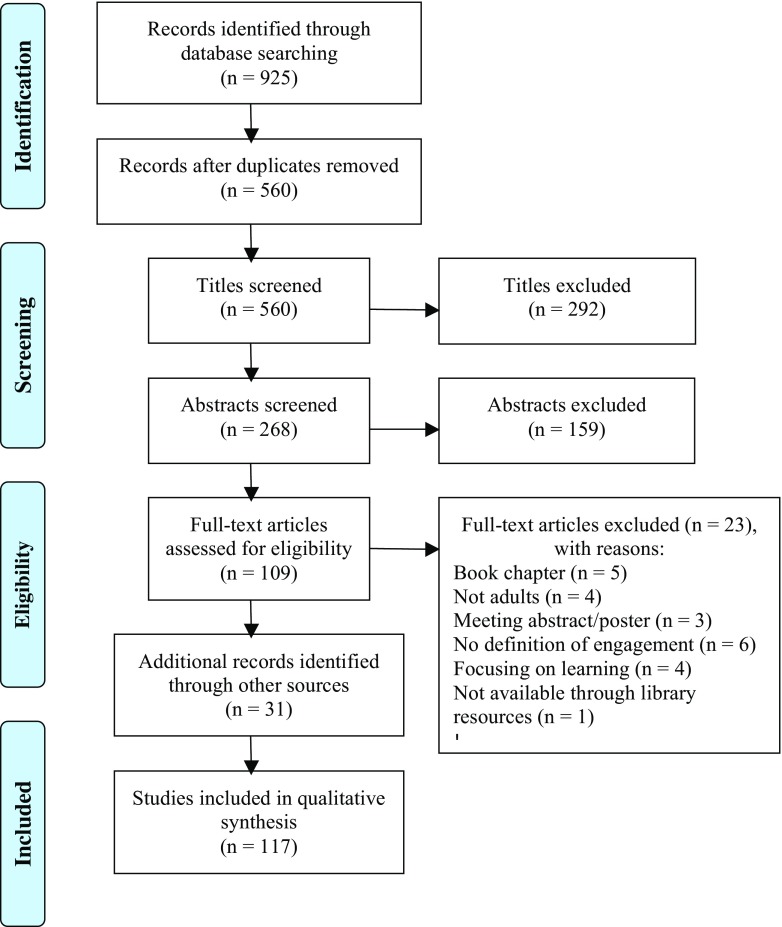
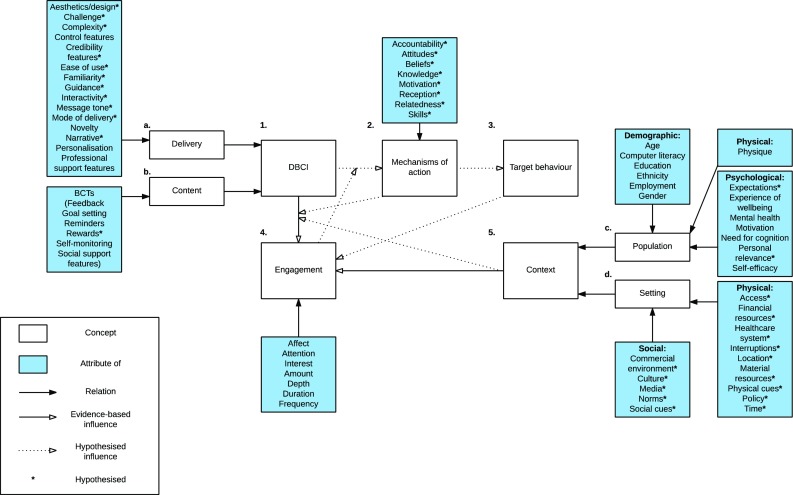
"Engagement" with digital behaviour change interventions (DBCIs) is considered important for their effectiveness. Evaluating engagement is therefore a priority; however, a shared understanding of how to usefully conceptualise engagement is lacking. This review aimed to synthesise literature on engagement to identify key conceptualisations and to develop an integrative conceptual framework involving potential direct and indirect influences on engagement and relationships between engagement and intervention effectiveness. Four electronic databases (Ovid MEDLINE, PsycINFO, ISI Web of Knowledge, ScienceDirect) were searched in November 2015. We identified 117 articles that met the inclusion criteria: studies employing experimental or non-experimental designs with adult participants explicitly or implicitly referring to engagement with DBCIs, digital games or technology. Data were synthesised using principles from critical interpretive synthesis. Engagement with DBCIs is conceptualised in terms of both experiential and behavioural aspects. A conceptual framework is proposed in which engagement with a DBCI is influenced by the DBCI itself (content and delivery), the context (the setting in which the DBCI is used and the population using it) and the behaviour that the DBCI is targeting. The context and "mechanisms of action" may moderate the influence of the DBCI on engagement. Engagement, in turn, moderates the influence of the DBCI on those mechanisms of action. In the research literature, engagement with DBCIs has been conceptualised in terms of both experience and behaviour and sits within a complex system involving the DBCI, the context of use, the mechanisms of action of the DBCI and the target behaviour.
Overview
The claims and statistics of this paper haven’t been checked yet.
Free: it reads the open-access text and checks the first 5 claims that cite a source we can check. Create a free account to check every claim.
Integrity signals
Registry
Cites
Statistics
Figures
Verification
Claims the paper makes
The claims and statistics of this paper haven’t been checked yet.
Free: it reads the open-access text and checks the first 5 claims that cite a source we can check. Create a free account to check every claim.
Claims other papers make about this one
Each is checked against this paper’s own text: does it say what the citing paper says it does?
The source backs part of the claim, not all of it — or backs it for a different population, condition or comparison.
In the citing paper
“In line with the emerging evidence from the human-computer interaction (HCI) literature, we found that an app coupled with human support [14,17] was likely to be more effective by increasing the intervention effectiveness and engagement [78,79].”
From Influences on the Uptake of and Engagement With Health and Well-Being Smartphone Apps: Systematic Review (2020) · cites this paper as [14]
Experimental — accuracy not yet measuredThe source backs part of the claim, not all of it — or backs it for a different population, condition or comparison.
In the citing paper
“In line with the findings of previous reviews, help with initial engagement could be achieved by improving the users’ app literacy skills and by providing knowledge [14,17].”
From Influences on the Uptake of and Engagement With Health and Well-Being Smartphone Apps: Systematic Review (2020) · cites this paper as [14]
Experimental — accuracy not yet measuredThe source backs part of the claim, not all of it — or backs it for a different population, condition or comparison.
In the citing paper
“Nonetheless, ECA use does decline over time, limiting long-term health effects [1,14-17].”
From Use and Effect of Embodied Conversational Agents for Improving Eating Behavior and Decreasing Loneliness Among Community-Dwelling Older Adults: Randomized Controlled Trial (2022) · cites this paper as [15]
Experimental — accuracy not yet measuredThe cited source says what the claim attributes to it.
In the citing paper
“A review based on experiential and behavioral perspectives conceptualized key factors that might affect engagement with digital behavior change interventions: the content (eg, behavior change techniques, social support, and reminders) and how the content is delivered (eg, professional support, personalization, and aesthetic features) [14].”
From Influences on the Uptake of and Engagement With Health and Well-Being Smartphone Apps: Systematic Review (2020) · cites this paper as [14]
The cited source says what the claim attributes to it.
In the citing paper
“Behavior change techniques, widely reported by others previously [14,17-19], were also identified as important factors to sustain engagement, including self-monitoring, feedback, goal setting, reminders, rewards, and social support.”
From Influences on the Uptake of and Engagement With Health and Well-Being Smartphone Apps: Systematic Review (2020) · cites this paper as [14]
5 more claims about this paper
Create a free account to see every claim other papers make about this one.
Self-check
Percentages, sums and reported differences re-computed from the paper’s own numbers.
The self-check needs the paper’s full text.
Citations
Cites
Preferred Reporting Items for Systematic Reviews and Meta-Analyses: the PRISMA statement
Moher, D., Liberati, A., Tetzlaff, J., Altman, D. G., & for the PRISMA Group (2009) · BMJ · doi:10.1136/bmj.b2535 · Cited by 83,823
Preferred Reporting Items for Systematic Reviews and Meta-Analyses: The PRISMA Statement
Moher, D., Liberati, A., Tetzlaff, J., Altman, D. G., & The PRISMA Group (2009) · PLoS Medicine · doi:10.1371/journal.pmed.1000097 · Cited by 64,042
Preferred reporting items for systematic reviews and meta-analyses: the PRISMA Statement.
(2009) · PubMed Central · Cited by 44,859
Wang, G., Ma, R., Qiao, G., Wada, K., Aizawa, Y., & Satoh, T. (2015) · Integrative Medicine International · doi:10.1159/000368408 · Cited by 18,657
Handbook of Qualitative Research
(1994) · Journal of Environmental Psychology · doi:10.1016/s0272-4944(05)80230-0 · Cited by 5,715
Data management and analysis methods.
Huberman, A. M., & Miles, M. B. (1994) · Cited by 3,400
Bellg, A. J., Treatment Fidelity Workgroup of the NIH Behavior Change Consortium, Borrelli, B., Resnick, B., Hecht, J., Minicucci, D. S., Ory, M., Ogedegbe, G., Orwig, D., Ernst, D., et al. (2004) · Health Psychology · doi:10.1037/0278-6133.23.5.443 · Cited by 2,620 · cited 1×
“A further distinction has been made between Bintervention receipt^, which refers to the extent to which participants understand and can perform the skills taught, and Benactment of intervention skills^, which refers to the extent to which participants use these skills [146, 147].”
BackgroundChecklists for improving rigour in qualitative research: a case of the tail wagging the dog?
Barbour, R. S. (2001) · BMJ · doi:10.1136/bmj.322.7294.1115 · Cited by 2,613 · cited 1×
“A subsample of codes was selected through random sequence generation (https://www.random.org/) for validation by an independent researcher to increase rigour [41].”
MethodEysenbach, G. (2005) · Journal of Medical Internet Research · doi:10.2196/jmir.7.1.e11 · Cited by 2,524 · cited 1×
“This kind of conceptualisation has emerged due to the observation that while many download and try DBCIs, sustained usage is typically low [21 – 24].”
BackgroundDixon-Woods, M., Cavers, D., Agarwal, S., Annandale, E., Arthur, A., Harvey, J., Hsu, R., Katbamna, S., Olsen, R., Smith, L., et al. (2006) · BMC Medical Research Methodology · doi:10.1186/1471-2288-6-35 · Cited by 2,289
Research works printed but not linked: 5
- 4. West R, Michie S. A Guide to Development and Evaluation of Digital Interventions in Healthcare. London: Silverback Publishing; 2016.
- 15. The Cochrane Collaboration. Cochrane Handbook for Systematic Reviews of Interventions Version 5.1.0. [Updated March 2011]. (J. Higgins & S. Green, Eds.) 2011 Retrieved from www.cochrane-handbook.org.
- 59. Chiang Y-T, Lin SSJ, Cheng C-Y, Liu EZ-F. Exploring online game players’ flow experiences and positive affect. The Turkish Online Journal of Educational Technology. 2011;10(1):106–114.
- 144. Miller AS, Cafazzo JA, Seto E. A game plan: gamification design principles in mHealth applications for chronic disease management. Health Informatics Journal. 2014 doi: 10.1177/1460458214537511. · DOI · Paper page
- 152. O’Brien HL, Toms EG. The development and evaluation of a survey to measure user engagement. Journal of the American Society for Information Science & Technology. 2010;61(1):50–69. doi: 10.1002/asi.21229. · DOI · Paper page
Cited by
Items 501–600 of 1,002
Lee, S., Myers, N. D., Bateman, A. G., Prilleltensky, I., McMahon, A., & Brincks, A. M. (2024) · Frontiers in Sports and Active Living · doi:10.3389/fspor.2024.1401206 · Cited by 14
Nahas, C., Gandit, M., & Monfort, E. (2025) · Frontiers in Aging · doi:10.3389/fragi.2025.1297704 · Cited by 13
Lo, B., Durocher, K., Charow, R., Kimball, S., Phạm, Q., Sockalingam, S., Wiljer, D., & Strudwick, G. (2025) · Journal of Medical Internet Research · doi:10.2196/67820 · Cited by 11
Yin, Z., Errisuriz, V. L., Evans, M., Inupakutika, D., Kaghyan, S., Li, S., Esparza, L., Akopian, D., & Parra-Medina, D. M. (2020) · JMIR Formative Research · doi:10.2196/20679 · Cited by 13
Åsberg, K., & Bendtsen, M. (2021) · Perioperative Medicine · doi:10.1186/s13741-021-00189-1 · Cited by 14
Serio, C. D., Gabarda, A., Uyar-Morency, F., Silfee, V., Ludwig, J. M., Szigethy, E., & Butterworth, S. W. (2022) · JMIR Formative Research · doi:10.2196/34552 · Cited by 13
Measuring User Engagement with a Socially Connected, Gamified Health Promotion Mobile App
White, B. K., Burns, S. K., Giglia, R. C., Dhaliwal, S. S., & Scott, J. A. (2022) · International Journal of Environmental Research and Public Health · doi:10.3390/ijerph19095626 · Cited by 13
An implementation framework for transformative gamification services
Tanouri, A., Kennedy, A., & Veer, E. (2023) · Behaviour and Information Technology · doi:10.1080/0144929x.2023.2241560 · Cited by 16
Reduction of Financial Health Incentives and Changes in Physical Activity
Spilsbury, S., Wilk, P., Taylor, C. M., Prapavessis, H., & Mitchell, M. (2023) · JAMA Network Open · doi:10.1001/jamanetworkopen.2023.42663 · Cited by 11
Reducing Primary Care Attendance Intentions for Pediatric Respiratory Tract Infections
Schneider, A., Cabral, C., Herd, N. L., Hay, A. D., Kesten, J. M., Anderson, E., Lane, I., Beck, C., & Michie, S. (2019) · The Annals of Family Medicine · doi:10.1370/afm.2392 · Cited by 12
Self-citationThe Science of Behavior Change: The Road Ahead
Hagger, M. S., Cameron, L. D., Hamilton, K., Hankonen, N. E., & Lintunen, T. (2020) · Cambridge University Press eBooks · doi:10.1017/9781108677318.046 · Cited by 16
Older Adult Use and Outcomes in a Digital Musculoskeletal (MSK) Program, by Generation
Wang, G., Bailey, J. F., Yang, M., & Krauss, J. (2021) · Frontiers in Digital Health · doi:10.3389/fdgth.2021.693170 · Cited by 12
Clough, B. A., Yousif, C., Miles, S., Stillerova, S., Ganapathy, A., & Casey, L. M. (2022) · Journal of Clinical Psychology · doi:10.1002/jclp.23342 · Cited by 14
Côté‐Allard, U., Pham, M. H., Schultz, A. K., Nordgreen, T., & Tørresen, J. (2022) · IEEE Journal of Biomedical and Health Informatics · doi:10.1109/jbhi.2022.3204737 · Cited by 12
Look who's talking: appearance of embodied conversational agents in eHealth
ter Stal, S. (2021) · doi:10.3990/1.9789036551267 · Cited by 12
Ditton, E., Knott, B., Hodyl, N., Horton, G., Walker, F. R., & Nilsson, M. (2023) · JMIR Formative Research · doi:10.2196/43263 · Cited by 9
“Medical students in this sample reported depression, anxiety, and stress experiences at levels higher than those observed in general population samples [66], and previous research indicates that these factors can affect engagement in digital interventions [73].”
BackgroundNorman, P., Webb, T. L., Millings, A., & Pechey, L. (2019) · Translational Behavioral Medicine · doi:10.1093/tbm/ibz110 · Cited by 9
Tokede, O. A., Yansane, A., Ibarra-Noriega, A., Mullins, J. M., Simmons, K. L., Skourtes, N., Mehta, U., Tungare, S., Holmes, D., White, J. M., et al. (2023) · JMIR mhealth and uhealth · doi:10.2196/49677 · Cited by 11
Ambrosio, M. D. G., Lachman, J. M., Zinzer, P., Sacolo-Gwebu, H., Vyas, S., Vallance, I., Calderón, F., Gardner, F. E. M., Markle, L., Stern, D., et al. (2024) · JMIR Research Protocols · doi:10.2196/52145 · Cited by 13
Ibrahim, A. H., Beaumont, C. T., & Strohacker, K. A. (2024) · Applied Psychophysiology and Biofeedback · doi:10.1007/s10484-024-09645-2 · Cited by 15
Ng, W. Y., Lau, N. Y., Lee, V. V., Vijayakumar, S., Leong, Q. Y., Ooi, D. S. Q., Su, L. L., Lee, Y. S., Chan, S., Blasiak, A., et al. (2024) · JMIR Human Factors · doi:10.2196/59269 · Cited by 19
User Engagement in an Online Digital Health Intervention to Promote Problem Solving
O'Brien, H. L., Chen, A., Kaneshiro, J., & Zaslavsky, O. (2024) · Interacting with Computers · doi:10.1093/iwc/iwae030 · Cited by 14
Carfora, V., Festa, S., Pompili, S., Azzena, I., Guidetti, M., Scaglioni, G., Carraro, L., Lenzi, M., Scatolon, A., Cavazza, N., et al. (2024) · Sustainability · doi:10.3390/su16156388 · Cited by 9
Torre, S. A. D. L., Mistiri, M. E., Hekler, E. B., Predrag, K., Marlin, B. M., Pavel, M., Spruijt‐Metz, D., & Rivera, D. E. (2024) · Journal of Biomedical Informatics · doi:10.1016/j.jbi.2024.104721 · Cited by 11
Daynes‐Kearney, R., & Gallagher, S. M. (2024) · British Journal of Health Psychology · doi:10.1111/bjhp.12764 · Cited by 12
Janowski, R., Cluver, L. D., Shenderovich, Y., Wamoyi, J., Wambura, M., Stern, D., Clements, L., Meléndez‐Torres, G. J., Baerecke, L., Ornellas, A., et al. (2025) · Journal of Medical Internet Research · doi:10.2196/60102 · Cited by 13
Engagement in Digital Self-management Interventions for Chronic Pain: A Systematic Review
MacLean, R. R., Shor, R., Reilly, E. D., Reuman, L., Solar, C. A., Halat, A. M., & Higgins, D. M. (2025) · Clinical Journal of Pain · doi:10.1097/ajp.0000000000001289 · Cited by 13
Whitehall, J. M., Cook, E., Všetečková, J., Jones, K., Pappas, Y., Donald, L., & Chater, A. (2025) · International Journal of Obesity · doi:10.1038/s41366-025-01811-8 · Cited by 13
Zhang, X., Fang, J., Hao, Y., Yang, D., Luo, J., & Li, X. (2025) · Journal of Medical Internet Research · doi:10.2196/65278 · Cited by 16
Ravichandran, A., Ferguson, M., Mulders, W. H. A. M., Choi, R. S. M., & Bennett, R. J. (2025) · Translational Behavioral Medicine · doi:10.1093/tbm/ibaf028 · Cited by 9
Conversational agent interventions in diabetes care: a systematic review
Shegal, M., Hu, L. T., Friesen, E. L., Minian, N., Maslej, M. M., Rodak, T., Whitmore, C., Sherifali, D., Selby, P., & Melamed, O. C. (2025) · Diabetes Research and Clinical Practice · doi:10.1016/j.diabres.2025.112429 · Cited by 15
Greenwell, K., Sereda, M., Coulson, N., Geraghty, A. W. A., Bradbury, K. J., & Hoare, D. J. (2020) · British Journal of Health Psychology · doi:10.1111/bjhp.12486 · Cited by 11
Rad, D., & Rad, G. (2021) · Technium Social Sciences Journal · doi:10.47577/tssj.v21i1.3950 · Cited by 12
Nuijten, R., Gorp, P. M. E. V., Khanshan, A., Blanc, P. M. L., Kemperman, A. D. A. M., van den Berg, P., & Simons, M. (2021) · Electronics · doi:10.3390/electronics10232935 · Cited by 12
Mahdi, S., Michalik-Denny, E., & Buckland, N. J. (2022) · Frontiers in Public Health · doi:10.3389/fpubh.2022.803152 · Cited by 10
Michalak, E. E., Barnes, S. J., Morton, E. E., O'Brien, H. L., Murray, G., Hole, R., & Meyer, D. (2022) · JMIR Research Protocols · doi:10.2196/36213 · Cited by 12
Wu, H., Yu, Y.-F., Ku, S. W., Tseng, Y., Yuan, C. W., Li, C., Huang, P., Ko, N., Anderson, P. L., & Strong, C. (2022) · Digital Health · doi:10.1177/20552076221102770 · Cited by 12
Understanding parent perspectives on engagement with online youth-focused mental health programs
Muller, J. L., Tomlin, L., March, S., Jackson, B., Budden, T., Law, K. H., & Dimmock, J. A. (2022) · Psychology and Health · doi:10.1080/08870446.2022.2090561 · Cited by 13
Buller, D. B., Walkosz, B. J., Henry, K. L., Woodall, W. G., Pagoto, S., Berteletti, J., Kinsey, A., DiVito, J., Baker, K., & Hillhouse, J. (2022) · JMIR Infodemiology · doi:10.2196/36210 · Cited by 12
Worthington, A., Gillies, N. A., Roy, R., & Braakhuis, A. J. (2022) · Journal of Nutrition Education and Behavior · doi:10.1016/j.jneb.2022.09.002 · Cited by 10
Ran, M. O., Zuozhi, F. A. N. G., & Jiandong, F. A. N. G. (2022) · Advances in Psychological Science · doi:10.3724/sp.j.1042.2023.00669 · Cited by 10
Haug, S., Boumparis, N., Wenger, A., Schaub, M. P., & Kiselev, N. (2023) · International Journal of Environmental Research and Public Health · doi:10.3390/ijerph20146379 · Cited by 10
Hietbrink, E. A. G., Nijeweme-d’Hollosy, W. O., Middelweerd, A., Konijnendijk, A., Schrijver, L. K., ten Voorde, A. S., Fokkema, E. M. S., Laverman, G. D., & Vollenbroek-Hutten, M. M. R. (2023) · JMIR Formative Research · doi:10.2196/45294 · Cited by 14
A look under the hood: analyzing engagement and usage data of a smartphone-based intervention
Siezenga, A. M., Mertens, E. C. A., & van Gelder, J. (2023) · BMC Digital Health · doi:10.1186/s44247-023-00048-7 · Cited by 10
Kamke, K., Grenen, E., Robinson, C. D., & El‐Toukhy, S. (2019) · JMIR mhealth and uhealth · doi:10.2196/14699 · Cited by 10
A Mobile Medical Knowledge Dissemination Platform (HeadToToe): Mixed Methods Study
Zamberg, I., Windisch, O. L., Agoritsas, T., NENDAZ, M. R., Savoldelli, G. L., & Schiffer, E. R. C. (2020) · JMIR Medical Education · doi:10.2196/17729 · Cited by 10
Autonomy-Supportive Interventions
Reeve, J., & Cheon, S. H. (2020) · Cambridge University Press eBooks · doi:10.1017/9781108677318.035 · Cited by 15
Magalhães, P., Silva, C., Pereira, B., Figueiredo, G., Guimarães, A., Pereira, A., & Rosário, P. J. S. L. F. (2020) · Trials · doi:10.1186/s13063-020-04685-5 · Cited by 11
Yilmaz, S. K., & Bohara, A. K. (2021) · Frontiers in Public Health · doi:10.3389/fpubh.2021.563515 · Cited by 11
Milne‐Ives, M., Homer, S. R., Andrade, J., & Meinert, E. (2022) · JMIR Research Protocols · doi:10.2196/35172 · Cited by 15
Neale, J., & Bowen, A. M. (2022) · JMIR Human Factors · doi:10.2196/33038 · Cited by 10
Implementation Science and Translation in Behavior Change
Łuszczyńska, A., Łobczowska, K., & Horodyska, K. (2020) · Cambridge University Press eBooks · doi:10.1017/9781108677318.023 · Cited by 13
Greenwell, K., Ainsworth, B., Bruton, A., Murray, E., Russell, D., Thomas, M., & Yardley, L. (2021) · npj Primary Care Respiratory Medicine · doi:10.1038/s41533-021-00248-6 · Cited by 8
Breakey, V. R., Gupta, A. A., Johnston, D. L., Portwine, C., Laverdière, C., May, S. L., Dick, B. D., Hundert, A. S., Nishat, F., Killackey, T., et al. (2022) · Journal of Pediatric Hematology/Oncology Nursing · doi:10.1177/27527530211068778 · Cited by 11
Janowski, R., Green, O., Shenderovich, Y., Stern, D., Clements, L., Wamoyi, J., Wambura, M., Lachman, J. M., Meléndez‐Torres, G. J., Gardner, F. E. M., et al. (2023) · BMC Public Health · doi:10.1186/s12889-023-15989-x · Cited by 11
Wähnke, L., Plück, J., Bodden, M., Ernst, A., Klemp, M., Mühlenmeister, J., & Döpfner, M. (2024) · Child and Adolescent Psychiatry and Mental Health · doi:10.1186/s13034-024-00724-0 · Cited by 8
Aldridge, G., Wu, L., Seguin, J. P., Robinson, J., Battaglia, E., Olivier, P. L., & Yap, M. B. H. (2024) · JMIR Formative Research · doi:10.2196/55639 · Cited by 13
Herrijgers, C., Verboon, P., Florence, É., Vandebosch, H., Poels, K., & Platteau, T. (2024) · JMIR Formative Research · doi:10.2196/56606 · Cited by 9
Rigg, A., Kemp, E., Koczwara, B., Butow, P. N., Girgis, A., Hulbert-Williams, N., Kaambwa, B., Long, R., Schofield, P. E., Turner, J., et al. (2024) · Supportive Care in Cancer · doi:10.1007/s00520-024-08924-2 · Cited by 11
Hypnosis Apps: A Systematic Review
Scheffrahn, K., Alldredge, C. T., Snyder, M., & Elkins, G. R. (2024) · International Journal of Clinical and Experimental Hypnosis · doi:10.1080/00207144.2024.2434085 · Cited by 9
Effective engagement in computerized cognitive training for older adults
Guimarães, A. L., Lin, F. V., Panizzutti, R., & Turnbull, A. G. (2025) · Ageing Research Reviews · doi:10.1016/j.arr.2024.102650 · Cited by 11
Ding, R., Wang, Y., Yu, Y., Meng, X., Gong, Q., Tang, Y., Wang, J., Mu, X., Li, H., Zhou, H., et al. (2025) · Environmental Health Perspectives · doi:10.1289/ehp14172 · Cited by 11
Levin, M. E., Mukasa, M. N., Bowers, E. M., Klimczak, K. S., & Aller, T. B. (2025) · Behavioral Sciences · doi:10.3390/bs15010075 · Cited by 16
Stassen, G., Grieben, C., Froböse, I., & Schaller, A. (2020) · International Journal of Environmental Research and Public Health · doi:10.3390/ijerph17072180 · Cited by 13
An Evaluation of a Commercialized mHealth Intervention to Promote Physical Activity in the Workplace
Sebastiano, K. M. D., Lau, E. Y., Yun, L., & Faulkner, G. (2022) · Frontiers in Public Health · doi:10.3389/fpubh.2022.740350 · Cited by 8
Meinert, E., Milne‐Ives, M., Chaudhuri, К. R., Harding, T., Whipps, J., Whipps, S., & Carroll, C. (2022) · JMIR Research Protocols · doi:10.2196/40317 · Cited by 8
Walsh, E. A., Safren, S. A., Penedo, F. J., & Antoni, M. H. (2023) · Clinical Psychology Review · doi:10.1016/j.cpr.2023.102374 · Cited by 9
Lukka, L., Karhulahti, V., Bergman, V.-R., & Palva, J. M. (2024) · Internet Interventions · doi:10.1016/j.invent.2023.100706 · Cited by 15
Okamoto, M., Saito, Y., Nakamura, S., Nagasawa, M., Shibuya, M., Nagasaka, G., & Narimatsu, H. (2024) · JMIR Formative Research · doi:10.2196/53759 · Cited by 8
User journey method: a case study for improving digital intervention use measurement
Lukka, L., Vesterinen, M., Salonen, A., Bergman, V.-R., Torkki, P. M., Palva, S., & Palva, J. M. (2025) · BMC Health Services Research · doi:10.1186/s12913-025-12641-9 · Cited by 9
Myneni, S., Sridharan, V., Cobb, N. K., & Cohen, T. (2018) · Journal of Participatory Medicine · doi:10.2196/jopm.9745 · Cited by 10
de Ridder, D. T. D., Gillebaart, M., & Friese, M. (2020) · Cambridge University Press eBooks · doi:10.1017/9781108677318.040 · Cited by 11
Epton, T., & Armitage, C. J. (2020) · Cambridge University Press eBooks · doi:10.1017/9781108677318.038 · Cited by 8
Sanchez-Flack, J., Buscemi, J., O’Donnell, A. J., Withington, M. H. C., & Fitzgibbon, M. (2021) · Frontiers in Digital Health · doi:10.3389/fdgth.2021.687648 · Cited by 9
Hentati, A., Forsell, E., Ljótsson, B., Lindefors, N., & Kraepelien, M. (2022) · BJPsych Open · doi:10.1192/bjo.2022.14 · Cited by 8
Laukkanen, L., Suhonen, R., Löyttyniemi, E., & Leino‐Kilpi, H. (2022) · BMC Medical Education · doi:10.1186/s12909-022-03241-w · Cited by 9
Mawdsley, G., Richiello, M. G., & Gutman, L. M. (2022) · Counselling and Psychotherapy Research · doi:10.1002/capr.12528 · Cited by 9
Can behavior change techniques be delivered via short text messages?
Doğru, O. C., Webb, T. L., & Norman, P. E. (2022) · Translational Behavioral Medicine · doi:10.1093/tbm/ibac058 · Cited by 8
Participant Engagement in Microrandomized Trials of mHealth Interventions: Scoping Review
Leong, U., & Chakraborty, B. (2023) · JMIR mhealth and uhealth · doi:10.2196/44685 · Cited by 9
Attrition in an Online Loneliness Intervention for Adults Aged 50 Years and Older: Survival Analysis
Bouwman, T., van Tilburg, T. G., & Aartsen, M. (2019) · JMIR Aging · doi:10.2196/13638 · Cited by 10
Olsen, P., Plourde, K. F., Lasway, C., & van Praag, E. (2018) · JMIR mhealth and uhealth · doi:10.2196/10190 · Cited by 14
Turnbull, S., & Cabral, C. (2024) · JMIR Diabetes · doi:10.2196/55201 · Cited by 9
Rojas, A. N., de Torres, L. Á. P., Mosquera, F. E. C., & Molina‐Recio, G. (2025) · Journal of Medical Internet Research · doi:10.2196/65888 · Cited by 11
Kwok, G., Levonyan‐Radloff, K., Masterson, M., Ohman‐Strickland, P., Pawlish, K. S., Burger, S. S., Paddock, L. E., Palermo, T. M., Bouchard, E., Manne, S. L., et al. (2025) · Journal of Pediatric Psychology · doi:10.1093/jpepsy/jsaf004 · Cited by 8
Ellis, T., Cheng, S. W. M., Zecchin, R. P., Hyun, K. K., Marks, D., Zhang, L., Gallagher, R. D., Clark, R. A., & Redfern, J. (2025) · European Heart Journal - Digital Health · doi:10.1093/ehjdh/ztaf036 · Cited by 7
Baumel, A. (2025) · Frontiers in Digital Health · doi:10.3389/fdgth.2025.1541676 · Cited by 8
Ivanitskaya, L. V., Zikos, D., & Erzikova, E. V. (2025) · Journal of Medical Internet Research · doi:10.2196/60071 · Cited by 12
Liu, C., Messer, M., Linardon, J., & Fuller‐Tyszkiewicz, M. (2025) · Frontiers in Digital Health · doi:10.3389/fdgth.2025.1380088 · Cited by 12
Application of the Supportive Accountability Model in Digital Health Interventions: Scoping Review
Kwok, G., Cheung, S., Duffecy, J. L., & Devine, K. A. (2025) · Journal of Medical Internet Research · doi:10.2196/72639 · Cited by 11
Mohan, D., O"Malley, A. J., Chelen, J. S. C., MacMartin, M. A., Murphy, M., Rudolph, M. A., & Barnato, A. E. (2021) · BMJ Open · doi:10.1136/bmjopen-2020-045084 · Cited by 7
Herbeć, A., Shahab, L., Brown, J., Ubhi, H. K., Beard, E., Matei, A., & West, R. (2021) · Digital Health · doi:10.1177/20552076211058935 · Cited by 7
Self-citationFagerström, C., Wickström, H., & Tuvesson, H. (2022) · BMC Health Services Research · doi:10.1186/s12913-022-07515-3 · Cited by 10
Personal and organisational resources on electronic health usage intentions in an emerging economy
Altab, H. M., Bosompem, J., Okae-Adjei, S., Avornyo, P., Boadi, E. A., Boadi, V. A., & Say, J. (2022) · Telematics and Informatics · doi:10.1016/j.tele.2022.101832 · Cited by 9
Toyama, M., Cavero, V., Araya, R., Menezes, P. R., Mohr, D. C., Miranda, J. J., & Diez‐Canseco, F. (2022) · JMIR Human Factors · doi:10.2196/35486 · Cited by 8
Watti, J., Millner, M., Siklósi, K., Hamvai, C., Kelemen, O., & Pócs, D. (2023) · International Journal of Environmental Research and Public Health · doi:10.3390/ijerph20020958 · Cited by 7
Long‐term effects of a healthy eating blog in mothers and children
Dumas, A., Lemieux, S., Lapointe, A., Provencher, V., Robitaille, J., & Desroches, S. (2020) · Maternal and Child Nutrition · doi:10.1111/mcn.12981 · Cited by 10
Evaluation of Behavior Change Interventions
Matthews, L., & Simpson, S. A. (2020) · Cambridge University Press eBooks · doi:10.1017/9781108677318.022 · Cited by 10
Mi, R. Z., Kornfield, R., Shah, D. V., Maus, A., & Gustafson, D. H. (2020) · Health Communication · doi:10.1080/10410236.2020.1846273 · Cited by 8
May, C. N., Ho, A. S., Yang, Q., McCallum, M., Iyengar, N. M., Comander, A. H., Mitchell, E. S., & Michaelides, A. P. (2021) · Nutrients · doi:10.3390/nu13092908 · Cited by 7
White, K. M., Matcham, F., Leightley, D., Carr, E., Conde, P., Dawe‐Lane, E., Ranjan, Y., Simblett, S. K., Henderson, C., & Hotopf, M. H. (2021) · JMIR Research Protocols · doi:10.2196/32653 · Cited by 8
Metadata
- Authors
- Perski, O., Blandford, A., West, R., & Michie, S.
- Affiliations
- University College London (GB)
- Cancer Research UK (GB)
- Corresponding author
- Perski, Olga
- Venue
- Translational Behavioral Medicine
- Publisher
- Oxford University Press (OUP)
- Published
- 2016-12-13
- Volume
- 7
- Issue
- 2
- Pages
- 254-267
- ISSN
- 1613-9860 (ISSN-L)
- 1869-6716
- PMC
- PMC5526809
- OpenAlex
- W2561174611
- Cited by
- 1,193
- References
- 160
- Citations by year
- 2026: 215 · 2025: 161 · 2024: 119 · 2023: 120 · 2022: 138 · 2021: 146 · 2020: 149 · 2019: 80 · 2018: 50 · 2017: 14
- FWCI
- 6.61
- Type
- journal article
- Language
- en
- Open access
- hybrid
- doi.org
- Locations
- Translational Behavioral Medicine (publishedVersion, cc-by)
- Europe PMC (PubMed Central) (publishedVersion, cc-by)
- PubMed Central (publishedVersion, cc-by)
- PubMed (publishedVersion)
- UCL Discovery (University College London) (submittedVersion)
- Funders
- Bupa Foundation
- Topics
- Social Sciences › Psychology › Applied Psychology › Digital Mental Health Interventions
- Health Sciences › Health Professions › General Health Professions › Mobile Health and mHealth Applications
- Social Sciences › Psychology › Developmental and Educational Psychology › Educational Games and Gamification
- Keywords
- engagement, digital behaviour change interventions, conceptual framework, intervention effectiveness, mechanism of action, context of use, video games, experiential engagement, behavioral engagement, complex systems
- MeSH terms
- Health Promotion, Humans, Patient Participation, Health Behavior, Telemedicine
About these checks
Registry, retraction, Cites and statistics results are computed, not judged, with one exception: a printed reference that no index lists is read once by a model before it counts as a citation error. Claims are extracted by a model and kept only when their quote appears verbatim in the text; each cited source is then checked, with a model’s help, for whether it says what the claim relies on. Those verdicts can be wrong — read the claim’s quote and the cited source before relying on one.
Statistics and arithmetic are recomputed, not judged.
Confidence bands are shown only for fields calibrated on our annotated test set. None is calibrated yet, so no band is shown.
What counts as a claim ›How we measure confidence ›How we check this ›
Are you an author, or do you see a problem with this page? Request a review
Data sources
Bibliographic data: Semantic Scholar, OpenAlex, Crossref.
Contains information from the Semantic Scholar Academic Graph Datasets, made available under the ODC Attribution License (ODC-BY 1.0).
Semantic Scholar’s data is described in: Kinney, R., et al. (2023). The Semantic Scholar Open Data Platform. arXiv:2301.10140.
