

Conceptualising engagement with digital behaviour change interventions: a systematic review using principles from critical interpretive synthesis
Open accessThe DOI matches its Crossref record; 158 of the 160 references it cites were found in a registry or an index.
Abstract
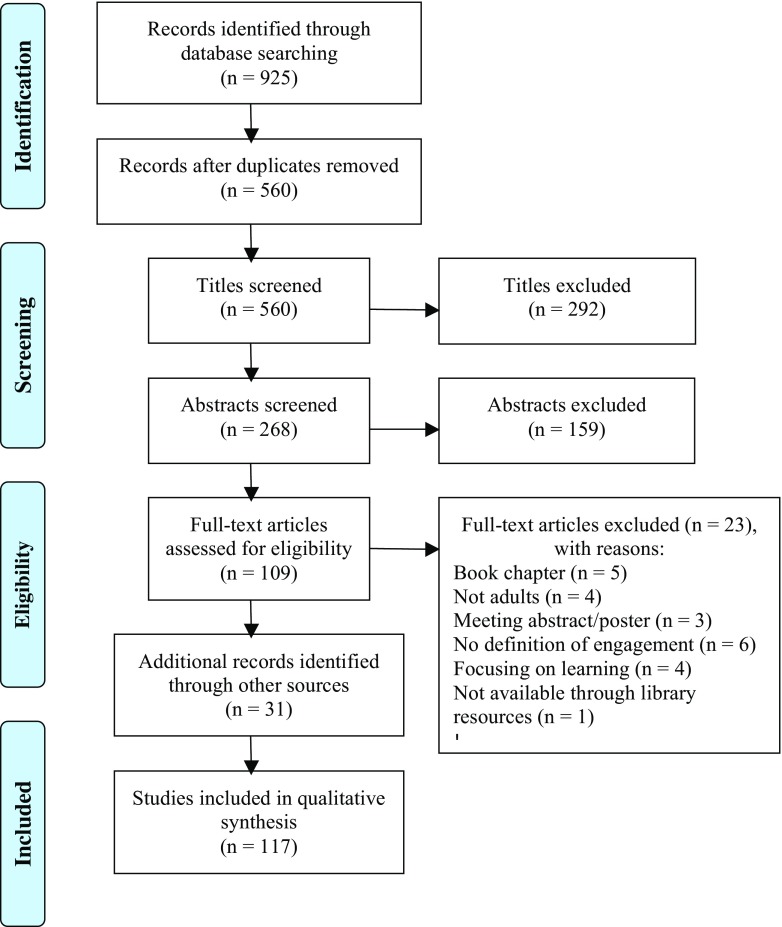
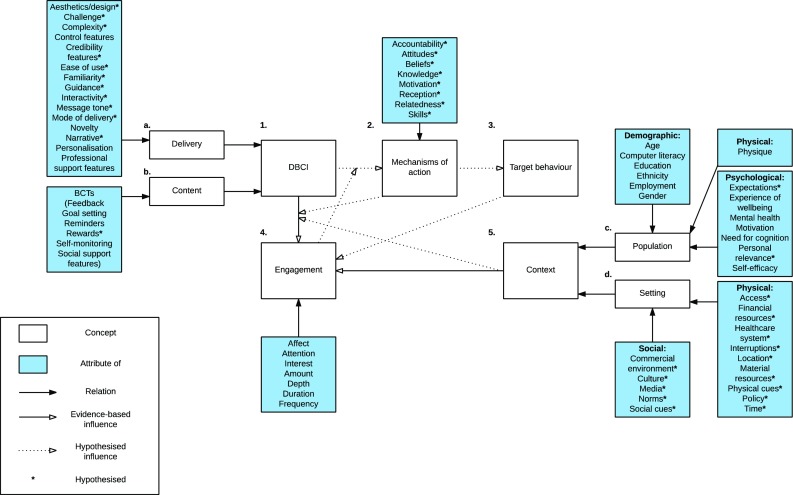
"Engagement" with digital behaviour change interventions (DBCIs) is considered important for their effectiveness. Evaluating engagement is therefore a priority; however, a shared understanding of how to usefully conceptualise engagement is lacking. This review aimed to synthesise literature on engagement to identify key conceptualisations and to develop an integrative conceptual framework involving potential direct and indirect influences on engagement and relationships between engagement and intervention effectiveness. Four electronic databases (Ovid MEDLINE, PsycINFO, ISI Web of Knowledge, ScienceDirect) were searched in November 2015. We identified 117 articles that met the inclusion criteria: studies employing experimental or non-experimental designs with adult participants explicitly or implicitly referring to engagement with DBCIs, digital games or technology. Data were synthesised using principles from critical interpretive synthesis. Engagement with DBCIs is conceptualised in terms of both experiential and behavioural aspects. A conceptual framework is proposed in which engagement with a DBCI is influenced by the DBCI itself (content and delivery), the context (the setting in which the DBCI is used and the population using it) and the behaviour that the DBCI is targeting. The context and "mechanisms of action" may moderate the influence of the DBCI on engagement. Engagement, in turn, moderates the influence of the DBCI on those mechanisms of action. In the research literature, engagement with DBCIs has been conceptualised in terms of both experience and behaviour and sits within a complex system involving the DBCI, the context of use, the mechanisms of action of the DBCI and the target behaviour.
Overview
The claims and statistics of this paper haven’t been checked yet.
Free: it reads the open-access text and checks the first 5 claims that cite a source we can check. Create a free account to check every claim.
Integrity signals
Registry
Cites
Statistics
Figures
Verification
Claims the paper makes
The claims and statistics of this paper haven’t been checked yet.
Free: it reads the open-access text and checks the first 5 claims that cite a source we can check. Create a free account to check every claim.
Claims other papers make about this one
Each is checked against this paper’s own text: does it say what the citing paper says it does?
The source backs part of the claim, not all of it — or backs it for a different population, condition or comparison.
In the citing paper
“In line with the emerging evidence from the human-computer interaction (HCI) literature, we found that an app coupled with human support [14,17] was likely to be more effective by increasing the intervention effectiveness and engagement [78,79].”
From Influences on the Uptake of and Engagement With Health and Well-Being Smartphone Apps: Systematic Review (2020) · cites this paper as [14]
Experimental — accuracy not yet measuredThe source backs part of the claim, not all of it — or backs it for a different population, condition or comparison.
In the citing paper
“In line with the findings of previous reviews, help with initial engagement could be achieved by improving the users’ app literacy skills and by providing knowledge [14,17].”
From Influences on the Uptake of and Engagement With Health and Well-Being Smartphone Apps: Systematic Review (2020) · cites this paper as [14]
Experimental — accuracy not yet measuredThe source backs part of the claim, not all of it — or backs it for a different population, condition or comparison.
In the citing paper
“Nonetheless, ECA use does decline over time, limiting long-term health effects [1,14-17].”
From Use and Effect of Embodied Conversational Agents for Improving Eating Behavior and Decreasing Loneliness Among Community-Dwelling Older Adults: Randomized Controlled Trial (2022) · cites this paper as [15]
Experimental — accuracy not yet measuredThe cited source says what the claim attributes to it.
In the citing paper
“A review based on experiential and behavioral perspectives conceptualized key factors that might affect engagement with digital behavior change interventions: the content (eg, behavior change techniques, social support, and reminders) and how the content is delivered (eg, professional support, personalization, and aesthetic features) [14].”
From Influences on the Uptake of and Engagement With Health and Well-Being Smartphone Apps: Systematic Review (2020) · cites this paper as [14]
The cited source says what the claim attributes to it.
In the citing paper
“Behavior change techniques, widely reported by others previously [14,17-19], were also identified as important factors to sustain engagement, including self-monitoring, feedback, goal setting, reminders, rewards, and social support.”
From Influences on the Uptake of and Engagement With Health and Well-Being Smartphone Apps: Systematic Review (2020) · cites this paper as [14]
5 more claims about this paper
Create a free account to see every claim other papers make about this one.
Self-check
Percentages, sums and reported differences re-computed from the paper’s own numbers.
The self-check needs the paper’s full text.
Citations
Cites
Preferred Reporting Items for Systematic Reviews and Meta-Analyses: the PRISMA statement
Moher, D., Liberati, A., Tetzlaff, J., Altman, D. G., & for the PRISMA Group (2009) · BMJ · doi:10.1136/bmj.b2535 · Cited by 83,823
Preferred Reporting Items for Systematic Reviews and Meta-Analyses: The PRISMA Statement
Moher, D., Liberati, A., Tetzlaff, J., Altman, D. G., & The PRISMA Group (2009) · PLoS Medicine · doi:10.1371/journal.pmed.1000097 · Cited by 64,042
Preferred reporting items for systematic reviews and meta-analyses: the PRISMA Statement.
(2009) · PubMed Central · Cited by 44,859
Wang, G., Ma, R., Qiao, G., Wada, K., Aizawa, Y., & Satoh, T. (2015) · Integrative Medicine International · doi:10.1159/000368408 · Cited by 18,657
Handbook of Qualitative Research
(1994) · Journal of Environmental Psychology · doi:10.1016/s0272-4944(05)80230-0 · Cited by 5,715
Data management and analysis methods.
Huberman, A. M., & Miles, M. B. (1994) · Cited by 3,400
Bellg, A. J., Treatment Fidelity Workgroup of the NIH Behavior Change Consortium, Borrelli, B., Resnick, B., Hecht, J., Minicucci, D. S., Ory, M., Ogedegbe, G., Orwig, D., Ernst, D., et al. (2004) · Health Psychology · doi:10.1037/0278-6133.23.5.443 · Cited by 2,620 · cited 1×
“A further distinction has been made between Bintervention receipt^, which refers to the extent to which participants understand and can perform the skills taught, and Benactment of intervention skills^, which refers to the extent to which participants use these skills [146, 147].”
BackgroundChecklists for improving rigour in qualitative research: a case of the tail wagging the dog?
Barbour, R. S. (2001) · BMJ · doi:10.1136/bmj.322.7294.1115 · Cited by 2,613 · cited 1×
“A subsample of codes was selected through random sequence generation (https://www.random.org/) for validation by an independent researcher to increase rigour [41].”
MethodEysenbach, G. (2005) · Journal of Medical Internet Research · doi:10.2196/jmir.7.1.e11 · Cited by 2,524 · cited 1×
“This kind of conceptualisation has emerged due to the observation that while many download and try DBCIs, sustained usage is typically low [21 – 24].”
BackgroundDixon-Woods, M., Cavers, D., Agarwal, S., Annandale, E., Arthur, A., Harvey, J., Hsu, R., Katbamna, S., Olsen, R., Smith, L., et al. (2006) · BMC Medical Research Methodology · doi:10.1186/1471-2288-6-35 · Cited by 2,289
Research works printed but not linked: 5
- 4. West R, Michie S. A Guide to Development and Evaluation of Digital Interventions in Healthcare. London: Silverback Publishing; 2016.
- 15. The Cochrane Collaboration. Cochrane Handbook for Systematic Reviews of Interventions Version 5.1.0. [Updated March 2011]. (J. Higgins & S. Green, Eds.) 2011 Retrieved from www.cochrane-handbook.org.
- 59. Chiang Y-T, Lin SSJ, Cheng C-Y, Liu EZ-F. Exploring online game players’ flow experiences and positive affect. The Turkish Online Journal of Educational Technology. 2011;10(1):106–114.
- 144. Miller AS, Cafazzo JA, Seto E. A game plan: gamification design principles in mHealth applications for chronic disease management. Health Informatics Journal. 2014 doi: 10.1177/1460458214537511. · DOI · Paper page
- 152. O’Brien HL, Toms EG. The development and evaluation of a survey to measure user engagement. Journal of the American Society for Information Science & Technology. 2010;61(1):50–69. doi: 10.1002/asi.21229. · DOI · Paper page
Cited by
Items 301–400 of 1,002
Predictors of adherence to a publicly available self-guided digital mental health intervention
Woolley, M. G., Klimczak, K. S., Davis, C. H., & Levin, M. E. (2024) · Cognitive Behaviour Therapy · doi:10.1080/16506073.2024.2341807 · Cited by 27
Perski, O., Lumsden, J., Garnett, C. V., BLANDFORD, A. E., West, R., & Michie, S. (2019) · Journal of Medical Internet Research · doi:10.2196/16197 · Cited by 26
Self-citationRothman, A. J., Klein, W. M. P., & Sheeran, P. (2020) · Cambridge University Press eBooks · doi:10.1017/9781108677318.020 · Cited by 30
Ditton, E., Knott, B., Hodyl, N., Horton, G., Oldmeadow, C., Walker, F. R., & Nilsson, M. (2023) · JMIR Mental Health · doi:10.2196/42566 · Cited by 22
Kelders, S. M., Kip, H., Jong, N. B.-D., & Köhle, N. (2024) · Digital Health · doi:10.1177/20552076241283530 · Cited by 24
Zainal, N. H., Wang, V. Y., Garthwaite, B., & Curtiss, J. E. (2025) · Health Psychology Review · doi:10.1080/17437199.2025.2547610 · Cited by 37
Jahnel, T., & Schüz, B. (2020) · Bundesgesundheitsblatt - Gesundheitsforschung - Gesundheitsschutz · doi:10.1007/s00103-019-03082-x · Cited by 30
Morton, E. E., Nicholas, J., Lapadat, L., O'Brien, H. L., Barnes, S. J., Poh, C., & Michalak, E. E. (2021) · Journal of Affective Disorders · doi:10.1016/j.jad.2021.08.132 · Cited by 28
Baumel, A. (2022) · Journal of Technology in Behavioral Science · doi:10.1007/s41347-022-00245-7 · Cited by 26
Johnson, R. W., White, B. K., Gucciardi, D. F., Gibson, N., & Williams, S. A. (2022) · JMIR Pediatrics and Parenting · doi:10.2196/34588 · Cited by 32
Casale, M., Somefun, O. D., Ronnie, G. H., Desmond, C., Sherr, L., & Cluver, L. D. (2023) · Social Science & Medicine · doi:10.1016/j.socscimed.2023.115899 · Cited by 30
Engaging Parents in Technology-Assisted Interventions for Childhood Adversity: Systematic Review
Aldridge, G., Tomaselli, A., Nowell, C., Reupert, A., Jorm, A. F., & Yap, M. B. H. (2024) · Journal of Medical Internet Research · doi:10.2196/43994 · Cited by 31
Imagery, Visualization, and Mental Simulation Interventions
Hagger, M. S., & Conroy, D. (2020) · Cambridge University Press eBooks · doi:10.1017/9781108677318.033 · Cited by 25
Changing Behavior Using the Common-Sense Model of Self-Regulation
Cameron, L. D., Fleszar‐Pavlović, S. E., & Khachikian, T. (2020) · Cambridge University Press eBooks · doi:10.1017/9781108677318.005 · Cited by 32
Finlay, A., Evans, H. E. L., Vincent, A. D., Wittert, G., Vandelanotte, C., & Short, C. E. (2020) · International Journal of Environmental Research and Public Health · doi:10.3390/ijerph17217920 · Cited by 23
The Guardians: Designing a Game for Long-term Engagement with Mental Health Therapy
Ferguson, C., Lewis, R., Wilks, C. R., & Picard, R. W. (2021) · IEEE Conference on Games (CoG) · doi:10.1109/cog52621.2021.9619026 · Cited by 26
Lee, S.-A., & Park, J.-H. (2025) · npj Digital Medicine · doi:10.1038/s41746-025-01827-4 · Cited by 22
Ampt, F. H., L’Engle, K. L., Lim, M. S. C., Plourde, K. F., Mangone, E., Mudogo, C. M., Gichangi, P., Manguro, G., Hellard, M. E., Stoove, M. A., et al. (2020) · JMIR mhealth and uhealth · doi:10.2196/15096 · Cited by 24
Kondylakis, H., Axenie, C., Bastola, D. K., Katehakis, D. G., Kouroubali, A., Kurz, D., Larburu, N., Macía, I., Maguire, R., Maramis, C., et al. (2020) · Journal of Medical Internet Research · doi:10.2196/22034 · Cited by 25
Hämäläinen, T., Kaipainen, K., Lappalainen, P., Puolakanaho, A., Keinonen, K., Lappalainen, R. I., & Kiuru, N. H. (2021) · Internet Interventions · doi:10.1016/j.invent.2021.100421 · Cited by 31
Establishing best practices in cancer online support groups: protocol for a realist review
Bender, J. L., Babinski, S., Wong, G., Tricco, A. C., Englesakis, M. F., Cyr, A. B., POTTS, H. W. W., Perski, O., Esplen, M. J., Young, C. D., et al. (2021) · BMJ Open · doi:10.1136/bmjopen-2021-053916 · Cited by 28
Self-citationWrobel, J., Silvasstar, J., Peterson, R., Sumbundu, K., Kelley, A., Stephens, D., Rushing, S. C., & Bull, S. S. (2022) · JMIR Formative Research · doi:10.2196/32138 · Cited by 21
Ramasawmy, M., Poole, L., Thorlu-Bangura, Z., Chauhan, A., Murali, M., Jagpal, P., Bijral, M., Prashar, J., G-Medhin, A., Murray, E., et al. (2022) · JMIR Cardio · doi:10.2196/37360 · Cited by 22
Self-citationLalloo, C., Nishat, F., Zempsky, W. T., Bakshi, N., Badawy, S. M., Ko, Y. J., Dampier, C., Stinson, J., & Palermo, T. M. (2022) · Journal of Medical Internet Research · doi:10.2196/40096 · Cited by 28
Henriksson, P., Migueles, J. H., Söderström, E., Sandborg, J., Maddison, R., & Löf, M. (2022) · Scientific Reports · doi:10.1038/s41598-022-17554-9 · Cited by 28
Herbeć, A., Perski, O., Shahab, L., & West, R. (2018) · International Journal of Environmental Research and Public Health · doi:10.3390/ijerph15020288 · Cited by 22
Self-citationFletcher, K., Foley, F., & Murray, G. (2018) · Journal of Medical Internet Research · doi:10.2196/11160 · Cited by 23
Predicting User Engagement in Longitudinal Interventions with Virtual Agents
Trinh, H., Shamekhi, A., Kimani, E., & Bickmore, T. (2018) · ACM International Conference on Intelligent Virtual Agents (IVA) · doi:10.1145/3267851.3267909 · Cited by 26
Duckworth, C., Cliffe, B., Pickering, B., Ainsworth, B., Blythin, A. M., Kirk, A., Wilkinson, T. M. A., & Boniface, M. (2024) · npj Digital Medicine · doi:10.1038/s41746-024-01063-2 · Cited by 31
Engagement of Stakeholders in the Design, Evaluation, and Implementation of Complex Interventions
Hudson, J. L., Moon, Z., Hughes, L. D., & Moss-Morris, R. E. (2020) · Cambridge University Press eBooks · doi:10.1017/9781108677318.024 · Cited by 29
Al‐Abbadey, M., Fong, M. M.-W., Wilde, L., Ingham, R., & Ghio, D. (2021) · Digital Health · doi:10.1177/20552076211014988 · Cited by 25
Scarpa, M. P., Prilletensky, I., McMahon, A., Myers, N. D., Prilleltensky, O., Lee, S., Pfeiffer, K. A., Bateman, A. G., & Brincks, A. M. (2021) · Frontiers in Computer Science · doi:10.3389/fcomp.2021.690389 · Cited by 21
Murphy, J., McSharry, J., Hynes, L., & Molloy, G. J. (2021) · JMIR Formative Research · doi:10.2196/28784 · Cited by 24
Newton, A. S., March, S., Gehring, N. D., Rowe, A., & Radomski, A. D. (2021) · Journal of Medical Internet Research · doi:10.2196/25012 · Cited by 30
Motivation-based approach for tailoring persuasive mental health applications
Alqahtani, F., Orji, R., Riper, H. M., McCleary, N., Witteman, H. O., & McGrath, P. J. (2022) · Behaviour and Information Technology · doi:10.1080/0144929x.2022.2031296 · Cited by 28
Li, S., Achilles, M. R., Werner‐Seidler, A., Beames, J. R., Subotic-Kerry, M., & O’Dea, B. (2022) · JMIR Mental Health · doi:10.2196/37640 · Cited by 25
Alphonse, A., Stewart, K., Brown, J., & Perski, O. (2022) · JMIR Formative Research · doi:10.2196/36869 · Cited by 26
Self-citationIglesias, M., Sinha, C., Vempati, R., Grace, S. E., Roy, M., Chapman, W. C., & Rinaldi, M. L. (2022) · Journal of Occupational and Environmental Medicine · doi:10.1097/jom.0000000000002762 · Cited by 27
Gneezy, U., Kajackaite, A., & Meier, S. (2020) · Cambridge University Press eBooks · doi:10.1017/9781108677318.036 · Cited by 28
Oliver, D. P., Washington, K. T., Demiris, G., & White, P. (2019) · Journal of Pain and Symptom Management · doi:10.1016/j.jpainsymman.2019.09.028 · Cited by 23
Macro-engagement in mHealth: Exploring user engagement beyond the screen
Meija, C. V., Remmerswaal, D., Engels, R. C. M. E., Ludden, G., & Boffo, M. (2024) · Digital Health · doi:10.1177/20552076231225591 · Cited by 19
Bijkerk, L. E., Spigt, M., Oenema, A., & Geschwind, N. (2024) · Journal of Contextual Behavioral Science · doi:10.1016/j.jcbs.2024.100748 · Cited by 29
Engagement Features in Physical Activity Smartphone Apps: Focus Group Study With Sedentary People
D’Αddario, M., Baretta, D., Zanatta, F., Greco, A., & Steca, P. (2020) · JMIR mhealth and uhealth · doi:10.2196/20460 · Cited by 26
Real, F. J., Rosen, B. L., Bishop, J. M., McDonald, S., DeBlasio, D. J., Kreps, G. L., Klein, M. D., & Kahn, J. A. (2020) · Academic Pediatrics · doi:10.1016/j.acap.2020.11.023 · Cited by 24
Nurakysh, S., Kurakbayev, K., Kosherbayeva, L., Tazhiyeva, A. Y., Aimakhanova, A. S., Kulkaeva, G., Asykbaeva, L., Ainabekov, M., Fakhradiyev, I. R., & Tanabayeva, S. B. (2022) · Acta Informatica Medica · doi:10.5455/aim.2022.30.18-24 · Cited by 24
Nardi, W. R., Roy, A., DUNSIGER, S. I., & Brewer, J. A. (2022) · Journal of Medical Internet Research · doi:10.2196/33696 · Cited by 22
Sporrel, K., Wang, S., Ettema, D., Nibbeling, N., Kröse, B., Deutekom, M. D. L. F., Boer, R. D., & Simons, M. (2022) · JMIR Formative Research · doi:10.2196/35268 · Cited by 22
Wang, S., & Kassavou, A. (2023) · Behavioral Sciences · doi:10.3390/bs13010062 · Cited by 22
White, K. M., Dawe‐Lane, E., Siddi, S., Lamers, F., Simblett, S. K., Alacid, G. R., Ivan, A., Myin‐Germeys, I., Haro, J. M., Oetzmann, C., et al. (2023) · JMIR Human Factors · doi:10.2196/39479 · Cited by 19
Hawkes, R. E., Miles, L. M., Ainsworth, B., Ross, J., Meacock, R., & French, D. (2023) · Internet Interventions · doi:10.1016/j.invent.2023.100647 · Cited by 23
Design for Engagement of Online Positive Psychology Interventions
Kelders, S. M. (2019) · Springer eBooks · doi:10.1007/978-3-030-20020-6_13 · Cited by 28
Georgiou, N., Morgan, R. M., & French, J. C. (2020) · Science & Justice · doi:10.1016/j.scijus.2020.04.002 · Cited by 27
Text message reminders for improving sun protection habits: A systematic review
Chambergo‐Michilot, D., Tellez, W. A., Becerra-Chauca, N., Zafra‐Tanaka, J. H., & Taype-Rondán, Á. (2020) · PLoS ONE · doi:10.1371/journal.pone.0233220 · Cited by 19
Wang, Y., König, L. M., & Reiterer, H. (2021) · JMIR Formative Research · doi:10.2196/15369 · Cited by 21
Siering, L., Ludden, G., Mader, A., & van Rees, H. (2019) · Journal of Personalized Medicine · doi:10.3390/jpm9020027 · Cited by 23
Engaging with EPIO, a digital pain self-management program: a qualitative study
Bostrøm, K., Varsi, C., Eide, H., Børøsund, E., Kristjansdottir, Ó. B., Schreurs, K. M. G., Waxenberg, L. B., Weiss, K. E., Morrison, E. J., Nordang, E. F., et al. (2022) · BMC Health Services Research · doi:10.1186/s12913-022-07963-x · Cited by 18
“Researchers argue that the reasons why individuals choose to engage with eHealth interventions might be more important than the actual time spent using the intervention [26, 27], and have suggested that engagement should be conceptualized and specified within every new context used, and involve the user’s behavioral a…”
BackgroundMedia literacy interventions: meta-analytic review of 40 years of research
Cho, H., Carpenter, C. J., & Li, W. (2025) · Human Communication Research · doi:10.1093/hcr/hqaf004 · Cited by 38
Davis, T. L., DiClemente, R. J., & Prietula, M. J. (2020) · JMIR Formative Research · doi:10.2196/22485 · Cited by 19
User engagement with organizational mHealth stress management intervention – A mixed methods study
Kowalski, L., Finnes, A., Koch, S., & Bujacz, A. (2024) · Internet Interventions · doi:10.1016/j.invent.2023.100704 · Cited by 26
Rules of engagement in mobile health: what does mobile health bring to research and theory?
Şahin, Ç. Ç. (2018) · Contemporary Nurse · doi:10.1080/10376178.2018.1448290 · Cited by 17
Washington, K. T., Oliver, D. P., Benson, J. J., Rolbiecki, A. J., Jorgensen, L., Cruz-Oliver, D. M., & Demiris, G. (2019) · Journal of Psychosocial Oncology · doi:10.1080/07347332.2019.1680592 · Cited by 22
Allan, S., McLeod, H. J., Bradstreet, S., Beedie, S. A., Moir, B., Gleeson, J., Farhall, J., Morton, E. E., & Gumley, A. I. (2019) · JMIR Research Protocols · doi:10.2196/15634 · Cited by 19
Ruiter, R. A. C., Crutzen, R., de Leeuw, E., & Kok, G. (2020) · Cambridge University Press eBooks · doi:10.1017/9781108677318.018 · Cited by 22
Palotai, M., Wallack, M., Kujbus, G., Dalnoki, A., & Guttmann, C. R. G. (2021) · JMIR mhealth and uhealth · doi:10.2196/19564 · Cited by 18
Active Use and Engagement in an mHealth Initiative Among Young Men With Obesity: Mixed Methods Study
Gorny, A. W., Chee, D., & Müller‐Riemenschneider, F. (2022) · JMIR Formative Research · doi:10.2196/33798 · Cited by 17
Stephenson, A., García-Constantino, M., MURPHY, M. H., McDonough, S., Nugent, C., & Mair, J. L. (2021) · BMC Public Health · doi:10.1186/s12889-021-11473-6 · Cited by 26
Measures of Engagement With mHealth Interventions in Patients With Heart Failure: Scoping Review
Madujibeya, I., Lennie, T. A., Aroh, A. C., Chung, M. L., & Moser, D. K. (2022) · JMIR mhealth and uhealth · doi:10.2196/35657 · Cited by 18
Baumel, A., Brandes, O., Brendryen, H., Muench, F. J., Kane, J. M., & Saar, C. R. (2023) · Internet Interventions · doi:10.1016/j.invent.2023.100680 · Cited by 21
Ehrlich, C., Hennelly, S. E., Wilde, N., Lennon, O., Beck, A., Messenger, H., Sergiou, K., & Davies, E. (2023) · International Journal of Applied Positive Psychology · doi:10.1007/s41042-023-00133-2 · Cited by 21
Dumas, A., Lemieux, S., Lapointe, A., Provencher, V., Robitaille, J., & Desroches, S. (2019) · Journal of the Academy of Nutrition and Dietetics · doi:10.1016/j.jand.2019.05.016 · Cited by 20
Salsman, J. M., McLouth, L. E. S., Cohn, M., Tooze, J. A., Sorkin, M., & Moskowitz, J. T. (2020) · JMIR Research Protocols · doi:10.2196/17078 · Cited by 18
Garnett, C. V., Perski, O., Michie, S., West, R., Field, M., Kaner, E., Munafo, M. R., Greaves, F., Hickman, M., Burton, R., et al. (2021) · F1000Research · doi:10.12688/f1000research.51416.1 · Cited by 20
Self-citationPócs, D., Adamovits, O., Watti, J., Kovács-Huber, R., & Kelemen, O. (2021) · Journal of Medical Internet Research · doi:10.2196/27853 · Cited by 17
Perski, O., Naughton, F., Garnett, C. V., BLANDFORD, A. E., Beard, E., West, R., & Michie, S. (2019) · JMIR mhealth and uhealth · doi:10.2196/14098 · Cited by 19
Self-citationMayberry, L. S., Bergner, E. M., Harper, K. J., Laing, S., & Berg, C. A. (2019) · Journal of the American Medical Informatics Association · doi:10.1093/jamia/ocz091 · Cited by 19
Online interventions for sexual health in cancer
Matthew, A., & Yang, Z. (2019) · Current Opinion in Supportive and Palliative Care · doi:10.1097/spc.0000000000000477 · Cited by 19
Graham, A. L., Papandonatos, G. D., Jacobs, M. A., Amato, M. S., Cha, S., Cohn, A. M., Abroms, L. C., & Whittaker, R. (2020) · Journal of Medical Internet Research · doi:10.2196/21027 · Cited by 17
Zoellner, J., Porter, K., You, W., Reid, A., Frederick, C., Hilgart, M. M., Brock, D. P., Tate, D. F., & Ritterband, L. M. (2021) · Contemporary Clinical Trials · doi:10.1016/j.cct.2021.106566 · Cited by 17
Cluesman, S. R., Gwadz, M. V., Freeman, R., Collins, L. M., Cleland, C. M., Wilton, L., Hawkins, R. L., Leonard, N. R., Silverman, E., Maslow, C. B., et al. (2023) · International Journal for Equity in Health · doi:10.1186/s12939-023-01836-3 · Cited by 19
Factors affecting authors' manuscript submission behaviour: A systematic review
Xu, X., Xie, J., Jianjun, S., & Cheng, Y. (2023) · Learned Publishing · doi:10.1002/leap.1521 · Cited by 19
Novel behaviour change frameworks for digital health interventions: A critical review
Pelly, M. L., Fatehi, F., Liew, D., & Verdejo‐García, A. (2023) · Journal of Health Psychology · doi:10.1177/13591053231164499 · Cited by 23
Dropout rate in clinical trials of smartphone apps for diabetes management: A meta-analysis
Iqhrammullah, M., Refin, R. Y., Andika, F. F., Amirah, S., Abdurrahman, M. F., Alina, M., Yufika, A., & Abdullah, A. (2024) · Diabetes Research and Clinical Practice · doi:10.1016/j.diabres.2024.111723 · Cited by 19
Mobile applications on app stores for deprescribing: A scoping review
Okati, L., Lo, S. Y., Gnjidic, D., Li, S. J., & Thillainadesan, J. (2024) · British Journal of Clinical Pharmacology · doi:10.1111/bcp.16191 · Cited by 20
McCoy, S. I., & Packel, L. J. (2020) · mHealth · doi:10.21037/mhealth.2020.02.03 · Cited by 17
Changing Behavior Using Social Identity Processes
Reynolds, K. J., Branscombe, N. R., Subašić, E., & Willis, L. (2020) · Cambridge University Press eBooks · doi:10.1017/9781108677318.016 · Cited by 24
Adherence of Mobile App-Based Surveys and Comparison With Traditional Surveys: eCohort Study
Pathiravasan, C. H., Zhang, Y., Trinquart, L., Benjamin, E. J., Borrelli, B., McManus, D. D., Kheterpal, V., Lin, H., Sardana, M., Hammond, M. M., et al. (2021) · Journal of Medical Internet Research · doi:10.2196/24773 · Cited by 19
Goldstein, S. P., Brick, L. A. D., Thomas, J. G., & Forman, E. M. (2020) · Translational Behavioral Medicine · doi:10.1093/tbm/ibaa097 · Cited by 17
Lewis, R., Ferguson, C., Wilks, C. R., Jones, N. C., & Picard, R. W. (2022) · CHI Conference Extended Abstracts on Human Factors in Computing Systems (CHI EA) · doi:10.1145/3491101.3519840 · Cited by 24
Proportionate methods for evaluating a simple digital mental health tool
Davies, E. B., Craven, M. P., Martin, J. L., & Simons, L. (2017) · Evidence Based Mental Health · doi:10.1136/eb-2017-102755 · Cited by 15
“9 We propose that the quality and value of these digital tools can be assessed through analysis of real-world usage data and assessment of user experience, methods which match the relative simplicity of these tools and anticipated size of effect on users’ mental health.”
MethodEiselt, A.-K., Kirkendall, S., Xiong, E., Langner, D., & Goldfarb, M. B. (2026) · Frontiers in Digital Health · doi:10.3389/fdgth.2025.1713334 · Cited by 21
Fontaine, G., Cossette, S., Maheu‐Cadotte, M., Mailhot, T., Lavoie, P., Gagnon, M., Dubé, V., & Côté, J. (2019) · Pédagogie médicale · doi:10.1051/pmed/2020009 · Cited by 22
Sekhon, M., White, C. M., Godfrey, E. L., Amirova, A., Revenäs, Å., King, S., Pedro, J., Quailey, J., & Bearne, L. (2021) · Rheumatology Advances in Practice · doi:10.1093/rap/rkab016 · Cited by 16
Agachi, E., Bijmolt, T. H. A., van Ittersum, K., & Mierau, J. O. (2023) · JMIR mhealth and uhealth · doi:10.2196/43033 · Cited by 21
Badawi, E., Coursaris, C. K., Sénécal, S., & Léger, P. (2023) · Frontiers in Digital Health · doi:10.3389/fdgth.2023.1040739 · Cited by 22
Design of Digital Mental Health Platforms for Family Member Cocompletion: Scoping Review
Welsh, E. T., McIntosh, J. E., Vuong, A. T., Cloud, Z. C. G., Hartley, E., & Boyd, J. (2024) · Journal of Medical Internet Research · doi:10.2196/49431 · Cited by 22
Lu, W., Li, Y., Montayre, J., Li, M., Ho, K. Y., Li, J., & Yorke, J. (2025) · Healthcare · doi:10.3390/healthcare13030305 · Cited by 20
Jin, S., Kim, B., & Han, K. (2025) · CHI Conference on Human Factors in Computing Systems · doi:10.1145/3706598.3713732 · Cited by 28
Affret, A., Luc, A., Baumann, C., Bergman, P., Faou, A.-L. L., Pasquereau, A., Arwidson, P., Alla, F., & Cambon, L. (2020) · BMJ Open · doi:10.1136/bmjopen-2020-039515 · Cited by 17
Young, C., Mohebbi, M., Staudacher, H. M., KAY‐LAMBKIN, F. J., Berk, M., Jacka, F. N., & O'Neil, A. E. (2021) · JMIR Mental Health · doi:10.2196/24871 · Cited by 18
Germini, F., Debono, V. B., Page, D., Zuk, V., Kucher, A., Cotoi, C., Hobson, N. M., Sevestre, M., Skinner, M. W., Iorio, A., et al. (2021) · JMIR Human Factors · doi:10.2196/30797 · Cited by 15
Metadata
- Authors
- Perski, O., Blandford, A., West, R., & Michie, S.
- Affiliations
- University College London (GB)
- Cancer Research UK (GB)
- Corresponding author
- Perski, Olga
- Venue
- Translational Behavioral Medicine
- Publisher
- Oxford University Press (OUP)
- Published
- 2016-12-13
- Volume
- 7
- Issue
- 2
- Pages
- 254-267
- ISSN
- 1613-9860 (ISSN-L)
- 1869-6716
- PMC
- PMC5526809
- OpenAlex
- W2561174611
- Cited by
- 1,193
- References
- 160
- Citations by year
- 2026: 215 · 2025: 161 · 2024: 119 · 2023: 120 · 2022: 138 · 2021: 146 · 2020: 149 · 2019: 80 · 2018: 50 · 2017: 14
- FWCI
- 6.61
- Type
- journal article
- Language
- en
- Open access
- hybrid
- doi.org
- Locations
- Translational Behavioral Medicine (publishedVersion, cc-by)
- Europe PMC (PubMed Central) (publishedVersion, cc-by)
- PubMed Central (publishedVersion, cc-by)
- PubMed (publishedVersion)
- UCL Discovery (University College London) (submittedVersion)
- Funders
- Bupa Foundation
- Topics
- Social Sciences › Psychology › Applied Psychology › Digital Mental Health Interventions
- Health Sciences › Health Professions › General Health Professions › Mobile Health and mHealth Applications
- Social Sciences › Psychology › Developmental and Educational Psychology › Educational Games and Gamification
- Keywords
- engagement, digital behaviour change interventions, conceptual framework, intervention effectiveness, mechanism of action, context of use, video games, experiential engagement, behavioral engagement, complex systems
- MeSH terms
- Health Promotion, Humans, Patient Participation, Health Behavior, Telemedicine
About these checks
Registry, retraction, Cites and statistics results are computed, not judged, with one exception: a printed reference that no index lists is read once by a model before it counts as a citation error. Claims are extracted by a model and kept only when their quote appears verbatim in the text; each cited source is then checked, with a model’s help, for whether it says what the claim relies on. Those verdicts can be wrong — read the claim’s quote and the cited source before relying on one.
Statistics and arithmetic are recomputed, not judged.
Confidence bands are shown only for fields calibrated on our annotated test set. None is calibrated yet, so no band is shown.
What counts as a claim ›How we measure confidence ›How we check this ›
Are you an author, or do you see a problem with this page? Request a review
Data sources
Bibliographic data: Semantic Scholar, OpenAlex, Crossref.
Contains information from the Semantic Scholar Academic Graph Datasets, made available under the ODC Attribution License (ODC-BY 1.0).
Semantic Scholar’s data is described in: Kinney, R., et al. (2023). The Semantic Scholar Open Data Platform. arXiv:2301.10140.
