

Conceptualising engagement with digital behaviour change interventions: a systematic review using principles from critical interpretive synthesis
Open accessThe DOI matches its Crossref record; 158 of the 160 references it cites were found in a registry or an index.
Abstract
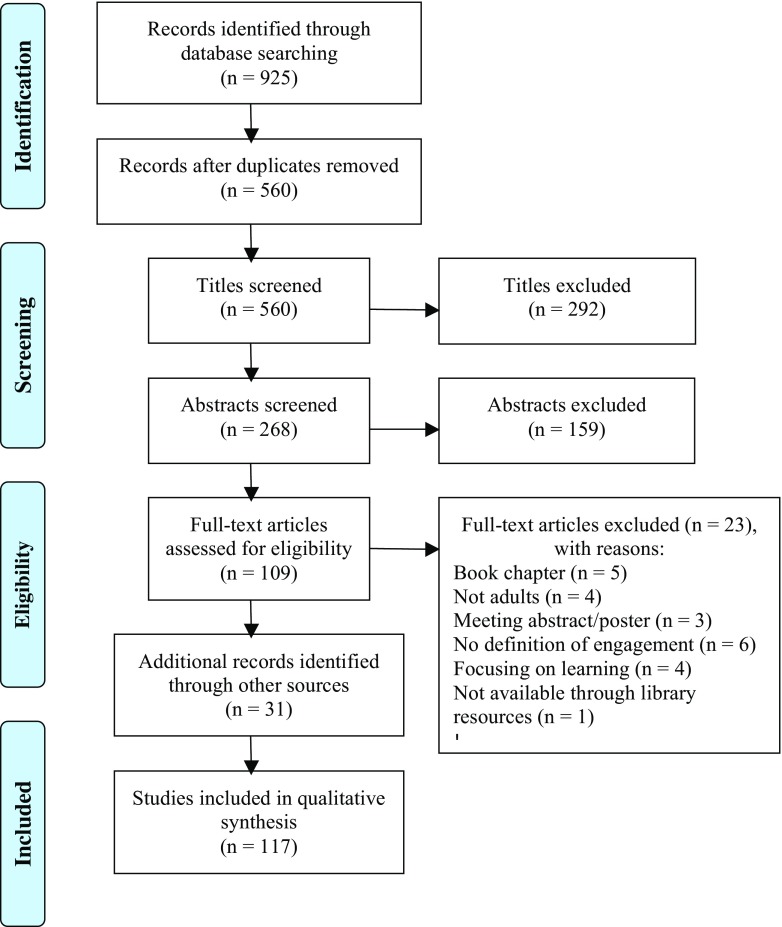
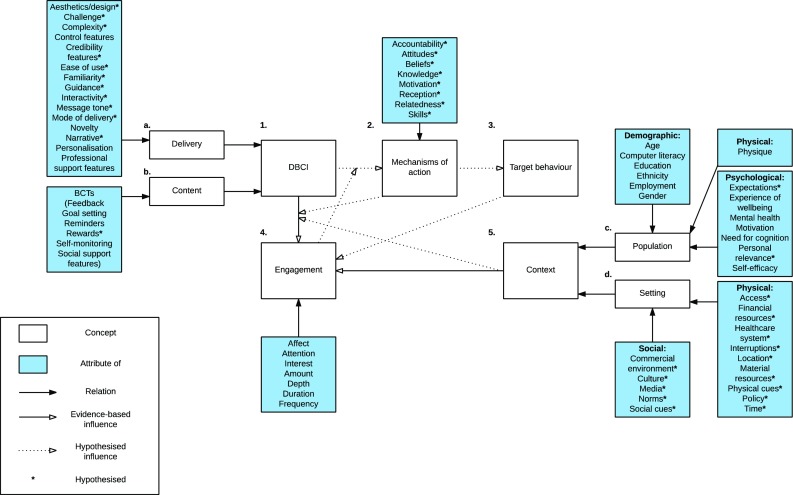
"Engagement" with digital behaviour change interventions (DBCIs) is considered important for their effectiveness. Evaluating engagement is therefore a priority; however, a shared understanding of how to usefully conceptualise engagement is lacking. This review aimed to synthesise literature on engagement to identify key conceptualisations and to develop an integrative conceptual framework involving potential direct and indirect influences on engagement and relationships between engagement and intervention effectiveness. Four electronic databases (Ovid MEDLINE, PsycINFO, ISI Web of Knowledge, ScienceDirect) were searched in November 2015. We identified 117 articles that met the inclusion criteria: studies employing experimental or non-experimental designs with adult participants explicitly or implicitly referring to engagement with DBCIs, digital games or technology. Data were synthesised using principles from critical interpretive synthesis. Engagement with DBCIs is conceptualised in terms of both experiential and behavioural aspects. A conceptual framework is proposed in which engagement with a DBCI is influenced by the DBCI itself (content and delivery), the context (the setting in which the DBCI is used and the population using it) and the behaviour that the DBCI is targeting. The context and "mechanisms of action" may moderate the influence of the DBCI on engagement. Engagement, in turn, moderates the influence of the DBCI on those mechanisms of action. In the research literature, engagement with DBCIs has been conceptualised in terms of both experience and behaviour and sits within a complex system involving the DBCI, the context of use, the mechanisms of action of the DBCI and the target behaviour.
Overview
The claims and statistics of this paper haven’t been checked yet.
Free: it reads the open-access text and checks the first 5 claims that cite a source we can check. Create a free account to check every claim.
Integrity signals
Registry
Cites
Statistics
Figures
Verification
Claims the paper makes
The claims and statistics of this paper haven’t been checked yet.
Free: it reads the open-access text and checks the first 5 claims that cite a source we can check. Create a free account to check every claim.
Claims other papers make about this one
Each is checked against this paper’s own text: does it say what the citing paper says it does?
The source backs part of the claim, not all of it — or backs it for a different population, condition or comparison.
In the citing paper
“In line with the emerging evidence from the human-computer interaction (HCI) literature, we found that an app coupled with human support [14,17] was likely to be more effective by increasing the intervention effectiveness and engagement [78,79].”
From Influences on the Uptake of and Engagement With Health and Well-Being Smartphone Apps: Systematic Review (2020) · cites this paper as [14]
Experimental — accuracy not yet measuredThe source backs part of the claim, not all of it — or backs it for a different population, condition or comparison.
In the citing paper
“In line with the findings of previous reviews, help with initial engagement could be achieved by improving the users’ app literacy skills and by providing knowledge [14,17].”
From Influences on the Uptake of and Engagement With Health and Well-Being Smartphone Apps: Systematic Review (2020) · cites this paper as [14]
Experimental — accuracy not yet measuredThe source backs part of the claim, not all of it — or backs it for a different population, condition or comparison.
In the citing paper
“Nonetheless, ECA use does decline over time, limiting long-term health effects [1,14-17].”
From Use and Effect of Embodied Conversational Agents for Improving Eating Behavior and Decreasing Loneliness Among Community-Dwelling Older Adults: Randomized Controlled Trial (2022) · cites this paper as [15]
Experimental — accuracy not yet measuredThe cited source says what the claim attributes to it.
In the citing paper
“A review based on experiential and behavioral perspectives conceptualized key factors that might affect engagement with digital behavior change interventions: the content (eg, behavior change techniques, social support, and reminders) and how the content is delivered (eg, professional support, personalization, and aesthetic features) [14].”
From Influences on the Uptake of and Engagement With Health and Well-Being Smartphone Apps: Systematic Review (2020) · cites this paper as [14]
The cited source says what the claim attributes to it.
In the citing paper
“Behavior change techniques, widely reported by others previously [14,17-19], were also identified as important factors to sustain engagement, including self-monitoring, feedback, goal setting, reminders, rewards, and social support.”
From Influences on the Uptake of and Engagement With Health and Well-Being Smartphone Apps: Systematic Review (2020) · cites this paper as [14]
5 more claims about this paper
Create a free account to see every claim other papers make about this one.
Self-check
Percentages, sums and reported differences re-computed from the paper’s own numbers.
The self-check needs the paper’s full text.
Citations
Cites
Preferred Reporting Items for Systematic Reviews and Meta-Analyses: the PRISMA statement
Moher, D., Liberati, A., Tetzlaff, J., Altman, D. G., & for the PRISMA Group (2009) · BMJ · doi:10.1136/bmj.b2535 · Cited by 83,823
Preferred Reporting Items for Systematic Reviews and Meta-Analyses: The PRISMA Statement
Moher, D., Liberati, A., Tetzlaff, J., Altman, D. G., & The PRISMA Group (2009) · PLoS Medicine · doi:10.1371/journal.pmed.1000097 · Cited by 64,042
Preferred reporting items for systematic reviews and meta-analyses: the PRISMA Statement.
(2009) · PubMed Central · Cited by 44,859
Wang, G., Ma, R., Qiao, G., Wada, K., Aizawa, Y., & Satoh, T. (2015) · Integrative Medicine International · doi:10.1159/000368408 · Cited by 18,657
Handbook of Qualitative Research
(1994) · Journal of Environmental Psychology · doi:10.1016/s0272-4944(05)80230-0 · Cited by 5,715
Data management and analysis methods.
Huberman, A. M., & Miles, M. B. (1994) · Cited by 3,400
Bellg, A. J., Treatment Fidelity Workgroup of the NIH Behavior Change Consortium, Borrelli, B., Resnick, B., Hecht, J., Minicucci, D. S., Ory, M., Ogedegbe, G., Orwig, D., Ernst, D., et al. (2004) · Health Psychology · doi:10.1037/0278-6133.23.5.443 · Cited by 2,620 · cited 1×
“A further distinction has been made between Bintervention receipt^, which refers to the extent to which participants understand and can perform the skills taught, and Benactment of intervention skills^, which refers to the extent to which participants use these skills [146, 147].”
BackgroundChecklists for improving rigour in qualitative research: a case of the tail wagging the dog?
Barbour, R. S. (2001) · BMJ · doi:10.1136/bmj.322.7294.1115 · Cited by 2,613 · cited 1×
“A subsample of codes was selected through random sequence generation (https://www.random.org/) for validation by an independent researcher to increase rigour [41].”
MethodEysenbach, G. (2005) · Journal of Medical Internet Research · doi:10.2196/jmir.7.1.e11 · Cited by 2,524 · cited 1×
“This kind of conceptualisation has emerged due to the observation that while many download and try DBCIs, sustained usage is typically low [21 – 24].”
BackgroundDixon-Woods, M., Cavers, D., Agarwal, S., Annandale, E., Arthur, A., Harvey, J., Hsu, R., Katbamna, S., Olsen, R., Smith, L., et al. (2006) · BMC Medical Research Methodology · doi:10.1186/1471-2288-6-35 · Cited by 2,289
Research works printed but not linked: 5
- 4. West R, Michie S. A Guide to Development and Evaluation of Digital Interventions in Healthcare. London: Silverback Publishing; 2016.
- 15. The Cochrane Collaboration. Cochrane Handbook for Systematic Reviews of Interventions Version 5.1.0. [Updated March 2011]. (J. Higgins & S. Green, Eds.) 2011 Retrieved from www.cochrane-handbook.org.
- 59. Chiang Y-T, Lin SSJ, Cheng C-Y, Liu EZ-F. Exploring online game players’ flow experiences and positive affect. The Turkish Online Journal of Educational Technology. 2011;10(1):106–114.
- 144. Miller AS, Cafazzo JA, Seto E. A game plan: gamification design principles in mHealth applications for chronic disease management. Health Informatics Journal. 2014 doi: 10.1177/1460458214537511. · DOI · Paper page
- 152. O’Brien HL, Toms EG. The development and evaluation of a survey to measure user engagement. Journal of the American Society for Information Science & Technology. 2010;61(1):50–69. doi: 10.1002/asi.21229. · DOI · Paper page
Cited by
Items 801–900 of 1,002
Bucci, S., Zhang, X., Dabrowska, K., Larkin, A., Quayle, E., Schwannauer, M., Varese, F., & Whelan, P. (2025) · Internet Interventions · doi:10.1016/j.invent.2025.100858 · Cited by 3
Lao, C. K., Xi, W., Li, X., Wang, Z., & Zhou, G. (2025) · Internet Interventions · doi:10.1016/j.invent.2025.100862 · Cited by 2
Development of an Ontology of Engagement with Behaviour Change Interventions
Finnerty, A. N., Schenk, P. M., Eymery, E. J., Moore, C., Atha, K., Norris, E., Marques, M. M., Santilli, M., West, R., Hastings, J., et al. (2025) · Wellcome Open Research · doi:10.12688/wellcomeopenres.24239.1 · Cited by 3
Self-citationKönig, L. M. (2025) · Springer series on epidemiology and public health · doi:10.1007/978-3-031-90154-6_19 · Cited by 1
Liu, C., Linardon, J., Fuller‐Tyszkiewicz, M., & Messer, M. (2025) · Technology Knowledge and Learning · doi:10.1007/s10758-025-09904-z · Cited by 1
Morris, J., Jones, M., DeRuyter, F., Putrino, D. F., Lang, C. E., & Jake‐Schoffman, D. E. (2019) · International Journal of Environmental Research and Public Health · doi:10.3390/ijerph17010274 · Cited by 2
Behavior Change in Community Contexts
Trickett, E. J., & Paterson, S. E. (2020) · Cambridge University Press eBooks · doi:10.1017/9781108677318.028 · Cited by 2
Ensari, I., & Elhadad, N. (2020) · Elsevier eBooks · doi:10.1016/b978-0-12-820077-3.00005-5 · Cited by 4
Delemere, E., & Maguire, R. (2021) · IEEE International Symposium on Technology and Society (ISTAS) · doi:10.1109/istas52410.2021.9629210 · Cited by 3
Soares, E. E., Giordano, B. L., Rogers, J., Leykin, Y., Cordova, M. J., Voorhees, B. W. V., Gladstone, T. R. G., & Bunge, E. L. (2022) · Journal of Technology in Behavioral Science · doi:10.1007/s41347-022-00249-3 · Cited by 3
Fontaine, G., & Cossette, S. (2022) · CIN Computers Informatics Nursing · doi:10.1097/cin.0000000000000942 · Cited by 3
Mohan, D., Elmer, J., Arnold, R. M., Forsythe, R. M., Fischhoff, B., Rak, K. J., Barnes, J. L., & White, D. B. (2022) · Pilot and Feasibility Studies · doi:10.1186/s40814-022-01212-y · Cited by 3
Murphy, L. L., Dascombe, B. J., Murawski, B., Rayward, A. T., Brown, W. J., Plotnikoff, R. C., Vandelanotte, C., Holliday, E. G., & Duncan, M. J. (2023) · Journal of Activity Sedentary and Sleep Behaviors · doi:10.1186/s44167-022-00013-1 · Cited by 6
Moffit, R. E., McTigue, K. M., Conroy, M. B., Kriska, A. M., Fischer, G. S., Ricci, E. M., Dunstan, D. W., DePerrior, S., Rao, N., Burke, L. E., et al. (2023) · American Journal of Health Promotion · doi:10.1177/08901171231194176 · Cited by 2
Montilva-Monsalve, J., Dimantas, B., Perski, O., & Gutman, L. M. (2023) · JMIR Diabetes · doi:10.2196/49097 · Cited by 7
Self-citationBlackwell, A. K. M., Daryan, S., Roy, D. R., Duffy, D. J., Hisler, G. C., Sawyer, K., Ainsworth, B., Richards, D., Hiscock, D., Papadakis, S., et al. (2024) · Contemporary Clinical Trials · doi:10.1016/j.cct.2024.107541 · Cited by 2
Prapkree, L., Deringer, R., Coccia, C. C., Huffman, F. G., & Palacios, C. S. (2024) · Journal of American College Health · doi:10.1080/07448481.2024.2337008 · Cited by 2
Becker, E. R., Myneni, S., Shegog, R., Fujimoto, K., Savas, L. S., Frost, E. L., Healy, C. M., Spinner, S. W., & Vernon, S. W. (2022) · Studies in health technology and informatics · doi:10.3233/shti220193 · Cited by 2
Clarkson, P., Adams, J., Muckelt, P. E., Grimmett, C., Everitt, H., Clark, C., SAYNOR, Z. L., Cook, K., Stephenson, A., & McDonough, S. (2020) · doi:10.17504/protocols.io.bf7gjrjw · Cited by 2
Toyama, M., Cavero, V., Araya, R., Menezes, P. R., Mohr, D. C., Miranda, J. J., & Diez‐Canseco, F. (2021) · doi:10.2196/preprints.35486 · Cited by 2
König, L. M., Attig, C., Franke, T., & Renner, B. (2020) · doi:10.2196/preprints.20037 · Cited by 2
Henke, R. M. (2021) · American Journal of Health Promotion · doi:10.1177/08901171211055310a · Cited by 2
Weiner, L. S., Crowley, R. N., Sheeber, L., Koegler, F. H., Davis, J. F., Wells, M., Funkhouser, C. J., Auerbach, R. P., & Allen, N. B. (2024) · doi:10.31234/osf.io/5tjrw · Cited by 2
The effects of isolated game elements on adherence rates in food-based response inhibition trainingPreprint
MacLellan, A., Pennington, C. R., Lawrence, N., Westwood, S. J., Jones, A., Slegrova, A., Sung, B., Parker, L., Relph, L., Miranda, J. O., et al. (2024) · doi:10.31234/osf.io/2e73b · Cited by 2
Palva, J. M., Juvonen, J. J., Lukka, L., Vesterinen, M., Salonen, A., Bergman, V.-R., Partanen, P., Pohjola, L., Kolehmainen, J., Meimer, M., et al. (2025) · SSRN Electronic Journal · doi:10.2139/ssrn.5409098 · Cited by 2
Cost-Effectiveness Evaluations of Behavior Change Interventions
Wang, T., Downes, M., Byrnes, J., & Scuffham, P. (2020) · Cambridge University Press eBooks · doi:10.1017/9781108677318.026 · Cited by 1
Challenges and opportunities for e- and m-health-based behaviour change interventions
Vandelanotte, C. (2018) · Perspectives in Public Health · doi:10.1177/1757913918801509 · Cited by 1
Stiles, B. J., Halverson, T. F., Stone, A. A., Still, C., Gleeson, J., Álvarez‐Jiménez, M., Perkins, D. O., & Penn, D. L. (2024) · Psychology and Psychotherapy Theory Research and Practice · doi:10.1111/papt.12522 · Cited by 2
Hurmuz, M. Z. M., Jansen-Kosterink, S. M., Hermens, H. J., & van Velsen, L. (2024) · Journal of Health Psychology · doi:10.1177/13591053241274097 · Cited by 6
The effects of isolated game elements on adherence rates in food response inhibition training
MacLellan, A., Pennington, C. R., Lawrence, N., Westwood, S. J., Jones, A., Slegrova, A., Sung, B., Parker, L., Relph, L., Miranda, J. O., et al. (2024) · Royal Society Open Science · doi:10.1098/rsos.241657 · Cited by 2
Kip, H., Haneveld, L. K., & Kelders, S. M. (2024) · Digital Health · doi:10.1177/20552076241303835 · Cited by 1
Da, S. M. A. R., Sasseville, M., Hardy, M., Beogo, I., Gogovor, A., Amil, S., Yameogo, A. R., Bergeron, F., Giguere, A. M. C., LeBlanc, A., et al. (2025) · JMIR Research Protocols · doi:10.2196/65515 · Cited by 2
O’Brien, H. (2025) · Synthesis lectures on information concepts, retrieval, and services · doi:10.1007/978-3-031-80916-3_1 · Cited by 1
Senyard, E., Rowe, A., Krishnamoorthy, G., Spence, S. H., Donovan, C. L., & March, S. (2025) · JMIR Pediatrics and Parenting · doi:10.2196/60523 · Cited by 1
Participant engagement in a moderated Facebook group to promote COVID-19 vaccination
Wu, T.-C., Abroms, L. C., Napolitano, M. A., Wysota, C. N., Koban, D., & Broniatowski, D. A. (2025) · Health Education Research · doi:10.1093/her/cyaf008 · Cited by 1
Gwadz, M. V., Heng, S., Cleland, C. M., Strayhorn, J. C., Robinson, J. A., Serrano, F. G. B., Wang, P., Parameswaran, L., & Chero, R. (2025) · Journal of Behavioral Medicine · doi:10.1007/s10865-025-00566-x · Cited by 1
Fan, Y., Zhang, S., Sun, X., Sun, Z., Peng, W. H., Shi, L. S., Gou, B., & Wang, Y. (2025) · Nutrients · doi:10.3390/nu17111886 · Cited by 1
Tersa-Miralles, C., Bravo, C., Bellon, F., Masbernat, M. A., Rubí‐Carnacea, F., & Rubinat, E. (2025) · PLoS ONE · doi:10.1371/journal.pone.0325376 · Cited by 3
Hurley, L., Gottfredson, N. C., Sciamanna, C., & Tate, D. F. (2025) · Journal of Health Psychology · doi:10.1177/13591053251348987 · Cited by 1
Barnett, I., Gordon, J. L., Medardi, D., & Snijder, M. (2025) · Maternal and Child Nutrition · doi:10.1111/mcn.70069 · Cited by 1
Helseth, S. A., Piper, K. N., Dunne, C. J., Kemp, K. A., Barnett, N. P., Clark, M. A., Spirito, A., & Becker, S. J. (2025) · Research on Child and Adolescent Psychopathology · doi:10.1007/s10802-025-01370-6 · Cited by 1
Liu, C., Fuller‐Tyszkiewicz, M., Linardon, J., Jarman, H. K., & Messer, M. (2025) · Journal of Technology in Behavioral Science · doi:10.1007/s41347-025-00553-8 · Cited by 2
Li, J., Liu, X., Du, X., Mi, T., & Ren, Z. (2025) · Journal of Medical Internet Research · doi:10.2196/77853 · Cited by 1
Sharif, R., Tagharrobi, Z., Farzandipour, M., & Rahimi, H. (2025) · International Journal of Medical Informatics · doi:10.1016/j.ijmedinf.2025.106124 · Cited by 2
Betz, C., Masri, M. A., König, L. M., & Bartelmeß, T. (2025) · Obesity Reviews · doi:10.1111/obr.70030 · Cited by 1
Zohar, S., Yuval, K., Gebremariam, S. G., Goldberg, S. B., Aviad, N., Baldwin, S. A., & Bernstein, A. (2025) · Mindfulness · doi:10.1007/s12671-025-02675-9 · Cited by 1
Lee, S., Lahoda, K., Myers, N. D., Horowitz, A., Freeland, M., Einav, E., Buckingham-Schutt, L., & Welk, G. J. (2025) · BMC Public Health · doi:10.1186/s12889-025-24763-0 · Cited by 1
Zijp, A., de Frel, D. L., van den Putte, B., Heemskerk, E., Chavannes, N. H., Hermsen, S., Troelstra, S. A., & Meijer, E. (2025) · Substance Abuse Treatment Prevention and Policy · doi:10.1186/s13011-025-00672-8 · Cited by 1
Idrees, A. R., Kraft, R., Küchler, A., Bantleon, L., Baumeister, H., Reichert, M., Kählke, F., Ebert, D. D., & Pryss, R. C. (2025) · Journal of Healthcare Informatics Research · doi:10.1007/s41666-025-00216-6 · Cited by 2
Baumel, A., Brandes, O., & Saar, C. R. (2025) · JMIR Pediatrics and Parenting · doi:10.2196/80420 · Cited by 1
Vinette, B., Côté, J., & Bilodeau, K. (2025) · Journal of Continuing Education in the Health Professions · doi:10.1097/ceh.0000000000000631 · Cited by 1
Amarti, K., Čihařová, M., Provoost, S., Schulte, M. H. J., Kleiboer, A. M., el Hassouni, A., Gonçalves, G., & Riper, H. M. (2025) · Internet Interventions · doi:10.1016/j.invent.2025.100900 · Cited by 1
Stavric, V., Saywell, N. L., & Kayes, N. M. (2026) · JMIR mhealth and uhealth · doi:10.2196/66678 · Cited by 1
Gasik, R. E., Skeen, S. J., Tokarz, S., Theall, K. P., & Clum, G. A. (2026) · AIDS and Behavior · doi:10.1007/s10461-026-05032-6 · Cited by 2
Clayton, D. C., Hadjiconstantinou, M., NG, A. G., Andrade, P., Bell, J., Eyitemi, F.-D., Hobson, R., Masood, A., Panagi, M., Raza, A., et al. (2026) · Research Involvement and Engagement · doi:10.1186/s40900-026-00837-0 · Cited by 1
Doğan, K., ten Klooster, I., Kip, H., Haeri, M. A., & Kelders, S. M. (2026) · Behaviour and Information Technology · doi:10.1080/0144929x.2026.2619659 · Cited by 2
Lin, Y., Mo, C., & Wei, B. (2026) · Frontiers in Public Health · doi:10.3389/fpubh.2026.1732924 · Cited by 4
Reyes, H. L. M., Langoni, E. G. A., Sharpless, L., Macy, R. J., Moracco, K. E., & Foshee, V. A. (2026) · Health Promotion Practice · doi:10.1177/15248399261419090 · Cited by 1
Yao, Z., Choi, E. P. H., Chow, W. S., Chen, H., Wang, L., & Ho, M. (2026) · Applied Psychology Health and Well-Being · doi:10.1111/aphw.70127 · Cited by 3
Uvhagen, L., Söderqvist, F., & Gustafsson, J. (2026) · Frontiers in Education · doi:10.3389/feduc.2026.1778047 · Cited by 1
Pimentel-Parra, G. A., Escalada‐Hernández, P., Martín‐Rodríguez, L. S., García‐Vivar, C., & Soto‐Ruiz, N. (2026) · JNCI Journal of the National Cancer Institute · doi:10.1093/jnci/djag328 · Cited by 1
Madfa, A. A., Alshammari, A. F., Alanazi, B. A., & Alshammari, S. A. (2026) · Frontiers in Oral Health · doi:10.3389/froh.2026.1778200 · Cited by 2
Schmidt, U., Rickstal, R. V., Goethem, V. V., Bakker, E. M., Pilch, M., Connolly, M., D’Alton, P., Jordan, C., Larkin, P. J., May, P., et al. (2026) · Palliative Medicine · doi:10.1177/02692163261424464 · Cited by 1
The use of telemedicine in palliative care in low- and middle-income countries: A scoping review
Goodman, W., Bhattarai, M., Shahzad, H., Chen, S., Burke, S. M., & Allsop, M. J. (2026) · Palliative Medicine · doi:10.1177/02692163261441432 · Cited by 2
Lee, S.-A., & Park, J. (2026) · Journal of Medical Internet Research · doi:10.2196/81070 · Cited by 2
Asamoah, K. O., Adjeisah, M., Darko, A. P., Mensah, P. K., Agyekum, K. O.-B. O., Kodjiku, S. L., & Aggrey, E. S. E. B. (2026) · Applied Soft Computing · doi:10.1016/j.asoc.2026.115450 · Cited by 1
Cooray, N., Powell, S., Yu, M., Ong, M. T. Y., & Brown, J. (2026) · JMIR Rehabilitation and Assistive Technologies · doi:10.2196/87471 · Cited by 1
Perceived barriers and facilitators to app use in Australian audiology clinics
Bennett, R. J., Ferguson, M., Tsiolkas, J., Ravichandran, A., Bamber, J. D. L., & Saunders, G. H. (2026) · International Journal of Audiology · doi:10.1080/14992027.2026.2658538 · Cited by 1
Hwang, M., Cho, Y., Park, S. Y., Veliz, P. T., Friese, C. R., & Jiang, Y. (2026) · International Journal of Nursing Studies · doi:10.1016/j.ijnurstu.2026.105614 · Cited by 1
Shah, N., Morris, M., Daraban, C., Johnson, S., & Murphy, S. L. (2026) · Arthritis Care & Research · doi:10.1002/acr.80109 · Cited by 1
van Vliet, M. H. M., Meijer, E., Albers, N., Penfornis, K. M., Baccinelli, W., Scheltinga, B. L., van Eersel, R. A., Chavannes, N. H., & Versluis, A. (2026) · JMIR Human Factors · doi:10.2196/83456 · Cited by 1
Engaging Older Adults With Neurocognitive Disorders in Digital Health Technologies: Scoping Review
Da, S. M. A. R., Sasseville, M., Hardy, M., Beogo, I., Gogovor, A., Amil, S., Yameogo, A. R., Naye, F., Yousefi, F., Bergeron, F., et al. (2026) · JMIR Human Factors · doi:10.2196/70157 · Cited by 1
Family digital mental health interventions: aligning design and systemic practice principles
Welsh, E. T., Boyd, J., Cloud, Z. C. G., Cordukes, K., Charles, N., & McIntosh, J. E. (2026) · Mental Health and Digital Technologies · doi:10.1108/mhdt-03-2026-0021 · Cited by 2
Zeng, J., Li, H., & Zhang, X. (2026) · Frontiers in Public Health · doi:10.3389/fpubh.2026.1878053 · Cited by 2
Huang, X., & Ma, K. (2026) · Frontiers in Public Health · doi:10.3389/fpubh.2026.1907690 · Cited by 2
Chen, X., Cheng, C.-Y., & Hartanto, A. (2026) · Computers in Human Behavior Reports · doi:10.1016/j.chbr.2026.101267 · Cited by 1
Tan, Q., Son, P., Nie, Y., Yang, P., Staiano, A. E., Wang, F., Shepherd, D. C., Queen, K., Gordon, S., & Chen, S. (2026) · Frontiers in Physiology · doi:10.3389/fphys.2026.1914161 · Cited by 1
Engaging teenagers with text-message services for glycaemic control
Waite, M. A. (2019) · Evidence-Based Nursing · doi:10.1136/ebnurs-2019-103115 · Cited by 1
Silva, C. V., Horsham, C., Kou, K., Baade, P. D., Soyer, H. P., & Janda, M. (2021) · Translational Behavioral Medicine · doi:10.1093/tbm/ibab135 · Cited by 3
Designing an App for Immunosuppression Adherence and Communication: A Qualitative Approach
Schick‐Makaroff, K., Lagendyk, L., Foster, B. J., Lam, N. N., Braam, B. G., Bello, A. K., Shojai, S., & Wen, K. C. (2022) · Canadian Journal of Kidney Health and Disease · doi:10.1177/20543581211072330 · Cited by 2
Kinouchi, K., & Ohashi, K. (2022) · JMIR Formative Research · doi:10.2196/35471 · Cited by 1
Watti, J., Millner, M., Siklósi, K., Kiss, H., Kelemen, O., & Pócs, D. (2022) · International Journal of Environmental Research and Public Health · doi:10.3390/ijerph19169983 · Cited by 3
Ostan, R., Varani, S., Giannelli, A., Malavasi, I., Pannuti, F., Pannuti, R., Biasco, G., Mattioli, A. V., & on behalf of the ANT Collaborative Group (2023) · Journal of Clinical Medicine · doi:10.3390/jcm12051922 · Cited by 2
Meßner, E.-M., Kraft, R., Baumel, A., Pryss, R. C., & Baumeister, H. (2023) · Springer eBooks · doi:10.1007/978-3-662-65816-1_26 · Cited by 1
Chung, T. A., Ahn, C., & Suffoletto, B. P. (2023) · Addictive Behaviors · doi:10.1016/j.addbeh.2023.107729 · Cited by 4
Examining engagement effects in an adaptive preventive intervention for college student drinking.
Patrick, M. E., Sur, A., Arterberry, B. J., Peterson, S. J., Morrell, N., & Vock, D. M. (2023) · Journal of Consulting and Clinical Psychology · doi:10.1037/ccp0000845 · Cited by 1
Using the person-based approach to implement placebo research into primary care
Bishop, F. L., Vennik, J. L., Smith, K. A., Morrison, L. G., & Everitt, H. (2023) · doi:10.1093/med/9780197645444.003.0023 · Cited by 1
Adedoyin, R. A., Makinde, J. O., Ademoyegun, A. B., Fatoye, F., & Mbada, C. E. (2023) · Progress in Rehabilitation Medicine · doi:10.2490/prm.20230045 · Cited by 2
Son, I. H., Hong, J., Han, Y., Gong, B. J., Zhang, M. Y., Na, W., Sohn, C., & Hyun, T. H. (2023) · 대한지역사회영양학회지 · doi:10.5720/kjcn.2023.28.6.466 · Cited by 1
Skolarus, L. E., Lin, C. C., Mishra, S. R., Meurer, W. J., Dinh, M., Whitfield, C., Bi, R., Brown, D. L., Oteng, R. A., Buis, L. R., et al. (2024) · JMIR mhealth and uhealth · doi:10.2196/54946 · Cited by 2
Ajja, R., Skelton, J. A., Peluso, A. G., Singletary, C. R., Cohen, G. M., Turner‐McGrievy, G. M., Ip, E. H., MILLER, D. P., & Moore, J. B. (2024) · Translational Journal of the American College of Sports Medicine · doi:10.1249/tjx.0000000000000267 · Cited by 2
Inside the Black Box of Deliberate Practice: How do Coaches Coach to Improve Trauma Triage
Mohan, D., Arnold, R. M., Fischhoff, B., Elmer, J., Forsythe, R. M., Rak, K. J., Barnes, J. L., & White, D. B. (2024) · Journal of Surgical Research · doi:10.1016/j.jss.2024.07.114 · Cited by 1
Kowalski, L., Finnes, A., Koch, S., Stenling, A., & Bujacz, A. (2024) · BMC Digital Health · doi:10.1186/s44247-024-00120-w · Cited by 4
Raudebaugh, C., Finlayson, M. L., Norman, K. E., & Stewart, S. (2024) · Imagining SoTL · doi:10.29173/isotl791
Petz, K. D., Toner, E. R., Rucker, M., Leventhal, E. L., Livermon, S., Davidson, B., Boukhechba, M., Barnes, L. E., & Teachman, B. A. (2025) · Cognitive Therapy and Research · doi:10.1007/s10608-025-10623-z · Cited by 2
Stewart, C., Carr, H., Tursini, M. S., Howe, A., & Hall, J. (2026) · JMIR Human Factors · doi:10.2196/87650 · Cited by 1
Social Support and Mental Health in Patients with Hematological Diseases
Högberg, K. M., & Broström, A. (2019) · Asian Journal of Social Health and Behavior · doi:10.4103/shb.shb_51_18 · Cited by 1
Impact Evaluation of Procedurally Content Generated Against Immersion Games Using ANOVA
Wibowo, H., Nurpratama, D., Suharso, W., Minarno, A. E., Wicaksono, G. W., & Harmanto, D. (2020) · doi:10.1109/icoict49345.2020.9166314 · Cited by 1
Scott, A. J., Rowse, G., & Webb, T. L. (2020) · Health Psychology Bulletin · doi:10.5334/hpb.6 · Cited by 1
Eckert, T., Wunsch, K., Fiedler, J., & Wöll, A. (2021) · Prävention und Gesundheitsförderung · doi:10.1007/s11553-021-00873-6 · Cited by 1
Metadata
- Authors
- Perski, O., Blandford, A., West, R., & Michie, S.
- Affiliations
- University College London (GB)
- Cancer Research UK (GB)
- Corresponding author
- Perski, Olga
- Venue
- Translational Behavioral Medicine
- Publisher
- Oxford University Press (OUP)
- Published
- 2016-12-13
- Volume
- 7
- Issue
- 2
- Pages
- 254-267
- ISSN
- 1613-9860 (ISSN-L)
- 1869-6716
- PMC
- PMC5526809
- OpenAlex
- W2561174611
- Cited by
- 1,193
- References
- 160
- Citations by year
- 2026: 215 · 2025: 161 · 2024: 119 · 2023: 120 · 2022: 138 · 2021: 146 · 2020: 149 · 2019: 80 · 2018: 50 · 2017: 14
- FWCI
- 6.61
- Type
- journal article
- Language
- en
- Open access
- hybrid
- doi.org
- Locations
- Translational Behavioral Medicine (publishedVersion, cc-by)
- Europe PMC (PubMed Central) (publishedVersion, cc-by)
- PubMed Central (publishedVersion, cc-by)
- PubMed (publishedVersion)
- UCL Discovery (University College London) (submittedVersion)
- Funders
- Bupa Foundation
- Topics
- Social Sciences › Psychology › Applied Psychology › Digital Mental Health Interventions
- Health Sciences › Health Professions › General Health Professions › Mobile Health and mHealth Applications
- Social Sciences › Psychology › Developmental and Educational Psychology › Educational Games and Gamification
- Keywords
- engagement, digital behaviour change interventions, conceptual framework, intervention effectiveness, mechanism of action, context of use, video games, experiential engagement, behavioral engagement, complex systems
- MeSH terms
- Health Promotion, Humans, Patient Participation, Health Behavior, Telemedicine
About these checks
Registry, retraction, Cites and statistics results are computed, not judged, with one exception: a printed reference that no index lists is read once by a model before it counts as a citation error. Claims are extracted by a model and kept only when their quote appears verbatim in the text; each cited source is then checked, with a model’s help, for whether it says what the claim relies on. Those verdicts can be wrong — read the claim’s quote and the cited source before relying on one.
Statistics and arithmetic are recomputed, not judged.
Confidence bands are shown only for fields calibrated on our annotated test set. None is calibrated yet, so no band is shown.
What counts as a claim ›How we measure confidence ›How we check this ›
Are you an author, or do you see a problem with this page? Request a review
Data sources
Bibliographic data: Semantic Scholar, OpenAlex, Crossref.
Contains information from the Semantic Scholar Academic Graph Datasets, made available under the ODC Attribution License (ODC-BY 1.0).
Semantic Scholar’s data is described in: Kinney, R., et al. (2023). The Semantic Scholar Open Data Platform. arXiv:2301.10140.
