

Conceptualising engagement with digital behaviour change interventions: a systematic review using principles from critical interpretive synthesis
Open accessThe DOI matches its Crossref record; 158 of the 160 references it cites were found in a registry or an index.
Abstract
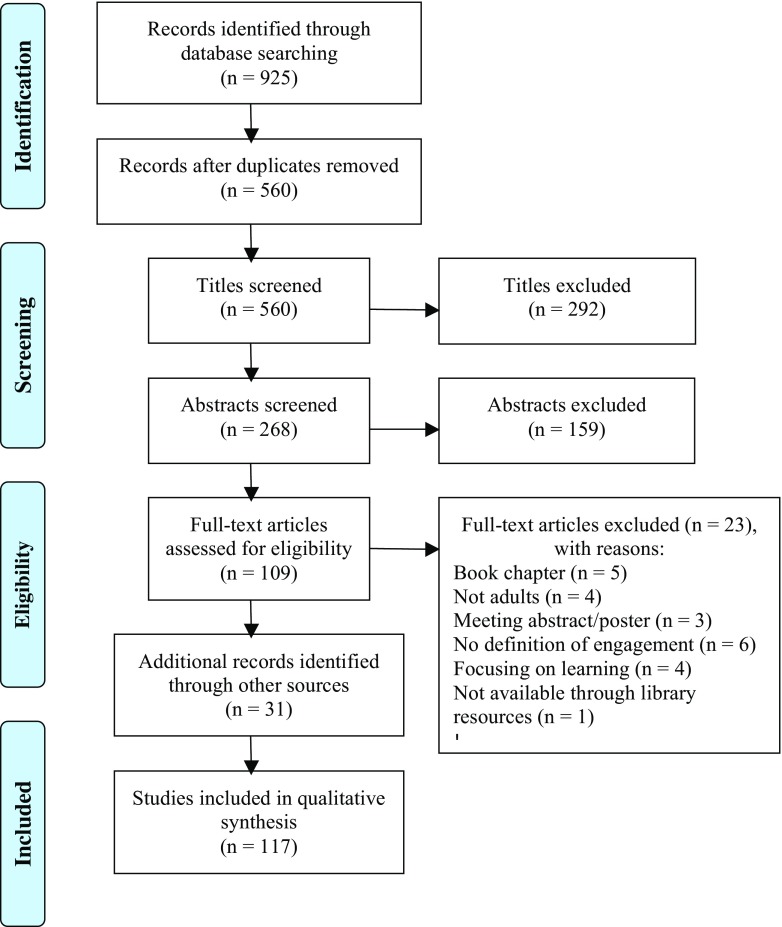
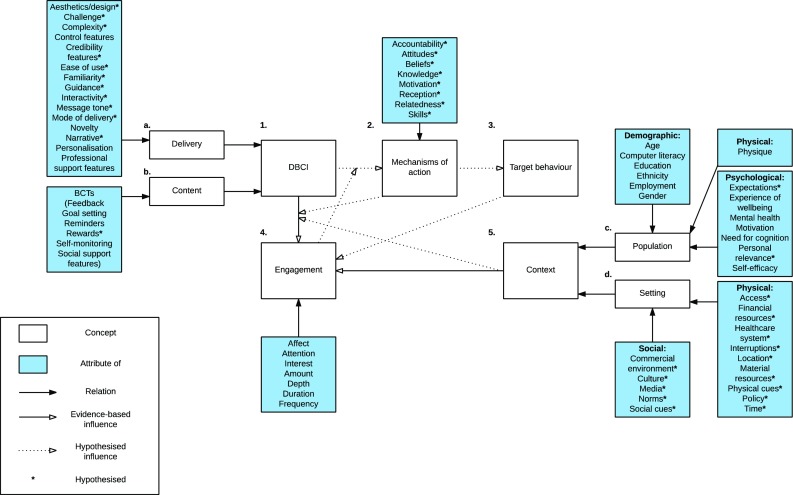
"Engagement" with digital behaviour change interventions (DBCIs) is considered important for their effectiveness. Evaluating engagement is therefore a priority; however, a shared understanding of how to usefully conceptualise engagement is lacking. This review aimed to synthesise literature on engagement to identify key conceptualisations and to develop an integrative conceptual framework involving potential direct and indirect influences on engagement and relationships between engagement and intervention effectiveness. Four electronic databases (Ovid MEDLINE, PsycINFO, ISI Web of Knowledge, ScienceDirect) were searched in November 2015. We identified 117 articles that met the inclusion criteria: studies employing experimental or non-experimental designs with adult participants explicitly or implicitly referring to engagement with DBCIs, digital games or technology. Data were synthesised using principles from critical interpretive synthesis. Engagement with DBCIs is conceptualised in terms of both experiential and behavioural aspects. A conceptual framework is proposed in which engagement with a DBCI is influenced by the DBCI itself (content and delivery), the context (the setting in which the DBCI is used and the population using it) and the behaviour that the DBCI is targeting. The context and "mechanisms of action" may moderate the influence of the DBCI on engagement. Engagement, in turn, moderates the influence of the DBCI on those mechanisms of action. In the research literature, engagement with DBCIs has been conceptualised in terms of both experience and behaviour and sits within a complex system involving the DBCI, the context of use, the mechanisms of action of the DBCI and the target behaviour.
Overview
The claims and statistics of this paper haven’t been checked yet.
Free: it reads the open-access text and checks the first 5 claims that cite a source we can check. Create a free account to check every claim.
Integrity signals
Registry
Cites
Statistics
Figures
Verification
Claims the paper makes
The claims and statistics of this paper haven’t been checked yet.
Free: it reads the open-access text and checks the first 5 claims that cite a source we can check. Create a free account to check every claim.
Claims other papers make about this one
Each is checked against this paper’s own text: does it say what the citing paper says it does?
The source backs part of the claim, not all of it — or backs it for a different population, condition or comparison.
In the citing paper
“In line with the emerging evidence from the human-computer interaction (HCI) literature, we found that an app coupled with human support [14,17] was likely to be more effective by increasing the intervention effectiveness and engagement [78,79].”
From Influences on the Uptake of and Engagement With Health and Well-Being Smartphone Apps: Systematic Review (2020) · cites this paper as [14]
Experimental — accuracy not yet measuredThe source backs part of the claim, not all of it — or backs it for a different population, condition or comparison.
In the citing paper
“In line with the findings of previous reviews, help with initial engagement could be achieved by improving the users’ app literacy skills and by providing knowledge [14,17].”
From Influences on the Uptake of and Engagement With Health and Well-Being Smartphone Apps: Systematic Review (2020) · cites this paper as [14]
Experimental — accuracy not yet measuredThe source backs part of the claim, not all of it — or backs it for a different population, condition or comparison.
In the citing paper
“Nonetheless, ECA use does decline over time, limiting long-term health effects [1,14-17].”
From Use and Effect of Embodied Conversational Agents for Improving Eating Behavior and Decreasing Loneliness Among Community-Dwelling Older Adults: Randomized Controlled Trial (2022) · cites this paper as [15]
Experimental — accuracy not yet measuredThe cited source says what the claim attributes to it.
In the citing paper
“A review based on experiential and behavioral perspectives conceptualized key factors that might affect engagement with digital behavior change interventions: the content (eg, behavior change techniques, social support, and reminders) and how the content is delivered (eg, professional support, personalization, and aesthetic features) [14].”
From Influences on the Uptake of and Engagement With Health and Well-Being Smartphone Apps: Systematic Review (2020) · cites this paper as [14]
The cited source says what the claim attributes to it.
In the citing paper
“Behavior change techniques, widely reported by others previously [14,17-19], were also identified as important factors to sustain engagement, including self-monitoring, feedback, goal setting, reminders, rewards, and social support.”
From Influences on the Uptake of and Engagement With Health and Well-Being Smartphone Apps: Systematic Review (2020) · cites this paper as [14]
5 more claims about this paper
Create a free account to see every claim other papers make about this one.
Self-check
Percentages, sums and reported differences re-computed from the paper’s own numbers.
The self-check needs the paper’s full text.
Citations
Cites
Preferred Reporting Items for Systematic Reviews and Meta-Analyses: the PRISMA statement
Moher, D., Liberati, A., Tetzlaff, J., Altman, D. G., & for the PRISMA Group (2009) · BMJ · doi:10.1136/bmj.b2535 · Cited by 83,823
Preferred Reporting Items for Systematic Reviews and Meta-Analyses: The PRISMA Statement
Moher, D., Liberati, A., Tetzlaff, J., Altman, D. G., & The PRISMA Group (2009) · PLoS Medicine · doi:10.1371/journal.pmed.1000097 · Cited by 64,042
Preferred reporting items for systematic reviews and meta-analyses: the PRISMA Statement.
(2009) · PubMed Central · Cited by 44,859
Wang, G., Ma, R., Qiao, G., Wada, K., Aizawa, Y., & Satoh, T. (2015) · Integrative Medicine International · doi:10.1159/000368408 · Cited by 18,657
Handbook of Qualitative Research
(1994) · Journal of Environmental Psychology · doi:10.1016/s0272-4944(05)80230-0 · Cited by 5,715
Data management and analysis methods.
Huberman, A. M., & Miles, M. B. (1994) · Cited by 3,400
Bellg, A. J., Treatment Fidelity Workgroup of the NIH Behavior Change Consortium, Borrelli, B., Resnick, B., Hecht, J., Minicucci, D. S., Ory, M., Ogedegbe, G., Orwig, D., Ernst, D., et al. (2004) · Health Psychology · doi:10.1037/0278-6133.23.5.443 · Cited by 2,620 · cited 1×
“A further distinction has been made between Bintervention receipt^, which refers to the extent to which participants understand and can perform the skills taught, and Benactment of intervention skills^, which refers to the extent to which participants use these skills [146, 147].”
BackgroundChecklists for improving rigour in qualitative research: a case of the tail wagging the dog?
Barbour, R. S. (2001) · BMJ · doi:10.1136/bmj.322.7294.1115 · Cited by 2,613 · cited 1×
“A subsample of codes was selected through random sequence generation (https://www.random.org/) for validation by an independent researcher to increase rigour [41].”
MethodEysenbach, G. (2005) · Journal of Medical Internet Research · doi:10.2196/jmir.7.1.e11 · Cited by 2,524 · cited 1×
“This kind of conceptualisation has emerged due to the observation that while many download and try DBCIs, sustained usage is typically low [21 – 24].”
BackgroundDixon-Woods, M., Cavers, D., Agarwal, S., Annandale, E., Arthur, A., Harvey, J., Hsu, R., Katbamna, S., Olsen, R., Smith, L., et al. (2006) · BMC Medical Research Methodology · doi:10.1186/1471-2288-6-35 · Cited by 2,289
Research works printed but not linked: 5
- 4. West R, Michie S. A Guide to Development and Evaluation of Digital Interventions in Healthcare. London: Silverback Publishing; 2016.
- 15. The Cochrane Collaboration. Cochrane Handbook for Systematic Reviews of Interventions Version 5.1.0. [Updated March 2011]. (J. Higgins & S. Green, Eds.) 2011 Retrieved from www.cochrane-handbook.org.
- 59. Chiang Y-T, Lin SSJ, Cheng C-Y, Liu EZ-F. Exploring online game players’ flow experiences and positive affect. The Turkish Online Journal of Educational Technology. 2011;10(1):106–114.
- 144. Miller AS, Cafazzo JA, Seto E. A game plan: gamification design principles in mHealth applications for chronic disease management. Health Informatics Journal. 2014 doi: 10.1177/1460458214537511. · DOI · Paper page
- 152. O’Brien HL, Toms EG. The development and evaluation of a survey to measure user engagement. Journal of the American Society for Information Science & Technology. 2010;61(1):50–69. doi: 10.1002/asi.21229. · DOI · Paper page
Cited by
Items 201–300 of 1,002
Bell, L., Garnett, C., Bao, Y., Cheng, Z., Qian, T., Perski, O., Potts, H. W. W., & Williamson, E. (2023) · JMIR mHealth and uHealth · doi:10.2196/38342 · Cited by 35
“Engagement, a construct of both experiential and behavioral aspects [14], fluctuates within and between users over time and is influenced not only by the static content of the intervention but also by internal (eg, the user’s momentary mood, cognitive state, and recent patterns of engagement and drinking) and external…”
BackgroundSelf-citationThe conceptualisation and measurement of engagement in digital health
Milne‐Ives, M., Homer, S. R., Andrade, J., & Meinert, E. (2024) · Internet Interventions · doi:10.1016/j.invent.2024.100735 · Cited by 47
Mobile applications, physical activity, and health promotion
Basto, P. S., & Ferreira, P. (2025) · BMC Health Services Research · doi:10.1186/s12913-025-12489-z · Cited by 68
Cho, H., Sanabria, G., Saylor, M., Gradilla, M., & Schnall, R. (2019) · International Journal of Medical Informatics · doi:10.1016/j.ijmedinf.2019.08.009 · Cited by 46
Changing Behavior Using Integrated Theories
Hagger, M. S., & Hamilton, K. (2020) · Cambridge University Press eBooks · doi:10.1017/9781108677318.015 · Cited by 51
Satre, D. D., Meacham, M. C., Asarnow, L. D., Fisher, W. S., Fortuna, L. R., & Iturralde, E. (2021) · American Journal of Health Promotion · doi:10.1177/08901171211055314 · Cited by 39
Psihogios, A. M., King‐Dowling, S., O’Hagan, B., Darabos, K., Maurer, L. A., Young, J., Fleisher, L. G., Barakat, L. P., Szalda, D. E., Hill‐Kayser, C. E., et al. (2021) · Annals of Behavioral Medicine · doi:10.1093/abm/kaab008 · Cited by 39
Vandelanotte, C., Kolt, G. S., Caperchione, C. M., Savage, T. N., Rosenkranz, R. R., Maeder, A., Itallie, A. K. V., Tague, R., Oldmeadow, C. J., Mummery, W. K., et al. (2017) · Journal of Medical Internet Research · doi:10.2196/jmir.8484 · Cited by 40
Heneghan, M. B., Hussain, T., Barrera, L., Cai, S. W., Haugen, M., Morgan, E. R., Rossoff, J. E., Weinstein, J. L., Hijiya, N., Cella, D. F., et al. (2021) · Journal of Medical Internet Research · doi:10.2196/24893 · Cited by 36
Flaherty, S. J., McCarthy, M. B., Collins, A., McCafferty, C., & McAuliffe, F. M. (2021) · European Journal of Marketing · doi:10.1108/ejm-06-2019-0531 · Cited by 44
Tombor, I., Beard, E., Brown, J., Shahab, L., Michie, S., & West, R. (2018) · Translational Behavioral Medicine · doi:10.1093/tbm/iby073 · Cited by 38
Self-citationUser Perspectives on a Resilience-Building App (JoyPop): Qualitative Study
Mushquash, A. R., Pearson, E. S., Waddington, K., MacIsaac, A., Mohammed, S., Grassia, E., Smith, S., & Wekerle, C. (2021) · JMIR mhealth and uhealth · doi:10.2196/28677 · Cited by 37
Grady, A., Pearson, N., Lamont, H., Leigh, L., Wolfenden, L., Barnes, C., Wyse, R., Finch, M., McLaughlin, M. J., Delaney, T. M., et al. (2023) · Journal of Medical Internet Research · doi:10.2196/47987 · Cited by 55
Engagement with MyFitnessPal in eating disorders: Qualitative insights from online forums
McCaig, D. C., Elliott, M. T., Prnjak, K., Walasek, L., & Meyer, C. (2019) · International Journal of Eating Disorders · doi:10.1002/eat.23205 · Cited by 35
Bell, L., Garnett, C. V., Qian, T., Perski, O., Williamson, E., & POTTS, H. W. W. (2020) · Journal of Medical Internet Research · doi:10.2196/23369 · Cited by 39
Self-citationCompernolle, S., Cardon, G., van der Ploeg, H. P., van Nassau, F., Bourdeaudhuij, I. D., Jelsma, J. G. M., Brondeel, R., & Dyck, D. V. (2020) · JMIR mhealth and uhealth · doi:10.2196/18653 · Cited by 37
Kramer, L. L., van Velsen, L., Clark, J. L., Mulder, B. C., & de Vet, E. (2022) · JMIR Formative Research · doi:10.2196/33974 · Cited by 31
Lukka, L., & Palva, J. M. (2023) · JMIR Serious Games · doi:10.2196/42173 · Cited by 40
Adu, M. D., Malabu, U. H., Malau‐Aduli, A. E. O., Drovandi, A. D., & Malau‐Aduli, B. S. (2020) · JMIR mhealth and uhealth · doi:10.2196/17802 · Cited by 48
Jannati, N., Nakhaee, N., Yazdi‐Feyzabadi, V., & Tjondronegoro, D. (2021) · International Journal of Medical Informatics · doi:10.1016/j.ijmedinf.2021.104474 · Cited by 43
Perski, O., Baretta, D., Blandford, A., West, R., & Michie, S. (2018) · DIGITAL HEALTH · doi:10.1177/2055207618785841 · Cited by 31
“how interested you are in the app, how much attention you pay to it, how much you enjoy using it).(15) Participants were each given a folder with Post-it Notes.”
BackgroundInfluentialSelf-citationChanging Behavior Using the Transtheoretical Model
DiClemente, C. C., & Graydon, M. M. (2020) · Cambridge University Press eBooks · doi:10.1017/9781108677318.010 · Cited by 38
Schwarz, A. F., Winkens, L. H. H., de Vet, E., Ossendrijver, D., Bouwsema, K., & Simons, M. (2023) · JMIR mhealth and uhealth · doi:10.2196/40898 · Cited by 45
Forman‐Hoffman, V. L., Flom, M., Mariano, T. Y., Chiauzzi, E. J., Williams, A. A. A., Kirvin-Quamme, A., Pajarito, S., Durden, E., & Perski, O. (2023) · Journal of Medical Internet Research · doi:10.2196/47198 · Cited by 44
Self-citationAkdemir, A., Smith, A. B., Wu, V. S., Rincones, O., Russell, H., Lyhne, J. D., Kemp, E., David, M., & Bamgboje‐Ayodele, A. (2024) · Psycho-Oncology · doi:10.1002/pon.6290 · Cited by 43
Zhang, S., Hamburger, E., Kahanda, S., Lyttle, M., Williams, R., & Jaser, S. S. (2018) · Diabetes Technology & Therapeutics · doi:10.1089/dia.2018.0015 · Cited by 30
Alshurafa, N. I., Jain, J., Alharbi, R., Iakovlev, G., Spring, B. J., & Pfammatter, A. F. (2018) · Proceedings of the ACM on Interactive Mobile Wearable and Ubiquitous Technologies · doi:10.1145/3287031 · Cited by 41
Kliemann, N., Croker, H. A., Johnson, F., & Beeken, R. J. (2019) · JMIR mhealth and uhealth · doi:10.2196/12326 · Cited by 33
Jaser, S. S., Datye, K. A., Morrow, T., Sinisterra, M., LeStourgeon, L. M., Abadula, F., Bell, G. E., & Streisand, R. M. (2020) · Contemporary Clinical Trials · doi:10.1016/j.cct.2020.106086 · Cited by 34
Sim, W. H., Jorm, A. F., & Yap, M. B. H. (2022) · International Journal of Environmental Research and Public Health · doi:10.3390/ijerph19042191 · Cited by 40
Hardy, A., Ward, T., Emsley, R., Greenwood, K., Freeman, D. H., Fowler, D. G., Kuipers, E., Bebbington, P., & Garety, P. A. (2022) · JMIR Human Factors · doi:10.2196/29725 · Cited by 34
Radomski, A. D., Bagnell, A., Curtis, S., Hartling, L., & Newton, A. S. (2020) · JMIR Mental Health · doi:10.2196/15795 · Cited by 30
“Currently, there is considerable heterogeneity in how the user experience is defined and evaluated, with most research being conducted with adult populations [65,69,110,111].”
Montalescot, L., Baussard, L., & Charbonnier, É. (2024) · Journal of Medical Internet Research · doi:10.2196/52542 · Cited by 43
A New Research Model for Artificial Intelligence–Based Well-Being Chatbot Engagement: Survey Study
Yang, Y., Tavares, J., & Oliveira, T. (2024) · JMIR Human Factors · doi:10.2196/59908 · Cited by 50
Manole, A., Cârciumaru, R., Brînzaș, R., & Manole, F. (2024) · Information · doi:10.3390/info16010011 · Cited by 44
Changing Behavior Using the Health Belief Model and Protection Motivation Theory
Orbell, S., Zahid, H., & Henderson, C. J. (2020) · Cambridge University Press eBooks · doi:10.1017/9781108677318.004 · Cited by 40
Ensari, I., Pichon, A., Gorman, S. L., Henry, S. B., & Elhadad, N. (2020) · Applied Clinical Informatics · doi:10.1055/s-0040-1718755 · Cited by 36
Graham, A. L., Papandonatos, G. D., Jacobs, M. A., Amato, M. S., Cha, S., Cohn, A. M., Abroms, L. C., & Whittaker, R. (2020) · Journal of Medical Internet Research · doi:10.2196/17734 · Cited by 33
Murray, E., Goodfellow, H., Bindman, J., BLANDFORD, A. E., Bradbury, K. J., Chaudhry, T., Fernández-Reyes, D., Gomes, M., Hamilton, F. L., Heightman, M., et al. (2022) · BMJ Open · doi:10.1136/bmjopen-2021-057408 · Cited by 32
Self-citationEscobar-Viera, C. G., Melcher, E. M., Miller, R. S., Whitfield, D. L., Jacobson-López, D., Gordon, J. D., Ballard, A. J., Rollman, B. L., & Pagoto, S. (2021) · Internet Interventions · doi:10.1016/j.invent.2021.100428 · Cited by 30
van der Hout, A., van Uden-Kraan, C. F., Holtmaat, K., Jansen, F., Lissenberg-Witte, B. I., Nieuwenhuijzen, G. A. P., Hardillo, J. A., Baatenburg de Jong, R. J., Tiren-Verbeet, N. L., Sommeijer, D. W., et al. (2021) · Internet Interventions · doi:10.1016/j.invent.2021.100429 · Cited by 29
McKeon, G., Steel, Z., Wells, R., Newby, J., Hadzi-Pavlovic, D., Vancampfort, D., & Rosenbaum, S. (2021) · JMIR Formative Research · doi:10.2196/23432 · Cited by 29
Mulvaney, S. A., Vaala, S., Hood, K. K., Lybarger, C., Carroll, R., Williams, L., Schmidt, D. C., Johnson, K., Dietrich, M. S., & Laffel, L. (2018) · Diabetes Technology & Therapeutics · doi:10.1089/dia.2018.0064 · Cited by 29
Pokémon GO Within the Context of Family Health: Retrospective Study
Militello, L. K., Hanna, N., & Nigg, C. R. (2018) · JMIR Pediatrics and Parenting · doi:10.2196/10679 · Cited by 35
Effectiveness of a Dyadic Buddy App for Smoking Cessation: Randomized Controlled Trial
Schwaninger, P., Berli, C., Scholz, U., & Lüscher, J. (2021) · Journal of Medical Internet Research · doi:10.2196/27162 · Cited by 30
Wynn, C. S., Catallozzi, M., Kolff, C. A., Holleran, S., Meyer, D. D., Ramakrishnan, R., & Stockwell, M. S. (2021) · JMIR mhealth and uhealth · doi:10.2196/26356 · Cited by 30
White, K. M., Williamson, C., Bergou, N., Oetzmann, C., de Angel, V., Matcham, F., Henderson, C., & Hotopf, M. H. (2022) · npj Digital Medicine · doi:10.1038/s41746-022-00624-7 · Cited by 32
Cock, N. D., Lippevelde, W. V., Vangeel, J., Notebaert, M., Beullens, K., Eggermont, S., Deforche, B. I., Maes, L., Goossens, L., Verbeken, S., et al. (2018) · Public Health Nutrition · doi:10.1017/s1368980018000678 · Cited by 31
Development and Initial Validation of a Scale to Measure Engagement with eHealth Technologies
Kelders, S. M., & Kip, H. (2019) · CHI Conference Extended Abstracts on Human Factors in Computing Systems (CHI EA) · doi:10.1145/3290607.3312917 · Cited by 34
Girginov, V., Moore, P., Olsen, N., Godfrey, T., & Cooke, F. (2020) · Cogent Social Sciences · doi:10.1080/23311886.2020.1742517 · Cited by 40
Bell, L., Garnett, C. V., Qian, T., Perski, O., POTTS, H. W. W., & Williamson, E. (2020) · JMIR Research Protocols · doi:10.2196/18690 · Cited by 35
Self-citationChanging Behavior by Changing Environments
Marteau, T. M., Fletcher, P. C., Hollands, G. J., & Munafo, M. R. (2020) · Cambridge University Press eBooks · doi:10.1017/9781108677318.014 · Cited by 35
Young, L. E., Soliz, S., Xu, J. J., & Young, S. D. (2020) · Preventive Medicine Reports · doi:10.1016/j.pmedr.2020.101158 · Cited by 37
Russ, S. J., Sevdalis, N., & Ocloo, J. E. (2021) · JMIR mhealth and uhealth · doi:10.2196/24065 · Cited by 32
Gray, C. S., Chau, E., Tahsin, F., Harvey, S., Loganathan, M., McKinstry, B., Mercer, S. W., Nie, J. X., Palen, T. E., Ramsay, T., et al. (2021) · Journal of Medical Internet Research · doi:10.2196/29071 · Cited by 29
Lavikainen, P., Mattila, E., Absetz, P., Harjumaa, M., Lindström, J., Järvelä‐Reijonen, E., Aittola, K., Männikkö, R., Tilles‐Tirkkonen, T., Lintu, N., et al. (2022) · Journal of Medical Internet Research · doi:10.2196/31530 · Cited by 37
User engagement in mobile apps for people with schizophrenia: A scoping review
de Almeida, R. S., & Marques, A. J. (2023) · Frontiers in Digital Health · doi:10.3389/fdgth.2022.1023592 · Cited by 35
Madkins, K., Moskowitz, D., Moran, K., Dellucci, T. V., & Mustanski, B. S. (2019) · AIDS Education and Prevention · doi:10.1521/aeap.2019.31.4.287 · Cited by 32
McGill, D. E., Volkening, L. K., Butler, D. A., Wasserman, R. M., Anderson, B. J., & Laffel, L. M. (2019) · Diabetic Medicine · doi:10.1111/dme.13929 · Cited by 27
Pritwani, S., Shrivastava, P., Pandey, S., Kumar, A., Malhotra, R., Maddison, R., & Devasenapathy, N. (2024) · JMIR mhealth and uhealth · doi:10.2196/47843 · Cited by 34
Kick.it: The development of an evidence-based smoking cessation smartphone app
van Agteren, J. E. M., Lawn, S., Bonevski, B., & Smith, B. J. (2018) · Translational Behavioral Medicine · doi:10.1093/tbm/ibx031 · Cited by 27
Moussa, K. C., Mira, J. J., & Orozco‐Beltrán, D. (2020) · JMIR mhealth and uhealth · doi:10.2196/15446 · Cited by 29
Associations between Digital Health Intervention Engagement and Dietary Intake: A Systematic Review
Delaney, T. M., McLaughlin, M. J., Hall, A. E., Yoong, S. L., Brown, A., O’Brien, K. M., Dray, J., Barnes, C., Hollis, J., Wyse, R., et al. (2021) · Nutrients · doi:10.3390/nu13093281 · Cited by 30
How Users Experience and Use an eHealth Intervention Based on Self-Regulation: Mixed-Methods Study
Poppe, L., der Mispel, C. V., Crombez, G., Bourdeaudhuij, I. D., Schroé, H., & Verloigne, M. (2018) · Journal of Medical Internet Research · doi:10.2196/10412 · Cited by 30
Garnett, C. V., Oldham, M., Angus, C., Beard, E., Burton, R., Field, M., Greaves, F., Hickman, M., Kaner, E., Loebenberg, G., et al. (2020) · Addiction · doi:10.1111/add.15287 · Cited by 31
Self-citationPovey, J., Sweet, M., Nagel, T., Lowell, A., Shand, F., Vigona, J., & Dingwall, K. M. (2022) · JMIR Formative Research · doi:10.2196/28342 · Cited by 26
Fowler, J. A., Buckley, L., Muir, M., Viskovich, S., Paradisis, C., Zanganeh, P., & Dean, J. A. (2023) · Journal of Clinical Psychology · doi:10.1002/jclp.23571 · Cited by 31
Tong, H. L., Alnasser, A., Alshahrani, N. Z., Bawaked, R. A., AlAhmed, R. S., Alsukait, R. F., Rakić, S., Çetinkaya, V., Al-Hazzaa, H. M., & Alqahtani, S. A. (2024) · Journal of Medical Internet Research · doi:10.2196/53651 · Cited by 40
Lehmann, M., Jones, L., & Schirmann, F. (2024) · Journal of Medical Internet Research · doi:10.2196/45469 · Cited by 28
Carbonnel, F., & Ninot, G. (2019) · Journal of Medical Internet Research · doi:10.2196/13606 · Cited by 33
Koneska, E., Appelbe, D., Williamson, P. R., & Dodd, S. R. (2020) · Journal of Medical Internet Research · doi:10.2196/15474 · Cited by 27
Design, Implementation, and Evaluation of Behavior Change Interventions: A Ten-Task Guide
Abraham, C., & Denford, S. (2020) · Cambridge University Press eBooks · doi:10.1017/9781108677318.019 · Cited by 36
Changing Behavior Using the Reflective-Impulsive Model
Deutsch, R., & Strack, F. (2020) · Cambridge University Press eBooks · doi:10.1017/9781108677318.012 · Cited by 37
Hassen, H. M., Behera, M. R., Jena, P. K., Dewey, R. S., & Disassa, G. A. (2022) · Journal of Multidisciplinary Healthcare · doi:10.2147/jmdh.s361212 · Cited by 34
Giovanelli, A., Rowe, J., Taylor, M., Berna, M. S., Tebb, K., Penilla, C., Pugatch, M., Lester, J. C., & Ozer, E. M. (2023) · Journal of Medical Internet Research · doi:10.2196/40306 · Cited by 42
Yeager, C. M., Shoji, K., Łuszczyńska, A., & Benight, C. C. (2018) · JMIR Mental Health · doi:10.2196/mental.9449 · Cited by 31
Murray, J., French, D., Patterson, C., Kee, F., Gough, A., Tang, J., & Hunter, R. F. (2019) · Journal of Medical Internet Research · doi:10.2196/11394 · Cited by 28
Understanding User Perceptions of Response Delays in Crowd-Powered Conversational Systems
Abbas, T., Gadiraju, U., Khan, V.-J., & Markopoulos, P. (2022) · Proceedings of the ACM on Human-Computer Interaction · doi:10.1145/3555765 · Cited by 26
Jackson, H. M., Calear, A. L., Batterham, P. J., Ohan, J. L., Farmer, G. M., & Farrer, L. M. (2023) · Journal of Medical Internet Research · doi:10.2196/44673 · Cited by 25
Merkouris, S., Hawker, C. O., Rodda, S. N., Youssef, G. J., & Dowling, N. A. (2020) · International Gambling Studies · doi:10.1080/14459795.2020.1749293 · Cited by 28
Understanding eHealth Cognitive Behavioral Therapy Targeting Substance Use: Realist Review
Shams, F., Wong, J. S. H., Nikoo, M., Outadi, A., Zadeh, E. M., Kamel, M. M., Song, M. J., Jang, K. L., & Krausz, M. R. (2020) · Journal of Medical Internet Research · doi:10.2196/20557 · Cited by 27
Shi, J., Lo, B., Wong, H. W., Hollenberg, E., Sanches, M., Abi-Jaoudé, A., Chaim, G., Cleverley, K., Henderson, J. L., Johnson, A., et al. (2021) · Internet Interventions · doi:10.1016/j.invent.2021.100386 · Cited by 32
Mobile health use predicts self-efficacy and self-management in adolescents with sickle cell disease
Hood, A., Nwankwo, C. N., Walton, A. E., McTate, E., Joffe, N. E., Quinn, C. T., Britto, M. T., Peugh, J., Mara, C. A., & Crosby, L. E. (2021) · Translational Behavioral Medicine · doi:10.1093/tbm/ibab041 · Cited by 29
Graham, A. L., Papandonatos, G. D., Cha, S., Amato, M. S., Jacobs, M. A., Cohn, A. M., Abroms, L. C., & Whittaker, R. (2021) · Addiction · doi:10.1111/add.15677 · Cited by 28
Yu, J., Wu, J., Huang, O., Chen, X., & Shen, K. (2021) · Journal of Medical Internet Research · doi:10.2196/27576 · Cited by 30
Chalmiers, M. A., Karaki, F. M., Muriki, M., Mody, S. K., Chen, A. Z. L., & de Bocanegra, H. T. (2021) · Contraception · doi:10.1016/j.contraception.2021.11.004 · Cited by 29
Maenhout, L., Peuters, C., Cardon, G., Crombez, G., DeSmet, A., & Compernolle, S. (2022) · JMIR mhealth and uhealth · doi:10.2196/36404 · Cited by 30
The Effect of Serious Games on Medical Students’ Motivation, Flow and Learning
Zaïri, I., Dhiab, M. B., Mzoughi, K., & Mrad, I. B. (2022) · Simulation & Gaming · doi:10.1177/10468781221123919 · Cited by 36
Taki, S., Russell, C. G., Lymer, S., Laws, R., Campbell, K., Appleton, J., Ong, K.-L., & Denney-Wilson, E. (2019) · Frontiers in Endocrinology · doi:10.3389/fendo.2019.00397 · Cited by 24
“Specifically, demographic characteristics, such as age, gender, education, employment, and ethnicity were reported to be significantly associated with engagement (30).”
BackgroundPsihogios, A. M., Li, Y., Butler, E., Hamilton, J., Daniel, L. C., Barakat, L. P., Bonafide, C. P., & Schwartz, L. A. (2019) · JMIR mhealth and uhealth · doi:10.2196/12547 · Cited by 24
“We recommend that future research make use of text message log data when possible and examine both intervention (eg, length of intervention, types of text messages, gamification, and target health behavior) and contextual factors (eg, participant age, sex, race/ethnicity, and health status) that influence engagement […”
Dyadic Behavior Change Interventions
Scholz, U., Berli, C., Lüscher, J., & Knoll, N. (2020) · Cambridge University Press eBooks · doi:10.1017/9781108677318.043 · Cited by 29
Carey, A., Yang, Q., DeLuca, L., Toro‐Ramos, T., Kim, Y., & Michaelides, A. P. (2021) · JMIR mhealth and uhealth · doi:10.2196/30622 · Cited by 27
Moorthy, K., Halliday, L. J., Noor, N., Peters, C. J., Wynter-Blyth, V., & Urch, C. (2023) · Current Oncology · doi:10.3390/curroncol30020128 · Cited by 24
Developing Behavior Change Interventions
Hankonen, N. E., & Hardeman, W. (2020) · Cambridge University Press eBooks · doi:10.1017/9781108677318.021 · Cited by 38
Müssener, U., Thomas, K., Linderoth, C., Löf, M., Åsberg, K., Henriksson, P., & Bendtsen, M. (2020) · JMIR mhealth and uhealth · doi:10.2196/17999 · Cited by 27
Nelson, L. A., Spieker, A. J., Mayberry, L. S., McNaughton, C., & Greevy, R. A. (2021) · Journal of the American Medical Informatics Association · doi:10.1093/jamia/ocab254 · Cited by 23
Smith, A. ‘., Bamgboje‐Ayodele, A., Jegathees, S., Butow, P., Klein, B., Salter, M., Turner, J., Fardell, J., Thewes, B., Sharpe, L., et al. (2024) · Journal of Cancer Survivorship · doi:10.1007/s11764-022-01233-9 · Cited by 23
Arigo, D., Jake‐Schoffman, D. E., & Pagoto, S. (2024) · Journal of Behavioral Medicine · doi:10.1007/s10865-024-00526-x · Cited by 32
Qin, Y., Wang, X., & Namkoong, K. (2021) · Mobile Media & Communication · doi:10.1177/20501579211054929 · Cited by 23
Gamification pedagogy: A motivational approach to student-centric course design in higher education
Gironella, F. (2023) · Journal of University Teaching and Learning Practice · doi:10.53761/1.20.3.04 · Cited by 40
Metadata
- Authors
- Perski, O., Blandford, A., West, R., & Michie, S.
- Affiliations
- University College London (GB)
- Cancer Research UK (GB)
- Corresponding author
- Perski, Olga
- Venue
- Translational Behavioral Medicine
- Publisher
- Oxford University Press (OUP)
- Published
- 2016-12-13
- Volume
- 7
- Issue
- 2
- Pages
- 254-267
- ISSN
- 1613-9860 (ISSN-L)
- 1869-6716
- PMC
- PMC5526809
- OpenAlex
- W2561174611
- Cited by
- 1,193
- References
- 160
- Citations by year
- 2026: 215 · 2025: 161 · 2024: 119 · 2023: 120 · 2022: 138 · 2021: 146 · 2020: 149 · 2019: 80 · 2018: 50 · 2017: 14
- FWCI
- 6.61
- Type
- journal article
- Language
- en
- Open access
- hybrid
- doi.org
- Locations
- Translational Behavioral Medicine (publishedVersion, cc-by)
- Europe PMC (PubMed Central) (publishedVersion, cc-by)
- PubMed Central (publishedVersion, cc-by)
- PubMed (publishedVersion)
- UCL Discovery (University College London) (submittedVersion)
- Funders
- Bupa Foundation
- Topics
- Social Sciences › Psychology › Applied Psychology › Digital Mental Health Interventions
- Health Sciences › Health Professions › General Health Professions › Mobile Health and mHealth Applications
- Social Sciences › Psychology › Developmental and Educational Psychology › Educational Games and Gamification
- Keywords
- engagement, digital behaviour change interventions, conceptual framework, intervention effectiveness, mechanism of action, context of use, video games, experiential engagement, behavioral engagement, complex systems
- MeSH terms
- Health Promotion, Humans, Patient Participation, Health Behavior, Telemedicine
About these checks
Registry, retraction, Cites and statistics results are computed, not judged, with one exception: a printed reference that no index lists is read once by a model before it counts as a citation error. Claims are extracted by a model and kept only when their quote appears verbatim in the text; each cited source is then checked, with a model’s help, for whether it says what the claim relies on. Those verdicts can be wrong — read the claim’s quote and the cited source before relying on one.
Statistics and arithmetic are recomputed, not judged.
Confidence bands are shown only for fields calibrated on our annotated test set. None is calibrated yet, so no band is shown.
What counts as a claim ›How we measure confidence ›How we check this ›
Are you an author, or do you see a problem with this page? Request a review
Data sources
Bibliographic data: Semantic Scholar, OpenAlex, Crossref.
Contains information from the Semantic Scholar Academic Graph Datasets, made available under the ODC Attribution License (ODC-BY 1.0).
Semantic Scholar’s data is described in: Kinney, R., et al. (2023). The Semantic Scholar Open Data Platform. arXiv:2301.10140.
