

Principles for urban nature-based solutions
Open accessThe DOI matches its Crossref record; 96 of the 96 references it cites were found in a registry or an index.
Abstract
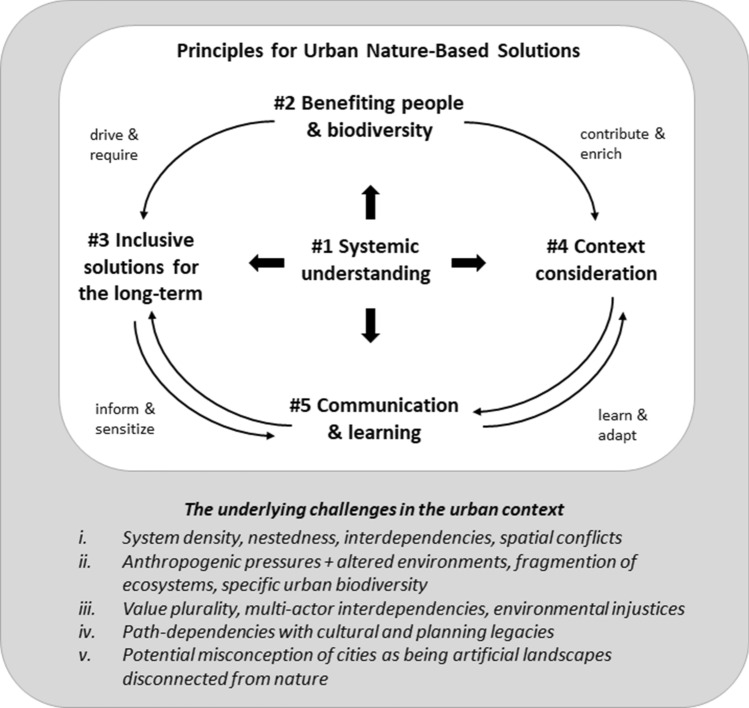
Nature-based solutions (NBS) were introduced as integrated, multifunctional and multi-beneficial solutions to a wide array of socio-ecological challenges. Although principles for a common understanding and implementation of NBS were already developed on a landscape scale, specific principles are needed with regard to an application in urban areas. Urban areas come with particular challenges including (i) spatial conflicts with urban system nestedness, (ii) specific urban biodiversity, fragmentation and altered environments, (iii) value plurality, multi-actor interdependencies and environmental injustices, (iv) path-dependencies with cultural and planning legacies and (v) a potential misconception of cities as being artificial landscapes disconnected from nature. Given these challenges, in this perspective paper, we build upon and integrate knowledge from the most recent academic work on NBS in urban areas and introduce five distinct, integrated principles for urban NBS design, planning and implementation. Our five principles should help to transcend governance gaps and advance the scientific discourse of urban NBS towards a more effective and sustainable urban development. To contribute to resilient urban futures, the design, planning, policy and governance of NBS should (1) consider the need for a systemic understanding, (2) contribute to benefiting people and biodiversity, (3) contribute to inclusive solutions for the long-term, (4) consider context conditions and (5) foster communication and learning.
Overview
The claims and statistics of this paper haven’t been checked yet.
Free: it reads the open-access text and checks the first 5 claims that cite a source we can check. Create a free account to check every claim.
Integrity signals
Registry
Cites
Statistics
Figures
Verification
Claims the paper makes
The claims and statistics of this paper haven’t been checked yet.
Free: it reads the open-access text and checks the first 5 claims that cite a source we can check. Create a free account to check every claim.
Self-check
Percentages, sums and reported differences re-computed from the paper’s own numbers.
The self-check needs the paper’s full text.
Citations
Cites
Promoting ecosystem and human health in urban areas using Green Infrastructure: A literature review
Tzoulas, K., Korpela, K., Venn, S., Yli-Pelkonen, V., Kaźmierczak, A., Niemela, J., & James, P. (2007) · Landscape and Urban Planning · doi:10.1016/j.landurbplan.2007.02.001 · Cited by 2,810 · cited 1×
“Urban areas come with particular challenges for the application of the NBS approach and as such, they also require a critical reflection of ecological concepts (Tzoulas et al. 2007; Beichler et al. 2017; Conway et al. 2019).”
BackgroundNature-based solutions to address global societal challenges
(2016) · doi:10.2305/iucn.ch.2016.13.en · Cited by 2,064 · cited 1×
“…the importance and opportunities of ‘‘actions to protect, sustainably manage and restore natural or modified ecosystems, that address societal challenges [...] effectively and adaptively, simultaneously providing human well-being and biodiversity benefits’’ (Cohen-Shacham et al. 2016, p.xii).”
BackgroundSeddon, N., Chausson, A., Berry, P., Girardin, C. A. J., Smith, A., & Turner, B. (2020) · Philosophical Transactions of the Royal Society B: Biological Sciences · doi:10.1098/rstb.2019.0120 · Cited by 2,024 · cited 1×
“…an inclusive NBS governance in which a diverse set of development options are discussed openly and transparently with a range of stakeholders (see Seddon et al. 2020 for inflexible forms of governance acting as barriers to uptake NBS and Fors et al. 2021 on participation during management of…”
BackgroundScaling up from gardens: biodiversity conservation in urban environments.
Goddard, M. A., Dougill, A. J., & Benton, T. G. (2010) · Trends in Ecology & Evolution · doi:10.1016/j.tree.2009.07.016 · Cited by 1,595 · cited 1×
“…other small private green patches might represent crucial NBS. Planning for NBS need to consider different spatial scales and deal with both publicly owned land and private land in order to steer collective as well as individual decisions for or against NBS (Goddard et al. 2010; Hsu et al. 2020).”
BackgroundHaaland, C., & van den Bosch, C. K. (2015) · Urban Forestry & Urban Greening · doi:10.1016/j.ufug.2015.07.009 · Cited by 1,585 · cited 1×
“…development (with potential negative impacts on environmental quality) and safeguarding and/or developing new urban green and blue spaces for mitigating and adapting to climate change impacts ensuring a high quality of life in cities (Haaland and van den Bosch 2015; Artmann et al. 2019).”
BackgroundKabisch, N., Frantzeskaki, N., Pauleit, S., Naumann, S., Davis, M., Artmann, M., Haase, D., Knapp, S., Korn, H., Stadler, J., et al. (2016) · Ecology and Society · doi:10.5751/es-08373-210239 · Cited by 1,490 · cited 3×
“…social policy, water infrastructure, green space planning and health with their particular expertise together to plan for integrating NBS to urban fabrics in an inclusive and multifunctional way (Kabisch et al. 2016; Bush 2020; Frantzeskaki et al. 2020; Moosavi et al. 2021).”
BackgroundSelf-citationA framework for assessing and implementing the co-benefits of nature-based solutions in urban areas
Raymond, C. M., Frantzeskaki, N., Kabisch, N., Berry, P., Breil, M., Nita, M. R., Geneletti, D., & Calfapietra, C. (2017) · Environmental Science & Policy · doi:10.1016/j.envsci.2017.07.008 · Cited by 1,362 · cited 1×
“…urban areas with a particular aim to mitigate and adapt to climate change (Kabisch et al. 2016; Hobbie and Grimm 2020) and The Author(s) 2022 www.kva.se/en 123 other societal challenges rather than using technical solutions only (Pauleit et al. 2017; Raymond et al. 2017; Babı́ Almenar et al. 2021).”
BackgroundSelf-citationNovel urban ecosystems, biodiversity, and conservation
Kowarik, I. (2011) · Environmental Pollution · doi:10.1016/j.envpol.2011.02.022 · Cited by 1,175 · cited 2×
“Ecosystems in cities are deeply changed through anthropogenic impact resulting in altered water and soil regimes as well as novel urban ecosystems and species behaviour adapted to urban conditions (Kowarik 2011a; Alberti 2015).”
BackgroundCore principles for successfully implementing and upscaling Nature-based Solutions
Cohen-Shacham, E., Andrade, A., Dalton, J., Dudley, N., Jones, M., Kumar, C., Maginnis, S., Maynard, S., Nelson, C. R., Renaud, F. G., et al. (2019) · Environmental Science & Policy · doi:10.1016/j.envsci.2019.04.014 · Cited by 943 · cited 12×
“Following a two-year consultation process with about 770 contributions from various stakeholders (IUCN 2021), the standard more strongly balances ecological, social and economic aspects of NBS.”
BackgroundInfluentialGreen justice or just green? Provision of urban green spaces in Berlin, Germany
Kabisch, N., & Haase, D. (2014) · Landscape and Urban Planning · doi:10.1016/j.landurbplan.2013.11.016 · Cited by 860 · cited 1×
“…and integration of cultural context in terms of inclusive design considering all dimensions of socio-environmental justice (distributive, procedural, interactional or recognition; see Kabisch and Haase 2014; Baró et al. 2021; 123 The Author(s) 2022 www.kva.se/en Pineda-Pinto et al. 2021).”
BackgroundSelf-citation
Research works printed but not linked: 3
- 31. European Commission. 2021. Evaluating the impact of nature-based solutions. A handbook for practitioners10.2777/2498 · doi:10.2777/2498
- 66. Kowarik I Novel urban ecosystems, biodiversity, and conservation Environmental Pollution 2011 159 1974 1983 10.1016/j.envpol.2011.02.022 21435761 · DOI · Paper page
- 78. Nagendra H Mundoli S Cities and canopies 2019 Penguin Random House, New Delhi Trees in Indian cities
Cited by
Items 101–200 of 314
Nature-based solutions for sustainable, resilient, and equitable cities
McPhearson, T., Kabisch, N., & Frantzeskaki, N. (2023) · Edward Elgar Publishing eBooks · doi:10.4337/9781800376762.00008 · Cited by 10
Self-citationKumar, P., Debele, S. E., Tiwari, A., Abhijith, K. V., Sahani, J., & Khalili, S. (2024) · Cities and nature · doi:10.1007/978-3-031-55482-7_11 · Cited by 7
Dushkova, D., Ivlieva, O. V., Vandewalle, M., Carrasco, A. R., Pontón-Cevallos, J., & Sieber, I. M. (2026) · Nature-Based Solutions · doi:10.1016/j.nbsj.2026.100306 · Cited by 7
Bauer, W., & Titz, A. (2025) · Nature-Based Solutions · doi:10.1016/j.nbsj.2025.100224 · Cited by 7
de Oliveira, F. L., Mare’e, S., Khattab, R., Alqatamin, H., Younis, A., Crinion, K., Zhong, H., Kaddour, I. Z., & Sharmin, T. (2024) · Urban Research & Practice · doi:10.1080/17535069.2024.2313211 · Cited by 6
“No potential conflict of interest was reported by the author(s).”
The Role of GIS-Based Thematic Urban Maps in Determining the Effectiveness of Nature-Based Solutions
Baykal, T. M., & Topal, T. Ü. (2022) · Artvin Çoruh Üniversitesi Uluslararası Sosyal Bilimler Dergisi · doi:10.22466/acusbd.1196850 · Cited by 7
Gupta, H., & Singh, P. K. (2024) · SSRN Electronic Journal · doi:10.2139/ssrn.4766944 · Cited by 6
Integrating NbS in compact city renewal: Preferences, constraints, and opportunities
Chen, Y., Dou, Y., Xu, S., Chan, F. K. S., Chong, D., Chen, B., & Wang, Y. (2025) · Ecological Indicators · doi:10.1016/j.ecolind.2025.114003 · Cited by 5
Das, M., Das, A., Rajjak, A., & Singha, S. (2025) · Sustainable Cities and Society · doi:10.1016/j.scs.2025.106656 · Cited by 6
Galdámez, E., Kauark-Fontes, B., Vásquez, A. E., Salbitano, F., Mercado, G., Wild, T., & Pauleit, S. (2025) · Sustainability Science Practice and Policy · doi:10.1080/15487733.2025.2545644 · Cited by 7
“NbS deal with cross-cutting issues that require multi-actor participation, breaking silos, and long-term thinking (Kabisch, Frantzeskaki, and Hansen 2022) which are often difficult to operationalize within municipal administrative, budgetary, and political constraints (Kauark-Fontes et al. 2023).”
de Macedo, M. B., Fava, M. C., da Silva, L. B. L., & Alencar, M. H. (2025) · Environmental Science & Policy · doi:10.1016/j.envsci.2025.104208 · Cited by 5
Hamidi, N., Ahmadi, R., Azini, P., Raisali, F., Janianpour, P., & Hasanakloo, A. E. (2025) · Journal of Housing and the Built Environment · doi:10.1007/s10901-025-10240-y · Cited by 5
“It is a significant aspect of overall quality of life (Campbell et al., 1976; Kabisch et al., 2022; Lu, 1999) that refers to residents’ assessment of their living environment based on their needs, expectations, and accomplishments (Jansen, 2014; Amerigo & Aragones, 1997).”
Assessing urban thermal comfort: a multi-model analysis of European cities over two decades
Aghazadeh, F., Ondrejička, V., Sharifi, A., Aghaloo, K., Firozjaei, M. K., Rahimi, A., Moshiri, S., Finka, M., & Zhou, Y. (2026) · npj Urban Sustainability · doi:10.1038/s42949-026-00355-8 · Cited by 5
Green infrastructure as panacea , deus ex machina , or both?
Mell, I. C., & Whitten, M. (2023) · Town Planning Review · doi:10.3828/tpr.2023.21 · Cited by 5
Residents’ perceptions of urban nature and nature-based solutions in Ouagadougou
Combary, Y. E. F., & Atchrimi, B. T. (2024) · Frontiers in Sustainable Cities · doi:10.3389/frsc.2024.1487272 · Cited by 5
Enu, K. B., Zingraff‐Hamed, A., Lupp, G., Raum, S., Moors, E. J., & Pauleit, S. (2025) · Environmental and Sustainability Indicators · doi:10.1016/j.indic.2025.100683 · Cited by 8
leBrasseur, R. (2022) · Social Sciences · doi:10.3390/socsci11070281 · Cited by 8
Latent potential? Searching for environmental justice in South African landscape architecture praxis
Shand, D. L., & Breed, C. (2024) · Landscape Research · doi:10.1080/01426397.2024.2322133 · Cited by 5
Sustainability and Urban Innovation
Arias-Meza, M., Álvarez-Risco, A., Cuya-Velásquez, B. B., Anderson-Seminario, M. D. L. M., & Del-Aguila-Arcentales, S. (2023) · Emerald Group Publishing Limited eBooks · doi:10.1108/s1877-636120230000030009 · Cited by 6
Revisiting the role of the Nature-based Solutions Standards to promote climate adaptation in cities
do Prado, H. A., & Pires, A. P. F. (2025) · Perspectives in Ecology and Conservation · doi:10.1016/j.pecon.2025.09.002 · Cited by 5
Cirella, G. T., Kempa, J., Paczoski, A., & Rościszewski-Dodgson, M. J. (2025) · Scientific Reports · doi:10.1038/s41598-025-32655-x · Cited by 4
“This perspective aligns with scholarship emphasizing that institutionalization of rewilding requires balancing ecological ambition with governance feasibility 38,64,65 .”
Abdou, I., Yousry, A., & Osman, T. (2025) · Journal of Engineering and Applied Science · doi:10.1186/s44147-025-00798-3 · Cited by 4
Schröder, P. T., Wübbelmann, T., & Kabisch, N. (2025) · npj Urban Sustainability · doi:10.1038/s42949-025-00326-5 · Cited by 4
Self-citationSECURE-NBS: A conceptual framework for integrated nature-based flood risk reduction
Asl, S. R., Tate, E. C., & Pearsall, H. (2026) · Landscape and Urban Planning · doi:10.1016/j.landurbplan.2026.105637 · Cited by 5
Re-Thinking People and Nature Interactions in Urban Nature-Based Solutions
Jones, L., Anderson, S. G., Læssøe, J., Banzhaf, E., Jensen, A., Tubadji, A., Hutchins, M. G., Yang, J., Taylor, T., Wheeler, B. W., et al. (2025) · Sustainability · doi:10.3390/su17073043 · Cited by 5
The Eco-Cathedric City: Rethinking the Human–Nature Relation in Urbanism
Roggema, R. (2023) · Land · doi:10.3390/land12081501 · Cited by 7
Geospatial Prioritization of Terrains for “Greening” Urban Infrastructure
Borisova, B., Semerdzhieva, L., Dimitrov, S., Valchev, S., Iliev, M., & Georgiev, K. (2024) · Land · doi:10.3390/land13091487 · Cited by 5
Diversity, Features, and Challenges of Managing Urban Protected Areas, the Case of Croatia
Vukadin, I. M., Dolenc, N., & Opačić, V. T. (2024) · Tourism Planning & Development · doi:10.1080/21568316.2024.2402323 · Cited by 5
“…and interrelationship between urban and natural habitats (Knapp et al., 2008; Mcdonald et al., 2009; Petroni et al., 2022), some papers focus on the specific approach to managing them, especially in terms of managing both natural and cultural values (Hummel et al., 2019; Kabisch et al., 2022).”
Başnou, C., Cid, L. R., Vidal-Casanovas, E., Fernández, S. C., Pino, J., Gordillo, J., García, P., Sanz, H., Pérez, M., & Vreese, R. D. (2025) · Urban forestry & urban greening · doi:10.1016/j.ufug.2025.128719 · Cited by 5
Leveraging nature for just cities: Planning nature-based solutions in Greece
Wanner, A., Pröbstl‐Haider, U., & Jungnickel, M. (2025) · Urban forestry & urban greening · doi:10.1016/j.ufug.2025.128731 · Cited by 6
Closing four remaining gaps in deploying urban vegetation to enable sustainable cities
Sander, H. A. (2022) · One Earth · doi:10.1016/j.oneear.2022.04.011 · Cited by 4
Promoting a city-river balance within neighborhoods in transition along the Rhone
Formery, S., Laprise, M., & Rey, E. (2022) · City and Environment Interactions · doi:10.1016/j.cacint.2022.100093 · Cited by 4
Long-term recommendations for sustainable urban tourism
Coca‐Stefaniak, J. A., Day, J., Maxim, C., & Morrison, A. M. (2024) · Edward Elgar Publishing eBooks · doi:10.4337/9781803926742.00054 · Cited by 4
Artmann, M., Herzig, M., & John, H. (2024) · Discover Cities · doi:10.1007/s44327-024-00039-x · Cited by 3
Mishra, A., Bajpai, S., & Bhadwal, S. (2025) · Springer eBooks · doi:10.1007/978-3-031-34967-6_159 · Cited by 3
Twum-Barimah, M., Asibey, M. O., Agyei, F., Inkoom, D. K. B., & Peprah, C. (2026) · Journal of Environmental Management · doi:10.1016/j.jenvman.2026.128939 · Cited by 4
Villanova, L. B., Puga, B. P., & Collier, M. J. (2026) · Nature-Based Solutions · doi:10.1016/j.nbsj.2026.100335 · Cited by 3
Dushkova, D., & Haase, D. (2023) · Springer eBooks · doi:10.1007/978-3-030-96778-9_133-1 · Cited by 7
Green Walls, Green Roofs, and Urban City Landscapes as Nature-Based Ecological Solutions
Vashishta, N., Gupta, H., & Bhargava, B. (2024) · Springer eBooks · doi:10.1007/978-981-97-4028-4_15 · Cited by 4
eXtended Reality for promoting people-nature relationships in cities: a scoping review
Sarabi, S., McPhearson, T., Tunçer, B., & Frantzeskaki, N. (2025) · npj Urban Sustainability · doi:10.1038/s42949-025-00240-w · Cited by 4
“Thesediversevaluespeoplehavetowardsnatureneedtobeincludedin NBS planning and policy to ensure effective and just urban sustainability transitions 9 .”
Self-citationBeyond Biodiversity: Eliciting Diverse Values of Urban Green Spaces in Flanders
Bastiaensen, T., Wambeke, E. V., Bakkali, C. E., Desair, J., Noël, C., Kenis, K., Vincke, L., & Jacobs, S. (2023) · Land · doi:10.3390/land12061186 · Cited by 3
“Participation is often considered crucial for taking into account the diverse needs and interests of citizens in the context of NBS [19,23,72].”
BackgroundStrategies and tools for just collaborative planning of nature-based solutions
Lierop, M. V., & Fakirova, E. (2022) · ISOCARP World Planning Congress · doi:10.47472/bfdvvsx5 · Cited by 3
Relational Values as a Nature-Based Solution in Copenhagen, Denmark
Gulsrud, N. M., Maurer, M. L., Olafsson, A. S., Chang, P., Abitz, J., Suhr, N., & Westergaard, S. (2023) · Sustainable development goals series · doi:10.1007/978-3-031-36640-6_24 · Cited by 3
Mishra, A., Bajpai, S., & Bhadwal, S. (2024) · Springer eBooks · doi:10.1007/978-3-030-98067-2_159-1 · Cited by 3
de Abreu, V. H. S., dos Santos, R. F., Oda, S., & Souza, A. D. S. (2024) · Environmental footprints and eco-design of products and processes · doi:10.1007/978-3-031-70262-4_7 · Cited by 4
Nature-based solutions for urban challenges
Kalantari, Z., Pan, H., Slavíková, L., Destouni, G., & Ferreira, C. (2024) · Anthropocene · doi:10.1016/j.ancene.2024.100443 · Cited by 3
Atinkut, H. B., Dagnew, D. C., Ketema, D. M., Berhanu, A. A., Taye, M., & Zhang, J. (2025) · SSRN Electronic Journal · doi:10.2139/ssrn.5358977 · Cited by 4
Research in Urban Ecology: Application into Landscape Design and Green Infrastructure
Dushkova, D., & Ignatieva, M. E. (2025) · Land · doi:10.3390/land14122297 · Cited by 3
Nature-Based Solutions for Climate Adaptation: A Documentary Review of Progress and Challenges
Patiño, G. R., Castillo, V. S., & Gallego, T. A. C. (2025) · Environmental Research and Ecotoxicity · doi:10.56294/ere2025173 · Cited by 2
Urban Climate Shelters: A Nature-Based Solution for Urban Resilience
Caldarice, O., Pincegher, B., Pizzorni, M., & Tollin, N. (2025) · Disaster risk reduction · doi:10.1007/978-981-96-5933-3_6 · Cited by 2
Riera-Spiegelhalder, M., Martínez, A. F., & Rodrigues, L. C. (2025) · Global Sustainability · doi:10.1017/sus.2025.10023 · Cited by 3
Georgiadou, M. C., & Fitton, S. L. (2025) · Sustainable Development · doi:10.1002/sd.70237 · Cited by 2
Walter, A., Wanner, A., & Pröbstl‐Haider, U. (2025) · Land · doi:10.3390/land14091884 · Cited by 2
Latinopoulos, D., Pelaez‐Sanchez, S., Martos, P. B., Berruezo, E., & Outón, P. R. (2025) · Land · doi:10.3390/land14102066 · Cited by 2
Storbjörk, S., Hjerpe, M., & Glaas, E. (2025) · Urban Climate · doi:10.1016/j.uclim.2025.102657 · Cited by 3
Echebarria, C., & de Salazar, I. G. (2025) · AMBIO · doi:10.1007/s13280-025-02273-y · Cited by 3
“…include promoting ecosystem health (Cohen-Shacham et al. 2019), respecting local communities and indigenous knowledge, ensuring long-term viability, and integrating other sustainable development goals into the solutions themselves with other sustainable development goals (Kabisch et al. 2022).”
Orta‐Ortiz, M. S., Falco, E., Silva, J. B. E., David, N., Frezzi, S., Kørnøv, L., Locher‐Krause, K. E., Ramos, I. L., Rojas, L. M. H., Parretta, C., et al. (2025) · European Planning Studies · doi:10.1080/09654313.2025.2582608 · Cited by 2
“…participatory approaches and environmental justice into traditional spatial planning (van der Jagt et al. 2020; Kato-Huerta and Geneletti 2022; Kabisch, Frantzeskaki, and Hansen 2022), and as end-products, providing multiple co-benefits for people and biodiversity while incorporating…”
Wang, J., Song, P., Li, Y., Zhang, Y., Wu, T., & Zhou, B. (2025) · Urban Science · doi:10.3390/urbansci9120501 · Cited by 2
Mammone, V., & Massarelli, C. (2026) · Applied Sciences · doi:10.3390/app16062686 · Cited by 2
Implementing nature-based solutions requires distinguishing place from space
Hall, D. M., & van Rees, C. B. (2026) · AMBIO · doi:10.1007/s13280-026-02373-3 · Cited by 4
“This unfamiliarity includes uncertainty about the delivery of co-benefits to mitigate risks (Solheim et al. 2021) and a fear of unfamiliar approaches (Scyphers et al. 2020; Kabisch et al. 2022; Cook et al. 2025).”
Nalumu, D. J., Perrotti, D., Rosa, E., Amponsah, O., & Takyi, S. A. (2026) · Local Environment · doi:10.1080/13549839.2026.2644482 · Cited by 3
Makhambetov, M., SERGEYEVA, A. M., Nurgaliyeva, G., Khamit, A., Саянов, А. А., & Duisekenova, R. (2026) · Land · doi:10.3390/land15040536 · Cited by 2
Creaco, E., Gnecco, I., Giudicianni, C., Boilini, S., Tameh, S. N., & Palla, A. (2026) · Journal of Flood Risk Management · doi:10.1111/jfr3.70170 · Cited by 2
Fischer, A., & Arnold, M. G. (2026) · Sustainable Development · doi:10.1002/sd.71050 · Cited by 3
Barriers and levers in the implementation of coastal nature-based solutions in France
Sédrati, M., Dalour, L., Bulot, G., & Metge, N. (2026) · Nature-Based Solutions · doi:10.1016/j.nbsj.2026.100339 · Cited by 2
Hernández, R. C., Mateos, F. C., Uriel, J. M., & Camerín, F. (2026) · Urban sustainability · doi:10.1007/978-981-95-6864-2_9 · Cited by 4
Enu, K. B., Albert, C., & Jessel, B. (2026) · AMBIO · doi:10.1007/s13280-026-02421-y · Cited by 2
Wolff, E., Hölscher, K., & Frantzeskaki, N. (2026) · npj Urban Sustainability · doi:10.1038/s42949-026-00420-2 · Cited by 3
Self-citationMell, I. C., Clément, S., O’Sullivan, F., Staples, J., Derbyshire, C., Nolan, P., Olver, C., & Shackel, S. (2023) · Urban sustainability · doi:10.1007/978-981-99-2695-4_23 · Cited by 3
Nulkar, G. V. (2024) · Springer eBooks · doi:10.1007/978-981-99-7379-8_11 · Cited by 2
Analyses of house-owners’ awareness and compliance with urban greenery regulations in Madina, Ghana
Akagla, S., & Boafo, Y. A. (2025) · Discover Environment · doi:10.1007/s44274-025-00195-w · Cited by 2
“Kabisch et al. [37] highlights the importance of greenery in urban resilience, demonstrating that green spaces can enhance social cohesion, improve mental health, and provide recreational opportunities.”
Environmental factors affecting living comfort perception in different localities in Sri Lanka
Mohamed Thariq, M. G., & Mohamed Mujithaba Mohamed, N. (2024) · TeMA · doi:10.6093/1970-9870/10865 · Cited by 2
Vikalista, E., & Warsono, H. (2023) · RSF Conference Series Business Management and Social Sciences · doi:10.31098/bmss.v3i3.669 · Cited by 2
Naturbasierte Lösungen in einer Smart City
Friedli, P.-A., & Wäspi, F. (2024) · Springer eBooks · doi:10.1007/978-3-658-42775-7_3 · Cited by 1
Implementation principles and means of nature-based solutions (NbS)
Lee, J.-W., Park, C., Jung, S. K., & Kim, Y. J. (2024) · Journal of Climate Change Research · doi:10.15531/ksccr.2024.15.4.447 · Cited by 1
Rochard, H., Clauzel, C., & Blanc, N. (2025) · Urban Ecosystems · doi:10.1007/s11252-025-01753-z · Cited by 1
Chacko, M. R., Frey, D., Albrecht, M., Ghazoul, J., & Moretti, M. (2026) · Journal of Applied Ecology · doi:10.1111/1365-2664.70384 · Cited by 1
Osei, G., Connop, S. P., Nash, C., & Sinnett, D. (2025) · Urban forestry & urban greening · doi:10.1016/j.ufug.2025.129075 · Cited by 1
Nature Relatedness, well‐being and life satisfaction across an urban–rural gradient
Shanahan, D. F., & Brown, P. H. (2025) · People and Nature · doi:10.1002/pan3.70184 · Cited by 1
“While research has begun to point to nature-based solutions that promote human well-being, it commonly focusses on urban landscapes and communities (e.g. Fleming et al., 2016; Kabisch et al., 2022).”
Urbanización y medioambiente: claves para el debate desde América Latina
Guardia, M. D., & Vilela, M. (2025) · Revista Kawsaypacha Sociedad y Medio Ambiente · doi:10.18800/kawsaypacha.202502.d000 · Cited by 1
de Beeck, T. O., & Coppens, T. (2025) · AMBIO · doi:10.1007/s13280-025-02314-6 · Cited by 2
“…between urban NBS to develop more resilient cities, which acknowledges the nestedness of these urban NBS within multi-level governance systems (Kabisch et al. 2022; Mercado et al. 2024) and the role of public financing mechanisms to achieve the transition toward an NBSapproach (Dhakal…”
Akanyawie, G. A., Aigbavboa, C., Aliu, J., & Aghimien, D. O. (2025) · Springer eBooks · doi:10.1007/978-3-031-99204-9_31 · Cited by 1
Ecoparque: An Example of Nature-Based Solutions Implementation at Tijuana a Global South City
Ojeda-Revah, L., & Meléndez, G. M. (2026) · Land · doi:10.3390/land15010089 · Cited by 1
“…and societal needs, benefit both people— including equity—and biodiversity, empower governance processes that promote broad participation and foster communication, are practical and viable economically, and, most importantly, are challenge oriented in ecological and social terms [8,10–12].”
A practical NbS framework for ecological landscape design: The Pınarbaşı example
Dinç, G. (2025) · Turkish Journal of Forestry | Türkiye Ormancılık Dergisi · doi:10.18182/tjf.1806463 · Cited by 1
Blind spots and actionable insights for urban governance of the climate–biodiversity–health nexus
Stojanovic, M., Wübbelmann, T., Juhola, S. K., Kabisch, N., McPhearson, T., Lipponen, V., & Raymond, C. (2026) · npj Urban Sustainability · doi:10.1038/s42949-026-00345-w · Cited by 2
Self-citationHyslop, C., Venter, Z. S., & Stevens, N. (2026) · Journal of Environmental Planning and Management · doi:10.1080/09640568.2026.2633253 · Cited by 1
Orta‐Ortiz, M. S., & Geneletti, D. (2026) · AMBIO · doi:10.1007/s13280-026-02360-8 · Cited by 1
“Multiple actors’ inclusion must be coupled with co-creation, co-design, and co-production (Cohen-Shacham et al. 2019; Frantzeskaki 2019; Wickenberg et al. 2021; Kabisch et al. 2022), supported by partnerships, advocacy coalitions, and specific enabling conditions.”
Mitincu, C.-G., Hossu, C.-A., Iojă, C., Niţă, M. R., Calotă, A.-M., Nita, A., Willems, J. J., & Junxiang, L. I. (2026) · Sustainability Science · doi:10.1007/s11625-026-01839-3 · Cited by 2
“These findings highlight the need to adopt a systemic perspective across geographical and administrative scales to guide both collective decisions (e.g., at the city level) and individual decisions (e.g., at the site or neighbourhood level) for or against NbS (Kabisch et al. 2022 ).”
Farina, G., Robinson, P. J., Botzen, W. J. W., & van Beukering, P. J. H. (2026) · Ecological Economics · doi:10.1016/j.ecolecon.2026.109146 · Cited by 1
Monitoring nature-based solutions is key for compliance, co-creation and practice improvement
Wolff, E., Hamel, P., Lechner, A. M., Irvine, K. N., Frantzeskaki, N., Diep, L., Tavenisa, L., Welch, A., Cajilig, P. G., Sen, M., et al. (2026) · Nature Sustainability · doi:10.1038/s41893-026-01885-w · Cited by 2
Self-citationRen, Y., Xu, X., Yu, Y., Chen, X., Song, M., & Liao, Z. (2026) · Sustainable Cities and Society · doi:10.1016/j.scs.2026.107702 · Cited by 1
de Salazar, I. G., & Moralejo, I. A. (2026) · Ecological Solutions and Evidence · doi:10.1002/2688-8319.70292 · Cited by 1
Leuzzo, A. (2023) · Lecture notes in networks and systems · doi:10.1007/978-3-031-34211-0_16 · Cited by 2
Dushkova, D., & Haase, D. (2023) · Springer eBooks · doi:10.1007/978-3-031-25110-8_133 · Cited by 3
Potentialities and Challenges of Nature-Based Solutions for Sustainable Cities
Brandimarte, L., & Borgström, S. T. (2024) · Springer geography · doi:10.1007/978-3-031-64503-7_11 · Cited by 2
Urban Planning, Nature-Based Solutions and Local Sustainability
Carvalho, R. (2024) · doi:10.62768/adjuris/2024/3/11 · Cited by 1
“Although NBS implementation faces some challenges 34 , there is a consensus as to their usefulness for building sustainable cities 35 .”
BackgroundMangano, G., & Laganà, D. (2024) · Lecture notes in networks and systems · doi:10.1007/978-3-031-74723-6_5 · Cited by 1
Orange, D., Bousselmı, L., Said, M. B., Nguyen, T. H., & Gérino, M. (2024) · HAL · Cited by 1
Entre contrôle et spontanéité: Repenser la nature en ville à travers la benoîte commune
Dambry, A., Fauché, M., & Lucot, D. (2025) · Revue d’ethnoécologie · doi:10.4000/14b0n · Cited by 1
Carvalho, R. (2025) · Elsevier eBooks · doi:10.1016/b978-0-443-29993-3.00018-7 · Cited by 1
Metadata
- Authors
- Kabisch, N., Frantzeskaki, N., & Hansen, R.
- Affiliations
- Helmholtz Centre for Environmental Research (DE)
- Swinburne University of Technology (AU)
- Hochschule Geisenheim University (DE)
- Corresponding author
- Kabisch, Nadja
- Venue
- Ambio
- Published
- 2022-01-17
- Volume
- 51
- Issue
- 6
- Pages
- 1388-1401
- ISSN
- 0044-7447 (ISSN-L)
- 1654-7209
- PMC
- PMC9005592
- OpenAlex
- W4205298739
- Cited by
- 272
- References
- 96
- Citations by year
- 2026: 72 · 2025: 78 · 2024: 57 · 2023: 44 · 2022: 20
- FWCI
- 19.83
- Type
- journal article
- Language
- en
- Open access
- hybrid
- doi.org
- Licence
- cc-by
- creativecommons.org/licenses/by/4.0 (tdm)
- creativecommons.org/licenses/by/4.0 (vor)
- Locations
- AMBIO (publishedVersion, cc-by)
- PubMed Central (publishedVersion, cc-by)
- PubMed (publishedVersion)
- edoc Publication server (Humboldt University of Berlin) (submittedVersion, cc-by)
- edoc Publication server (Humboldt University of Berlin) (cc-by)
- Funders
- bundesministerium für bildung und forschung (01LN1705A)
- horizon 2020 framework programme (Connecting Nature)
- Humboldt-Universität zu Berlin
- Topics
- Physical Sciences › Environmental Science › Global and Planetary Change › Land Use and Ecosystem Services
- Physical Sciences › Environmental Science › Management, Monitoring, Policy and Law › Urban Planning and Landscape Design
- Physical Sciences › Environmental Science › Environmental Engineering › Urban Stormwater Management Solutions
- Keywords
- nature-based solutions, urban nature-based solutions, design principles, urban biodiversity, urban fragmentation, environmental justice, path dependence, urban resilience, sustainable urban development, socio-environmental problems, systemic understanding
- MeSH terms
- Cities, Humans, Knowledge, Biodiversity
About these checks
Registry, retraction, Cites and statistics results are computed, not judged, with one exception: a printed reference that no index lists is read once by a model before it counts as a citation error. Claims are extracted by a model and kept only when their quote appears verbatim in the text; each cited source is then checked, with a model’s help, for whether it says what the claim relies on. Those verdicts can be wrong — read the claim’s quote and the cited source before relying on one.
Statistics and arithmetic are recomputed, not judged.
Confidence bands are shown only for fields calibrated on our annotated test set. None is calibrated yet, so no band is shown.
What counts as a claim ›How we measure confidence ›How we check this ›
Are you an author, or do you see a problem with this page? Request a review
Data sources
Bibliographic data: Semantic Scholar, OpenAlex, Crossref.
Contains information from the Semantic Scholar Academic Graph Datasets, made available under the ODC Attribution License (ODC-BY 1.0).
Semantic Scholar’s data is described in: Kinney, R., et al. (2023). The Semantic Scholar Open Data Platform. arXiv:2301.10140.
