

Principles for urban nature-based solutions
Open accessThe DOI matches its Crossref record; 96 of the 96 references it cites were found in a registry or an index.
Abstract
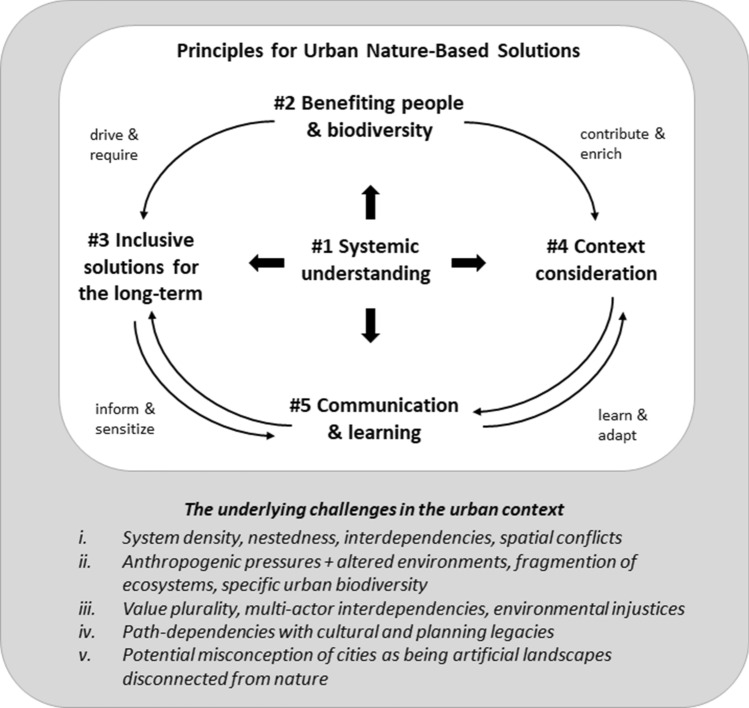
Nature-based solutions (NBS) were introduced as integrated, multifunctional and multi-beneficial solutions to a wide array of socio-ecological challenges. Although principles for a common understanding and implementation of NBS were already developed on a landscape scale, specific principles are needed with regard to an application in urban areas. Urban areas come with particular challenges including (i) spatial conflicts with urban system nestedness, (ii) specific urban biodiversity, fragmentation and altered environments, (iii) value plurality, multi-actor interdependencies and environmental injustices, (iv) path-dependencies with cultural and planning legacies and (v) a potential misconception of cities as being artificial landscapes disconnected from nature. Given these challenges, in this perspective paper, we build upon and integrate knowledge from the most recent academic work on NBS in urban areas and introduce five distinct, integrated principles for urban NBS design, planning and implementation. Our five principles should help to transcend governance gaps and advance the scientific discourse of urban NBS towards a more effective and sustainable urban development. To contribute to resilient urban futures, the design, planning, policy and governance of NBS should (1) consider the need for a systemic understanding, (2) contribute to benefiting people and biodiversity, (3) contribute to inclusive solutions for the long-term, (4) consider context conditions and (5) foster communication and learning.
Overview
The claims and statistics of this paper haven’t been checked yet.
Free: it reads the open-access text and checks the first 5 claims that cite a source we can check. Create a free account to check every claim.
Integrity signals
Registry
Cites
Statistics
Figures
Verification
Claims the paper makes
The claims and statistics of this paper haven’t been checked yet.
Free: it reads the open-access text and checks the first 5 claims that cite a source we can check. Create a free account to check every claim.
Self-check
Percentages, sums and reported differences re-computed from the paper’s own numbers.
The self-check needs the paper’s full text.
Citations
Cites
Promoting ecosystem and human health in urban areas using Green Infrastructure: A literature review
Tzoulas, K., Korpela, K., Venn, S., Yli-Pelkonen, V., Kaźmierczak, A., Niemela, J., & James, P. (2007) · Landscape and Urban Planning · doi:10.1016/j.landurbplan.2007.02.001 · Cited by 2,810 · cited 1×
“Urban areas come with particular challenges for the application of the NBS approach and as such, they also require a critical reflection of ecological concepts (Tzoulas et al. 2007; Beichler et al. 2017; Conway et al. 2019).”
BackgroundNature-based solutions to address global societal challenges
(2016) · doi:10.2305/iucn.ch.2016.13.en · Cited by 2,064 · cited 1×
“…the importance and opportunities of ‘‘actions to protect, sustainably manage and restore natural or modified ecosystems, that address societal challenges [...] effectively and adaptively, simultaneously providing human well-being and biodiversity benefits’’ (Cohen-Shacham et al. 2016, p.xii).”
BackgroundSeddon, N., Chausson, A., Berry, P., Girardin, C. A. J., Smith, A., & Turner, B. (2020) · Philosophical Transactions of the Royal Society B: Biological Sciences · doi:10.1098/rstb.2019.0120 · Cited by 2,024 · cited 1×
“…an inclusive NBS governance in which a diverse set of development options are discussed openly and transparently with a range of stakeholders (see Seddon et al. 2020 for inflexible forms of governance acting as barriers to uptake NBS and Fors et al. 2021 on participation during management of…”
BackgroundScaling up from gardens: biodiversity conservation in urban environments.
Goddard, M. A., Dougill, A. J., & Benton, T. G. (2010) · Trends in Ecology & Evolution · doi:10.1016/j.tree.2009.07.016 · Cited by 1,595 · cited 1×
“…other small private green patches might represent crucial NBS. Planning for NBS need to consider different spatial scales and deal with both publicly owned land and private land in order to steer collective as well as individual decisions for or against NBS (Goddard et al. 2010; Hsu et al. 2020).”
BackgroundHaaland, C., & van den Bosch, C. K. (2015) · Urban Forestry & Urban Greening · doi:10.1016/j.ufug.2015.07.009 · Cited by 1,585 · cited 1×
“…development (with potential negative impacts on environmental quality) and safeguarding and/or developing new urban green and blue spaces for mitigating and adapting to climate change impacts ensuring a high quality of life in cities (Haaland and van den Bosch 2015; Artmann et al. 2019).”
BackgroundKabisch, N., Frantzeskaki, N., Pauleit, S., Naumann, S., Davis, M., Artmann, M., Haase, D., Knapp, S., Korn, H., Stadler, J., et al. (2016) · Ecology and Society · doi:10.5751/es-08373-210239 · Cited by 1,490 · cited 3×
“…social policy, water infrastructure, green space planning and health with their particular expertise together to plan for integrating NBS to urban fabrics in an inclusive and multifunctional way (Kabisch et al. 2016; Bush 2020; Frantzeskaki et al. 2020; Moosavi et al. 2021).”
BackgroundSelf-citationA framework for assessing and implementing the co-benefits of nature-based solutions in urban areas
Raymond, C. M., Frantzeskaki, N., Kabisch, N., Berry, P., Breil, M., Nita, M. R., Geneletti, D., & Calfapietra, C. (2017) · Environmental Science & Policy · doi:10.1016/j.envsci.2017.07.008 · Cited by 1,362 · cited 1×
“…urban areas with a particular aim to mitigate and adapt to climate change (Kabisch et al. 2016; Hobbie and Grimm 2020) and The Author(s) 2022 www.kva.se/en 123 other societal challenges rather than using technical solutions only (Pauleit et al. 2017; Raymond et al. 2017; Babı́ Almenar et al. 2021).”
BackgroundSelf-citationNovel urban ecosystems, biodiversity, and conservation
Kowarik, I. (2011) · Environmental Pollution · doi:10.1016/j.envpol.2011.02.022 · Cited by 1,175 · cited 2×
“Ecosystems in cities are deeply changed through anthropogenic impact resulting in altered water and soil regimes as well as novel urban ecosystems and species behaviour adapted to urban conditions (Kowarik 2011a; Alberti 2015).”
BackgroundCore principles for successfully implementing and upscaling Nature-based Solutions
Cohen-Shacham, E., Andrade, A., Dalton, J., Dudley, N., Jones, M., Kumar, C., Maginnis, S., Maynard, S., Nelson, C. R., Renaud, F. G., et al. (2019) · Environmental Science & Policy · doi:10.1016/j.envsci.2019.04.014 · Cited by 943 · cited 12×
“Following a two-year consultation process with about 770 contributions from various stakeholders (IUCN 2021), the standard more strongly balances ecological, social and economic aspects of NBS.”
BackgroundInfluentialGreen justice or just green? Provision of urban green spaces in Berlin, Germany
Kabisch, N., & Haase, D. (2014) · Landscape and Urban Planning · doi:10.1016/j.landurbplan.2013.11.016 · Cited by 860 · cited 1×
“…and integration of cultural context in terms of inclusive design considering all dimensions of socio-environmental justice (distributive, procedural, interactional or recognition; see Kabisch and Haase 2014; Baró et al. 2021; 123 The Author(s) 2022 www.kva.se/en Pineda-Pinto et al. 2021).”
BackgroundSelf-citation
Research works printed but not linked: 3
- 31. European Commission. 2021. Evaluating the impact of nature-based solutions. A handbook for practitioners10.2777/2498 · doi:10.2777/2498
- 66. Kowarik I Novel urban ecosystems, biodiversity, and conservation Environmental Pollution 2011 159 1974 1983 10.1016/j.envpol.2011.02.022 21435761 · DOI · Paper page
- 78. Nagendra H Mundoli S Cities and canopies 2019 Penguin Random House, New Delhi Trees in Indian cities
Cited by
Items 201–300 of 314
Granai, G., Borrelli, C., Mariti, C., & Iacovo, F. D. (2025) · Cuadernos de Vivienda y Urbanismo · doi:10.11144/javeriana.cvu18.sihw · Cited by 1
“As reported by different authors (Albert et al., 2021; Frantzeskaki et al., 2019; Kabisch et al., 2022; Lafortezza et al., 2018), indeed, the NBS concept includes various types of approaches aimed at the implementation of natural elements in urban areas with the goal of adapting to both climate…”
Lugo, S. G., Gomez, B. M., & Graziano, M. (2025) · Restoration Ecology · doi:10.1111/rec.70269 · Cited by 1
“In perspective, linking incentive-based community engagement in restoration with broader policy frameworks, including nature-based solutions (Kabisch et al. 2022) and participatory governance (Turnhout et al. 2010), offers a pathway for sustainable upscaling and institutional embedding.”
Enu, K. B., Zingraff‐Hamed, A., Rahman, M. A., et al. (2022) · doi:10.5194/egusphere-2022-604-rc1
Enu, K. B., Zingraff-Hamed, A., Rahman, M. A., et al. (2022) · doi:10.5194/egusphere-2022-604-rc2
Enu, K. B. (2022) · doi:10.5194/egusphere-2022-604-ac1
Enu, K. B. (2022) · doi:10.5194/egusphere-2022-604-ac2
Gestão de transição: estratégia de governança para impulsionar soluções baseadas na natureza
Azevedo, F. S., da Silva, R. M., & da Silveira, J. A. R. (2022) · Encontro Nacional de Tecnologia do Ambiente Construído · doi:10.46421/entac.v19i1.2077
Nocturnal futures : a necessary reflection in times of uncertainty
Nofre, J., García-Ruiz, M., & Mercado, A. (2023) · Forum Sociológico · doi:10.4000/sociologico.11953
Nocturnal cities: past, present, and future
(2023) · Forum Sociológico · doi:10.4000/sociologico.11343
Kobojek, E. (2023) · Acta Universitatis Lodziensis Folia Geographica Physica · doi:10.18778/1427-9711.22.03
Zhang, Z. (2024) · Frontiers in Humanities and Social Sciences · doi:10.54691/m02zvm24
“The cultural ecology of a city stands at the nucleus of its cultural identity and vibrancy[18].”
BackgroundMcCormick, K., Kiss, B., Palgan, Y. V., Bulkeley, H., Davis, M., Raven, R. P. J. M., Luque-Ayala, A., & Hörschelmann, K. (2024) · Cambridge University Press eBooks · doi:10.1017/9781108924122.006
The integration and adoption of the concept of urban resilience into policy in the Netherlands
Fernandez, N. E., & Pan, H. (2024) · Elsevier eBooks · doi:10.1016/b978-0-443-21782-1.00009-9 · Cited by 1
Influence and Countermeasures of Geological Factors in Urban Environmental Design
Wang, X., & Lu, W. (2024) · Polish Journal of Environmental Studies · doi:10.15244/pjoes/192376
“City environment design ought to be taken into account with local economic, cultural, social, and ecological factors, scientific planning, and designing of the city environment [4, 5].”
Scaling Nature-Based Solutions in Urban Landscapes: A Case Study of Naturescapes in Bogotá, ColombiaPreprint
Ek, H. T., & Pintér, L. (2024) · SSRN Electronic Journal · doi:10.2139/ssrn.5054024
EKOLOJİK BAKIŞ AÇISIYLA KENTSEL DİRENÇLİLİK KAVRAMININ İRDELENMESİ
Erdoğan, F. S. (2024) · PEYZAJ · doi:10.53784/peyzaj.1506572
Herodowicz, T. (2025) · Przegląd Geograficzny · doi:10.7163/przg.2024.4.5
Padvaiskas, E., Richmond, I. C., & Ziter, C. D. (2025) · Ecoscience · doi:10.1080/11956860.2025.2495427
“Institutions and communities alike have recognized the need for nature-based solutions to build more sustainable cities, for the long-term benefit of both people and biodiversity (United Nations Sustainable Development 2015; Kabisch et al. 2022).”
Application of Nature-Based Solutions for the Regeneration of Urban Waterfronts: A ReviewPreprint
Marzio, S., Poggi, F., & Amado, M. (2025) · SSRN Electronic Journal · doi:10.2139/ssrn.5258372
Combary, Y. E. F., Atchrimi, B. T., & Zemo, M. A. T. (2025) · International Journal of Sustainable Development and Planning · doi:10.18280/ijsdp.200515
Damme, S. V., de Beeck, T. O., Vandendriessche, J., Esbroeck, C. V., Limpt, L. V., Crabé, A., & Coppens, T. (2023) · ISOCARP World Planning Congress · doi:10.47472/tzmny99z
Wu, Z., Keremane, G. B., Guo, S., & Fu, H. (2025) · Disaster risk reduction · doi:10.1007/978-981-96-5933-3_13
Akram, M. W., Madhusudhanan, S., Żurek-Mortka, M., Chandramathy, I., & Szymanski, J. R. (2025) · Recent Advances in Computer Science and Communications · doi:10.2174/0126662558387129250723142751
Doğu, T., & Çetin, H. A. (2025) · Journal of Design for Resilience in Architecture and Planning · doi:10.47818/drarch.2025.v6i2170
“…Doyon, 2019); (2) be cost-effective and applicable at multiple scales by replacing hard and grey with soft and green urban infrastructure (Vojinovic et al., 2021); (3) and respond to societal challenges rather than aiming only at technological solutions (Almenar et al., 2021; Kabisch et al., 2022).”
Dambry, A. (2025) · theses.fr (ABES)
Green planning of public spaces as a way to create a new image of medium-sized cities
Twardzik, M., Rynio, D., & Majorek, A. (2025) · Acta Scientiarum Polonorum Administratio Locorum · doi:10.31648/aspal.11077
Саянов, А. А., Makhambetov, M., Khamit, A. B., & SERGEYEVA, A. M. (2025) · Journal of Geography and Environmental Management · doi:10.26577/jgem20257838
The Caatinga as a Living Lab: Climate, Resilience and Smart Cities
de Araújo, J. S. F., Cavalcanti, M. T., & Agra, A. (2025) · Street Art & Urban Creativity · doi:10.62161/sauc.v11.6030
“In this sense, protecting urban and rural ecosystems and conserving biodiversity are indispensable, since green infrastructure and nature-based solutions provide multifunctional benefits for resilience, well-being, and ecological integrity (Kabisch et al., 2022; Paudel & States, 2023).”
Mayordomo-Herranz, L., Forgione-Ciarrocchi, E., Santos, A. M. C., López‐Baucells, A., Tena, E., & de Carvalho, W. D. (2025) · Urban Ecosystems · doi:10.1007/s11252-025-01861-w
“Therefore, urban planning that prioritises green spaces would increase the availability of areas for biodiversity and create cleaner, healthier spaces, ultimately providing greater well-being to all citizens (Kabisch et al. 2022).”
Başnou, C., Mercado, G., Sang, Å. O., Randrup, T. B., Fabio, V., Cabezas, A. H., Lluch, A., Montlleó, M., Kanai, J. M., Saraco, R., et al. (2025) · Nature-Based Solutions · doi:10.1016/j.nbsj.2025.100296
Feldmann, F., Quambusch, M., & Vogler, U. (2024) · Journal für Kulturpflanzen · doi:10.5073/jfk.2024.01.05
Horbachevska, A. (2024) · Lund University Publications Student Papers (Lund University)
Jakobsson, R. (2024) · Epsilon Archive for Student Projects (Swedish University of Agricultural Sciences)
Muishout, C. E. (2023) · Research Repository (Delft University of Technology)
A Political Ecology of Nature-based Solutions : empirical cases in Spain and Germany
Nóblega-Carriquiry, A. (2024) · Tesis Doctorals en Xarxa (Consorci de Serveis Universitaris de Catalunya)
Toward citizen-centered urban green
Phillips, A. (2023) · VUBIR (Vrije Universiteit Brussel)
Baptista, D., Madureira, H., & Monteiro, L. C. A. (2025) · doi:10.55333/rima-978-65-83933-22-5_008
Gestão de Desastres & Sistemas Complexos no Contexto de Mudanças Climáticas
Vasconcelos, A. F., Valencio, N., Peres, R. B., Baptista, D., Queiroz, I. H. B., & da Silva, A. E. T. (2025) · doi:10.55333/rima-978-65-83933-22-5
Balocco, C., Pierucci, G., Lanini, M. C., Baia, M., Piselli, C., Carletti, C., & Sciurpi, F. (2025) · Journal of Physics Conference Series · doi:10.1088/1742-6596/3143/1/012022
Streetscape Ecologies in Southern Europe: Design for Culturally Rooted Nature-Based Regeneration
Raffa, A., & Baggio, M. (2025) · The Plan Journal · doi:10.15274/tpj.2025.10.02.2 · Cited by 2
Design Sustentável como estratégia para soluções baseadas na natureza
de Sena, P. S. (2025) · Pensamentos em Design · doi:10.36704/pendes.v5i1.9837
Tools for Introducing Nature-Based Solutions Into Urban Spaces: A Preliminary Set
Kurianowicz, A., Janikowska, W., PIETER, K., & SZATON-ORLIŃSKA, K. (2025) · Architecture Civil Engineering Environment · doi:10.2478/acee-2025-0043
Vásquez, A. E., Dobbs, C., Giusti, M., Ruiz, D., Fabio, V., Galdámez, E., Kanai, M., Velásquez, P., & Labra, F. (2025) · Urban forestry & urban greening · doi:10.1016/j.ufug.2025.129251
Singh, P. K., Smith, P., Cherubini, F., Díaz‐José, J., Duchková, H., Gupta, H., Hori, M., Ito, A., Khan, S., Llope, M., et al. (2026) · DIGITAL.CSIC (Spanish National Research Council (CSIC)) · doi:10.5281/zenodo.13850339
The Future of Urban Greening Strategies Between Planning, Shared Governance Models and Technologies
Morello, E. (2026) · Research for development · doi:10.1007/978-3-031-95292-0_7
Urban green infrastructure planning for enhancing urban resilience in metropolitan Lagos, Nigeria
Akinde, J. O., Abiola, O., Ogundele, F. O., & Ibrahim, R. A. (2026) · Journal of Geography and Regional Planning · doi:10.5897/jgrp2025.0879
Feng, Z., Liu, X., Jian, I. Y., Bao, H. X. H., Tsou, J. Y., & Wang, Q.-C. (2026) · SSRN Electronic Journal · doi:10.2139/ssrn.6177981
Villanova, L. B., Puga, B. P., & Collier, M. J. (2026) · SSRN Electronic Journal · doi:10.2139/ssrn.6182518
Nexus Thinking and Its Principles for Sustainable Cities
Yan, W. (2026) · Springer eBooks · doi:10.1007/978-981-95-6156-8_1
Khromova, S., Busse, S., Benati, G., Cantis, P. H., Mioulet, C., Eckelman, M. J., Villalba, G., & Langemeyer, J. (2026) · npj Urban Sustainability · doi:10.1038/s42949-026-00461-7
Timur, P., Johnson, A., Carter, E., & Laksana, S. D. (2025) · Civil Engineering Science and Technology · doi:10.51903/ks8maj14
de França, J. U. B., Ferreira, A. T. D. S., dos Reis, A. R. N., de Oliveira, N. C., Catharino, E. L. M., Rosario, R. P. G., Ribeiro, M. C. H., Alvim, D. S., Simões, A. F., & Ferreira, M. L. (2026) · Ecological Indicators · doi:10.1016/j.ecolind.2026.114964 · Cited by 1
Mejia, D. M. B., & Ospina, T. G. (2026) · Urban sustainability · doi:10.1007/978-981-95-6864-2_8
Integrating Wetlands into Urban Planning for Resilient Cities—Towards an Urban Autopoiesis
Usto, K., & Coelho, L. M. G. (2026) · Sustainable development goals series · doi:10.1007/978-3-032-20649-7_5
Hazmi, A. F. A. (2026) · Urban sustainability · doi:10.1007/978-981-95-6864-2_11
Ferreira, I., Barbas, A., & Santos, J. (2026) · Social Sciences · doi:10.3390/socsci15060354
Garau, C., Annunziata, A., & Scorza, F. (2026) · International Journal of E-Planning Research · doi:10.4018/ijepr.411215
Galvis, L. K. S., Popartan, L. A., Gaspar, À. B., Comas, J., Camps, E. C., & Monclús, H. (2026) · Landscape and Urban Planning · doi:10.1016/j.landurbplan.2026.105692
Green, Indoor, or No Exercise? Health Outcomes of Physical Activity Settings Among Turkish Adults
Akpınar, A. (2026) · Journal of Physical Activity and Health · doi:10.1123/jpah.2025-0322
Boddupalli, P., Nijhuis, S., & Tillie, N. (2026) · Sustainability · doi:10.3390/su18115726
Prasetyo, A., Prabowo, H., Prakosa, W., & Rani, D. M. (2026) · International Journal of Engineering Science and Information Technology · doi:10.52088/ijesty.v6i2.1790
“The benefits of this approach have been empirically proven, where exposure to biophilic environments can improve physical and mental health, reduce stress, increase productivity, and strengthen community social cohesion [4][9][20].”
Connected but Misaligned: Rethinking Urban Nature for Biodiversity, Equity, and ResiliencePreprint
Gil, A. G. (2026) · EcoEvoRxiv · doi:10.32942/x26676
High spatial resolution evidence of multifunctionality across urban nature-based solutions typesPreprint
Li, M., van Oudenhoven, A. P. E., Morpurgo, J., Hu, J., van Bodegom, P. M., & Remme, R. P. (2026) · SSRN Electronic Journal · doi:10.2139/ssrn.6989228
Donati, G., Archbold, J., van den Brandeler, F., Fischer, M., Casanova, J., & Bolliger, J. (2026) · npj Urban Sustainability · doi:10.1038/s42949-026-00426-w
Polgár, A. (2026) · Advances in Science, Technology & Innovation/Advances in science, technology & innovation · doi:10.1007/978-3-032-23463-6_1
Strategies for green roofs implementation in Mexico City from a social perspectivePreprint
Rodríguez, M., Cervantes-Nájera, A. L., Ochman, M., & Moreno, C. N. (2026) · SSRN Electronic Journal · doi:10.2139/ssrn.7049066
Developing business ecosystems around urban nature-based solutions: Evidence from Finland
Harmanen, J., Viljanen, A., Harju, C., Lähtinen, K., & Toppinen, A. (2026) · Urban forestry & urban greening · doi:10.1016/j.ufug.2026.129598 · Cited by 1
Hamid, A. A., Asiama, K. O., Gyamfi-Yeboah, F., Yakubu, I., & Dinye, R. D. (2026) · Land Use Policy · doi:10.1016/j.landusepol.2026.108216
Ayantaş, T., & Karabaş, A. (2026) · Cumhuriyet International Journal of Education · doi:10.30703/cije.1751867
Mousavi, F., Hilger, C., Swiontek, K., Bergmann, K., & Werchan, M. (2026) · Aerobiologia · doi:10.1007/s10453-026-09938-5
“Cities are characterized by sharp spatial gradients in air pollution, temperature, humidity, soil properties, and vegetation cover, resulting in highly variable microenvironments within relatively small spatial scales (Jabareen, 2013; Kabisch et al., 2022; Llausàs & Roe, 2012).”
Regenerative Built Environments Are Grounded in Living Systems Thinking
Craft, W., Prasad, D. K., & Ding, L. (2026) · Springer eBooks · doi:10.1007/978-981-95-7976-1_5
Designing micro-scale Nature-Based Solutions using AI-based predictive models
Tache, A., & Petrişor, A.-I. (2026) · International Conference on Future Challenges in Sustainable Urban Planning & Territorial Management (SUPTM) · doi:10.31428/10317/24066
Mendonça, R., Roebeling, P. C., Fidélis, T., & Saraiva, M. (2026) · Urban forestry & urban greening · doi:10.1016/j.ufug.2026.129602
Public engagement for nature-based regeneration of the built environment
Arnetoli, M. V. (2025) · Studi e saggi · doi:10.36253/979-12-215-0966-3.16
Battisti, L., Csizmady, A., Cuomo, F., Kristóf, L., & Megyesi, B. G. (2026) · Sustainability Science Practice and Policy · doi:10.1080/15487733.2026.2685846
Annadurai, G. K., & Chitra, M. B. (2026) · Environmental and Sustainability Indicators · doi:10.1016/j.indic.2026.101459
An integrative nature-based planning model for sustainable and resilient environments
Çınar, H. S., & Yılmazsoy, B. (2026) · Discover Environment · doi:10.1007/s44274-026-00961-4 · Cited by 2
“This proposes a strong potential for ecological resilience, where restored wetlands act as buffers against both hydrological and climatic disturbances [8, 28].”
Influentialde Beeck, T. O., & Coppens, T. (2026) · European Planning Studies · doi:10.1080/09654313.2026.2714960
Navarrete‐Segueda, A., Cortés‐Flores, J., Chávez-García, E., González‐Arqueros, M. L., Cornejo‐Tenorio, G., Gaona, D. S., Soria-Nambo, A., Ek‐Rodríguez, I. L., & Ibarra‐Manríquez, G. (2026) · Urban forestry & urban greening · doi:10.1016/j.ufug.2026.129639
Tišma, S., Škrtić, M. M., & Funduk, M. (2026) · Land · doi:10.3390/land15081507
“…policy mixes, institutional learning, and coordination across planning domains rather than as the diffusion of a single environmental instrument [21,25–27, 30, The European Green Deal and the EU Biodiversity Strategy for 2030 and the EU Strategy on Adaptation to Climate Change have strengthened…”
Küçükali, U. F., Erkartal, P. Ö., & Yaşar, D. (2026) · Urban Science · doi:10.3390/urbansci10090489
Boyall, K., Burch, S. L., & Berbés‐Blázquez, M. (2026) · Research Square · doi:10.21203/rs.3.rs-10319713/v1
From stress to strategy – Conceptualizing urban infrastructure transformation under climate pressure
Müller, L., & Scheer, D. (2026) · Cities · doi:10.1016/j.cities.2026.107518
Forest-based NBS in disaster-prone landscapes: evidence from the 2022 Swat floods, Pakistan
Imran, N., Munir, N., Räsänen, A., Heikkinen, H. I., & Sarkki, S. (2026) · Nature-Based Solutions · doi:10.1016/j.nbsj.2026.100373
Mahfudz, M., Khalwani, K. M., Sumardi, D., & Hamdani, F. A. U. (2026) · International Journal Of Humanities Education and Social Sciences (IJHESS) · doi:10.55227/ijhess.v6i1.2488
“…the proposed framework also aligns with the growing international discourse on Nature-based Solutions (NbS), which emphasizes the integration of ecological integrity, social inclusion, and economic resilience in addressing complex sustainability challenges (Cook et al., 2025; Kabisch et al., 2022).”
Wang, C., Pei, X., Mao, Y., Kang, L., Xu, B., Jin, J., Cao, J., & Liang, H. (2026) · Environmental Science & Technology · doi:10.1021/acs.est.6c08296
Carmen, D., Carmen, D., & Gilos (2026) · Environmental and Urban Planning International Journal · doi:10.63941/eupij.2026.1.2.07
A diagnostic framework blue-green infrastructure readiness in developing-country cities
Rivera, L. M., & Faggian, R. (2026) · Journal of Environmental Policy & Planning · doi:10.1080/1523908x.2026.2728167
Mackenzie, A., & Brown, M. (2026) · Management & Sustainability An Arab Review · doi:10.1108/msar-08-2025-0312
Nature-Based Solutions Policy Frameworks for Building a Resilient Africa
Chirisa, I. E., Matamanda, A. R., Magande, T., Chirisa, H., & Mapfumo, E. T. (2026) · Palgrave Studies in Sustainable Futures. · doi:10.1007/978-3-031-72931-7_6-1
Mammone, V., & Massarelli, C. (2026) · Urban Science · doi:10.3390/urbansci10090533
TOURE, N. J., Zaouri, B. G. J.-M., Béligné, V., Kouassi, J.-L., & Zo‐Bi, I. C. (2026) · Trees Forests and People · doi:10.1016/j.tfp.2026.101502
Jaime-Segura, C., & Rosa‐Jiménez, C. (2026) · VITRUVIO - International Journal of Architectural Technology and Sustainability · doi:10.4995/vitruvio-ijats.2026.25218
“European precedents, such as the renaturalisation of the Besòs River (Barcelona, Spain), demonstrate that restoring urban waterways yields positive effects on biodiversity, public health, climate resilience, and social cohesion (Kabisch et al., 2022).”
ERDEM, G. (2026) · Discover Cities · doi:10.1007/s44327-026-00372-3
“…with the ecological design theories of Yeang [6], who argues that architecture must integrate with natural systems rather than oppose them, and with more recent scholarship on urban nature-based solutions that emphasizes the multifunctional role of green infrastructure in climate adaptation [7, 8].”
Urban Greening Under Rapid Expansion: Benchmarking Riyadh Against Four Decades of Arid-City Evidence
Waheeb, S. A., & Binabid, J. (2026) · Land · doi:10.3390/land15101875
Gestão de transição: : estratégia de governança para impulsionar soluções baseadas na natureza
Azevedo, F. S., da Silva, R. M., & da Silveira, J. A. R. (2022) · Encontro Nacional de Tecnologia do Ambiente Construído
Metadata
- Authors
- Kabisch, N., Frantzeskaki, N., & Hansen, R.
- Affiliations
- Helmholtz Centre for Environmental Research (DE)
- Swinburne University of Technology (AU)
- Hochschule Geisenheim University (DE)
- Corresponding author
- Kabisch, Nadja
- Venue
- Ambio
- Published
- 2022-01-17
- Volume
- 51
- Issue
- 6
- Pages
- 1388-1401
- ISSN
- 0044-7447 (ISSN-L)
- 1654-7209
- PMC
- PMC9005592
- OpenAlex
- W4205298739
- Cited by
- 272
- References
- 96
- Citations by year
- 2026: 72 · 2025: 78 · 2024: 57 · 2023: 44 · 2022: 20
- FWCI
- 19.83
- Type
- journal article
- Language
- en
- Open access
- hybrid
- doi.org
- Licence
- cc-by
- creativecommons.org/licenses/by/4.0 (tdm)
- creativecommons.org/licenses/by/4.0 (vor)
- Locations
- AMBIO (publishedVersion, cc-by)
- PubMed Central (publishedVersion, cc-by)
- PubMed (publishedVersion)
- edoc Publication server (Humboldt University of Berlin) (submittedVersion, cc-by)
- edoc Publication server (Humboldt University of Berlin) (cc-by)
- Funders
- bundesministerium für bildung und forschung (01LN1705A)
- horizon 2020 framework programme (Connecting Nature)
- Humboldt-Universität zu Berlin
- Topics
- Physical Sciences › Environmental Science › Global and Planetary Change › Land Use and Ecosystem Services
- Physical Sciences › Environmental Science › Management, Monitoring, Policy and Law › Urban Planning and Landscape Design
- Physical Sciences › Environmental Science › Environmental Engineering › Urban Stormwater Management Solutions
- Keywords
- nature-based solutions, urban nature-based solutions, design principles, urban biodiversity, urban fragmentation, environmental justice, path dependence, urban resilience, sustainable urban development, socio-environmental problems, systemic understanding
- MeSH terms
- Cities, Humans, Knowledge, Biodiversity
About these checks
Registry, retraction, Cites and statistics results are computed, not judged, with one exception: a printed reference that no index lists is read once by a model before it counts as a citation error. Claims are extracted by a model and kept only when their quote appears verbatim in the text; each cited source is then checked, with a model’s help, for whether it says what the claim relies on. Those verdicts can be wrong — read the claim’s quote and the cited source before relying on one.
Statistics and arithmetic are recomputed, not judged.
Confidence bands are shown only for fields calibrated on our annotated test set. None is calibrated yet, so no band is shown.
What counts as a claim ›How we measure confidence ›How we check this ›
Are you an author, or do you see a problem with this page? Request a review
Data sources
Bibliographic data: Semantic Scholar, OpenAlex, Crossref.
Contains information from the Semantic Scholar Academic Graph Datasets, made available under the ODC Attribution License (ODC-BY 1.0).
Semantic Scholar’s data is described in: Kinney, R., et al. (2023). The Semantic Scholar Open Data Platform. arXiv:2301.10140.
