

Principles for urban nature-based solutions
Open accessThe DOI matches its Crossref record; 96 of the 96 references it cites were found in a registry or an index.
Abstract
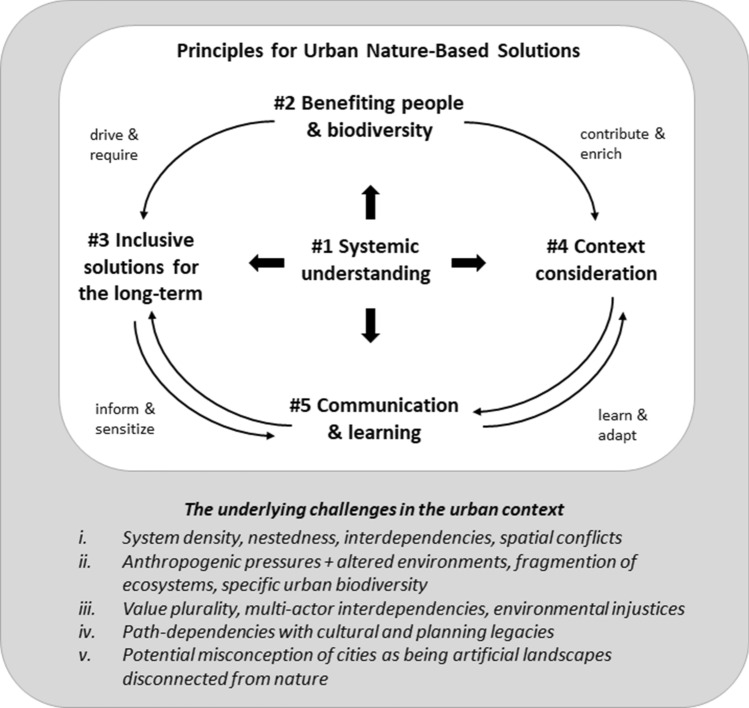
Nature-based solutions (NBS) were introduced as integrated, multifunctional and multi-beneficial solutions to a wide array of socio-ecological challenges. Although principles for a common understanding and implementation of NBS were already developed on a landscape scale, specific principles are needed with regard to an application in urban areas. Urban areas come with particular challenges including (i) spatial conflicts with urban system nestedness, (ii) specific urban biodiversity, fragmentation and altered environments, (iii) value plurality, multi-actor interdependencies and environmental injustices, (iv) path-dependencies with cultural and planning legacies and (v) a potential misconception of cities as being artificial landscapes disconnected from nature. Given these challenges, in this perspective paper, we build upon and integrate knowledge from the most recent academic work on NBS in urban areas and introduce five distinct, integrated principles for urban NBS design, planning and implementation. Our five principles should help to transcend governance gaps and advance the scientific discourse of urban NBS towards a more effective and sustainable urban development. To contribute to resilient urban futures, the design, planning, policy and governance of NBS should (1) consider the need for a systemic understanding, (2) contribute to benefiting people and biodiversity, (3) contribute to inclusive solutions for the long-term, (4) consider context conditions and (5) foster communication and learning.
Overview
The claims and statistics of this paper haven’t been checked yet.
Free: it reads the open-access text and checks the first 5 claims that cite a source we can check. Create a free account to check every claim.
Integrity signals
Registry
Cites
Statistics
Figures
Verification
Claims the paper makes
The claims and statistics of this paper haven’t been checked yet.
Free: it reads the open-access text and checks the first 5 claims that cite a source we can check. Create a free account to check every claim.
Self-check
Percentages, sums and reported differences re-computed from the paper’s own numbers.
The self-check needs the paper’s full text.
Citations
Cites
Promoting ecosystem and human health in urban areas using Green Infrastructure: A literature review
Tzoulas, K., Korpela, K., Venn, S., Yli-Pelkonen, V., Kaźmierczak, A., Niemela, J., & James, P. (2007) · Landscape and Urban Planning · doi:10.1016/j.landurbplan.2007.02.001 · Cited by 2,810 · cited 1×
“Urban areas come with particular challenges for the application of the NBS approach and as such, they also require a critical reflection of ecological concepts (Tzoulas et al. 2007; Beichler et al. 2017; Conway et al. 2019).”
BackgroundNature-based solutions to address global societal challenges
(2016) · doi:10.2305/iucn.ch.2016.13.en · Cited by 2,064 · cited 1×
“…the importance and opportunities of ‘‘actions to protect, sustainably manage and restore natural or modified ecosystems, that address societal challenges [...] effectively and adaptively, simultaneously providing human well-being and biodiversity benefits’’ (Cohen-Shacham et al. 2016, p.xii).”
BackgroundSeddon, N., Chausson, A., Berry, P., Girardin, C. A. J., Smith, A., & Turner, B. (2020) · Philosophical Transactions of the Royal Society B: Biological Sciences · doi:10.1098/rstb.2019.0120 · Cited by 2,024 · cited 1×
“…an inclusive NBS governance in which a diverse set of development options are discussed openly and transparently with a range of stakeholders (see Seddon et al. 2020 for inflexible forms of governance acting as barriers to uptake NBS and Fors et al. 2021 on participation during management of…”
BackgroundScaling up from gardens: biodiversity conservation in urban environments.
Goddard, M. A., Dougill, A. J., & Benton, T. G. (2010) · Trends in Ecology & Evolution · doi:10.1016/j.tree.2009.07.016 · Cited by 1,595 · cited 1×
“…other small private green patches might represent crucial NBS. Planning for NBS need to consider different spatial scales and deal with both publicly owned land and private land in order to steer collective as well as individual decisions for or against NBS (Goddard et al. 2010; Hsu et al. 2020).”
BackgroundHaaland, C., & van den Bosch, C. K. (2015) · Urban Forestry & Urban Greening · doi:10.1016/j.ufug.2015.07.009 · Cited by 1,585 · cited 1×
“…development (with potential negative impacts on environmental quality) and safeguarding and/or developing new urban green and blue spaces for mitigating and adapting to climate change impacts ensuring a high quality of life in cities (Haaland and van den Bosch 2015; Artmann et al. 2019).”
BackgroundKabisch, N., Frantzeskaki, N., Pauleit, S., Naumann, S., Davis, M., Artmann, M., Haase, D., Knapp, S., Korn, H., Stadler, J., et al. (2016) · Ecology and Society · doi:10.5751/es-08373-210239 · Cited by 1,490 · cited 3×
“…social policy, water infrastructure, green space planning and health with their particular expertise together to plan for integrating NBS to urban fabrics in an inclusive and multifunctional way (Kabisch et al. 2016; Bush 2020; Frantzeskaki et al. 2020; Moosavi et al. 2021).”
BackgroundSelf-citationA framework for assessing and implementing the co-benefits of nature-based solutions in urban areas
Raymond, C. M., Frantzeskaki, N., Kabisch, N., Berry, P., Breil, M., Nita, M. R., Geneletti, D., & Calfapietra, C. (2017) · Environmental Science & Policy · doi:10.1016/j.envsci.2017.07.008 · Cited by 1,362 · cited 1×
“…urban areas with a particular aim to mitigate and adapt to climate change (Kabisch et al. 2016; Hobbie and Grimm 2020) and The Author(s) 2022 www.kva.se/en 123 other societal challenges rather than using technical solutions only (Pauleit et al. 2017; Raymond et al. 2017; Babı́ Almenar et al. 2021).”
BackgroundSelf-citationNovel urban ecosystems, biodiversity, and conservation
Kowarik, I. (2011) · Environmental Pollution · doi:10.1016/j.envpol.2011.02.022 · Cited by 1,175 · cited 2×
“Ecosystems in cities are deeply changed through anthropogenic impact resulting in altered water and soil regimes as well as novel urban ecosystems and species behaviour adapted to urban conditions (Kowarik 2011a; Alberti 2015).”
BackgroundCore principles for successfully implementing and upscaling Nature-based Solutions
Cohen-Shacham, E., Andrade, A., Dalton, J., Dudley, N., Jones, M., Kumar, C., Maginnis, S., Maynard, S., Nelson, C. R., Renaud, F. G., et al. (2019) · Environmental Science & Policy · doi:10.1016/j.envsci.2019.04.014 · Cited by 943 · cited 12×
“Following a two-year consultation process with about 770 contributions from various stakeholders (IUCN 2021), the standard more strongly balances ecological, social and economic aspects of NBS.”
BackgroundInfluentialGreen justice or just green? Provision of urban green spaces in Berlin, Germany
Kabisch, N., & Haase, D. (2014) · Landscape and Urban Planning · doi:10.1016/j.landurbplan.2013.11.016 · Cited by 860 · cited 1×
“…and integration of cultural context in terms of inclusive design considering all dimensions of socio-environmental justice (distributive, procedural, interactional or recognition; see Kabisch and Haase 2014; Baró et al. 2021; 123 The Author(s) 2022 www.kva.se/en Pineda-Pinto et al. 2021).”
BackgroundSelf-citation
Research works printed but not linked: 3
- 31. European Commission. 2021. Evaluating the impact of nature-based solutions. A handbook for practitioners10.2777/2498 · doi:10.2777/2498
- 66. Kowarik I Novel urban ecosystems, biodiversity, and conservation Environmental Pollution 2011 159 1974 1983 10.1016/j.envpol.2011.02.022 21435761 · DOI · Paper page
- 78. Nagendra H Mundoli S Cities and canopies 2019 Penguin Random House, New Delhi Trees in Indian cities
Cited by
Items 301–314 of 314
Hoegh-Guldberg, F., Visintin, C., Kirk, H. L., Chee, Y. E., & Bekessy, S. A. (2026) · Ecological Solutions and Evidence · doi:10.1002/2688-8319.70319
Dapsopoulou, M., Lazaridou, D. C., Georgiou, D., Zianis, D., & Papadopoulos, A. (2026) · Forestry An International Journal of Forest Research · doi:10.1093/forestry/cpag084
SALSABILA, B., Sujaya, F. A., & Rahayu, S. (2026) · Economics and Digital Business Review · doi:10.37531/ecotal.v7i2.4154
Lussana, G., Senes, G., & Fumagalli, N. (2026) · Water · doi:10.3390/w18202502
Grendelman, R., Werners, S. E., & Ludwig, F. (2026) · SSRN Electronic Journal · doi:10.2139/ssrn.7611653
Niinemägi, M., Sarv, L., & Ausin, G. (2026) · Land · doi:10.3390/land15101991
WANG, T., XIE, Z. X., XU, L., & LIANG, X. D. (2026) · Applied Ecology and Environmental Research · doi:10.15666/aeer/2404_71337159
Taiwo, Q. O., Nnadi, K. I., Tonade, E. A., Oluyege, D. E., Oyeniyi, W. A., & Baruwa, N. (2026) · Discover Cities · doi:10.1007/s44327-026-00390-1
“Urban NbS principles emphasise systemic thinking, inclusive benefit sharing, context sensitivity, communication and long-term learning [22].”
Analyzing the implementation of nature-based solutions in Mongolia
Banzragch, B., & Gasparatos, A. (2026) · Environmental Development · doi:10.1016/j.envdev.2026.101581
Soares, J. P. A. (2026) · Portuguese National Funding Agency for Science, Research and Technology (RCAAP Project by FCT)
Panousi, M. M., Stijnen, C., & Frantzeskaki, N. (2026) · Nature-Based Solutions · doi:10.1016/j.nbsj.2026.100389
Self-citationCorozo, J. P. M., Meléndez, H. V., Mackenzie-Rivero, A. J., Cantos, J. G. M., Zambrano, M. L. V., Carballo, N., & Tufiño, K. A. H. (2026) · doi:10.66927/x8g8s206
Raparthi, K. (2026) · Revista iberoamericana de estudios de desarrollo = Iberoamerican journal of development studies · doi:10.26754/ojs_ried/ijds.12667
Combary, Y. E. F., & Atchrimi, B. T. (2024) · doi:10.3389/frsc.2024.1487272.s003
Metadata
- Authors
- Kabisch, N., Frantzeskaki, N., & Hansen, R.
- Affiliations
- Helmholtz Centre for Environmental Research (DE)
- Swinburne University of Technology (AU)
- Hochschule Geisenheim University (DE)
- Corresponding author
- Kabisch, Nadja
- Venue
- Ambio
- Published
- 2022-01-17
- Volume
- 51
- Issue
- 6
- Pages
- 1388-1401
- ISSN
- 0044-7447 (ISSN-L)
- 1654-7209
- PMC
- PMC9005592
- OpenAlex
- W4205298739
- Cited by
- 272
- References
- 96
- Citations by year
- 2026: 72 · 2025: 78 · 2024: 57 · 2023: 44 · 2022: 20
- FWCI
- 19.83
- Type
- journal article
- Language
- en
- Open access
- hybrid
- doi.org
- Licence
- cc-by
- creativecommons.org/licenses/by/4.0 (tdm)
- creativecommons.org/licenses/by/4.0 (vor)
- Locations
- AMBIO (publishedVersion, cc-by)
- PubMed Central (publishedVersion, cc-by)
- PubMed (publishedVersion)
- edoc Publication server (Humboldt University of Berlin) (submittedVersion, cc-by)
- edoc Publication server (Humboldt University of Berlin) (cc-by)
- Funders
- bundesministerium für bildung und forschung (01LN1705A)
- horizon 2020 framework programme (Connecting Nature)
- Humboldt-Universität zu Berlin
- Topics
- Physical Sciences › Environmental Science › Global and Planetary Change › Land Use and Ecosystem Services
- Physical Sciences › Environmental Science › Management, Monitoring, Policy and Law › Urban Planning and Landscape Design
- Physical Sciences › Environmental Science › Environmental Engineering › Urban Stormwater Management Solutions
- Keywords
- nature-based solutions, urban nature-based solutions, design principles, urban biodiversity, urban fragmentation, environmental justice, path dependence, urban resilience, sustainable urban development, socio-environmental problems, systemic understanding
- MeSH terms
- Cities, Humans, Knowledge, Biodiversity
About these checks
Registry, retraction, Cites and statistics results are computed, not judged, with one exception: a printed reference that no index lists is read once by a model before it counts as a citation error. Claims are extracted by a model and kept only when their quote appears verbatim in the text; each cited source is then checked, with a model’s help, for whether it says what the claim relies on. Those verdicts can be wrong — read the claim’s quote and the cited source before relying on one.
Statistics and arithmetic are recomputed, not judged.
Confidence bands are shown only for fields calibrated on our annotated test set. None is calibrated yet, so no band is shown.
What counts as a claim ›How we measure confidence ›How we check this ›
Are you an author, or do you see a problem with this page? Request a review
Data sources
Bibliographic data: Semantic Scholar, OpenAlex, Crossref.
Contains information from the Semantic Scholar Academic Graph Datasets, made available under the ODC Attribution License (ODC-BY 1.0).
Semantic Scholar’s data is described in: Kinney, R., et al. (2023). The Semantic Scholar Open Data Platform. arXiv:2301.10140.
