

Principles for urban nature-based solutions
Open accessThe DOI matches its Crossref record; 96 of the 96 references it cites were found in a registry or an index.
Abstract
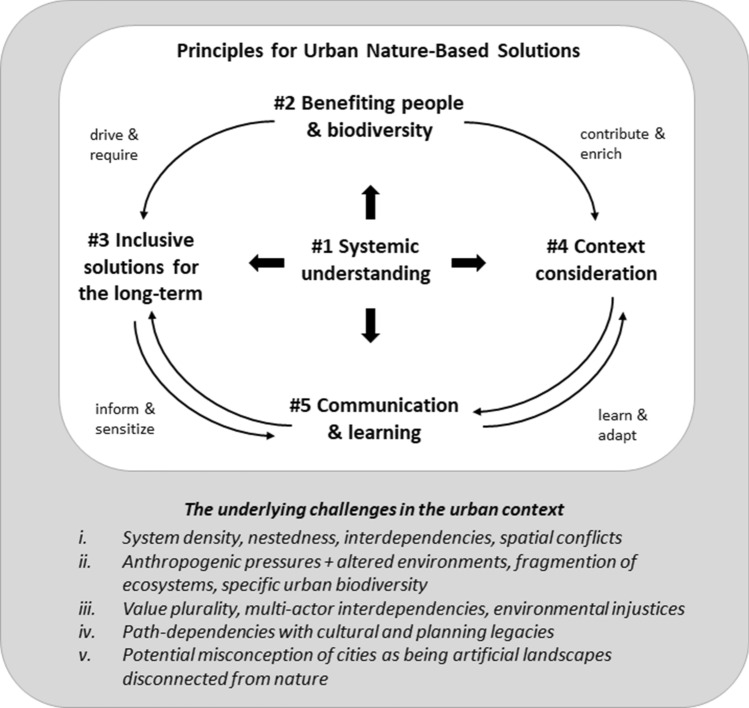
Nature-based solutions (NBS) were introduced as integrated, multifunctional and multi-beneficial solutions to a wide array of socio-ecological challenges. Although principles for a common understanding and implementation of NBS were already developed on a landscape scale, specific principles are needed with regard to an application in urban areas. Urban areas come with particular challenges including (i) spatial conflicts with urban system nestedness, (ii) specific urban biodiversity, fragmentation and altered environments, (iii) value plurality, multi-actor interdependencies and environmental injustices, (iv) path-dependencies with cultural and planning legacies and (v) a potential misconception of cities as being artificial landscapes disconnected from nature. Given these challenges, in this perspective paper, we build upon and integrate knowledge from the most recent academic work on NBS in urban areas and introduce five distinct, integrated principles for urban NBS design, planning and implementation. Our five principles should help to transcend governance gaps and advance the scientific discourse of urban NBS towards a more effective and sustainable urban development. To contribute to resilient urban futures, the design, planning, policy and governance of NBS should (1) consider the need for a systemic understanding, (2) contribute to benefiting people and biodiversity, (3) contribute to inclusive solutions for the long-term, (4) consider context conditions and (5) foster communication and learning.
Overview
The claims and statistics of this paper haven’t been checked yet.
Free: it reads the open-access text and checks the first 5 claims that cite a source we can check. Create a free account to check every claim.
Integrity signals
Registry
Cites
Statistics
Figures
Verification
Claims the paper makes
The claims and statistics of this paper haven’t been checked yet.
Free: it reads the open-access text and checks the first 5 claims that cite a source we can check. Create a free account to check every claim.
Self-check
Percentages, sums and reported differences re-computed from the paper’s own numbers.
The self-check needs the paper’s full text.
Citations
Cites
Promoting ecosystem and human health in urban areas using Green Infrastructure: A literature review
Tzoulas, K., Korpela, K., Venn, S., Yli-Pelkonen, V., Kaźmierczak, A., Niemela, J., & James, P. (2007) · Landscape and Urban Planning · doi:10.1016/j.landurbplan.2007.02.001 · Cited by 2,810 · cited 1×
“Urban areas come with particular challenges for the application of the NBS approach and as such, they also require a critical reflection of ecological concepts (Tzoulas et al. 2007; Beichler et al. 2017; Conway et al. 2019).”
BackgroundNature-based solutions to address global societal challenges
(2016) · doi:10.2305/iucn.ch.2016.13.en · Cited by 2,064 · cited 1×
“…the importance and opportunities of ‘‘actions to protect, sustainably manage and restore natural or modified ecosystems, that address societal challenges [...] effectively and adaptively, simultaneously providing human well-being and biodiversity benefits’’ (Cohen-Shacham et al. 2016, p.xii).”
BackgroundSeddon, N., Chausson, A., Berry, P., Girardin, C. A. J., Smith, A., & Turner, B. (2020) · Philosophical Transactions of the Royal Society B: Biological Sciences · doi:10.1098/rstb.2019.0120 · Cited by 2,024 · cited 1×
“…an inclusive NBS governance in which a diverse set of development options are discussed openly and transparently with a range of stakeholders (see Seddon et al. 2020 for inflexible forms of governance acting as barriers to uptake NBS and Fors et al. 2021 on participation during management of…”
BackgroundScaling up from gardens: biodiversity conservation in urban environments.
Goddard, M. A., Dougill, A. J., & Benton, T. G. (2010) · Trends in Ecology & Evolution · doi:10.1016/j.tree.2009.07.016 · Cited by 1,595 · cited 1×
“…other small private green patches might represent crucial NBS. Planning for NBS need to consider different spatial scales and deal with both publicly owned land and private land in order to steer collective as well as individual decisions for or against NBS (Goddard et al. 2010; Hsu et al. 2020).”
BackgroundHaaland, C., & van den Bosch, C. K. (2015) · Urban Forestry & Urban Greening · doi:10.1016/j.ufug.2015.07.009 · Cited by 1,585 · cited 1×
“…development (with potential negative impacts on environmental quality) and safeguarding and/or developing new urban green and blue spaces for mitigating and adapting to climate change impacts ensuring a high quality of life in cities (Haaland and van den Bosch 2015; Artmann et al. 2019).”
BackgroundKabisch, N., Frantzeskaki, N., Pauleit, S., Naumann, S., Davis, M., Artmann, M., Haase, D., Knapp, S., Korn, H., Stadler, J., et al. (2016) · Ecology and Society · doi:10.5751/es-08373-210239 · Cited by 1,490 · cited 3×
“…social policy, water infrastructure, green space planning and health with their particular expertise together to plan for integrating NBS to urban fabrics in an inclusive and multifunctional way (Kabisch et al. 2016; Bush 2020; Frantzeskaki et al. 2020; Moosavi et al. 2021).”
BackgroundSelf-citationA framework for assessing and implementing the co-benefits of nature-based solutions in urban areas
Raymond, C. M., Frantzeskaki, N., Kabisch, N., Berry, P., Breil, M., Nita, M. R., Geneletti, D., & Calfapietra, C. (2017) · Environmental Science & Policy · doi:10.1016/j.envsci.2017.07.008 · Cited by 1,362 · cited 1×
“…urban areas with a particular aim to mitigate and adapt to climate change (Kabisch et al. 2016; Hobbie and Grimm 2020) and The Author(s) 2022 www.kva.se/en 123 other societal challenges rather than using technical solutions only (Pauleit et al. 2017; Raymond et al. 2017; Babı́ Almenar et al. 2021).”
BackgroundSelf-citationNovel urban ecosystems, biodiversity, and conservation
Kowarik, I. (2011) · Environmental Pollution · doi:10.1016/j.envpol.2011.02.022 · Cited by 1,175 · cited 2×
“Ecosystems in cities are deeply changed through anthropogenic impact resulting in altered water and soil regimes as well as novel urban ecosystems and species behaviour adapted to urban conditions (Kowarik 2011a; Alberti 2015).”
BackgroundCore principles for successfully implementing and upscaling Nature-based Solutions
Cohen-Shacham, E., Andrade, A., Dalton, J., Dudley, N., Jones, M., Kumar, C., Maginnis, S., Maynard, S., Nelson, C. R., Renaud, F. G., et al. (2019) · Environmental Science & Policy · doi:10.1016/j.envsci.2019.04.014 · Cited by 943 · cited 12×
“Following a two-year consultation process with about 770 contributions from various stakeholders (IUCN 2021), the standard more strongly balances ecological, social and economic aspects of NBS.”
BackgroundInfluentialGreen justice or just green? Provision of urban green spaces in Berlin, Germany
Kabisch, N., & Haase, D. (2014) · Landscape and Urban Planning · doi:10.1016/j.landurbplan.2013.11.016 · Cited by 860 · cited 1×
“…and integration of cultural context in terms of inclusive design considering all dimensions of socio-environmental justice (distributive, procedural, interactional or recognition; see Kabisch and Haase 2014; Baró et al. 2021; 123 The Author(s) 2022 www.kva.se/en Pineda-Pinto et al. 2021).”
BackgroundSelf-citation
Research works printed but not linked: 3
- 31. European Commission. 2021. Evaluating the impact of nature-based solutions. A handbook for practitioners10.2777/2498 · doi:10.2777/2498
- 66. Kowarik I Novel urban ecosystems, biodiversity, and conservation Environmental Pollution 2011 159 1974 1983 10.1016/j.envpol.2011.02.022 21435761 · DOI · Paper page
- 78. Nagendra H Mundoli S Cities and canopies 2019 Penguin Random House, New Delhi Trees in Indian cities
Cited by
Polish journal of environmental studies
Ryczkowski, J. (1993) · Applied Catalysis A: General · doi:10.1016/0926-860x(93)80167-o · Cited by 3,982
Debele, S. E., Leo, L. S., Kumar, P., Sahani, J., Ommer, J., Bucchignani, E., Vranić, S., Kalas, M., Amirzada, Z., Pavlova, I., et al. (2023) · Science of The Total Environment · doi:10.1016/j.scitotenv.2023.165824 · Cited by 221
Calliari, E., Castellari, S., Davis, M., Linnerooth‐Bayer, J., Martin, J. G. C., Myšiak, J., Pastor, T., Ramieri, E., Scolobig, A., Sterk, M., et al. (2022) · Climate Risk Management · doi:10.1016/j.crm.2022.100450 · Cited by 172
Promoting urban biodiversity for the benefit of people and nature
Kowarik, I., Fischer, L. K., Haase, D., Kabisch, N., Kleinschroth, F., Konijnendijk, C. C., Straka, T. M., & von Haaren, C. (2025) · Nature Reviews Biodiversity · doi:10.1038/s44358-025-00035-y · Cited by 137
“These approaches tackle societal challenges in a flexible and effective way while also enhancing human well-being and biodiversity 346 .”
Self-citationTowards the intentional multifunctionality of urban green infrastructure: a paradox of choice?
Cook, L. M., Good, K. D., Moretti, M., Kremer, P., Wadzuk, B., Traver, R. G., & Smith, V. B. (2024) · npj Urban Sustainability · doi:10.1038/s42949-024-00145-0 · Cited by 100
“ecosystem functions 24,25 or services 26 – 28 in a way that intentionally promotes synergies and reduces trade-offs 5,25,29 – 31 .”
Hölscher, K., Frantzeskaki, N., Collier, M. J., Connop, S. P., Kooijman, E. D., Lodder, M., McQuaid, S., Vandergert, P., Xidous, D., Bešlagić, L., et al. (2023) · npj Urban Sustainability · doi:10.1038/s42949-023-00134-9 · Cited by 91
Self-citationKauark-Fontes, B., Marchetti, L., & Salbitano, F. (2023) · Ecology and Society · doi:10.5751/es-14182-280225 · Cited by 83
Collier, M. J., Frantzeskaki, N., Connop, S. P., Dick, G., Dumitru, A., Dziubala, A., Fletcher, I., Georgiou, P., Hölscher, K., Kooijman, E. D., et al. (2023) · Nature-Based Solutions · doi:10.1016/j.nbsj.2023.100060 · Cited by 85
“…of research and practice has deepened our understanding of the potency and diversity of nature-based solutions, yet they present complex problems for those charged with implementing and mainstreaming them, especially planners, designers, managers, communities, investors and evaluators [20,22 – 25].”
BackgroundSelf-citationCorgo, J., Cruz, S. S., & Conceição, P. S. (2024) · AMBIO · doi:10.1007/s13280-024-02052-1 · Cited by 65
“Among all the set of principles analysed, it is important to highlight the IUCN’s eight principles (IUCN 2016; Cohen-Shacham et al. 2019), the five principles from the Global and Land Project (GLP) (Albert et al. 2021), and the five principles proposed by Kabisch et al. (2022).”
Aligning nature-based solutions with ecosystem services in the urban century
Remme, R. P., Meacham, M., Pellowe, K. E., Andersson, E., Guerry, A. D., Janke, B. D., Liu, L., Lonsdorf, E. V., Li, M., Mao, Y., et al. (2024) · Ecosystem Services · doi:10.1016/j.ecoser.2024.101610 · Cited by 61
Sokolova, M. V., Fath, B. D., Grande, U., Buonocore, E., & Franzese, P. P. (2024) · Land · doi:10.3390/land13101664 · Cited by 63
Enu, K. B., Zingraff‐Hamed, A., Rahman, M. A., Stringer, L. C., & Pauleit, S. (2023) · Natural hazards and earth system sciences · doi:10.5194/nhess-23-481-2023 · Cited by 61
Wellmann, T., Andersson, E., Knapp, S., Lausch, A., Palliwoda, J., Priess, J. A., Scheuer, S., & Haase, D. (2022) · AMBIO · doi:10.1007/s13280-022-01801-4 · Cited by 55
“Connecting, translating and making different knowledge actionable is key to successfully work towards resilient polycentric forms of NbS management (Tengo¨ et al. 2017; Zingraff-Hamed et al. 2021; Kabisch et al. 2022).”
BackgroundA Decision Support Tool for Green Infrastructure Planning in the Face of Rapid Urbanization
Brom, P. D., Engemann, K., Breed, C., Pasgaard, M., Onaolapo, T., & Svenning, J. (2023) · Land · doi:10.3390/land12020415 · Cited by 62
Global synthesis and regional insights for mainstreaming urban nature-based solutions
McPhearson, T., Frantzeskaki, N., Ossola, A., Diep, L., Anderson, P. M. L., Blatch, T., Collier, M. J., Cook, E. M., Culwick Fatti, C., Grabowski, Z. J., et al. (2025) · Proceedings of the National Academy of Sciences · doi:10.1073/pnas.2315910121 · Cited by 47
“Systematizing the knowledge of NbS is required at regional and global scales to understand which NbS types, planning practices, and approaches for their application and implementation are likely to work across different geographies, social, economic, ecological, and infrastructural contexts (122).”
Self-citationMegyesi, B. G., Gholipour, A., Cuomo, F., Canga, E., Tsatsou, A., Zihlmann, V., Junge, R., Milošević, D. D., & Pineda‐Martos, R. (2024) · Urban forestry & urban greening · doi:10.1016/j.ufug.2024.128344 · Cited by 48
Pradilla, G., & Hack, J. (2024) · Urban Ecosystems · doi:10.1007/s11252-024-01571-9 · Cited by 48
“Lastly, they must be strategically and adaptably planned and managed to har-monize short-and long-term goals, address uncertainty, and harness ecosystem resilience (Cohen-Shacham et al. 2019; IUCN 2020; Kabisch et al. 2022; Monteiro et al. 2020; Sowińska-Świerkosz and García 2022).”
Dondina, O., Tirozzi, P., Viviano, A., Mori, E., Orioli, V., Tommasi, N., Tanzi, A., Bazzoli, L., Caprio, E., Patetta, C., et al. (2024) · Urban forestry & urban greening · doi:10.1016/j.ufug.2024.128641 · Cited by 46
Phillips, A., da Schio, N., Canters, F., & Khan, A. Z. (2023) · Urban forestry & urban greening · doi:10.1016/j.ufug.2023.128034 · Cited by 43
Frantzeskaki, N., Childers, D. L., Pickett, S. T. A., Hoover, F.-A., Anderson, P., Barau, A. A., Ginsberg, J., Grove, J. M., Lodder, M., Lugo, A. E., et al. (2024) · AMBIO · doi:10.1007/s13280-024-01992-y · Cited by 43
“This will not only enhance inclusivity in the planning and governance of nature-based solutions (Kabisch et al 2022) but it will also strengthen the place-suitability of selected nature-based solutions (Croeser et al 2021).”
Self-citationNature-based solutions for urban sustainability
Cook, E. M., Kim, Y., Grimm, N. B., McPhearson, T., Anderson, P., Bulkeley, H., Collier, M. J., Diep, L., Morató, J., & Zhou, W. (2025) · Proceedings of the National Academy of Sciences · doi:10.1073/pnas.2315909122 · Cited by 39
Nature-based solutions to global environmental challenges
Kalantari, Z., Ferreira, C., Pan, H., & Pereira, P. A. D. S. (2023) · The Science of The Total Environment · doi:10.1016/j.scitotenv.2023.163227 · Cited by 39
Solution to what? Global assessment of nature-based solutions, urban challenges, and outcomes
Li, M., Remme, R. P., van Bodegom, P. M., & van Oudenhoven, A. P. E. (2025) · Landscape and Urban Planning · doi:10.1016/j.landurbplan.2025.105294 · Cited by 42
Just nature-based solutions and the pursuit of climate resilient urban development
Cousins, J. J. (2024) · Landscape and Urban Planning · doi:10.1016/j.landurbplan.2024.105054 · Cited by 43
Wilding cities for biodiversity and people: a transdisciplinary framework
Bonthoux, S., & Chollet, S. (2024) · Biological reviews/Biological reviews of the Cambridge Philosophical Society · doi:10.1111/brv.13076 · Cited by 43
“Throughout this process, questions arise about visions and values of nature in cities, urban practices and techniques, as well as issues of governance, social inclusion and transdisciplinarity (Albert et al ., 2021; Kabisch, Frantzeskaki & Hansen, 2022).”
BackgroundNature in nature-based solutions in urban planning
de Oliveira, F. L. (2024) · Landscape and Urban Planning · doi:10.1016/j.landurbplan.2024.105282 · Cited by 42
leBrasseur, R. (2022) · Frontiers in Environmental Science · doi:10.3389/fenvs.2022.950894 · Cited by 36
“Yet, moving current practice in urban greenspace planning toward a holistic approach poses many challenges, such as the need for more inter- and transdisciplinary perspectives, comprehensive information about greenspace functions and benefits as well as more integrated assessments (Czembrowski et al., 2019; Kabisch et…”
BackgroundFrantzeskaki, N., Wijsman, K., Kabisch, N., & McPhearson, T. (2025) · Proceedings of the National Academy of Sciences · doi:10.1073/pnas.2315911121 · Cited by 40
Self-citationBalzan, M. V., Geneletti, D., Grace, M., Santis, L. D., Tomaškinová, J., Reddington, H., Sapundzhieva, A., Dicks, L. V., & Collier, M. J. (2022) · Nature-Based Solutions · doi:10.1016/j.nbsj.2022.100029 · Cited by 41
Co-benefits of nature-based solutions exceed the costs of implementation
González‐García, A., Palomo, I., Codemo, A., Rodeghiero, M., Dubo, T., Vallet, A., & Lavorel, S. (2025) · Cell Reports Sustainability · doi:10.1016/j.crsus.2025.100336 · Cited by 47
Reframing Urban Nature-Based Solutions Through Perspectives of Environmental Justice and Privilege
Bauer, W. (2022) · Urban Planning · doi:10.17645/up.v8i1.6018 · Cited by 46
“Kabisch et al. (2022), for example, position long‐term inclusivity as a guiding prin‐ ciple for urban NbS.”
BackgroundBridging the adaptation finance gap: the role of nature-based solutions for climate resilience
Meraj, G., & Hashimoto, S. (2025) · Sustainability Science · doi:10.1007/s11625-025-01655-1 · Cited by 33
“In urban or peri-urban areas, green roofs, wetlands, and ecological corridors can effectively reduce heat island effects and manage floodwaters (Kabisch et al. 2022).”
Evaluating Nature-Based Solutions for Water Management in Peri-Urban Areas
Hale, S. E., von der Tann, L., Rebelo, A. J., Esler, K. J., de Lima, A. P. M., Rodrigues, A. F., Latawiec, A. E., Ramírez-Agudelo, N. A., Bosch, E. R., Suleiman, L., et al. (2023) · Water · doi:10.3390/w15050893 · Cited by 32
Indigenous critiques and recommendations for reclaiming nature-based solutions
Nelson, M. K., & Reed, G. (2025) · Proceedings of the National Academy of Sciences · doi:10.1073/pnas.2315917121 · Cited by 30
“The concern under - lying this criticism is the recognition that current nature - based solutions, as well as discussions on carbon pricing and carbon offsetting, are embedded within an economic system that prioritizes growth and progress ( 15 , 16 ).”
Anderson, I., Ariati, A., Bradley, S., Buijs, A. E., da Silva, B. C., Ferreira, I., Mateo, M. C. G., Hilding-Hamann, K. E., Lupp, G., Mahmoud, I. H., et al. (2023) · Wageningen University & Research Publications · doi:10.2777/157060 · Cited by 56
Kato-Huerta, J., & Geneletti, D. (2023) · Local Environment · doi:10.1080/13549839.2023.2221431 · Cited by 38
“…are highly complex systems where environmental injustices are exacerbated, NbS could also play a fundamental role in reducing the unequal distribution of green spaces by enhancing participatory processes that acknowledge communities ’ realities and needs (Kabisch, Frantzeskaki, and Hansen 2022).”
BackgroundEcosystem Services by Urban Forest (UF) towards Climate Change Adaptation: A Review
Rahim, N. H., Razak, S. A., Chang, X., Saun, F. C., Khan, M. N., Hamzah, S. N., Rohman, F., Ali, B., Kaplan, A., Iqbal, M., et al. (2024) · Polish Journal of Environmental Studies · doi:10.15244/pjoes/177147 · Cited by 29
“These principles are: (1) addressing the need for systemic understanding; (2) benefits to people and biodiversity; (3) promoting inclusive, long-term solutions; (4) addressing contextual conditions; and (5) promoting communication and learning [42].”
BackgroundPremises, practices and politics of co-creation for urban sustainability transitions
Frantzeskaki, N., Collier, M. J., Hölscher, K., Gaziulusoy, İ., Ossola, A., Albulescu, P., Bonneau, M., Borgström, S. T., Connop, S. P., Dumitru, A., et al. (2025) · Urban Transformations · doi:10.1186/s42854-025-00075-9 · Cited by 32
Self-citationNassary, E. K. (2025) · Cleaner and Circular Bioeconomy · doi:10.1016/j.clcb.2025.100142 · Cited by 30
Grabowski, Z., Fairbairn, A. J., Teixeira, L. H., Micklewright, J., Fakirova, E., Adeleke, E., Meyer, S. T., Traidl‐Hoffmann, C., Schloter, M., & Helmreich, B. (2023) · Biodiversity and Conservation · doi:10.1007/s10531-023-02614-x · Cited by 26
“2022); designing biodiverse green roofs for increased thermal insulation and stormwater retention functions (Kabisch et al. 2022); planting diverse street trees to reduce pests, disease, and maintenance costs (Dümpelmann 2019); UGI with structurally diverse vegetation increases thermal comfort and reduces building ene…”
BackgroundNature-based solutions potential for flood risk reduction under extreme rainfall events
Manes, S., Vale, M. M., & Pires, A. P. F. (2024) · AMBIO · doi:10.1007/s13280-024-02005-8 · Cited by 25
“…solutions (NbS) are strategies with the greatest ‘no-regrets’ potential for climate adaptation and are especially promising for flood risk reduction in urban areas (Alves et al. 2019; Kadaverugu et al. 2020; Dushkova and Haase 2020; Chen et al. 2021; Turkelboom et al. 2021; Kabisch et al. 2022).”
Wu, X., Zhang, J., Han, Y., Zhou, N., Qiao, X.-J., & Han, C. S. (2023) · Water · doi:10.3390/w15152767 · Cited by 24
Tsatsou, A., Pergar, P., Frantzeskaki, N., Malamis, S., & Atanasova, N. (2023) · Urban forestry & urban greening · doi:10.1016/j.ufug.2023.128090 · Cited by 23
Self-citationChowdhury, K., Basu, S., Pramanik, M., & Plieninger, T. (2025) · Nature-Based Solutions · doi:10.1016/j.nbsj.2025.100211 · Cited by 25
Innovative Urban Blue Space Design in a Changing Climate: Transition Models in the Baltic Sea Region
Burda, I. M., & Nyka, L. (2023) · Water · doi:10.3390/w15152826 · Cited by 24
Naumann, S., Cuevas, N. B., Davies, C., Bradley, S., Israa, H. M., & Arlati, A. (2023) · Virtual Community of Pathological Anatomy (University of Castilla La Mancha) · doi:10.25405/ncl.34488819 · Cited by 22
Resetting the clock by integrating urban nature and its biodiversity into the 15-minute city concept
Kabisch, N., & Egerer, M. (2025) · Nature Communications · doi:10.1038/s41467-025-65170-8 · Cited by 21
“Adopting an inclusive governance approach helps integrate ecological goalswithsocialequityobjectivesandcanincludestrategiessuchasto ensure community involvement and participatory planning to re fl ect diverse voices and needs and differing public attitudes toward nature 78 .”
Self-citationHow bio-inspired solutions have influenced the built environment design in hot and humid climates
Solano, T., Bernal, A., Mora, D., & Austin, M. C. (2023) · Frontiers in Built Environment · doi:10.3389/fbuil.2023.1267757 · Cited by 20
From urban ecology to urban enquiry: How to build cumulative and context-sensitive understandings
Andersson, E., McPhearson, T., & Pickett, S. T. A. (2024) · AMBIO · doi:10.1007/s13280-023-01959-5 · Cited by 20
“Nature is now positioned as a provider of benefits to people (Pascual et al. 2017) and a basis for tentative solutions to various urban challenges (IUCN 2020; Palomo et al. 2021; Dodman et al. 2022; Kabisch et al. 2022), implicitly asking the question ‘for whom?’.”
Nóblega-Carriquiry, A., March, H., & Saurí, D. (2023) · Urban forestry & urban greening · doi:10.1016/j.ufug.2023.127966 · Cited by 19
Governance of and with nature-based solutions in cities
Frantzeskaki, N., Wijsman, K., Adams, C., Kabisch, N., Malekpour, S., Pineda-Pinto, M., & Vandergert, P. (2023) · Edward Elgar Publishing eBooks · doi:10.4337/9781800376762.00022 · Cited by 34
Self-citationShifting forward: Urban ecology in perspective
Pickett, S. T. A., Frantzeskaki, N., Andersson, E., Barau, A. A., Childers, D. L., Hoover, F.-A., Lugo, A. E., McPhearson, T., Nagendra, H., Schepers, S., et al. (2024) · AMBIO · doi:10.1007/s13280-024-02007-6 · Cited by 20
“Third, working solutions, informed by urban ecology, must be systemic and transdisciplinary to be realistic and relevant (Kabisch et al. 2022; McPhearson et al. 2021b; Kowarik 2023).”
Self-citationAdams, C., Moglia, M., & Frantzeskaki, N. (2024) · Nature-Based Solutions · doi:10.1016/j.nbsj.2024.100155 · Cited by 19
Self-citationRenaturing cities: from utopias to contested realities and futures
Sarabi, S., Frantzeskaki, N., Waldenberger, J., Alvarado, O., Raaimakers, D., Runhaar, H. A. C., Stijnen, C., Toxopeus, H. S., & Vrînceanu, E. (2023) · Urban forestry & urban greening · doi:10.1016/j.ufug.2023.127999 · Cited by 19
Self-citationWild, T., Fuchs, G., & Davis, M. (2024) · Nature-Based Solutions · doi:10.1016/j.nbsj.2024.100113 · Cited by 21
Adams, C., Frantzeskaki, N., & Moglia, M. (2024) · Environmental Science & Policy · doi:10.1016/j.envsci.2024.103723 · Cited by 19
Self-citationde Beeck, T. O., den Heijer, C., & Coppens, T. (2024) · Landscape and Urban Planning · doi:10.1016/j.landurbplan.2024.105094 · Cited by 18
Nature based solutions in cities of the global South—The ‘where, who and how’ of implementation
Lakshmisha, A., Nazar, A. F., & Nagendra, H. (2024) · Environmental Research Ecology · doi:10.1088/2752-664x/ad53cf · Cited by 29
Multi-criteria evaluation method for the selection of nature-based solutions for urban challenges
Wójcik-Madej, J., García, J., & Sowińska-Świerkosz, B. N. (2024) · Journal of Environmental Management · doi:10.1016/j.jenvman.2024.123387 · Cited by 18
Engineering nature-based solutions: examining the barriers to effective intervention
Mell, I. C., Clément, S., & O’Sullivan, F. (2022) · Proceedings of the Institution of Civil Engineers - Engineering Sustainability · doi:10.1680/jensu.21.00033 · Cited by 19
Using species-habitat models to predict bird counts from urban development plans
Cooper, J. E. J., Plummer, K. E., & SIRIWARDENA, G. M. (2022) · Landscape and Urban Planning · doi:10.1016/j.landurbplan.2022.104629 · Cited by 20
Sahay, S. (2024) · Sustainable Cities and Society · doi:10.1016/j.scs.2024.106037 · Cited by 19
Azadgar, A., Luciani, G., & Nyka, L. (2024) · Land Use Policy · doi:10.1016/j.landusepol.2024.107454 · Cited by 20
Bajja, S., Radoine, H., Çelik, A., Dakyaga, F., & Damrah, S. (2024) · Frontiers in Environmental Science · doi:10.3389/fenvs.2023.1322789 · Cited by 17
Mguni, P., Herslund, L. B., Abrams, A. L., Carden, K., Tanyanyiwa, C. T., Mclachlan, J., Schneuwly, R., & Armitage, N. P. (2025) · npj Urban Sustainability · doi:10.1038/s42949-024-00190-9 · Cited by 18
Paes, L. A. B., Bezerra, B. S., Jugend, D., & Agudo, F. L. (2024) · Environmental Development · doi:10.1016/j.envdev.2024.101039 · Cited by 22
Urban solutions to climate change: an overview of the latest progress
Tang, K. H. D. (2024) · Academia Environmental Sciences and Sustainability · doi:10.20935/acadenvsci7342 · Cited by 20
A decade of nature: Evolving approaches to Melbourne’s ‘nature in the city’
Bush, J., Oke, C., Dickey, A., Humphrey, J. E., Harrison, L. J., Amati, M., Fornari, G., Soanes, K., Callow, D., & van der Ree, R. (2023) · Landscape and Urban Planning · doi:10.1016/j.landurbplan.2023.104754 · Cited by 17
Do, D. T., Nguyen-Quoc, H., & Do, X. S. (2024) · Journal of Asian Architecture and Building Engineering · doi:10.1080/13467581.2024.2358210 · Cited by 14
“The common rules for understanding and implementing nature-based solutions are developed based on landscape scale (Kabisch et al. 2022).”
Hoyle, H. E., & Cottrill, W. (2023) · Urban forestry & urban greening · doi:10.1016/j.ufug.2023.127847 · Cited by 14
Defining Natural Habitat Types as Nature-Based Solutions in Urban Planning
Dremel, M., Marušić, B. G., & Zelnik, I. (2023) · Sustainability · doi:10.3390/su151813708 · Cited by 15
Nature-based solutions and urban biodiversity conservation in the Global South
Jambhekar, R., Satish, R., Sharma, S., Bakhale, G., Ranganathan, P., Naidu, D. G. T., Deshpande, K., & Krishnaswamy, J. (2026) · Ecological Indicators · doi:10.1016/j.ecolind.2026.114627 · Cited by 13
Dushkova, D., Taherkhani, M., Konstantinova, A., Vasenev, V., & Dovletyarova, E. A. (2025) · Land · doi:10.3390/land14020237 · Cited by 15
“CES delivered by UGS not only offer opportunities for leisure, recreation, environmental education, and mental health/well-being but also directly reflect the interaction between people and urban nature [24,30].”
Schoolyards greening for connecting people and nature: an example of nature-based solutions?
Blanc, N., Clauzel, C., About, C., Riché, A.-L., Gippet, M., & Bortolamiol, S. (2025) · npj Urban Sustainability · doi:10.1038/s42949-025-00252-6 · Cited by 17
Cao, Y., & Wantzen, K. M. (2023) · Norois · doi:10.4000/norois.13111 · Cited by 14
The effectiveness of nature-based solutions to address climate change in Dhaka, Bangladesh
Anjum, B., Sultana, R., & Saddaf, N. (2024) · Social Sciences & Humanities Open · doi:10.1016/j.ssaho.2024.100985 · Cited by 18
Lorenzato, L., Fantinato, E., Sommaggio, D., Favarin, S., & Buffa, G. (2024) · Urban Ecosystems · doi:10.1007/s11252-024-01565-7 · Cited by 12
“Thus, although fragmented and often of limited surface, urban green spaces may represent small biodiversity hotspots (Kabisch et al. 2022 ), becoming beneficial microhabitats for pollinators.”
Bello, J., Adetoro, P. E., Mogaji, I. J., & Stephen, S. S. (2024) · Intelligent Buildings International · doi:10.1080/17508975.2024.2378705 · Cited by 13
“Feasibility of integrating nature-based solutions in stealth construction practices In recent years, nature-based solutions (NBS) have gained attention as sustainable alternatives in various fi elds, including construction (Kabisch, Frantzeskaki, and Hansen 2022).”
How do nature-based solutions contribute to biodiversity in cities?
Li, M., Remme, R. P., van Bodegom, P. M., & van Oudenhoven, A. P. E. (2025) · Ecological Indicators · doi:10.1016/j.ecolind.2025.113523 · Cited by 12
Wolff, E., Natakun, B., Marome, W. A., Chew, G., Tang, K. S., & Hamel, P. (2025) · Urban forestry & urban greening · doi:10.1016/j.ufug.2025.128973 · Cited by 12
Floods and nature-based solutions. A call for a legal approach
Bogdzevič, K. (2023) · Current Opinion in Environmental Science & Health · doi:10.1016/j.coesh.2023.100521 · Cited by 12
Inclusion of ecosystem services in the management of municipal natural open space systems
Wessels, N., Sitas, N., O’Farrell, P. J., & Esler, K. J. (2023) · People and Nature · doi:10.1002/pan3.10572 · Cited by 11
Soni, L. A., Iqbal, A., & Shah, A. A. (2025) · Habitat International · doi:10.1016/j.habitatint.2025.103564 · Cited by 11
Keryan, T., Uhlhorn, B., Wals, A. E. J., Jones, M., & Radinger-Peer, V. (2025) · Urban forestry & urban greening · doi:10.1016/j.ufug.2025.129163 · Cited by 12
Rethinking Urban Lawns: Rewilding and Other Nature-Based Alternatives
Dushkova, D., & Ignatieva, M. E. (2025) · Diversity · doi:10.3390/d17120830 · Cited by 10
Kudzin, M. H., Mrozińska, Z., Sikora, M., & Żyłła, R. (2026) · Water · doi:10.3390/w18030347 · Cited by 11
Mariano, C., & Marino, M. (2023) · Sustainability · doi:10.3390/su15108387 · Cited by 10
Exploring the Factors Shaping Urban Greenspace Interactions: A Case Study of Nagpur, India
Lahoti, S. A., Dhyani, S., & Saitô, O. (2024) · Land · doi:10.3390/land13101576 · Cited by 12
“For instance, European cities like London and Paris are integrating green infrastructure into urban planning to mitigate urban heat islands and promote social cohesion [7].”
BackgroundMortensen, E. S., Tiggeloven, T., Kiesel, J., & Ward, P. J. (2024) · Nature-Based Solutions · doi:10.1016/j.nbsj.2024.100189 · Cited by 17
Mell, I. C., Clément, S., & O’Sullivan, F. (2023) · Land · doi:10.3390/land12071371 · Cited by 11
“…an understanding of (a) NBS form and function, (b) the benefits delivered to people and biodiversity, (c) the role of NBS as inclusive long-term solutions, and (d) the contexts in which they are implemented, and such benefits need to be communicated effectively to all communities of interest [6].”
BackgroundInfluentialAdams, C., Frantzeskaki, N., & Moglia, M. (2023) · Australian Planner · doi:10.1080/07293682.2023.2268222 · Cited by 10
“As Kabisch, Frantzeskaki, and Hansen (2022) discuss, urban NBS need to be understood as integrated solutions that are delivered through systemic approaches in governance, which have novel designs to provide bene fi ts for humans and non-humans, and that elevate justice in planning discourses, which…”
BackgroundSelf-citationLessons from exploring the relationship between livability and biodiversity in the built environment
Hazbei, M., Yesayan, T., Yu, N., Hutt‐Taylor, K., & Ziter, C. D. (2025) · Urban forestry & urban greening · doi:10.1016/j.ufug.2025.129110 · Cited by 10
The urban ecological transition and the future of Europe’s nightlife industry
Nofre, J., & García-Ruiz, M. (2022) · World Leisure Journal · doi:10.1080/16078055.2022.2162112 · Cited by 9
“…nature-based, and social solutions can provide multiple co-benefits to address complex socio-ecological issues in cities while increasing resilience to potential adverse impacts derived from the current climate emergency scenario (Kabisch et al., 2022; Lin et al., 2021; Mahmoud et al., 2022).”
BackgroundEnvisaging nature-based solutions as designed ecosystems in the changing world
Vasiliev, D., & Hazlett, R. W. (2024) · Land Use Policy · doi:10.1016/j.landusepol.2024.107438 · Cited by 8
Boafo, Y. A., Enu, K. B., Agyei, K. D., & Kolog, J. D. (2025) · Nature-Based Solutions · doi:10.1016/j.nbsj.2025.100234 · Cited by 8
Urban ecological resilience: ensuring urban ecosystems can provide nature-based solutions
McPhearson, T., Andersson, E., Grilo, F., Lopez, B. E., Zein, N., Grimm, N. B., Wellmann, T., Kendal, D., Haase, D., & Lausch, A. (2023) · Edward Elgar Publishing eBooks · doi:10.4337/9781800376762.00013 · Cited by 13
Yılmaz, D. G. (2023) · Journal of Design for Resilience in Architecture and Planning · doi:10.47818/drarch.2023.v4i2092 · Cited by 9
“Kabisch et al. (2022) highlighted that NbS should be driven by mutual learning and should bring sustainable transitions in cities.”
InfluentialArlati, A. (2024) · Futures · doi:10.1016/j.futures.2024.103403 · Cited by 8
Granai, G., Borrelli, C., Moruzzo, R., Rovai, M., Riccioli, F., Mariti, C., Bibbiani, C., & Iacovo, F. D. (2022) · Sustainability · doi:10.3390/su14137956 · Cited by 7
Zoderer, B. M., & Wieser, H. (2025) · People and Nature · doi:10.1002/pan3.70101 · Cited by 7
“…strategies have previously been pro - posed for renaturing cities, including the implementation of nature-based solutions (Eggermont et al., 2015 ; Kabisch et al., 2022 ), the application of biodiversity-sensitive urban design principles (Apfelbeck et al., 2020; Visintin et al., 2024 ) and the…”
Metadata
- Authors
- Kabisch, N., Frantzeskaki, N., & Hansen, R.
- Affiliations
- Helmholtz Centre for Environmental Research (DE)
- Swinburne University of Technology (AU)
- Hochschule Geisenheim University (DE)
- Corresponding author
- Kabisch, Nadja
- Venue
- Ambio
- Published
- 2022-01-17
- Volume
- 51
- Issue
- 6
- Pages
- 1388-1401
- ISSN
- 0044-7447 (ISSN-L)
- 1654-7209
- PMC
- PMC9005592
- OpenAlex
- W4205298739
- Cited by
- 272
- References
- 96
- Citations by year
- 2026: 72 · 2025: 78 · 2024: 57 · 2023: 44 · 2022: 20
- FWCI
- 19.83
- Type
- journal article
- Language
- en
- Open access
- hybrid
- doi.org
- Licence
- cc-by
- creativecommons.org/licenses/by/4.0 (tdm)
- creativecommons.org/licenses/by/4.0 (vor)
- Locations
- AMBIO (publishedVersion, cc-by)
- PubMed Central (publishedVersion, cc-by)
- PubMed (publishedVersion)
- edoc Publication server (Humboldt University of Berlin) (submittedVersion, cc-by)
- edoc Publication server (Humboldt University of Berlin) (cc-by)
- Funders
- bundesministerium für bildung und forschung (01LN1705A)
- horizon 2020 framework programme (Connecting Nature)
- Humboldt-Universität zu Berlin
- Topics
- Physical Sciences › Environmental Science › Global and Planetary Change › Land Use and Ecosystem Services
- Physical Sciences › Environmental Science › Management, Monitoring, Policy and Law › Urban Planning and Landscape Design
- Physical Sciences › Environmental Science › Environmental Engineering › Urban Stormwater Management Solutions
- Keywords
- nature-based solutions, urban nature-based solutions, design principles, urban biodiversity, urban fragmentation, environmental justice, path dependence, urban resilience, sustainable urban development, socio-environmental problems, systemic understanding
- MeSH terms
- Cities, Humans, Knowledge, Biodiversity
About these checks
Registry, retraction, Cites and statistics results are computed, not judged, with one exception: a printed reference that no index lists is read once by a model before it counts as a citation error. Claims are extracted by a model and kept only when their quote appears verbatim in the text; each cited source is then checked, with a model’s help, for whether it says what the claim relies on. Those verdicts can be wrong — read the claim’s quote and the cited source before relying on one.
Statistics and arithmetic are recomputed, not judged.
Confidence bands are shown only for fields calibrated on our annotated test set. None is calibrated yet, so no band is shown.
What counts as a claim ›How we measure confidence ›How we check this ›
Are you an author, or do you see a problem with this page? Request a review
Data sources
Bibliographic data: Semantic Scholar, OpenAlex, Crossref.
Contains information from the Semantic Scholar Academic Graph Datasets, made available under the ODC Attribution License (ODC-BY 1.0).
Semantic Scholar’s data is described in: Kinney, R., et al. (2023). The Semantic Scholar Open Data Platform. arXiv:2301.10140.
