

Sarcopenia and cachexia: the adaptations of negative regulators of skeletal muscle mass
Open accessThe DOI matches its Crossref record; 259 of the 261 references it cites were found in a registry or an index.
Abstract
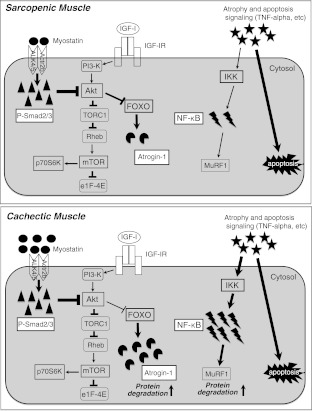
Recent advances in our understanding of the biology of muscle, and how anabolic and catabolic stimuli interact to control muscle mass and function, have led to new interest in the pharmacological treatment of muscle wasting. Loss of muscle occurs as a consequence of several chronic diseases (cachexia) as well as normal aging (sarcopenia). Although many negative regulators [Atrogin-1, muscle ring finger-1, nuclear factor-kappaB (NF-κB), myostatin, etc.] have been proposed to enhance protein degradation during both sarcopenia and cachexia, the adaptation of mediators markedly differs among these conditions. Sarcopenic and cachectic muscles have been demonstrated to be abundant in myostatin- and apoptosis-linked molecules. The ubiquitin-proteasome system (UPS) is activated during many different types of cachexia (cancer cachexia, cardiac heart failure, chronic obstructive pulmonary disease), but not many mediators of the UPS change during sarcopenia. NF-κB signaling is activated in cachectic, but not in sarcopenic, muscle. Some studies have indicated a change of autophagic signaling during both sarcopenia and cachexia, but the adaptation remains to be elucidated. This review provides an overview of the adaptive changes in negative regulators of muscle mass in both sarcopenia and cachexia.
Overview
The claims and statistics of this paper haven’t been checked yet.
Free: it reads the open-access text and checks the first 5 claims that cite a source we can check. Create a free account to check every claim.
Integrity signals
Registry
Cites
Statistics
Figures
Verification
Claims the paper makes
The claims and statistics of this paper haven’t been checked yet.
Free: it reads the open-access text and checks the first 5 claims that cite a source we can check. Create a free account to check every claim.
Claims other papers make about this one
Each is checked against this paper’s own text: does it say what the citing paper says it does?
The cited source says what the claim attributes to it.
In the citing paper
“Namely, the circulating levels of microbiota-derived indoxyl sulfate are positively associated with the expression of myostatin and atrogin-1 [29], representing two of the main negative regulators of skeletal muscle mass [30].”
From Gut Microbiota, Muscle Mass and Function in Aging: A Focus on Physical Frailty and Sarcopenia (2019) · cites this paper as [30]
Self-check
Percentages, sums and reported differences re-computed from the paper’s own numbers.
The self-check needs the paper’s full text.
Citations
Cites
2 retracted
Items 201–259 of 259
The effect of age on protein metabolism
Short, K. R., & Nair, K. S. (2000) · Current Opinion in Clinical Nutrition and Metabolic Care · doi:10.1097/00075197-200001000-00007 · Cited by 107
Molecular Mechanisms in Aging and Current Strategies to Counteract Sarcopenia
Sakuma, K., & Yamaguchi, A. (2010) · Current Aging Sciencee · doi:10.2174/1874609811003020090 · Cited by 106
Self-citationDenson, L. A., Menon, R. K., Shaufl, A., Bajwa, H. S., Williams, C. R., & Karpen, S. J. (2001) · Journal of Clinical Investigation · doi:10.1172/jci10994 · Cited by 105
Marcell, T. J., Harman, S. M., Urban, R. J., Metz, D. D., Rodgers, B. D., & Blackman, M. R. (2001) · American Journal of Physiology-Endocrinology and Metabolism · doi:10.1152/ajpendo.2001.281.6.e1159 · Cited by 103
Myostatin inhibition slows muscle atrophy in rodent models of amyotrophic lateral sclerosis
Holzbaur, E. L. F., Howland, D. S., Weber, N., Wallace, K., She, Y., Kwak, S., Tchistiakova, L. A., Murphy, E., Hinson, J., Karim, R., et al. (2006) · Neurobiology of Disease · doi:10.1016/j.nbd.2006.05.009 · Cited by 101
Thomson, D. M., & Gordon, S. E. (2006) · The Journal of Physiology · doi:10.1113/jphysiol.2006.107490 · Cited by 101
Myostatin expression in ventricular myocardium in a rat model of volume‐overload heart failure
Shyu, K. G., Lu, M. J., Wang, B. W., Sun, H. Y., & Chang, H. (2006) · European Journal of Clinical Investigation · doi:10.1111/j.1365-2362.2006.01718.x · Cited by 100
Akamizu, T., & Kangawa, K. (2010) · Journal of Cachexia Sarcopenia and Muscle · doi:10.1007/s13539-010-0011-5 · Cited by 99
Myostatin Up-Regulation Is Associated with the Skeletal Muscle Response to Hypoxic Stimuli
Hayot, M., Rodriguez, J., Vernus, B., Carnac, G., Jean, E., Allen, D., Goret, L., Obert, P., Candau, R., & Bonnieu, A. (2011) · Molecular and Cellular Endocrinology · doi:10.1016/j.mce.2010.09.008 · Cited by 98 · cited 2×
“[148] found”
Fasting-related autophagic response in slow- and fast-twitch skeletal muscle
Ogata, T., Oishi, Y., Higuchi, M., & Muraoka, I. (2010) · Biochemical and Biophysical Research Communications · doi:10.1016/j.bbrc.2010.02.130 · Cited by 98
Effect of rhGH and rhIGF-I treatment on protein utilization in elderly women
Butterfield, G. E., Thompson, J., Rennie, M. J., Marcus, R., Hintz, R. L., & Hoffman, A. R. (1997) · American Journal of Physiology-Endocrinology and Metabolism · doi:10.1152/ajpendo.1997.272.1.e94 · Cited by 95
Petraglia, F., Florio, P., Luisi, S., Gallo, R., Gadducci, A., Viganò, P., Di Blasio, A. M., Genazzani, A. R., & Vale, W. (1998) · The Journal of Clinical Endocrinology & Metabolism · doi:10.1210/jcem.83.4.4689 · Cited by 94
Wouters, E. F. �. (2004) · The Lancet · doi:10.1016/s0140-6736(04)16984-5 · Cited by 94
Expression of the ubiquitin-proteasome pathway and muscle loss in experimental cancer cachexia
Khal, J., Wyke, S. M., Russell, S. T., Hine, A. V., & Tisdale, M. J. (2005) · British Journal of Cancer · doi:10.1038/sj.bjc.6602780 · Cited by 92
Chelh, I., Meunier, B., Picard, B., Reecy, M. J., Chevalier, C., Hocquette, J.-F., & Cassar-Malek, I. (2009) · BMC Genomics · doi:10.1186/1471-2164-10-196 · Cited by 91
Hypogonadism in male patients with metastatic cancer prior to chemotherapy.
Chlebowski, R. T., & Heber, D. (1982) · PubMed · Cited by 90
Fiber Type-Specific Nitric Oxide Protects Oxidative Myofibers against Cachectic Stimuli
Yu, Z., Li, P., Zhang, M., Hannink, M., Stamler, J. S., & Yan, Z. (2008) · PLoS ONE · doi:10.1371/journal.pone.0002086 · Cited by 88
Atrophy and hypertrophy signalling in the diaphragm of patients with COPD
Testelmans, D., Crul, T., Maes, K., Agten, A., Crombach, M., Decramer, M., & Gayan-Ramirez, G. (2010) · European Respiratory Journal · doi:10.1183/09031936.00091108 · Cited by 87
The epidemiology of sarcopenia in community living older adults: what role does lifestyle play?
Scott, D. S., Blizzard, L., Fell, J. W., & Jones, G. (2011) · Journal of Cachexia Sarcopenia and Muscle · doi:10.1007/s13539-011-0036-4 · Cited by 87
Androgen deficiency in aging men: Role of testosterone replacement therapy
Morley, J. E., & Perry, H. M. (2000) · Journal of Laboratory and Clinical Medicine · doi:10.1067/mlc.2000.106455 · Cited by 86
Insulin-Like Growth Factor I: Implications in Aging
Arvat, E., Broglio, F., & Ghigo, E. (2000) · Drugs & Aging · doi:10.2165/00002512-200016010-00003 · Cited by 85
NF-κB Inhibition Protects against Tumor-Induced Cardiac Atrophy in Vivo
Wysong, A. S., Couch, M. E., Shadfar, S., Li, L., Rodriguez, J., Asher, S. A., Yin, X., Gore, M. R., Baldwin, A., Patterson, C., et al. (2011) · American Journal Of Pathology · doi:10.1016/j.ajpath.2010.12.009 · Cited by 84
Pattison, J. S., Folk, L. C., Madsen, R. W., Childs, T. E., & Booth, F. W. (2003) · Physiological Genomics · doi:10.1152/physiolgenomics.00040.2003 · Cited by 81
Denervation-induced oxidative stress and autophagy signaling in muscle
O’Leary, M. F. N., & Hood, D. A. (2009) · Autophagy · doi:10.4161/auto.5.2.7391 · Cited by 81
Pathophysiology of peripheral muscle wasting in cardiac cachexia
Filippatos, G. S., Anker, S. D., & Kremastinos, D. T. (2005) · Current Opinion in Clinical Nutrition & Metabolic Care · doi:10.1097/01.mco.0000165002.08955.5b · Cited by 79
Moresi, V., Pristerà, A., Scicchitano, B. M., Molinaro, M., Teodori, L., Sassoon, D., Adamo, S., & Coletti, D. (2008) · Stem Cells · doi:10.1634/stemcells.2007-0493 · Cited by 76
Myostatin as a therapeutic target for musculoskeletal disease
Bradley, L., Yaworsky, P. J., & Walsh, F. S. (2008) · Cellular and Molecular Life Sciences · doi:10.1007/s00018-008-8077-3 · Cited by 74
Sakuma, K., Akiho, M., Nakashima, H., Akima, H., & Yasuhara, M. (2008) · Biochimica et Biophysica Acta (BBA) - Molecular Basis of Disease · doi:10.1016/j.bbadis.2008.03.008 · Cited by 73
Self-citationAutophagy in chronic obstructive pulmonary disease: Homeostatic or pathogenic mechanism?
Ryter, S. W., Chen, Z.-H., Kim, H.-P., & Choi, A. M. K. (2009) · Autophagy · doi:10.4161/auto.5.2.7495 · Cited by 71
Pharmacological interference with tissue hypercatabolism in tumour-bearing rats
Tessitore, L., Costelli, P., & Baccino, F. M. (1994) · Biochemical Journal · doi:10.1042/bj2990071 · Cited by 70
Hormonal changes in aging men: a therapeutic indication?
Hermann, M., & Berger, P. (2001) · Experimental Gerontology · doi:10.1016/s0531-5565(01)00113-9 · Cited by 69
Growth Hormone in the Treatment of Dilated Cardiomyopathy
Frustaci, A., Gentiloni, N., & Russo, M. A. (1996) · New England Journal of Medicine · doi:10.1056/nejm199608293350915 · Cited by 68
Anti-TNF Treatment Reverts Increased Muscle Ubiquitin Gene Expression in Tumour-Bearing Rats
Llovera, M., Carbó, N., Garcia‐Martínez, C., Costelli, P., Tessitore, L., Baccino, F. M., Agell, N., Bagby, G. J., López-Soriano, F. J., & Argilés, J. M. A. (1996) · Biochemical and Biophysical Research Communications · doi:10.1006/bbrc.1996.0651 · Cited by 66
Ubiquitin expression is up-regulated in human and rat skeletal muscles during aging
Cai, D., Lee, K. K. H., Li, M., Tang, M. K., & Chan, K. M. (2004) · Archives of Biochemistry and Biophysics · doi:10.1016/j.abb.2004.02.027 · Cited by 65 · cited 1×
“mRNA levels encoding some components of the UPS [67–69] or ubiquitin–conjugate accumulation) in old”
BackgroundAge-related changes of cell death pathways in rat extraocular muscle
McMullen, C. A., Ferry, A. L., Gamboa, J. L., Andrade, F. H., & Dupont-Versteegden, E. E. (2009) · Experimental Gerontology · doi:10.1016/j.exger.2009.03.006 · Cited by 64
PKB signaling and atrogene expression in skeletal muscle of aged mice
Gaugler, M., Brown, A., Merrell, E., DiSanto-Rose, M., Rathmacher, J. A., & Reynolds, T. H. (2011) · Journal of Applied Physiology · doi:10.1152/japplphysiol.00175.2011 · Cited by 64
Skeletal muscle wasting in tumor-bearing rats is associated with MyoD down-regulation
Costelli, P., Muscaritoli, M., Bossola, M., Moore-Carrasco, R., Crepaldi, S., Grieco, G., Autelli, R., Bonelli, G., Pacelli, F., Lopez-Soriano, F., et al. (2005) · International Journal of Oncology · doi:10.3892/ijo.26.6.1663 · Cited by 62
DeRuisseau, K. C., Kavazis, A. N., & Powers, S. K. (2005) · Experimental Gerontology · doi:10.1016/j.exger.2005.04.005 · Cited by 61
Morphological and functional characteristics of the ageing skeletal muscle in man
Larsson, L. (1978) · Medical Entomology and Zoology · Cited by 60
Petraglia, F. (1998) · The Journal of Clinical Endocrinology & Metabolism · doi:10.1210/jc.83.4.1194 · Cited by 60
Argilés, J. M. A., López-Soriano, F. J., & Busquets, S. (2008) · The International Journal of Biochemistry & Cell Biology · doi:10.1016/j.biocel.2008.02.001 · Cited by 57
Knapp, P. E., Storer, T. W., Herbst, K. L., Singh, A. B., Dzekov, C., Dzekov, J., LaValley, M., Zhang, A., Ulloor, J., & Bhasin, S. (2008) · American Journal of Physiology-Endocrinology and Metabolism · doi:10.1152/ajpendo.90213.2008 · Cited by 56
Role of ubiquitin-proteasome pathway in skeletal muscle wasting in rats with endotoxemia
Chai, J., Wu, Y., & Sheng (Zy Sheng), Z. (2003) · Critical Care Medicine · doi:10.1097/01.ccm.0000069728.49939.e4 · Cited by 55
Baker, D. J., & Hepple, R. T. (2006) · Experimental Gerontology · doi:10.1016/j.exger.2006.08.007 · Cited by 53
Insulin-like growth factor I preserves host lean tissue mass in cancer cachexia
Ng, E. H. Y., Rock, C. S., Lazarus, D. D., Stiaino-Coico, L., Moldawer, L. L., & Lowry, S. F. (1992) · American Journal of Physiology-Regulatory, Integrative and Comparative Physiology · doi:10.1152/ajpregu.1992.262.3.r426 · Cited by 53
Transcription factors and muscle cachexia: is there a therapeutic target?
Mitch, W. E., & Price, S. R. (2001) · The Lancet · doi:10.1016/s0140-6736(00)04177-5 · Cited by 51
Oxidative Stress and Skeletal Muscle Dysfunction with Aging
Aoi, W., & Sakuma, K. (2011) · Current Aging Sciencee · doi:10.2174/1874609811104020101 · Cited by 51
Self-citationResearch methodology: cancer cachexia syndrome
Dahele, M., & Fearon, K. (2004) · Palliative Medicine · doi:10.1191/0269216304pm906ra · Cited by 49
Bar‐Shai, M., Carmeli, E., Coleman, R., Rozen, N., Perek, S., Fuchs, D., & Reznick, A. Z. (2004) · Mechanisms of Ageing and Development · doi:10.1016/j.mad.2004.08.030 · Cited by 47
Martineau, L. C., Chadan, S. G., & Parkhouse, W. S. (1999) · Mechanisms of Ageing and Development · doi:10.1016/s0047-6374(98)00106-7 · Cited by 44
Sakuma, K., Watanabe, K., Hotta, N., Koike, T., Ishida, K., Katayama, K., & Akima, H. (2009) · Acta Physiologica · doi:10.1111/j.1748-1716.2009.01995.x · Cited by 42
Self-citationPark, S., Kim, H., Lee, J., Yoon, K., Chang, M., & Park, S. (2010) · Cellular and Molecular Biology Letters · doi:10.2478/s11658-009-0030-4 · Cited by 37
Mulligan, K. M., Zackin, R. A., Roenn, J. H. V., Chesney, M. A., Egorin, M. J., Sattler, F. R., Benson, C. A., Liu, T., Umbleja, T., Shriver, S., et al. (2006) · The Journal of Clinical Endocrinology & Metabolism · doi:10.1210/jc.2006-0954 · Cited by 36
Proteasome activities in the rectus abdominis muscle of young and older individuals
Bossola, M., Pacelli, F., Costelli, P., Tortorelli, A. P., Rosa, F., & Doglietto, G. B. (2008) · Biogerontology · doi:10.1007/s10522-008-9135-9 · Cited by 36
Jiang, Z., & Clemens, P. R. (2006) · The FASEB Journal · doi:10.1096/fj.06-6347fje · Cited by 24
Hk, L., & Marzella, L. (1994) · PubMed · Cited by 22
Inhibitors of Myostatin- and Proteasome-Dependent Signaling for Attenuating Muscle Wasting
Sakuma, K., & Yamaguchi, A. (2011) · Recent Patents on Regenerative Medicine · doi:10.2174/2210296511101030284 · Cited by 10
Self-citationAutophagy in chronic obstructive pulmonary disease
Zhou, M., & Jiang, T. (2013) · Chinese Journal of Asthma · doi:10.3760/cma.j.issn.1673-436x.2013.003.015 · Cited by 4
Inhibitors of Myostatin- and Proteasome-Dependent Signaling for Attenuating Muscle Wasting
Sakuma, K., & Yamaguchi, A. (2012) · Recent Patents on Regenerative Medicine · doi:10.2174/2210297311101030284 · Cited by 2
Self-citation
Research works printed but not linked: 3
- Roubenoff R Hughes VA Sarcopenia: current concepts J Gerontol A Biol Sci Med Sci 2000 55 M716 M724 10.1093/gerona/55.12.M716 11129393 · DOI · Paper page
- Sakuma K, Yamaguchi A (2011) Sarcopenia: molecular mechanisms and current therapeutic strategy. In: Perloft JW, Wong AH (eds) Cell aging. Nova Science, New York (in press)
- Moresi V Pristera A Scicchitano BM Molinaro M Teodori L Sassoon D Tumor necrosis factor-α inhibition of skeletal muscle regeneration is mediated by a caspase-dependent stem cell response Stem Cells 2008 26 997 11008 10.1634/stemcells.2007-0493 18258721 · DOI · Paper page
Cited by
Quality of Life in Sarcopenia and Frailty
Rizzoli, R., Reginster, J.-Y., Arnal, J.-F., Bautmans, I., Beaudart, C., Bischoff-Ferrari, H., Biver, E., Boonen, S., Brandi, M.-L., Chines, A., et al. (2013) · Calcified Tissue International · doi:10.1007/s00223-013-9758-y · Cited by 425
“inflammatory conditions)[50].”
Mitochondria and ageing: Role in heart, skeletal muscle and adipose tissue
Boengler, K., Kosiol, M., Mayr, M., Schulz, R., & Rohrbach, S. (2017) · Journal of Cachexia Sarcopenia and Muscle · doi:10.1002/jcsm.12178 · Cited by 421
“sponse to a chronic disease such as cancer, shows not only some similarities in the underlying mechanisms of muscle loss but also a number of significant differences compared with sarcopenia.(114,115) Cancer-associated cachexia, which is characterized by severe muscle wasting, systemic inflammation, and malnutrition,…”
ResultGut Microbiota, Muscle Mass and Function in Aging: A Focus on Physical Frailty and Sarcopenia
Ticinesi, A., Nouvenne, A., Cerundolo, N., Catania, P., Prati, B., Tana, C., & Meschi, T. (2019) · Nutrients · doi:10.3390/nu11071633 · Cited by 418
“Namely, the circulating levels of microbiota-derived indoxyl sulfate are positively associated with the expression of myostatin and atrogin-1 [29], representing two of the main negative regulators of skeletal muscle mass [30].”
BackgroundLee, Y., Kim, S. U., Song, K., Park, J. Y., Kim, D. Y., Ahn, S. H., Lee, B., Kang, E. S., Cha, B., & Han, K. (2016) · Hepatology · doi:10.1002/hep.28376 · Cited by 340
Wakabayashi, H., & Sakuma, K. (2014) · Journal of Cachexia, Sarcopenia and Muscle · doi:10.1007/s13539-014-0162-x · Cited by 334
Self-citation
Metadata
- Authors
- Sakuma, K., & Yamaguchi, A.
- Affiliations
- Toyohashi University of Technology (JP)
- Health Sciences University of Hokkaido (JP)
- Corresponding author
- Sakuma, Kunihiro
- Venue
- Journal of Cachexia Sarcopenia and Muscle
- Publisher
- Wiley
- Published
- 2012-01-12
- Volume
- 3
- Issue
- 2
- Pages
- 77-94
- ISSN
- 2190-5991 (ISSN-L)
- 2190-6009
- PMC
- PMC3374017
- OpenAlex
- W2079792861
- Cited by
- 137
- References
- 261
- Citations by year
- 2026: 2 · 2025: 12 · 2024: 7 · 2023: 7 · 2022: 9 · 2021: 10 · 2020: 5 · 2019: 6 · 2018: 11 · 2017: 11 · 2016: 7 · 2015: 11 · 2014: 15 · 2013: 21 · 2012: 3
- FWCI
- 6.42
- Type
- journal article
- Language
- en
- Open access
- gold
- doi.org
- Licence
- Locations
- Journal of Cachexia Sarcopenia and Muscle (publishedVersion, cc-by-nc)
- Europe PMC (PubMed Central) (publishedVersion, cc-by-nc)
- PubMed Central (publishedVersion, cc-by-nc)
- PubMed (publishedVersion)
- Funders
- Japan Society for the Promotion of Science (23500778)
- Topics
- Life Sciences › Biochemistry, Genetics and Molecular Biology › Molecular Biology › Muscle Physiology and Disorders
- Health Sciences › Medicine › Physiology (medical) › Nutrition and Health in Aging
- Health Sciences › Nursing › Nutrition and Dietetics › Muscle metabolism and nutrition
- Keywords
- sarcopenia, cachexia, muscle atrophy, skeletal muscle mass, atrogin-1, MuRF1, NF-κB signaling, myostatin, ubiquitin-proteasome system, apoptosis, autophagy, protein degradation, aging, cancer cachexia, heart failure, chronic obstructive pulmonary disease
About these checks
Registry, retraction, Cites and statistics results are computed, not judged, with one exception: a printed reference that no index lists is read once by a model before it counts as a citation error. Claims are extracted by a model and kept only when their quote appears verbatim in the text; each cited source is then checked, with a model’s help, for whether it says what the claim relies on. Those verdicts can be wrong — read the claim’s quote and the cited source before relying on one.
Statistics and arithmetic are recomputed, not judged.
Confidence bands are shown only for fields calibrated on our annotated test set. None is calibrated yet, so no band is shown.
What counts as a claim ›How we measure confidence ›How we check this ›
Are you an author, or do you see a problem with this page? Request a review
Data sources
Bibliographic data: Semantic Scholar, OpenAlex, Crossref.
Contains information from the Semantic Scholar Academic Graph Datasets, made available under the ODC Attribution License (ODC-BY 1.0).
Semantic Scholar’s data is described in: Kinney, R., et al. (2023). The Semantic Scholar Open Data Platform. arXiv:2301.10140.
