

Sarcopenia and cachexia: the adaptations of negative regulators of skeletal muscle mass
Open accessThe DOI matches its Crossref record; 259 of the 261 references it cites were found in a registry or an index.
Abstract
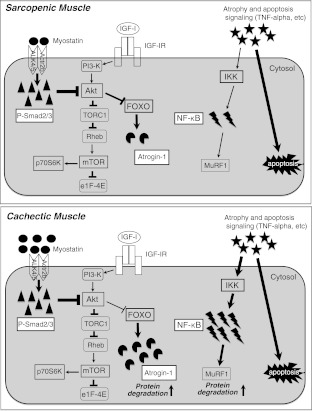
Recent advances in our understanding of the biology of muscle, and how anabolic and catabolic stimuli interact to control muscle mass and function, have led to new interest in the pharmacological treatment of muscle wasting. Loss of muscle occurs as a consequence of several chronic diseases (cachexia) as well as normal aging (sarcopenia). Although many negative regulators [Atrogin-1, muscle ring finger-1, nuclear factor-kappaB (NF-κB), myostatin, etc.] have been proposed to enhance protein degradation during both sarcopenia and cachexia, the adaptation of mediators markedly differs among these conditions. Sarcopenic and cachectic muscles have been demonstrated to be abundant in myostatin- and apoptosis-linked molecules. The ubiquitin-proteasome system (UPS) is activated during many different types of cachexia (cancer cachexia, cardiac heart failure, chronic obstructive pulmonary disease), but not many mediators of the UPS change during sarcopenia. NF-κB signaling is activated in cachectic, but not in sarcopenic, muscle. Some studies have indicated a change of autophagic signaling during both sarcopenia and cachexia, but the adaptation remains to be elucidated. This review provides an overview of the adaptive changes in negative regulators of muscle mass in both sarcopenia and cachexia.
Overview
The claims and statistics of this paper haven’t been checked yet.
Free: it reads the open-access text and checks the first 5 claims that cite a source we can check. Create a free account to check every claim.
Integrity signals
Registry
Cites
Statistics
Figures
Verification
Claims the paper makes
The claims and statistics of this paper haven’t been checked yet.
Free: it reads the open-access text and checks the first 5 claims that cite a source we can check. Create a free account to check every claim.
Claims other papers make about this one
Each is checked against this paper’s own text: does it say what the citing paper says it does?
The cited source says what the claim attributes to it.
In the citing paper
“Namely, the circulating levels of microbiota-derived indoxyl sulfate are positively associated with the expression of myostatin and atrogin-1 [29], representing two of the main negative regulators of skeletal muscle mass [30].”
From Gut Microbiota, Muscle Mass and Function in Aging: A Focus on Physical Frailty and Sarcopenia (2019) · cites this paper as [30]
Self-check
Percentages, sums and reported differences re-computed from the paper’s own numbers.
The self-check needs the paper’s full text.
Citations
Cites
2 retracted
Wenz, T., Rossi, S. G., Rotundo, R. L., Spiegelman, B. M., & Moraes, C. T. (2009) · Proceedings of the National Academy of Sciences · doi:10.1073/pnas.0911570106 · Cited by 600 · cited 2×
“[111] recognized a”
RetractedMariño, G., Urı́a, J. A., Puente, X. S., Quesada, V., Bordallo, J., & López-Otı́n, C. (2003) · Journal of Biological Chemistry · doi:10.1074/jbc.m208247200 · Cited by 208
RetractedRepertoires of Autophagy in the Pathogenesis of Ocular Diseases
Li, Y.-J., Jiang, Q., Cao, G.-F., Yao, J., & Yan, B. (2015) · Cellular Physiology and Biochemistry · doi:10.1159/000373980 · Cited by 16,304
Cui, C., Cui, J., Jin, F., Cui, Y., Li, R., Jiang, X., Tian, Y., Wang, K., Jiang, P., & Gao, J. (2017) · Cellular Physiology and Biochemistry · doi:10.1159/000479571 · Cited by 5,203
Danial, N. N., & Korsmeyer, S. J. (2004) · Cell · doi:10.1016/s0092-8674(04)00046-7 · Cited by 4,651
Pankiv, S., Clausen, T. H., Lamark, T., Brech, A., Bruun, J.-A., Outzen, H., Øvervatn, A., Bjørkøy, G., & Johansen, T. (2007) · Journal of Biological Chemistry · doi:10.1074/jbc.m702824200 · Cited by 4,578 · cited 1×
“p62/SQSTM1 interacts with the autophagosome membrane microtubule-associated protein light chain (LC3) protein which facilitates the delivery of its polyubiquitinated cargo for lysosomal degradation [101, 102].”
BackgroundThe Ubiquitin-Proteasome Proteolytic Pathway: Destruction for the Sake of Construction
Glickman, M. H., & Ciechanover, A. (2002) · Physiological Reviews · doi:10.1152/physrev.00027.2001 · Cited by 4,237
Levine, B., & Klionsky, D. J. (2004) · Developmental Cell · doi:10.1016/s1534-5807(04)00099-1 · Cited by 3,678
Identification of ubiquitin ligases required for skeletal muscle atrophy.
Bodine, S. C., Latres, E., Baumhueter, S., Lai, V. K.-M., Nunez, L., Clarke, B. A., Poueymirou, W. T., Panaro, F. J., Na, E., Dharmarajan, K., et al. (2001) · Science · doi:10.1126/science.1065874 · Cited by 3,521 · cited 2×
“improved knowledge of the regulation of the ubiquitin– proteasome system in skeletal muscle [47].”
BackgroundBjørkøy, G., Lamark, T., Brech, A., Outzen, H., Perander, M., Øvervatn, A., Stenmark, H., & Johansen, T. (2005) · The Journal of Cell Biology · doi:10.1083/jcb.200507002 · Cited by 3,276 · cited 1×
“p62/SQSTM1 interacts with the autophagosome membrane microtubule-associated protein light chain (LC3) protein which facilitates the delivery of its polyubiquitinated cargo for lysosomal degradation [101, 102].”
Background
Research works printed but not linked: 3
- Roubenoff R Hughes VA Sarcopenia: current concepts J Gerontol A Biol Sci Med Sci 2000 55 M716 M724 10.1093/gerona/55.12.M716 11129393 · DOI · Paper page
- Sakuma K, Yamaguchi A (2011) Sarcopenia: molecular mechanisms and current therapeutic strategy. In: Perloft JW, Wong AH (eds) Cell aging. Nova Science, New York (in press)
- Moresi V Pristera A Scicchitano BM Molinaro M Teodori L Sassoon D Tumor necrosis factor-α inhibition of skeletal muscle regeneration is mediated by a caspase-dependent stem cell response Stem Cells 2008 26 997 11008 10.1634/stemcells.2007-0493 18258721 · DOI · Paper page
Cited by
Quality of Life in Sarcopenia and Frailty
Rizzoli, R., Reginster, J.-Y., Arnal, J.-F., Bautmans, I., Beaudart, C., Bischoff-Ferrari, H., Biver, E., Boonen, S., Brandi, M.-L., Chines, A., et al. (2013) · Calcified Tissue International · doi:10.1007/s00223-013-9758-y · Cited by 425
“inflammatory conditions)[50].”
Mitochondria and ageing: Role in heart, skeletal muscle and adipose tissue
Boengler, K., Kosiol, M., Mayr, M., Schulz, R., & Rohrbach, S. (2017) · Journal of Cachexia Sarcopenia and Muscle · doi:10.1002/jcsm.12178 · Cited by 421
“sponse to a chronic disease such as cancer, shows not only some similarities in the underlying mechanisms of muscle loss but also a number of significant differences compared with sarcopenia.(114,115) Cancer-associated cachexia, which is characterized by severe muscle wasting, systemic inflammation, and malnutrition,…”
ResultGut Microbiota, Muscle Mass and Function in Aging: A Focus on Physical Frailty and Sarcopenia
Ticinesi, A., Nouvenne, A., Cerundolo, N., Catania, P., Prati, B., Tana, C., & Meschi, T. (2019) · Nutrients · doi:10.3390/nu11071633 · Cited by 418
“Namely, the circulating levels of microbiota-derived indoxyl sulfate are positively associated with the expression of myostatin and atrogin-1 [29], representing two of the main negative regulators of skeletal muscle mass [30].”
BackgroundLee, Y., Kim, S. U., Song, K., Park, J. Y., Kim, D. Y., Ahn, S. H., Lee, B., Kang, E. S., Cha, B., & Han, K. (2016) · Hepatology · doi:10.1002/hep.28376 · Cited by 340
Wakabayashi, H., & Sakuma, K. (2014) · Journal of Cachexia, Sarcopenia and Muscle · doi:10.1007/s13539-014-0162-x · Cited by 334
Self-citationNess, K. K., Krull, K. R., Jones, K. E., Mulrooney, D. A., Armstrong, G. T., Green, D. M., Chemaitilly, W., Smith, W. A., Wilson, C. L., Sklar, C. A., et al. (2013) · Journal of Clinical Oncology · doi:10.1200/jco.2013.52.2268 · Cited by 333
Léger, B., Derave, W., De Bock, K., Hespel, P., & Russell, A. P. (2008) · Rejuvenation Research · doi:10.1089/rej.2007.0588 · Cited by 274
Curcio, F., Testa, G., Liguori, I., Papillo, M., Flocco, V., Panicara, V., Galizia, G., Della-Morte, D., Gargiulo, G., Cacciatore, F., et al. (2020) · Nutrients · doi:10.3390/nu12010211 · Cited by 258
Intensive Care Unit–acquired Weakness: Clinical Phenotypes and Molecular Mechanisms
Batt, J., dos Santos, C. C., Cameron, J. I., & Herridge, M. S. (2013) · American Journal of Respiratory and Critical Care Medicine · doi:10.1164/rccm.201205-0954so · Cited by 254
Muscle dysfunction in cancer patients
Christensen, J. F., Jones, L. W., Andersen, J. L., Daugaard, G., Rorth, M., & Hojman, P. (2014) · Annals of Oncology · doi:10.1093/annonc/mdt551 · Cited by 242
“The direct tumor-derived impact on muscle tissue has been extensively studied in preclinical models demonstrating roles for tumor-induced inflammation and altered metabolism (reviewed in [37–39]).”
BackgroundSarcopenic obesity and endocrinal adaptation with age
Sakuma, K., & Yamaguchi, A. (2013) · International Journal of Endocrinology · doi:10.1155/2013/204164 · Cited by 189
“Myostatin levels increase with muscle atrophy due to unloading in mice and humans [106, 107] andwith severemusclewasting inHIV patients [108].”
BackgroundSelf-citationSarcopenia and Age-Related Endocrine Function
Sakuma, K., & Yamaguchi, A. (2012) · International Journal of Endocrinology · doi:10.1155/2012/127362 · Cited by 179
Self-citationAnimal models of chronic obstructive pulmonary disease
Fricker, M., Deane, A., & Hansbro, P. M. (2014) · Expert Opinion on Drug Discovery · doi:10.1517/17460441.2014.909805 · Cited by 169
“1 Cachexia Cachexia is a progressive, wasting loss of adipose and skeletal muscle associated with other severe disease manifestations [121].”
BackgroundMolecular mechanism of sarcopenia and cachexia: recent research advances
Sakuma, K., Aoi, W., & Yamaguchi, A. (2017) · Pflügers Archiv - European Journal of Physiology · doi:10.1007/s00424-016-1933-3 · Cited by 172
Self-citationSepúlveda‐Loyola, W., Phu, S., Hassan, E. B., Brennan-Olsen, S. L., Zanker, J., Vogrin, S., Conzade, R., Kirk, B., Saedi, A. A., Probst, V. S., et al. (2019) · Journal of the American Medical Directors Association · doi:10.1016/j.jamda.2019.09.005 · Cited by 153
Myostatin inhibitors as therapies for muscle wasting associated with cancer and other disorders
Smith, R. C., & Lin, B. K. (2013) · Current Opinion in Supportive & Palliative Care · doi:10.1097/spc.0000000000000013 · Cited by 151
Current understanding of sarcopenia: possible candidates modulating muscle mass
Sakuma, K., Aoi, W., & Yamaguchi, A. (2014) · Pflügers Archiv - European Journal of Physiology · doi:10.1007/s00424-014-1527-x · Cited by 150
Self-citationExercise therapy for people with sarcopenic obesity: myokines and adipokines as effective actors
Alizadeh Pahlavani, H. (2022) · Frontiers in Endocrinology · doi:10.3389/fendo.2022.811751 · Cited by 145
Muscle wasting in heart failure: An overview
von Haehling, S., Steinbeck, L., Doehner, W., Springer, J., & Anker, S. D. (2013) · The International Journal of Biochemistry & Cell Biology · doi:10.1016/j.biocel.2013.04.025 · Cited by 139
Myostatin and its Regulation: A Comprehensive Review of Myostatin Inhibiting Strategies
Baig, M. H., Ahmad, K., Moon, J. S., Park, S.-Y., Ho Lim, J., Chun, H. J., Qadri, A. F., Hwang, Y. C., Jan, A. T., Ahmad, S. S., et al. (2022) · Frontiers in Physiology · doi:10.3389/fphys.2022.876078 · Cited by 135
Nutritional influences on age-related skeletal muscle loss
Welch, A. A. (2014) · Proceedings of the Nutrition Society · doi:10.1017/s0029665113003698 · Cited by 133
Sarcopenia as a comorbidity of cardiovascular disease
Sasaki, K., & Fukumoto, Y. (2021) · Journal of Cardiology · doi:10.1016/j.jjcc.2021.10.013 · Cited by 129
Sarcopenia in heart failure: mechanisms and therapeutic strategies.
Collamati, A., Marzetti, E., Calvani, R., Tosato, M., D’Angelo, E., Sisto, A. N., & Landi, F. (2016) · 老年心脏病学杂志:英文版 · doi:10.11909/j.issn.1671-5411.2016.07.004 · Cited by 123
Novel aspects of health promoting compounds in meat
Young, J. F., Therkildsen, M., Ekstrand, B., Che, B. N., Larsen, M., Oksbjerg, N., & Stagsted, J. (2013) · Meat Science · doi:10.1016/j.meatsci.2013.04.036 · Cited by 113
Autophagy as a Potential Target for Sarcopenia: AUTOPHAGY REGULATION IN SARCOPENIA
Fan, J., Kou, X., Jia, S., Yang, X., Yang, Y., & Chen, N. (2016) · Journal of Cellular Physiology · doi:10.1002/jcp.25260 · Cited by 101
Cho, Y., Kim, J. W., Keum, K. C., Lee, C. G., Jeung, H., & Lee, I. J. (2018) · Frontiers in Oncology · doi:10.3389/fonc.2018.00457 · Cited by 101
Treatment of cachexia: An overview of recent developments
von Haehling, S., & Anker, S. D. (2014) · International Journal of Cardiology · doi:10.1016/j.ijcard.2014.10.026 · Cited by 99
Mueller, T. C., Bachmann, J., Prokopchuk, O., Friess, H., & Martignoni, M. E. (2016) · BMC Cancer · doi:10.1186/s12885-016-2121-8 · Cited by 95
“In addition to the increased protein degradation, it has been postulated that muscle atrophy in cancer cachexia is also due to decreased protein synthesis [78, 141].”
BackgroundCellular interplay in skeletal muscle regeneration and wasting: insights from animal models
Henrot, P., Blervaque, L., Dupin, I., Zysman, M., Estèves, P., Gouzi, F., Hayot, M., Pomiès, P., & Berger, P. (2023) · Journal of Cachexia Sarcopenia and Muscle · doi:10.1002/jcsm.13103 · Cited by 94
Murine models of atrophy, cachexia, and sarcopenia in skeletal muscle
Romanick, M., Thompson, L. V., & Brown-Borg, H. M. (2013) · Biochimica et Biophysica Acta (BBA) - Molecular Basis of Disease · doi:10.1016/j.bbadis.2013.03.011 · Cited by 92
Sampaio, R. A. C., Sewo Sampaio, P. Y., Yamada, M., Yukutake, T., Uchida, M. C., Tsuboyama, T., & Arai, H. (2014) · Geriatrics & Gerontology International · doi:10.1111/ggi.12206 · Cited by 84
Treatment of cachexia: an overview of recent developments
von Haehling, S., & Anker, S. D. (2014) · Journal of the American Medical Directors Association · doi:10.1016/j.jamda.2014.09.007 · Cited by 79
Tan, P. L., Shavlakadze, T., Grounds, M. D., & Arthur, P. G. (2015) · The International Journal of Biochemistry & Cell Biology · doi:10.1016/j.biocel.2015.02.015 · Cited by 73
Muscoloskeletal aging, sarcopenia and cancer
Colloca, G. A., Capua, B. D., Bellieni, A., Cesari, M., Marzetti, E., Valentini, V., & Calvani, R. (2018) · Journal of Geriatric Oncology · doi:10.1016/j.jgo.2018.11.007 · Cited by 72
The Intriguing Regulators of Muscle Mass in Sarcopenia and Muscular Dystrophy
Sakuma, K., Aoi, W., & Yamaguchi, A. (2014) · Frontiers in Aging Neuroscience · doi:10.3389/fnagi.2014.00230 · Cited by 69
Self-citationEmerging role of extracellular vesicles in mediating cancer cachexia
Chitti, S. V., Fonseka, P., & Mathivanan, S. (2018) · Biochemical Society Transactions · doi:10.1042/bst20180213 · Cited by 65
Recent advances in pharmacological, hormonal, and nutritional intervention for sarcopenia
Sakuma, K., & Yamaguchi, A. (2017) · Pflügers Archiv - European Journal of Physiology · doi:10.1007/s00424-017-2077-9 · Cited by 63
Self-citationMoreau, J., Ordan, M., Barbe, C., Mazza, C., Perrier, M., Botsen, D., Brasseur, M., Portefaix, C., Renard, Y., Tallière, B., et al. (2019) · Cancer Medicine · doi:10.1002/cam4.2238 · Cited by 54
Cardiac cachexia is associated with right ventricular failure and liver dysfunction
Valentová, M., von Haehling, S., Krause, C., Ebner, N., Steinbeck, L., Cramer, L., Doehner, W., Murín, J., Anker, S. D., & Sandek, A. (2013) · International Journal of Cardiology · doi:10.1016/j.ijcard.2013.08.134 · Cited by 58
Garibotto, G., Sofia, A., Parodi, E. L., Ansaldo, F., Bonanni, A., Picciotto, D., Signori, A., Vettore, M., Tessari, P., & Verzola, D. (2018) · Kidney International Reports · doi:10.1016/j.ekir.2018.01.003 · Cited by 54
dos Santos, L. P., Santo, R. C. D. E., Ramis, T. R., Portes, J. K. S., Chakr, R. M. D. S., & Xavier, R. M. (2021) · PLoS ONE · doi:10.1371/journal.pone.0259574 · Cited by 53
Han, E., Lee, Y., Kim, B. K., Park, J. Y., Kim, D. Y., Ahn, S. H., Lee, B., Kang, E. S., Cha, B. ‐., Han, K., et al. (2018) · Alimentary Pharmacology & Therapeutics · doi:10.1111/apt.14843 · Cited by 50
Epigenetic mechanisms in chronic obstructive pulmonary disease.
Dd, Z., Ry, O., & Chen, P. (2015) · PubMed · Cited by 46
Muscle wasting: an overview of recent developments in basic research
Palus, S., von Haehling, S., & Springer, J. (2014) · Journal of Cachexia, Sarcopenia and Muscle · doi:10.1007/s13539-014-0157-7 · Cited by 41
Muscle wasting in collagen-induced arthritis and disuse atrophy
de Oliveira Nunes Teixeira, V., Filippin, L. I., Viacava, P. R., de Oliveira, P. G., & Xavier, R. M. (2013) · Experimental Biology and Medicine · doi:10.1177/1535370213505961 · Cited by 40
“and cytokine-driven hypermetabolism, particularly by tumor necrosis factor (TNF)-a.(6,7) Although experimental”
BackgroundZhang, L., Guo, Q., Feng, B., Wang, C., Han, P., Hu, J., Sun, X.-D., Zeng, W.-F., Zheng, Z., Li, H.-S., et al. (2018) · The journal of nutrition health & aging · doi:10.1007/s12603-018-1147-9 · Cited by 40
Benavides-Rodriguez, L. E., García‐Hermoso, A., Rodrigues-Bezerra, D., Izquierdo, M., Correa‐Bautista, J. E., & Ramírez‐Vélez, R. (2017) · Nutrients · doi:10.3390/nu9070695 · Cited by 40
Systemic Regulators of Skeletal Muscle Regeneration in Obesity
Sinha, I., Sakthivel, D., & Varon, D. E. (2017) · Frontiers in Endocrinology · doi:10.3389/fendo.2017.00029 · Cited by 39
Febuxostat improves outcome in a rat model of cancer cachexia
Konishi, M., Pelgrim, L., Tschirner, A., Baumgarten, A., von Haehling, S., Palus, S., Doehner, W., Anker, S. D., & Springer, J. (2015) · Journal of Cachexia Sarcopenia and Muscle · doi:10.1002/jcsm.12017 · Cited by 35
The association between muscle mass deficits and arterial stiffness in middle-aged men
Im, I. J., Choi, H. J., Jeong, S. M., Kim, H. J., Son, J. S., & Oh, H.-J. (2017) · Nutrition Metabolism and Cardiovascular Diseases · doi:10.1016/j.numecd.2017.10.002 · Cited by 35
Pijet, B., Pijet, M., Litwiniuk, A., Gajewska, M., Pająk, B., & Orzechowski, A. (2013) · Mediators of Inflammation · doi:10.1155/2013/171437 · Cited by 34
Asami, Y., Aizawa, M., Kinoshita, M., Ishikawa, J., & Sakuma, K. (2018) · International Journal of Medical Sciences · doi:10.7150/ijms.22723 · Cited by 33
Self-citationEbner, N., Elsner, S., Springer, J., & von Haehling, S. (2014) · Current Opinion in Supportive & Palliative Care · doi:10.1097/spc.0000000000000030 · Cited by 33
Neuromuscular electrical stimulation for muscle wasting in heart failure patients
Saitoh, M., dos Santos, M. R., Anker, M. S., Anker, S. D., von Haehling, S., & Springer, J. (2016) · International Journal of Cardiology · doi:10.1016/j.ijcard.2016.09.127 · Cited by 33
Muscle wasting: An overview of recent developments in basic research
Palus, S., von Haehling, S., & Springer, J. (2014) · International Journal of Cardiology · doi:10.1016/j.ijcard.2014.08.086 · Cited by 31
Ishida, J., Saitoh, M., Doehner, W., von Haehling, S., Anker, M. S., Anker, S. D., & Springer, J. (2017) · International Journal of Cardiology · doi:10.1016/j.ijcard.2017.03.154 · Cited by 30
A non-human primate model of radiation-induced cachexia
Cui, W., Bennett, A. W., Zhang, P., Barrow, K. R., Kearney, S. R., Hankey, K. G., Taylor-Howell, C., Gibbs, A. M., Smith, C. P., & MacVittie, T. J. (2016) · Scientific Reports · doi:10.1038/srep23612 · Cited by 29
Ahmad, K., Shaikh, S., Lim, J. H., Ahmad, S. S., Chun, H. J., Lee, E. J., & Choi, I. (2023) · Biomedicine & Pharmacotherapy · doi:10.1016/j.biopha.2023.115642 · Cited by 28
Chronic Systemic Symptoms in Head and Neck Cancer Patients
Murphy, B. A., Wulff-Burchfield, E. M., Ghiam, M. K., Bond, S. M., & Deng, J. F. (2019) · JNCI Monographs · doi:10.1093/jncimonographs/lgz004 · Cited by 28
Dietary Management of Feline Endocrine Disease
Peterson, M. E., & Eirmann, L. (2014) · Veterinary Clinics of North America Small Animal Practice · doi:10.1016/j.cvsm.2014.03.005 · Cited by 27
Role of Protein Arginine Methyltransferases and Inflammation in Muscle Pathophysiology
So, H.-K., Kim, S., Kang, J., & Lee, S.-J. (2021) · Frontiers in Physiology · doi:10.3389/fphys.2021.712389 · Cited by 26
Exercise therapy for sarcopenia and diabetes
Lim, S., & Kang, S. (2023) · World Journal of Diabetes · doi:10.4239/wjd.v14.i5.565 · Cited by 26
Automated Methods for the Analysis of Skeletal Muscle Fiber Size and Metabolic Type
Kostrominova, T. Y., Reiner, D. S., Haas, R., Ingermanson, R. S., & McDonough, P. M. (2013) · International review of cytology · doi:10.1016/b978-0-12-407694-5.00007-9 · Cited by 24
Verhees, K. J. P., Pansters, N. A. M., Schols, A. M. W. J., & LANGEN, R. C. J. (2013) · Current Pharmaceutical Design · doi:10.2174/1381612811319180011 · Cited by 24
Coletti, D., Teodori, L., Lin, Z., Beranudin, J., & Adamo, S. (2013) · Regenerative Medicine Research · doi:10.1186/2050-490x-1-4 · Cited by 24
Nutritional Concerns for Cancer, Cachexia, Frailty, and Sarcopenia in Canine and Feline Pets
Saker, K. E. (2021) · Veterinary Clinics of North America Small Animal Practice · doi:10.1016/j.cvsm.2021.01.012 · Cited by 20
Sarcopenia in Chronic Illness and Rehabilitative Approaches
Saggini, R., Carmignano, S. M., Cosenza, L., Palermo, T., & Bellomo, R. G. (2017) · InTech eBooks · doi:10.5772/intechopen.70223 · Cited by 17
Kim, R., Kim, H., Im, M., Park, S. K., Han, H. J., An, S., Kang, J., Lee, S.-J., & Bae, G. (2021) · International Journal of Environmental Research and Public Health · doi:10.3390/ijerph18052367 · Cited by 16
Lee, S.-J., Im, M., Park, S. K., Kim, J. Y., So, E. Y., Liang, O. D., Kang, J., & Bae, G. (2020) · The American Journal of Chinese Medicine · doi:10.1142/s0192415x20500329 · Cited by 15
Anker, S. D., & von Haehling, S. (2014) · Journal of Cachexia Sarcopenia and Muscle · doi:10.1007/s13539-014-0158-6 · Cited by 15
Guichelaar, M. M. J., & Charlton, M. (2014) · Hepatology · doi:10.1002/hep.27058 · Cited by 15
Seene, T., & Kaasik, P. (2016) · Metabolites · doi:10.3390/metabo6020015 · Cited by 15
Roh, Y. H., Hong, S. W., Chung, S. W., & Lee, Y. S. (2019) · Journal of Bone and Mineral Metabolism · doi:10.1007/s00774-019-00995-0 · Cited by 14
The Role of Micronutrients and Macronutrients in Patients Hospitalized for Heart Failure
Trippel, T. D., Anker, S. D., & von Haehling, S. (2013) · Heart Failure Clinics · doi:10.1016/j.hfc.2013.05.001 · Cited by 14
Drugs of Muscle Wasting and Their Therapeutic Targets
Sakuma, K., & Yamaguchi, A. (2018) · Advances in experimental medicine and biology · doi:10.1007/978-981-13-1435-3_21 · Cited by 14
Self-citationStudy on the comorbid mechanisms of sarcopenia and late-life depression
Wu, J., Tang, J., Huang, D., Wang, Y., Zhou, E., Ru, Q., Xu, G., Chen, L., & Wu, Y. (2025) · Behavioural Brain Research · doi:10.1016/j.bbr.2025.115538 · Cited by 12
“The IGF-1/Akt/mTOR signaling pathway not only stimulates myocyte differentiation and myotube hypertrophy but also inhibits the activation of myostatin-induced Smad2/3 signaling, thereby promoting muscle growth[231].”
Carbon monoxide-loaded cell therapy as an exercise mimetic for sarcopenia treatment
Noguchi, I., Maeda, H., Kobayashi, K., Nagasaki, T., Kato, H., Yanagisawa, H., Wada, N., Kanazawa, G., Kaji, T., Sakai, H., et al. (2024) · Free Radical Biology and Medicine · doi:10.1016/j.freeradbiomed.2024.04.231 · Cited by 12
Fetuin-A as a predicator of sarcopenic left ventricular dysfunction
Chang, W., Tsai, W., Wu, C., Lee, Y.-W., Tai, Y.-L., Li, Y., Tsai, L.-M., Chen, J.-H., & Liu, P. (2015) · Scientific Reports · doi:10.1038/srep12078 · Cited by 12
MicroRNAs associated with signaling pathways and exercise adaptation in sarcopenia
Javanmardifard, Z., Shahrbanian, S., & Mowla, S. J. (2021) · Life Sciences · doi:10.1016/j.lfs.2021.119926 · Cited by 12
Sarcopenia in chronic liver diseases: a translational overview
Barbero-Becerra, V. J., López-Méndez, I., Romo‐Araiza, A., Visag-Castillo, V., Chávez-Tapia, N. C., Uribe, M., & Juárez-Hernández, E. (2020) · Expert Review of Gastroenterology & Hepatology · doi:10.1080/17474124.2020.1757427 · Cited by 11
Baek, K., Jung, Y., Park, J. S., Kim, J., Hah, Y., Kim, S.-J., & Yoo, J. (2021) · Journal of Bone Metabolism · doi:10.11005/jbm.2021.28.3.179 · Cited by 11
Barnes, B., Confides, A. L., Rich, M. M., & Dupont‐Versteegden, E. E. (2015) · Journal of Muscle Research and Cell Motility · doi:10.1007/s10974-015-9410-8 · Cited by 11
Muscular Atrophy in Cardiovascular Disease
Sisto, I. R., Hauck, M., & Plentz, R. D. M. (2018) · Advances in experimental medicine and biology · doi:10.1007/978-981-13-1435-3_17 · Cited by 11
Myostatin and markers of bone metabolism in dermatomyositis
Kerschan‐Schindl, K., Gruther, W., Föger‐Samwald, U., Bangert, C., Kudlacek, S., & Pietschmann, P. (2021) · BMC Musculoskeletal Disorders · doi:10.1186/s12891-021-04030-0 · Cited by 11
Co‐morbid sarcopenia and low bone mineral density in young paediatric cancer survivors
Mármol-Pérez, A., Ubago‐Guisado, E., Gil-Cosano, J. J., Llorente‐Cantarero, F. J., Pascual-Gázquez, J. F., Muñoz‐Torres, M., Martínez‐Vizcaíno, V., Ness, K. K., Ruiz, J. R., & Gracia‐Marco, L. (2024) · Journal of Cachexia Sarcopenia and Muscle · doi:10.1002/jcsm.13563 · Cited by 11
Musculoskeletal Aging, Sarcopenia, and Cancer
Cesari, M., Calvani, R., & Marzetti, E. (2020) · Springer eBooks · doi:10.1007/978-3-319-57415-8_59 · Cited by 11
Is TP53INP2 a critical regulator of muscle mass?
Sala, D., & Zorzano, A. (2015) · Current Opinion in Clinical Nutrition & Metabolic Care · doi:10.1097/mco.0000000000000163 · Cited by 10
Metabolic dysfunction-associated steatotic liver disease: an emerging comorbidity in COPD
Dailaty, A. A., Ghanem, A., Daher, G. A., Chaaban, T. A., & Chatila, R. (2025) · Therapeutic Advances in Chronic Disease · doi:10.1177/20406223251378868 · Cited by 9
Sarcopenia: an overview and analysis of molecular mechanisms
Bottoni, A., Garnes, S. D. A., Lasakosvitsch, F., & Bottoni, A. (2019) · Nutrire · doi:10.1186/s41110-019-0097-2 · Cited by 9
Effect of Isoflavone on Muscle Atrophy in Ovariectomized Mice
Kawai, S., Okamura, T., Munekawa, C., Hasegawa, Y., Kobayashi, A., Nakajima, H., Majima, S., Nakanishi, N., Sasano, R., Hamaguchi, M., et al. (2024) · Nutrients · doi:10.3390/nu16193295 · Cited by 8
Ahn, H., Kim, H., Yoon, Y., Jeong, M., Lee, S., Chen, P., Wang, K., Park, S., Kim, J. H., Ahn, J., et al. (2025) · Journal of Advanced Research · doi:10.1016/j.jare.2025.07.001 · Cited by 7
Doren, B. A. V., Roy, D., Noone, J., Blanchette, C. M., & Arthur, S. T. (2015) · Drugs in Context · doi:10.7573/212277 · Cited by 7
Tan, R., Baranauskas, M. N., Karl, S. T., de Zevallos, J. O., Shei, R., Paris, H. L. R., Wiggins, C. C., & Bailey, S. J. (2023) · Nitric Oxide · doi:10.1016/j.niox.2023.05.003 · Cited by 7
Wilson, C. L., Liu, W., Chemaitilly, W., Howell, C. R., Srivastava, D. K., Howell, R. M., Hudson, M. M., Robison, L. L., & Ness, K. K. (2020) · Cancer Epidemiology Biomarkers & Prevention · doi:10.1158/1055-9965.epi-19-1321 · Cited by 7
Kim, A., Kwon, D.-W., Yeom, E., Lee, K., Kwon, K., Yu, K., & Lee, K. (2021) · Biochemical and Biophysical Research Communications · doi:10.1016/j.bbrc.2021.06.080 · Cited by 7
Diagnosis of arterial stiffness using the cardio-ankle vascular index. Expert consensus
Podzolkov, V. I., Safronova, T. A., Vasyuk, Y. A., Kotovskaya, Y. V., Кislyak, O. A., Starodubova, A. V., Kopylov, P., Evsevyeva, M. E., Sumin, A. N., Tarzimanova, A. I., et al. (2025) · CARDIOVASCULAR THERAPY AND PREVENTION · doi:10.15829/1728-8800-2025-4481 · Cited by 5
Diagnosis of osteosarcopenia—Clinical
Negm, A. M., & Παπαϊωάννου, Α. (2022) · Elsevier eBooks · doi:10.1016/b978-0-12-820088-9.00009-3 · Cited by 5
Skeletal Muscle and Subcutaneous Fat Quantity as Prognostic Indicators in Cardiac Amyloidosis
Longinow, J., Mirzai, S., Chen, P., Hanna, M. A., & Tang, W. H. W. (2025) · European Journal of Heart Failure · doi:10.1002/ejhf.3622 · Cited by 5
Valente, J. S., Perez, E. S., Zanella, B. T. T., de Paula, T. G., dos Santos, S. A. A., Duran, B. O. D. S., Carvalho, R. F., Justulin, L. A., Fantinatti, B. E. A., & Dal‐Pai‐Silva, M. (2021) · PubMed · doi:10.14670/hh-18-337 · Cited by 5
Wasir, A. S., Doad, J. S., Wasir, J. S., Bansal, M., & Joshi, A. R. (2025) · Endocrine Regulations · doi:10.2478/enr-2025-0023 · Cited by 4
Metadata
- Authors
- Sakuma, K., & Yamaguchi, A.
- Affiliations
- Toyohashi University of Technology (JP)
- Health Sciences University of Hokkaido (JP)
- Corresponding author
- Sakuma, Kunihiro
- Venue
- Journal of Cachexia Sarcopenia and Muscle
- Publisher
- Wiley
- Published
- 2012-01-12
- Volume
- 3
- Issue
- 2
- Pages
- 77-94
- ISSN
- 2190-5991 (ISSN-L)
- 2190-6009
- PMC
- PMC3374017
- OpenAlex
- W2079792861
- Cited by
- 137
- References
- 261
- Citations by year
- 2026: 2 · 2025: 12 · 2024: 7 · 2023: 7 · 2022: 9 · 2021: 10 · 2020: 5 · 2019: 6 · 2018: 11 · 2017: 11 · 2016: 7 · 2015: 11 · 2014: 15 · 2013: 21 · 2012: 3
- FWCI
- 6.42
- Type
- journal article
- Language
- en
- Open access
- gold
- doi.org
- Licence
- Locations
- Journal of Cachexia Sarcopenia and Muscle (publishedVersion, cc-by-nc)
- Europe PMC (PubMed Central) (publishedVersion, cc-by-nc)
- PubMed Central (publishedVersion, cc-by-nc)
- PubMed (publishedVersion)
- Funders
- Japan Society for the Promotion of Science (23500778)
- Topics
- Life Sciences › Biochemistry, Genetics and Molecular Biology › Molecular Biology › Muscle Physiology and Disorders
- Health Sciences › Medicine › Physiology (medical) › Nutrition and Health in Aging
- Health Sciences › Nursing › Nutrition and Dietetics › Muscle metabolism and nutrition
- Keywords
- sarcopenia, cachexia, muscle atrophy, skeletal muscle mass, atrogin-1, MuRF1, NF-κB signaling, myostatin, ubiquitin-proteasome system, apoptosis, autophagy, protein degradation, aging, cancer cachexia, heart failure, chronic obstructive pulmonary disease
About these checks
Registry, retraction, Cites and statistics results are computed, not judged, with one exception: a printed reference that no index lists is read once by a model before it counts as a citation error. Claims are extracted by a model and kept only when their quote appears verbatim in the text; each cited source is then checked, with a model’s help, for whether it says what the claim relies on. Those verdicts can be wrong — read the claim’s quote and the cited source before relying on one.
Statistics and arithmetic are recomputed, not judged.
Confidence bands are shown only for fields calibrated on our annotated test set. None is calibrated yet, so no band is shown.
What counts as a claim ›How we measure confidence ›How we check this ›
Are you an author, or do you see a problem with this page? Request a review
Data sources
Bibliographic data: Semantic Scholar, OpenAlex, Crossref.
Contains information from the Semantic Scholar Academic Graph Datasets, made available under the ODC Attribution License (ODC-BY 1.0).
Semantic Scholar’s data is described in: Kinney, R., et al. (2023). The Semantic Scholar Open Data Platform. arXiv:2301.10140.
