

The DOI matches its Crossref record; 61 of the 62 references it cites were found in a registry or an index.
The evolution of cognitive load theory and its application to medical education
Open accessAbstract
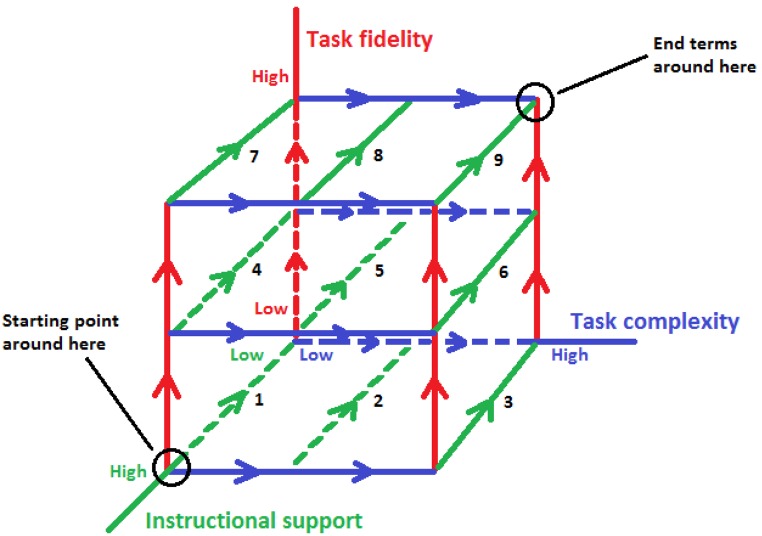
Cognitive Load Theory (CLT) has started to find more applications in medical education research. Unfortunately, misconceptions such as lower cognitive load always being beneficial to learning and the continued use of dated concepts and methods can result in improper applications of CLT principles in medical education design and research. This review outlines how CLT has evolved and presents a synthesis of current-day CLT principles in a holistic model for medical education design. This model distinguishes three dimensions: task fidelity: from literature (lowest) through simulated patients to real patients (highest); task complexity: the number of information elements; and instructional support: from worked examples (highest) through completion tasks to autonomous task performance (lowest). These three dimensions together constitute three steps to proficient learning: (I) start with high support on low-fidelity low-complexity tasks and gradually fade that support as learners become more proficient; (II) repeat I for low-fidelity but higher-complexity tasks; and (III) repeat I and II in that order at subsequent levels of fidelity. The numbers of fidelity levels and complexity levels within fidelity levels needed depend on the aims of the course, curriculum or individual learning trajectory. This paper concludes with suggestions for future research based on this model.
Overview
The claims and statistics of this paper haven’t been checked yet.
Run the check — free, no account needed. It reads the open-access text and checks the sources it cites.
Integrity signals
Registry
Cites
Statistics
Figures
Verification
Claims the paper makes
The claims and statistics of this paper haven’t been checked yet.
Run the check — free, no account needed. It reads the open-access text and checks the sources it cites.
Claims other papers make about this one
Each is checked against this paper’s own text: does it say what the citing paper says it does?
The source backs part of the claim, not all of it — or backs it for a different population, condition or comparison.
In the citing paper
“An assessment after the out-of-class instruction is an excellent way to evaluate student comprehension of a topic and facilitate the use of mastery learning techniques (22).”
From Applying learning theories and instructional design models for effective instruction (2016) · cites this paper as [22]
Experimental — accuracy not yet measured
Self-check
Percentages, sums and reported differences re-computed from the paper’s own numbers.
The self-check needs the paper’s full text.
Citations
Cites
Development of NASA-TLX (Task Load Index): Results of Empirical and Theoretical Research
(1988) · Advances in Psychology · doi:10.1016/s0166-4115(08)62386-9 · Cited by 15,003
(2011) · Cited by 14,317
Cognitive Load During Problem Solving: Effects on Learning
Sweller, J. (1988) · Cognitive Science · doi:10.1016/0364-0213(88)90023-7 · Cited by 11,048
The magical number 4 in short-term memory: A reconsideration of mental storage capacity
Cowan, N. (2001) · Behavioral and Brain Sciences · doi:10.1017/s0140525x01003922 · Cited by 6,779
Sweller, J., Ayres, P., & Kalyuga, S. (2011) · Elsevier eBooks · doi:10.1007/978-1-4419-1428-6_446 · Cited by 6,172
Cognitive Architecture and Instructional Design
Sweller, J., van Merrienboer, J. J. G., & Paas, F. G. W. C. (1998) · Educational Psychology Review · doi:10.1023/a:1022193728205 · Cited by 6,023
Cognitive load theory, learning difficulty, and instructional design
Sweller, J. (1994) · Learning and Instruction · doi:10.1016/0959-4752(94)90003-5 · Cited by 3,801 · cited 2×
“It goes without saying that the more working memory capacity is required for dealing with the way in which information is presented—a concept coined extraneous cognitive load [6]—the less working memory capacity remains for dealing with the intrinsic content of information—hereinafter referred to as intrinsic cognitiv…”
BackgroundCognitive Load Theory and the Format of Instruction
Chandler, P., & Sweller, J. (1991) · Cognition and Instruction · doi:10.1207/s1532690xci0804_2 · Cited by 2,894
Cognitive Load Measurement as a Means to Advance Cognitive Load Theory
Paas, F., Tuovinen, J. E., Tabbers, H., & Van Gerven, P. W. M. (2003) · Educational Psychologist · doi:10.1207/s15326985ep3801_8 · Cited by 2,527
Paas, F. G. W. C. (1992) · Journal of Educational Psychology · doi:10.1037/0022-0663.84.4.429 · Cited by 2,150
Cited by
Sorted by citations
Items 101–200 of 299
Balhaddad, A. A., Marghalani, A. A., Raderman, M. A., Miginsky, E., Massey, W. L., Strassler, H. E., & Melo, M. A. S. (2020) · European Journal Of Dental Education · doi:10.1111/eje.12635 · Cited by 11
McNamara, L., Scott, K. M., Boyd, R. N., Farmer, E. S., Webb, A., Bosanquet, M., Nguyen, K., & Novak, I. (2022) · BMJ Open · doi:10.1136/bmjopen-2022-063558 · Cited by 13
A preliminary psychometric evaluation of the eight-item cognitive load scale
Pignatiello, G. A., Tsivitse, E., & Hickman, R. L. (2018) · Applied Nursing Research · doi:10.1016/j.apnr.2018.01.006 · Cited by 11
Influence of Instructional Design to Manage Intrinsic Cognitive Load on Learning Effectiveness
Huang, Y. (2018) · Eurasia Journal of Mathematics Science and Technology Education · doi:10.29333/ejmste/90264 · Cited by 11
Sridhar, P. K., Chan, S., Chua, Y., Yow, W. Q., & Nanayakkara, S. C. (2019) · International Journal of Child-Computer Interaction · doi:10.1016/j.ijcci.2019.04.002 · Cited by 11
Toy, S., Miller, C. R., Guris, R. J. D., Duarte, S. S., Koessel, S., & Schiavi, A. J. (2020) · Simulation in Healthcare The Journal of the Society for Simulation in Healthcare · doi:10.1097/sih.0000000000000458 · Cited by 11
Helping medical students in their study of statistics: A flexible approach
Leppink, J. (2016) · Journal of Taibah University Medical Sciences · doi:10.1016/j.jtumed.2016.08.007 · Cited by 13
Self-citationBozorgian, H., Muhammadpour, M., & Alehchali, A. B. (2025) · Language Awareness · doi:10.1080/09658416.2025.2489937 · Cited by 11
Hart, M. J., Sung, J. Y., McQuillin, S. D., & Schleider, J. L. (2022) · Journal of Community Psychology · doi:10.1002/jcop.22927 · Cited by 10
Weber, J., & Wilhelm, T. E. (2024) · Physical Review Physics Education Research · doi:10.1103/physrevphyseducres.20.020130 · Cited by 16
The Relationship Between Persuasion Cues and Idea Adoption in Virtual Crowdsourcing Communities
Daradkeh, M. K. (2021) · International Journal of Knowledge Management · doi:10.4018/ijkm.291708 · Cited by 9
Hanham, J., & Leppink, J. (2018) · Springer eBooks · doi:10.1007/978-981-13-2808-4_6 · Cited by 9
Self-citationKugler, H. L., Taylor, N. F., Boyd, L., & Brusco, N. K. (2022) · Disability and Rehabilitation · doi:10.1080/09638288.2022.2048908 · Cited by 9
Yoosoof, F., Liyanage, I., de Silva, R., & Samaraweera, S. (2022) · BMC Medical Education · doi:10.1186/s12909-022-03926-2 · Cited by 9
An Opportunity for Cognitive Task Analysis in Neonatal Resuscitation
Zehnder, E. C., Law, B. H. Y., & Schmölzer, G. M. (2019) · Frontiers in Pediatrics · doi:10.3389/fped.2019.00356 · Cited by 9
Medical Student Experiential Learning in Telesimulation
Gerstenberger, J. P., Hayes, L., Chow, C. J., & Raaum, S. E. (2023) · Journal of Medical Education and Curricular Development · doi:10.1177/23821205231216067 · Cited by 8
Wu, L. Y., & Wang, S. (2024) · Education and Information Technologies · doi:10.1007/s10639-024-13051-w · Cited by 9
Nair, B., Khan, S., Naidoo, N. S., Jannati, S., Shivani, B., & Banerjee, Y. (2024) · Frontiers in Psychology · doi:10.3389/fpsyg.2024.1240791 · Cited by 16
Human Cognitive Architecture Through the Lens of Cognitive Load Theory
Leppink, J., & Hanham, J. (2018) · Springer eBooks · doi:10.1007/978-981-13-2808-4_2 · Cited by 8
Self-citationUsing Cognitive Load Theory to Optimize Simulation Design
Naismith, L. M., Cheung, J. J. H., Sibbald, M., Tavares, W., Cavalcanti, R. B., Haji, F. A., & Fraser, K. L. (2019) · Elsevier eBooks · doi:10.1016/b978-0-12-815657-5.00010-3 · Cited by 11
London, D. A., Zastrow, R. K., Gluck, M. J., & Cagle, P. J. (2021) · The Journal Of Hand Surgery · doi:10.1016/j.jhsa.2021.03.007 · Cited by 8
Residency Education Redesign: The Interplay of Innovation and Standardization
Garvin, R. D., & Carney, P. A. (2021) · Family Medicine · doi:10.22454/fammed.2021.862031 · Cited by 8
The Impacts of Visual Aids in Promoting the Learning Processes in Schools in Pakistan
Hamad, J. I. (2023) · African Journal of Education and Practice · doi:10.47604/ajep.1912 · Cited by 13
Chiniara, G., Clark, M., Jaffrelot, M., Posner, G., & Rivière, É. (2019) · Elsevier eBooks · doi:10.1016/b978-0-12-815657-5.00038-3 · Cited by 8
Verification of Cognitive Load Theory with Psychophysiological Measures in Complex Problem-Solving
Jo, I., & Kim, J. (2019) · The Asia-Pacific Education Researcher · doi:10.1007/s40299-019-00495-9 · Cited by 9
The voice effect in multimedia instruction revisited: Does it still exist
Dinçer, N. (2022) · Journal of Pedagogical Research · doi:10.33902/jpr.202214591 · Cited by 7
The effect of subtitle format on cognitive load and comprehension: an eye-tracking study
Matthew, G. (2024) · Technology Pedagogy and Education · doi:10.1080/1475939x.2024.2433259 · Cited by 7
Chao, Y.-H., Wu, H., & Chang, T. (2025) · Nurse Education Today · doi:10.1016/j.nedt.2025.106854 · Cited by 7
Eickelmann, A.-K., Waldner, N., & Huwendiek, S. (2021) · BMC Medical Education · doi:10.1186/s12909-021-03027-6 · Cited by 8
Change in students’ critical thinking over the course of dental education
Anders, P. L., Davis, E. L., & McCall, W. D. (2023) · Journal of Dental Education · doi:10.1002/jdd.13287 · Cited by 7
Methodological Preparation of a Within-Subject Audiovisual Cognition, Reception and Perception Study
Hoecke, S. M. V., Schrijver, I., & Robert, I. (2022) · Journal of Audiovisual Translation · doi:10.47476/jat.v5i1.2022.163 · Cited by 7
Hempel, G., Heinke, W., Struck, M. F., Piegeler, T., & Rotzoll, D. (2019) · Journal of Clinical Medicine · doi:10.3390/jcm8091465 · Cited by 8
Teaching with Cadavers Outside of the Dissection Room Using Cadaveric Videos
Stone, D. M., Hennessy, C., & Smith, C. F. (2022) · Advances in experimental medicine and biology · doi:10.1007/978-3-030-87779-8_12 · Cited by 9
Managing cognitive load in simulations: exploring the role of simulation technologists
Sibbald, M., Wang, B., & Caners, K. (2019) · Canadian Medical Education Journal · doi:10.36834/cmej.68093 · Cited by 7
A survey of Australian sonographer psychomotor teaching practices
Nicholls, D., Sweet, L. P., Hyett, J. A., & Müller, A. (2020) · Australasian Journal of Ultrasound in Medicine · doi:10.1002/ajum.12223 · Cited by 8
Saravanan, P., & Menold, J. (2021) · Human Factors The Journal of the Human Factors and Ergonomics Society · doi:10.1177/00187208211032860 · Cited by 7
What is Transferred and How Much is Retained? A Simulation Study of Complex Surgical Skills
Wilson, C. A., Davidson, J., Chahine, S., Chan, E. P., Stringer, L., Quantz, M., Saklofske, D. H., & Wang, P. Z. T. (2022) · Journal of Surgical Research · doi:10.1016/j.jss.2022.07.040 · Cited by 6
The Application of Cognitive Teaching and Learning Strategies to Instruction in Medical Education
Yeo, S. (2024) · Korean Medical Education Review · doi:10.17496/kmer.24.006 · Cited by 12
Solar Energy Systems Design Using Immersive Virtual Reality: A Multi-Modal Evaluation Approach
AlQallaf, N., AlQallaf, A., & Ghannam, R. (2024) · Solar · doi:10.3390/solar4020015 · Cited by 10
Pignatiello, G. A., Daly, B. J., Demaree, H. A., Moore, S. M., & Hickman, R. L. (2019) · Applied Nursing Research · doi:10.1016/j.apnr.2019.151192 · Cited by 6
Estacio, R. D., Quicho, R. F., Ibarra, F. P., Bustos, I. G., Collantes, L. M., & Ibañez, E. D. (2023) · Pedagogika · doi:10.15823/p.2022.148.11 · Cited by 5
Smith, N. E., Barbé, T., & Randolph, J. (2022) · International Journal of Nursing Education Scholarship · doi:10.1515/ijnes-2021-0127 · Cited by 5
Brown, M. E. L., Parekh, R., Collin, V., Sivam, V., Ahuja, N., & Kumar, S. (2023) · BMJ Open · doi:10.1136/bmjopen-2023-074227 · Cited by 5
Miller, D. J., Noble, P., Medlen, S., Jones, K., & Munns, S. L. (2021) · The Journal of Experimental Education · doi:10.1080/00220973.2021.1947763 · Cited by 6
Hoecke, S. M. V., Schrijver, I., & Robert, I. (2022) · Translation Spaces · doi:10.1075/ts.21038.van · Cited by 5
Kanda, K., Tei, S., Takahashi, H., & Fujino, J. (2023) · PLoS ONE · doi:10.1371/journal.pone.0288042 · Cited by 5
Considering the Yin and Yang of Teaching and Learning: a Resource for the Novice Educator
Wyatt, T. R., & Gilliland, S. J. (2018) · Medical Science Educator · doi:10.1007/s40670-018-00641-w · Cited by 5
Huang, J. J., Licatino, L. K., & Long, T. R. (2020) · Journal of Education in Perioperative Medicine · doi:10.46374/volxxii-issue3-licatino · Cited by 5
Maggio, L. A., Haustein, S., Costello, J. A., Driessen, E. W., & Artino, A. R. (2022) · Perspectives on Medical Education · doi:10.1007/s40037-022-00717-9 · Cited by 5
Miller, C. R., Greer, S. K., Toy, S., & Schiavi, A. J. (2025) · Simulation in Healthcare The Journal of the Society for Simulation in Healthcare · doi:10.1097/sih.0000000000000854 · Cited by 4
Managing cognitive load and enhancing metacognitive learning in postgraduate training and practice
Ng, I. K., Ko, C. J., & Lim, T. K. (2025) · Diagnosis · doi:10.1515/dx-2025-0067 · Cited by 5
van Sassen, C., Mamede, S., Bos, M., van den Broek, W. W., Bindels, P., & Zwaan, L. (2023) · BMC Medical Education · doi:10.1186/s12909-023-04448-1 · Cited by 4
Sridhar, P. K., & Nanayakkara, S. C. (2020) · Education Sciences · doi:10.3390/educsci10070177 · Cited by 4
Nicholls, D., Sweet, L. P., Hyett, J. A., & Müller, A. (2020) · Australasian Journal of Ultrasound in Medicine · doi:10.1002/ajum.12222 · Cited by 4
Tracing and Pointing Support Multimedia Learning: A Cross-Cultural Replication
Wang, Y., Han, K., & Ginns, P. (2025) · Educational Psychology Review · doi:10.1007/s10648-025-10005-7 · Cited by 4
Managing the Load on a Learner’s Mind: a Cognitive Load Theory Perspective
Leppink, J. (2017) · Medical Science Educator · doi:10.1007/s40670-017-0439-8 · Cited by 4
Self-citationVarsou, O., & Welsh, M. (2021) · Journal of Learning Development in Higher Education · doi:10.47408/jldhe.vi22.796 · Cited by 4
Videoconferencing: A Steep Learning Curve for Medical Educators
Smeraglio, A. C., DiVeronica, M., Terndrup, C. P., McGhee, B., & Hunsaker, S. (2020) · Journal of Graduate Medical Education · doi:10.4300/jgme-d-20-00514.1 · Cited by 5
On the Design of Instruction and Assessment
Lee, C. B., Leppink, J., & Hanham, J. (2018) · Springer eBooks · doi:10.1007/978-981-13-2808-4_11 · Cited by 4
Self-citationAsanre, A. A., Oguntola, J. I., Ramatea, M. A., & Lawani, A. O. (2026) · European Journal of STEM Education · doi:10.20897/ejsteme/18268 · Cited by 4
Visualization and metacognitive scaffolding in learning from animations
Deibl, I., Zumbach, J., & Fleischer, T. (2023) · Social Sciences & Humanities Open · doi:10.1016/j.ssaho.2023.100601 · Cited by 8
Amoudi, A. A., & Alshawwa, L. (2023) · Journal of Medical Education and Curricular Development · doi:10.1177/23821205231212297 · Cited by 3
Cerovac, M., & Keane, T. (2024) · International Journal of Technology and Design Education · doi:10.1007/s10798-024-09934-1 · Cited by 3
Reducing Cognitive Load in Emerging Digital Learning Environments Through Peer Instruction
Edwards, B. I., Shukor, N. A., & Mohamed, H. (2021) · Lecture notes in educational technology · doi:10.1007/978-981-16-3521-2_7 · Cited by 3
Managing ambiguity and uncertainty in clinical decision-making
Lafitte, N. (2023) · Journal of Paramedic Practice · doi:10.12968/jpar.2023.15.4.cpd1 · Cited by 4
Time-lapse dissection videos: traditional practice in a new, digital format
Buddle, S. (2023) · Journal of Visual Communication in Medicine · doi:10.1080/17453054.2024.2304838 · Cited by 3
Al‐Omari, H., Aljawarneh, Y. M., & Al-Rawashdeh, S. Y. (2025) · Critical Public Health · doi:10.1080/09581596.2025.2504074 · Cited by 3
Measuring germane load requires correlation with learning
Naismith, L. M., & Cavalcanti, R. B. (2016) · Medical Education · doi:10.1111/medu.13134 · Cited by 3
Using Mobile Devices to Augment Inquiry-Based Learning Processes with Multiple RepresentationsPreprint
Becker, S., Klein, P., Gößling, A., & Kühn, J. (2019) · arXiv (Cornell University) · doi:10.48550/arxiv.1908.11281 · Cited by 3
A novel model for developing thrust joint manipulation skills: a teaching and learning perspective
Adams, K. R., Kolb, W. H., Geiser, M. B., & Dolphin, M. (2024) · Journal of Manual & Manipulative Therapy · doi:10.1080/10669817.2023.2299184 · Cited by 2
Gärtner, R., Peters, H., & Holzhausen, Y. (2025) · BMC Medical Education · doi:10.1186/s12909-025-08083-w · Cited by 2
How to deliver effective paediatric simulation based education
O’Leary, F. (2024) · Paediatric Respiratory Reviews · doi:10.1016/j.prrv.2024.05.001 · Cited by 2
A theoretical framework for experiential learning: Creating Active Knowledge Experiences (CAKE)
Archer, R. M., Wagner, M., & Snell, L. (2026) · Advances in Health Sciences Education · doi:10.1007/s10459-026-10508-0 · Cited by 10
Managing LearningThrough Mathematical Literacy Based on Cognitive Load
Asmara, S. B. W. A. S. (2021) · Türk bilgisayar ve matematik eğitimi dergisi · doi:10.17762/turcomat.v12i5.807 · Cited by 2
Jones, K., Miller, D. J., & Noble, P. (2024) · Journal of Veterinary Medical Education · doi:10.3138/jvme-2023-0135 · Cited by 2
McLaughlin, P. A., Vaughan, B., Tripodi, N., & Kelly, K. (2023) · Focus on Health Professional Education A Multi-Professional Journal · doi:10.11157/fohpe.v24i3.676 · Cited by 2
Effects of finger tracing on learning from spatially separated and integrated multimedia materials
Zuo, G., de Koning, B. B., & PAAS, F. G. W. C. (2025) · Educational Psychology · doi:10.1080/01443410.2025.2516549 · Cited by 2
Bailey, S. K. T. (2017) · Journal of International Crisis and Risk Communication Research · Cited by 2
The Application of Cognitive Teaching and Learning Strategies to Instruction in Medical Education
Yeo, S. (2020) · Korean Medical Education Review · doi:10.17496/kmer.2020.22.2.57 · Cited by 2
Theories of Blended Learning: A Novel Approach to Tertiary Neuroanatomy
Whiting, H., Blackmore, C., Vitali, J., Langfield, T., Colthorpe, K. L., Ernst, H., & Ainscough, L. (2022) · International Journal of Higher Education · doi:10.5430/ijhe.v11n4p191 · Cited by 2
Martín, A. C., Ortega‐Arranz, A., Alario‐Hoyos, C., Amarasinghe, I., Hernández‐Leo, D., & Kloos, C. D. (2022) · Lecture notes in computer science · doi:10.1007/978-3-031-20218-6_21 · Cited by 2
From Boring to Bravo! Using Learning Science to Create Memorable Presentations
Schwartz, J. E., Brondfield, S., Walsh, K. J., & Manochakian, R. (2023) · American Society of Clinical Oncology Educational Book · doi:10.1200/edbk_389392 · Cited by 2
Gobée, O. P., Sulaiman, S., Boaz, N. T., Mork, A. L., & Whitmore, I. (2024) · Anatomical Science International · doi:10.1007/s12565-024-00761-x · Cited by 3
Taking presentations seriously: Invoking narrative craft in academic talks
Kulasegaram, K. M., Buller, D., & Whitehead, C. R. (2017) · Perspectives on Medical Education · doi:10.1007/s40037-017-0366-9 · Cited by 2
Mental Processes in Emergency Medicine
Leppink, J., & Hanham, J. (2018) · Springer eBooks · doi:10.1007/978-981-13-2808-4_5 · Cited by 2
Self-citationMeasuring brand image : personification and non-personification methods
Mete, M. (2018) · Research Explorer (The University of Manchester) · Cited by 2
Cognitive Load Theory-Informed Curriculum Design in Health Sciences Education
Rana, K., Alford, S., Moore, A., & Chimoriya, R. (2026) · Encyclopedia · doi:10.3390/encyclopedia6050102 · Cited by 2
Teaching Simple and Complex Psychomotor Skills
Nicholls, D. (2020) · Springer eBooks · doi:10.1007/978-981-13-6106-7_45-1 · Cited by 1
Confusion and Chinese character learning
Hong, J., Lin, C.-H., Tsai, Y.-H., & Tai, K. (2021) · Language Learning Journal · doi:10.1080/09571736.2021.1915365 · Cited by 2
London, D. A., Zastrow, R. K., & Cagle, P. J. (2021) · The Journal Of Hand Surgery · doi:10.1016/j.jhsa.2021.10.010 · Cited by 1
Influence of Faculty-Derived Concept Maps on Student Study Strategies
Hardy, K. P., Burbage, A. K., & Kerry, J. A. (2025) · Medical Science Educator · doi:10.1007/s40670-025-02496-4 · Cited by 1
Alfarani, L., & Alharbi, A. (2025) · Medical Science Educator · doi:10.1007/s40670-025-02467-9 · Cited by 1
Written instruction that significantly promotes science learning
Wei, Y. (2025) · Physical Review Physics Education Research · doi:10.1103/lhjv-rq13 · Cited by 1
Estellés, J. T., Mendoza, E. M., & Breton, P. (2025) · Education Sciences · doi:10.3390/educsci16010051 · Cited by 1
When less is more: The puzzling impact of employee education on green innovation performance
Adewumi, O. M., & Zhang, D. (2026) · Journal of Cleaner Production · doi:10.1016/j.jclepro.2026.147857 · Cited by 1
Liu, C., Zhang, M., Xiao, Y., Tong, H., Ru, J., Wang, W. J., Liang, Q., Zu, S., Zhao, C., & Wang, Y. (2026) · Advances in Medical Education and Practice · doi:10.2147/amep.s559725 · Cited by 1
Adding pedagogical agents who point or trace to children's instructional videos
Cheng, M., Qiao, P., Ni, H., Xie, H., Mayer, R. E., & Wang, F. (2026) · Computers & Education · doi:10.1016/j.compedu.2026.105618 · Cited by 2
Vasluianu, R.-I., Katsonis, A., Tatarciuc, M., Vițalariu, A. M., Armencia, A. O., Katsoni, A. S., Perperidis, P., Cioloca, C. H., Grădinaru, I., Stamatin, O., et al. (2026) · Dentistry Journal · doi:10.3390/dj14040234 · Cited by 1
Changes to Master Adaptive Learning in the Pre-Clerkship Phase of Medical School
Lawson, L. E., Domico, L., Deiorio, N. M., Cana, C., Santen, S. A., Garber, A. M., Lord, K., & Feldman, M. (2026) · Medical Science Educator · doi:10.1007/s40670-026-02794-5 · Cited by 1
Using undergraduate research to develop transferable skills for the modern workforce
Wang, J. T. H. (2016) · Microbiology Australia · doi:10.1071/ma16026 · Cited by 1
Metadata
- Authors
- Leppink, J., & Van den Heuvel, A.
- Affiliations
- Maastricht University (NL)
- Corresponding author
- Leppink, Jimmie
- ORCID
- Leppink, Jimmie
- Venue
- Perspectives on Medical Education
- Publisher
- Ubiquity Press, Ltd.
- Published
- 2015-05-28
- Volume
- 4
- Issue
- 3
- Pages
- 119-127
- ISSN
- 2212-2761 (ISSN-L)
- 2212-277X
- PMC
- PMC4456454
- OpenAlex
- W1499793228
- Cited by
- 299
- References
- 62
- Citations by year
- 2026: 40 · 2025: 28 · 2024: 20 · 2023: 29 · 2022: 35 · 2021: 35 · 2020: 31 · 2019: 28 · 2018: 21 · 2017: 13 · 2016: 17 · 2015: 2
- FWCI
- 18.95
- Type
- journal article
- Language
- en
- Open access
- diamond
- doi.org
- Licence
- Locations
- Perspectives on Medical Education (publishedVersion, cc-by)
- PubMed Central (publishedVersion, cc-by)
- PubMed (publishedVersion)
- Research Publications (Maastricht University) (publishedVersion, cc-by)
- DOAJ (DOAJ: Directory of Open Access Journals) (submittedVersion)
- Research Publications (Maastricht University) (submittedVersion, other-oa)
- Topics
- Social Sciences › Education › Innovations in Medical Education
- Social Sciences › Psychology › Experimental and Cognitive Psychology › Visual and Cognitive Learning Processes
- Health Sciences › Medicine › Family Practice › Clinical Reasoning and Diagnostic Skills
- Keywords
- cognitive load theory, medical education, instructional design, task complexity, pedagogical support, worked examples, standardized patients
About these checks
Registry, retraction, Cites and statistics results are computed, not judged, with one exception: a printed reference that no index lists is read once by a model before it counts as a citation error. Claims are extracted by a model and kept only when their quote appears verbatim in the text; each cited source is then checked, with a model’s help, for whether it says what the claim relies on. Those verdicts can be wrong — read the claim’s quote and the cited source before relying on one.
Statistics and arithmetic are recomputed, not judged.
Confidence bands are shown only for fields calibrated on our annotated test set. None is calibrated yet, so no band is shown.
What counts as a claim ›How we measure confidence ›How we check this ›
Are you an author, or do you see a problem with this page? Request a review
