

The DOI matches its Crossref record; 61 of the 62 references it cites were found in a registry or an index.
The evolution of cognitive load theory and its application to medical education
Open accessAbstract
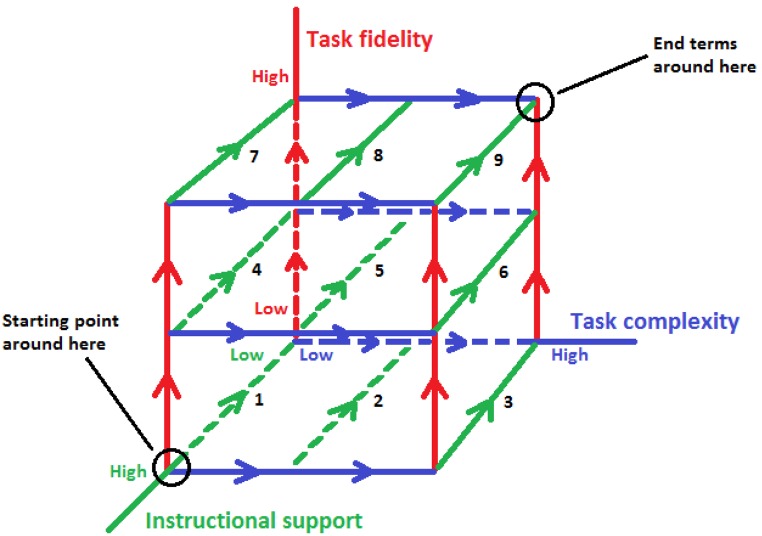
Cognitive Load Theory (CLT) has started to find more applications in medical education research. Unfortunately, misconceptions such as lower cognitive load always being beneficial to learning and the continued use of dated concepts and methods can result in improper applications of CLT principles in medical education design and research. This review outlines how CLT has evolved and presents a synthesis of current-day CLT principles in a holistic model for medical education design. This model distinguishes three dimensions: task fidelity: from literature (lowest) through simulated patients to real patients (highest); task complexity: the number of information elements; and instructional support: from worked examples (highest) through completion tasks to autonomous task performance (lowest). These three dimensions together constitute three steps to proficient learning: (I) start with high support on low-fidelity low-complexity tasks and gradually fade that support as learners become more proficient; (II) repeat I for low-fidelity but higher-complexity tasks; and (III) repeat I and II in that order at subsequent levels of fidelity. The numbers of fidelity levels and complexity levels within fidelity levels needed depend on the aims of the course, curriculum or individual learning trajectory. This paper concludes with suggestions for future research based on this model.
Overview
The claims and statistics of this paper haven’t been checked yet.
Run the check — free, no account needed. It reads the open-access text and checks the sources it cites.
Integrity signals
Registry
Cites
Statistics
Figures
Verification
Claims the paper makes
The claims and statistics of this paper haven’t been checked yet.
Run the check — free, no account needed. It reads the open-access text and checks the sources it cites.
Claims other papers make about this one
Each is checked against this paper’s own text: does it say what the citing paper says it does?
The source backs part of the claim, not all of it — or backs it for a different population, condition or comparison.
In the citing paper
“An assessment after the out-of-class instruction is an excellent way to evaluate student comprehension of a topic and facilitate the use of mastery learning techniques (22).”
From Applying learning theories and instructional design models for effective instruction (2016) · cites this paper as [22]
Experimental — accuracy not yet measured
Self-check
Percentages, sums and reported differences re-computed from the paper’s own numbers.
The self-check needs the paper’s full text.
Citations
Cites
Development of NASA-TLX (Task Load Index): Results of Empirical and Theoretical Research
(1988) · Advances in Psychology · doi:10.1016/s0166-4115(08)62386-9 · Cited by 15,003
(2011) · Cited by 14,317
Cognitive Load During Problem Solving: Effects on Learning
Sweller, J. (1988) · Cognitive Science · doi:10.1016/0364-0213(88)90023-7 · Cited by 11,048
The magical number 4 in short-term memory: A reconsideration of mental storage capacity
Cowan, N. (2001) · Behavioral and Brain Sciences · doi:10.1017/s0140525x01003922 · Cited by 6,779
Sweller, J., Ayres, P., & Kalyuga, S. (2011) · Elsevier eBooks · doi:10.1007/978-1-4419-1428-6_446 · Cited by 6,172
Cognitive Architecture and Instructional Design
Sweller, J., van Merrienboer, J. J. G., & Paas, F. G. W. C. (1998) · Educational Psychology Review · doi:10.1023/a:1022193728205 · Cited by 6,023
Cognitive load theory, learning difficulty, and instructional design
Sweller, J. (1994) · Learning and Instruction · doi:10.1016/0959-4752(94)90003-5 · Cited by 3,801 · cited 2×
“It goes without saying that the more working memory capacity is required for dealing with the way in which information is presented—a concept coined extraneous cognitive load [6]—the less working memory capacity remains for dealing with the intrinsic content of information—hereinafter referred to as intrinsic cognitiv…”
BackgroundCognitive Load Theory and the Format of Instruction
Chandler, P., & Sweller, J. (1991) · Cognition and Instruction · doi:10.1207/s1532690xci0804_2 · Cited by 2,894
Cognitive Load Measurement as a Means to Advance Cognitive Load Theory
Paas, F., Tuovinen, J. E., Tabbers, H., & Van Gerven, P. W. M. (2003) · Educational Psychologist · doi:10.1207/s15326985ep3801_8 · Cited by 2,527
Paas, F. G. W. C. (1992) · Journal of Educational Psychology · doi:10.1037/0022-0663.84.4.429 · Cited by 2,150
Cited by
Sorted by citations
Items 201–299 of 299
Medical Simulation as an Instructional Tool in Health Education
Lerant, A. A., Bates, O. J., Holder, M. G., Orledge, J. D., Rockhold, R. W., Kyle, R. R., & Murray, W. B. (2016) · Advances in medical education, research, and ethics (AMERE) book series · doi:10.4018/978-1-5225-2098-6.ch005 · Cited by 1
Chunk Learning Media for Cognitive Load Optimization on Science Learning
Angga, M., Phieranto, C. C., Teio, F., Yovan, D., Angelica, A., & Putri, F. S. (2022) · International Conference on Informatics and Computing (ICIC) · doi:10.1109/icic56845.2022.10006912 · Cited by 1
NETWORK OF INFORMAL TOURISM EDUCATION ORGANIZATIONS IN PARE ENGLISH VILLAGE
Yunanto, Y. (2023) · Media Mahardhika · doi:10.29062/mahardika.v21i2.517 · Cited by 1
The ABCs of OTCs: A Video-Based Curriculum Regarding Over-the-Counter Pediatric Products
Joyce, A. H., Genderen, K. V., Flais, S. V., Keeley, M., Gollehon, N. S., & Ryan, M. S. (2023) · MedEdPORTAL · doi:10.15766/mep_2374-8265.11315 · Cited by 1
Teaching Simple and Complex Psychomotor Skills
Nicholls, D. (2023) · Springer eBooks · doi:10.1007/978-981-15-3344-0_45 · Cited by 1
Modeling in molecular genetics allows students to make connections between biological scales
Wilson, K. J., & Chatterjee, A. K. (2023) · Biochemistry and Molecular Biology Education · doi:10.1002/bmb.21790 · Cited by 1
Virtual Reality Anatomy Trainer Turns Teaching Endobronchial Ultrasound Inside-Out
New, M. L., Huie, T. J., Claar, D. D., Amass, T. H., Peterson, R., McGrath, M., Jacobson, N. M., Neumeier, A. T., & Nelson, D. R. (2024) · CHEST Journal · doi:10.1016/j.chest.2024.11.032 · Cited by 1
van Sassen, C., van den Broek, W. W., Bindels, P., & Zwaan, L. (2025) · Perspectives on Medical Education · doi:10.5334/pme.1730 · Cited by 1
Threshold Concepts and Concept Networks in Evolution Education: An Experimental Intervention Study
Aptyka, H., Fiedler, D., & Großschedl, J. (2025) · Science Education · doi:10.1002/sce.21977 · Cited by 1
Arnaert, A., Ponzoni, N., Liebert, J., & Debe, Z. (2017) · Elsevier eBooks · doi:10.1016/b978-0-12-805362-1.00007-3 · Cited by 1
Visual metaphors in medical knowledge representation
Sánchez, M. T., & Valenzuela, A. C. (2019) · Linguistica Antverpiensia New Series – Themes in Translation Studies · doi:10.52034/lanstts.v17i0.464 · Cited by 1
Measuring Cognitive Load in Blended Laboratory Setting: Toward Enhanced Learning in Chemistry
Urbano, R. D., & Caballes, D. G. (2020) · International Journal of English Literature and Social Sciences · doi:10.22161/ijels.53.21 · Cited by 1
Pignatiello, G. A. (2021) · OhioLink ETD Center (Ohio Library and Information Network) · Cited by 1
Measuring the cognitive load induced by subtitled audiovisual texts in an educational context
Matthew, G. (2019) · Boloka Institutional Repository (North-west University) · Cited by 1
Lights. Camera. Action. Debrief.
Tremblay, M.-L. (2023) · Research Publications (Maastricht University) · doi:10.26481/dis.20230508mt · Cited by 2
Instructional Strategies to Manage Cognitive Load in Orthodontics
Asad, S. (2016) · Annals of King Edward Medical University · doi:10.21649/akemu.v22i1.794 · Cited by 1
Lau, K. H. V., & Moeller, J. J. (2016) · Medical Education · doi:10.1111/medu.13046
McCallister, C. (2019) · IRL - University of Missouri, St. Louis (University of Missouri–St. Louis)
Ramírez, S. E., Aprea, M., Fontana, M. A., Ferrero, F., & Cobián, J. I. (2020) · Revista Latinoamericana de Simulación Clínica · doi:10.35366/95233
Teaching and Learning Methods for Drug Information
Fernández-Llimós, F., Borba, H. H. L., Mendes, A. M., Pontarolo, R., & Tonin, F. S. (2020) · Advances in medical education, research, and ethics (AMERE) book series · doi:10.4018/978-1-7998-4486-0.ch003
Abdelmannan, D. K. (2021) · MedEdPublish · doi:10.15694/mep.2021.000127.1
INSPIRE Simulación Femeba. La Plata, A., Cobián, J. I., Ferrero, F., Alonso, M. P., & Fontana, A. M. (2021) · Revista Argentina de Cirugía · doi:10.25132/raac.v113.n1.1569.ei
Motivational Languaging for L2 Learning and Motivation
Kim, T.-Y., & Kim, Y.-K. (2021) · Porta Linguarum Revista Interuniversitaria de Didáctica de las Lenguas Extranjeras · doi:10.30827/portalin.v0i36.17805
Cao, W., Kamal, J. I., & Goh, C. H. (2021) · Malaysian Journal of Social Sciences and Humanities (MJSSH) · doi:10.47405/mjssh.v6i10.1108 · Cited by 1
Replacement Of Conceptions Developed During Health Professions Education
Usmani, A., & Imran, M. (2018) · Journal of Bahria University Medical and Dental College · doi:10.51985/jbumdc2018049
Building an Extended Reality Pedagogical Continuum Through 180° First-Person Point-of-View Video
Ros, M., & Neuwirth, L. S. (2021) · Advances in medical technologies and clinical practice book series · doi:10.4018/978-1-7998-8371-5.ch006
Students’ Perception of Cognitive Load in an Accelerated DPT Program with a Blended Curriculum
Marinas, R., Groff, S. L., Panesar-Aguilar, S., & Bobbio, T. G. (2022) · Global Journal of Health Science · doi:10.5539/gjhs.v14n2p52
Virtual Wards: A Rapid Adaptation to Clinical Attachments in MBChB During the COVID-19 Pandemic
Huser, C. A. M., Templeton, K. M., Stewart, M., Dhanani, S., Hughes, M., & Boyle, J. G. (2022) · Advances in experimental medicine and biology · doi:10.1007/978-3-030-87779-8_5
Theories of Blended Learning: A Novel Approach to Tertiary Neuroanatomy
Whiting, H., Blackmore, C., Vitali, J., Langfield, T., Colthorpe, K. L., Ernst, H., & Ainscough, L. (2022) · International Journal of Higher Education · doi:10.5430/ijhe.v11n4p192
بدوى, ا. ع. ا. ف. ق. (2021) · تکنولوجيا التعليم سلسلة دراسات وبحوث · doi:10.21608/tesr.2021.224397
(2016) · Microbiology Australia · doi:10.1071/mav37n2
Paralikar, S., Shah, C. J., Kapoor, A., & Parmar, U. (2022) · Indian Journal of Physiology and Pharmacology · doi:10.25259/ijpp_136_2020
Adaptive single case design (ASCD)
Leppink, J. (2022) · Scientia Medica · doi:10.15448/1980-6108.2022.1.42370
Self-citationReflection portfolio as an instrument of academic self-regulation in Family Medicine Residency
Gutiérrez-Murillo, R. S. (2022) · Revista Virtual de la Sociedad Paraguaya de Medicina Interna · doi:10.18004/rvspmi/2312-3893/2022.09.02.168
Ansari, R. M., Idris, S., Latiff, A. A., & Hong, W. (2022) · Education in Medicine Journal · doi:10.21315/eimj2022.14.4.2
Solar Energy Systems Design using Immersive Virtual Reality: A Multi-Modal Learning ApproachPreprint
AlQallaf, N., AlQallaf, A., & Ghannam, R. (2023) · doi:10.36227/techrxiv.22790174
Solar Energy Systems Design using Immersive Virtual Reality: A Multi-Modal Learning ApproachPreprint
AlQallaf, N., AlQallaf, A., & Ghannam, R. (2023) · doi:10.36227/techrxiv.22790174.v1
Identifying problems in onboarding design for expertise-centric citizen science games
Miller, J. A. (2023) · Digital Repository Service (Northeastern University) · doi:10.17760/d20560789
A peer-to-peer handoff tool to ease clerkship transitions
Fishman, C. E., Sommers, T. F., Bennett, N. L., & Cohen, M. E. (2023) · Medical Teacher · doi:10.1080/0142159x.2023.2292980
Orak, C., Küçük, S., & Gülcü, A. (2023) · Öğretim Teknolojisi ve Hayat Boyu Öğrenme Dergisi - Instructional Technology and Lifelong Learning · doi:10.52911/itall.1344964
الكفاءة السيكومترية لمقياس العبء المعرفي المدرك لدى طلاب المدارس الاعدادية بمحافظة الوادي الجديد
احمد, أ. ر. ع. م., & جادالله, أ. م. د. ش. م. (2023) · Maǧallaẗ Kulliyyaẗ Al-Adāb bi Al-Wadī Al-Ǧadīd/Maǧallaẗ Kulliyyaẗ Al-Adāb bi Al-Wadī Al-Ǧadīd · doi:10.21608/mkwn.2023.331995
Holland, J., McGarvey, A., Flood, M., Joyce, P., & Pawlikowska, T. R. B. (2024) · Medical Science Educator · doi:10.1007/s40670-024-02104-x
Asim, N., & Alberto, I. (2024) · Advances in Medical Education and Practice · doi:10.2147/amep.s499646
Bowen, J., Kelleher, M. E., Kinnear, B., Schumacher, D. J., Turner, D. A., & Herrmann, L. E. (2024) · Academic Pediatrics · doi:10.1016/j.acap.2024.102600
Nema, N., Goyal, Y., Gupta, H., Paralikar, S., Shah, C. J., & Singh, P. (2024) · CHRISMED Journal of Health and Research · doi:10.4103/cjhr.cjhr_103_24
Ayala, S., Abrams, E. R., Melniker, L. A., Melville, L. D., & Chiricolo, G. C. (2025) · Emergency Care and Medicine · doi:10.3390/ecm2030031
Impact of Peer-Led Donor Videos on Gross Anatomy Medical Education
Bennitt, A., Woodcock, J., Allison, S. M., & Gyorkos, A. M. (2025) · Medical Science Educator · doi:10.1007/s40670-025-02481-x
Alruwaili, A. R., Alnajashi, S. A., Alwasedi, A. M., Albraihi, S. K., Keenan, R. J., Melzer, T. R., & Almuqbel, M. M. (2025) · Medicine · doi:10.1097/md.0000000000044455
Cognitive Load Effect on Intraoperative Learning – A Randomized Trial in Simulation-Based Settings
Shaheen, M. F., Alhabeeb, A. Y., Mukhtar, F., Alhabeeb, J., Alhamadh, M. S., Alothri, M. A., Aldusari, R., Almunyif, R. M., & Alnasser, S. (2025) · Journal of surgical education · doi:10.1016/j.jsurg.2025.103729
Leveraging simulation to understand nursing student learning in technologically complex environments
Rojas, D. E., Dingley, C., Holt, K. E., Morgan, J. J., & Serafica, R. C. (2025) · Clinical Simulation in Nursing · doi:10.1016/j.ecns.2025.101841
Bowen, J., Prideaux, J., Kelleher, M., Gilliam, C. A., Kinnear, B., Schumacher, D. J., Real, F. J., & Herrmann, L. E. (2025) · Academic Pediatrics · doi:10.1016/j.acap.2025.103172
Creating and Disseminating Meaningful Education Research
Rodríguez, J., Ohman, K. A., & Wise, P. E. (2025) · Clinics in Colon and Rectal Surgery · doi:10.1055/s-0045-1813669
İŞCAN, G., & Gürdal, O. (2025) · BMC Medical Education · doi:10.1186/s12909-025-08397-9
Papanagnou, D., Klein, M. R., Zhang, X. C. C., Cameron, K. A., Doty, A. M. B., McCarthy, D. M., Rising, K. L., & Salzman, D. H. (2021) · Figshare · doi:10.6084/m9.figshare.15041058
Aptyka, H., Fiedler, D., & Großschedl, J. (2022) · Figshare · doi:10.6084/m9.figshare.19687013
Papanagnou, D., Klein, M. R., Zhang, X. C. C., Cameron, K. A., Doty, A. M. B., McCarthy, D. M., Rising, K. L., & Salzman, D. H. (2021) · Figshare · doi:10.6084/m9.figshare.15041061
van Sassen, C., Mamede, S., Bos, M., van den Broek, W., Bindels, P., & Zwaan, L. (2024) · Figshare · doi:10.6084/m9.figshare.26600050
Aptyka, H., Fiedler, D., & Großschedl, J. (2022) · Figshare · doi:10.6084/m9.figshare.19687016
Papanagnou, D., Klein, M. R., Zhang, X. C. C., Cameron, K. A., Doty, A. M. B., McCarthy, D. M., Rising, K. L., & Salzman, D. H. (2021) · Figshare · doi:10.6084/m9.figshare.15041067
Aptyka, H., Fiedler, D., & Großschedl, J. (2022) · Figshare · doi:10.6084/m9.figshare.19687019
Papanagnou, D., Klein, M. R., Zhang, X. C. C., Cameron, K. A., Doty, A. M. B., McCarthy, D. M., Rising, K. L., & Salzman, D. H. (2021) · Figshare · doi:10.6084/m9.figshare.15041064
Gauwbergen, Y. V., Robert, I., & Schrijver, I. (2026) · Translation Spaces · doi:10.1075/ts.25017.van
Lavekar, P. A., Shetty, V. B., Garcha, V. P., Ambildhok, K. A., Vinay, V., Suryawanshi, A. A., & Shaikh, S. S. A. (2026) · World Journal of Dentistry · doi:10.5005/jp-journals-10015-2786
Liao, J., & Wahlberg, K. J. (2026) · Cardiology in Review · doi:10.1097/crd.0000000000001210
The Importance of Testing: Using Test-Enhanced Learning to Teach Point-of-Care Ultrasound
Kim, A., Pugh, D., Halman, S., Mustafa, H., & McConnell, M. (2026) · Archives of Medicine and Health Sciences · doi:10.4103/amhs.amhs_252_24
Reasoning over recall: a six-step tutorial for muscle actions and innervations in functional anatomy
Gyorkos, A. M. (2026) · AJP Advances in Physiology Education · doi:10.1152/advan.00235.2025
ProjecTA: A Semi-Humanoid Robotic Teaching Assistant with In-Situ Projection for Guided Tours
Zhou, H., Zhang, Y., Zhang, Z., Zhang, W., Wang, C., & An, P. (2026) · CHI Conference on Human Factors in Computing Systems · doi:10.1145/3772318.3790577 · Cited by 1
Nelson, A., Burns, A., McGreevy, J., Halvorson, E. E., Kiger, M., Li, S.-T. T., & Hart, R. (2026) · Journal of Hospital Medicine · doi:10.1002/jhm.70330
Shen, Y., Li, F., Zhang, Q. P., Zhang, Y., Ren, Y., Liu, W. T., & Liu, Y. (2026) · BMC Medical Education · doi:10.1186/s12909-026-09472-5
Wang, Z., Xu, J. Y., Hu, X., Ren, W., Xin, S., Zhao, N., Ye, L., 陆勤康, & 张君涛 (2026) · Frontiers in Medicine · doi:10.3389/fmed.2026.1859841
Du, Z., Li, T., Xu, M., & Xiong, C. (2026) · Frontiers in Sociology · doi:10.3389/fsoc.2026.1740629
Wilson, R. D., Arefin, P., & Sansgiry, S. S. (2026) · Pharmacy · doi:10.3390/pharmacy14040105
Sujannah, W. D., Suwarso, P. N., & Unsiah, F. (2026) · Cogent Education · doi:10.1080/2331186x.2026.2699474
Vitlov, N., Bralić, N., Peričić, T. P., García-Costa, D., López-Iñesta, E., Álvarez-García, E., Grimaldo, F., & Marušić, A. (2026) · Journal of Medical Internet Research · doi:10.2196/86045
Do Large Language Models Suffer from Cognitive Overload? A Benchmark and Orchestration Framework
Tu, B., Yu, Z., Jin, S., Zhang, Y., Xu, M. M., Zhang, M., Jiang, Y., Zhang, X., Weng, J., & Han, X. (2026) · Communications in computer and information science · doi:10.1007/978-981-92-3557-5_2
Lin, L., Chen, X., Huang, Q., Zheng, Q., Wu, Z., Lyu, G., & Chen, M. (2026) · Journal of Cardiothoracic Surgery · doi:10.1186/s13019-026-04507-w
Applying Cognitive Load Theory to Best Practices in Pharmacy Education: A Narrative Review
Islam, M. A., Yang, S., Kim, L., & Talukder, R. M. (2026) · American Journal of Pharmaceutical Education · doi:10.1016/j.ajpe.2026.102060 · Cited by 1
Hoecke, S. M. V., Schrijver, I., Robert, I., & Kruger, J.-L. (2026) · Technology Knowledge and Learning · doi:10.1007/s10758-026-10000-z
Meylani, R., & Kaya, İ. (2026) · Frontiers in Psychology · doi:10.3389/fpsyg.2026.1800998
McCafferty, P., Marshall, G., Cushnan, J., Booth, N., Brady, B., Quinn, A., & Best, P. (2026) · The British Journal of Social Work · doi:10.1093/bjsw/bcag162
Xie, J., Shao, J., Wang, C., Shi, X., Miao, Q., Yip, C. C., & Ye, J. (2026) · Frontiers in Medicine · doi:10.3389/fmed.2026.1934529
Li, J., 黎志远, Pan, H., Yi, J., & Cai, H. (2026) · Journal of surgical education · doi:10.1016/j.jsurg.2026.104165
Wang, G., Zhang, Y., Zhang, C., Wang, H., Liu, X., Zhou, X., & Jin, Q. (2026) · Journal of Radiation Research and Applied Sciences · doi:10.1016/j.jrras.2026.102653
Singh, K., Rohilla, A., Narayan, K. A., & Rathee, S. K. (2026) · National Journal of Clinical Anatomy · doi:10.4103/njca.njca_230_25
Ludovichetti, R., Pawlus, K., Chhugani, A., Chhugani, Y., Nierobisch, N., Federau, C., Kulcsár, Z., & Hainc, N. (2026) · Research Square · doi:10.21203/rs.3.rs-10445073/v1
Faisal, C. M. N., Piccinno, A., Rodríguez, M. G., Fernández-Lanvin, D., & Suárez, J. D. A. (2026) · Behaviour and Information Technology · doi:10.1080/0144929x.2026.2732018
Apostolidi, A., Fortis, S. P., Liossi, S., Papageorgiou, E., & Kriebardis, A. G. (2026) · Education Sciences · doi:10.3390/educsci16101578
Venter, G., Bosman, M. C., & Lubbe, I. (2026) · Journal of ExoTechnology and Education · doi:10.36615/c4x40046
Escaffi, C. A. V., Martínez-Líbano, J., Meza, V., Cerda-Pardo, E., Ibarra, D. F., Torres-Morales, V., & Vera, M. V. (2026) · Trends in Higher Education · doi:10.3390/higheredu5040118
Liu, S., & Liu, T. (2026) · Frontiers in Psychology · doi:10.3389/fpsyg.2026.1946487
Beyond usability: Spatial learning across autonomy-structured browser-based 360° virtual exhibitions
Hsieh, T., & Sheu, K.-W. (2026) · Computers in Human Behavior Reports · doi:10.1016/j.chbr.2026.101383
Towards a model of multidimensional cognitive load telemetry
Holmes, J. (2026) · Annual Symposium on Computer-Human Interaction in Play · doi:10.1145/3800965.3834678
Gozum, I. E. A. (2026) · Journal of Religion and Health · doi:10.1007/s10943-026-02818-9
The Ergonomics of Learning: A Proposed Update to Bloom’s Taxonomy
Curtis, A., & Johansson, A. (2025) · Intersection: A Journal at the Intersection of Assessment and Learning · doi:10.61669/001c.142595
Metadata
- Authors
- Leppink, J., & Van den Heuvel, A.
- Affiliations
- Maastricht University (NL)
- Corresponding author
- Leppink, Jimmie
- ORCID
- Leppink, Jimmie
- Venue
- Perspectives on Medical Education
- Publisher
- Ubiquity Press, Ltd.
- Published
- 2015-05-28
- Volume
- 4
- Issue
- 3
- Pages
- 119-127
- ISSN
- 2212-2761 (ISSN-L)
- 2212-277X
- PMC
- PMC4456454
- OpenAlex
- W1499793228
- Cited by
- 299
- References
- 62
- Citations by year
- 2026: 40 · 2025: 28 · 2024: 20 · 2023: 29 · 2022: 35 · 2021: 35 · 2020: 31 · 2019: 28 · 2018: 21 · 2017: 13 · 2016: 17 · 2015: 2
- FWCI
- 18.95
- Type
- journal article
- Language
- en
- Open access
- diamond
- doi.org
- Licence
- Locations
- Perspectives on Medical Education (publishedVersion, cc-by)
- PubMed Central (publishedVersion, cc-by)
- PubMed (publishedVersion)
- Research Publications (Maastricht University) (publishedVersion, cc-by)
- DOAJ (DOAJ: Directory of Open Access Journals) (submittedVersion)
- Research Publications (Maastricht University) (submittedVersion, other-oa)
- Topics
- Social Sciences › Education › Innovations in Medical Education
- Social Sciences › Psychology › Experimental and Cognitive Psychology › Visual and Cognitive Learning Processes
- Health Sciences › Medicine › Family Practice › Clinical Reasoning and Diagnostic Skills
- Keywords
- cognitive load theory, medical education, instructional design, task complexity, pedagogical support, worked examples, standardized patients
About these checks
Registry, retraction, Cites and statistics results are computed, not judged, with one exception: a printed reference that no index lists is read once by a model before it counts as a citation error. Claims are extracted by a model and kept only when their quote appears verbatim in the text; each cited source is then checked, with a model’s help, for whether it says what the claim relies on. Those verdicts can be wrong — read the claim’s quote and the cited source before relying on one.
Statistics and arithmetic are recomputed, not judged.
Confidence bands are shown only for fields calibrated on our annotated test set. None is calibrated yet, so no band is shown.
What counts as a claim ›How we measure confidence ›How we check this ›
Are you an author, or do you see a problem with this page? Request a review
