

The Economic Burden of Adults with Major Depressive Disorder in the United States (2010 and 2018)
Open accessThe DOI matches its Crossref record; 33 of the 33 references it cites were found in a registry or an index.
Abstract
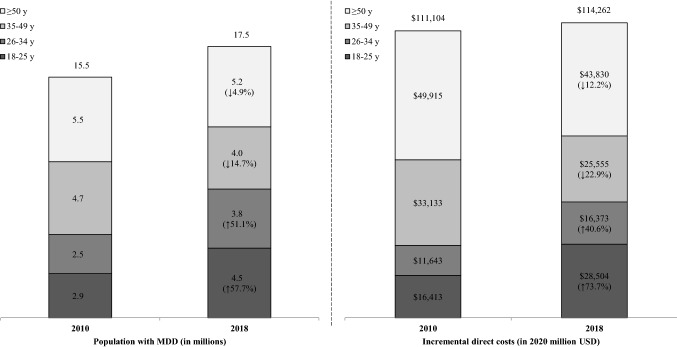
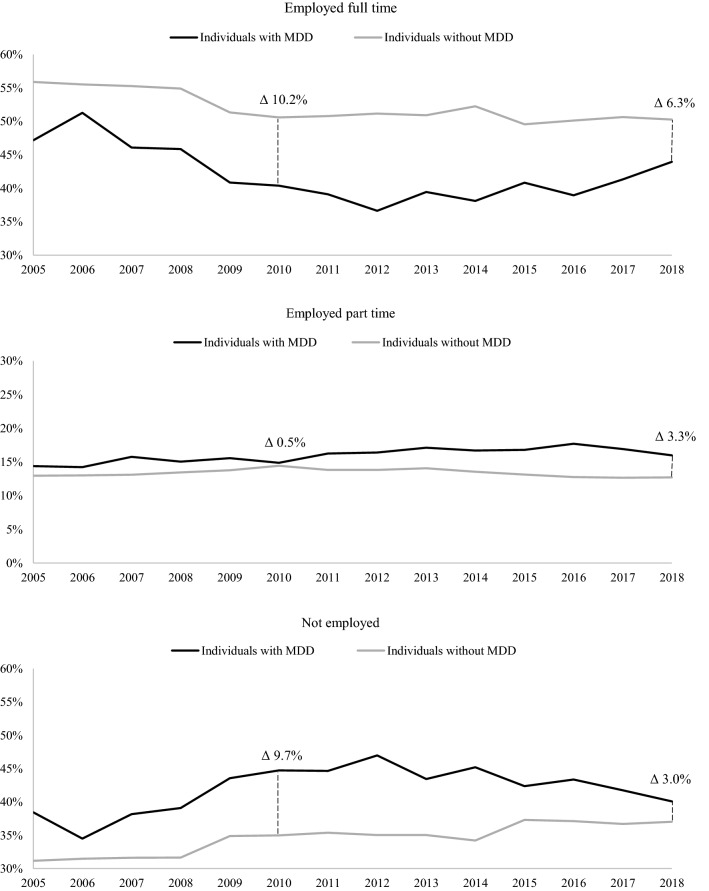
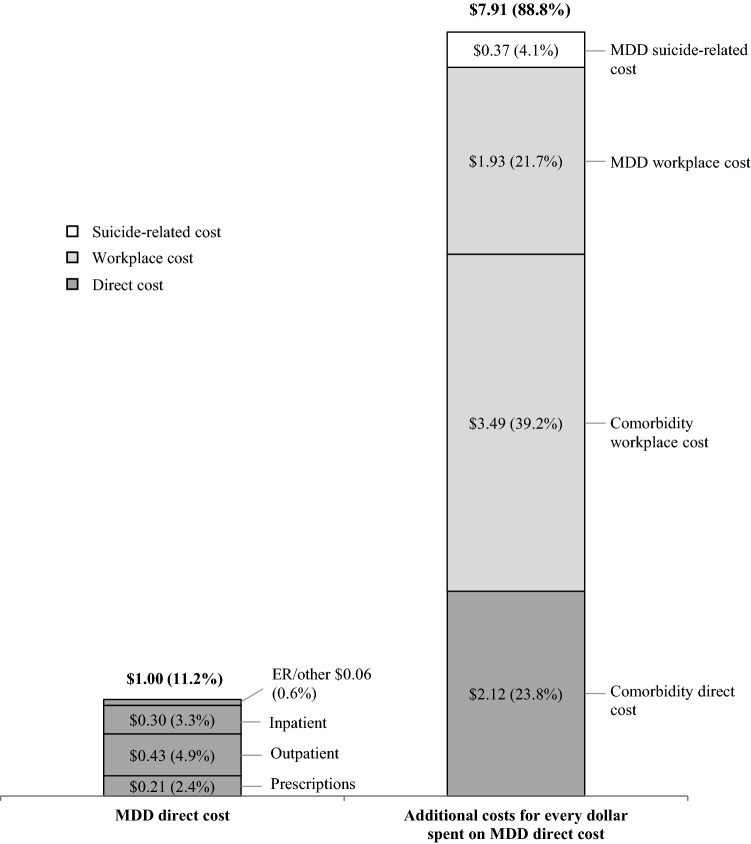
BACKGROUND: The incremental economic burden of US adults with major depressive disorder (MDD) was estimated at $US210.5 billion in 2010 (year 2012 values). OBJECTIVE: Following a similar methodology, this study updates the previous findings with more recent data to report the economic burden of adults with MDD in 2018. METHOD: This study used a framework for evaluating the incremental economic burden of adults with MDD in the USA that combined original and literature-based estimates, focusing on key changes between 2010 and 2018. The prevalence rates of MDD by sex, age, employment, and treatment status over time were estimated based on the National Survey on Drug Use and Health (NSDUH). The incremental direct and workplace costs per individual with MDD were primarily derived from administrative claims data and NSDUH data using comparative analyses of individuals with and without MDD. Societal direct and workplace costs were extrapolated by multiplying NSDUH estimates of the number of people with MDD by the direct and workplace cost estimates per patient. The suicide-related costs were estimated using a human capital method. RESULTS: The number of US adults with MDD increased by 12.9%, from 15.5 to 17.5 million, between 2010 and 2018, whereas the proportion of adults with MDD aged 18-34 years increased from 34.6 to 47.5%. Over this period, the incremental economic burden of adults with MDD increased by 37.9% from $US236.6 billion to 326.2 billion (year 2020 values). All components of the incremental economic burden increased (i.e., direct costs, suicide-related costs, and workplace costs), with the largest growth observed in workplace costs, at 73.2%. Consequently, the composition of 2018 costs changed meaningfully, with 35% attributable to direct costs (47% in 2010), 4% to suicide-related costs (5% in 2010), and 61% to workplace costs (48% in 2010). This increase in the workplace cost share was consistent with more favorable employment conditions for those with MDD. Finally, the proportion of total costs attributable to MDD itself as opposed to comorbid conditions remained stable at 37% (38% in 2010). CONCLUSION: Workplace costs accounted for the largest portion of the growing economic burden of MDD as this population trended younger and was increasingly likely to be employed. Although the total number of adults with MDD increased from 2010 to 2018, the incremental direct cost per individual declined. At the same time, the proportion of adults with MDD who received treatment remained stable over the past decade, suggesting that substantial unmet treatment needs remain in this population. Further research is warranted into the availability, composition, and quality of MDD treatment services.
Overview
The claims and statistics of this paper haven’t been checked yet.
Free: it reads the open-access text and checks the first 5 claims that cite a source we can check. Create a free account to check every claim.
Integrity signals
Registry
Cites
Statistics
Figures
Verification
Claims the paper makes
The claims and statistics of this paper haven’t been checked yet.
Free: it reads the open-access text and checks the first 5 claims that cite a source we can check. Create a free account to check every claim.
Claims other papers make about this one
Each is checked against this paper’s own text: does it say what the citing paper says it does?
The cited source doesn’t support the claim as written.
In the citing paper
“The current estimate of total incremental costs of MDD in 2019 represents a 3.5% increase in the burden compared with a prior estimate in 2018 (when standardized to 2019 values), with 36.0% of the total incremental costs of MDD in 2019 coming from novel components not previously included in the prior estimate (i.e., unemployment, all-cause mortality, householdrelated costs) [8].”
From The Economic Burden of Adults with Major Depressive Disorder in the United States (2019) (2023) · cites this paper as [8]
Checked by a reasoning model — may be wrong.
Experimental — accuracy not yet measuredThe cited source says what the claim attributes to it.
In the citing paper
“one of the key differentiators of the current study from previous estimations of the economic burden of MDD [8,33,34] was the consideration of household-related costs.”
From The Economic Burden of Adults with Major Depressive Disorder in the United States (2019) (2023) · cites this paper as [8]
The check wasn’t confident either way, so it gives no verdict — never disputed.
In the citing paper
“The COVID-19 pandemic exacerbated many risk factors for depression across countries of disparate economic status 5,6 ;”
From Digital health technologies and major depressive disorder (2023) · cites this paper as [5]
Experimental — accuracy not yet measuredIn the citing paper
“The current estimate of total incremental costs of MDD in 2019 represents a 3.5% increase in the burden compared with a prior estimate in 2018 (when standardized to 2019 values), with 36.0% of the total incremental costs of MDD in 2019 coming from novel components not previously included in the prior estimate (i.e., unemployment, all-cause mortality, householdrelated costs) [8].”
From The Economic Burden of Adults with Major Depressive Disorder in the United States (2019) (2023) · cites this paper as [8]
In the citing paper
“which was an increase from the previous estimate of 7.1% in 2018 [8].”
From The Economic Burden of Adults with Major Depressive Disorder in the United States (2019) (2023) · cites this paper as [8]
Self-check
Percentages, sums and reported differences re-computed from the paper’s own numbers.
The self-check needs the paper’s full text.
Citations
Cites
Charlson, M. E., Pompei, P., Ales, K. L., & MacKenzie, C. R. (1987) · Journal of Chronic Diseases · doi:10.1016/0021-9681(87)90171-8 · Cited by 49,742
Coding algorithms for defining comorbidities in ICD-9-CM and ICD-10 administrative data
Quan, H., Sundararajan, V., Halfon, P., Fong, A., Burnand, B., Luthi, J.-C., Saunders, L. D., Beck, C. A., Feasby, T. E., & Ghali, W. A. (2005) · Medical Care · doi:10.1097/01.mlr.0000182534.19832.83 · Cited by 10,669
Scoville, W. B. (1949) · Journal of neurosurgery · doi:10.3171/jns.1949.6.1.0065 · Cited by 7,381
Centers for Disease Control and Prevention
(2007) · Encyclopedia of Measurement and Statistics · doi:10.4135/9781412952644.n74 · Cited by 6,444
Quan, H., Li, B., Couris, C. M., Fushimi, K., Graham, P., Hider, P., Januel, J.-M., & Sundararajan, V. (2011) · American Journal of Epidemiology · doi:10.1093/aje/kwq433 · Cited by 5,843
The outbreak of COVID-19 coronavirus and its impact on global mental health
Torales, J., O’Higgins, M., Castaldelli-Maia, J. M., & Ventriglio, A. (2020) · International Journal of Social Psychiatry · doi:10.1177/0020764020915212 · Cited by 3,013
Prevalence of depression symptoms in US adults before and during the COVID-19 pandemic
Ettman, C. K., Abdalla, S. M., Cohen, G. H., Sampson, L., Vivier, P. M., & Galea, S. (2020) · JAMA Network Open · doi:10.1001/jamanetworkopen.2020.19686 · Cited by 2,138
The Economic Burden of Adults With Major Depressive Disorder in the United States (2005 and 2010)
Greenberg, P. E., Fournier, A.-A., Sisitsky, T., Pike, C. T., & Kessler, R. C. (2015) · The Journal of Clinical Psychiatry · doi:10.4088/jcp.14m09298 · Cited by 1,779
Self-citationMokdad (2018) · doi:10.1001/jama.2018.0158 · Cited by 1,517
Depression Is the Leading Cause of Disability Around the World
Friedrich, M. J. (2017) · JAMA · doi:10.1001/jama.2017.3826 · Cited by 1,459
Cited by
Items 501–600 of 1,000
Hypnotically enhancing behavioral activation in the treatment of depression
McCann, B. S., & Collin, A. (2023) · American Journal of Clinical Hypnosis · doi:10.1080/00029157.2023.2270005 · Cited by 3
Stress sensitivity in women with a history of recurrent versus first-episode major depression
Gan, A. K. X., & Gibb, B. E. (2025) · Psychiatry Research · doi:10.1016/j.psychres.2025.116382 · Cited by 3
Yu, H., Jiang, L., Li, H., Dang, W., & Lv, D. (2026) · Biomedical Signal Processing and Control · doi:10.1016/j.bspc.2026.110130 · Cited by 3
Majkic, N., & Taylor, D. M. (2025) · Journal of Psychopharmacology · doi:10.1177/02698811251364388 · Cited by 3
Silhan, M., & Garnefski, N. (2022) · Advances in Health and Behavior · doi:10.25082/ahb.2022.01.004 · Cited by 3
Frequency of suicidal ideation inventory: A reliability generalization meta-analysis
Hidalgo-Fuentes, S., Caro‐Cañizares, I., & Izquierdo-Sotorrío, E. (2024) · Death Studies · doi:10.1080/07481187.2024.2390904 · Cited by 3
Raveendran, S., Singh, D., Burke, M. C., McAuliffe‐Fogarty, A. H., Parikh, S. V., McIntyre, R. S., Roy, A., Martin, M., Chrones, L., Opler, M. G. A., et al. (2023) · BMC Psychiatry · doi:10.1186/s12888-023-04922-6 · Cited by 3
Clayton, A. H., Parikh, M., Yee, T., Mercer, D., Haiyan, S., Cummings, N., Rava, A., Hayes, O., & Nabulsi, N. A. (2025) · Current Medical Research and Opinion · doi:10.1080/03007995.2025.2465617 · Cited by 3
Sharpley, C. F., Evans, I. D., Bitsika, V., Arnold, W. M., Jesulola, E., & Agnew, L. L. (2023) · Symmetry · doi:10.3390/sym15122201 · Cited by 3
Korenblik, V., Kőrösi, A., Brul, S., Bockting, C., Nieuwdorp, M., & Lok, A. (2025) · BMJ Open · doi:10.1136/bmjopen-2025-108423 · Cited by 3
Rogers, B., Deng, Y., Moniruzzaman, M., & Tamura, K. (2025) · Community Mental Health Journal · doi:10.1007/s10597-025-01500-w · Cited by 3
Khan, M. R., Acri, M. C., Ban, K. F., Scheidell, J. D., Stevens, E. R., Manandhar-Sasaki, P., Charles, D. L., Chichetto, N. E., Crystal, S., Gordon, A. J., et al. (2024) · AJPM Focus · doi:10.1016/j.focus.2024.100258 · Cited by 3
Noormohammadi, M., Etesam, F., Amini, A., Khosravian, P., Mohammadzadeh, M., & Shidfar, F. (2025) · BioMetals · doi:10.1007/s10534-025-00750-1 · Cited by 3
Huang, X. L., Sun, Y., Wu, A., & Zhang, X. (2023) · BMC Psychiatry · doi:10.1186/s12888-023-04842-5 · Cited by 3
Schuiling, M. D., Wu, W., Polanka, B. M., Shell, A. L., Williams, M. K., Crawford, C. A., MacDonald, K. L., Nürnberger, J. I., Callahan, C. M., & Stewart, J. C. (2025) · Journal of Mood and Anxiety Disorders · doi:10.1016/j.xjmad.2025.100132 · Cited by 3
Li, P., & Wu, K. (2026) · PLoS ONE · doi:10.1371/journal.pone.0340260 · Cited by 3
Willemsen, R. F., Versluis, A., Aardoom, J. J., Petrus, A. H. J., Silven, A. V., Chavannes, N. H., & van Dijke, A. (2024) · International Journal of Medical Informatics · doi:10.1016/j.ijmedinf.2024.105485 · Cited by 3
Slejko, J. F., Mattingly, T. J., Wilson, A., Xie, R. Z., Chapman, R. H., Amill‐Rosario, A., & dosReis, S. (2024) · Value in Health · doi:10.1016/j.jval.2024.05.017 · Cited by 3
Anggadiredja, K., & Garmana, A. N. (2022) · Journal of Applied Pharmaceutical Science · doi:10.7324/japs.2022.121017 · Cited by 3
Cha, B. S., Eikey, E. V., Mukamel, D. B., Palomares, K., Schueller, S. M., Sorkin, D. H., Stadnick, N. A., Stoeckl, S. E., Zheng, K., & Schneider, M. L. (2025) · Administration and Policy in Mental Health and Mental Health Services Research · doi:10.1007/s10488-025-01441-2 · Cited by 3
The Effect of the COVID-19 Pandemic on Mental Health among College Students in the United States
Sahay, S., Vargas, C. F.-A., Hoar, S. C., Choi, J., & O'Donovan, S. M. (2024) · Translation The University of Toledo Journal of Medical Sciences · doi:10.46570/utjms.vol12-2024-1280 · Cited by 3
Liu, G., Jiang, Y., Zhou, C., Wang, X., Dai, M., Zhang, J., Yu, J., & Zhang, G. (2025) · Frontiers in Nutrition · doi:10.3389/fnut.2025.1615978 · Cited by 3
Pearson, L. R., Timmer‐Murillo, S. C., Schroeder, M. E., deRoon‐Cassini, T. A., & Holena, D. N. (2025) · Journal of Surgical Research · doi:10.1016/j.jss.2025.10.037 · Cited by 3
Mental Health Shortfalls: Perceptions of Unmet Needs and Barriers and Facilitators to Receiving Care
Berkout, O. V., & Barena, E. (2025) · Administration and Policy in Mental Health and Mental Health Services Research · doi:10.1007/s10488-025-01438-x · Cited by 3
Zhang, Y., Peña, M. T., Lal, L. S., Lin, Y.-Y., Summers, R. L., Chandra, S., & Swint, J. M. (2024) · Telemedicine Journal and e-Health · doi:10.1089/tmj.2024.0112 · Cited by 3
A Clinical Suspicion of Quetiapine-Induced Psychosis: A Case Report and Literature Review
Valentine, M. J., Kayastha, A., Newsome-Cuby, T., Nguyen, A. T. N., Fisher, R. G., Pham, H. M., Meimon, S. A., Phu, A., Parry, C. A., Nelson, J. J., et al. (2024) · Cureus · doi:10.7759/cureus.52167 · Cited by 3
Macroeconomics of Mental HealthPreprint
Abramson, B., Boerma, J., & Tsyvinski, A. (2024) · SSRN Electronic Journal · doi:10.2139/ssrn.4802569 · Cited by 3
Label matters: how labeling and diagnosis affect lay perception of people with depressive symptoms
Kulwicka, K., Rusowicz, J., & Gąsiorowska, A. (2025) · Frontiers in Psychiatry · doi:10.3389/fpsyt.2025.1612517 · Cited by 3
Biopsychosocial Factors of Depression Among Hispanic Women Aged ≥50 Years
Oliveira, G. C. D., Cianelli, R., Martinez, A. J. S., Villegas, N., & Iriarte, E. (2023) · Journal of Psychosocial Nursing and Mental Health Services · doi:10.3928/02793695-20230523-04 · Cited by 3
Dobrescu, A. I., Chapman, A. L., Affengruber, L., Persad, E., Toromanova, A., Wagner, G., Klerings, I., Emprechtinger, R., & Gartlehner, G. (2023) · Annals of Internal Medicine · doi:10.7326/m22-1872 · Cited by 3
Cabello-Rangel, H., Arredondo, A., Diaz‐Castro, L., Reyes‐Morales, H., & Medina‐Mora, M. E. (2022) · Journal of Global Health Neurology and Psychiatry · doi:10.52872/001c.32312 · Cited by 3
A Miniaturized Closed-Loop Optogenetic Brain Stimulation Device
Kumari, L. S., & Kouzani, A. Z. (2022) · Electronics · doi:10.3390/electronics11101591 · Cited by 3
Review Paper on Predicting Mood Disorder Risk Using Machine Learning
Ahmad, A., Asif, M., & Ali, S. R. (2019) · International Journal of Scientific Research in Computer Sciences and Engineering · doi:10.26438/ijsrcse/v7i1.1622 · Cited by 3
Zhang, L., Wang, J., Dong, X., Sakakibara, S., Guitart‐Masip, M., Yang, W., Liu, X., Wang, C., Wang, Z., Welmer, A., et al. (2026) · Journal of Affective Disorders · doi:10.1016/j.jad.2026.121214 · Cited by 3
Long-Term Health Care Costs for Service Members Injured in Iraq and Afghanistan
Stewart, I. J., Ambardar, S., Howard, J. T., Janak, J. C., Walker, L. E., Poltavskiy, E. A., Alcover, K. C., Watrous, J. R., Gundlapalli, A. V., Pettey, W. B. P., et al. (2023) · Military Medicine · doi:10.1093/milmed/usad008 · Cited by 3
Oluszczak, K., Korta, K., Szeliga, A., Szostak, A., Wawszkowicz, K., Śmigielska-Mikołajczyk, M. J., Dyląg, L., Łowicka, W., Szopińska, K., & Graca, M. (2024) · Quality in Sport · doi:10.12775/qs.2024.22.54625 · Cited by 3
Depression in Working Professionals – A Systematic Review of the Literature
Das, S. (2023) · Scholars Journal of Applied Medical Sciences · doi:10.36347/sjams.2023.v11i11.001 · Cited by 3
JOB-RELATED DEPRESSION AMONG ICU AND NON-ICU HEALTHCARE WORKERS IN A TERTIARY CARE HOSPITAL
Ali, A., Munir, H., Ali, Y., Ali, H., Ullah, S., & Israr, A. R. (2023) · Pakistan Journal of Physiology · doi:10.69656/pjp.v19i2.1509 · Cited by 3
Denee, T., Kerr, C., Richards, S., Dennis, N., Foix-Colonier, A., Fischer, C., & Larkin, F. (2024) · BMC Psychiatry · doi:10.1186/s12888-024-05961-3 · Cited by 2
“Major depressive disorder in the United Kingdom Major depressive disorder (MDD) is a disabling mental illness that can affect all aspects of daily life and is a leading cause of health-related economic costs [1, 2].”
BackgroundWatanabe, K., Sumiyoshi, T., Kato, M., Kikuchi, T., Moriguchi, Y., Åström, D. O., & Christensen, M. C. (2025) · Journal of Affective Disorders Reports · doi:10.1016/j.jadr.2025.100955 · Cited by 2
Yang, K., Tiwari, S., Liu, D., Xu, Q., Qi, L., Zhu, Y. P., Jiang, L., Zouqin, H., Wong, J. W., Chen, J., et al. (2024) · BMJ Open · doi:10.1136/bmjopen-2024-091214 · Cited by 2
Zhao, F.-Y., Xu, P., Kennedy, G. A., Jin, X., Wang, Y., Zhang, W., Yue, L.-P., Ho, J. Y. S., Fu, Q.-Q., & Conduit, R. (2025) · Neuropsychiatric Disease and Treatment · doi:10.2147/ndt.s499574 · Cited by 2
Wei, J., He, L., Fan, L., Fan, X., Chen, L., & Wang, T. (2025) · Social Psychiatry and Psychiatric Epidemiology · doi:10.1007/s00127-025-02991-4 · Cited by 2
Pavón, L., Cabrera, D. M., Pérez‐Sánchez, G., Becerril-Villanueva, L. E., Álvarez-Herrera, S., Vallejo‐Castillo, L., García-Mena, L. H., & Maldonado-García, J. L. (2024) · Integrated science · doi:10.1007/978-3-031-72079-6_6 · Cited by 2
Adegoke, A., Adegoke, K. A., Durojaye, O. A., Dawodu, D., Aluko, A. I., Adekoya, A., & Knapp, K. A. (2026) · INQUIRY The Journal of Health Care Organization Provision and Financing · doi:10.1177/00469580261441768 · Cited by 2
Almutairi, F. M., Alnemari, R. M., Abduljabbar, M. H., Althobaiti, Y. S., Alzhrani, R. M., Alatwi, E. S., Serag, A., & Almalki, A. H. (2025) · Journal of Photochemistry and Photobiology A Chemistry · doi:10.1016/j.jphotochem.2025.116534 · Cited by 2
Depressive and Anxiety Disorders
Tonini, E., Hickie, I. B., & Crouse, J. J. (2024) · Elsevier eBooks · doi:10.1016/b978-0-323-99967-0.00189-7 · Cited by 2
Increasing Provider Utilization of Apps for Anxiety and Depression Management
Brigham, J., Catchings, S., & Kitzmiller, R. (2025) · The Journal for Nurse Practitioners · doi:10.1016/j.nurpra.2025.105348 · Cited by 2
Chen, Q., Huang, H., & Yang, Y. (2025) · Acta Psychologica · doi:10.1016/j.actpsy.2025.105932 · Cited by 2
When radical uncertainty is too much: Clinical aspects of Conviction Narrative Theory
Linkovski, O., & Eitan, R. (2023) · Behavioral and Brain Sciences · doi:10.1017/s0140525x2200259x · Cited by 2
Jha, M. K., Zhdanava, M., Shah, A., Voegel, A., Tardif‐Samson, A., Pilon, D., & Joshi, K. (2025) · Drugs - Real World Outcomes · doi:10.1007/s40801-024-00478-3 · Cited by 2
Stimpson, K. H., Feyder, M. T., Maron‐Katz, A., Kiris, E., Ford, T. J., Carreon, D. M., DeSouza, D. D., Cole, E. J., Meng, N. F., Williams, N., et al. (2025) · Transcranial magnetic stimulation . · doi:10.1016/j.transm.2025.100203 · Cited by 2
Structural inequalities and chronic disease health outcomes: Mental health
Bauer, A. G., Dawson, D. N., Bellot, J., & Davidson, T. M. (2025) · Elsevier eBooks · doi:10.1016/b978-0-443-23750-8.00015-1 · Cited by 2
Baiden, P., Sesay, B. J., Ramsey-Soroghaye, B. N., Agboh, H. N. K., Anagbonu, J. S., Jenoch, J., Glikpo, R. M., Nebe, B. U., Wang, Y., & LaBrenz, C. A. (2026) · Journal of Affective Disorders · doi:10.1016/j.jad.2026.121689 · Cited by 2
Takeshima, M., Umakoshi, A., Omori, Y., Yoshizawa, K., Ogasawara, M., Kudo, M., Itoh, Y., Ayabe, N., & Mishima, K. (2024) · Psychopharmacology · doi:10.1007/s00213-024-06581-1 · Cited by 2
Nădășan, I., & Hancu, G. (2023) · Acta Marisiensis. Seria Medica · doi:10.2478/amma-2023-0042 · Cited by 2
Bellanti, P. A., Lewis, J., Seifferth, B., & Adams, D. Z. (2026) · Frontiers in Psychiatry · doi:10.3389/fpsyt.2026.1867963 · Cited by 2
Sayed, M. M., Gaafary, M. M. E., Elsheikh, M. M. E., Hamed, S. S., Mohamed, R. M. A., & Mohamed, M. Y. (2025) · Middle East Current Psychiatry · doi:10.1186/s43045-025-00549-3 · Cited by 2
Lower extremity prosthesis usage among U.S. veterans: 10-year cohort study
Paquette, R., Carnaby, G., Reistetter, T., Phillips, S. L., Hill, O., Almeida, G. J., & Highsmith, M. J. (2025) · Disability and Rehabilitation · doi:10.1080/09638288.2025.2530783 · Cited by 2
Baiden, P., LaBrenz, C. A., & Sellers, C. M. (2025) · Public Health · doi:10.1016/j.puhe.2025.02.013 · Cited by 2
Bello, O., & Kearney, K. (2025) · Archives of Psychiatric Nursing · doi:10.1016/j.apnu.2025.151968 · Cited by 2
Kumar, R., Vedwan, K. K., & Singh, V. (2026) · Sport Sciences for Health · doi:10.1007/s11332-026-01688-8 · Cited by 2
Valentino, K., Ballum, H., Cheung, W., Dri, C. E., Teopiz, K. M., Kwan, A. T. H., Wong, S., Shen, B., Cheng, M. C. H., Le, G. H., et al. (2026) · Journal of Psychiatric Research · doi:10.1016/j.jpsychires.2026.02.011 · Cited by 2
Machine learning for immune biomarkers in severe mental illness: a systematic review
Slatni, R., Colombo, F., Enrico, P., Branchi, I., Picker, L. D., & Vai, B. (2026) · Neuroscience Applied · doi:10.1016/j.nsa.2026.107003 · Cited by 2
Fatt, C. C., Jha, M. K., Vasu, S., Deane, A. E., Foster, J. A., & Trivedi, M. H. (2025) · Journal of Primary Care & Community Health · doi:10.1177/21501319251394192 · Cited by 2
Wu, S., Jordan, D. G., Goel, D., Winer, E. S., Giollabhui, N. M., & Collins, A. C. (2026) · Journal of Affective Disorders · doi:10.1016/j.jad.2025.121100 · Cited by 2
Hamilton, D., & Engerman, K. (2023) · Springer eBooks · doi:10.1007/978-3-031-34140-3_7 · Cited by 2
Davarinejad, O., Komasi, S., Moradi, M., Nouraei, S., & Kazemisafa, F. (2025) · Journal of Psychiatric Research · doi:10.1016/j.jpsychires.2025.09.030 · Cited by 2
Anderson, C. D., Hall, S., Steadman, M., McCallister, C., Humphries, D., & Loosli, F. (2025) · Journal of Disability & Religion · doi:10.1080/23312521.2025.2457772 · Cited by 2
Lutz, M., Nowak, J. A., Dönnhoff, I., Friederich, H., Terhoeven, V., & Nikendei, C. (2025) · BMC Psychiatry · doi:10.1186/s12888-025-07666-7 · Cited by 2
Masand, P. S., Parikh, M., Ta, J. T., Zanardo, E., Lejeune, D., Martínez, C., Laliberté, F., & Nabulsi, N. A. (2025) · Journal of Medical Economics · doi:10.1080/13696998.2025.2470014 · Cited by 2
Rutter, L. A., & Hamilton, L. J. (2026) · The Journals of Gerontology Series B · doi:10.1093/geronb/gbag055 · Cited by 2
Sprenger, A. A., Harrer, M., Miguel, C., Illing, S., Kuper, P., Buntrock, C., Karyotaki, E., Fried, E. I., Cuijpers, P. J., & Apfelbacher, C. (2025) · Journal of Affective Disorders · doi:10.1016/j.jad.2025.120873 · Cited by 2
Baeza, M. J., Cianelli, R., Oliveira, G. C. D., Villegas, N., Santis, J. P. D., Iriarte, E., & Montano, N. P. (2023) · Issues in Mental Health Nursing · doi:10.1080/01612840.2023.2195500 · Cited by 2
Gafaranga, J. P., Bitunguhari, L., Mudenge, C., Manirakiza, F., Kelly, B. J., & Gatabazi, P. (2024) · Neuropsychiatric Disease and Treatment · doi:10.2147/ndt.s443811 · Cited by 2
Adaptive Knowledge Fusion Model for Depression Recognition
Zhou, L., Zhang, X., Guan, S., & Luo, X. (2025) · IEEE Transactions on Computational Social Systems · doi:10.1109/tcss.2025.3591195 · Cited by 2
Jin, M., Xia, W., Chau, W. M. W., Shi, N. M. X. Y., Qin, P. P., Zhang, B. B. B., Kan, R. L. D., Tang, A. H. P., Lin, T. T. Z., Wang, S. X., et al. (2026) · Psychiatry and Clinical Neurosciences · doi:10.1111/pcn.70066 · Cited by 2
Establishing content validity of the Dimensional Anhedonia Rating Scale
Bean, S. E., Dhanda, R., Graham, C. A., Hoffman, D., Rodríguez-Lee, M., Ionescu, A., Karantzoulis, S., Kennedy, S. H., & Rizvi, S. J. (2025) · Journal of Patient-Reported Outcomes · doi:10.1186/s41687-025-00860-x · Cited by 2
Lasting Income Costs of Mental and Physical Illness
Johnson, E. K., Parikh, H., Ettman, C. K., Ge, G., Sopina, L., & Chang, A. Y. (2026) · JAMA Health Forum · doi:10.1001/jamahealthforum.2026.0196 · Cited by 2
Mental Health Effects on Job Retention in Indonesia
Arizal, M., & Wisana, I. D. G. K. (2023) · Journal of Developing Economies · doi:10.20473/jde.v8i1.37445 · Cited by 2
Slowing down to live with purpose: a systematic review on Slow Living
UFPR, Thomaz, D. C., Prado, G. C., & UFPR (2023) · doi:10.29183/978-65-00-87779-3.sds2023.p135-146 · Cited by 2
Boskovic, D. H., Huang, D., Severtson, S. G., Marci, C. D., Awasthi, S., Ardic, F. C., Eisenberg, D. F., & Kapadia, S. (2026) · Neurology and Therapy · doi:10.1007/s40120-026-01027-6 · Cited by 2
Therapeutic doses of ketamine acutely attenuate the aversive effect of losses during decision-making
Oemisch, M., & Seo, H. (2024) · eLife · doi:10.7554/elife.87529 · Cited by 2
Lychee peel extract attenuates depression-like behavior in a rat model of chronic restraint stress
Phachonpai, W., Preedapirom, W., Wuthiyan, K., Junkaew, A., & Tong-un, T. (2024) · Journal of Applied Pharmaceutical Science · doi:10.7324/japs.2024.148021 · Cited by 2
Kim, J.-H., Choi, K., Lee, J., Yu, J.-A., & Yun, J.-A. (2024) · 신경정신의학 · doi:10.4306/jknpa.2024.63.1.57 · Cited by 2
Area-level credit scores and symptoms of depression and anxiety in adults
Ettman, C. K., Goicoechea, E. B., Stuart, E. A., & Dean, L. T. (2024) · American Journal of Epidemiology · doi:10.1093/aje/kwae275 · Cited by 2
Scaramutti, C., Lee, T. K., Lee, S. W., Bochkina, E. V., Isaza, A. G., Montero‐Zamora, P., Nishimura, M. J. K., Brown, E. C., & Schwartz, S. J. (2025) · Behavioral Sciences · doi:10.3390/bs15081110 · Cited by 3
Zhang, Y., Xia, M., Song, W., Li, D., Wei, X., & Wang, D. (2025) · Journal of Innovative Optical Health Sciences · doi:10.1142/s1793545825500087 · Cited by 2
Should residents be taught how to prescribe monoamine oxidase inhibitors?
Reinfeld, S. (2022) · Current Psychiatry · doi:10.12788/cp.0316 · Cited by 2
Beyond symptoms: Other outcomes that also matter in depression trials
Molloy, N., Jin, H., & Wykes, T. (2025) · Journal of Affective Disorders · doi:10.1016/j.jad.2025.120923 · Cited by 2
Geoghegan, E. M. (2024) · Undergraduate Research in Natural and Clinical Science and Technology (URNCST) Journal · doi:10.26685/urncst.610 · Cited by 2
Carrino, L., Avendaño, M., Oliveira, T. C., Regalado, J. C. O., & Nozal, A. L. (2025) · Cambridge University Press eBooks · doi:10.1017/9781009563444.003 · Cited by 2
Gender Influences on Depression Severity in Patients With Urinary Incontinence
Ganz, M., Halabi, M., Goliger, M., Sezanayev, D., Nasimov, B., Balakhani, S., Riznyk, N., & West, M. A. (2025) · Cureus · doi:10.7759/cureus.82477 · Cited by 2
Koutra, K., Mavroeides, G., Paschalidou, A., Roumeliotaki, T., Basta, M., & Vgontzas, A. N. (2024) · International Journal of Mental Health and Addiction · doi:10.1007/s11469-024-01348-3 · Cited by 2
Peer Effects in Adolescent Mental HealthPreprint
Hadah, H. (2025) · SSRN Electronic Journal · doi:10.2139/ssrn.5159123 · Cited by 2
O’Keeffe, A., Merla, A., & Ashkan, K. (2024) · British Journal of Neurosurgery · doi:10.1080/02688697.2024.2311128 · Cited by 2
Kuang, J., Xie, J., & Yan, Z. (2023) · arXiv (Cornell University) · doi:10.48550/arxiv.2305.13127 · Cited by 2
What Symptoms and How Long? An Interpretable AI Approach for Depression Detection in Social Media
Kuang, J., Xie, J., & Yan, Z. (2024) · Hawaii International Conference on System Sciences (HICSS) · doi:10.24251/hicss.2024.299 · Cited by 2
Petrozzi, B. P., Lamadé, E. K., Hübner, N., Zippelius, J., Neumann, E., & Sammer, G. (2025) · Biomarkers in Neuropsychiatry · doi:10.1016/j.bionps.2025.100121 · Cited by 1
Ching, J., Duff, S., & Hernandez, J. (2024) · medRxiv · doi:10.1101/2024.06.05.24306788 · Cited by 1
Metadata
- Authors
- Greenberg, P. E., Fournier, A.-A., Sisitsky, T., Simes, M., Berman, R., Koenigsberg, S. H., & Kessler, R. C.
- Affiliations
- Analysis Group (United States) (US)
- Harvard University (US)
- Venue
- PharmacoEconomics
- Published
- 2021-05-05
- Volume
- 39
- Issue
- 6
- Pages
- 653-665
- ISSN
- 1170-7690 (ISSN-L)
- 1179-2027
- PMC
- PMC8097130
- OpenAlex
- W3157759986
- Cited by
- 838
- References
- 33
- Citations by year
- 2026: 123 · 2025: 204 · 2024: 221 · 2023: 177 · 2022: 95 · 2021: 14
- FWCI
- 124.30
- Type
- journal article
- Language
- en
- Open access
- hybrid
- doi.org
- Licence
- cc-by-nc
- creativecommons.org/licenses/by-nc/4.0 (tdm)
- creativecommons.org/licenses/by-nc/4.0 (vor)
- Locations
- PharmacoEconomics (publishedVersion, cc-by-nc)
- PubMed Central (publishedVersion, cc-by-nc)
- PubMed (publishedVersion)
- RePEc: Research Papers in Economics (submittedVersion)
- Topics
- Health Sciences › Medicine › Psychiatry and Mental health › Mental Health Treatment and Access
- Social Sciences › Economics, Econometrics and Finance › Economics and Econometrics › Health Systems, Economic Evaluations, Quality of Life
- Health Sciences › Medicine › Pharmacology (medical) › Treatment of Major Depression
- Keywords
- major depressive disorder, economic burden, direct medical costs, human capital, depression prevalence, comorbidities, United States adults, National Survey on Drug Use and Health, administrative claims data, productivity loss, age and sex differences
- MeSH terms
- Adult, Major Depressive Disorder, Humans, United States, Prevalence, Health Care Costs, Cost of Illness
About these checks
Registry, retraction, Cites and statistics results are computed, not judged, with one exception: a printed reference that no index lists is read once by a model before it counts as a citation error. Claims are extracted by a model and kept only when their quote appears verbatim in the text; each cited source is then checked, with a model’s help, for whether it says what the claim relies on. Those verdicts can be wrong — read the claim’s quote and the cited source before relying on one.
Statistics and arithmetic are recomputed, not judged.
Confidence bands are shown only for fields calibrated on our annotated test set. None is calibrated yet, so no band is shown.
What counts as a claim ›How we measure confidence ›How we check this ›
Are you an author, or do you see a problem with this page? Request a review
Data sources
Bibliographic data: Semantic Scholar, OpenAlex, Crossref.
Contains information from the Semantic Scholar Academic Graph Datasets, made available under the ODC Attribution License (ODC-BY 1.0).
Semantic Scholar’s data is described in: Kinney, R., et al. (2023). The Semantic Scholar Open Data Platform. arXiv:2301.10140.
