

The Economic Burden of Adults with Major Depressive Disorder in the United States (2010 and 2018)
Open accessThe DOI matches its Crossref record; 33 of the 33 references it cites were found in a registry or an index.
Abstract
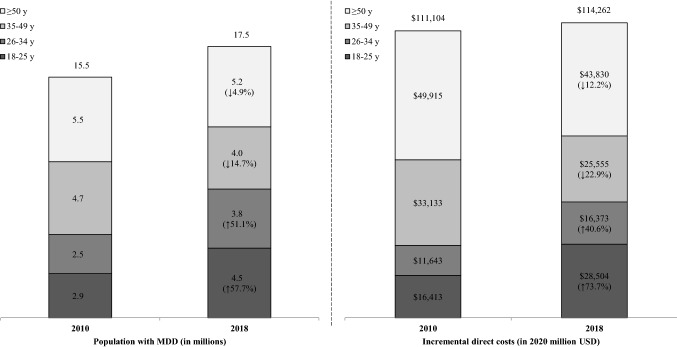
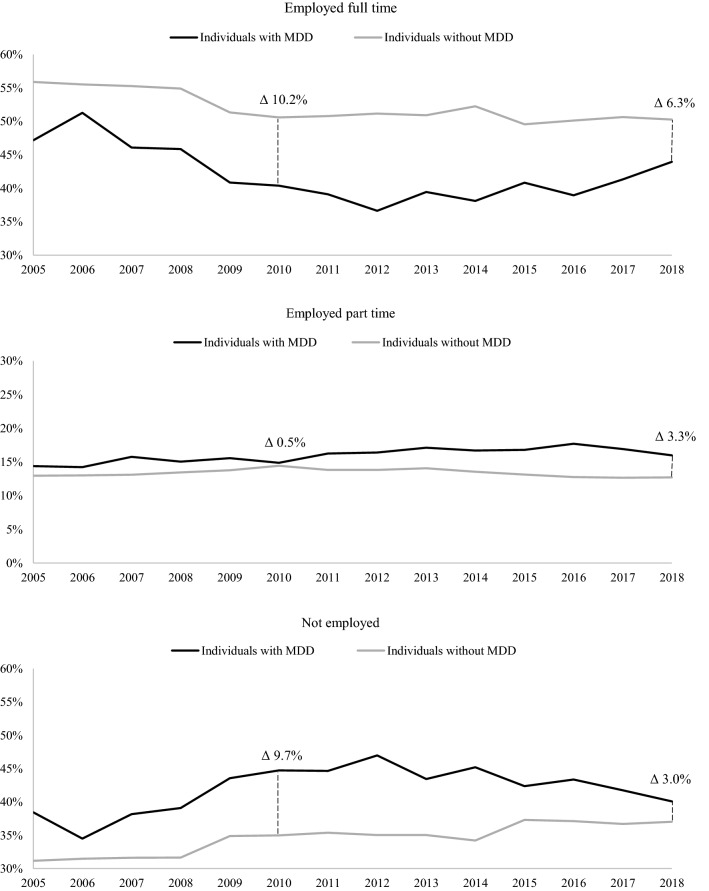
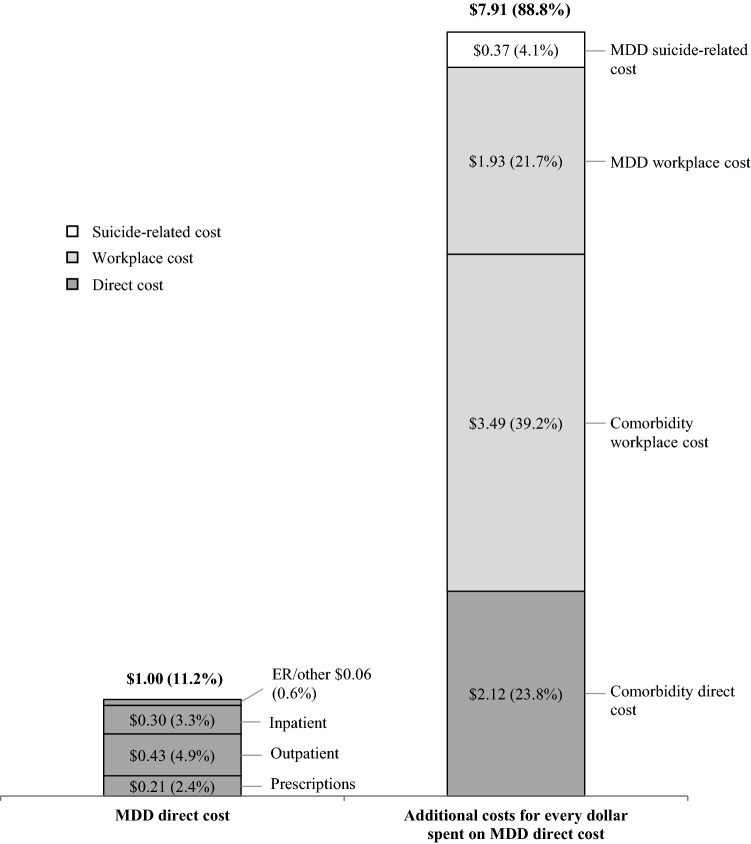
BACKGROUND: The incremental economic burden of US adults with major depressive disorder (MDD) was estimated at $US210.5 billion in 2010 (year 2012 values). OBJECTIVE: Following a similar methodology, this study updates the previous findings with more recent data to report the economic burden of adults with MDD in 2018. METHOD: This study used a framework for evaluating the incremental economic burden of adults with MDD in the USA that combined original and literature-based estimates, focusing on key changes between 2010 and 2018. The prevalence rates of MDD by sex, age, employment, and treatment status over time were estimated based on the National Survey on Drug Use and Health (NSDUH). The incremental direct and workplace costs per individual with MDD were primarily derived from administrative claims data and NSDUH data using comparative analyses of individuals with and without MDD. Societal direct and workplace costs were extrapolated by multiplying NSDUH estimates of the number of people with MDD by the direct and workplace cost estimates per patient. The suicide-related costs were estimated using a human capital method. RESULTS: The number of US adults with MDD increased by 12.9%, from 15.5 to 17.5 million, between 2010 and 2018, whereas the proportion of adults with MDD aged 18-34 years increased from 34.6 to 47.5%. Over this period, the incremental economic burden of adults with MDD increased by 37.9% from $US236.6 billion to 326.2 billion (year 2020 values). All components of the incremental economic burden increased (i.e., direct costs, suicide-related costs, and workplace costs), with the largest growth observed in workplace costs, at 73.2%. Consequently, the composition of 2018 costs changed meaningfully, with 35% attributable to direct costs (47% in 2010), 4% to suicide-related costs (5% in 2010), and 61% to workplace costs (48% in 2010). This increase in the workplace cost share was consistent with more favorable employment conditions for those with MDD. Finally, the proportion of total costs attributable to MDD itself as opposed to comorbid conditions remained stable at 37% (38% in 2010). CONCLUSION: Workplace costs accounted for the largest portion of the growing economic burden of MDD as this population trended younger and was increasingly likely to be employed. Although the total number of adults with MDD increased from 2010 to 2018, the incremental direct cost per individual declined. At the same time, the proportion of adults with MDD who received treatment remained stable over the past decade, suggesting that substantial unmet treatment needs remain in this population. Further research is warranted into the availability, composition, and quality of MDD treatment services.
Overview
The claims and statistics of this paper haven’t been checked yet.
Free: it reads the open-access text and checks the first 5 claims that cite a source we can check. Create a free account to check every claim.
Integrity signals
Registry
Cites
Statistics
Figures
Verification
Claims the paper makes
The claims and statistics of this paper haven’t been checked yet.
Free: it reads the open-access text and checks the first 5 claims that cite a source we can check. Create a free account to check every claim.
Claims other papers make about this one
Each is checked against this paper’s own text: does it say what the citing paper says it does?
The cited source doesn’t support the claim as written.
In the citing paper
“The current estimate of total incremental costs of MDD in 2019 represents a 3.5% increase in the burden compared with a prior estimate in 2018 (when standardized to 2019 values), with 36.0% of the total incremental costs of MDD in 2019 coming from novel components not previously included in the prior estimate (i.e., unemployment, all-cause mortality, householdrelated costs) [8].”
From The Economic Burden of Adults with Major Depressive Disorder in the United States (2019) (2023) · cites this paper as [8]
Checked by a reasoning model — may be wrong.
Experimental — accuracy not yet measuredThe cited source says what the claim attributes to it.
In the citing paper
“one of the key differentiators of the current study from previous estimations of the economic burden of MDD [8,33,34] was the consideration of household-related costs.”
From The Economic Burden of Adults with Major Depressive Disorder in the United States (2019) (2023) · cites this paper as [8]
The check wasn’t confident either way, so it gives no verdict — never disputed.
In the citing paper
“The COVID-19 pandemic exacerbated many risk factors for depression across countries of disparate economic status 5,6 ;”
From Digital health technologies and major depressive disorder (2023) · cites this paper as [5]
Experimental — accuracy not yet measuredIn the citing paper
“The current estimate of total incremental costs of MDD in 2019 represents a 3.5% increase in the burden compared with a prior estimate in 2018 (when standardized to 2019 values), with 36.0% of the total incremental costs of MDD in 2019 coming from novel components not previously included in the prior estimate (i.e., unemployment, all-cause mortality, householdrelated costs) [8].”
From The Economic Burden of Adults with Major Depressive Disorder in the United States (2019) (2023) · cites this paper as [8]
In the citing paper
“which was an increase from the previous estimate of 7.1% in 2018 [8].”
From The Economic Burden of Adults with Major Depressive Disorder in the United States (2019) (2023) · cites this paper as [8]
Self-check
Percentages, sums and reported differences re-computed from the paper’s own numbers.
The self-check needs the paper’s full text.
Citations
Cites
Charlson, M. E., Pompei, P., Ales, K. L., & MacKenzie, C. R. (1987) · Journal of Chronic Diseases · doi:10.1016/0021-9681(87)90171-8 · Cited by 49,742
Coding algorithms for defining comorbidities in ICD-9-CM and ICD-10 administrative data
Quan, H., Sundararajan, V., Halfon, P., Fong, A., Burnand, B., Luthi, J.-C., Saunders, L. D., Beck, C. A., Feasby, T. E., & Ghali, W. A. (2005) · Medical Care · doi:10.1097/01.mlr.0000182534.19832.83 · Cited by 10,669
Scoville, W. B. (1949) · Journal of neurosurgery · doi:10.3171/jns.1949.6.1.0065 · Cited by 7,381
Centers for Disease Control and Prevention
(2007) · Encyclopedia of Measurement and Statistics · doi:10.4135/9781412952644.n74 · Cited by 6,444
Quan, H., Li, B., Couris, C. M., Fushimi, K., Graham, P., Hider, P., Januel, J.-M., & Sundararajan, V. (2011) · American Journal of Epidemiology · doi:10.1093/aje/kwq433 · Cited by 5,843
The outbreak of COVID-19 coronavirus and its impact on global mental health
Torales, J., O’Higgins, M., Castaldelli-Maia, J. M., & Ventriglio, A. (2020) · International Journal of Social Psychiatry · doi:10.1177/0020764020915212 · Cited by 3,013
Prevalence of depression symptoms in US adults before and during the COVID-19 pandemic
Ettman, C. K., Abdalla, S. M., Cohen, G. H., Sampson, L., Vivier, P. M., & Galea, S. (2020) · JAMA Network Open · doi:10.1001/jamanetworkopen.2020.19686 · Cited by 2,138
The Economic Burden of Adults With Major Depressive Disorder in the United States (2005 and 2010)
Greenberg, P. E., Fournier, A.-A., Sisitsky, T., Pike, C. T., & Kessler, R. C. (2015) · The Journal of Clinical Psychiatry · doi:10.4088/jcp.14m09298 · Cited by 1,779
Self-citationMokdad (2018) · doi:10.1001/jama.2018.0158 · Cited by 1,517
Depression Is the Leading Cause of Disability Around the World
Friedrich, M. J. (2017) · JAMA · doi:10.1001/jama.2017.3826 · Cited by 1,459
Cited by
Items 601–700 of 1,000
Masand, P. S., Clayton, A. H., Parikh, M., Haile, F., Germain, G., Ripley, S., Ma, S., Laliberté, F., & Nabulsi, N. A. (2025) · Journal of Medical Economics · doi:10.1080/13696998.2025.2587412 · Cited by 1
Fonzo, G. A., Doss, M. K., & Nemeroff, C. B. (2025) · American Journal of Psychiatry · doi:10.1176/appi.ajp.20250247 · Cited by 1
Feng, J. J., Huang, X., Yang, X., Tao, R., & Wen, J. (2026) · Chronobiology International · doi:10.1080/07420528.2026.2679136 · Cited by 1
Fármacos enteógenos y la depresión resistente al tratamiento: Una revisión narrativa
Herrera-Solís, A., Morelos, J. C., Ruiz‐Contreras, A. E., Méndez‐Díaz, M., Ortega-Gómez, A., & Prospero-Garcia, O. E. (2024) · PSICUMEX · doi:10.36793/psicumex.v14i1.628 · Cited by 1
Jeon, M., Lee, S., Lee, Y., Uam, S.-B., Ahn, Y.-M., & Shin, M. (2026) · Frontiers in Psychiatry · doi:10.3389/fpsyt.2026.1773101 · Cited by 1
González-Orozco, J. C., & López-López, B. M. (2023) · Revista de Fomento Social · doi:10.24875/rmn.22000084 · Cited by 1
Crawford, C. A., Minor, K. S., Cyders, M. A., & Stewart, J. C. (2025) · Sleep Medicine · doi:10.1016/j.sleep.2025.106824 · Cited by 1
The Effects of Waiting Periods on Firearm Suicides in the U.SPreprint
Hadah, H. (2025) · SSRN Electronic Journal · doi:10.2139/ssrn.5383500 · Cited by 1
Persistent anhedonic dysregulation of positive social emotion processing in major depression
Bezmaternykh, D. D., Melnikov, M. Y., Petrovskiy, E. D., Геннадьевна, М. К., Savelov, A. A., Natarova, K. A., Hu, Q., Wang, J., Wang, J., Sambataro, F., et al. (2026) · Journal of Affective Disorders · doi:10.1016/j.jad.2026.122049 · Cited by 1
Chatterton, M. L., Faller, J., Le, L. K., Engel, L., Williams, L. J., Pasco, J. A., & Mihalopoulos, C. (2024) · Australian & New Zealand Journal of Psychiatry · doi:10.1177/00048674241229931 · Cited by 1
Dai, L., Huang, L., Chen, L., & Dong, Z. (2026) · Environmental Research Communications · doi:10.1088/2515-7620/ae53af · Cited by 1
Akinola, O., Tele, A., McAuliffe, É., & Ebuenyi, I. D. (2023) · Journal of Affective Disorders Reports · doi:10.1016/j.jadr.2023.100512 · Cited by 1
Tamal, M. E. H., Hassan, K., Gasbarro, D., & Alam, K. (2026) · Health Economics Review · doi:10.1186/s13561-026-00725-z · Cited by 1
Cha, B. S., Kim, J., Borghouts, J. W., Eikey, E. V., Schneider, M. L., Schueller, S. M., Stadnick, N. A., Zheng, K., Mukamel, D. B., & Sorkin, D. H. (2025) · Psychiatric Quarterly · doi:10.1007/s11126-025-10225-8 · Cited by 1
Lin, C., Chen, L., Chang, W., Sack, A. T., Chang, C.-C., & Chang, H. (2025) · Journal of Affective Disorders · doi:10.1016/j.jad.2025.120977 · Cited by 1
Torres-Cuellar, L., Fundación Universitaria Konrad Lorenz, C., Puerto-Rojas, E., Fundación Universitaria Konrad Lorenz, C., González-Bernal, M., Fundación Universitaria Konrad Lorenz, C., Grau-Gonzalez, I. A., Fundación Universitaria Konrad Lorenz, C., Ortega, L. A., & Fundación Universitaria Konrad Lorenz, C. (2022) · Papeles del Psicólogo - Psychologist Papers · doi:10.23923/pap.psicol.2997 · Cited by 1
Zhang, J., Huang, S., Hu, C., Liao, C., Tang, Z., Li, N., Qian, Y., Luo, H., Tang, F., & He, Z. (2025) · Obesity Research & Clinical Practice · doi:10.1016/j.orcp.2025.05.002 · Cited by 1
Peng, H., Zhou, D., Dai, Y., & Chen, W. (2025) · Behavioural Neurology · doi:10.1155/bn/8868665 · Cited by 1
Masand, P. S., Parikh, M., Ta, J. T., Wade, S. W., Haile, F., Ripley, S., Zanardo, E., Spencer, C., Laliberté, F., & Nabulsi, N. A. (2025) · ClinicoEconomics and Outcomes Research · doi:10.2147/ceor.s522756 · Cited by 1
Hardoy, C. R., Shipley, J. H., Kramer, E. N., & McCarron, R. M. (2023) · Harvard Review of Psychiatry · doi:10.1097/hrp.0000000000000385 · Cited by 1
Nguyen, A. W., Rentrope, C. R., Shin, Y., Kim, E., & Taylor, H. O. (2026) · Sociological Focus · doi:10.1080/00380237.2026.2626865 · Cited by 1
Puccetti, N. A., Maffly‐Kipp, J., Gallagher, M. R., Biggs, A. L., Silva, P. Q. D., Jones, N. P., Chase, H. W., Edmiston, E. K., Moe, A. M., & Fournier, J. C. (2026) · Cognitive Affective & Behavioral Neuroscience · doi:10.3758/s13415-026-01456-8 · Cited by 1
Borgogna, N. C., Owen, T., Spencer, S. D., Jo, D., Jafari, M., Vaughn, J., Nia, N. N., Shegedin, M., Meyer, C. L., Johnson, D. A., et al. (2026) · Cognitive Behaviour Therapy · doi:10.1080/16506073.2026.2633192 · Cited by 1
Wen, J., Zheng, S., Chen, Z., Lin, X., Yang, S., Cui, W., Gao, L., Wu, Z., Gong, L., Li, Z., et al. (2025) · NeuroImage Clinical · doi:10.1016/j.nicl.2025.103890 · Cited by 1
Ettman, C. K., Lupton‐Smith, C., Goicoechea, E. B., Dohlman, P., Ringlein, G., Straub, J., Sthapit, S., Mojtabai, R., Spivak, S., Albert, M., et al. (2025) · Psychiatry Research · doi:10.1016/j.psychres.2025.116354 · Cited by 1
Flywheel resistance training and depressive symptoms in older women: a randomized controlled trial
Bedoya, É. A. P., López, L. F. P., Agostinho, P. A. G., Cota, A. D. R., de Oliveira, C. E. P., Carneiro‐Júnior, M. A., Villada, F. A. P., & Moreira, O. C. (2025) · Aging & Mental Health · doi:10.1080/13607863.2025.2575025 · Cited by 1
Using mobile apps to improve mental health (literature review)
Грибкова, И. В. (2025) · Health Care of the Russian Federation · doi:10.47470/0044-197x-2025-69-6-561-566 · Cited by 1
Clapp, A. D. M., Pujalte, G. G. A., Nishi, L. Y. M., Bulbarelli, E. M. B., Yazeji, J., Shahsamand, A., Niazi, S. K., Ismaeel, O., & Chauhan, M. (2023) · Southern Medical Journal · doi:10.14423/smj.0000000000001633 · Cited by 1
Mei, H., Rowe, J. T. W., Sowinski, A., & Greer, D. (2024) · Cureus · doi:10.7759/cureus.76200 · Cited by 1
Impact of sex chromosomes and gonad type in stress susceptibility in corticostriatal brain regions
Barko, K., Shelton, M. A., Kropp, D. R., Pham, T. Q., Rainville, J. R., Xue, X., Tseng, G. C., Hodes, G. E., & Seney, M. L. (2026) · Proceedings of the National Academy of Sciences · doi:10.1073/pnas.2531920123 · Cited by 1
Fujii, T., Seo, T., & Nogami, Y. (2026) · Nutritional Psychiatry · doi:10.1016/j.nupsyc.2026.100019 · Cited by 1
Brain stimulation for treatment-resistant depression
Rodrigues, A., Martins, L., Villela, N. R., Razza, L. B., & Brunoni, A. R. (2023) · Progress in brain research · doi:10.1016/bs.pbr.2023.03.006 · Cited by 1
Stress, Anxiety, and Depression
O’Brien, K., & Bosak, C. (2025) · Springer eBooks · doi:10.1007/978-3-032-01737-6_3 · Cited by 1
Puchner, E., Platzer, M., Dalkner, N., Schwalsberger, K., Lenger, M., Fellendorf, F. T., Unterrainer, H., Schwerdtfeger, A. R., Reininghaus, B., & Reininghaus, E. Z. (2023) · Metabolites · doi:10.3390/metabo13050652 · Cited by 1
Portela, R., Brister, T. S., Mattingly, G. W., Drissen, T., & Bowrey, H. E. (2026) · Annals of General Psychiatry · doi:10.1186/s12991-026-00662-5 · Cited by 1
Jani, S., Hassel, S., Foster, J. A., Turecki, G., Bock, N. A., Churchill, N. W., Müller, D. J., Lam, R. W. M., Taylor, V. H., Milev, R. V., et al. (2025) · Biological Psychiatry Global Open Science · doi:10.1016/j.bpsgos.2025.100649 · Cited by 1
Remya Bhaskaran, S., Sugumar, R., Kantipudi, S. J., Priya, C. D. M., & Sasikumar, C. S. (2026) · Diagnostics · doi:10.3390/diagnostics16060884 · Cited by 1
Digital phenotyping of affect and stress in emerging adults
Phanord, C. S., Ruzic, L. L., Kalyanasundaram, S., Barnes-Horowitz, S., Friedman, N. P., Chaspari, T., & Kaiser, R. H. (2026) · Frontiers in Digital Health · doi:10.3389/fdgth.2026.1799541 · Cited by 2
Lu, S., Feng, Q., Kang, C., & Yang, J.-Z. (2026) · Psychiatry Research · doi:10.1016/j.psychres.2026.117008 · Cited by 1
Breitzig, M., He, F., Kong, L., Liu, G., Waschbusch, D. A., Yanosky, J. D., Liao, D., & Saunders, E. F. H. (2024) · Journal of Clinical and Translational Science · doi:10.1017/cts.2024.562 · Cited by 1
Liu, Y., Yu, J., & Meng, F. (2025) · Tobacco Induced Diseases · doi:10.18332/tid/207154 · Cited by 1
Wei, J., Zhang, Y., Lohman, M. C., & Merchant, A. T. (2024) · Journal of Affective Disorders · doi:10.1016/j.jad.2024.07.093 · Cited by 1
Espel‐Huynh, H., Chen, S.-Y., Ialynytchev, A., Wickham, R. E., Wang, L., Varra, A. A., Chen, C., Lungu, A., & Lee, J. L. (2025) · Journal of Occupational and Environmental Medicine · doi:10.1097/jom.0000000000003508 · Cited by 1
Chow, C.-Y., Wong, V. W.-H., & Ho, F. Y. (2026) · Journal of Affective Disorders · doi:10.1016/j.jad.2026.122319 · Cited by 1
Lim, M., Kim, M.-S., Baek, S., Kim, T., Won, J., & Yoon, J. (2024) · International Archives of Occupational and Environmental Health · doi:10.1007/s00420-024-02061-3 · Cited by 1
Moitra, E., Amaral, T. M., Benz, M. B., Cambow, S., Elwy, A. R., Kunicki, Z. J., Lu, Z., Rafferty, N. S., Rabasco, A., Rossi, R., et al. (2024) · Contemporary Clinical Trials · doi:10.1016/j.cct.2024.107481 · Cited by 1
Bates, R. A., Norrod, P. E., & Dynia, J. M. (2025) · Early Childhood Education Journal · doi:10.1007/s10643-025-02012-8 · Cited by 1
Ahuja, M., Ghimire, A., Dahal, K., Adebayo-Abikoye, E., Mamudu, H. M., Patel, J., Dooley, M., Sathiyaseelan, T., Arize, C. J., Cimilluca, J., et al. (2025) · Chronic Stress · doi:10.1177/24705470251324781 · Cited by 1
Kale, H. P., Ganz, M. L., Ghosh, R., Saiontz-Martinez, C., Drissen, T., & Cutler, A. J. (2025) · Journal of Affective Disorders · doi:10.1016/j.jad.2025.120147 · Cited by 1
Evaluation of an enhanced depression and anxiety screening with targeted pharmacist intervention
Reid, S., Nichols, R., Veach, S. R., Alhersh, E., & Witry, M. J. (2024) · Journal of the American Pharmacists Association · doi:10.1016/j.japh.2024.102180 · Cited by 1
Turbulent-like Dynamics Predict Treatment Outcome in Major Depressive DisorderPreprint
Ruhé, H. G., Poirot, M. G., Perl, Y. S., Caan, M. W. A., Marquering, H. A., Deco, G., Kringelbach, M. L., & Reneman, L. (2025) · Research Square · doi:10.21203/rs.3.rs-7208894/v1 · Cited by 1
Connolly, E., Moylett, S., Monroe, D. C., Scarlett, S., McCrory, C., Kenny, R. A., & Herring, M. P. (2025) · Journal of Affective Disorders · doi:10.1016/j.jad.2025.120822 · Cited by 1
Yen, C.-T., Livneh, H., Huang, H.-J., Lu, M., Chen, W., & Tsai, T. (2025) · Pharmaceuticals · doi:10.3390/ph18040480 · Cited by 1
Brueggemann, A., Harper, P. G., Boyer, H. C., Fjestad, S., & Burmeister, L. A. (2024) · Cureus · doi:10.7759/cureus.74234 · Cited by 1
Li, B. M., Corponi, F., Anmella, G., Mas, A., Sanabra, M., Pacchiarotti, I., Valentí, M., Giménez‐Palomo, A., Garriga, M., Agasi, I., et al. (2022) · medRxiv · doi:10.1101/2022.05.19.22274670 · Cited by 1
The effects of antenatal depression and SSRI exposure on children: A systematic review
Gogolu, R. F., Ysbæk-Nielsen, A. T., & Lansner, J. (2025) · Journal of Psychopharmacology · doi:10.1177/02698811251370973 · Cited by 1
Intermittent Ketamine and Neuromodulation Treatment Evoke Synergistic Antidepressant-Relevant Action
Brown, K. A., & Gould, T. D. (2025) · Biological Psychiatry · doi:10.1016/j.biopsych.2025.10.009 · Cited by 1
Moitra, E., Stein, M. D., Busch, A. M., Pinkston, M. M., Bray, J. W., Abrantes, A. M., Baker, J. V., Weisberg, R. B., Anderson, B. J., & Uebelacker, L. A. (2024) · AIDS and Behavior · doi:10.1007/s10461-024-04554-1 · Cited by 1
Huang, X. D., Wu, A., & Zhang, X. (2025) · Metabolites · doi:10.3390/metabo15020117 · Cited by 1
Cano-López, J. B., Nordahl, H., García‐Sancho, E., Anyan, F., & Salguero, J. M. (2025) · Journal of Psychiatric Research · doi:10.1016/j.jpsychires.2025.10.038 · Cited by 1
Aberrant Aversive Learning Signals in the Habenula in Remitted Patients With Recurrent Depression
de Klerk‐Sluis, J. M., Geugies, H., Mocking, R. J. T., Figueroa, C. A., Groot, P. F. C., Marsman, J.-B. C., van Eijndhoven, P., Geurts, D. E. M., & Ruhé, H. G. (2025) · Biological Psychiatry Cognitive Neuroscience and Neuroimaging · doi:10.1016/j.bpsc.2025.04.006 · Cited by 1
Therapeutic doses of ketamine acutely attenuate the aversive effect of losses during decision-makingPreprint
Oemisch, M., & Seo, H. (2023) · eLife · doi:10.7554/elife.87529.1 · Cited by 1
Economic factors associated with county-level mental health – United States, 2019
Bolduc, M. L. F., Saberi, P., Neilands, T. B., Mercado, C. I., Battle, S., Freggens, Z. R. F., Banks, D., Njai, R. S., & Bullard, K. M. (2025) · PLoS ONE · doi:10.1371/journal.pone.0300939 · Cited by 1
Schilling, R., Cody, R., Kreppke, J.-N., Faude, O., Beck, J., Brand, S., Donath, L., Hatzinger, M., Imboden, C., Lang, U. E., et al. (2024) · Frontiers in Sports and Active Living · doi:10.3389/fspor.2024.1447821 · Cited by 1
Reinforcement learning processes as forecasters of depression remission
Bansal, V., McCurry, K. L., Lisinski, J. M., Kim, D.-Y., Goyal, S., Wang, J. M., Lee, J., Brown, V. M., LaConte, S. M., Casas, B. R., et al. (2024) · Journal of Affective Disorders · doi:10.1016/j.jad.2024.09.066 · Cited by 1
Kulwicka, K., & Gąsiorowska, A. (2024) · Springer eBooks · doi:10.1007/978-3-031-32046-0_121-1 · Cited by 1
Frequency Of Depression In Patients With Vitamin B12 Deficiency
Fatima, A., Shah, F. U., Khan, H. S., Rauf, K., Ali, S., & Khan, S. A. (2023) · Journal of Rawalpindi Medical College · doi:10.37939/jrmc.v27i2.2039 · Cited by 1
van Rossum, T. B., Kok, R. N., & Nieuwenhuijsen, K. (2025) · Journal of Occupational Rehabilitation · doi:10.1007/s10926-025-10334-y · Cited by 1
Li, F., Visser, E., Brilman, M. F., de Vries, S. O., Goeree, B., Feenstra, T., & Jörg, F. (2023) · BMJ Mental Health · doi:10.1136/bmjment-2023-300792 · Cited by 1
Invisible Victims and the Case for OTC SSRIs
Appel, J. M. (2024) · Cambridge Quarterly of Healthcare Ethics · doi:10.1017/s096318012400032x · Cited by 1
Abd-elmonsif, N. M., Gamal, S., & Deeb, M. E. (2025) · Odovtos - International Journal of Dental Sciences · doi:10.15517/6vyxfq08 · Cited by 1
d’Andrea, G., Marco, O. D., Semeraro, F. M., Carullo, R., Sensi, S. L., Pettorruso, M., & Martinotti, G. (2023) · Psychiatry Research Case Reports · doi:10.1016/j.psycr.2023.100188 · Cited by 1
Narloch, G., Mulinari, G., & Machado, T. P. (2024) · OBSERVATÓRIO DE LA ECONOMÍA LATINOAMERICANA · doi:10.55905/oelv22n6-072 · Cited by 1
Kameg, B., & Kameg, K. M. (2025) · The Nurse Practitioner · doi:10.1097/01.npr.0000000000000388 · Cited by 1
Després, J., & Alméras, N. (2024) · Obesity · doi:10.1002/oby.24119 · Cited by 1
Shimizu, R., Ishizuka, K., Kobayakawa, K., Miyagami, T., Saita, M., Uchikado, H., Yamada, T., Sakama, T., Kusakabe, A., Ohta, M., et al. (2026) · PLoS ONE · doi:10.1371/journal.pone.0349091 · Cited by 1
Morgan, R. M., Trager, B. M., Boyle, S. C., & LaBrie, J. W. (2023) · Journal of Affective Disorders Reports · doi:10.1016/j.jadr.2023.100603 · Cited by 1
Silva, D. F. M. D. [. (2025) · LA Referencia (Red Federada de Repositorios Institucionales de Publicaciones Científicas) · Cited by 1
Evidence-Based Pharmacotherapies for Major Depressive Disorder: A Clinical Update
Marques, M. G., & Singh, B. (2026) · Psychopharmacology Bulletin · doi:10.64719/pb.18522 · Cited by 1
Sheen, J. (2023) · TSpace (University of Toronto) · Cited by 1
Chaïb, S. (2023) · theses.fr (ABES) · doi:10.70675/00e3b294z3b0az4a32zb1c5z3c09edd92416 · Cited by 1
Otálora, D. M., Oyarzún, B. A., López-Palomo, E., Toquica-Orjuela, D. J., Rozo-Neuta, M., Hernández-Bernal, X., Méndez, A., Bravo, D. M., Peña-Vargas, A., Barrero-López, L., et al. (2026) · Journal of Contextual Behavioral Science · doi:10.1016/j.jcbs.2026.101038 · Cited by 1
Pople, C. B. (2024) · TSpace (University of Toronto) · Cited by 1
Impact analysis of expanded access to ketamine for treatment-resistant depression
Lu, T. T., D’Angelo, S. R., Tayebali, Z., Dempsey, M., Giombi, K., & Khavjou, O. (2025) · Journal of Comparative Effectiveness Research · doi:10.57264/cer-2024-0233 · Cited by 1
Sannah, Y. (2022) · Deep Blue (University of Michigan) · doi:10.7302/21607 · Cited by 1
A RIGOROUS DOUBLE-BLIND RANDOMIZED-CONTROLLED TRIAL ON MICRODOSING PSILOCYBIN OVER EIGHT WEEKS
Petranker, R. (2025) · MacSphere (McMaster University) · doi:10.71548/11826 · Cited by 1
Swati, S., Sharma, S., & Thakur, N. (2025) · Journal of Neonatal Surgery · Cited by 1
Variation in Experiences of Unpredictability and Mental Health: A Developmental Perspective
Ugarte, E. (2023) · eScholarship (California Digital Library) · Cited by 1
Najafabadi, A. J., & Bagh, K. (2026) · Springer eBooks · doi:10.1007/978-3-032-18509-9_1 · Cited by 1
Moser, M., Barrett, A., Luyten, P., Ozols, I., Every‐Palmer, S., Fonagy, P., & Campbell, C. (2026) · Psychotherapy · doi:10.1037/pst0000609 · Cited by 1
Skibińska, J., Syed, A. S., Channa, A., Shah, Z. S., Syed, S. S., & Baloch, J. (2025) · International Conference on Activity and Behavior Computing (ABC) · doi:10.1109/abc64332.2025.11118591 · Cited by 1
Treatment-resistant depression – is magnetic seizure therapy the novel treatment?
Glatzel, H., & Shaughnessy, A. (2023) · BJPsych Advances · doi:10.1192/bja.2022.88 · Cited by 1
Sexual Dysfunctions Among Female Major Depressive Disorder Patients of Reproductive Age
Habiba, R., Sharif-ul-Alam, S., Uddin, M. J., Singha, R. K., Sayed, M. A., & Chowdhury, A. R. (2024) · Scholars Journal of Applied Medical Sciences · doi:10.36347/sjams.2024.v12i02.020 · Cited by 1
Revisiting the Connection Between State Medicaid Expansions and Adult Mortality
Courtemanche, C., Jones, J. T., Koumpias, A. M., & Zapata, D. (2023) · National Bureau of Economic Research · doi:10.3386/w30818 · Cited by 1
Milbradt, T. C. (2024) · LA Referencia (Red Federada de Repositorios Institucionales de Publicaciones Científicas) · Cited by 1
Sekine, Y., Kasuya, S., & Tago, K. (2022) · International Conference on Information Technology in Medicine and Education · doi:10.1109/itme56794.2022.00086 · Cited by 1
Chang, J. J., Hopwood, C. D., Sugawara, Y., Andresen, A., Burroughs, T. E., Fakhreddine, A. B., & Rigdon, S. E. (2026) · International Journal of Environmental Research and Public Health · doi:10.3390/ijerph23020177 · Cited by 1
Sannikov, D. (2025) · Russian Journal of Management · doi:10.29039/2500-1469-2025-13-4-235-248 · Cited by 1
Synthetic Data for Mental Health: A Comparative Analysis of LLMs, BERT, and Copy-Based Augmentation
Utino, M. Y. R., Matsushima, E. H., Aline, P., & Mann, P. (2025) · Anais da Brazilian Conference on Intelligent Systems (BRACIS) · Cited by 1
Zero, D. (2021) · ThinkIR: The University of Louisville's Institutional Repository (University of Louisville) · doi:10.18297/etd/3709
Metadata
- Authors
- Greenberg, P. E., Fournier, A.-A., Sisitsky, T., Simes, M., Berman, R., Koenigsberg, S. H., & Kessler, R. C.
- Affiliations
- Analysis Group (United States) (US)
- Harvard University (US)
- Venue
- PharmacoEconomics
- Published
- 2021-05-05
- Volume
- 39
- Issue
- 6
- Pages
- 653-665
- ISSN
- 1170-7690 (ISSN-L)
- 1179-2027
- PMC
- PMC8097130
- OpenAlex
- W3157759986
- Cited by
- 838
- References
- 33
- Citations by year
- 2026: 123 · 2025: 204 · 2024: 221 · 2023: 177 · 2022: 95 · 2021: 14
- FWCI
- 124.30
- Type
- journal article
- Language
- en
- Open access
- hybrid
- doi.org
- Licence
- cc-by-nc
- creativecommons.org/licenses/by-nc/4.0 (tdm)
- creativecommons.org/licenses/by-nc/4.0 (vor)
- Locations
- PharmacoEconomics (publishedVersion, cc-by-nc)
- PubMed Central (publishedVersion, cc-by-nc)
- PubMed (publishedVersion)
- RePEc: Research Papers in Economics (submittedVersion)
- Topics
- Health Sciences › Medicine › Psychiatry and Mental health › Mental Health Treatment and Access
- Social Sciences › Economics, Econometrics and Finance › Economics and Econometrics › Health Systems, Economic Evaluations, Quality of Life
- Health Sciences › Medicine › Pharmacology (medical) › Treatment of Major Depression
- Keywords
- major depressive disorder, economic burden, direct medical costs, human capital, depression prevalence, comorbidities, United States adults, National Survey on Drug Use and Health, administrative claims data, productivity loss, age and sex differences
- MeSH terms
- Adult, Major Depressive Disorder, Humans, United States, Prevalence, Health Care Costs, Cost of Illness
About these checks
Registry, retraction, Cites and statistics results are computed, not judged, with one exception: a printed reference that no index lists is read once by a model before it counts as a citation error. Claims are extracted by a model and kept only when their quote appears verbatim in the text; each cited source is then checked, with a model’s help, for whether it says what the claim relies on. Those verdicts can be wrong — read the claim’s quote and the cited source before relying on one.
Statistics and arithmetic are recomputed, not judged.
Confidence bands are shown only for fields calibrated on our annotated test set. None is calibrated yet, so no band is shown.
What counts as a claim ›How we measure confidence ›How we check this ›
Are you an author, or do you see a problem with this page? Request a review
Data sources
Bibliographic data: Semantic Scholar, OpenAlex, Crossref.
Contains information from the Semantic Scholar Academic Graph Datasets, made available under the ODC Attribution License (ODC-BY 1.0).
Semantic Scholar’s data is described in: Kinney, R., et al. (2023). The Semantic Scholar Open Data Platform. arXiv:2301.10140.
