

The Economic Burden of Adults with Major Depressive Disorder in the United States (2010 and 2018)
Open accessThe DOI matches its Crossref record; 33 of the 33 references it cites were found in a registry or an index.
Abstract
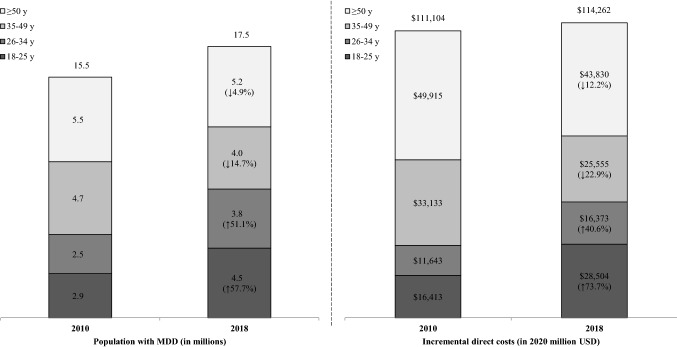
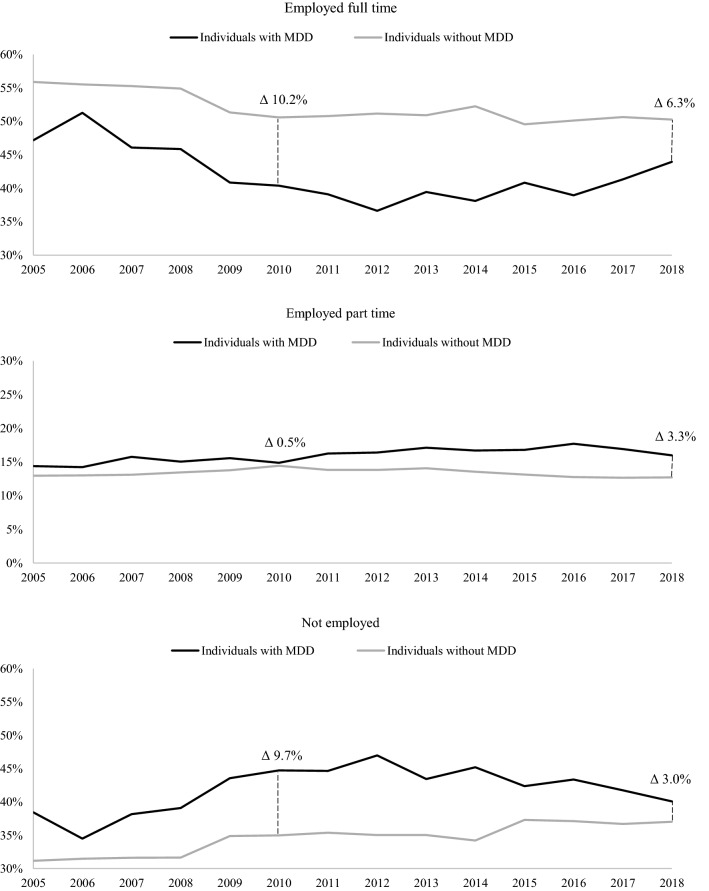
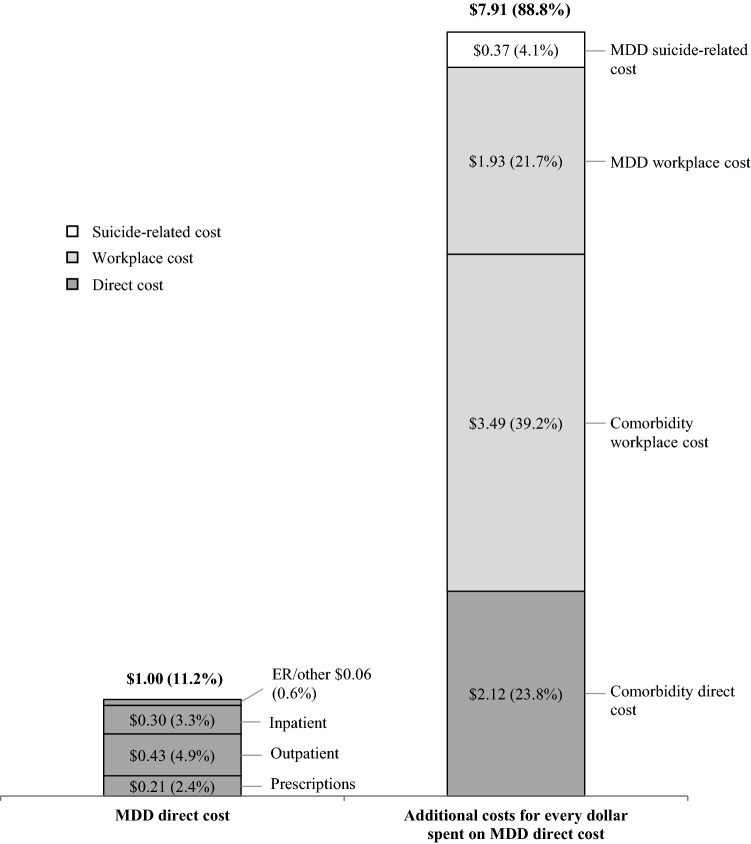
BACKGROUND: The incremental economic burden of US adults with major depressive disorder (MDD) was estimated at $US210.5 billion in 2010 (year 2012 values). OBJECTIVE: Following a similar methodology, this study updates the previous findings with more recent data to report the economic burden of adults with MDD in 2018. METHOD: This study used a framework for evaluating the incremental economic burden of adults with MDD in the USA that combined original and literature-based estimates, focusing on key changes between 2010 and 2018. The prevalence rates of MDD by sex, age, employment, and treatment status over time were estimated based on the National Survey on Drug Use and Health (NSDUH). The incremental direct and workplace costs per individual with MDD were primarily derived from administrative claims data and NSDUH data using comparative analyses of individuals with and without MDD. Societal direct and workplace costs were extrapolated by multiplying NSDUH estimates of the number of people with MDD by the direct and workplace cost estimates per patient. The suicide-related costs were estimated using a human capital method. RESULTS: The number of US adults with MDD increased by 12.9%, from 15.5 to 17.5 million, between 2010 and 2018, whereas the proportion of adults with MDD aged 18-34 years increased from 34.6 to 47.5%. Over this period, the incremental economic burden of adults with MDD increased by 37.9% from $US236.6 billion to 326.2 billion (year 2020 values). All components of the incremental economic burden increased (i.e., direct costs, suicide-related costs, and workplace costs), with the largest growth observed in workplace costs, at 73.2%. Consequently, the composition of 2018 costs changed meaningfully, with 35% attributable to direct costs (47% in 2010), 4% to suicide-related costs (5% in 2010), and 61% to workplace costs (48% in 2010). This increase in the workplace cost share was consistent with more favorable employment conditions for those with MDD. Finally, the proportion of total costs attributable to MDD itself as opposed to comorbid conditions remained stable at 37% (38% in 2010). CONCLUSION: Workplace costs accounted for the largest portion of the growing economic burden of MDD as this population trended younger and was increasingly likely to be employed. Although the total number of adults with MDD increased from 2010 to 2018, the incremental direct cost per individual declined. At the same time, the proportion of adults with MDD who received treatment remained stable over the past decade, suggesting that substantial unmet treatment needs remain in this population. Further research is warranted into the availability, composition, and quality of MDD treatment services.
Overview
The claims and statistics of this paper haven’t been checked yet.
Free: it reads the open-access text and checks the first 5 claims that cite a source we can check. Create a free account to check every claim.
Integrity signals
Registry
Cites
Statistics
Figures
Verification
Claims the paper makes
The claims and statistics of this paper haven’t been checked yet.
Free: it reads the open-access text and checks the first 5 claims that cite a source we can check. Create a free account to check every claim.
Claims other papers make about this one
Each is checked against this paper’s own text: does it say what the citing paper says it does?
The cited source doesn’t support the claim as written.
In the citing paper
“The current estimate of total incremental costs of MDD in 2019 represents a 3.5% increase in the burden compared with a prior estimate in 2018 (when standardized to 2019 values), with 36.0% of the total incremental costs of MDD in 2019 coming from novel components not previously included in the prior estimate (i.e., unemployment, all-cause mortality, householdrelated costs) [8].”
From The Economic Burden of Adults with Major Depressive Disorder in the United States (2019) (2023) · cites this paper as [8]
Checked by a reasoning model — may be wrong.
Experimental — accuracy not yet measuredThe cited source says what the claim attributes to it.
In the citing paper
“one of the key differentiators of the current study from previous estimations of the economic burden of MDD [8,33,34] was the consideration of household-related costs.”
From The Economic Burden of Adults with Major Depressive Disorder in the United States (2019) (2023) · cites this paper as [8]
The check wasn’t confident either way, so it gives no verdict — never disputed.
In the citing paper
“The COVID-19 pandemic exacerbated many risk factors for depression across countries of disparate economic status 5,6 ;”
From Digital health technologies and major depressive disorder (2023) · cites this paper as [5]
Experimental — accuracy not yet measuredIn the citing paper
“The current estimate of total incremental costs of MDD in 2019 represents a 3.5% increase in the burden compared with a prior estimate in 2018 (when standardized to 2019 values), with 36.0% of the total incremental costs of MDD in 2019 coming from novel components not previously included in the prior estimate (i.e., unemployment, all-cause mortality, householdrelated costs) [8].”
From The Economic Burden of Adults with Major Depressive Disorder in the United States (2019) (2023) · cites this paper as [8]
In the citing paper
“which was an increase from the previous estimate of 7.1% in 2018 [8].”
From The Economic Burden of Adults with Major Depressive Disorder in the United States (2019) (2023) · cites this paper as [8]
Self-check
Percentages, sums and reported differences re-computed from the paper’s own numbers.
The self-check needs the paper’s full text.
Citations
Cites
Charlson, M. E., Pompei, P., Ales, K. L., & MacKenzie, C. R. (1987) · Journal of Chronic Diseases · doi:10.1016/0021-9681(87)90171-8 · Cited by 49,742
Coding algorithms for defining comorbidities in ICD-9-CM and ICD-10 administrative data
Quan, H., Sundararajan, V., Halfon, P., Fong, A., Burnand, B., Luthi, J.-C., Saunders, L. D., Beck, C. A., Feasby, T. E., & Ghali, W. A. (2005) · Medical Care · doi:10.1097/01.mlr.0000182534.19832.83 · Cited by 10,669
Scoville, W. B. (1949) · Journal of neurosurgery · doi:10.3171/jns.1949.6.1.0065 · Cited by 7,381
Centers for Disease Control and Prevention
(2007) · Encyclopedia of Measurement and Statistics · doi:10.4135/9781412952644.n74 · Cited by 6,444
Quan, H., Li, B., Couris, C. M., Fushimi, K., Graham, P., Hider, P., Januel, J.-M., & Sundararajan, V. (2011) · American Journal of Epidemiology · doi:10.1093/aje/kwq433 · Cited by 5,843
The outbreak of COVID-19 coronavirus and its impact on global mental health
Torales, J., O’Higgins, M., Castaldelli-Maia, J. M., & Ventriglio, A. (2020) · International Journal of Social Psychiatry · doi:10.1177/0020764020915212 · Cited by 3,013
Prevalence of depression symptoms in US adults before and during the COVID-19 pandemic
Ettman, C. K., Abdalla, S. M., Cohen, G. H., Sampson, L., Vivier, P. M., & Galea, S. (2020) · JAMA Network Open · doi:10.1001/jamanetworkopen.2020.19686 · Cited by 2,138
The Economic Burden of Adults With Major Depressive Disorder in the United States (2005 and 2010)
Greenberg, P. E., Fournier, A.-A., Sisitsky, T., Pike, C. T., & Kessler, R. C. (2015) · The Journal of Clinical Psychiatry · doi:10.4088/jcp.14m09298 · Cited by 1,779
Self-citationMokdad (2018) · doi:10.1001/jama.2018.0158 · Cited by 1,517
Depression Is the Leading Cause of Disability Around the World
Friedrich, M. J. (2017) · JAMA · doi:10.1001/jama.2017.3826 · Cited by 1,459
Cited by
Items 801–900 of 1,000
Mosiño, A., & Herrera, C. A. L. (2022) · Authorea · doi:10.22541/au.166801479.96749074/v1
Low-dose colchicine: a potential augmenting agent in the treatment of refractory mood disorders
Singh, A., Skvarc, D., Lago, J., & Berk, M. P. (2026) · Acta Neuropsychiatrica · doi:10.1017/neu.2026.10098
Sulej, Z., & Zielińska, M. (2026) · Frontiers in Molecular Neuroscience · doi:10.3389/fnmol.2026.1950244
Omachonu, R. A., Uzuh, S. A., Akinola, K., Ovabor, K., & Odibo, A. (2026) · Cureus · doi:10.7759/cureus.117858
Liu, Z., Deierlein, A. L., & Gaba, A. (2026) · Research Square · doi:10.21203/rs.3.rs-10856558/v1
Bishop, N. J., Walker, K. J., Nagel, C., Newsom, J. T., Botoseneanu, A., Allore, H. G., Triolo, F., & Quiñones, A. R. (2026) · Aging & Mental Health · doi:10.1080/13607863.2026.2720598
Combining Behavior Change Strategies to Develop Meditation App Habits: A Randomized Controlled Trial
Stecher, C. D., Cloonan, S., Huberty, J., Hanley, A. W., Lecy, N., & Berardi, V. (2026) · Mindfulness · doi:10.1007/s12671-026-03001-7
Jiang, M., Liu, L., Huang, X., Yao, Y., Feng, J., & Ma, Z. (2026) · Geriatric Nursing · doi:10.1016/j.gerinurse.2026.103916
Recognition of depression in individual subjects with eye movement tracking (Preprint)Preprint
Gao, M., Yu, Y., Xu, X., Wang, Q., Wang, J., & Gao, D. (2023) · doi:10.2196/preprints.52339
Decoding Depression: Advances in Selectively Bred Rodent Models
Iglesias, L. P., Wegener, G., & Godoy, L. D. (2026) · Neuromethods · doi:10.1007/978-1-0716-5599-3_19
Hawk, L. W., Schnoll, R. A., Dahne, J., Carpenter, M. J., Cropsey, K. L., Wilding, G. E., Duerr, C., Allen, C. G., Nghiem, V. T., Shelton, R. C., et al. (2026) · Trials · doi:10.1186/s13063-026-09910-1
Finasteride and depression: the high cost of failed regulation
Brezis, M. (2026) · Journal of Public Health · doi:10.1093/pubmed/fdag077
Fowers, R., Coza, A., Chung, Y., Ghasemzadeh, H. G., Cloonan, S., Huberty, J., Berardi, V., & Stecher, C. D. (2025) · Behavioral Sciences · doi:10.3390/bs15030381
Cox, A. E., Coppus, T. A., & Delinsky, L. K. (2026) · Sport Management Education Journal · doi:10.1123/smej.2024-0006
Medicaid expansion and inpatient hospital charges among women with major depressive disorders
Akinyemi, O. A., Fasokun, M., Ogunyankin, F., Kuffour, G., Khalil, S. K., Omokhodion, O., Oyebade, R., Ekwunazu, C., Ogunsakin, A., Michael, M., et al. (2026) · PLoS ONE · doi:10.1371/journal.pone.0335006
The Behavioral Health Wellness Visit
Zimmermann, M., & O’Donohue, W. (2021) · Springer eBooks · doi:10.1007/978-3-030-83469-2_2
Hu, Q., & Xia, Y. (2025) · American Journal of Health Economics · doi:10.1086/735165
Schulz, R., Post, W. J., Huisman, M., Waldorp, L., & de Jong, P. J. (2026) · Clinical Psychological Science · doi:10.1177/21677026261485974
Zheng, Z., Li, X., Lei, H., Liang, G., Zhang, X., Li, Z., Xu, X., & Xu, C. (2026) · Cerebral Cortex · doi:10.1093/cercor/bhag102
Damgaard, S. N., Naesager, A. H. D., Jensen, K. T., Dalsgaard, A. H., Siersma, V., Jørgensen, M. B., Osler, M., Brodersen, J. B., & Rozing, M. P. (2026) · Nordic Journal of Psychiatry · doi:10.1080/08039488.2026.2666066
Additional file 1 of Factors affecting major depression in Iran: a mixed-method study
Hosseinzadeh-Shanjani, Z., Zarnaq, R. K., Khosravi, M. F., Arab‐Zozani, M., & Alizadeh, G. (2024) · Figshare · doi:10.6084/m9.figshare.25909978
Psychiatric morbidity among resident doctors in a tertiary hospital in Nigeria
Salihu, M. O., Makanjuola, A. B., Ajiboye, P., & Abiodun, O. A. (2024) · Journal of the Colleges of Medicine of South Africa · doi:10.4102/jcmsa.v2i1.91
Song, M., Launder, N. H., Phutane, V. H., Moss, F., Keogh, A., & Chong, T. W. H. (2025) · Australasian Psychiatry · doi:10.1177/10398562251389557
Furukawa, S., Horigome, T., Shiga, K., Fujioka, M., Kobayashi, N., Uchida, H., & Kishimoto, T. (2026) · Comprehensive Psychiatry · doi:10.1016/j.comppsych.2026.152719
Häkkinen, V., & Airaksinen, A. (2023) · UEF eRepo (University of Eastern Finland)
Charnsil, C. (2023) · Research Square · doi:10.21203/rs.3.rs-3394891/v1
Depression as a Disease of White Matter Network Disruption: Learning From Multiple Sclerosis
Baller, E. B., Cooper, E. C., Schindler, M. K., Bar‐Or, A., Fox, M., Shinohara, R. T., & Satterthwaite, T. D. (2025) · Biological Psychiatry · doi:10.1016/j.biopsych.2025.11.011
Kulwicka, K., & Gąsiorowska, A. (2025) · Springer eBooks · doi:10.1007/978-3-031-73363-5_121
Ciotei, C., Păunescu, H., Lungu, C., Marica, A., Tănase, M. F., Marin, R., Costescu, M., Fulga, I., & Coman, O. A. (2026) · Journal of Cellular and Molecular Medicine · doi:10.1111/jcmm.71392
Additional file 1 of Economic burden of major depressive disorder: a case study in Southern Iran
Keshavarz, K., Hedayati, A., Rezaei, M., Goudarzi, Z., Moghimi, E., Rezaee, M., & Lotfi, F. (2022) · Figshare · doi:10.6084/m9.figshare.20745390
Patient preferences for the integration of exercise for depression into mental health care
Dregney, T. M., Kaja, S. M., Eadeh, H., Adkins-Hempel, M., Uebelacker, L. A., Sylvia, L. G., Abrantes, A. M., & Busch, A. M. (2026) · Translational Behavioral Medicine · doi:10.1093/tbm/ibag041
Blake, A. F., Paxton, L., & Chassin, L. (2026) · Emerging Adulthood · doi:10.1177/21676968261444059
Suen, Y. N., Wong, Y. C., Winnie, N., Patwardhan, S., Cheung, C., Wong, S. M. Y., Hui, C. L. M., Wong, M. T. H., Mahtani, S., & Chen, E. Y. H. (2025) · SSM - Mental Health · doi:10.1016/j.ssmmh.2025.100485
Panaite, V. (2023) · Administration and Policy in Mental Health and Mental Health Services Research · doi:10.1007/s10488-023-01260-3
Additional file 1 of A framework for inferring and analyzing pharmacotherapy treatment patterns
Rush, E. N., Özmen, Ö., Kim, M., Ortegon, E. R., Jones, M., Park, B. H., Pizer, S. D., Trafton, J. A., Brenner, L. A., Ward, M. C., et al. (2024) · Figshare · doi:10.6084/m9.figshare.26691082
Fava, M., Mischoulon, D., Cassano, P., Papakostas, G. I., & Stern, T. A. (2024) · Elsevier eBooks · doi:10.1016/b978-0-443-11844-9.00028-x
Lee, S., Mun, S., Yun, Y., Woo, M. S., Kang, H., & Lee, J. (2025) · Clinical Psychopharmacology and Neuroscience · doi:10.9758/cpn.25.1301
Major depressive disorder relapse in primary care
Abu-Ashour, W. (2026) · doi:10.48336/143
Financial hardship from medical bills and depression among adults with diabetes in the United States
Alharbi, H., & Popovici, I. (2025) · Journal of Pharmaceutical Health Services Research · doi:10.1093/jphsr/rmaf016
Verma, G., Jacob, Y., Morris, L. S., Xing, X., Delman, B. N., Murrough, J. W., Lin, A., & Balchandani, P. (2026) · Frontiers in Psychiatry · doi:10.3389/fpsyt.2026.1747824
Matos, M. A., Ogata, A., Abdo, C. H. N., Gondo, C., Lodi, M. T., Stefani, S. D., & Bilevicius, E. (2023) · Jornal Brasileiro de Economia da Saúde · doi:10.21115/jbes.v15.n1.p24-31
Cabanas‐Sánchez, V., Martínez‐Gómez, D., Rodríguez-Artalejo, F., Ho, F., Pell, J. P., & Celis-Morales, C. (2026) · Mayo Clinic Proceedings · doi:10.1016/j.mayocp.2026.09.010
Junyi, W. (2026) · Exploring Science Academic Conference Series · doi:10.70267/iclpce.20265966
Dobson, K. G., Chien, Y., Carnide, N., Smith, P., & Mustard, C. (2026) · American Journal of Industrial Medicine · doi:10.1002/ajim.70061
Mohamed, O., Duggan, J. L., Hines, K. E., Harper, C. M., Rozental, T. D., & Shoji, M. M. (2026) · Journal of Hand Surgery Global Online · doi:10.1016/j.jhsg.2026.100989
Smith, M. (2025) · cIRcle (University of British Columbia) · doi:10.14288/1.0449035
Cardiorespiratory Fitness in Young Adulthood and Depressive Symptoms Later in Life Among Swedish Men
Stenling, A., Björk, M. P., Ekblom‐Bak, E., Kivi, M., & Lindwall, M. (2026) · Journal of Aging and Health · doi:10.1177/08982643261497190
Jain, S., Gupta, S., Li, V. W., Suthoff, E. D., & Arnaud, A. (2022) · Figshare · doi:10.6084/m9.figshare.20479545
Kujanpää, T., Jäppinen, S., Suominen, K. H., Pohjolainen, V., & Luoto, R. (2026) · Scandinavian Journal of Public Health · doi:10.1177/14034948261422954
Changes to Depression-Related Health Care Encounters and Telehealth Adoption in the COVID-19 Era
Hansen, E. J., Cizik, A. M., Goldstein, E. V., Kean, J. T., Singer, P. M., & Wilson, F. A. (2025) · Telemedicine Journal and e-Health · doi:10.1177/15305627251392175
Marçal, K. E. (2026) · Journal of Community Psychology · doi:10.1002/jcop.70078
Mouhanna, F., Nakayama, J. Y., Whitfield, G. P., Matjasko, J. L., Rose, K., Abad, N. S., Seiler, M., Esparza, C., & Thomas, C. W. (2026) · MMWR Morbidity and Mortality Weekly Report · doi:10.15585/mmwr.mm7539a1
Exercise As a Prescription for Patients with Depressive Disorders: A Quality Improvement Project
Roscoe, S., & Pace, R. (2023) · Digital USD (University of San Diego) · doi:10.22371/07.2023.009
Sex-Specific Elevated Fasting Glucose in Patients with Major Depressive Disorder
Prathivadi, N. P., Birur, B., & Li, L. (2024) · Journal of Diabetes and Treatment · doi:10.29011/2574-7568.010131
Wang, Y., Kou, R., Xu, Q., Wu, Y., Wang, H., & Zhang, X. (2026) · Healthcare · doi:10.3390/healthcare14101397
Tetlow, S. M., & Druss, B. G. (2026) · JAMA Health Forum · doi:10.1001/jamahealthforum.2026.3759
Rozell, C. J., & Alagapan, S. (2023) · The Conversation · doi:10.64628/aai.wqd74jvgy
Implications of cellular changes in depression on human cortical microcircuit activity
Yao, H. K. (2025) · TSpace (University of Toronto)
Sun, G., Zhang, Q., Liu, X., Guo, X., Duanwei, W., & Xun, G. (2025) · Journal of Affective Disorders · doi:10.1016/j.jad.2025.120777
Exploration of a Network-Based EEG Marker for Major Depressive Disorder
Lemaitre, C., Charles, A. S., & Sarma, S. V. (2024) · Annual International Conference of the IEEE Engineering in Medicine and Biology Society (EMBC) · doi:10.1109/embc53108.2024.10782339
Ying, J., Chew, Q. H., Si, T., Kallivayalil, R. A., Tanra, A. J., Nadoushan, A. H. J., Chee, K. Y., Javed, A., Pariwatcharakul, P., Park, S., et al. (2026) · Asia-Pacific Psychiatry · doi:10.1111/appy.70017
Cabello-Rangel, H., Santos, H. F. D. L., Jiménez, J. L. L., Vázque-Rosales, M. A., Velázquez-Posada, M., & Diaz‐Castro, L. (2026) · Actas Españolas de Psiquiatría · doi:10.62641/aep.v54i4.2180
Chen, Z., Feng, Z., Dai, Q., & Sirois, F. M. (2023) · Frontiers in Psychiatry · doi:10.3389/fpsyt.2023.1249049
Pharmacogenetic clinical implementation
Esquivel, B., & Dawes, M. G. (2024) · Elsevier eBooks · doi:10.1016/b978-0-323-98808-7.00005-9
The mechanisms beneath the urban buffer against depression
Li, J., Gan, T., Lyu, S., Wu, H., Macrì, S., & Porfiri, M. (2026) · Cities · doi:10.1016/j.cities.2026.107215
Denee, T., Kerr, C., Richards, S., Dennis, N., Foix-Colonier, A., Fischer, C., & Larkin, F. (2024) · Figshare · doi:10.6084/m9.figshare.26825477
Schladitz, K., Luppa, M., Riedel-Heller, S. G., & Loebner, M. (2023) · Qucosa (Saxon State and University Library Dresden)
Roos, C. R., McHugh, R. K., Vafaie, N., Schleider, J. L., McDanal, R., DeBenedictis, A., Palmer, R. L., John, M., Votaw, V. R., & Kober, H. (2026) · Scientific Reports · doi:10.1038/s41598-026-59035-3
Kohli, M., Gupta, N., Saini, P., & Kohli, G. (2025) · National Journal of Community Medicine · doi:10.55489/njcm.160320254952
(2025) · Frontiers research topics · doi:10.3389/978-2-8325-5916-1
Roy, S., Oană, B. M., Adams, G., Arvanitis, S., Ho, A., Gupta, A., Lopez, M., Clark, L., Kanbar, A., Aziz, A., et al. (2026) · Journal of Clinical and Basic Psychosomatics · doi:10.36922/jcbp025490093
Zhang, J., Miao, M., Wang, Y., Jiang, L., Zhu, R., Mao, T., Lu, Z., Wang, J., Zhao, L., Fu, S., et al. (2026) · Translational Psychiatry · doi:10.1038/s41398-026-04075-6
Food insecurity patterns and mental health among youth and young adults with diabetes
Alfalki, A. M., Julceus, E. F., Flory, K., MENDOZA, J. A., Malik, F. S., Frongillo, E. A., Reboussin, B. A., Bellatorre, A., Dabelea, D., Pihoker, C., et al. (2025) · BMJ Open Diabetes Research & Care · doi:10.1136/bmjdrc-2025-005511
Watanabe, H., Ihara, A. S., Okada, M., Sakti, S., Tachimori, M., Mizukami, E., & Naruse, Y. (2025) · Research Square · doi:10.21203/rs.3.rs-6913281/v1
Who does iCBT work for and why: predicting and understanding treatment outcomes in depression
Lee, C. T. (2024) · Trinity's Access to Research Output (TARA) (Trinity College Dublin)
Menguak Gangguan Mood Pada Otak Manusia Menurut Prespektif Psikiatri Biologi
Maramis, M. M. (2023) · Universitas Airlangga Repository (Universitas Airlangga)
Ozkaya, S. (2025) · Queen Mary Research Online (Queen Mary University of London)
Mechanisms of neuroplasticity induced by permeable serotonergicsPreprint
Fedorov, A. (2025) · doi:10.58445/rars.3131
Brigham, J. (2024) · Carolina Digital Repository (University of North Carolina at Chapel Hill) · doi:10.17615/4pq9-1966
Association Between Antidepressant Adherence and Major Depressive Disorder Complications
Lisinge, P. (2023) · ScholarWorks (Walden University)
Rani, N. D. M. (2026) · UiTM Institutional Repositories (Universiti Teknologi MARA)
Associations between individual symptoms of Major Depressive Disorder and peripheral inflammation
Fellows, E. (2024) · TSpace (University of Toronto)
Dahrendorff, J. (2025) · Digital Commons - University of South Florida (University of South Florida)
Cognitive and affective deficits after chronic stress: role of inhibitory circuits
Wan-Yan-Chan, D. (2023) · Memorial University Research Repository (Memorial University) · doi:10.48336/2a28-6j52
Serravalle, L. (2023) · Spectrum Research Repository (Concordia University)
Treino Metacognitivo na pessoa mais velha com Sintomas Depressivos (MCT-Silver)
Silva, C. F. B. D. (2025) · Portuguese National Funding Agency for Science, Research and Technology (RCAAP Project by FCT)
Anosike, C., Adibe, M. O., Isah, A., Mosanya, A. U., & Onuzulike, I. J. (2025) · Journal of Pharmaceutical Health Services Research · doi:10.1093/jphsr/rmaf013
Impacto de la Percepción Genital Femenina en la Salud mental de la Mujer como Variable Mediadora
Rebollo, I. M. R.-H. (2026) · RODIN (Universidad de Cádiz)
Antidepressant Class and Concurrent rTMS Outcomes in MDD: a Systematic Review and Meta-Analysis
Zaidi, A. (2025) · TSpace (University of Toronto)
Construcción y validación de un cuestionario para la evaluación de la depresión
Guillot Valdés, M. (2024) · Institutional Repository of the University of Granada (University of Granada)
Lehtinen, M. (2025) · Tampere University Institutional Repository (Tampere University)
Physical exercise and depression in adults and older adults
Bedoya, É. A. P. (2024) · doi:10.47328/ufvbbt.2024.545
Chen-Li, D. C. J. (2024) · TSpace (University of Toronto)
Buck Dodson, R. E. (2023) · ThinkTech (Texas Tech University)
Gut-Brain Connection: How Microbiota and Diet Influence Major Depressive DisorderPreprint
Wunnava, S. (2025) · doi:10.58445/rars.3172
Post-Covid Era: Predictive Aspect of Psychological Condition Due to Sudden Pandemic
Ojha, S., Singh, A., Pandey, A., Kumar, S., & Mishra, S. K. (2022) · Journal of Drug Delivery and Therapeutics · doi:10.22270/jddt.v12i5-s.5723
The role of small nucleolar RNAS in major depressive disorder and antidepressant treatment
Lin, R. (2023) · eScholarship@McGill (McGill) · doi:10.82308/33962
Effects of maternal mental disorders on mother-infant emotional availability in the perinatal period
Aran, P. (2021) · Murdoch University Research Portal
Μπακάκου, Ε. Χ., & Μπακάκου, Ε. Χ. (2024) · University of Thessaly Institutional Repository (University of Thessaly) · doi:10.26253/heal.uth.40343
Metadata
- Authors
- Greenberg, P. E., Fournier, A.-A., Sisitsky, T., Simes, M., Berman, R., Koenigsberg, S. H., & Kessler, R. C.
- Affiliations
- Analysis Group (United States) (US)
- Harvard University (US)
- Venue
- PharmacoEconomics
- Published
- 2021-05-05
- Volume
- 39
- Issue
- 6
- Pages
- 653-665
- ISSN
- 1170-7690 (ISSN-L)
- 1179-2027
- PMC
- PMC8097130
- OpenAlex
- W3157759986
- Cited by
- 838
- References
- 33
- Citations by year
- 2026: 123 · 2025: 204 · 2024: 221 · 2023: 177 · 2022: 95 · 2021: 14
- FWCI
- 124.30
- Type
- journal article
- Language
- en
- Open access
- hybrid
- doi.org
- Licence
- cc-by-nc
- creativecommons.org/licenses/by-nc/4.0 (tdm)
- creativecommons.org/licenses/by-nc/4.0 (vor)
- Locations
- PharmacoEconomics (publishedVersion, cc-by-nc)
- PubMed Central (publishedVersion, cc-by-nc)
- PubMed (publishedVersion)
- RePEc: Research Papers in Economics (submittedVersion)
- Topics
- Health Sciences › Medicine › Psychiatry and Mental health › Mental Health Treatment and Access
- Social Sciences › Economics, Econometrics and Finance › Economics and Econometrics › Health Systems, Economic Evaluations, Quality of Life
- Health Sciences › Medicine › Pharmacology (medical) › Treatment of Major Depression
- Keywords
- major depressive disorder, economic burden, direct medical costs, human capital, depression prevalence, comorbidities, United States adults, National Survey on Drug Use and Health, administrative claims data, productivity loss, age and sex differences
- MeSH terms
- Adult, Major Depressive Disorder, Humans, United States, Prevalence, Health Care Costs, Cost of Illness
About these checks
Registry, retraction, Cites and statistics results are computed, not judged, with one exception: a printed reference that no index lists is read once by a model before it counts as a citation error. Claims are extracted by a model and kept only when their quote appears verbatim in the text; each cited source is then checked, with a model’s help, for whether it says what the claim relies on. Those verdicts can be wrong — read the claim’s quote and the cited source before relying on one.
Statistics and arithmetic are recomputed, not judged.
Confidence bands are shown only for fields calibrated on our annotated test set. None is calibrated yet, so no band is shown.
What counts as a claim ›How we measure confidence ›How we check this ›
Are you an author, or do you see a problem with this page? Request a review
Data sources
Bibliographic data: Semantic Scholar, OpenAlex, Crossref.
Contains information from the Semantic Scholar Academic Graph Datasets, made available under the ODC Attribution License (ODC-BY 1.0).
Semantic Scholar’s data is described in: Kinney, R., et al. (2023). The Semantic Scholar Open Data Platform. arXiv:2301.10140.
