

Dose–Response Relationships of Resistance Training in Healthy Old Adults: A Systematic Review and Meta-Analysis
Open accessThe DOI matches its Crossref record; 103 of the 104 references it cites were found in a registry or an index.
Abstract
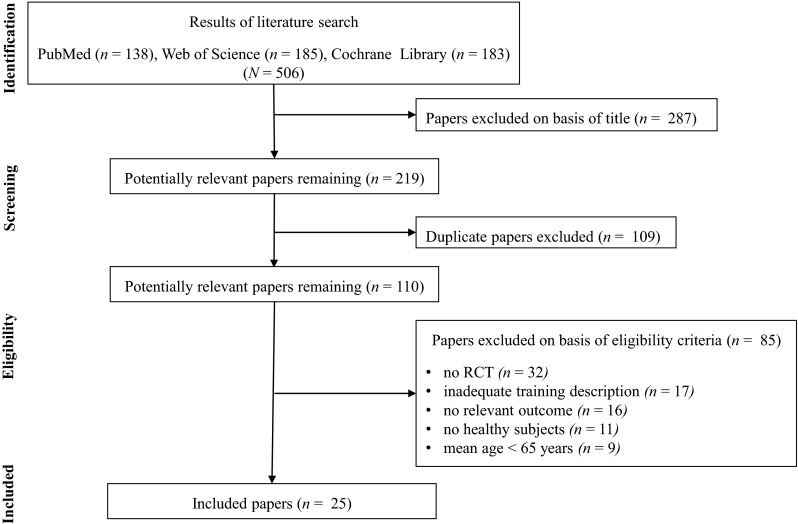
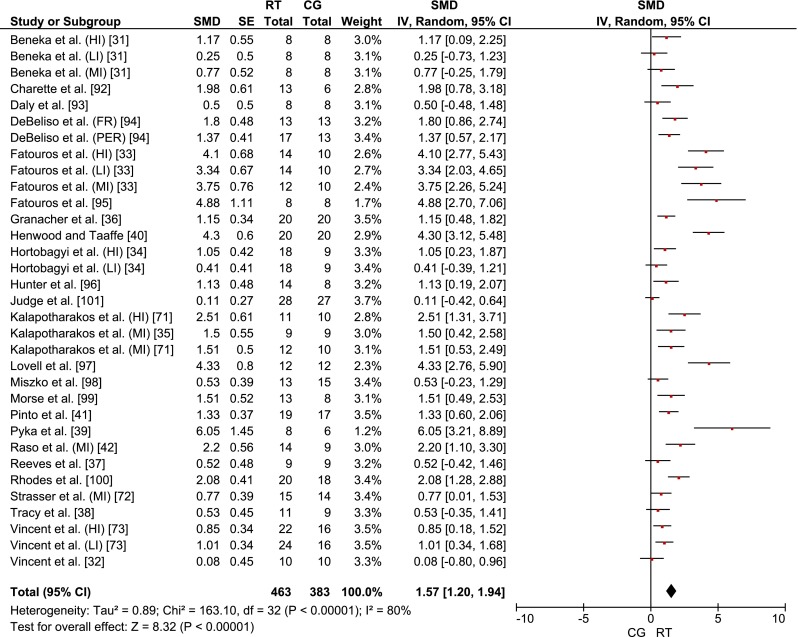
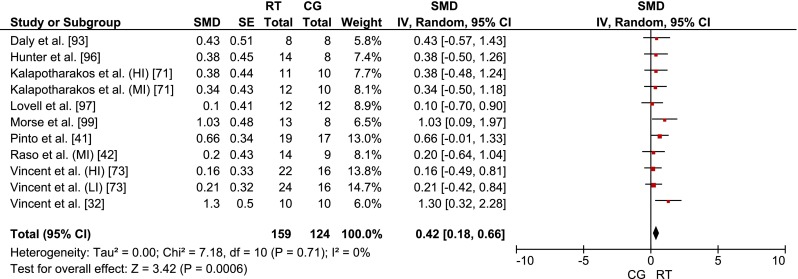
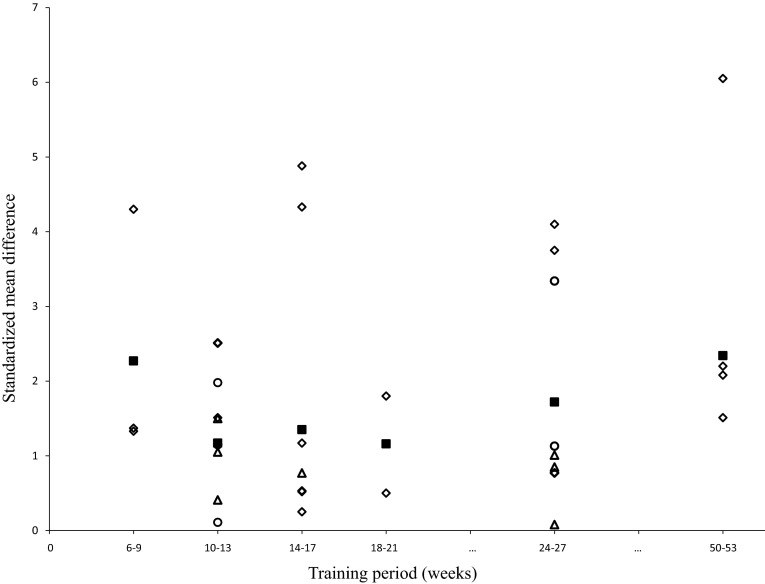
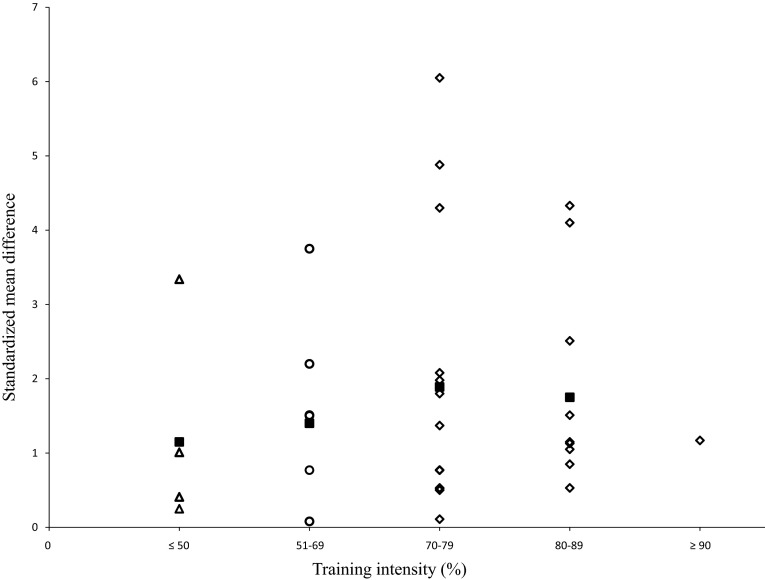
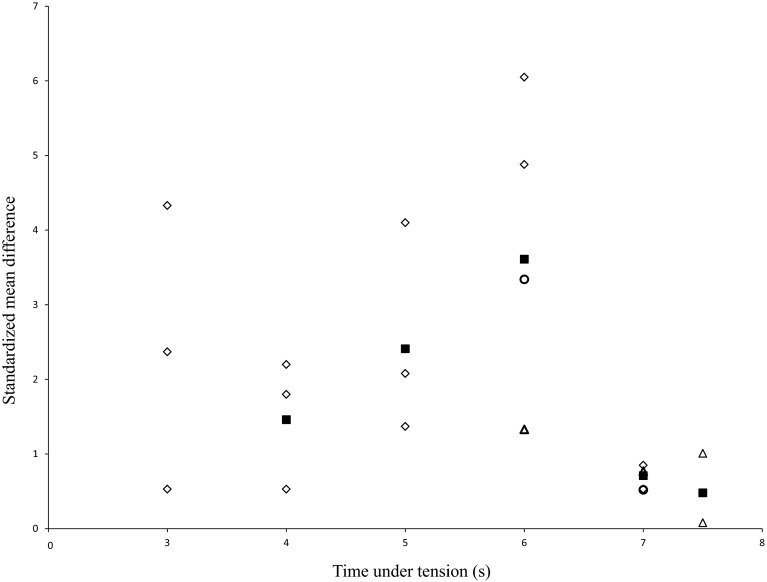
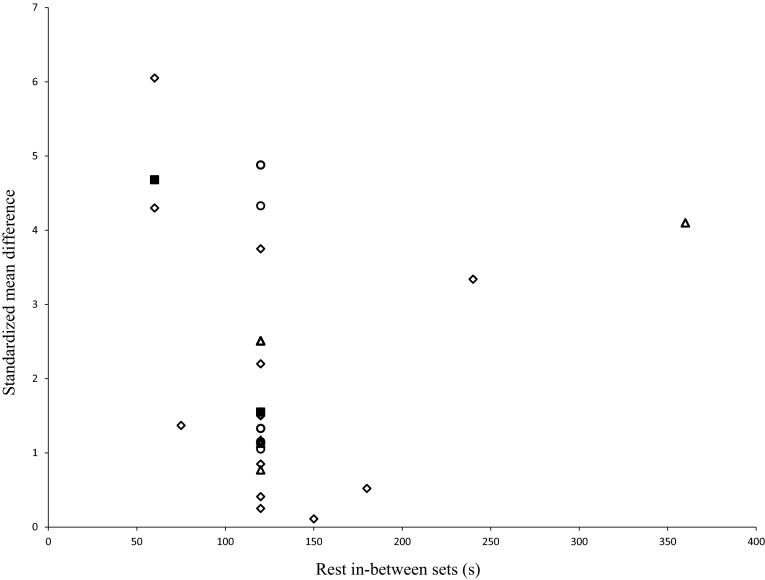
BACKGROUND: Resistance training (RT) is an intervention frequently used to improve muscle strength and morphology in old age. However, evidence-based, dose-response relationships regarding specific RT variables (e.g., training period, frequency, intensity, volume) are unclear in healthy old adults. OBJECTIVES: The aims of this systematic review and meta-analysis were to determine the general effects of RT on measures of muscle strength and morphology and to provide dose-response relationships of RT variables through an analysis of randomized controlled trials (RCTs) that could improve muscle strength and morphology in healthy old adults. DATA SOURCES: A computerized, systematic literature search was performed in the electronic databases PubMed, Web of Science, and The Cochrane Library from January 1984 up to June 2015 to identify all RCTs related to RT in healthy old adults. STUDY ELIGIBILITY CRITERIA: The initial search identified 506 studies, with a final yield of 25 studies. Only RCTs that examined the effects of RT in adults with a mean age of 65 and older were included. The 25 studies quantified at least one measure of muscle strength or morphology and sufficiently described training variables (e.g., training period, frequency, volume, intensity). STUDY APPRAISAL AND SYNTHESIS METHODS: We quantified the overall effects of RT on measures of muscle strength and morphology by computing weighted between-subject standardized mean differences (SMDbs) between intervention and control groups. We analyzed the data for the main outcomes of one-repetition maximum (1RM), maximum voluntary contraction under isometric conditions (MVC), and muscle morphology (i.e., cross-sectional area or volume or thickness of muscles) and assessed the methodological study quality by Physiotherapy Evidence Database (PEDro) scale. Heterogeneity between studies was assessed using I2 and χ2 statistics. A random effects meta-regression was calculated to explain the influence of key training variables on the effectiveness of RT in terms of muscle strength and morphology. For meta-regression, training variables were divided into the following subcategories: volume, intensity, and rest. In addition to meta-regression, dose-response relationships were calculated independently for single training variables (e.g., training frequency). RESULTS: RT improved muscle strength substantially (mean SMDbs = 1.57; 25 studies), but had small effects on measures of muscle morphology (mean SMDbs = 0.42; nine studies). Specifically, RT produced large effects in both 1RM of upper (mean SMDbs = 1.61; 11 studies) and lower (mean SMDbs = 1.76; 19 studies) extremities and a medium effect in MVC of lower (mean SMDbs = 0.76; four studies) extremities. Results of the meta-regression revealed that the variables "training period" (p = 0.04) and "intensity" (p < 0.01) as well as "total time under tension" (p < 0.01) had significant effects on muscle strength, with the largest effect sizes for the longest training periods (mean SMDbs = 2.34; 50-53 weeks), intensities of 70-79% of the 1RM (mean SMDbs = 1.89), and total time under tension of 6.0 s (mean SMDbs = 3.61). A tendency towards significance was found for rest in between sets (p = 0.06), with 60 s showing the largest effect on muscle strength (mean SMDbs = 4.68; two studies). We also determined the independent effects of the remaining training variables on muscle strength. The following independently computed training variables are most effective in improving measures of muscle strength: a training frequency of two sessions per week (mean SMDbs = 2.13), a training volume of two to three sets per exercise (mean SMDbs = 2.99), seven to nine repetitions per set (mean SMDbs = 1.98), and a rest of 4.0 s between repetitions (SMDbs = 3.72). With regard to measures of muscle morphology, the small number of identified studies allowed us to calculate meta-regression for the subcategory training volume only. No single training volume variable significantly predicted RT effects on measures of muscle morphology. Additional training variables were independently computed to detect the largest effect for the single training variable. A training period of 50-53 weeks, a training frequency of three sessions per week, a training volume of two to three sets per exercise, seven to nine repetitions per set, a training intensity from 51 to 69% of the 1RM, a total time under tension of 6.0 s, a rest of 120 s between sets, and a rest of 2.5 s between repetitions turned out to be most effective. LIMITATIONS: The current results must be interpreted with caution because of the poor overall methodological study quality (mean PEDro score 4.6 points) and the considerable large heterogeneity (I2) = 80%, χ2 = 163.1, df = 32, p < 0.01) for muscle strength. In terms of muscle morphology, our search identified nine studies only, which is why we consider our findings preliminary. While we were able to determine a dose-response relationship based on
Overview
The claims and statistics of this paper haven’t been checked yet.
Free: it reads the open-access text and checks the first 5 claims that cite a source we can check. Create a free account to check every claim.
Integrity signals
Registry
Cites
Statistics
Figures
Verification
Claims the paper makes
The claims and statistics of this paper haven’t been checked yet.
Free: it reads the open-access text and checks the first 5 claims that cite a source we can check. Create a free account to check every claim.
Claims other papers make about this one
Each is checked against this paper’s own text: does it say what the citing paper says it does?
The source backs part of the claim, not all of it — or backs it for a different population, condition or comparison.
In the citing paper
“> 3 to 4 sets of training have been reported to result in a ceiling effect with, for example, older adults [52].”
From Minimalist Training: Is Lower Dosage or Intensity Resistance Training Effective to Improve Physical Fitness? A Narrative Review (2024) · cites this paper as [52]
Experimental — accuracy not yet measuredThe cited source says what the claim attributes to it.
In the citing paper
“meta-analysis by Borde and colleagues (6) suggested that resistance exercise for older adults improves muscle strength but had small effect on muscle morphology.”
From Modulation of Neural and Muscular Adaptation Processes During Resistance Training by Fish Protein Ingestions in Older Adults (2020) · cites this paper as [6]
The check wasn’t confident either way, so it gives no verdict — never disputed.
In the citing paper
“While interesting, the inability of the group that delayed supplementation but still completed the resistance training program to experience any measurable increase in muscle cross-sectional area has led some to question the outcomes resulting from this study [5, 123].”
From International society of sports nutrition position stand: nutrient timing (2017) · cites this paper as [123]
Experimental — accuracy not yet measuredIn the citing paper
“Research indicates TRT duration has a significant effect on improvements in muscle strength [107].”
From Comparison of weightlifting, traditional resistance training and plyometrics on strength, power and speed: a systematic review with meta-analysis. (2022) · cites this paper as [107]
In the citing paper
“Fortunately, various types of exercise interventions can reverse or at least mitigate such age-related declines in health and daily life.”
From The efficacy and safety of lower-limb plyometric training in older adults: a systematic review. (2019) · cites this paper as [17]
1 more claim about this paper
Create a free account to see every claim other papers make about this one.
Self-check
Percentages, sums and reported differences re-computed from the paper’s own numbers.
The self-check needs the paper’s full text.
Citations
Cites
Liberati, A., Altman, D. G., Tetzlaff, J., Mulrow, C., Gøtzsche, P. C., Ioannidis, J. P. A., Clarke, M., Devereaux, P. J., Kleijnen, J., & Moher, D. (2009) · PLoS Medicine · doi:10.1371/journal.pmed.1000100 · Cited by 28,164 · cited 15×
“Considering that the already published meta-analyses are methodologically limited in terms of study selection criteria {inclusion of non-randomized controlled trials (RCTs) [12, 13] }, the number of included training variables (e.g., traditional variables such as training period, frequency, volume, intensity only) [14…”
BackgroundMethodInfluentialAssessing the quality of reports of randomized clinical trials: Is blinding necessary?
Jadad, A. R., Moore, R. A., Carroll, D., Jenkinson, C., Reynolds, D. J. M., Gavaghan, D. J., & McQuay, H. J. (1996) · Controlled Clinical Trials · doi:10.1016/0197-2456(95)00134-4 · Cited by 17,582
Zhang, Q., Wang, C., Zheng, M., Li, Y., Li, J., Zhang, L., Shang, X., & Yan, C. (2015) · Cerebrovascular Diseases · doi:10.1159/000369778 · Cited by 11,533
Statistical Methods for Meta-Analysis
Wasserman, S., Hedges, L. V., & Olkin, I. (1988) · Journal of Educational Statistics · doi:10.2307/1164953 · Cited by 10,326
Exercise and Physical Activity for Older Adults
Chodzko-Zajko, W. J., Proctor, D. N., Fiatarone Singh, M. A., Minson, C. T., Nigg, C. R., Salem, G. J., & Skinner, J. S. (2009) · Medicine & Science in Sports & Exercise · doi:10.1249/mss.0b013e3181a0c95c · Cited by 5,153
Reliability of the PEDro Scale for Rating Quality of Randomized Controlled Trials
Maher, C. G., Sherrington, C., Herbert, R. D., Moseley, A. M., & Elkins, M. (2003) · Physical Therapy · doi:10.1093/ptj/83.8.713 · Cited by 4,808
Dong, Y., Hao, L., Shi, Z., Wang, G., Zhang, Z., & Han, C. (2013) · Urologia Internationalis · doi:10.1159/000351405 · Cited by 4,540
Falls in older people: epidemiology, risk factors and strategies for prevention
Rubenstein, L. Z. (2006) · Age and Ageing · doi:10.1093/ageing/afl084 · Cited by 3,287
Verhagen, A. P., de Vet, H. C. W., de Bie, R. A., Kessels, A. G. H., Boers, M., Bouter, L. M., & Knipschild, P. G. (1998) · Journal of Clinical Epidemiology · doi:10.1016/s0895-4356(98)00131-0 · Cited by 2,379
Investigating and dealing with publication and other biases in meta-analysis
Sterne, J. A. C., Egger, M., & Smith, G. D. (2001) · BMJ · doi:10.1136/bmj.323.7304.101 · Cited by 2,225
Research works printed but not linked: 5
- American College of Sports M. ACSM’s guidelines for exercise testing and prescription. Baltimore: Lippincott,Williams & Wilkins; 2009.
- Deeks J Higgins J Statistical algorithms in Review Manager 5 2010 Melbourne The Cochrane Collaboration
- Cohen J Statistical power for the behavioral sciences 1988 Hillsdale Erlbaum
- Marschall F Buesch D Positionspapier für eine beanspruchungsorientierte Trainingsgestaltung im Krafttraining Schweiz Z Sportmed Sporttraumatol 2014 62 1 24 31
- Judge JO Whipple RH Wolfson LI Effects of resistive and balance exercises on isokinetic strength in older persons J Am Geriatr Soc 1994 42 9 937 946 10.1111/j.1532-5415.1994.tb06584.x 8064101 · DOI · Paper page
Cited by
Items 601–700 of 735
“Strength gains in different age groups of overweight/obese adults: A pilot uncontrolled study”
Pippi, R., Moretti, L., Carnevali, C., Tingoli, L., Settequattrini, A., Fatone, C., Perrone, C., Reginato, E., Feo, P. D., & Fanelli, C. G. (2022) · Cogent Social Sciences · doi:10.1080/23311886.2022.2106645 · Cited by 2
“As in Borde et al. (2015), that confirmed the effectiveness of resistance exercise training on upper and lower extremity muscle strength in healthy old adults, our results showed strength training effects in both 1-RM of upper and lower limbs.”
ResultEffects of ageing and resistance training on intrinsic motor neurone excitability
Orssatto, L. B. R. (2022) · Queensland University of Technology · doi:10.5204/thesis.eprints.233612
Rodrigues, I. B., Wagler, J. B., Keller, H., Thabane, L., Weston, Z. J., Straus, S. E., Παπαϊωάννου, Α., Mourtzakis, M., Milligan, J., Isaranuwatchai, W., et al. (2022) · Promotion de la santé et prévention des maladies chroniques au Canada · doi:10.24095/hpcdp.42.6.02f
Sarcopenia: Current Topics and Future Perspective
Yamada, M., Kinoshita, K., Satake, S., Matsui, Y., & Arai, H. (2022) · Springer eBooks · doi:10.1007/978-981-16-7977-3_12 · Cited by 1
Gezondheid, fysieke activiteit en oefenen: definities, voordelen, risico’s en normen
Cambier, D. C. G. (2022) · Bohn Stafleu van Loghum eBooks · doi:10.1007/978-90-368-2783-6_2
de Lima, J. G. R. (2022) · Digital Library of Theses and Dissertations (Universidade de São Paulo) · doi:10.11606/d.17.2022.tde-03102022-084228
Doctor, A. K., Monnig, J. M., Kerr, C. N., Bagg, A. M., Pickering, C. E., & Reidy, P. T. (2022) · Nutrition and Healthy Aging · doi:10.3233/nha-220183
“Longer RCT RET duration may [49–51] or may not [52] impact strength and muscle mass gain [50].”
BackgroundFüzéki, E., & Banzer, W. E. (2022) · Springer Reference Pflege, Therapie, Gesundheit · doi:10.1007/978-3-662-65219-0_32
Tatebayashi, D., & Ono, R. (2022) · Springer eBooks · doi:10.1007/978-981-19-6710-8_10
Sarcopenia and Physical Performance in Patients with Cancer
Tanaka, S., & Tatematsu, N. (2022) · Springer eBooks · doi:10.1007/978-981-19-6710-8_23
PÓS-COVID-19: TREINAMENTO COM RESTRIÇÃO DE FLUXO SANGUÍNEO COMO ALIADO NO PROCESSO DE REABILITAÇÃO
Junio, J. F. V., Vilela, J. D. S., & Lopes, J. D. F. (2022) · Editora Científica Digital eBooks · doi:10.37885/230211979
ENVEJECIMIENTO SALUDABLE. EL PAPEL DE LA PRESCRIPCIÓN DE EJERCICIOS EN EL ANCIANO FRÁGIL
Saavedra, F. J. F. (2023) · International Journal of Health Science · doi:10.22533/at.ed.1593312324041
Marcinski, W., & Kuisma, R. (2023) · Bulletin of Faculty of Physical Therapy · doi:10.1186/s43161-023-00138-7
Ersöz, Y. (2023) · International Journal of Disabilities Sports & Health Sciences · doi:10.33438/ijdshs.1323722
Keskin, K., & Tokat, F. (2023) · Turkish Journal of Kinesiology · doi:10.31459/turkjkin.1339348
“…by Figueiredo et al. 2018 confirmed that training volume is the most effective variable in resistance training for muscle size and health outcomes, not for strength because exercise load seems to be the predominant variable modifying muscle strength compared to other variables (Borde et al., 2015).”
BackgroundГолод, Н. Р. (2023) · Реабілітаційні та фізкультурно-рекреаційні аспекти розвитку людини (Rehabilitation & recreation) · doi:10.32782/2522-1795.2023.17.5 · Cited by 1
Polo-Ferrero, L. (2023) · Gredos (University of Salamanca) · doi:10.14201/gredos.155732 · Cited by 1
Zhidong, C., Wang, X., Yin, J., Song, D., & Chen, Z. (2021) · Figshare · doi:10.6084/m9.figshare.16639728
Intradialytic exercise in haemodialysis patients: applicability and effects on muscle function
Zelko, A. (2024) · University of Groningen research database (University of Groningen / Centre for Information Technology) · doi:10.33612/diss.1003141320
The Beneficial Effects of Aerobic Exercise on Human Systems and Organs: A Literature Review
Koman, A. M., Chamera-Cyrek, K., Pliszka, M., Janik, I., Gadżała, K., Palacz, K. A., Kułak, K. B., & Sztybór, I. (2024) · Journal of Education Health and Sport · doi:10.12775/jehs.2024.73.51710 · Cited by 6
“They lead to improvements in muscle and bone mass, and the effects have been confirmed in postmenopausal women and the adults [64, 65].”
BackgroundPristianto, A., Latifah, A. P., & Susilo, T. E. (2024) · JURNAL PENDIDIKAN JASMANI DAN OLAHRAGA · doi:10.17509/jpjo.v9i1.68251 · Cited by 2
Campos, G. O. (2023) · Digital Library of Theses and Dissertations (Universidade de São Paulo) · doi:10.11606/t.17.2023.tde-11042024-094740
Fan, Q., & Wang, J. (2024) · Research Square · doi:10.21203/rs.3.rs-4682957/v1
Momtaz, A., Shabani, R., & Elmieh, A. (2024) · International journal of new findings in health and educational sciences (IJHES). · doi:10.63053/ijhes.88
Lee, Y. (2024) · Springer eBooks · doi:10.1007/978-981-97-3348-4_9
Lee, Y. (2024) · Springer eBooks · doi:10.1007/978-981-97-3348-4_8
Gait Training for People with Specific Diseases
Lee, Y. (2024) · Springer eBooks · doi:10.1007/978-981-97-3348-4_14
Viviers, W. K., & Jordre, B. D. (2024) · Topics in Geriatric Rehabilitation · doi:10.1097/tgr.0000000000000455
“As such, the same authors 112 conducted a now highly cited meta-regression of data obtained from 25 intervention studies, which resulted in the following recommendations for dosing of resistance training to improve muscle strength in OAs; 50 to 53 weeks of 2 to 3 training sessions per week, with 2…”
InfluentialArai, H. (2024) · Nihon Naika Gakkai Zasshi · doi:10.2169/naika.113.277
Gonzales, L. P., Ngo, K., Kraus, P., Zander, Y., & Hatch, M. N. (2025) · PM&R · doi:10.1002/pmrj.13358 · Cited by 40
Farraj, M., Bouchibett, R. G., & CANT, J. V. (2025) · JOSPT open. · doi:10.2519/josptopen.2025.0100
Rao, S. M., Chorba, A. L., Helppi, M., Tuladhar, A., Penko, A. L., Holley, S., Nehls, B., Paulino, S., Streicher, M. C., Zhu, A., et al. (2025) · Frontiers in Aging Neuroscience · doi:10.3389/fnagi.2025.1584115
Klemp, A., Ormsbee, M. J., Yeh, M., Sokolowski, C. M., Kim, D., Panton, L. B., & Kim, J. (2025) · Journal of the International Society of Sports Nutrition · doi:10.1080/15502783.2025.2519511 · Cited by 1
“All participants completed 12 weeks of RET, two times per week on nonconsecutive days (separated by 72–96 hours), which has been demonstrated to be efficacious for increasing maximum muscle strength and hypertrophy in older adults [13–15].”
Kurth, J. D., Sciamanna, C., Danilovich, M., Conroy, D. E., Schmitz, K. H., Silvis, M. L., Rovniak, L. S., Creath, R. A., & Karakoleva, E. V. (2025) · PLoS ONE · doi:10.1371/journal.pone.0329684
3) Implication of Frailty and Sarcopenia in Geriatric Practice
Arai, H. (2024) · Nihon Naika Gakkai Zasshi · doi:10.2169/naika.113.1640
Hurst, C., Johansson, J., Witham, M. D., Robinson, S. M., Cooper, R., & Sayer, A. A. (2026) · JCSM Communications · doi:10.1002/rco2.70045
Sun, L., Ren, G., Wang, Q., Zhang, X., Hua, H., & Gu, Y. (2025) · Frontiers in Medicine · doi:10.3389/fmed.2025.1649127
“…better functional status can leverage their stronger bodily repair and compensatory capabilities to activate the body’s self-recovery mechanisms (31), thereby reducing the occurrence of pre-frailty symptoms such as decreased postoperative mobility and lowering the probability of frailty…”
長嶺, 隆. (2025) · Orthopedics & Traumatology · doi:10.5035/nishiseisai.74.703
Dai, X., Wu, Y., Yuan, Y., Lu, B., Wang, X., Xu, G., & Zhuang, J. (2025) · Frontiers in Global Women s Health · doi:10.3389/fgwh.2025.1681138
“Compared to moderate-to-low resistance training, high-load resistance training has a greater impact on increasing strength in older people (45, 46).”
Sezen, B., & SARIALİOĞLU, N. (2025) · Isokinetics and Exercise Science · doi:10.1177/09593020251394807 · Cited by 1
“3,56 Furthermore, a strong dose-response relationship between training volume and muscle hypertrophy has been established, with the optimal volume threshold yet to be fully determined.”
Knowles, K. S., Banks, L. A., Cabrera, V. C., Wilkinson, W., Pantoja, A. J., Thomas, I. G., Parsowith, E. J., Beausejour, J. P., Norte, G. E., Stout, J. R., et al. (2025) · Frontiers in Aging · doi:10.3389/fragi.2025.1670709 · Cited by 1
“Taken together, our results further support the use of minimal effective training volumes for older adults participating in resistance training, especially given the reduced recovery capacity commonly associated with aging (Borde et al., 2015).”
Vendramini, I. C., Machado, R. O., Ribeiro, D. C., Papcke, C., Lisboa, T., & Scheeren, E. M. (2025) · Advances in Gerontology · doi:10.1134/s2079057025600454
“However, there is substantial evidence supporting the benefits of strength training [15, 16].”
Chang, J., Gao, Y., Fang, X.-Y., Zhao, S.-M., 侯原平, & Sun, Q. (2020) · Figshare · doi:10.6084/m9.figshare.12246557
Neil-Sztramko, S. E., Teggart, K., Moore, C., Sherifali, D., Fitzpatrick‐Lewis, D., Coletta, G., Phillips, S. M., Newbold, K. B., Alvarez, E., Kuspinar, A., et al. (2022) · Figshare · doi:10.6084/m9.figshare.20194173
Neil-Sztramko, S. E., Teggart, K., Moore, C., Sherifali, D., Fitzpatrick‐Lewis, D., Coletta, G., Phillips, S. M., Newbold, K. B., Alvarez, E., Kuspinar, A., et al. (2022) · Figshare · doi:10.6084/m9.figshare.20194194
Gladin, A., Katzman, W. B., Fukuoka, Y., Parimi, N., Wong, S., & Lane, N. E. (2021) · Figshare · doi:10.6084/m9.figshare.14091534
Yuan, Y., Yang, Y., Hu, X., Zhang, L., Xiong, Z., Bai, Y., Zeng, J., & Xu, F. (2024) · Figshare · doi:10.6084/m9.figshare.25953312
Tagawa, R., Watanabe, D., Ito, K., Otsuyama, T., Nakayama, K., Sanbongi, C., & Miyachi, M. (2022) · Figshare · doi:10.6084/m9.figshare.20921197
Neil-Sztramko, S. E., Teggart, K., Moore, C., Sherifali, D., Fitzpatrick‐Lewis, D., Coletta, G., Phillips, S. M., Newbold, K. B., Alvarez, E., Kuspinar, A., et al. (2022) · Figshare · doi:10.6084/m9.figshare.20194191
Pearson, L. T., Fox, K. T., Keenan, A., Behm, D. G., Stuart, S., Goodall, S., & Barry, G. (2024) · Figshare · doi:10.6084/m9.figshare.25466613
Neil-Sztramko, S. E., Teggart, K., Moore, C., Sherifali, D., Fitzpatrick‐Lewis, D., Coletta, G., Phillips, S. M., Newbold, K. B., Alvarez, E., Kuspinar, A., et al. (2022) · Figshare · doi:10.6084/m9.figshare.20194167
Qian, Y., Fu, X., Zhang, H., Yang, Y., & Wang, G. (2023) · Figshare · doi:10.6084/m9.figshare.24046125
Li, Q., Huang, F., Cheng, Y., Dai, Y., Lin, Z., Lin, Z., & Zhu, P. (2024) · Figshare · doi:10.6084/m9.figshare.26962339
Meigh, N. J., Davidson, A. R., Keogh, J., & Hing, W. (2022) · Figshare · doi:10.6084/m9.figshare.20003433
Li, Q., Huang, F., Cheng, Y., Dai, Y., Lin, Z., Lin, Z., & Zhu, P. (2024) · Figshare · doi:10.6084/m9.figshare.26962342
Neil-Sztramko, S. E., Teggart, K., Moore, C., Sherifali, D., Fitzpatrick‐Lewis, D., Coletta, G., Phillips, S. M., Newbold, K. B., Alvarez, E., Kuspinar, A., et al. (2022) · Figshare · doi:10.6084/m9.figshare.20194182
Tagawa, R., Watanabe, D., Ito, K., Otsuyama, T., Nakayama, K., Sanbongi, C., & Miyachi, M. (2022) · Figshare · doi:10.6084/m9.figshare.20921200
Chen, N., He, X., Feng, Y., Ainsworth, B. E., & Liu, Y. (2021) · Figshare · doi:10.6084/m9.figshare.16994180
Rubí‐Carnacea, F., Masbernat, M. A., Climent‐Sanz, C., Soler-González, J., Garcia-Escudero, M., Martínez-Navarro, O., & Valenzuela-Pascual, F. (2023) · Figshare · doi:10.6084/m9.figshare.24098340
Jardim, R. A. C., de Sousa, T. S., Santos, W. N. N., Matos, A. P., & Iosimuta, N. C. R. (2022) · Figshare · doi:10.6084/m9.figshare.18482496
Park, J. H., Lim, N.-K., & Park, H.-Y. (2024) · Figshare · doi:10.6084/m9.figshare.26690084
Abel, B., Bongartz, M., Rapp, K., Roigk, P., Peiter, J., Metz, B., Finger, B., Büchele, G., Wensing, M., Roth, C., et al. (2024) · Figshare · doi:10.6084/m9.figshare.26668794
Park, J. H., Lim, N.-K., & Park, H.-Y. (2024) · Figshare · doi:10.6084/m9.figshare.26690087
Pearson, L. T., Fox, K. T., Keenan, A., Behm, D. G., Stuart, S., Goodall, S., & Barry, G. (2024) · Figshare · doi:10.6084/m9.figshare.25466625
Chang, J., Gao, Y., Fang, X.-Y., Zhao, S.-M., 侯原平, & Sun, Q. (2020) · Figshare · doi:10.6084/m9.figshare.12246572
Meigh, N. J., Davidson, A. R., Keogh, J., & Hing, W. (2022) · Figshare · doi:10.6084/m9.figshare.20003427
Gladin, A., Katzman, W. B., Fukuoka, Y., Parimi, N., Wong, S., & Lane, N. E. (2021) · Figshare · doi:10.6084/m9.figshare.14091537
Neil-Sztramko, S. E., Teggart, K., Moore, C., Sherifali, D., Fitzpatrick‐Lewis, D., Coletta, G., Phillips, S. M., Newbold, K. B., Alvarez, E., Kuspinar, A., et al. (2022) · Figshare · doi:10.6084/m9.figshare.20194185
Neil-Sztramko, S. E., Teggart, K., Moore, C., Sherifali, D., Fitzpatrick‐Lewis, D., Coletta, G., Phillips, S. M., Newbold, K. B., Alvarez, E., Kuspinar, A., et al. (2022) · Figshare · doi:10.6084/m9.figshare.20194176
Park, J. H., Lim, N.-K., & Park, H.-Y. (2024) · Figshare · doi:10.6084/m9.figshare.26690081
Li, Q., Huang, F., Cheng, Y., Dai, Y., Lin, Z., Lin, Z., & Zhu, P. (2024) · Figshare · doi:10.6084/m9.figshare.26962345
Park, J. H., Lim, N.-K., & Park, H.-Y. (2024) · Figshare · doi:10.6084/m9.figshare.26690078
Meigh, N. J., Davidson, A. R., Keogh, J., & Hing, W. (2022) · Figshare · doi:10.6084/m9.figshare.20003430
Gladin, A., Katzman, W. B., Fukuoka, Y., Parimi, N., Wong, S., & Lane, N. E. (2021) · Figshare · doi:10.6084/m9.figshare.14091540
Bandeira‐Guimarães, M., Blanco‐Rambo, E., Vieira, A., de Asteasu, M. L. S., Pinto, R. S., Izquierdo, M., & Cadore, E. L. (2024) · Figshare · doi:10.6084/m9.figshare.26631061
Neil-Sztramko, S. E., Teggart, K., Moore, C., Sherifali, D., Fitzpatrick‐Lewis, D., Coletta, G., Phillips, S. M., Newbold, K. B., Alvarez, E., Kuspinar, A., et al. (2022) · Figshare · doi:10.6084/m9.figshare.20194170
Tagawa, R., Watanabe, D., Ito, K., Otsuyama, T., Nakayama, K., Sanbongi, C., & Miyachi, M. (2022) · Figshare · doi:10.6084/m9.figshare.20921191
Pearson, L. T., Fox, K. T., Keenan, A., Behm, D. G., Stuart, S., Goodall, S., & Barry, G. (2024) · Figshare · doi:10.6084/m9.figshare.26697068
Hoppes, C. W., Anson, E. R., Carender, W. J., Marchetti, G. F., Hall, C. D., Whitney, S. L., Keinath, C., & Herdman, S. J. (2023) · Figshare · doi:10.6084/m9.figshare.24143812
Isenmann, E., Kaluza, D., Havers, T., Elbeshausen, A., Geisler, S., Hofmann, K., Flenker, U., Diel, P. R., & Gavanda, S. (2023) · Figshare · doi:10.6084/m9.figshare.24264713
Park, J. H., Lim, N.-K., & Park, H.-Y. (2024) · Figshare · doi:10.6084/m9.figshare.26690090
Tagawa, R., Watanabe, D., Ito, K., Otsuyama, T., Nakayama, K., Sanbongi, C., & Miyachi, M. (2022) · Figshare · doi:10.6084/m9.figshare.20921188
Neil-Sztramko, S. E., Teggart, K., Moore, C., Sherifali, D., Fitzpatrick‐Lewis, D., Coletta, G., Phillips, S. M., Newbold, K. B., Alvarez, E., Kuspinar, A., et al. (2022) · Figshare · doi:10.6084/m9.figshare.20194179
Hoppes, C. W., Anson, E. R., Carender, W. J., Marchetti, G. F., Hall, C. D., Whitney, S. L., Keinath, C., & Herdman, S. J. (2023) · Figshare · doi:10.6084/m9.figshare.24143809
Neil-Sztramko, S. E., Teggart, K., Moore, C., Sherifali, D., Fitzpatrick‐Lewis, D., Coletta, G., Phillips, S. M., Newbold, K. B., Alvarez, E., Kuspinar, A., et al. (2022) · Figshare · doi:10.6084/m9.figshare.20194188
Walter, F., Schalla, J., Bloch, W., Diel, P. R., Geisler, S., & Isenmann, E. (2026) · Sports Medicine - Open · doi:10.1186/s40798-025-00954-2 · Cited by 3
“However, these findings were not corroborated by Thomas et al. [8] and Borde et al. [69] Notably, Borde et al. [69] observed significant changes in muscle morphology with only two training sessions per week.”
Remote Exercise Effects on Physical/Cognitive Abilities in Active Older Adults: Preliminary Report
da Costa, M. S., Alves, M. R., de Paula, A. M. B., Santos, S. H. S., Oliva, H. N. P., SOARES, W. D., & Monteiro-Júnior, R. S. (2026) · Translational Journal of the American College of Sports Medicine · doi:10.1249/tjx.0000000000000340
Webster, K., Hacker, E. D., & Lu, Y. Y.-F. (2026) · Disability and Rehabilitation Assistive Technology · doi:10.1080/17483107.2026.2616044
“Resistance training should also be incorporated to improve muscle strength [86]. although we do not know the direction of the relationship between physical activity and sleep in our sample, these results highlight the potential opportunity for behavioural interventions to optimise both physical…”
Hernandez-Martinez, J., Vásquez-Carrasco, E., Cid-Calfucura, I., Rodríguez‐Rodríguez, F., Villafaina, S., Herrera-Valenzuela, T., Branco, B. H. M., & Valdés-Badilla, P. A. (2026) · Experimental Gerontology · doi:10.1016/j.exger.2026.113064 · Cited by 1
Cano-Montoya, J., Álvarez, C., Castillo, L. C., Vergara, C. N., Espinoza-Salinas, A., Valdebenito, K. D., Araya, P. R., & Martínez-Huenchullán, S. (2026) · Fisioterapia · doi:10.1016/j.ft.2026.01.004
Ljung, M., Gustafsson, K., & Kvist, J. (2026) · BMJ Open · doi:10.1136/bmjopen-2025-113185 · Cited by 1
Baschirotto, C., Venturelli, M., & Pedrinolla, A. (2026) · BMC Geriatrics · doi:10.1186/s12877-026-07020-w
“Additionally, HIET has demonstrated superior effects on muscle hypertrophy, including increases in muscle mass and CSA, compared to lower-intensity training protocols [13, 14].”
Маматкулович, Б. М., Kochkorova, F., Anarkulov, B. K., Anarkulova, A. A., Anarkulov, R. P., Anarkulov, K. F., & Атамырзаевна, К. Г. (2026) · Heart Vessels and Transplantation · doi:10.24969/hvt.2026.631
Dandekar, S. C., Kurth, J. D., Shang, Y., Stine, J. G., Ladwig, M. A., Conroy, D. E., Schmitz, K. H., Rovniak, L. S., Silvis, M. L., Danilovich, M., et al. (2026) · PLoS ONE · doi:10.1371/journal.pone.0336748
Gladin, A., & Zhu, S. (2026) · Musculoskeletal Care · doi:10.1002/msc.70197
Rauzi, M. R., Weeks, C., Thurston, T. S., Fitzpatrick, J., Plew, J. T., Fuller, M., Forster, J. E., Abbate, L. M., Christiansen, C. L., & Stevens‐Lapsley, J. E. (2026) · Physical Therapy · doi:10.1093/ptj/pzag030
Hernández-Nahuelcoy, P., Salazar‐Méndez, J., Ribeiro, I. L., Salazar-Orellana, C., Suso‐Martí, L., Calatayud, J., López‐Bueno, R., Andersen, L. L., Cruz‐Montecinos, C., & Núñez-Cortés, R. (2026) · Brazilian Journal of Physical Therapy · doi:10.1016/j.bjpt.2026.101595
Capacités d’adaptations tendineuses à l’entraînement : effet de l'âge
Létocart, A. (2018) · theses.fr (ABES) · doi:10.70675/e7b43c58z4312z4bb4za225z7306939eeb4b
“Cependant, l’intensité maximisant les gains de force musculaire et/ou la réduction de la sarcopénie restent vagues malgré plusieurs revues (entre 50 à 80% de 1RM) (Mayer et al. 2011; Borde et al. 2015).”
BackgroundYao, W. X., Mamone, B., Wu, Y., Jiang, B. Y., Zhang, J. Q., Guan, J., & Yue, G. H. (2026) · Frontiers in Psychology · doi:10.3389/fpsyg.2026.1817866
Ryu, M. (2026) · Muscles · doi:10.3390/muscles5020033
“Combined exercise programs integrating both modalities have shown promise in comprehensive sarcopenia management [10,11].”
Metadata
- Authors
- Borde, R., Hortobágyi, T., & Granacher, U.
- Affiliations
- University of Potsdam (DE)
- University Medical Center Groningen (NL)
- Corresponding author
- Borde, Ron
- Venue
- Sports Medicine
- Published
- 2015-09-29
- Volume
- 45
- Issue
- 12
- Pages
- 1693-1720
- ISSN
- 0112-1642 (ISSN-L)
- 1179-2035
- PMC
- PMC4656698
- OpenAlex
- W1840491359
- Cited by
- 737
- References
- 104
- Citations by year
- 2026: 69 · 2025: 61 · 2024: 76 · 2023: 91 · 2022: 103 · 2021: 82 · 2020: 77 · 2019: 67 · 2018: 63 · 2017: 32 · 2016: 14 · 2015: 2
- FWCI
- 6.15
- Type
- journal article
- Language
- en
- Open access
- hybrid
- doi.org
- Locations
- Sports Medicine (publishedVersion, cc-by)
- PubMed (publishedVersion)
- University of Groningen research database (University of Groningen / Centre for Information Technology) (publishedVersion)
- University of Groningen research database (University of Groningen / Centre for Information Technology) (submittedVersion)
- Funders
- Deutsche Forschungsgemeinschaft (DE) ((MU 3327/2-1))
- Topics
- Health Sciences › Medicine › Orthopedics and Sports Medicine › Sports Performance and Training
- Health Sciences › Medicine › Physiology (medical) › Nutrition and Health in Aging
- Health Sciences › Nursing › Nutrition and Dietetics › Muscle metabolism and nutrition
- Keywords
- resistance training, older adults, dose-response relationship, muscle strength, muscle morphology, training volume, exercise intensity, exercise frequency, rest periods, one-repetition maximum, cross-sectional area, healthy aging
- MeSH terms
- Aged, Aged, 80 and over, Humans, Time Factors, Muscle, Skeletal, Muscle Strength, Resistance Training
About these checks
Registry, retraction, Cites and statistics results are computed, not judged, with one exception: a printed reference that no index lists is read once by a model before it counts as a citation error. Claims are extracted by a model and kept only when their quote appears verbatim in the text; each cited source is then checked, with a model’s help, for whether it says what the claim relies on. Those verdicts can be wrong — read the claim’s quote and the cited source before relying on one.
Statistics and arithmetic are recomputed, not judged.
Confidence bands are shown only for fields calibrated on our annotated test set. None is calibrated yet, so no band is shown.
What counts as a claim ›How we measure confidence ›How we check this ›
Are you an author, or do you see a problem with this page? Request a review
Data sources
Bibliographic data: Semantic Scholar, OpenAlex, Crossref.
Contains information from the Semantic Scholar Academic Graph Datasets, made available under the ODC Attribution License (ODC-BY 1.0).
Semantic Scholar’s data is described in: Kinney, R., et al. (2023). The Semantic Scholar Open Data Platform. arXiv:2301.10140.
