

Context matters: revisiting the first step of the 'Sequence of Prevention' of sports injuries
Open accessThe DOI matches its Crossref record; 47 of the 47 references it cites were found in a registry or an index.
Abstract
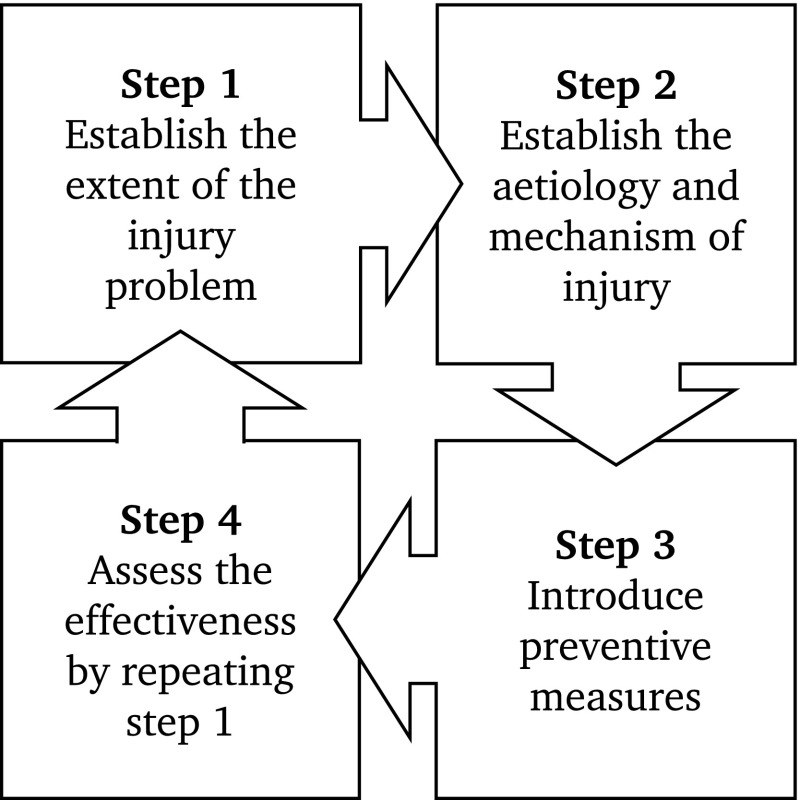
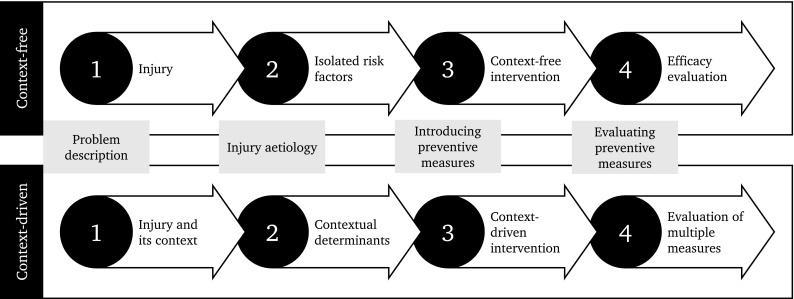
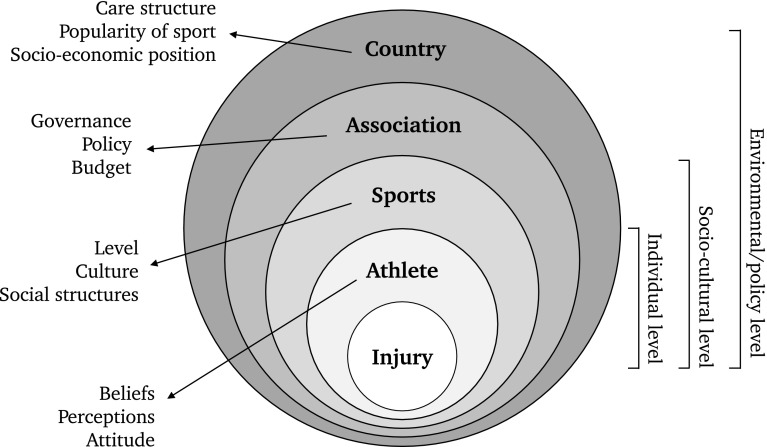
It is possible to prevent sports injuries. Unfortunately, the demonstrated efficacy and effectiveness of injury prevention approaches are not translated into lasting real-world effects. Contemporary views in sports medicine and injury prevention suggest that sports injuries are 'complex' phenomena. If the problem we aim to prevent is complex, then the first step in the 'sequence of prevention' that defines the 'injury problem' already needs to have considered this. The purpose of this paper is to revisit the first step of the 'sequence of prevention', and to explore new perspectives that acknowledge the complexity of the sports injury problem. First, this paper provides a retrospective of the 'sequence of prevention', acknowledging contemporary views on sports injuries and their prevention. Thereafter, from the perspective of the socioecological model, we demonstrate the need for taking into account the complex nature of sports injuries in the first step. Finally, we propose an alternative approach to explore and understand injury context through qualitative research methods. A better understanding of the injury problem in context will guide more context-sensitive studies, thus providing a new perspective for sports injury prevention research.
Overview
The claims and statistics of this paper haven’t been checked yet.
Free: it reads the open-access text and checks the first 5 claims that cite a source we can check. Create a free account to check every claim.
Integrity signals
Registry
Cites
Statistics
Figures
Verification
Claims the paper makes
The claims and statistics of this paper haven’t been checked yet.
Free: it reads the open-access text and checks the first 5 claims that cite a source we can check. Create a free account to check every claim.
Claims other papers make about this one
Each is checked against this paper’s own text: does it say what the citing paper says it does?
The cited source says what the claim attributes to it.
In the citing paper
“Previous authors have suggested a real need to understand the broader factors at play, 52 53 yet there has been a curious and alarming absence of gender in the conversation, given that the higher rate of ACL injury in girls and women reported in the 1990s caused an explosion of research in the area.”
From Anterior cruciate ligament injury: towards a gendered environmental approach (2021) · cites this paper as [52]
Self-check
Percentages, sums and reported differences re-computed from the paper’s own numbers.
The self-check needs the paper’s full text.
Citations
Cites
Research Design: Qualitative, Quantitative, and Mixed Methods Approaches
Creswell, J. W. (1994) · Cited by 35,508
Evaluating the public health impact of health promotion interventions: the RE-AIM framework.
Glasgow, R. E., Vogt, T. M., & Boles, S. M. (1999) · American Journal of Public Health · doi:10.2105/ajph.89.9.1322 · Cited by 7,217
Nature-nurture reconceptualized in developmental perspective: A bioecological model.
Bronfenbrenner, U., & Ceci, S. J. (1994) · Psychological Review · doi:10.1037/0033-295x.101.4.568 · Cited by 2,973 · cited 1×
“Bronfenbrenner and Ceci [29] postulated that to understand an individual’s development and behaviour, the entire ecological system in which this individual acts needs to be taken into account.”
BackgroundTwycross, A. (2004) · Nurse Researcher · doi:10.7748/nr.12.1.82.s2 · Cited by 2,031
Incidence, Severity, Aetiology and Prevention of Sports Injuries: A Review of Concepts
van Mechelen, W., Hlobil, H., & Kemper, H. C. G. (1992) · Sports Medicine · doi:10.2165/00007256-199214020-00002 · Cited by 2,015 · cited 4×
“Conflict of interest Caroline Bolling, Willem van Mechelen, Roeline Pasman and Evert Verhagen declare that they have no conflicts of interest relevant to the content of this review.”
BackgroundInfluential(2010) · Oxford University Press eBooks · doi:10.1093/acref/9780199571123.001.0001 · Cited by 1,610 · cited 1×
“In the Oxford Dictionary, ‘context’ is defined as “the interrelated conditions in which something exists or occurs” [8].”
BackgroundThe need for a complex systems model of evidence for public health
Rutter, H., Savona, N., Glonti, K., Bibby, J., Cummins, S., Finegood, D. T., Greaves, F., Harper, L., Hawe, P., Moore, L., et al. (2017) · The Lancet · doi:10.1016/s0140-6736(17)31267-9 · Cited by 1,260
Evidence-based intervention in physical activity: lessons from around the world
Heath, G. W., Parra, D. C., Sarmiento, O. L., Andersen, L. B., Owen, N., Goenka, S., Montes, F., & Brownson, R. C. (2012) · The Lancet · doi:10.1016/s0140-6736(12)60816-2 · Cited by 1,199
A new framework for research leading to sports injury prevention
Finch, C. (2006) · Journal of Science and Medicine in Sport · doi:10.1016/j.jsams.2006.02.009 · Cited by 1,071
The RE-AIM framework: a systematic review of use over time
Gaglio, B., Shoup, J. A., & Glasgow, R. E. (2013) · American Journal of Public Health · doi:10.2105/ajph.2013.301299 · Cited by 1,029
Research works printed but not linked: 1
- McGlashan AJ Enhancing the integration of specialised exercise training into coach practices to prevent lower-limb injury: using theory and exploring coaches’ salient beliefs (PhD) 2015 Ballarat Federation University Australia
Cited by
Items 201–300 of 300
Profile of physiotherapists working with soccer teams in South Africa
Selomo, M., Cochrane, M. E., & Dawood, M. A. (2023) · South African Journal of Physiotherapy · doi:10.4102/sajp.v79i1.1920 · Cited by 1
“Soccer teams will lose out on the benefits of a full socioecological approach to injury prevention if frequent team meetings are not held (Bolling et al. 2018).”
BackgroundHameed, F. A., Atta, S., Amjad, S., Alam, M. S., Asim, H. M., & Waqas, S. (2023) · Pakistan Journal of Health Sciences · doi:10.54393/pjhs.v4i12.1190 · Cited by 1
Åkerlund, I. (2024) · Linköping University medical dissertations · doi:10.3384/9789180753753 · Cited by 2
Incidencia de lesiones en basquetbolistas femeninas U18 de Liga FEMISUR-Chile
Méndez-Rodríguez, R., Mansilla-Gutiérrez, P., Oyarzún-Nenén, D., Valderrama, J. F., Uarac, M. A. M., & Gajardo-Burgos, R. E. (2024) · Ciencias de la actividad física · doi:10.29035/rcaf.25.1.10 · Cited by 1
Injury prevention and rehabilitation
Croix, M. D. S., Ayala, F., Julian, R., Sargent, D., & Hughes, J. D. (2024) · Routledge eBooks · doi:10.4324/9781003381914-16 · Cited by 1
Performance of long short-term memory networks in predicting athlete injury risk
Tao, H., Deng, Y., Xiang, Y., & Liu, L. (2024) · Journal of Computational Methods in Sciences and Engineering · doi:10.3233/jcm-247563 · Cited by 4
Windt, J. (2018) · cIRcle (University of British Columbia) · doi:10.14288/1.0375765 · Cited by 2
A multi-factorial evaluation of lower back injury risk factors in fast bowlers.
Barry, T. J. (2026) · e-space (Manchester Metropolitan University) · doi:10.83056/mmu.32478234 · Cited by 2
Buchholtz, K., Lambert, M., & Burgess, T. L. (2020) · doi:10.21203/rs.2.20157/v2 · Cited by 1
Buchholtz, K., Lambert, M., & Burgess, T. L. (2020) · doi:10.21203/rs.2.20157/v1 · Cited by 1
Verletzungsvorhersage und Risikoscreening bei Verletzungen des vorderen Kreuzbandes
Gokeler, A., & Benjaminse, A. (2019) · Sportphysio · doi:10.1055/a-0863-0065 · Cited by 1
“[27] Bolling C, van Mechelen W, Pasman HR et al.”
BackgroundInfluentialRelationship between selected physical characteristics and hamstring injuries in male soccer players
Schippers, R. C. (2018) · UWC Research Repository (University of the Western Cape)
The Role of Sports Medicine in Elite Sports
Verhagen, E. A. L. M. (2018) · Proceedings of the 2nd Yogyakarta International Seminar on Health, Physical Education, and Sport Science (YISHPESS 2018) and 1st Conference on Interdisciplinary Approach in Sports (CoIS 2018) · doi:10.2991/yishpess-cois-18.2018.90
“Adapted from Verhagen and Gabbett [4].”
Self-citationEtiologie a typy úrazů při zimních sportech
Zimová, P. (2019) · Digitální knihovna Univerzity Pardubice (Univerzity Pardubice)
Futboleko lesioen epidemiologiaren, arrisku faktoreen eta ondorioen ikerketa athletic cluben
Larruskain, J. (2020) · Communities in ADDI (University of the Basque Country)
Édouard, P., & Ford, K. R. (2022) · Frontiers in Sports and Active Living · doi:10.3389/fspor.2022.830769
Institutionalization of sports safety: lessons from Swiss youth sports promotion programme
(2022) · Swiss Sports & Exercise Medicine · doi:10.34045/sems/2022/1
Jones, E., Martin, P., Barr, M., Soundy, A., & Heneghan, N. R. (2022) · American Journal of Physical Medicine & Rehabilitation · doi:10.1097/phm.0000000000002065
Baker, C., Nottingham, Q. J., & Holloway, J. (2022) · International Journal for Population Data Science · doi:10.23889/ijpds.v7i1.1749
Winter breaks: How do they affect injuries in field hockey?
Rees, H., Persson, U. M., Delahunt, E., Boreham, C. A., & Blake, C. M. (2022) · Journal of science and medicine in sport · doi:10.1016/j.jsams.2022.08.004
“In this regard, it has been hypothesised that understanding the context in which injuries occur in a sport may assist in informing strategies of prevention.(26,27) Indeed, improving preparedness post-winter break, clubs and athletes may be able to prevent this sharp increase in muscle strain injury rates.”
BackgroundDevelopment of a trail running injury screening instrument (TRISI)
Viljoen, C. T. (2022) · doi:10.5463/thesis.78
Sports participation, Injuries and Bleeds in People with Haemophilia
Versloot, O. (2023) · Utrecht University Repository (Utrecht University) · doi:10.33540/666
Édouard, P., Depiesse, F., Bruneau, A., & Pruvost, J. (2022) · Elsevier eBooks · doi:10.1016/b978-2-294-77430-0.00006-0 · Cited by 2
ANALYSIS OF TECHNICAL TRAINING ON PHYSICAL FITNESS IN COLLEGE TENNIS PLAYERS
Wang, X. (2023) · Revista Brasileira de Medicina do Esporte · doi:10.1590/1517-8692202329012022_0734
KNEE JOINT REHABILITATION IN BADMINTON ATHLETES
Zhang, T. (2023) · Revista Brasileira de Medicina do Esporte · doi:10.1590/1517-8692202329012022_0703
SCS 5th Annual Conference. São Paulo, Brazil, 2022
Alcaráz, P. E., Cascales, E. M., Blazevich, A. J., Pereira, L. A., Mercer, V. P., Moura, T. B. M. A., Fernandes, V., Freitas, T. T., & Loturco, I. (2023) · Sports · doi:10.3390/sports11050095
Moser, N., & Gänsslen, A. (2023) · Springer eBooks · doi:10.1007/978-3-662-65600-6_39
SCHOOL IS IN SESSION: STRENGTH AND CONDITIONING IN THE HIGH SCHOOL ENVIRONMENT
Viramontes, E. (2023) · Zenodo (CERN European Organization for Nuclear Research) · doi:10.5281/zenodo.8202022
Approche préventive des lésions d’épaule chez le joueur de tennis
Tooth, C., Gofflot, A., Schwartz, C., Croisier, J. ‐., Kaux, J., & Forthomme, B. (2023) · Journal de Traumatologie du Sport · doi:10.1016/j.jts.2023.06.013
Shaw, J. (2023) · Elsevier eBooks · doi:10.1016/b978-0-323-91259-4.00037-0
Epidemiology and prevention of sports injuries
Nauta, J., Bittencourt, N. F. N., & Bolling, C. S. (2023) · Oxford University Press eBooks · doi:10.1093/med/9780192843968.003.0042
Self-citationLi, L., Wei, Y., & Xiang, S. (2024) · Research Square · doi:10.21203/rs.3.rs-3849482/v1
Zheng, Z., & Xia, Q. (2023) · Journal of Nanoelectronics and Optoelectronics · doi:10.1166/jno.2023.3549
Gamonales, J. M., Hernández-Beltrán, V., Perdomo-Alonso, A., Barguerias-Martínez, J., Gómez-Carrero, S., Ferreira, C. C., Paulo, R. M., & Espada, M. C. (2024) · Retos · doi:10.47197/retos.v56.104386
Footwear Characteristics and Ankle Sprain Risk in Indoor and Court Sports
Bagehorn, T. (2024) · VBN Forskningsportal (Aalborg Universitet) · doi:10.54337/aau746920959 · Cited by 1
Delvaux, F. H., Kaux, J., & Croisier, J. ‐. (2024) · Journal de Traumatologie du Sport · doi:10.1016/j.jts.2024.09.009
Prioul, V., SLAWINSKI, J. S., Guersent, S., Monnier, L. L., Goëb, V., Krim, F., Lopes, P., & Leprêtre, P. (2024) · Frontiers in Sports and Active Living · doi:10.3389/fspor.2024.1466118
“Recently, Bolling et al. (3) recommended taking into account the practice forms right from the fi rst step of the Van Mechelen Model of injury prevention.”
Qi, J., & Ge, C. (2025) · Molecular & cellular biomechanics · doi:10.62617/mcb1135
“He proposed an alternative method to explore and understand the injury background through qualitative research [1].”
Okell, A., & Dobbin, N. (2025) · Sport Sciences for Health · doi:10.1007/s11332-025-01468-w
“…into contextual factors, such as snow and weather conditions during on-snow training, travel requirements, and competition requirements (e.g. back-to-back competition days), may allow greater understanding in relation to the likelihood of reporting LBP using a larger number of case series [26].”
Lindblom, H., Sonesson, S., Åkerlund, I., & Hägglund, M. (2025) · Science and Medicine in Football · doi:10.1080/24733938.2025.2533797 · Cited by 1
“Since research on injuries in sports is context-specific and the setting, culture, and infrastructure may vary (Bolling et al. 2018), the results of the present study can mainly be transferred to similar contexts, such as amateur team sports – particularly football – and similar IPEPs.”
Gladdines, S., de Vos, R., Eygendaal, D. E., & Verhagen, E. A. L. M. (2025) · Translational Sports Medicine · doi:10.1155/tsm2/9501921
“Diferent contextual factors infuence the perspective of adopting measures and supporting maintenance [20].”
Self-citationPolish language questionnaires for monitoring athletes’ health and classifying reported symptoms
Zając, B., Siekańska, M., Wyrobiec, G., & Gaj, P. K. (2025) · Scientific Reports · doi:10.1038/s41598-025-17954-7
“To reduce the prevalence of health issues specific to a given sport, it is crucial to first identify these problems, link them to risk factors and understand the mechanisms behind them 10–12 .”
Baldjian, A. C., Sampietro, M., Gays, C., Brusco, A., Mohrenberger, H., Giménez, G., Menayed, R., Villalba, F. J., Tondelli, E., & Clarsen, B. M. (2025) · The Physician and Sportsmedicine · doi:10.1080/00913847.2025.2568379
“In professional football, prospective cohort studies have been carried out in different leagues worldwide, aiming to identify the injury patterns in the sport and link them to regional and cultural factors [2–5].”
Oghumu, S. N., & Ekom, E. A. (2025) · Ibom Medical Journal · doi:10.61386/imj.v18i4.806
Horan, D., Kelly, S., Hägglund, M., Blake, C., Roe, M., & Delahunt, E. (2024) · Figshare · doi:10.6084/m9.figshare.26607391
Horan, D., Kelly, S., Hägglund, M., Blake, C., Roe, M., & Delahunt, E. (2024) · Figshare · doi:10.6084/m9.figshare.26607394
Horan, D., Kelly, S., Hägglund, M., Blake, C., Roe, M., & Delahunt, E. (2024) · Figshare · doi:10.6084/m9.figshare.26607400
Horan, D., Kelly, S., Hägglund, M., Blake, C., Roe, M., & Delahunt, E. (2024) · Figshare · doi:10.6084/m9.figshare.26607406
Dunlop, G. R. (2023) · Edinburgh Napier Research Repository (Edinburgh Napier University) · doi:10.17869/enu.2023.3175170
An Ecological Dynamics Approach to ACL Injury Risk Screening in Team Ball Sports
Heuvelmans, P. (2025) · Amtliche Mitteilungen (Universitätsbibliothek Paderborn) · doi:10.17619/unipb/1-2350
Horan, D., Kelly, S., Hägglund, M., Blake, C., Roe, M., & Delahunt, E. (2024) · Figshare · doi:10.6084/m9.figshare.26607403
Horan, D., Kelly, S., Hägglund, M., Blake, C., Roe, M., & Delahunt, E. (2024) · Figshare · doi:10.6084/m9.figshare.26607397
Eetvelde, H. V., Mendonça, L. D. M., Ley, C., Seil, R., & Tischer, T. (2021) · Figshare · doi:10.6084/m9.figshare.14418044
Making Sense of Sports Injury: A Psycho-Social-Cultural Exploration
Everard, C. (2023) · St Mary's University Repository (ULCC) · Cited by 2
Costa Lindow, R. R. (2022) · Tuwhera (Auckland University of Technology)
A pathway to understanding running related injuries
Lacey, A. (2024) · Dublin City University Open Access Institutional Repository (Dublin City University)
Leduc, S. (2024) · Archipel (Université du Québec à Montréal) · Cited by 1
Kestovoimaharjoittelu kestävyysjuoksijoiden alaraajavaivojen hoidossa
Kuokkanen, A., Nenonen, H., & Väkevä, V. (2024) · Theseus (Ammattikorkeakoulujen)
VOIMANOSTON URHEILUVAMMAT : kuvaileva kirjallisuuskatsaus
Räsänen, A., & Eskelinen, T. (2024) · Theseus (Ammattikorkeakoulujen)
Hur hanteras idrottsrelaterade skador i undervisningen? : En didaktisk utmaning i idrott och hälsa
Bärlund, G. (2023) · DiVA (Linnaeus University)
Ala-Tuori, R. (2024) · Theseus (Ammattikorkeakoulujen) · Cited by 2
Injury Incidence in Adolescent Rowers Within England: A Prospective Study
MCCARTHY, A. (2022) · Durham e-Theses (Durham University)
Injurie in gymnastics: The knowledge, attitudes, and practices of South African gymnastics coaches
Rhodes, D. A. (2024) · Open University of Cape Town (University of Cape Town)
Performance and Health in Combined Events: A Scoping Review
Édouard, P. (2025) · Scandinavian Journal of Medicine and Science in Sports · doi:10.1111/sms.70190
Injury patterns in footvolley players: an epidemiological survey
Pozzobom, R. F., Martins, T. B., Migliorini, F., Maffulli, N., & Okubo, R. (2026) · Journal of Orthopaedics · doi:10.1016/j.jor.2025.12.066
Anais do XI Congresso Brasileiro e IX Congresso Internacional da SONAFE - 2023
Formiga, M. F. (2023) · LA Referencia (Red Federada de Repositorios Institucionales de Publicaciones Científicas) · doi:10.36517/rfsf.v10i2.92559
Ribeiro, A. F. M. (2025) · LA Referencia (Red Federada de Repositorios Institucionales de Publicaciones Científicas)
État des lieux de la prévention lésionnelle dans le milieu sportif. Quelles perspectives ?
Haquet, F., & Tooth, C. (2026) · Journal de Traumatologie du Sport · doi:10.1016/j.jts.2025.11.003
Lesiones en el baloncesto profesional: Estudio epidemiológico del Club Bàsquet Manresa
Jiménez, A. R. (2025) · Tesis Doctorals en Xarxa (Consorci de Serveis Universitaris de Catalunya)
From Ankle Sprain to Chronic Ankle Instability
Andrade, R., Gomes, E., Karlsson, L., Vilas-Boas, J. P., Espregueira‐Mendes, J., van Dijk, N. C., & Karlsson, J. (2025) · Springer eBooks · doi:10.1007/978-3-030-65430-6_212-1 · Cited by 1
Gomes, L. A. B., Verhagen, E. A. L. M., & Hespanhol, L. (2026) · Sports Medicine - Open · doi:10.1186/s40798-026-00985-3
“Researchers allow flexibility in the delivery process, recognising the influence of and addressing contextual factors during implementation [34, 42].”
Self-citationAre we missing something? Athletes’ voices and their lessons beyond structure and function
Bolling (2026) · Swiss Sports & Exercise Medicine · doi:10.34045/sems/2026/10
Drysdale, L., Toohey, L. A., Pumpa, K. L., & Newman, P. (2026) · Journal of Dance Medicine & Science · doi:10.1177/1089313x261430396
Wilke, C. F., McCall, A., Serner, A., Berthelot, G., Massey, A., Patterson, S. D., Kryger, K. O., & Clarsen, B. M. (2026) · Science and Medicine in Football · doi:10.1080/24733938.2026.2642645
“Player health patterns in football vary between sexes (Lopez-Valenciano et al. 2020, 2021; Horan et al. 2023), age groups, and competitive levels (Robles-Palazon et al. 2022), and may also be influenced by socio-cultural factors (Bolling et al. 2018).”
Construire une culture de la prévention dans le sport – l’exemple du projet Healthy Active
Tooth, C., Aguilaniu, A., Majerus, C., Goedert, N., Pauls, J., Nührenbörger, C., & Seil, R. (2026) · Journal de Traumatologie du Sport · doi:10.1016/j.jts.2026.02.002
Aufbau einer Präventionskultur im Sport – das Beispiel des Healthy Active Projekts
Tooth, C., Aguilaniu, A., Majerus, C., Goedert, N., Pauls, J., Nührenbörger, C., & Seil, R. (2026) · Sports Orthopaedics and Traumatology · doi:10.1016/j.orthtr.2026.03.002
Vella, S. (2026) · British Journal of Sports Medicine · doi:10.1136/bjsports-2026-111700
Lésions des ischio-jambiers au football : vers un modèle prédictif multifactoriel pluridisciplinaire
Baize, D. (2024) · theses.fr (ABES) · doi:10.70675/adfc03ffza0d3z498ez96c9zbc426c296846
Psychosocial determinants of overuse injury in competitive sport : a complex approach
Martín, S. F. (2023) · theses.fr (ABES) · doi:10.70675/57d6061bz3bd2z4580zb608zc9aa0afde287 · Cited by 1
BYRNE, D. V., Blake, C., Lodge, C. A., O’Keeffe, M., McEvoy, D., Matthews, J., & van Dyk, N. (2026) · International Journal of Sports Science & Coaching · doi:10.1177/17479541261421589
“30,31 Giving a voice to the athlete, opening a communication channel between the staff and athlete, and a shared responsibility in the decision making process should be included in the development of injury prevention strategies.”
Tooth, C., Fischer, L., Macquet, A., Leclerc, S., Douryang, M., Aminake, G. N., Delvaux, F., Kaux, J., Seil, R., Hannouche, D., et al. (2026) · Journal de Traumatologie du Sport · doi:10.1016/j.jts.2026.04.002
The female pelvic floor—anatomy, function, and the lifespan model
LaCross, J. A., Ashton‐Miller, J. A., & DeLancey, J. O. L. (2026) · Elsevier eBooks · doi:10.1016/b978-0-443-32986-9.00015-1 · Cited by 1
Pollen, T. R., & Kunz, M. (2026) · Strength and conditioning journal · doi:10.1519/ssc.0000000000000980
Injury prevention in football: Coaches’ practices, perceived expertise, and influencing factors
Delvaux, F. H., Schwartz, C., Kaux, J., & Croisier, J. (2026) · International Journal of Sports Science & Coaching · doi:10.1177/17479541261457556
Injury Patterns and Preventive Approaches in Kho-Kho: A Comprehensive Review
Thariwal, S., Pal, S., Goyal, M., Gakhar, H., Kalra, S., & Rana, P. (2026) · PAIN JOINTS SPINE · doi:10.1922/pjs.16.3s.2026.608
Aguilaniu, A., Tooth, C., Benoît-Piau, J., Mouton, C., Goedert, N., Pauls, J., Nührenbörger, C., Verhagen, E. A. L. M., & Seil, R. (2026) · BMJ Open Sport & Exercise Medicine · doi:10.1136/bmjsem-2026-003318
“19 20 Despite the availability of effective prevention strategies, injury rates remain high, underscoring a persistent disconnect between scientific recommendations and field-based practice.”
Self-citationRepenser la médecine du sport à l’échelle du continent africain : un appel à l’action !!
Tooth, C., Douryang, M., & Édouard, P. (2026) · Journal de Traumatologie du Sport · doi:10.1016/j.jts.2026.06.001
Mattiussi, A. M., & Shaw, J. W. (2026) · Sports Medicine · doi:10.1007/s40279-026-02496-3
Aksoy, Ö., & Tangil, K. B. (2026) · International Journal of Disabilities Sports & Health Sciences · doi:10.33438/ijdshs.1949888
Weerasinghe, K., Jayawardena, R., Williams, A. D., & Hills, A. P. (2026) · International Journal of Sports Science & Coaching · doi:10.1177/17479541261472756
Barriers to Injury Prevention in University-Level Contact Sports
Nasr, H., Madi, M., Aksh, M., & Abdelnour, H. M. (2026) · Modern journal of health and applied sciences. · doi:10.70411/mjhas.3.2.2026377
“Because these barriers appear to be structural and educational rather than material, university programmes must transition toward mandatory Integrated Neuromuscular Training (INT) protocols that are strictly embedded within the allocated training duration (Bolling et al., 2018).”
Bolling, C. S., Weiler, R., Finnoff, J. T., Kerkhoffs, G. M. M. J., Tol, J. L., Crossley, K. M., Villa, F. D., Gouttebarge, V., & Verhagen, E. A. L. M. (2026) · BMJ Open Sport & Exercise Medicine · doi:10.1136/bmjsem-2026-003320
Self-citationMulenga, D., Tooth, C., Édouard, P., Bakare, U., Forelli, F., & Owoeye, O. B. A. (2026) · International Journal of Sports Physical Therapy · doi:10.26603/001c.171307
Stepper, B., Donath, L., Stagge, H., Faude, O., & Hecksteden, A. (2026) · Sports Medicine - Open · doi:10.1186/s40798-026-01107-9
“Frameworks such as the ‘web of determinants’ model [14], Finch’s TRIPP framework [15], and more recent contextual extensions of the van Mechelen model [16] emphasise that injury risk emerges from dynamic interactions between biological, psychological, and environmental factors, among others.”
Tuncel, O., Atlı, A., Eraslan, A., Düger, G., & Aras, Z. (2026) · DergiPark
Quantifizierung und Objektivierung der Präventionsdiagnostik mit Hilfe mobiler Technologie
Arenz, S. (2026) · Technische Universität Dortmund Eldorado (Technische Universität Dortmund) · doi:10.17877/de290r-26997
Fownes-Walpole, M., Chesson, L., Heyward, O., Till, K., Owen, C., Stodter, A., Patterson, B., Conville, R., Eckley, A., Lashley, A., et al. (2026) · BMJ Open Sport & Exercise Medicine · doi:10.1136/bmjsem-2026-003524
Metadata
- Authors
- Bolling, C., van Mechelen, W., Pasman, H. R., & Verhagen, E.
- Affiliations
- Amsterdam Public Health (NL)
- University of Cape Town (ZA)
- Corresponding author
- Pasman, H. Roeline
- Venue
- Sports Medicine
- Published
- 2018-06-28
- Volume
- 48
- Issue
- 10
- Pages
- 2227-2234
- ISSN
- 0112-1642 (ISSN-L)
- 1179-2035
- PMC
- PMC6132444
- OpenAlex
- W2811471078
- Cited by
- 262
- References
- 47
- Citations by year
- 2026: 29 · 2025: 33 · 2024: 46 · 2023: 44 · 2022: 38 · 2021: 30 · 2020: 23 · 2019: 15 · 2018: 4
- FWCI
- 3.69
- Type
- journal article
- Language
- en
- Open access
- hybrid
- doi.org
- Licence
- cc-by
- creativecommons.org/licenses/by/4.0 (tdm)
- Locations
- Sports Medicine (publishedVersion, cc-by)
- Europe PMC (PubMed Central) (publishedVersion, other-oa)
- PubMed Central (publishedVersion, cc-by)
- PubMed (publishedVersion)
- Pure Amsterdam UMC (publishedVersion, cc-by)
- Amsterdam UMC (VU Amsterdam) - Institutional Repository (submittedVersion, other-oa)
- VUBIR (Vrije Universiteit Brussel) (submittedVersion)
- Data Archiving and Networked Services (DANS) (submittedVersion, other-oa)
- Funders
- Ministério da Ciência, Tecnologia e Inovação (202242/2015-3)
- Topics
- Health Sciences › Medicine › Orthopedics and Sports Medicine › Sports injuries and prevention
- Health Sciences › Medicine › Public Health, Environmental and Occupational Health › Injury Epidemiology and Prevention
- Social Sciences › Psychology › Developmental and Educational Psychology › Sport Psychology and Performance
- Keywords
- sports injury prevention, socio-ecological model, qualitative research
- MeSH terms
- Athletic Injuries, Humans, Sports Medicine
About these checks
Registry, retraction, Cites and statistics results are computed, not judged, with one exception: a printed reference that no index lists is read once by a model before it counts as a citation error. Claims are extracted by a model and kept only when their quote appears verbatim in the text; each cited source is then checked, with a model’s help, for whether it says what the claim relies on. Those verdicts can be wrong — read the claim’s quote and the cited source before relying on one.
Statistics and arithmetic are recomputed, not judged.
Confidence bands are shown only for fields calibrated on our annotated test set. None is calibrated yet, so no band is shown.
What counts as a claim ›How we measure confidence ›How we check this ›
Are you an author, or do you see a problem with this page? Request a review
Data sources
Bibliographic data: Semantic Scholar, OpenAlex, Crossref.
Contains information from the Semantic Scholar Academic Graph Datasets, made available under the ODC Attribution License (ODC-BY 1.0).
Semantic Scholar’s data is described in: Kinney, R., et al. (2023). The Semantic Scholar Open Data Platform. arXiv:2301.10140.
