

Precipitation Extremes Under Climate Change
Open accessThe DOI matches its Crossref record; 106 of the 106 references it cites were found in a registry or an index; 52 of the 112 sources its claims cite were checked for support.
Abstract
The response of precipitation extremes to climate change is considered using results from theory, modeling, and observations, with a focus on the physical factors that control the response. Observations and simulations with climate models show that precipitation extremes intensify in response to a warming climate. However, the sensitivity of precipitation extremes to warming remains uncertain when convection is important, and it may be higher in the tropics than the extratropics. Several physical contributions govern the response of precipitation extremes. The thermodynamic contribution is robust and well understood, but theoretical understanding of the microphysical and dynamical contributions is still being developed. Orographic precipitation extremes and snowfall extremes respond differently from other precipitation extremes and require particular attention. Outstanding research challenges include the influence of mesoscale convective organization, the dependence on the duration considered, and the need to better constrain the sensitivity of tropical precipitation extremes to warming.
Overview
CoChat Summary
## TL;DR
This review synthesizes theory, observations, and model simulations on how precipitation extremes respond to climate change. It concludes that extremes generally intensify with warming, but the response is more uncertain for convective, tropical, orographic, snowfall, and short-duration events.
## Key findings
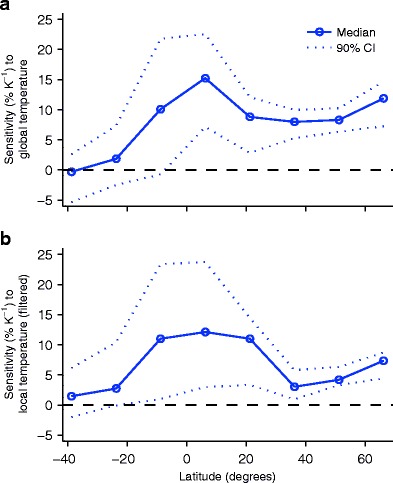
- Historical rain-gauge analyses over land show both increasing and decreasing trends, but grid boxes or stations with significant increases outnumber those with significant decreases; the global sensitivity of annual-maximum daily precipitation is 8 % K−1 with a 90% confidence interval of 5 to 10 % K−1.
- Regressing by latitude band gives higher observed sensitivity in the tropics than the extratropics: 9 % K−1 (90% CI 6–14 % K−1) for 30S to 30N versus 4 % K−1 (90% CI 2–5 % K−1) for the extratropics.
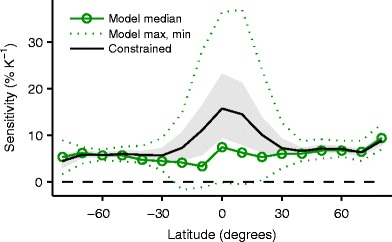
- CMIP5 projections show a general increase in the intensity of precipitation extremes, with the multimodel-median extratropical sensitivity about 6 % K−1 (or 5 % K−1 when normalized by extratropical-mean temperature), while tropical responses span from near 0 to >30 % K−1 across models.
- Observationally constrained estimates suggest tropical extremes are more sensitive than extratropical extremes: 11 % K−1 (90% CI 7–15 % K−1) in the tropics versus 6 % K−1 (90% CI 6–7 % K−1) in the extratropics.
- Snowfall extremes and orographic extremes behave differently from rainfall extremes: snowfall extremes peak near an optimal temperature of roughly −2 °C by liquid-water equivalent (or −4 °C by snow depth), and orographic extremes show larger fractional increases on leeward slopes than windward slopes.
## Methods
- Review article synthesizing results from theory, observations, and modeling, with sections on observed changes, physical theory, climate-model projections, orographic extremes, snowfall extremes, and duration dependence.
- Uses observational datasets and analyses described in the text, including HadEX2, NOAA MLOST, and rain-gauge records, with regressions based on the Theil-Sen estimator and confidence intervals reported for latitude-band sensitivities.
- Summarizes results from multiple modeling frameworks, including CMIP3/CMIP5 global climate models, regional climate models, cloud-system resolving models (CRMs), and idealized simulations such as radiative-convective equilibrium and idealized mountain cases.
## Limitations
- The paper explicitly states that available data have limited geographic coverage, especially for observations, and that there are relatively few observational records of tropical precipitation extremes.
- It states that global climate models with parameterized moist convection are not expected to be reliable for precipitation extremes that are primarily convective in nature, and that models have important limitations in simulating precipitation extremes.
- Evident from the text: some results are hard to compare directly because the observational and modeling analyses use different time periods, geographic coverage, and definitions of extreme precipitation.
Model-written summary. Check it against the paper before relying on it.
Integrity signals
Registry
Cites
Statistics
Figures
Verification
Claims the paper makes
37 Valid · 5 Not valid · 41 Not checked · 53 Own results and interpretations
The sources with a verdict support this claim; the rest weren’t checked yet, have no full text we could read, or their verdicts aren’t rated yet.
In the paper
“If changes in dynamics and precipitation efficiency are negligible, precipitation extremes increase with warming because of increases in the saturation vapor pressure of water [4, 62, 85, 86]; this will be made more precise in the “Theory” section.”
§ Precipitation Extremes Under Climate Change > Introduction
What the sources say
- Not checked — no full text of the sourcecites [4] Allen MR Ingram WJ Constraints on future changes in climate and the hydrologic cycle Nature 2002 419 224 232 10.1038/nature01092 12226677 source
- Supportedcites [62] O’Gorman PA Schneider T Scaling of precipitation extremes over a wide range of climates simulated with an idealized GCM J Clim 2009 22 5676 5685 10.1175/2009JCLI2701.1 source
Section 4a explains that, when changes in vertical velocity are neglected, the scaling of tropical precipitation extremes approximately follows the temperature dependence of saturation specific humidity. The Conclusions report that extremes generally increase with warming in the idealized simulations, while cautioning that their rate of increase need not follow Clausius–Clapeyron scaling. The cited claim asserts an increase, not an exact rate, and is conditional on negligible non-thermodynamic changes. (LLM, conf=0.88)
- Not checked — no full text of the sourcecites [85] Trenberth KE Conceptual framework for changes of extremes of the hydrological cycle with climate change Clim Chang 1999 42 327 339 10.1023/A:1005488920935 source
- Supportedcites [86] Trenberth KE Dai A Rasmussen RM Parsons DB The changing character of precipitation Bull Am Meteorol Soc 2003 84 1205 1217 10.1175/BAMS-84-9-1205 source
In “How Should Precipitation Change as the Climate Changes?”, the paper says atmospheric water-holding capacity rises with warming according to the Clausius–Clapeyron equation and argues that heavy-rainfall intensity should rise at about the same rate as moisture content. Its statement that stronger rainfall rates follow “all things being equal” supports the claim’s condition that other influences are negligible. (LLM, conf=0.92)
plainstates a cause- Asserted: passes — The authors put it forward as true.
- Checkable: passes — It can be checked against evidence.
- Load-bearing: passes — The paper’s conclusions depend on it.
- Based: passes — The paper gives a reason why it holds.
Every source the paper cites for this claim was checked and supports it.
In the paper
“One exception was the Community Climate Model System 3 which underestimated the 30-year return values [17]”
§ Precipitation Extremes Under Climate Change > Climate-Model Projections
What the sources say
- Supportedcites [17] Chen CT Knutson T On the verification and comparison of extreme rainfall indices from climate models J Clim 2008 21 1605 1621 10.1175/2007JCLI1494.1 source
Section 4 states that the NCAR Community Climate System Model version 3 (CCSM3), at T85 resolution, produced a domain-averaged 30-year precipitation return level (P30) much smaller than the observed value. The paper's evaluation concerns the conterminous United States; this finding uses the authors' recommended comparison in which model output is treated as an areal mean. (LLM, conf=0.92)
plainstates a cause- Asserted: passes — The authors put it forward as true.
- Checkable: passes — It can be checked against evidence.
- Load-bearing: unclear — It is unclear whether the paper’s conclusions depend on it.
- Based: passes — The paper gives a reason why it holds.
- Supported
The sources with a verdict support this claim; the rest weren’t checked yet, have no full text we could read, or their verdicts aren’t rated yet.
In the paper
“Over the available record, there are regions with both increasing and decreasing trends in precipitation extremes [1, 28], as might be expected given large internal variability [25]”
§ Precipitation Extremes Under Climate Change > Observed Changes in Precipitation Extremes
What the sources say
- Not checked — no full text of the sourcecites [1] Alexander LV Zhang X Peterson TC Caesar J Gleason B Klein Tank AMG Global observed changes in daily climate extremes of temperature and precipitation J Geophys Res Atmos 2006 111 D05109 10.1029/2005JE002462 source
- Supportedcites [28] Groisman PY Knight RW Easterling DR Karl TR Hegerl GC Razuvaev VN Trends in intense precipitation in the climate record J Clim 2005 18 1326 1350 10.1175/JCLI3339.1 source
The section on southeastern and southwestern Australia reports an increase in very heavy precipitation frequency in the southeast and a decrease in the southwest over their available records. The southwest decrease is significant only at the 0.10 level, a qualification the citing sentence does not rule out. (LLM, conf=0.91)
plain- Asserted: passes — The authors put it forward as true.
- Checkable: passes — It can be checked against evidence.
- Load-bearing: unclear — It is unclear whether the paper’s conclusions depend on it.
- Based: passes — The paper gives a reason why it holds.
Every source the paper cites for this claim was checked and supports it.
In the paper
“For example, in an analysis of 30-year return values of daily precipitation over the conterminous USA, most global climate models were found to overestimate or roughly agree with observations that were conservatively interpolated to the model resolution for comparison [17].”
§ Precipitation Extremes Under Climate Change > Climate-Model Projections
What the sources say
- Supportedcites [17] Chen CT Knutson T On the verification and comparison of extreme rainfall indices from climate models J Clim 2008 21 1605 1621 10.1175/2007JCLI1494.1 source
Split into 2 atoms — 2 confirmed, 0 partially supported, 0 disputed, 0 misattributed, 0 unverifiable. Expand the claim to see per-atom verdicts.
plain- Asserted: passes — The authors put it forward as true.
- Checkable: passes — It can be checked against evidence.
- Load-bearing: unclear — It is unclear whether the paper’s conclusions depend on it.
- Based: passes — The paper gives a reason why it holds.
- Supported
The sources with a verdict support this claim; the rest weren’t checked yet, have no full text we could read, or their verdicts aren’t rated yet.
In the paper
“Important limitations in the ability of current models to simulate precipitation extremes have also been recognized and are related in part to the use of parameterized convection [38, 43, 58, 89, 93].”
§ Precipitation Extremes Under Climate Change > Climate-Model Projections
What the sources say
- Supportedcites [38] Kharin VV Zwiers FW Zhang X Hegerl GC Changes in temperature and precipitation extremes in the IPCC ensemble of global coupled model simulations J Clim 2007 20 1419 1444 10.1175/JCLI4066.1 source
The Precipitation Extremes section reports that models simulate extremes less consistently in the Tropics and subtropics than at higher latitudes, and identifies the details of deep-convection parameterizations as especially important for tropical results. The Summary likewise reports large differences among models in tropical precipitation extremes. The support is strongest for tropical extremes, rather than for all regions equally; page numbers are unavailable in our copy. (LLM, conf=0.85)
- Supportedcites [43] Kooperman GJ Pritchard MS Somerville RC The response of US summer rainfall to quadrupled CO2 climate change in conventional and superparameterized versions of the NCAR community atmosphere model J Adv Model Earth Syst 2014 6 859 882 10.1002/2014MS000306 source
The Introduction states that conventional GCMs underestimate increases in extreme rainfall and identifies their simplified representation of deep convection as one reason. The paper also says conventionally parameterized GCMs simulate extreme precipitation too weakly and too often compared with observations. (LLM, conf=0.93)
- Not checked — no full text of the sourcecites [58] O’Gorman PA Sensitivity of tropical precipitation extremes to climate change Nat Geosci 2012 5 697 700 10.1038/ngeo1568 source
- Supportedcites [89] Wehner MF Very extreme seasonal precipitation in the NARCCAP ensemble: model performance and projections Clim Dyn 2013 40 59 80 10.1007/s00382-012-1393-1 source
The Introduction says current climate models struggle to reproduce observed extreme-precipitation statistics and attributes part of that limitation to inadequacies in their moist-physics formulations. It also explains that moist physics generally includes parameterized treatments of convective cloud processes, supporting the citing sentence’s qualified connection to parameterized convection. (LLM, conf=0.87)
- Supportedcites [93] Wilcox EM Donner LJ The frequency of extreme rain events in satellite rain-rate estimates and an atmospheric general circulation model J Clim 2007 20 53 69 10.1175/JCLI3987.1 source
Section 3 reports that changes to convection parameterizations can substantially alter the simulated frequency of intense rain events and says further refinements are needed before models can reliably simulate rain-rate distributions. The Abstract likewise identifies uncertainty in simulating precipitation intensity distributions and links improvements to convection schemes. (LLM, conf=0.93)
plainstates an association- Asserted: passes — The authors put it forward as true.
- Checkable: passes — It can be checked against evidence.
- Load-bearing: unclear — It is unclear whether the paper’s conclusions depend on it.
- Based: passes — The paper gives a reason why it holds.
- Supported
81 more claims · 19 with their cited sources checked
Create a free account to see all 136 claims and to verify the 2 references still open.
- It may state two separate claims as one. 42
- Probably not a substantial claim. 14
Citations
Cites
Global observed changes in daily climate extremes of temperature and precipitation
Alexander, L. V., Zhang, X., Peterson, T. C., Caesar, J., Gleason, B., Klein Tank, A. M. G., Haylock, M., Collins, D., Trewin, B., Rahimzadeh, F., et al. (2006) · Journal of Geophysical Research: Atmospheres · doi:10.1029/2005jd006290 · Cited by 4,492 · cited 1×
“Over the available record, there are regions with both increasing and decreasing trends in precipitation extremes [28,1], as might be expected given large internal variability [25], but the gridboxes or stations with significant increasing trends outnumber those with significant decreasing trends [23,91].”
BackgroundAn Introduction to Dynamic Meteorology
Holton, J. R., & Staley, D. O. (1973) · American Journal of Physics · doi:10.1119/1.1987371 · Cited by 3,355
The Changing Character of Precipitation
Trenberth, K. E., Dai, A., Rasmussen, R. M., & Parsons, D. B. (2003) · Bulletin of the American Meteorological Society · doi:10.1175/bams-84-9-1205 · Cited by 3,196 · cited 1×
“por pressure of water [85,86,4,62]; this will be made more precise in section 3.”
BackgroundTropical cyclones and climate change
Knutson, T. R., McBride, J. L., Chan, J., Emanuel, K., Holland, G., Landsea, C., Held, I., Kossin, J. P., Srivastava, A. K., & Sugi, M. (2010) · Nature Geoscience · doi:10.1038/ngeo779 · Cited by 3,194
Constraints on future changes in climate and the hydrologic cycle
Allen, M. R., & Ingram, W. J. (2002) · Nature · doi:10.1038/nature01092 · Cited by 3,009 · cited 1×
“por pressure of water [85,86,4,62]; this will be made more precise in section 3.”
BackgroundImprovements to NOAA’s Historical Merged Land–Ocean Surface Temperature Analysis (1880–2006)
Smith, T. M., Reynolds, R. W., Peterson, T. C., & Lawrimore, J. (2008) · Journal of Climate · doi:10.1175/2007jcli2100.1 · Cited by 2,923 · cited 4×
“Differences in convective parameterizations are less important in the extratropics, and the correlation coefficient across models between the sensitivities for climate change and variability becomes smaller for climate change at higher latitudes, reaching a value of 0.5 at 50S and 40N as compared to a maximum of 0.86…”
MethodInfluentialRecent Arctic amplification and extreme mid-latitude weather
Cohen, J., Screen, J. A., Furtado, J. C., Barlow, M., Whittleston, D., Coumou, D., Francis, J., Dethloff, K., Entekhabi, D., Overland, J., et al. (2014) · Nature Geoscience · doi:10.1038/ngeo2234 · Cited by 2,492
Human contribution to more-intense precipitation extremes
Min, S.-K., Zhang, X., Zwiers, F. W., & Hegerl, G. C. (2011) · Nature · doi:10.1038/nature09763 · Cited by 2,083
Atmospheric Warming and the Amplification of Precipitation Extremes
Allan, R. P., & Soden, B. J. (2008) · Science · doi:10.1126/science.1160787 · Cited by 1,562 · cited 1×
“ulate the interannual variability in tropical precipitation extremes when compared to observations [2,3], and the disproportionate increases in precipitation extremes compared to other parts of the precipitation distribution that is found in some models – an “extreme mode” in the tropical response to climate change th…”
Background
Cited by
Items 301–400 of 809
El-Samra, R., Bou-Zeid, E. R., Bangalath, H. K., Stenchikov, G. L., & El‐Fadel, M. (2017) · Climate Dynamics · doi:10.1007/s00382-017-3542-z · Cited by 22
“As for snowfall, it is likely to be impacted by climate warming with increases in saturation vapor pressures and fluctuations in the frequency of occurrence of temperatures below the rain-snow shift temperature (O’Gorman 2015).”
BackgroundMarshall, G. J., Jylhä, K., Kivinen, S., Laapas, M., & Dyrrdal, A. V. (2020) · Climatic Change · doi:10.1007/s10584-020-02747-w · Cited by 24
“Indeed, observations and climate model simulations have demonstrated that Arctic precipitation increases in response to Arctic amplification (of SAT) (Anderson et al. 2018) and that both liquid and solid extreme precipitation events (hereinafter EPEs) intensify (O’Gorman 2014, 2015).”
BackgroundMizuta, R., & Endo, H. (2020) · Geophysical Research Letters · doi:10.1029/2019gl086855 · Cited by 24
Fukushima, T., KITAMURA, T., & Matsushita, B. (2021) · SN Applied Sciences · doi:10.1007/s42452-021-04823-x · Cited by 20
Gimeno‐Sotelo, L., Fernández‐Alvarez, J. C., Nieto, R., Vicente-Serrano, S. M., & Gimeno, L. (2024) · Communications Earth & Environment · doi:10.1038/s43247-024-01787-9 · Cited by 31
“Behind extreme precipitation and meteorological drought and their changes under climate change, there are a number of diverse and complex mechanisms 7,14,15 , but both hydrometeorological extremes have in common the fact that excesses or de fi cits in moisture transport to the region are frequent…”
Nayak, S., & Takemi, T. (2020) · Journal of the Meteorological Society of Japan Ser II · doi:10.2151/jmsj.2020-058 · Cited by 22
Varghese, S. J., Surendran, S., Rajendran, K., Ghosh, S., Kitoh, A., & Ashok, K. (2024) · Geophysical Research Letters · doi:10.1029/2023gl105680 · Cited by 21
“So , the regional changes in extreme precipitation can be composed of a thermodynamic component representing changes in water vapor/precipitation and a dynamic component representing changes in vertical motion (Allen & Ingram, 2002; O’Gorman, 2015; Trenberth, 1999).”
BackgroundCalvo‐Sancho, C., Díaz-Fernández, J., González‐Alemán, J. J., Halifa‐Marín, A., Miglietta, M., Azorín-Molina, C., Prein, A. F., Montoro-Mendoza, A., Bolgiani, P., Morata, A., et al. (2026) · Nature Communications · doi:10.1038/s41467-026-68929-9 · Cited by 40
“This ampli fi cation suggests that enhanced atmospheric moisture may have played a major role in fueling heavier precipitation over the Valencia region, as observed in other cases 23,43 .”
Stegall, S. T., & Kunkel, K. E. (2019) · Journal of Applied Meteorology and Climatology · doi:10.1175/jamc-d-18-0057.1 · Cited by 18
Analysis of extreme rainfall events under the climatic change
Fowler, H. J., & Ali, H. (2022) · Elsevier eBooks · doi:10.1016/b978-0-12-822544-8.00017-2 · Cited by 34
Fourcade, Y., & Vercauteren, M. (2022) · Diversity and Distributions · doi:10.1111/ddi.13505 · Cited by 22
“Similarly, precipitation extremes are predicted to intensify in response to a warming climate (O’Gorman, 2015).”
BackgroundSubrahmanyam, K. V., & Kumar, K. K. (2022) · Natural Hazards · doi:10.1007/s11069-022-05426-4 · Cited by 17
Martinez, D. M., & Solman, S. A. (2022) · International Journal of Climatology · doi:10.1002/joc.7911 · Cited by 19
“Several studies highlighted the role of climate change in explaining the increase in extreme precipitation (O'Gorman, 2015; Trenberth, 2011, among others).”
BackgroundKimutai, J., New, M. G., Wolski, P., & Otto, F. E. L. (2022) · Weather and Climate Extremes · doi:10.1016/j.wace.2022.100529 · Cited by 24
Wu, X., Fu, Q., & Kodama, C. (2023) · Geophysical Research Letters · doi:10.1029/2023gl104210 · Cited by 22
“It is predicted that extreme precipitation and the most severe storms will increase (e.g., Bao et al., 2017) and intensify (O’Gorman, 2015) in a warmer climate.”
BackgroundLinking physical climate risk with mandatory business risk disclosure requirements
Pitman, A. J., Saribatir, E., Greenhill, C., Green, S., Pitman, S. J., & Fiedler, T. (2024) · Environmental Research Letters · doi:10.1088/1748-9326/ad4377 · Cited by 22
“Highly detailed modelling studies can help identify the likely magnitude of a change in some phenomenon (e.g. O’Gorman 2015) but these do not provide geolocated projections that a business can use.”
BackgroundLand and Atmospheric Drivers of the 2023 Flood in India
Kushwaha, A. P., Solanki, H., Vegad, U., Mahto, S. S., & Mishra, V. K. (2024) · Earth and Space Science · doi:10.1029/2024ea003750 · Cited by 26
“Climate warming has enhanced the frequency and intensity of extreme precipitation events (Nanditha et al., 2023; O’Gorman, 2015; Pfahl et al., 2017).”
Flow Strength and Bedload Sediment Travel Distance in Gravel Bed Rivers
Papangelakis, E., MacVicar, B., Montakhab, A., et al. (2022) · Water Resources Research · doi:10.1029/2022wr032296 · Cited by 18
“Climate change is also anticipated to alter the frequency, intensity, and duration of precipitation events (Dore, 2005; O’Gorman, 2015) and thus the resulting hydrograph shapes.”
BackgroundHydrological post-processing for predicting extreme quantiles
Tyralis, H., & Papacharalampous, G. (2023) · Journal of Hydrology · doi:10.1016/j.jhydrol.2023.129082 · Cited by 25
“Prediction of extreme events is of interest in hydrology (O’Gorman 2015, Donat et al. 2016, Pfahl et al. 2017), because of the severity of socio-economic losses when those events take place (Vogel et al. 2018).”
BackgroundTian, B., Chen, H., Yin, J., Liao, Z., Li, N., & He, S. (2023) · Environmental Research Letters · doi:10.1088/1748-9326/acb836 · Cited by 20
Sreenath, A. V., Abhilash, S. R., & Ajilesh, P. (2023) · Atmospheric Research · doi:10.1016/j.atmosres.2023.106752 · Cited by 18
Wojkowski, J., Wałęga, A., Młyński, D., Radecki‐Pawlik, A., Lepeška, T., Piniewski, M., & Kundzewicz, Z. W. (2023) · Ecological Indicators · doi:10.1016/j.ecolind.2023.110913 · Cited by 21
Saki, S., Sofia, G., & Anagnostou, E. N. (2023) · Journal of Hydrology · doi:10.1016/j.jhydrol.2023.130336 · Cited by 24
Jaiswal, R. K., Lohani, A. K., & Tiwari, H. L. (2021) · Journal of Hydrology · doi:10.1016/j.jhydrol.2021.127051 · Cited by 18
Uranchimeg, S., Kwon, H., Kim, B., et al. (2020) · Hydrology research · doi:10.2166/nh.2020.003 · Cited by 18
Rahimi, L., Hoque, M., Ahmadisharaf, E., Alamdari, N., Misra, V., Maran, C., Kao, S., AghaKouchak, A., & Talchabhadel, R. (2024) · Earth s Future · doi:10.1029/2024ef004531 · Cited by 27
“…impacts on the frequency and severity of hydroclimatic hazards such as floods, droughts and extreme heat events (Arnell & Gosling, 2015; Bates et al., 2021; Cook et al., 2018; Dai et al., 2018; Gilroy & McCuen, 2012; Mukherjee et al., 2018; O’Gorman, 2015; Schiermeier, 2018; Trenberth, 2011).”
Modeling River Runoff Temporal Behavior through a Hybrid Causal–Hydrological (HCH) Method
Zazo, S., Molina, J.-L., Ruiz-Ortiz, V., Vélez-Nicolás, M., & García-López, S. (2020) · Water · doi:10.3390/w12113137 · Cited by 18
“Currently, extreme events such as heavy rainfall, droughts, and floods are becoming more common and less exceptional [1–5], even within a particular territory [6,7], resulting in growing variability in certain hydrological processes [8,9], in addition to pressure on, and uncertainty regarding, water resources [10–12],…”
BackgroundSharma, B., Kumar, J., Collier, N., Ganguly, A. R., & Hoffman, F. M. (2022) · Journal of Geophysical Research Biogeosciences · doi:10.1029/2021jg006738 · Cited by 24
“9 of 19 concentration, the climate becomes warmer and increases the intensity of precipitation and accompanying precipitation extremes (Ban et al., 2015; O'Gorman, 2015).”
BackgroundInfluentialWhy has Precipitation Increased in the Last 120 Years in Norway?
Konstali, K., & Sorteberg, A. (2022) · Journal of Geophysical Research Atmospheres · doi:10.1029/2021jd036234 · Cited by 21
“Vertical velocity is thought to change little with climate change in the extratropics because it does not depend on either static stability or latent heating in a non-convective environment (O’Gorman, 2015).”
BackgroundSoil management considerations for water resiliency in a changing climate
Heitman, J. L., Kool, D., & Carvalho, H. D. R. (2023) · Agronomy Journal · doi:10.1002/agj2.21425 · Cited by 22
Cui, L., Meng, J., Li, Y. X., An, J., Zou, Z., Zhong, L., Mao, Y., & Wu, G. (2024) · Remote Sensing · doi:10.3390/rs16091601 · Cited by 19
Precipitation extremes and depth-duration-frequency under internal climate variability
Bhatia, U., & Ganguly, A. R. (2019) · Scientific Reports · doi:10.1038/s41598-019-45673-3 · Cited by 18
Lehtonen, I., & Jylhä, K. (2019) · Atmospheric Science Letters · doi:10.1002/asl.895 · Cited by 18
On the need to integrate uncertainty into U.S. water resource planning
Hart, O. E., & Halden, R. U. (2019) · The Science of The Total Environment · doi:10.1016/j.scitotenv.2019.07.164 · Cited by 17
Future extreme precipitation amplified by intensified mesoscale moisture convergence
Chang, P., Fu, D., Liu, X., Castruccio, F. S., Prein, A. F., Danabasoglu, G., Wang, X., Bacmeister, J. T., Zhang, Q., Rosenbloom, N. A., et al. (2025) · Nature Geoscience · doi:10.1038/s41561-025-01859-1 · Cited by 44
“As climate change accelerates, extreme precipitation continues to intensify, consistent with theoretical considerations 1–4 and projections from the Coupled Model Intercomparison Project Phases 5 and 6 (CMIP5 and CMIP6) 5,6 .”
Gómez‐Navarro, J. J., Raible, C. C., Valero, J. A. G., et al. (2019) · Climate Dynamics · doi:10.1007/s00382-019-04818-w · Cited by 16
“For this reason, the output of ESMs is brought to a higher spatial resolution using either statistical or dynamical down-scaling methods (Maraun et al. 2010, 2015).”
BackgroundMethodCroce, P., Formichi, P., & Landi, F. (2021) · Remote Sensing · doi:10.3390/rs13112025 · Cited by 20
“Global warming effects are generally associated to an increase in precipitation extremes [65,66].”
BackgroundChiu, S., Hu, S.-C., Liao, L.-M., Chen, Y., & Lin, J. (2022) · Viruses · doi:10.3390/v14030641 · Cited by 17
“Temperature, rainfall, and humidity can influence virus activity, distribution, and pathogenicity [40].”
BackgroundNonstationary extreme precipitation in Brazil
Cortez, B. N., Pires, G. F., Ávila-Díaz, A., Fonseca, H. P., & Oliveira, L. R. (2022) · Hydrological Sciences Journal · doi:10.1080/02626667.2022.2075267 · Cited by 22
“…air temperature and sea surface temperature, and changes the atmospheric water vapour content and transport (Liu et al. 2020), with the potential to change the spatial patterns, intensity, and frequency of extreme precipitation (O’Gorman and Schneider 2009, O’Gorman 2015, Lehtonen and Jylhä 2019).”
BackgroundVeiga, S. F., Nobre, P., Giarolla, E., Capistrano, V., SILVA, M. B. D., Casagrande, F., Soares, H. C., Kubota, P. Y., Figueroa, S. N., Bottino, M. J., et al. (2023) · Journal of South American Earth Sciences · doi:10.1016/j.jsames.2023.104598 · Cited by 23
Prediction of Clausius–Clapeyron Scaling of Daily Precipitation Extremes over China
Chen, W., Cui, H., & Zheng, J. (2023) · Journal of Climate · doi:10.1175/jcli-d-23-0030.1 · Cited by 19
Alemu, M. G., Wubneh, M. A., Sahlu, D., & Zimale, F. A. (2023) · Sustainable Water Resources Management · doi:10.1007/s40899-023-00981-5 · Cited by 16
“Although there is no universally accepted definition of an extreme event, several definitions have been proposed and used in the past (O’Gorman 2015; Suman and Maity 2020).”
MethodPredicted Climate Change will Increase Landslide Risk in Hanjiang River Basin, China
Tang, X., Wang, L.-J., Wang, H., Yuan, Y., Huang, D., & Zhang, J. (2024) · Journal of Earth Science · doi:10.1007/s12583-021-1511-2 · Cited by 18
“In terms of precipitation, climate warming affects the water va‐ por content in the air, leading to changes in the precipitation structure (O’Gorman, 2015; Dore, 2005).”
Simulation of an extreme rainfall event over Mumbai using a regional climate model: a case study
Pant, M., Ghosh, S., Verma, S., et al. (2021) · Meteorology and Atmospheric Physics · doi:10.1007/s00703-021-00845-7 · Cited by 16
“The thermodynamic and dynamic aspects provide the favourable genesis conditions to an extreme rainfall event and affect with several processes during its different stages (Pfahlet al. 2017; O’Gorman 2015).”
BackgroundRyu, S., Song, J. J., & Lee, G. (2025) · Remote Sensing · doi:10.3390/rs17030530 · Cited by 22
Khan, A. N., Mandal, S., Satpati, L., Dogar, M. M., Hasanean, H. M., & Salah, A. M. (2025) · Earth Systems and Environment · doi:10.1007/s41748-025-00679-y · Cited by 18
“Historical records and climate models revealed the frequency and intensity of heavy precipitation events over recent decades in tropical and mid-latitude regions (O’Gorman 2015).”
Subdaily Extreme Precipitation and Its Linkage to Global Warming Over the Tibetan Plateau
Ma, M., Tang, J., Ou, T., & Chen, D. (2023) · Journal of Geophysical Research Atmospheres · doi:10.1029/2023jd039062 · Cited by 18
“On regional scales, dynamic factors and local factors such as topography can make the response of precipitation extremes more complex, especially when convection is important (O’Gorman, 2015).”
BackgroundClimatic Indices’ Analysis on Extreme Precipitation for Tanzania Synoptic Stations
Ndabagenga, D. M., Yu, J., Mbawala, J. R., Ntigwaza, C. Y., & Juma, A. S. (2023) · Journal of Geoscience and Environment Protection · doi:10.4236/gep.2023.1112010 · Cited by 16
Uytven, E. V., & Willems, P. (2018) · Journal of Hydrology · doi:10.1016/j.jhydrol.2018.01.018 · Cited by 17
Ibrahim, M. (2019) · Theoretical and Applied Climatology · doi:10.1007/s00704-019-02863-3 · Cited by 15
Huang, X., & Stevenson, S. L. (2021) · Earth s Future · doi:10.1029/2020ef001944 · Cited by 15
A Satellite View of an Intense Snowfall in Madrid (Spain): The Storm ‘Filomena’ in January 2021
Tapiador, F. J., Pradas, A. V., Navarro, A., Martín, R. M., Merino, A., García‐Ortega, E., Sánchez, J. L., Kim, K., & Lee, G. (2021) · Remote Sensing · doi:10.3390/rs13142702 · Cited by 16
“Indeed, frequent phenomena such as Filomena can be considered a consequence of ongoing global change [42,43].”
BackgroundInvestigating the Causes and Impacts of Convective Aggregation in a High Resolution Atmospheric GCM
Zhang, B., Soden, B. J., Vecchi, G. A., & Yang, W. (2021) · Journal of Advances in Modeling Earth Systems · doi:10.1029/2021ms002675 · Cited by 16
Observed Increase of Urban Extreme Rainfall as Surface Temperature Rise: The Jakarta Case
Siswanto, S., van der Schrier, G., & van den Hurk, B. (2022) · Journal of the Meteorological Society of Japan Ser II · doi:10.2151/jmsj.2022-023 · Cited by 25
“Exploring the mechanisms of climate change-induced convective activity in the midlatitudes, strong increases of CAPE in climate change model simulations were found to be associated with near-uniform vertical temperature changes (Byrne and O’Gorman 2015).”
InfluentialZhang, Y., Lu, Y., & Zhai, G. (2025) · International Journal of Disaster Risk Reduction · doi:10.1016/j.ijdrr.2025.105674 · Cited by 14
Influences of Extreme Precipitation on China’s Mining Industry
Liu, Y., & Song, W. (2019) · Sustainability · doi:10.3390/su11236719 · Cited by 14
“, affecting labor productivity, reducing investment into the mining industry, and destroying the infrastructure of the ining industry [11,14,39].”
BackgroundNazarian, R. H., Vizzard, J. V., Agostino, C. P., & Lutsko, N. J. (2022) · Journal of Applied Meteorology and Climatology · doi:10.1175/jamc-d-22-0008.1 · Cited by 16
Evaluation of change factor methods in downscaling extreme precipitation over India
VishnuPriya, M. S., & Agilan, V. (2022) · Journal of Hydrology · doi:10.1016/j.jhydrol.2022.128531 · Cited by 17
A gauge-based sub-daily extreme rainfall climatology for western Europe
Whitford, A., Blenkinsop, S., Pritchard, D. M. W., & Fowler, H. J. (2023) · Weather and Climate Extremes · doi:10.1016/j.wace.2023.100585 · Cited by 15
HyetoClust method: Hyetograph design through cluster analysis
Patino, C., Molina, J.-L., Espejo, F., et al. (2023) · Journal of Hydrology · doi:10.1016/j.jhydrol.2023.130014 · Cited by 14
Spatial and Temporal Variability of Extreme Precipitation Events in the Southeastern United States
Rahman, M. S., Senkbeil, J. C., & Keellings, D. J. (2023) · Atmosphere · doi:10.3390/atmos14081301 · Cited by 19
Bringing Statistics to Storylines: Rare Event Sampling for Sudden, Transient Extreme Events
Finkel, J. M., & O’Gorman, P. A. (2024) · Journal of Advances in Modeling Earth Systems · doi:10.1029/2024ms004264 · Cited by 24
“(Myhre et al., 2019; O’Gorman, 2015; Pfahl et al., 2017; Tandon et al., 2018).”
BackgroundSelf-citationWater Resource and Use Efficiency Under Changing Climate
Abhilash, Rani, A., Kumari, A., & Kumar, J. (2020) · Springer eBooks · doi:10.1007/978-981-15-6953-1_15 · Cited by 14
Ding, Z., Niu, F., Li, G., Mu, Y., Chai, M., & He, P. (2022) · Remote Sensing · doi:10.3390/rs14122918 · Cited by 16
Santoro, A., Yu, Q., Piras, F., Fiore, B., Bazzurro, A., & Agnoletti, M. (2022) · Land · doi:10.3390/land11111920 · Cited by 14
Robust inferences on climate change patterns of precipitation extremes in the Iberian Peninsula
Melo-Gonçalves, P., Rocha, A. C., & Santos, J. A. (2016) · Physics and Chemistry of the Earth Parts A/B/C · doi:10.1016/j.pce.2016.05.003 · Cited by 15
Weller, E., Jakob, C., & Reeder, M. J. (2019) · Geophysical Research Letters · doi:10.1029/2018gl080813 · Cited by 13
Drivers of flash floods in the Indian sub-continental river basins
Nandana Dilip, K., Vegad, U., & Mishra, V. K. (2025) · npj natural hazards. · doi:10.1038/s44304-025-00121-3 · Cited by 16
Impact of Microphysics on Tropical Precipitation Extremes in a Global Storm‐Resolving Model
Bao, J., & Windmiller, J. M. (2021) · Geophysical Research Letters · doi:10.1029/2021gl094206 · Cited by 14
Guo, Q., & Hibino, K. (2022) · Weather and Climate Extremes · doi:10.1016/j.wace.2022.100547 · Cited by 14
Gan, F., Zhang, Y., Diao, X., Cao, G., Tan, K., Zhong, X., & Gao, Y. (2023) · Atmospheric Research · doi:10.1016/j.atmosres.2023.106639 · Cited by 18
Huang, Z., Tan, X., Wu, X., Tan, X., Fu, J., & Liu, B. (2023) · Journal of Climate · doi:10.1175/jcli-d-22-0737.1 · Cited by 17
Gimeno‐Sotelo, L., Bevacqua, E., Fernández‐Alvarez, J. C., Barriopedro, D., Jakob Zscheischler, A., & Gimeno, L. (2024) · Atmospheric Research · doi:10.1016/j.atmosres.2024.107413 · Cited by 18
Ma, C., Su, H., Lelieveld, J., Randel, W. J., Yu, P., Andreae, M. O., & Cheng, Y. (2024) · Science Advances · doi:10.1126/sciadv.adn3657 · Cited by 20
Yate, T. A., & Ren, G. (2025) · Earth-Science Reviews · doi:10.1016/j.earscirev.2025.105063 · Cited by 18
Dong, S., & Sun, Y. (2018) · Climate Research · doi:10.3354/cr01534 · Cited by 12
Hu, Y., Deng, Y., Zhou, Z., et al. (2019) · Climate Dynamics · doi:10.1007/s00382-019-04803-3 · Cited by 13
“2003; O’Gorman 2015).”
Li, W., Zhao, M., Scaioni, M., Hosseini, S. R., Wang, X., Yao, D., Zhang, K., Gao, J., & Li, X. (2019) · Environmental Monitoring and Assessment · doi:10.1007/s10661-019-7900-7 · Cited by 13
“Recent Intergovernmental Panel on Climate Change (IPCC) reports show that the frequency of extreme rainfall events has generally increased with global climate warming and elevated atmospheric CO2 concentrations (Allan and Soden 2008; O’Gorman 2015).”
BackgroundForecasting bathing water quality in the UK : A critical review
Krupska, K. U., Speight, L. J., Robinson, J. S., Gilbert, A. J., & Cloke, H. (2024) · Wiley Interdisciplinary Reviews Water · doi:10.1002/wat2.1718 · Cited by 19
“…UV/visible spectra); hydrodynamic conditions (flow, magnitude, and direction of water currents, wave height, tidal stage); and other factors such as number of birds or bathers present (Table 2) (Kay et al., 2012; Stidson et al., 2012; Thoe et al., 2014, 2015; Tyrrell, 2017; USEPA, 2010).”
BackgroundLi, E. (2024) · Sustainability · doi:10.3390/su16177457 · Cited by 13
Did the Deccan Volcanism impact the Indian flora during the Maastrichtian?
Mishra, S., Bansal, M., Prasad, V., Singh, V. P., Murthy, S., Parmar, S., Utescher, T., & Khangar, R. G. (2024) · Earth-Science Reviews · doi:10.1016/j.earscirev.2024.104950 · Cited by 14
Bjerke, J. W., López‐Blanco, E., Tømmervik, H., Striberny, A., Davids, C., Ólafsdóttir, R., Karlsen, S. R., Sandström, P., Turunen, M. T., Rikkonen, T., et al. (2024) · Earth-Science Reviews · doi:10.1016/j.earscirev.2024.105012 · Cited by 20
Ghausi, S. A., Zehe, E., Ghosh, S., Tian, Y., & Kleidon, A. (2024) · Nature Communications · doi:10.1038/s41467-024-55143-8 · Cited by 16
Eccles, R., Syktus, J. I., Trancoso, R., Chapman, S., Wasko, C., Evans, J. P., Thatcher, M., Virgilio, G. D., & Stassen, C. (2025) · npj natural hazards. · doi:10.1038/s44304-025-00107-1 · Cited by 16
“On the other hand, latent heat release results in atmospheric instability that can strengthen storms and precipitation extremes, with the most extreme events seeing the largest increases 12,13 .”
Najibi, N., Mukhopadhyay, S., & Steinschneider, S. (2022) · Geophysical Research Letters · doi:10.1029/2021gl097100 · Cited by 12
“…support this underlying hypothesis (Alexander et al., 2006; Groisman et al., 2005; Handmer et al., 2012; Lenderink & Van Meijgaard, 2008; Meehl et al., 2005; O’Gorman, 2015; O’Gorman & Schneider, 2009; Pall et al., 2007; Panthou et al., 2014; Schneider et al., 2010; Trenberth, 2011; Trenberth…”
Molina, J.-L., Espejo, F., Zazo, S., Molina, M.-C., Hamitouche, M., & García-Aróstegui, J. L. (2022) · Journal of Hydrology · doi:10.1016/j.jhydrol.2022.127929 · Cited by 15
Henny, L., Thorncroft, C. D., & Bosart, L. F. (2022) · Journal of Climate · doi:10.1175/jcli-d-21-0953.1 · Cited by 16
Quantification of model uncertainty in sub-daily extreme precipitation projections
Majhi, A., Dhanya, C. T., & Chakma, S. (2022) · Global and Planetary Change · doi:10.1016/j.gloplacha.2022.103967 · Cited by 15
Sengupta, A., Vissa, N. K., & Roy, I. (2023) · Atmospheric Research · doi:10.1016/j.atmosres.2023.106741 · Cited by 14
“This relationship has been used as a benchmark for interpreting changes to precipitation extremes (Ali et al., 2018; Ali and Mishra, 2017; Fischer and Knutti, 2016; O’Gorman, 2015).”
Ghoshmaulik, S., Bhattacharya, S. K., Hazra, M., Roy, P. K., Khan, M. A., Liang, M., Iizuka, Y., Hsiao, S.-Y., Lee, D., & Sarkar, A. (2023) · Chemical Geology · doi:10.1016/j.chemgeo.2023.121599 · Cited by 13
Rivers’ Temporal Sustainability through the Evaluation of Predictive Runoff Methods
Molina, J.-L., Zazo, S., Martín, A.-M., & Patino-Alonso, M. C. (2020) · Sustainability · doi:10.3390/su12051720 · Cited by 12
“Hydrological processes’ variability is increasing on a global and local scale [3,4].”
BackgroundSwales, A., & Gibbs, M. M. (2020) · The Science of The Total Environment · doi:10.1016/j.scitotenv.2020.137850 · Cited by 12
Convective Aggregation and the Amplification of Tropical Precipitation Extremes
Dai, N., & Soden, B. J. (2020) · AGU Advances · doi:10.1029/2020av000201 · Cited by 15
How Do Regional Distributions of Daily Precipitation Change under Warming?
Chadwick, R. S., Pendergrass, A. G., Alves, L. M., & Moise, A. F. (2022) · Journal of Climate · doi:10.1175/jcli-d-20-0864.1 · Cited by 19
“, Muller and O’Gorman 2011) and calculated at each grid point. Dry static energy is defined as s = cpT 1 gZ, where cp is the specific heat capacity of air under constant pressure, T is temperature, g is the acceleration due to gravity, and Z is the geopotential height. Following O’Gorman et al. (2012) we omit the boun…”
BackgroundThomas, J., Barrett, A. I., & Hoose, C. (2023) · Atmospheric chemistry and physics · doi:10.5194/acp-23-1987-2023 · Cited by 11
Nonstationarity in Extreme Precipitation Return Values along the U.S. Gulf and Southeastern Coasts
Jorgensen, S., & Nielsen‐Gammon, J. W. (2024) · Journal of Hydrometeorology · doi:10.1175/jhm-d-22-0157.1 · Cited by 18
Parkes, M. W., Déry, S. J., Owens, P. N., Petticrew, E. L., & Booth, B. P. (2024) · PLOS Water · doi:10.1371/journal.pwat.0000263 · Cited by 11
Moradian, S., Gharbia, S. S., Haghighi, A. T., & Olbert, A. I. (2024) · International Journal of Water Resources Development · doi:10.1080/07900627.2024.2400505 · Cited by 15
“Many studies have been dedicated to understanding the impacts of climate change on extreme precipitation events (Alexander, 2015; Araya-Osses et al., 2020; O’Gorman, 2015; Pfahl et al., 2017; Stott, 2016).”
A Multiscale Evaluation of the Wet 2022 in Eastern Australia
Reid, K. J., Barnes, M. A., Gillett, Z. E., Parker, T., Udy, D. G., Ayat, H., Boschat, G., Bowden, A. J., Grosfeld, N. H., King, A. D., et al. (2024) · Journal of Climate · doi:10.1175/jcli-d-24-0224.1 · Cited by 17
Ayantobo, O. O., & Wei, J. (2025) · Water Resources Research · doi:10.1029/2024wr037644 · Cited by 11
Metadata
- Authors
- O’Gorman, P. A.
- Affiliations
- Massachusetts Institute of Technology (US)
- Corresponding author
- O’Gorman, Paul A.
- ORCID
- O’Gorman, Paul A.
- Venue
- Current Climate Change Reports
- Published
- 2015-04-22
- Volume
- 1
- Issue
- 2
- Pages
- 49-59
- ISSN
- 2198-6061 (ISSN-L)
- PMC
- PMC4542457
- OpenAlex
- W2951418525
- Cited by
- 881
- References
- 104
- Citations by year
- 2026: 124 · 2025: 130 · 2024: 103 · 2023: 107 · 2022: 90 · 2021: 73 · 2020: 70 · 2019: 59 · 2018: 54 · 2017: 42 · 2016: 26 · 2015: 3
- FWCI
- 2.81
- Type
- journal article
- Language
- en
- Open access
- hybrid
- doi.org
- Locations
- Current Climate Change Reports (publishedVersion, cc-by)
- Europe PMC (PubMed Central) (publishedVersion, cc-by)
- PubMed Central (publishedVersion, cc-by)
- PubMed (publishedVersion)
- arXiv (Cornell University) (submittedVersion)
- DSpace@MIT (Massachusetts Institute of Technology) (submittedVersion, cc-by-nc)
- arXiv (Cornell University)
- Cambridge International Law Journal
- Funders
- National Science Foundation (1148594)
- U.S. Department of Energy
- National Aeronautics and Space Administration (NNX11AO92G)
- University of New South Wales
- National Oceanic and Atmospheric Administration
- Topics
- Physical Sciences › Environmental Science › Global and Planetary Change › Climate variability and models
- Physical Sciences › Earth and Planetary Sciences › Atmospheric Science › Meteorological Phenomena and Simulations
- Physical Sciences › Environmental Science › Global and Planetary Change › Climate Change and Environmental Impact
- Keywords
- heavy rainfall, climate change, precipitation intensification, thermodynamic response, microphysical processes, convective processes, tropical precipitation, orographic precipitation, duration dependence, climate model simulation
About these checks
Registry, retraction, Cites and statistics results are computed, not judged, with one exception: a printed reference that no index lists is read once by a model before it counts as a citation error. Claims are extracted by a model and kept only when their quote appears verbatim in the text; each cited source is then checked, with a model’s help, for whether it says what the claim relies on. Those verdicts can be wrong — read the claim’s quote and the cited source before relying on one.
The claim verdicts this report counts are experimental: their accuracy is not yet measured.
A language model drew the claims from the paper on 2026-10-11, under version 3 of the claim definition (model deepseek-v4.1-flash, prompt extract-v3).
A second model labelled each claim on 2026-10-11 (model jev-1.13-20260917, definition revision gold-guideline-v0.2).
Cited sources are checked with a language model’s help (gpt-6-sol).
Statistics and arithmetic are recomputed, not judged.
Confidence bands are shown only for fields calibrated on our annotated test set. None is calibrated yet, so no band is shown.
What counts as a claim ›How we measure confidence ›How we check this ›
Are you an author, or do you see a problem with this page? Request a review
Data sources
Bibliographic data: Semantic Scholar, OpenAlex, Crossref.
Contains information from the Semantic Scholar Academic Graph Datasets, made available under the ODC Attribution License (ODC-BY 1.0).
Semantic Scholar’s data is described in: Kinney, R., et al. (2023). The Semantic Scholar Open Data Platform. arXiv:2301.10140.
