

Precipitation Extremes Under Climate Change
Open accessThe DOI matches its Crossref record; 106 of the 106 references it cites were found in a registry or an index; 52 of the 112 sources its claims cite were checked for support.
Abstract
The response of precipitation extremes to climate change is considered using results from theory, modeling, and observations, with a focus on the physical factors that control the response. Observations and simulations with climate models show that precipitation extremes intensify in response to a warming climate. However, the sensitivity of precipitation extremes to warming remains uncertain when convection is important, and it may be higher in the tropics than the extratropics. Several physical contributions govern the response of precipitation extremes. The thermodynamic contribution is robust and well understood, but theoretical understanding of the microphysical and dynamical contributions is still being developed. Orographic precipitation extremes and snowfall extremes respond differently from other precipitation extremes and require particular attention. Outstanding research challenges include the influence of mesoscale convective organization, the dependence on the duration considered, and the need to better constrain the sensitivity of tropical precipitation extremes to warming.
Overview
CoChat Summary
## TL;DR
This review synthesizes theory, observations, and model simulations on how precipitation extremes respond to climate change. It concludes that extremes generally intensify with warming, but the response is more uncertain for convective, tropical, orographic, snowfall, and short-duration events.
## Key findings
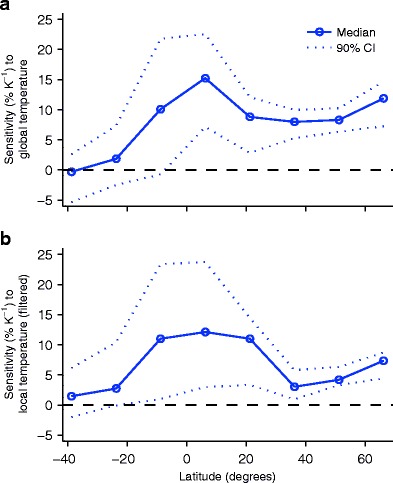
- Historical rain-gauge analyses over land show both increasing and decreasing trends, but grid boxes or stations with significant increases outnumber those with significant decreases; the global sensitivity of annual-maximum daily precipitation is 8 % K−1 with a 90% confidence interval of 5 to 10 % K−1.
- Regressing by latitude band gives higher observed sensitivity in the tropics than the extratropics: 9 % K−1 (90% CI 6–14 % K−1) for 30S to 30N versus 4 % K−1 (90% CI 2–5 % K−1) for the extratropics.
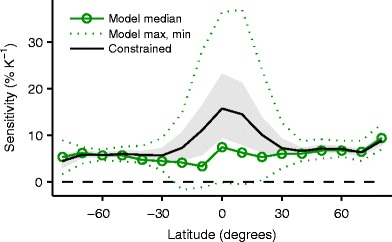
- CMIP5 projections show a general increase in the intensity of precipitation extremes, with the multimodel-median extratropical sensitivity about 6 % K−1 (or 5 % K−1 when normalized by extratropical-mean temperature), while tropical responses span from near 0 to >30 % K−1 across models.
- Observationally constrained estimates suggest tropical extremes are more sensitive than extratropical extremes: 11 % K−1 (90% CI 7–15 % K−1) in the tropics versus 6 % K−1 (90% CI 6–7 % K−1) in the extratropics.
- Snowfall extremes and orographic extremes behave differently from rainfall extremes: snowfall extremes peak near an optimal temperature of roughly −2 °C by liquid-water equivalent (or −4 °C by snow depth), and orographic extremes show larger fractional increases on leeward slopes than windward slopes.
## Methods
- Review article synthesizing results from theory, observations, and modeling, with sections on observed changes, physical theory, climate-model projections, orographic extremes, snowfall extremes, and duration dependence.
- Uses observational datasets and analyses described in the text, including HadEX2, NOAA MLOST, and rain-gauge records, with regressions based on the Theil-Sen estimator and confidence intervals reported for latitude-band sensitivities.
- Summarizes results from multiple modeling frameworks, including CMIP3/CMIP5 global climate models, regional climate models, cloud-system resolving models (CRMs), and idealized simulations such as radiative-convective equilibrium and idealized mountain cases.
## Limitations
- The paper explicitly states that available data have limited geographic coverage, especially for observations, and that there are relatively few observational records of tropical precipitation extremes.
- It states that global climate models with parameterized moist convection are not expected to be reliable for precipitation extremes that are primarily convective in nature, and that models have important limitations in simulating precipitation extremes.
- Evident from the text: some results are hard to compare directly because the observational and modeling analyses use different time periods, geographic coverage, and definitions of extreme precipitation.
Model-written summary. Check it against the paper before relying on it.
Integrity signals
Registry
Cites
Statistics
Figures
Verification
Claims the paper makes
37 Valid · 5 Not valid · 41 Not checked · 53 Own results and interpretations
The sources with a verdict support this claim; the rest weren’t checked yet, have no full text we could read, or their verdicts aren’t rated yet.
In the paper
“If changes in dynamics and precipitation efficiency are negligible, precipitation extremes increase with warming because of increases in the saturation vapor pressure of water [4, 62, 85, 86]; this will be made more precise in the “Theory” section.”
§ Precipitation Extremes Under Climate Change > Introduction
What the sources say
- Not checked — no full text of the sourcecites [4] Allen MR Ingram WJ Constraints on future changes in climate and the hydrologic cycle Nature 2002 419 224 232 10.1038/nature01092 12226677 source
- Supportedcites [62] O’Gorman PA Schneider T Scaling of precipitation extremes over a wide range of climates simulated with an idealized GCM J Clim 2009 22 5676 5685 10.1175/2009JCLI2701.1 source
Section 4a explains that, when changes in vertical velocity are neglected, the scaling of tropical precipitation extremes approximately follows the temperature dependence of saturation specific humidity. The Conclusions report that extremes generally increase with warming in the idealized simulations, while cautioning that their rate of increase need not follow Clausius–Clapeyron scaling. The cited claim asserts an increase, not an exact rate, and is conditional on negligible non-thermodynamic changes. (LLM, conf=0.88)
- Not checked — no full text of the sourcecites [85] Trenberth KE Conceptual framework for changes of extremes of the hydrological cycle with climate change Clim Chang 1999 42 327 339 10.1023/A:1005488920935 source
- Supportedcites [86] Trenberth KE Dai A Rasmussen RM Parsons DB The changing character of precipitation Bull Am Meteorol Soc 2003 84 1205 1217 10.1175/BAMS-84-9-1205 source
In “How Should Precipitation Change as the Climate Changes?”, the paper says atmospheric water-holding capacity rises with warming according to the Clausius–Clapeyron equation and argues that heavy-rainfall intensity should rise at about the same rate as moisture content. Its statement that stronger rainfall rates follow “all things being equal” supports the claim’s condition that other influences are negligible. (LLM, conf=0.92)
plainstates a cause- Asserted: passes — The authors put it forward as true.
- Checkable: passes — It can be checked against evidence.
- Load-bearing: passes — The paper’s conclusions depend on it.
- Based: passes — The paper gives a reason why it holds.
Every source the paper cites for this claim was checked and supports it.
In the paper
“One exception was the Community Climate Model System 3 which underestimated the 30-year return values [17]”
§ Precipitation Extremes Under Climate Change > Climate-Model Projections
What the sources say
- Supportedcites [17] Chen CT Knutson T On the verification and comparison of extreme rainfall indices from climate models J Clim 2008 21 1605 1621 10.1175/2007JCLI1494.1 source
Section 4 states that the NCAR Community Climate System Model version 3 (CCSM3), at T85 resolution, produced a domain-averaged 30-year precipitation return level (P30) much smaller than the observed value. The paper's evaluation concerns the conterminous United States; this finding uses the authors' recommended comparison in which model output is treated as an areal mean. (LLM, conf=0.92)
plainstates a cause- Asserted: passes — The authors put it forward as true.
- Checkable: passes — It can be checked against evidence.
- Load-bearing: unclear — It is unclear whether the paper’s conclusions depend on it.
- Based: passes — The paper gives a reason why it holds.
- Supported
The sources with a verdict support this claim; the rest weren’t checked yet, have no full text we could read, or their verdicts aren’t rated yet.
In the paper
“Over the available record, there are regions with both increasing and decreasing trends in precipitation extremes [1, 28], as might be expected given large internal variability [25]”
§ Precipitation Extremes Under Climate Change > Observed Changes in Precipitation Extremes
What the sources say
- Not checked — no full text of the sourcecites [1] Alexander LV Zhang X Peterson TC Caesar J Gleason B Klein Tank AMG Global observed changes in daily climate extremes of temperature and precipitation J Geophys Res Atmos 2006 111 D05109 10.1029/2005JE002462 source
- Supportedcites [28] Groisman PY Knight RW Easterling DR Karl TR Hegerl GC Razuvaev VN Trends in intense precipitation in the climate record J Clim 2005 18 1326 1350 10.1175/JCLI3339.1 source
The section on southeastern and southwestern Australia reports an increase in very heavy precipitation frequency in the southeast and a decrease in the southwest over their available records. The southwest decrease is significant only at the 0.10 level, a qualification the citing sentence does not rule out. (LLM, conf=0.91)
plain- Asserted: passes — The authors put it forward as true.
- Checkable: passes — It can be checked against evidence.
- Load-bearing: unclear — It is unclear whether the paper’s conclusions depend on it.
- Based: passes — The paper gives a reason why it holds.
Every source the paper cites for this claim was checked and supports it.
In the paper
“For example, in an analysis of 30-year return values of daily precipitation over the conterminous USA, most global climate models were found to overestimate or roughly agree with observations that were conservatively interpolated to the model resolution for comparison [17].”
§ Precipitation Extremes Under Climate Change > Climate-Model Projections
What the sources say
- Supportedcites [17] Chen CT Knutson T On the verification and comparison of extreme rainfall indices from climate models J Clim 2008 21 1605 1621 10.1175/2007JCLI1494.1 source
Split into 2 atoms — 2 confirmed, 0 partially supported, 0 disputed, 0 misattributed, 0 unverifiable. Expand the claim to see per-atom verdicts.
plain- Asserted: passes — The authors put it forward as true.
- Checkable: passes — It can be checked against evidence.
- Load-bearing: unclear — It is unclear whether the paper’s conclusions depend on it.
- Based: passes — The paper gives a reason why it holds.
- Supported
The sources with a verdict support this claim; the rest weren’t checked yet, have no full text we could read, or their verdicts aren’t rated yet.
In the paper
“Important limitations in the ability of current models to simulate precipitation extremes have also been recognized and are related in part to the use of parameterized convection [38, 43, 58, 89, 93].”
§ Precipitation Extremes Under Climate Change > Climate-Model Projections
What the sources say
- Supportedcites [38] Kharin VV Zwiers FW Zhang X Hegerl GC Changes in temperature and precipitation extremes in the IPCC ensemble of global coupled model simulations J Clim 2007 20 1419 1444 10.1175/JCLI4066.1 source
The Precipitation Extremes section reports that models simulate extremes less consistently in the Tropics and subtropics than at higher latitudes, and identifies the details of deep-convection parameterizations as especially important for tropical results. The Summary likewise reports large differences among models in tropical precipitation extremes. The support is strongest for tropical extremes, rather than for all regions equally; page numbers are unavailable in our copy. (LLM, conf=0.85)
- Supportedcites [43] Kooperman GJ Pritchard MS Somerville RC The response of US summer rainfall to quadrupled CO2 climate change in conventional and superparameterized versions of the NCAR community atmosphere model J Adv Model Earth Syst 2014 6 859 882 10.1002/2014MS000306 source
The Introduction states that conventional GCMs underestimate increases in extreme rainfall and identifies their simplified representation of deep convection as one reason. The paper also says conventionally parameterized GCMs simulate extreme precipitation too weakly and too often compared with observations. (LLM, conf=0.93)
- Not checked — no full text of the sourcecites [58] O’Gorman PA Sensitivity of tropical precipitation extremes to climate change Nat Geosci 2012 5 697 700 10.1038/ngeo1568 source
- Supportedcites [89] Wehner MF Very extreme seasonal precipitation in the NARCCAP ensemble: model performance and projections Clim Dyn 2013 40 59 80 10.1007/s00382-012-1393-1 source
The Introduction says current climate models struggle to reproduce observed extreme-precipitation statistics and attributes part of that limitation to inadequacies in their moist-physics formulations. It also explains that moist physics generally includes parameterized treatments of convective cloud processes, supporting the citing sentence’s qualified connection to parameterized convection. (LLM, conf=0.87)
- Supportedcites [93] Wilcox EM Donner LJ The frequency of extreme rain events in satellite rain-rate estimates and an atmospheric general circulation model J Clim 2007 20 53 69 10.1175/JCLI3987.1 source
Section 3 reports that changes to convection parameterizations can substantially alter the simulated frequency of intense rain events and says further refinements are needed before models can reliably simulate rain-rate distributions. The Abstract likewise identifies uncertainty in simulating precipitation intensity distributions and links improvements to convection schemes. (LLM, conf=0.93)
plainstates an association- Asserted: passes — The authors put it forward as true.
- Checkable: passes — It can be checked against evidence.
- Load-bearing: unclear — It is unclear whether the paper’s conclusions depend on it.
- Based: passes — The paper gives a reason why it holds.
- Supported
81 more claims · 19 with their cited sources checked
Create a free account to see all 136 claims and to verify the 2 references still open.
- It may state two separate claims as one. 42
- Probably not a substantial claim. 14
Citations
Cites
Global observed changes in daily climate extremes of temperature and precipitation
Alexander, L. V., Zhang, X., Peterson, T. C., Caesar, J., Gleason, B., Klein Tank, A. M. G., Haylock, M., Collins, D., Trewin, B., Rahimzadeh, F., et al. (2006) · Journal of Geophysical Research: Atmospheres · doi:10.1029/2005jd006290 · Cited by 4,492 · cited 1×
“Over the available record, there are regions with both increasing and decreasing trends in precipitation extremes [28,1], as might be expected given large internal variability [25], but the gridboxes or stations with significant increasing trends outnumber those with significant decreasing trends [23,91].”
BackgroundAn Introduction to Dynamic Meteorology
Holton, J. R., & Staley, D. O. (1973) · American Journal of Physics · doi:10.1119/1.1987371 · Cited by 3,355
The Changing Character of Precipitation
Trenberth, K. E., Dai, A., Rasmussen, R. M., & Parsons, D. B. (2003) · Bulletin of the American Meteorological Society · doi:10.1175/bams-84-9-1205 · Cited by 3,196 · cited 1×
“por pressure of water [85,86,4,62]; this will be made more precise in section 3.”
BackgroundTropical cyclones and climate change
Knutson, T. R., McBride, J. L., Chan, J., Emanuel, K., Holland, G., Landsea, C., Held, I., Kossin, J. P., Srivastava, A. K., & Sugi, M. (2010) · Nature Geoscience · doi:10.1038/ngeo779 · Cited by 3,194
Constraints on future changes in climate and the hydrologic cycle
Allen, M. R., & Ingram, W. J. (2002) · Nature · doi:10.1038/nature01092 · Cited by 3,009 · cited 1×
“por pressure of water [85,86,4,62]; this will be made more precise in section 3.”
BackgroundImprovements to NOAA’s Historical Merged Land–Ocean Surface Temperature Analysis (1880–2006)
Smith, T. M., Reynolds, R. W., Peterson, T. C., & Lawrimore, J. (2008) · Journal of Climate · doi:10.1175/2007jcli2100.1 · Cited by 2,923 · cited 4×
“Differences in convective parameterizations are less important in the extratropics, and the correlation coefficient across models between the sensitivities for climate change and variability becomes smaller for climate change at higher latitudes, reaching a value of 0.5 at 50S and 40N as compared to a maximum of 0.86…”
MethodInfluentialRecent Arctic amplification and extreme mid-latitude weather
Cohen, J., Screen, J. A., Furtado, J. C., Barlow, M., Whittleston, D., Coumou, D., Francis, J., Dethloff, K., Entekhabi, D., Overland, J., et al. (2014) · Nature Geoscience · doi:10.1038/ngeo2234 · Cited by 2,492
Human contribution to more-intense precipitation extremes
Min, S.-K., Zhang, X., Zwiers, F. W., & Hegerl, G. C. (2011) · Nature · doi:10.1038/nature09763 · Cited by 2,083
Atmospheric Warming and the Amplification of Precipitation Extremes
Allan, R. P., & Soden, B. J. (2008) · Science · doi:10.1126/science.1160787 · Cited by 1,562 · cited 1×
“ulate the interannual variability in tropical precipitation extremes when compared to observations [2,3], and the disproportionate increases in precipitation extremes compared to other parts of the precipitation distribution that is found in some models – an “extreme mode” in the tropical response to climate change th…”
Background
Cited by
Understanding the regional pattern of projected future changes in extreme precipitation
Pfahl, S., O’Gorman, P. A., & Fischer, E. M. (2017) · Nature Climate Change · doi:10.1038/nclimate3287 · Cited by 1,040
Self-citationFrequency of extreme precipitation increases extensively with event rareness under global warming
Myhre, G., Alterskjær, K., Stjern, C. W., Hodnebrog, Ø., Marelle, L., Samset, B. H., Sillmann, J., Schaller, N., Fischer, E., Schulz, M., et al. (2019) · Scientific Reports · doi:10.1038/s41598-019-52277-4 · Cited by 996
Quantifying the influence of global warming on unprecedented extreme climate events
Diffenbaugh, N. S., Singh, D., Mankin, J. S., Horton, D. E., Swain, D. L., Touma, D., Charland, A., Liu, Y., Haugen, M., Tsiang, M., et al. (2017) · Proceedings of the National Academy of Sciences · doi:10.1073/pnas.1618082114 · Cited by 766
“However, thermodynamic arguments suggest that global warming should have increased the event probability by increasing atmospheric moisture (2, 48).”
BackgroundObserved heavy precipitation increase confirms theory and early models
Fischer, E. M., & Knutti, R. (2016) · Nature Climate Change · doi:10.1038/nclimate3110 · Cited by 758
Advances in understanding large‐scale responses of the water cycle to climate change
Allan, R. P., Barlow, M., Byrne, M. P., Cherchi, A., Douville, H., Fowler, H. J., Gan, T. Y., Pendergrass, A. G., Rosenfeld, D., Swann, A. L. S., et al. (2020) · Annals of the New York Academy of Sciences · doi:10.1111/nyas.14337 · Cited by 687
Extreme weather impacts of climate change: an attribution perspective
Clarke, B., Otto, F., Stuart-Smith, R., & Harrington, L. (2022) · Environmental Research: Climate · doi:10.1088/2752-5295/ac6e7d · Cited by 573
“…moisture at a given pressure: the Clausius–Clapeyron relation states that the increase in moisture held at a given pressure is 6%–7% per 1 ◦C. Extra water in the atmosphere combines with changes in weather patterns to affect rainfall extremes in a given region (O’Gorman 2015, Pfahl et al 2017).”
BackgroundIf Precipitation Extremes Are Increasing, Why Aren't Floods?
Sharma, A., Wasko, C., & Lettenmaier, D. P. (2018) · Water Resources Research · doi:10.1029/2018wr023749 · Cited by 528
“While significant advances have been made (O’Gorman, 2015), observed increases in precipitation extremes (Alexander et al., 2006; Donat et al., 2013; Groisman et al., 2005; Wentz et al., 2007; Westra et al., 2013) do not appear to have translated to observed increases in flooding.”
BackgroundAttribution of extreme rainfall from Hurricane Harvey, August 2017
van Oldenborgh, G. J., van der Wiel, K., Sebastian, A., Singh, R., Arrighi, J., Otto, F., Haustein, K., Li, S., Vecchi, G., & Cullen, H. (2017) · Environmental Research Letters · doi:10.1088/1748-9326/aa9ef2 · Cited by 481
Large increase in global storm runoff extremes driven by climate and anthropogenic changes
Yin, J., Gentine, P., Zhou, S., Sullivan, S. C., Wang, R., Zhang, Y., & Guo, S. (2018) · Nature Communications · doi:10.1038/s41467-018-06765-2 · Cited by 476
Frequency of extreme Sahelian storms tripled since 1982 in satellite observations
Taylor, C. M., Belušić, D., Guichard, F., Parker, D. J., Vischel, T., Bock, O., Harris, P. P., Janicot, S., Klein, C., & Panthou, G. (2017) · Nature · doi:10.1038/nature22069 · Cited by 439
A Global, Continental, and Regional Analysis of Changes in Extreme Precipitation
Sun, Q., Zhang, X., Zwiers, F., Westra, S., & Alexander, L. V. (2021) · Journal of Climate · doi:10.1175/jcli-d-19-0892.1 · Cited by 402
“7%/K, 57 which is close to the intensification expected from the Clausius-Clapeyron relationship (~7%/K, 58 Boer et al., 1993; Allen and Ingram 2002; O’Gorman 2015).”
BackgroundResponses and impacts of atmospheric rivers to climate change
Payne, A. E., Demory, M.-E., Leung, L. R., Ramos, A. M., Shields, C. A., Rutz, J. J., Siler, N., Villarini, G., Hall, A., & Ralph, F. M. (2020) · Nature Reviews Earth & Environment · doi:10.1038/s43017-020-0030-5 · Cited by 398
Future increases in extreme precipitation exceed observed scaling rates
Bao, J., Sherwood, S. C., Alexander, L. V., & Evans, J. P. (2017) · Nature Climate Change · doi:10.1038/nclimate3201 · Cited by 382
Influence of changes in rainfall and soil moisture on trends in flooding
Wasko, C., & Nathan, R. (2019) · Journal of Hydrology · doi:10.1016/j.jhydrol.2019.05.054 · Cited by 357
Wang, G., Wang, D., Trenberth, K. E., Erfanian, A., Yu, M., Bosilovich, M. G., & Parr, D. T. (2017) · Nature Climate Change · doi:10.1038/nclimate3239 · Cited by 318
Constraining the increased frequency of global precipitation extremes under warming
Thackeray, C. W., Hall, A., Norris, J., & Chen, D. (2022) · Nature Climate Change · doi:10.1038/s41558-022-01329-1 · Cited by 296
Lenderink, G., Barbero, R., Loriaux, J. M., & Fowler, H. J. (2017) · Journal of Climate · doi:10.1175/jcli-d-16-0808.1 · Cited by 288
“…from simple thermodynamics—an increase in moisture content of the atmosphere—while contributions from changes in atmospheric dynamics and microphysics are still rather uncertain (Westra et al. 2014; Singh and O’Gorman 2014;O’Gorman 2015; Lenderink andAttema 2015; Fischer and Knutti 2016).”
BackgroundThe Pakistan Flood of August 2022: Causes and Implications
Nanditha, J. S., Kushwaha, A. P., Singh, R., Malik, I., Solanki, H., Chuphal, D. S., Dangar, S., Mahto, S. S., Vegad, U., & Mishra, V. (2023) · Earth's Future · doi:10.1029/2022ef003230 · Cited by 269
“Global temperature rise will increase the frequency of extreme precipitation events (O’Gorman, 2015; Pfahl et al., 2017) as warm air can hold more atmospheric water vapor (E. K. Trenberth, 2011; K. E. Trenberth et al., 2003).”
BackgroundA warming-induced reduction in snow fraction amplifies rainfall extremes
Ombadi, M., Risser, M. D., Rhoades, A. M., & Varadharajan, C. (2023) · Nature · doi:10.1038/s41586-023-06092-7 · Cited by 273
Complexity in estimating past and future extreme short-duration rainfall
Zhang, X., Zwiers, F. W., Li, G., Wan, H., & Cannon, A. J. (2017) · Nature Geoscience · doi:10.1038/ngeo2911 · Cited by 265
Rajczak, J., & Schär, C. (2017) · Journal of Geophysical Research: Atmospheres · doi:10.1002/2017jd027176 · Cited by 236
“In the context of global warming, there are concerns that heavy precipitation events will become more intense and more frequent under future climatic conditions (e.g., Frei et al., 1998; Trenberth et al., 2003; O’Gorman, 2015).”
BackgroundMid-latitude freshwater availability reduced by projected vegetation responses to climate change
Mankin, J. S., Seager, R., Smerdon, J. E., Cook, B. I., & Williams, A. P. (2019) · Nature Geoscience · doi:10.1038/s41561-019-0480-x · Cited by 231
Barbero, R., Fowler, H. J., Lenderink, G., & Blenkinsop, S. (2017) · Geophysical Research Letters · doi:10.1002/2016gl071917 · Cited by 222
Business risk and the emergence of climate analytics
Fiedler, T., Pitman, A. J., Mackenzie, K., Wood, N., Jakob, C., & Perkins-Kirkpatrick, S. E. (2021) · Nature Climate Change · doi:10.1038/s41558-020-00984-6 · Cited by 220
Reduced exposure to extreme precipitation from 0.5 °C less warming in global land monsoon regions
Zhang, W., Zhou, T., Zou, L., Zhang, L., & Chen, X. (2018) · Nature Communications · doi:10.1038/s41467-018-05633-3 · Cited by 220
van der Wiel, K., Kapnick, S. B., van Oldenborgh, G. J., Whan, K., Philip, S., Vecchi, G. A., Singh, R. K., Arrighi, J., & Cullen, H. (2017) · Hydrology and Earth System Sciences · doi:10.5194/hess-21-897-2017 · Cited by 202
“…precipitation extremes are expected to increase due to the greater moisture content of a warmer atmosphere following Clausius– Clapeyron scaling (O’Gorman, 2015; Lenderink and Attema, 2015; Scherrer et al., 2016): e.g., “Disasters like Louisiana floods will worsen as planet warms, scientists…”
BackgroundInfluentialHydroclimate volatility on a warming Earth
Swain, D. L., Prein, A. F., Abatzoglou, J. T., Albano, C. M., Brunner, M., Diffenbaugh, N. S., Singh, D., Skinner, C. B., & Touma, D. (2025) · Nature Reviews Earth & Environment · doi:10.1038/s43017-024-00624-z · Cited by 204
“While thermodynamically driven increases in extreme precipitation events have been widely recognized 60 , a smaller but rapidly growing body of research has focused on the drivers 61–65 and impacts 30,46,66 of increasing evaporative demand.”
Intensification of extreme precipitation in arid Central Asia
Yao, J., Chen, Y., Chen, J., Zhao, Y., Tuoliewubieke, D., Li, J., Yang, L., & Mao, W. (2021) · Journal of Hydrology · doi:10.1016/j.jhydrol.2020.125760 · Cited by 194
Myhre, G., Forster, P. M., Samset, B. H., Hodnebrog, Ø., Sillmann, J., Aalbergsjø, S. G., Andrews, T., Boucher, O., Faluvegi, G., Fläschner, D., et al. (2017) · Bulletin of the American Meteorological Society · doi:10.1175/bams-d-16-0019.1 · Cited by 188
“The rates of extreme precipitation events have been found, through both observations and modeling, to scale closely with the Clausius–Clapeyron relationship rather than with global-mean precipitation change (Allan and Soden 2008; Boucher et al. 2013; O’Gorman 2015).”
BackgroundTrends and Extremes in Northern Hemisphere Snow Characteristics
Kunkel, K. E., Robinson, D. A., Champion, S., Yin, X., Estilow, T., & Frankson, R. M. (2016) · Current Climate Change Reports · doi:10.1007/s40641-016-0036-8 · Cited by 181
“Extreme snowfall events tend to occur just below the freezing point [2] while seasonal metrics may be affected in complex ways by temperature characteristics and weather system This article is part of the Topical Collection on Extreme Events”
BackgroundAdaptation of urban drainage networks to climate change: A review
Kourtis, I. M., & Tsihrintzis, V. A. (2021) · Science of The Total Environment · doi:10.1016/j.scitotenv.2021.145431 · Cited by 174
Seasonality, Intensity, and Duration of Rainfall Extremes Change in a Warmer Climate
Moustakis, Y., Papalexiou, S. M., Onof, C. J., & Paschalis, A. (2021) · Earth's Future · doi:10.1029/2020ef001824 · Cited by 160
“However, the complexity of precipitating systems and the interplay between thermodynamic and dynamic factors enhancing or diminishing precipitation formation shed doubt over approaches based on thermodynamic scaling alone (Moustakis et al., 2020; O'Gorman, 2015; Pfahl et al., 2017).”
BackgroundTowards advancing scientific knowledge of climate change impacts on short-duration rainfall extremes
Fowler, H. J., Ali, H., Allan, R. P., Ban, N., Barbero, R., Berg, P., Blenkinsop, S., Cabi, N. S., Chan, S., Dale, M., et al. (2021) · Philosophical Transactions of the Royal Society A: Mathematical, Physical and Engineering Sciences · doi:10.1098/rsta.2019.0542 · Cited by 160
“According to this relationship, specific humidity increases at approximately 6–7% per degree warming (K−1) near to the Earth’s surface [36]: a rate used as a first approximation to indicate how rainfall extremes may change with a warming climate[37].”
BackgroundSelf-citationIncreasing global precipitation whiplash due to anthropogenic greenhouse gas emissions
Tan, X., Wu, X., Huang, Z., Fu, J., Tan, X., Deng, S., Liu, Y., Gan, T. Y., & Liu, B. (2023) · Nature Communications · doi:10.1038/s41467-023-38510-9 · Cited by 161
Precipitation From Persistent Extremes is Increasing in Most Regions and Globally
Du, H., Alexander, L. V., Donat, M. G., Lippmann, T., Srivastava, A., Salinger, J., Kruger, A., Choi, G., He, H. S., Fujibe, F., et al. (2019) · Geophysical Research Letters · doi:10.1029/2019gl081898 · Cited by 160
Wang, W., Lu, H. M., Leung, L.-Y. R., Li, H., Zhao, J., Tian, F., Yang, K., & Khem, S. (2017) · Geophysical Research Letters · doi:10.1002/2017gl075037 · Cited by 164
Dai, A., Rasmussen, R., Liu, C., Ikeda, K., & Prein, A. F. (2017) · Climate Dynamics · doi:10.1007/s00382-017-3787-6 · Cited by 178
“2012; O’Gorman 2015; Prein et al.”
BackgroundMethodInfluentialAli, H., Fowler, H. J., & Mishra, V. K. (2018) · Geophysical Research Letters · doi:10.1029/2018gl080557 · Cited by 161
“Under a warming climate, observations show an increase in extreme precipitation events, which often result in flooding (Fischer & Knutti, 2016; Groisman et al., 2005; O’Gorman, 2015; Wang et al., 2017).”
BackgroundObserved extreme precipitation trends and scaling in Central Europe
Zeder, J., & Fischer, E. M. (2020) · Weather and Climate Extremes · doi:10.1016/j.wace.2020.100266 · Cited by 188
Observed changes in air temperature and precipitation extremes over Brazil
Regoto, P., Dereczynski, C. P., Chou, S. C., & Bazzanela, A. C. (2021) · International Journal of Climatology · doi:10.1002/joc.7119 · Cited by 172
Emerging trends in heavy precipitation and hot temperature extremes in Switzerland
Scherrer, S. C., Fischer, E. M., Posselt, R., Liniger, M. A., Croci‐Maspoli, M., & Knutti, R. (2016) · Journal of Geophysical Research Atmospheres · doi:10.1002/2015jd024634 · Cited by 183
Dynamic amplification of extreme precipitation sensitivity
Nie, J., Sobel, A. H., Shaevitz, D. A., & Wang, S. (2018) · Proceedings of the National Academy of Sciences · doi:10.1073/pnas.1800357115 · Cited by 163
“The first two right-hand side (RHS) terms represent the adiabatic QG forcing (F) (34), while the last RHS term represents the effects of the diabatic heating on ω.”
BackgroundExtreme weather events in Iran under a changing climate
Alizadeh-Choobari, O., & Najafi, M. S. (2017) · Climate Dynamics · doi:10.1007/s00382-017-3602-4 · Cited by 156
“Analysis of O’Gorman (2015) provided evidence for linking extreme precipitation to global warming.”
BackgroundInfluentialSchröer, K., & Kirchengast, G. (2017) · Climate Dynamics · doi:10.1007/s00382-017-3857-9 · Cited by 152
Liu, B., Tan, X., Gan, T. Y., Chen, X., Lin, K., Lu, M., & Liu, Z. (2020) · Wiley Interdisciplinary Reviews Water · doi:10.1002/wat2.1412 · Cited by 160
Hydrological Intensification Will Increase the Complexity of Water Resource Management
Ficklin, D. L., Null, S. E., Abatzoglou, J. T., Novick, K. A., & Myers, D. T. (2022) · Earth s Future · doi:10.1029/2021ef002487 · Cited by 178
“, 2013) and disproportionately increases the magnitude of precipitation extremes relative to total annual precipitation (Donat et al., 2013; O’Gorman, 2015; Pendergrass & Knutti, 2018; Polade et al., 2014).”
BackgroundHazardous thunderstorm intensification over Lake Victoria
Thiery, W., Davin, E. L., Seneviratne, S. I., Bedka, K., Lhermitte, S., & van Lipzig, N. P. M. (2016) · Nature Communications · doi:10.1038/ncomms12786 · Cited by 106
Does nonstationarity in rainfall require nonstationary intensity–duration–frequency curves?
Ganguli, P., & Coulibaly, P. (2017) · Hydrology and earth system sciences · doi:10.5194/hess-21-6461-2017 · Cited by 154
Identifying climate drivers of infectious disease dynamics: recent advances and challenges ahead
Metcalf, C. J. E., Walter, K. S., Wesolowski, A., Buckee, C. O., Shevliakova, E., Tatem, A. J., Boos, W. R., Weinberger, D. M., & Pitzer, V. E. (2017) · Proceedings of the Royal Society B Biological Sciences · doi:10.1098/rspb.2017.0901 · Cited by 168
Does storm duration modulate the extreme precipitation-temperature scaling relationship?
Wasko, C., Sharma, A., & Johnson, F. M. (2015) · Geophysical Research Letters · doi:10.1002/2015gl066274 · Cited by 130
Gründemann, G. J., van de Giesen, N., Brunner, L., & van der Ent, R. (2022) · Communications Earth & Environment · doi:10.1038/s43247-022-00558-8 · Cited by 161
Extreme precipitation in the tropics is closely associated with long-lived convective systems
Roca, R., & Fiolleau, T. (2020) · Communications Earth & Environment · doi:10.1038/s43247-020-00015-4 · Cited by 143
Zhang, W., & Zhou, T. (2019) · Journal of Climate · doi:10.1175/jcli-d-18-0662.1 · Cited by 126
Variability conceals emerging trend in 100yr projections of UK local hourly rainfall extremes
Kendon, E., Fischer, E. M., & Short, C. J. (2023) · Nature Communications · doi:10.1038/s41467-023-36499-9 · Cited by 151
Atmospheric Moisture Measurements Explain Increases in Tropical Rainfall Extremes
Roderick, T. P., Wasko, C., & Sharma, A. (2019) · Geophysical Research Letters · doi:10.1029/2018gl080833 · Cited by 124
“Negative scaling rates challenge the notion that extreme rainfall will increase as near SAT increases and contradict observational studies which have shown increased tropical precipitation extremes (O'Gorman, 2015).”
BackgroundOverview of Observed Clausius-Clapeyron Scaling of Extreme Precipitation in Midlatitudes
Martínková, M., & Kyselý, J. (2020) · Atmosphere · doi:10.3390/atmos11080786 · Cited by 129
Knist, S., Goergen, K., & Simmer, C. (2018) · Climate Dynamics · doi:10.1007/s00382-018-4147-x · Cited by 122
“(2014), Gorman (2015), Ban et al.”
Review: The influence of global change on Europe’s water cycle and groundwater recharge
Riedel, T., & Weber, T. K. D. (2020) · Hydrogeology Journal · doi:10.1007/s10040-020-02165-3 · Cited by 132
Consistent Large‐Scale Response of Hourly Extreme Precipitation to Temperature Variation Over Land
Ali, H., Fowler, H. J., Lenderink, G., Lewis, E., & Pritchard, D. M. W. (2021) · Geophysical Research Letters · doi:10.1029/2020gl090317 · Cited by 128
“The Clausius-Clapeyron (CC) relationship has therefore been used as a benchmark to interpret change to extreme precipitation (Fischer & Knutti, 2016; O'Gorman, 2015).”
MethodGao, Y., Lu, J., & Leung, L.-Y. R. (2016) · Journal of Climate · doi:10.1175/jcli-d-16-0088.1 · Cited by 120
“For nonconvective events in the extratropics, O’Gorman (2015) further showed weak dependence of extreme precipitation on changes in static stability.”
BackgroundSalt Spray Distribution and Its Impact on Vegetation Zonation on Coastal Dunes: a Review
Du, J., & Hesp, P. A. (2020) · Estuaries and Coasts · doi:10.1007/s12237-020-00820-2 · Cited by 118
“Precipitation changes driven by climate change (Trenberth 2011; O’Gorman 2015) will also affect the deposition and redistribution of salt spray (Hesp and Martínez 2007; Jackson et al. 2019).”
BackgroundQuantifying CMIP6 model uncertainties in extreme precipitation projections
John, A., Douville, H., Ribes, A., & Yiou, P. (2022) · Weather and Climate Extremes · doi:10.1016/j.wace.2022.100435 · Cited by 143
Increased melting level height impacts surface precipitation phase and intensity
Prein, A. F., & Heymsfield, A. J. (2020) · Nature Climate Change · doi:10.1038/s41558-020-0825-x · Cited by 124
Blenkinsop, S., Fowler, H. J., Barbero, R., Chan, S. C., Guerreiro, S. B., Kendon, E., Lenderink, G., Lewis, E., Li, X., Westra, S., et al. (2018) · Advances in science and research · doi:10.5194/asr-15-117-2018 · Cited by 114
Schlef, K., Kunkel, K. E., Brown, C., Demissie, Y. K., Lettenmaier, D. P., Wagner, A. M., Wigmosta, M. S., Karl, T. R., Easterling, D. R., Wang, K. J., et al. (2022) · Journal of Hydrology · doi:10.1016/j.jhydrol.2022.128757 · Cited by 130
Anthropogenic fingerprints in daily precipitation revealed by deep learning
Ham, Y., Kim, J.-H., Min, S., Kim, D., Li, T., Timmermann, A., & Stuecker, M. F. (2023) · Nature · doi:10.1038/s41586-023-06474-x · Cited by 128
Neelin, J. D., Martinez‐Villalobos, C., Stechmann, S. N., Ahmed, F., Chen, G., Norris, J., Kuo, Y., & Lenderink, G. (2022) · Current Climate Change Reports · doi:10.1007/s40641-021-00177-z · Cited by 140
Wasko, C., Lu, W. T., & Mehrotra, R. (2018) · Environmental Research Letters · doi:10.1088/1748-9326/aad135 · Cited by 109
“It is generally accepted that climate change will result in warming in most regions around the world (Collins et al 2013, Meehl et al 2012) increasing the capacity of the atmosphere to hold moisture leading to increased precipitation extremes (Trenberth et al 2003, O ’ Gorman 2015).”
BackgroundKooperman, G. J., Fowler, M. D., Hoffman, F. M., Koven, C. D., Lindsay, K., Pritchard, M. S., Swann, A. L. S., & Randerson, J. T. (2018) · Geophysical Research Letters · doi:10.1029/2018gl079901 · Cited by 109
“Radiative responses in the tropics are expected to drive an intensification of extreme (99.9th percentile rates) precipitation at a rate of ~10%/°C (O’Gorman, 2012, 2015).”
BackgroundLudwig, P., Ehmele, F., Franca, M. J., Mohr, S., Caldas-Alvarez, A., Daniell, J. E., Ehret, U., Feldmann, H., Hundhausen, M., Knippertz, P., et al. (2023) · Natural Hazards and Earth System Sciences · doi:10.5194/nhess-23-1287-2023 · Cited by 85
The Influence of Topography on the Global Terrestrial Water Cycle
Gnann, S. J., Baldwin, J. W., Cuthbert, M. O., Gleeson, T., Schwanghart, W., & Wagener, T. (2025) · Reviews of Geophysics · doi:10.1029/2023rg000810 · Cited by 139
“In current simulation models, orographic effects on short duration extreme precipitation are poorly explored (O’Gorman, 2015), and likely not well‐captured at the resolution used by most global climate models (approximately 100–200 km; Akinsanola et al., 2020).”
Projections of river floods in Europe using EURO‐CORDEX , CMIP5 and CMIP6 simulations
Sante, F. D., Coppola, E., & Giorgi, F. (2021) · International Journal of Climatology · doi:10.1002/joc.7014 · Cited by 110
“…by the fact that a warmer atmosphere is able to contain larger amounts of water vapour, 6–7% per degree of warming, and this would increase the probability of extreme rainfall events across Europe (IPCC, 2012; Madsen et al., 2014; O'Gorman, 2015; Rajczak and Schär, 2017; Giorgi et al., 2018, 2019).”
BackgroundAmplification of downstream flood stage due to damming of fine-grained rivers
Ma, H., Nittrouer, J. A., Fu, X., Parker, G., Zhang, Y., Wang, Y., Wang, Y., Lamb, M. P., Cisneros, J., Best, J., et al. (2022) · Nature Communications · doi:10.1038/s41467-022-30730-9 · Cited by 108
Changes in the occurrence of extreme precipitation events at the Paleocene–Eocene thermal maximum
Carmichael, M. J., Pancost, R. D., & Lunt, D. J. (2018) · Earth and Planetary Science Letters · doi:10.1016/j.epsl.2018.08.005 · Cited by 100
“Projections of how Earth’s hydrological cycle will operate on a future warmer Earth indicate changes to the sub-annual character of precipitation including the frequency and intensity of extreme events (Emori and Brown, 2005; O’Gorman, 2015).”
BackgroundMeteorological aspects of heavy precipitation in relation to floods – An overview
Breugem, A., Wesseling, J. G., Oostindie, K., & Ritsema, C. J. (2020) · Earth-Science Reviews · doi:10.1016/j.earscirev.2020.103171 · Cited by 109
Predicting Climate Change Using Response Theory: Global Averages and Spatial Patterns
Lucarini, V., Ragone, F., & Lunkeit, F. (2017) · Journal of Statistical Physics · doi:10.1007/s10955-016-1506-z · Cited by 92
Nkemelang, T., New, M. G., & Zaroug, M. (2018) · Environmental Research Letters · doi:10.1088/1748-9326/aac2f8 · Cited by 109
“However, within their own climate, they do simulate precipitation extremes (O’Gorman 2015), and so trends in these extremes can provide insights for the real world.”
BackgroundPin, W., Goggins, W. B., & Chan, E. Y. Y. (2018) · The Science of The Total Environment · doi:10.1016/j.scitotenv.2018.06.189 · Cited by 98
Increase in Subdaily Precipitation Extremes in India Under 1.5 and 2.0 °C Warming Worlds
Ali, H., & Mishra, V. K. (2018) · Geophysical Research Letters · doi:10.1029/2018gl078689 · Cited by 92
“O’Gorman (2015), however, argued that the influence of mesoscale convection and precipitation duration needs to be better understood to reduce the uncertainty in precipitation extremes over the tropics.”
BackgroundRethinking methane from animal agriculture
Liu, S., Proudman, J., & Mitloehner, F. M. (2021) · CABI Agriculture and Bioscience · doi:10.1186/s43170-021-00041-y · Cited by 114
“The irreversible impacts of climate change have threatened the sustainability of the earth’s eco-system (O’Gorman 2015; Sahade et al.”
BackgroundQuasi‐Stationary Intense Rainstorms Spread Across Europe Under Climate Change
Kahraman, A., Kendon, E., Chan, S. C., & Fowler, H. J. (2021) · Geophysical Research Letters · doi:10.1029/2020gl092361 · Cited by 111
“Processes proposed to explain super-CC scaling include localized dynamics and convective organization (Chan et al., 2016; Feng et al., 2016; Lochbihler et al., 2019; Moseley et al., 2016; O’Gorman, 2015; Pfahl et al., 2017; Prein et al., 2017).”
BackgroundLiu, H., Zou, L., Xia, J., Chen, T., & Wang, F. (2022) · Sustainable Cities and Society · doi:10.1016/j.scs.2022.104038 · Cited by 94
Towards the effect of climate change in structural loads of urban infrastructure: A review
Mishra, V., & Sadhu, A. (2022) · Sustainable Cities and Society · doi:10.1016/j.scs.2022.104352 · Cited by 88
Changes in Observed Daily Precipitation over Global Land Areas since 1950
Contractor, S., Donat, M. G., & Alexander, L. V. (2020) · Journal of Climate · doi:10.1175/jcli-d-19-0965.1 · Cited by 95
Kooperman, G. J., Pritchard, M. S., Burt, M. A., Branson, M. D., & Randall, D. A. (2016) · Journal of Advances in Modeling Earth Systems · doi:10.1002/2015ms000574 · Cited by 83
The Resolution Dependence of Contiguous U.S. Precipitation Extremes in Response to CO2 Forcing
van der Wiel, K., Kapnick, S., Vecchi, G. A., Cooke, W. F., Delworth, T. L., Jia, L., Murakami, H., Underwood, S. D., & Zeng, F. (2016) · Journal of Climate · doi:10.1175/jcli-d-16-0307.1 · Cited by 86
“For precipitation, these are generally based on either precipitation rates (e.g., total annual precipitation, annual maximum daily or monthly precipitation, and the precipitation rate of the 99th percentile of daily or monthly precipitation; Sen Roy and Balling 2004; Min et al. 2011; O’Gorman 2015) or the number or du…”
BackgroundInfluentialRamos, M. C., Lizaga, I., Gaspar, L., Quijano, L., & Navas, A. (2019) · Agricultural Water Management · doi:10.1016/j.agwat.2019.105789 · Cited by 93
Understanding the Dynamics of Future Changes in Extreme Precipitation Intensity
Tandon, N. F., Zhang, X., & Sobel, A. H. (2018) · Geophysical Research Letters · doi:10.1002/2017gl076361 · Cited by 92
“QGω-based formulations have been used in earlier studies of extreme precipitation (Nie & Sobel, 2016; Nie et al., 2016; O’Gorman, 2015), and we provide the derivation of our specific formulation in the supporting information.”
BackgroundMethodThe role of anthropogenic aerosols in future precipitation extremes over the Asian Monsoon Region
Zhao, A., Stevenson, D. S., & Bollasina, M. A. (2018) · Climate Dynamics · doi:10.1007/s00382-018-4514-7 · Cited by 90
“2007; Pendergrass and Hartmann 2014; O’Gorman 2015; Burke and Stott 2017).”
BackgroundSteinschneider, S., Ray, P. A., Rahat, S. H., & Kucharski, J. (2019) · Water Resources Research · doi:10.1029/2018wr024446 · Cited by 85
The impact of climate change on extreme precipitation in Sicily, Italy
Forestieri, A., Arnone, E., Blenkinsop, S., Candela, A., Fowler, H. J., & Noto, L. (2018) · Hydrological Processes · doi:10.1002/hyp.11421 · Cited by 91
“that quantifying and modelling the impacts of climate change on short duration rainfall remains an open and arduous challenge (Arnbjerg‐ Nielsen et al., 2013; Nguyen, Desramaut, & Nguyen, 2010; O'Gorman, 2015; Olsson, Willén, & Kawamura, 2012; Westra et al., 2014).”
BackgroundWemple, B. C., Browning, T., Ziegler, A. D., Celi, J., Chun, K. P. (., Jaramillo, F., Leite, N. K., Ramchunder, S. J., Negishi, J. N., Palomeque, X., et al. (2018) · Ecohydrology · doi:10.1002/eco.1881 · Cited by 65
“In areas where tropical rainfall events become more intense, accelerated erosion rates could result in stream ecosystem degradation from increased sediment and nutrient loading (Casimiro, Labat, Guyot, & Ardoin‐Bardin, 2011; Costa, Coe, & Guyot, 2009; Dore, 2005; Guimberteau et al., 2013; Jaramillo et al., 2016; O'Gor…”
BackgroundPendergrass, A. G., Reed, K. A., & Medeiros, B. (2016) · Geophysical Research Letters · doi:10.1002/2016gl071285 · Cited by 80
Latitudinal heterogeneity and hotspots of uncertainty in projected extreme precipitation
Tabari, H., Hosseinzadehtalaei, P., AghaKouchak, A., & Willems, P. (2019) · Environmental Research Letters · doi:10.1088/1748-9326/ab55fd · Cited by 83
“In contrast, precipitation extremes in the extratropics except some JJA extremes are mostly associated with cyclones and frontal systems andmore reliably represented by the GCMs (Pfahl and Wernli 2012, Catto and Pfahl 2013, O’Gorman 2015).”
BackgroundAssessment of rainfall variability and future change in Brazil across multiple timescales
Alves, L. M., Chadwick, R. S., Moise, A. F., Brown, J. R., & Marengo, J. A. (2020) · International Journal of Climatology · doi:10.1002/joc.6818 · Cited by 101
Li, B. V., Jenkins, C. N., & Xu, W. (2022) · Proceedings of the National Academy of Sciences · doi:10.1073/pnas.2113416118 · Cited by 103
A short review of numerical cloud-resolving models
Guichard, F., & Couvreux, F. (2017) · Tellus A Dynamic Meteorology and Oceanography · doi:10.1080/16000870.2017.1373578 · Cited by 104
“The projected climatic increase in the intensity of rain events with warming (Emori and Brown, 2005; O’Gorman, 2015; Westra et al., 2014) together with observational studies emphasizing an intensification of heavy-rain events in the last decades (Lenderink and Van Meijgaard, 2008; Panthou et al.”
BackgroundQuantifying the Effect of Precipitation on Landslide Hazard in Urbanized and Non‐Urbanized Areas
Bush, A. E., Davenport, F. V., Wang, L., Caers, J., Muthukrishnan, S., Burke, M., & Diffenbaugh, N. S. (2021) · Geophysical Research Letters · doi:10.1029/2021gl094038 · Cited by 88
“Robust literature attributes increasing intensity of extreme wet events to rising greenhouse gas concentrations (e.g., Allan & Soden, 2008; Diffenbaugh et al., 2017; O'Gorman, 2015) and forecasts further precipitation intensification in response to continued global warming (e.”
BackgroundSubsoil organo-mineral associations under contrasting climate conditions
Inagaki, T. M., Possinger, A. R., Grant, K. E., Schweizer, S. A., Mueller, C. W., Derry, L. A., Lehmann, J. C., & Kögel‐Knabner, I. (2019) · Geochimica et Cosmochimica Acta · doi:10.1016/j.gca.2019.11.030 · Cited by 87
Pereira, S. C., Carvalho, D., & Rocha, A. C. (2021) · Climate · doi:10.3390/cli9090139 · Cited by 95
“, [44–48]) and increases either in the contribution of the extreme precipitation and the frequency and intensity of precipitation extremes [49,50] in winter precipitation for specific regions (e.”
Background
Metadata
- Authors
- O’Gorman, P. A.
- Affiliations
- Massachusetts Institute of Technology (US)
- Corresponding author
- O’Gorman, Paul A.
- ORCID
- O’Gorman, Paul A.
- Venue
- Current Climate Change Reports
- Published
- 2015-04-22
- Volume
- 1
- Issue
- 2
- Pages
- 49-59
- ISSN
- 2198-6061 (ISSN-L)
- PMC
- PMC4542457
- OpenAlex
- W2951418525
- Cited by
- 881
- References
- 104
- Citations by year
- 2026: 124 · 2025: 130 · 2024: 103 · 2023: 107 · 2022: 90 · 2021: 73 · 2020: 70 · 2019: 59 · 2018: 54 · 2017: 42 · 2016: 26 · 2015: 3
- FWCI
- 2.81
- Type
- journal article
- Language
- en
- Open access
- hybrid
- doi.org
- Locations
- Current Climate Change Reports (publishedVersion, cc-by)
- Europe PMC (PubMed Central) (publishedVersion, cc-by)
- PubMed Central (publishedVersion, cc-by)
- PubMed (publishedVersion)
- arXiv (Cornell University) (submittedVersion)
- DSpace@MIT (Massachusetts Institute of Technology) (submittedVersion, cc-by-nc)
- arXiv (Cornell University)
- Cambridge International Law Journal
- Funders
- National Science Foundation (1148594)
- U.S. Department of Energy
- National Aeronautics and Space Administration (NNX11AO92G)
- University of New South Wales
- National Oceanic and Atmospheric Administration
- Topics
- Physical Sciences › Environmental Science › Global and Planetary Change › Climate variability and models
- Physical Sciences › Earth and Planetary Sciences › Atmospheric Science › Meteorological Phenomena and Simulations
- Physical Sciences › Environmental Science › Global and Planetary Change › Climate Change and Environmental Impact
- Keywords
- heavy rainfall, climate change, precipitation intensification, thermodynamic response, microphysical processes, convective processes, tropical precipitation, orographic precipitation, duration dependence, climate model simulation
About these checks
Registry, retraction, Cites and statistics results are computed, not judged, with one exception: a printed reference that no index lists is read once by a model before it counts as a citation error. Claims are extracted by a model and kept only when their quote appears verbatim in the text; each cited source is then checked, with a model’s help, for whether it says what the claim relies on. Those verdicts can be wrong — read the claim’s quote and the cited source before relying on one.
The claim verdicts this report counts are experimental: their accuracy is not yet measured.
A language model drew the claims from the paper on 2026-10-11, under version 3 of the claim definition (model deepseek-v4.1-flash, prompt extract-v3).
A second model labelled each claim on 2026-10-11 (model jev-1.13-20260917, definition revision gold-guideline-v0.2).
Cited sources are checked with a language model’s help (gpt-6-sol).
Statistics and arithmetic are recomputed, not judged.
Confidence bands are shown only for fields calibrated on our annotated test set. None is calibrated yet, so no band is shown.
What counts as a claim ›How we measure confidence ›How we check this ›
Are you an author, or do you see a problem with this page? Request a review
Data sources
Bibliographic data: Semantic Scholar, OpenAlex, Crossref.
Contains information from the Semantic Scholar Academic Graph Datasets, made available under the ODC Attribution License (ODC-BY 1.0).
Semantic Scholar’s data is described in: Kinney, R., et al. (2023). The Semantic Scholar Open Data Platform. arXiv:2301.10140.
