

Precipitation Extremes Under Climate Change
Open accessThe DOI matches its Crossref record; 106 of the 106 references it cites were found in a registry or an index; 52 of the 112 sources its claims cite were checked for support.
Abstract
The response of precipitation extremes to climate change is considered using results from theory, modeling, and observations, with a focus on the physical factors that control the response. Observations and simulations with climate models show that precipitation extremes intensify in response to a warming climate. However, the sensitivity of precipitation extremes to warming remains uncertain when convection is important, and it may be higher in the tropics than the extratropics. Several physical contributions govern the response of precipitation extremes. The thermodynamic contribution is robust and well understood, but theoretical understanding of the microphysical and dynamical contributions is still being developed. Orographic precipitation extremes and snowfall extremes respond differently from other precipitation extremes and require particular attention. Outstanding research challenges include the influence of mesoscale convective organization, the dependence on the duration considered, and the need to better constrain the sensitivity of tropical precipitation extremes to warming.
Overview
CoChat Summary
## TL;DR
This review synthesizes theory, observations, and model simulations on how precipitation extremes respond to climate change. It concludes that extremes generally intensify with warming, but the response is more uncertain for convective, tropical, orographic, snowfall, and short-duration events.
## Key findings
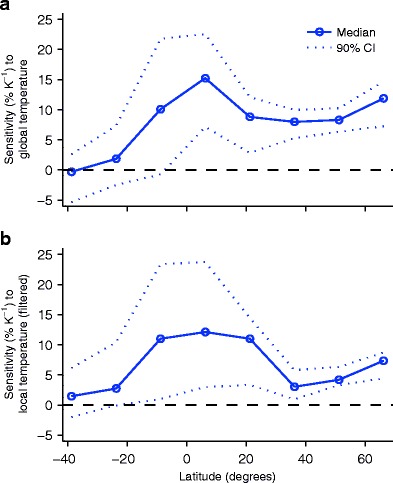
- Historical rain-gauge analyses over land show both increasing and decreasing trends, but grid boxes or stations with significant increases outnumber those with significant decreases; the global sensitivity of annual-maximum daily precipitation is 8 % K−1 with a 90% confidence interval of 5 to 10 % K−1.
- Regressing by latitude band gives higher observed sensitivity in the tropics than the extratropics: 9 % K−1 (90% CI 6–14 % K−1) for 30S to 30N versus 4 % K−1 (90% CI 2–5 % K−1) for the extratropics.
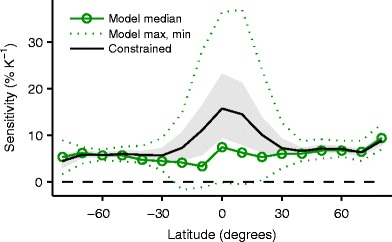
- CMIP5 projections show a general increase in the intensity of precipitation extremes, with the multimodel-median extratropical sensitivity about 6 % K−1 (or 5 % K−1 when normalized by extratropical-mean temperature), while tropical responses span from near 0 to >30 % K−1 across models.
- Observationally constrained estimates suggest tropical extremes are more sensitive than extratropical extremes: 11 % K−1 (90% CI 7–15 % K−1) in the tropics versus 6 % K−1 (90% CI 6–7 % K−1) in the extratropics.
- Snowfall extremes and orographic extremes behave differently from rainfall extremes: snowfall extremes peak near an optimal temperature of roughly −2 °C by liquid-water equivalent (or −4 °C by snow depth), and orographic extremes show larger fractional increases on leeward slopes than windward slopes.
## Methods
- Review article synthesizing results from theory, observations, and modeling, with sections on observed changes, physical theory, climate-model projections, orographic extremes, snowfall extremes, and duration dependence.
- Uses observational datasets and analyses described in the text, including HadEX2, NOAA MLOST, and rain-gauge records, with regressions based on the Theil-Sen estimator and confidence intervals reported for latitude-band sensitivities.
- Summarizes results from multiple modeling frameworks, including CMIP3/CMIP5 global climate models, regional climate models, cloud-system resolving models (CRMs), and idealized simulations such as radiative-convective equilibrium and idealized mountain cases.
## Limitations
- The paper explicitly states that available data have limited geographic coverage, especially for observations, and that there are relatively few observational records of tropical precipitation extremes.
- It states that global climate models with parameterized moist convection are not expected to be reliable for precipitation extremes that are primarily convective in nature, and that models have important limitations in simulating precipitation extremes.
- Evident from the text: some results are hard to compare directly because the observational and modeling analyses use different time periods, geographic coverage, and definitions of extreme precipitation.
Model-written summary. Check it against the paper before relying on it.
Integrity signals
Registry
Cites
Statistics
Figures
Verification
Claims the paper makes
37 Valid · 5 Not valid · 41 Not checked · 53 Own results and interpretations
The sources with a verdict support this claim; the rest weren’t checked yet, have no full text we could read, or their verdicts aren’t rated yet.
In the paper
“If changes in dynamics and precipitation efficiency are negligible, precipitation extremes increase with warming because of increases in the saturation vapor pressure of water [4, 62, 85, 86]; this will be made more precise in the “Theory” section.”
§ Precipitation Extremes Under Climate Change > Introduction
What the sources say
- Not checked — no full text of the sourcecites [4] Allen MR Ingram WJ Constraints on future changes in climate and the hydrologic cycle Nature 2002 419 224 232 10.1038/nature01092 12226677 source
- Supportedcites [62] O’Gorman PA Schneider T Scaling of precipitation extremes over a wide range of climates simulated with an idealized GCM J Clim 2009 22 5676 5685 10.1175/2009JCLI2701.1 source
Section 4a explains that, when changes in vertical velocity are neglected, the scaling of tropical precipitation extremes approximately follows the temperature dependence of saturation specific humidity. The Conclusions report that extremes generally increase with warming in the idealized simulations, while cautioning that their rate of increase need not follow Clausius–Clapeyron scaling. The cited claim asserts an increase, not an exact rate, and is conditional on negligible non-thermodynamic changes. (LLM, conf=0.88)
- Not checked — no full text of the sourcecites [85] Trenberth KE Conceptual framework for changes of extremes of the hydrological cycle with climate change Clim Chang 1999 42 327 339 10.1023/A:1005488920935 source
- Supportedcites [86] Trenberth KE Dai A Rasmussen RM Parsons DB The changing character of precipitation Bull Am Meteorol Soc 2003 84 1205 1217 10.1175/BAMS-84-9-1205 source
In “How Should Precipitation Change as the Climate Changes?”, the paper says atmospheric water-holding capacity rises with warming according to the Clausius–Clapeyron equation and argues that heavy-rainfall intensity should rise at about the same rate as moisture content. Its statement that stronger rainfall rates follow “all things being equal” supports the claim’s condition that other influences are negligible. (LLM, conf=0.92)
plainstates a cause- Asserted: passes — The authors put it forward as true.
- Checkable: passes — It can be checked against evidence.
- Load-bearing: passes — The paper’s conclusions depend on it.
- Based: passes — The paper gives a reason why it holds.
Every source the paper cites for this claim was checked and supports it.
In the paper
“One exception was the Community Climate Model System 3 which underestimated the 30-year return values [17]”
§ Precipitation Extremes Under Climate Change > Climate-Model Projections
What the sources say
- Supportedcites [17] Chen CT Knutson T On the verification and comparison of extreme rainfall indices from climate models J Clim 2008 21 1605 1621 10.1175/2007JCLI1494.1 source
Section 4 states that the NCAR Community Climate System Model version 3 (CCSM3), at T85 resolution, produced a domain-averaged 30-year precipitation return level (P30) much smaller than the observed value. The paper's evaluation concerns the conterminous United States; this finding uses the authors' recommended comparison in which model output is treated as an areal mean. (LLM, conf=0.92)
plainstates a cause- Asserted: passes — The authors put it forward as true.
- Checkable: passes — It can be checked against evidence.
- Load-bearing: unclear — It is unclear whether the paper’s conclusions depend on it.
- Based: passes — The paper gives a reason why it holds.
- Supported
The sources with a verdict support this claim; the rest weren’t checked yet, have no full text we could read, or their verdicts aren’t rated yet.
In the paper
“Over the available record, there are regions with both increasing and decreasing trends in precipitation extremes [1, 28], as might be expected given large internal variability [25]”
§ Precipitation Extremes Under Climate Change > Observed Changes in Precipitation Extremes
What the sources say
- Not checked — no full text of the sourcecites [1] Alexander LV Zhang X Peterson TC Caesar J Gleason B Klein Tank AMG Global observed changes in daily climate extremes of temperature and precipitation J Geophys Res Atmos 2006 111 D05109 10.1029/2005JE002462 source
- Supportedcites [28] Groisman PY Knight RW Easterling DR Karl TR Hegerl GC Razuvaev VN Trends in intense precipitation in the climate record J Clim 2005 18 1326 1350 10.1175/JCLI3339.1 source
The section on southeastern and southwestern Australia reports an increase in very heavy precipitation frequency in the southeast and a decrease in the southwest over their available records. The southwest decrease is significant only at the 0.10 level, a qualification the citing sentence does not rule out. (LLM, conf=0.91)
plain- Asserted: passes — The authors put it forward as true.
- Checkable: passes — It can be checked against evidence.
- Load-bearing: unclear — It is unclear whether the paper’s conclusions depend on it.
- Based: passes — The paper gives a reason why it holds.
Every source the paper cites for this claim was checked and supports it.
In the paper
“For example, in an analysis of 30-year return values of daily precipitation over the conterminous USA, most global climate models were found to overestimate or roughly agree with observations that were conservatively interpolated to the model resolution for comparison [17].”
§ Precipitation Extremes Under Climate Change > Climate-Model Projections
What the sources say
- Supportedcites [17] Chen CT Knutson T On the verification and comparison of extreme rainfall indices from climate models J Clim 2008 21 1605 1621 10.1175/2007JCLI1494.1 source
Split into 2 atoms — 2 confirmed, 0 partially supported, 0 disputed, 0 misattributed, 0 unverifiable. Expand the claim to see per-atom verdicts.
plain- Asserted: passes — The authors put it forward as true.
- Checkable: passes — It can be checked against evidence.
- Load-bearing: unclear — It is unclear whether the paper’s conclusions depend on it.
- Based: passes — The paper gives a reason why it holds.
- Supported
The sources with a verdict support this claim; the rest weren’t checked yet, have no full text we could read, or their verdicts aren’t rated yet.
In the paper
“Important limitations in the ability of current models to simulate precipitation extremes have also been recognized and are related in part to the use of parameterized convection [38, 43, 58, 89, 93].”
§ Precipitation Extremes Under Climate Change > Climate-Model Projections
What the sources say
- Supportedcites [38] Kharin VV Zwiers FW Zhang X Hegerl GC Changes in temperature and precipitation extremes in the IPCC ensemble of global coupled model simulations J Clim 2007 20 1419 1444 10.1175/JCLI4066.1 source
The Precipitation Extremes section reports that models simulate extremes less consistently in the Tropics and subtropics than at higher latitudes, and identifies the details of deep-convection parameterizations as especially important for tropical results. The Summary likewise reports large differences among models in tropical precipitation extremes. The support is strongest for tropical extremes, rather than for all regions equally; page numbers are unavailable in our copy. (LLM, conf=0.85)
- Supportedcites [43] Kooperman GJ Pritchard MS Somerville RC The response of US summer rainfall to quadrupled CO2 climate change in conventional and superparameterized versions of the NCAR community atmosphere model J Adv Model Earth Syst 2014 6 859 882 10.1002/2014MS000306 source
The Introduction states that conventional GCMs underestimate increases in extreme rainfall and identifies their simplified representation of deep convection as one reason. The paper also says conventionally parameterized GCMs simulate extreme precipitation too weakly and too often compared with observations. (LLM, conf=0.93)
- Not checked — no full text of the sourcecites [58] O’Gorman PA Sensitivity of tropical precipitation extremes to climate change Nat Geosci 2012 5 697 700 10.1038/ngeo1568 source
- Supportedcites [89] Wehner MF Very extreme seasonal precipitation in the NARCCAP ensemble: model performance and projections Clim Dyn 2013 40 59 80 10.1007/s00382-012-1393-1 source
The Introduction says current climate models struggle to reproduce observed extreme-precipitation statistics and attributes part of that limitation to inadequacies in their moist-physics formulations. It also explains that moist physics generally includes parameterized treatments of convective cloud processes, supporting the citing sentence’s qualified connection to parameterized convection. (LLM, conf=0.87)
- Supportedcites [93] Wilcox EM Donner LJ The frequency of extreme rain events in satellite rain-rate estimates and an atmospheric general circulation model J Clim 2007 20 53 69 10.1175/JCLI3987.1 source
Section 3 reports that changes to convection parameterizations can substantially alter the simulated frequency of intense rain events and says further refinements are needed before models can reliably simulate rain-rate distributions. The Abstract likewise identifies uncertainty in simulating precipitation intensity distributions and links improvements to convection schemes. (LLM, conf=0.93)
plainstates an association- Asserted: passes — The authors put it forward as true.
- Checkable: passes — It can be checked against evidence.
- Load-bearing: unclear — It is unclear whether the paper’s conclusions depend on it.
- Based: passes — The paper gives a reason why it holds.
- Supported
81 more claims · 19 with their cited sources checked
Create a free account to see all 136 claims and to verify the 2 references still open.
- It may state two separate claims as one. 42
- Probably not a substantial claim. 14
Citations
Cites
Global observed changes in daily climate extremes of temperature and precipitation
Alexander, L. V., Zhang, X., Peterson, T. C., Caesar, J., Gleason, B., Klein Tank, A. M. G., Haylock, M., Collins, D., Trewin, B., Rahimzadeh, F., et al. (2006) · Journal of Geophysical Research: Atmospheres · doi:10.1029/2005jd006290 · Cited by 4,492 · cited 1×
“Over the available record, there are regions with both increasing and decreasing trends in precipitation extremes [28,1], as might be expected given large internal variability [25], but the gridboxes or stations with significant increasing trends outnumber those with significant decreasing trends [23,91].”
BackgroundAn Introduction to Dynamic Meteorology
Holton, J. R., & Staley, D. O. (1973) · American Journal of Physics · doi:10.1119/1.1987371 · Cited by 3,355
The Changing Character of Precipitation
Trenberth, K. E., Dai, A., Rasmussen, R. M., & Parsons, D. B. (2003) · Bulletin of the American Meteorological Society · doi:10.1175/bams-84-9-1205 · Cited by 3,196 · cited 1×
“por pressure of water [85,86,4,62]; this will be made more precise in section 3.”
BackgroundTropical cyclones and climate change
Knutson, T. R., McBride, J. L., Chan, J., Emanuel, K., Holland, G., Landsea, C., Held, I., Kossin, J. P., Srivastava, A. K., & Sugi, M. (2010) · Nature Geoscience · doi:10.1038/ngeo779 · Cited by 3,194
Constraints on future changes in climate and the hydrologic cycle
Allen, M. R., & Ingram, W. J. (2002) · Nature · doi:10.1038/nature01092 · Cited by 3,009 · cited 1×
“por pressure of water [85,86,4,62]; this will be made more precise in section 3.”
BackgroundImprovements to NOAA’s Historical Merged Land–Ocean Surface Temperature Analysis (1880–2006)
Smith, T. M., Reynolds, R. W., Peterson, T. C., & Lawrimore, J. (2008) · Journal of Climate · doi:10.1175/2007jcli2100.1 · Cited by 2,923 · cited 4×
“Differences in convective parameterizations are less important in the extratropics, and the correlation coefficient across models between the sensitivities for climate change and variability becomes smaller for climate change at higher latitudes, reaching a value of 0.5 at 50S and 40N as compared to a maximum of 0.86…”
MethodInfluentialRecent Arctic amplification and extreme mid-latitude weather
Cohen, J., Screen, J. A., Furtado, J. C., Barlow, M., Whittleston, D., Coumou, D., Francis, J., Dethloff, K., Entekhabi, D., Overland, J., et al. (2014) · Nature Geoscience · doi:10.1038/ngeo2234 · Cited by 2,492
Human contribution to more-intense precipitation extremes
Min, S.-K., Zhang, X., Zwiers, F. W., & Hegerl, G. C. (2011) · Nature · doi:10.1038/nature09763 · Cited by 2,083
Atmospheric Warming and the Amplification of Precipitation Extremes
Allan, R. P., & Soden, B. J. (2008) · Science · doi:10.1126/science.1160787 · Cited by 1,562 · cited 1×
“ulate the interannual variability in tropical precipitation extremes when compared to observations [2,3], and the disproportionate increases in precipitation extremes compared to other parts of the precipitation distribution that is found in some models – an “extreme mode” in the tropical response to climate change th…”
Background
Cited by
Items 601–700 of 809
Guilloteau, C., Chen, X., Leung, L.-Y. R., & Foufoula‐Georgiou, E. (2025) · Journal of Climate · doi:10.1175/jcli-d-24-0343.1 · Cited by 6
Posa, P. C. L., & Bhowmik, R. D. (2025) · Journal of Hydrology Regional Studies · doi:10.1016/j.ejrh.2025.102442 · Cited by 6
Xu, C. B., Bian, C., Yu, T.-T., et al. (2025) · Landslides · doi:10.1007/s10346-025-02532-9 · Cited by 2
“Furthermore, climate change in the past several decades (IPCC, 2013) leads to an increasing numbers of extreme weather event (O’Gorman 2015; Qiu et al. 2022), which also increased the occurrence frequency of landslide events (Kirschbaum and Adler 2013).”
Shahgholian, K., Bazrafshan, J., Irannejad, P., Ranazadeh, D., & Singh, V. P. (2025) · Earth Systems and Environment · doi:10.1007/s41748-025-00672-5 · Cited by 3
Zhu, L., Liang, Z., Yan, Z., Ming, X., Duan, H., Su, B., & Wang, S. (2025) · PNAS Nexus · doi:10.1093/pnasnexus/pgaf230 · Cited by 2
The Role of Tectonic Luck in Long-term Habitability of Abiotic Earth-like Planets
Coy, B. P., Kite, E. S., & Graham, R. J. (2025) · The Planetary Science Journal · doi:10.3847/psj/adf643 · Cited by 4
Toride, K., Ishida, K., Kavvas, L. M., et al. (2017) · World Environmental and Water Resources Congress (EWRI) · doi:10.1061/9780784480618.033 · Cited by 2
Catastrophic Insurance in South Asia: Scope in India
Sen, S. (2017) · Disaster risk reduction · doi:10.1007/978-981-10-3310-0_17 · Cited by 6
The African Sahel Region: An Introduction
Kardjadj, M. (2019) · Springer eBooks · doi:10.1007/978-3-030-25385-1_1 · Cited by 5
Piol, M. S., dos Reis, J. A. T., Rodrigues, M. B., et al. (2023) · Revista Brasileira de Ciências Ambientais · doi:10.5327/z2176-94781598 · Cited by 2
“2 | Jun 2023 | 171-181 - ISSN 2176-9478 Introduction The availability of water, which exhibits significant temporal and spatial variability (Lira and Cardoso, 2018), is a permanent social concern, particularly when considering the world’s population growth in a context of uncertainties associated with variations in pr…”
BackgroundZheleznova, I. V., & Gushchina, D. Y. (2023) · Известия Российской академии наук Физика атмосферы и океана · doi:10.31857/s0002351523050139 · Cited by 2
Uribe, A., Mauritsen, T., & Vial, J. (2021) · Geophysical Research Letters · doi:10.1029/2020gl091371 · Cited by 3
Subrahmanyam, K. V., & Kumar, K. K. (2020) · doi:10.5194/nhess-2020-2 · Cited by 1
Drivers of Past and Predicted Changes of Rainfall in and Around Mainland Southeast AsiaPreprint
Skliris, N., Marsh, R., Haigh, I. D., et al. (2021) · Research Square · doi:10.21203/rs.3.rs-194416/v2 · Cited by 2
Swenson, L. M., & Grotjahn, R. (2023) · Journal of Climate · doi:10.1175/jcli-d-22-0673.1 · Cited by 3
Chan, S. S., Li, J., & Lee, T.-C. (2024) · Urban Climate · doi:10.1016/j.uclim.2024.101988 · Cited by 2
Annual precipitation trends and flood estimation: a case of Shanghai City in China
Khan, M. A. (2024) · Urban Water Journal · doi:10.1080/1573062x.2024.2423295 · Cited by 1
“…it has been noted in earlier research that the regional distribution of precipitation is expected to undergo changes and experience an overall rise as a consequence of the influence exerted by world-wide changes in climate (O’Gorman 2015; Shongwe et al. 2011; Sohoulande Djebou and Singh 2016).”
Compound Precipitation and Wind Extremes in the Eastern Part of the Baltic Sea Region
Klimavičius, L., Rimkus, E., & Stankūnavičius, G. (2025) · Atmosphere · doi:10.3390/atmos16030276 · Cited by 2
Ren, M., Wang, S., Liang, B., & Wei, C. X. (2025) · IEEE Access · doi:10.1109/access.2025.3549101 · Cited by 1
“In recent years, the frequent occurrence of extreme weather events, exacerbated by factors such as global warming, has profoundly impacted the economy, society, life safety, and environmental protection [1], [2], [3].”
Qin, H., Alvee, F. M., Leung, L.-Y. R., Sun, X., & Wang, G. (2025) · Journal of Climate · doi:10.1175/jcli-d-24-0589.1 · Cited by 5
A Generalized Lagrangian Attribution Tool for Hydrometeorological Extremes
Zhang, S., Wright, J. S., & Lu, M. (2025) · Journal of Geophysical Research Atmospheres · doi:10.1029/2025jd043314 · Cited by 1
“…significant threats to public safety and result in substantial economic losses, are projected to become even more frequent and severe as the full effects of global warming unfold (Han et al., 2022; O’Gorman, 2015; Perkins‐Kirkpatrick & Lewis, 2020; Robinson et al., 2021; Thackeray et al., 2022).”
Sun, N., Huang, T., Wang, J., et al. (2025) · Geophysical Research Letters · doi:10.1029/2025gl116841 · Cited by 1
“Additionally, models predicted an increase in and intensification of extreme precipitation and severe storms under a global warming scenario, implying significant risks for human health and economic development (Bao et al., 2017; O’Gorman, 2015).”
Guilloteau, C., Chen, X., Leung, L.-Y. R., & Foufoula‐Georgiou, E. (2025) · Geophysical Research Letters · doi:10.1029/2025gl117588 · Cited by 5
“…whose frequency and magnitude appear to increase consistently with temperature in both observations and models, across different regions of the globe, different observational data sets, and different climate models (e.g., O’Gorman, 2015; Papalexiou & Mon-tanari, 2019; Thackeray et al., 2022).”
Trends and causal drivers of extreme snowfall intensification in China under climate warming
Wang, W., Qin, Y., Zhao, Q., Liu, Y., Liu, Y., Li, H., Li, Y., Liu, J., & Enwer, R. (2025) · Environmental Research · doi:10.1016/j.envres.2025.123525 · Cited by 1
Huang, H., Feng, A., Chao, Q., et al. (2025) · Journal of Hydrology Regional Studies · doi:10.1016/j.ejrh.2025.102615 · Cited by 1
More intermittent mid-latitude precipitation accompanied extreme early Palaeogene warmth
Slawson, J. S., Plink‐Björklund, P., Reichler, T. J., & Baldassare, D. (2025) · Nature Geoscience · doi:10.1038/s41561-025-01870-6 · Cited by 4
“We address global trends and focus on precipitation intermittency (wet-season length and interannual recurrence interval) to help address the large uncertainties in future precipitation trends 3,27 .”
Trends in Surface Water Quality and Trophic State in the Yucatán Peninsula over the Last Decade
Hernández-Hernández, P., Macario-González, L., Cohuo-Zaragoza, N. O., et al. (2025) · Hydrology · doi:10.3390/hydrology13010006 · Cited by 1
A bibliometric analysis of extreme weather events and nutritional outcomes
Yadav, A., Rana, M. J., Rahaman, M., & Mishra, A. (2025) · Discover Sustainability · doi:10.1007/s43621-025-02249-8 · Cited by 1
“Extreme weather events are dispropor-tionally distributed across the globe [8], like tropical regions are facing increased severity and alteration in precipitation pattern [9] while extra-tropical regions are suffering due to record-breaking rise in temperature, heatwave, and drought incidence [10].”
Fazel‐Rastgar, F., Rostami, M., Sivakumar, V., & Fallah, B. (2025) · Journal of Atmospheric and Solar-Terrestrial Physics · doi:10.1016/j.jastp.2025.106712 · Cited by 1
Unravelling the drivers of the April–May 2024 extreme precipitation event in Rio Grande do Sul
Pérez‐Alarcón, A., Sorí, R., Stojanovic, M., Libonati, R., Trigo, R. M., Nieto, R., & Gimeno, L. (2026) · Atmospheric Research · doi:10.1016/j.atmosres.2026.108773 · Cited by 3
Satyanarayana, G. C., Sahukar, H., Biswasharma, R., Umakanth, N., Velivelli, S., & Srinivas, D. (2026) · Atmospheric Research · doi:10.1016/j.atmosres.2026.108821 · Cited by 2
Jong, B., Labe, Z. M., Delworth, T. L., & Cooke, W. F. (2026) · Environmental Research Letters · doi:10.1088/1748-9326/ae51a6 · Cited by 2
“…forcing (Min et al 2011, Zhang et al 2013, Fischer and Knutti 2015, 2016, Seneviratne et al 2021), and extreme precipitation is projected to continue increasing with greater global warming (Fowler and Hennessy 1995, O’Gorman 2015, Donat et al 2016, Seneviratne et al 2021, Kotz et al 2024).”
Galatoulas, N.-F., Tsesmelis, D. E., Kavga, A., Kalogeropoulos, K., & BAROUCHAS, P. E. (2026) · Earth · doi:10.3390/earth7020061 · Cited by 3
Zhang, Y., & Liang, K. (2026) · Advances in Climate Change Research · doi:10.1016/j.accre.2026.05.016 · Cited by 4
Koovekallu, P., Kottayil, A., Xavier, P., & Podglajen, A. (2026) · Scientific Reports · doi:10.1038/s41598-026-52143-0 · Cited by 2
Ramadhan, R., Hanif, M., Marzuki, M., et al. (2026) · International Journal of Disaster Risk Reduction · doi:10.1016/j.ijdrr.2026.106256 · Cited by 1
Reji, M. J. K., Varikoden, H., & Vellore, R. K. (2026) · Climate Dynamics · doi:10.1007/s00382-026-08261-6 · Cited by 2
“Under a warming scenario, the intensifying hydrological cycle is expected to increase precipitation extremes over Kerala, in agreement with global assessments (Allan et al. 2020; O’Gorman 2015).”
Benetó, P., Valiente, J. A., & Khodayar, S. (2026) · Weather and Climate Extremes · doi:10.1016/j.wace.2026.100929 · Cited by 1
Jin, X., Yang, Z., Shu, S., Dong, M., Xu, H., ZHANG, C., Lang, X., Yuan, H., & Shen, H. (2026) · Remote Sensing · doi:10.3390/rs18142397 · Cited by 2
“Extreme precipitation has increased in terms of frequency and severity due to global climate change over the last couple of decades [1].”
Zhang, T., Zhang, Y., Pang, H., et al. (2026) · Frontiers in Earth Science · doi:10.3389/feart.2026.1908253 · Cited by 1
Historical trend of probable maximum precipitation in Utah and associated weather types
Gu, H., Wang, S., Lin, Y., Meyer, J. D. D., Gillies, R. R., Taylor, E. G. R., & Pokharel, B. (2022) · International Journal of Climatology · doi:10.1002/joc.7503 · Cited by 2
“A significant increase in the intensity and frequency of extreme precipitation due to global warming at global and local scale has been documented in many studies (Allan and Soden, 2008; Utsumi et al., 2011; O'Gorman, 2015; Madakumbura et al., 2019).”
BackgroundOn the Responses of Mangrove Trophic Interactions to Climate Change
Sousa, W. P., & Dangremond, E. M. (2023) · Elsevier eBooks · doi:10.1016/b978-0-323-90798-9.00002-0 · Cited by 1
Luiz‐Silva, W., da Silva, F. P., Dereczynski, C. P., et al. (2023) · Journal of Geoscience and Environment Protection · doi:10.4236/gep.2023.118008 · Cited by 1
Meng, F., Sun, Z., Dong, F., et al. (2023) · Agronomy · doi:10.3390/agronomy13123057 · Cited by 1
“Consequently, the uneven distribution of precipitation has garnered widespread attention from scholars [7–11].”
Mizuta, R. (2023) · JAPANESE JOURNAL OF MULTIPHASE FLOW · doi:10.3811/jjmf.2023.t012 · Cited by 1
Nonequilibrium Fluctuations of Global Warming
Yin, J., Porporato, A. M., & Rondoni, L. (2024) · Journal of Climate · doi:10.1175/jcli-d-23-0273.1 · Cited by 15
Majhi, A., Dhanya, C. T., Pattanayak, S., & Chakma, S. (2024) · International Journal of Climatology · doi:10.1002/joc.8665 · Cited by 1
Wang, L., Bao, X., Chen, G., & Zhang, S. (2025) · Geophysical Research Letters · doi:10.1029/2024gl112680 · Cited by 4
“…short‐term precipitation due to global warming, such as the increase in atmospheric water vapor content and changes in the degree of convective organization (Fowler et al., 2021; Min et al., 2011; O’Gorman, 2015; Pendergrass, 2020; Pirone et al., 2023; Rossow et al., 2013; Westra et al., 2014).”
On the Extreme Precipitation Events With and Without Lightning Over Eastern and Southern China
Ren, Y., Xu, W., Fu, J., & Wei, H. (2025) · Journal of Geophysical Research Atmospheres · doi:10.1029/2025jd043509 · Cited by 2
“Despite understanding of the large‐scale dynamical contribution in extreme precipitation, knowledge of the convective‐scale dynamics and precipitation microphysics is limited (Muller, 2013; O’Gorman, 2015; Singh & O’Gorman, 2014).”
Liu, Y., Kjellsson, J., Savita, A., & Park, W. (2025) · Geoscientific model development · doi:10.5194/gmd-18-5435-2025 · Cited by 2
Anthropogenic Climate Change in Deserts
Whitford, W. G., & Duval, B. D. (2019) · Elsevier eBooks · doi:10.1016/b978-0-12-815055-9.00011-4 · Cited by 1
Sarvestan, R., Karami, M., & Sabbaghian, R. J. (2023) · Theoretical and Applied Climatology · doi:10.1007/s00704-023-04476-3 · Cited by 1
“1 Introduction Extreme rainfall events cause casualties, infrastructure damages, and economic and social damages around the world every year (Handmer et al. 2012; O’Gorman 2015; Hu et al. 2020; de Bodas Terassi et al. 2020).”
BackgroundPotential Impacts of Accelerated Climate Change
Pacific Northwest National Lab. (PNNL), R., Leung, L., USDOE, Nuclear Regulatory Commission, W., & Vail, L. W. (2016) · OSTI OAI (U.S. Department of Energy Office of Scientific and Technical Information) · doi:10.2172/1259942 · Cited by 1
Molina, J.-L., & García-Aróstegui, J. L. (2022) · Research Square · doi:10.21203/rs.3.rs-1408117/v1 · Cited by 1
Chen, J. (2023) · doi:10.31223/x5sq15 · Cited by 1
Extreme precipitation in urban Jakarta: historical and future trends
Siswanto, S. (2023) · doi:10.5463/thesis.112 · Cited by 2
Sharma, K., Singh, V., Bisht, D. S., et al. (2026) · Research Square · doi:10.21203/rs.3.rs-9650448/v1 · Cited by 1
Drivers of past and predicted changes of rainfall in and around Mainland Southeast AsiaPreprint
Skliris, N., Marsh, R., Haigh, I. D., Wood, M., Hirschi, J., Darby, S. E., Quynh, N. P., & Hung, N. N. (2021) · Research Square · doi:10.21203/rs.3.rs-194416/v1 · Cited by 1
The Anomalous Weather Parameters that Lead to the Extreme Rainfall of Kerala in August 2018Preprint
Suneela, S. S., Mathew, B., & Sureshkumar, S. (2021) · Research Square · doi:10.21203/rs.3.rs-735159/v1
Ovallos, B., & de Andrés, C. G. (2020)
Variability and trends of precipitation on lowand high-altitude stations in Serbia
Leščešen, I., Milošević, D. D., & Stojsavljević, R. (2021) · Zbornik radova Departmana za geografiju turizam i hotelijerstvo · doi:10.5937/zbdght2101014l
“…2013;Hynčica et al., 2019), precipitation extremes (Frich et al., 2002; Allan, Soden, 2008; van den Besselaar et al., 2013; Villarini et al., 2013; O’Gorman, 2015) and precipitation intensity (e.g., Brunetti et al., 2000; Maraun et al., 2008; Berg et al., 2013; Cioffi et al., 2015; Ye et al.,…”
BackgroundShelton, S. (2021) · Research Square · doi:10.21203/rs.3.rs-894605/v1
Kühl, S. J., & Kuhl, M. E. (2022) · Ärztliche Psychotherapie · doi:10.21706/aep-17-1-5
State of the Science in Meteorological/Hydrological Extremes
Tye, M. R., & Giovannettone, J. (2021) · American Society of Civil Engineers eBooks · doi:10.1061/9780784415863.ch2
Projected Changes in Future Extreme Precipitation over the Northeast US in the NA-CORDEX EnsemblePreprint
Nazarian, R. H., Vizzard, J. V., Agostino, C. P., & Lutsko, N. J. (2022) · doi:10.1002/essoar.10510293.1
“…over the past century (Groisman et al. 2005;46 Alexander et al. 2006) and numerous modeling studies suggest extreme precipitation will47 continue to change as the climate warms (Kao and Ganguly 2011; Fischer et al. 2013;48 Kharin et al. 2013; Fischer et al. 2014; O’Gorman 2015; Bao et al. 2017).”
BackgroundResultInfluentialWei, Z., Li, X., & Ma, L. (2022) · Theoretical and Applied Climatology · doi:10.1007/s00704-022-03995-9
Sustainable Water Management under Future Uncertainty
Tang, Q., & Leng, G. (2022) · Cambridge University Press eBooks · doi:10.1017/9781108787291.018
Meyer, S. E. (2022) · Elsevier eBooks · doi:10.1016/b978-0-12-823731-1.00004-4
Mathbout, S., Bustins, J. A. L., Royé, D., Vide, J. M., Bech, J., & Rodrigo, F. S. (2019) · Pageoph topical volumes · doi:10.1007/978-3-030-11958-4_10
(2016) · COSMOS · doi:10.1142/s0219607716710014
Forecasting Precipitation by Machine Learning Algorithms to Adapt Climate Change
Ülker, E. (2022) · JENAS Journal of Environmental and Natural Studies · doi:10.53472/jenas.1150975 · Cited by 3
Jones, W. K. (2022) · Atmospheric measurement techniques · doi:10.5194/amt-2022-31-ac2
Jones, W. K. (2022) · Atmospheric measurement techniques · doi:10.5194/amt-2022-31-ac1
Towards the intensification of convective rain events with rising temperatures in Germany
Purr, C. (2022) · Publication Server of Goethe University Frankfurt am Main (Goethe University Frankfurt) · doi:10.21248/gups.68987
Drivers influencing climate of growing cities
Mujumdar, S. S., Pandit, C., & Patel, A. (2022) · Computational Urban Science · doi:10.1007/s43762-022-00055-w
“Studies (Allan & Soden, 2008; O’Gorman, 2015) show global warming is a primary indicator of climate change with rising temperatures and precipitation intensification on regional and global scales.”
BackgroundParamasivam, R., Alias, N. E., Hassan, S. A., & Sanin, F. A. M. (2022) · Lecture notes in civil engineering · doi:10.1007/978-981-19-5947-9_4
Ludwig, P., Ehmele, F., Franca, M. J., et al. (2022) · Natural hazards and earth system sciences · doi:10.5194/nhess-2022-225-rc2
The trend of rainfall, discharge, and land cover of Kaligarang Watershed, Central Java, Indonesia
Basuki, T. M., Pramono, I. B., Yulianto, F., Priyanto, E., Fakhrudin, M., Imaduddin, F., Ramelan, A., & Ibrahim, M. H. (2022) · IOP Conference Series Earth and Environmental Science · doi:10.1088/1755-1315/1109/1/012016 · Cited by 1
Climate Change Exacerbates the Impacts of Small Hydropower Projects
Riggins, B. A. (2022) · doi:10.46569/20.500.12680/2r36v4677 · Cited by 1
Yoshikawa, S., Watanabe, M., & Kanae, S. (2022) · Journal of Japan Society of Civil Engineers Ser B1 (Hydraulic Engineering) · doi:10.2208/jscejhe.78.2_i_103
(2023) · Elsevier eBooks · doi:10.1016/b978-0-323-95490-7.16001-1
Causal reasoning modeling (CRM) for rivers’ runoff behavior analysis and prediction
Molina, J.-L., Zazo, S., Patino-Alonso, M. C., et al. (2023) · Elsevier eBooks · doi:10.1016/b978-0-12-821962-1.00005-2
Floodplain Mapping of Ungauged Watershed Using HEC Models and PERSIANN Precipitation
Kalra, A., Aryal, A., Bhusal, A., & Gupta, R. (2023) · World Environmental and Water Resources Congress (EWRI) · doi:10.1061/9780784484852.022
Danbauchi, E. S. (2023) · IIARD INTERNATIONAL JOURNAL OF GEOGRAPHY AND ENVIRONMENTAL MANAGEMENT · doi:10.56201/ijgem.v9.no2.2023.pg10.24
“Furthermore, changes to the dynamics of the atmosphere amplify or weaken future rainfall extremes at the regional scale (O’Gorman 2015; Pfahl et al. 2017).”
Dennis, E. J., Goldenson, N., Krantz, W., Rahimi, S., Hall, A. D., & Nasseri, I. (2023) · doi:10.22541/essoar.169603590.00455865/v1
Dong, W., & Lin, Y. (2023) · Geophysical monograph · doi:10.1002/9781119700357.ch14
Szymczak, S., Bott, F., Fabella, V. M., et al. (2024) · doi:10.5194/nhess-2023-196-rc1
Szymczak, S., Bott, F., Fabella, V. M., et al. (2024) · doi:10.5194/nhess-2023-196-cc2
Szymczak, S., Bott, F., Fabella, V. M., et al. (2024) · doi:10.5194/nhess-2023-196-cc1
Szymczak, S., Bott, F., Fabella, V. M., et al. (2024) · doi:10.5194/nhess-2023-196-rc2
Szymczak, S., Bott, F., Fabella, V. M., et al. (2024) · doi:10.5194/nhess-2023-196-rc3
Ravi, S., & Sreekala, P. P. (2024) · Research Square · doi:10.21203/rs.3.rs-4097582/v1
Szymczak, S. (2024) · doi:10.5194/nhess-2023-196-ac5
Szymczak, S. (2024) · Natural hazards and earth system sciences · doi:10.5194/nhess-2023-196-ac1
Szymczak, S. (2024) · doi:10.5194/nhess-2023-196-ac2
Szymczak, S. (2024) · doi:10.5194/nhess-2023-196-ac3
Szymczak, S. (2024) · doi:10.5194/nhess-2023-196-ac4
Annual Runoff Forecasting through Bayesian Causality
Zazo, S., Molina, J.-L., Patino-Alonso, M. C., et al. (2024) · doi:10.3390/engproc2024068007
Metadata
- Authors
- O’Gorman, P. A.
- Affiliations
- Massachusetts Institute of Technology (US)
- Corresponding author
- O’Gorman, Paul A.
- ORCID
- O’Gorman, Paul A.
- Venue
- Current Climate Change Reports
- Published
- 2015-04-22
- Volume
- 1
- Issue
- 2
- Pages
- 49-59
- ISSN
- 2198-6061 (ISSN-L)
- PMC
- PMC4542457
- OpenAlex
- W2951418525
- Cited by
- 881
- References
- 104
- Citations by year
- 2026: 124 · 2025: 130 · 2024: 103 · 2023: 107 · 2022: 90 · 2021: 73 · 2020: 70 · 2019: 59 · 2018: 54 · 2017: 42 · 2016: 26 · 2015: 3
- FWCI
- 2.81
- Type
- journal article
- Language
- en
- Open access
- hybrid
- doi.org
- Locations
- Current Climate Change Reports (publishedVersion, cc-by)
- Europe PMC (PubMed Central) (publishedVersion, cc-by)
- PubMed Central (publishedVersion, cc-by)
- PubMed (publishedVersion)
- arXiv (Cornell University) (submittedVersion)
- DSpace@MIT (Massachusetts Institute of Technology) (submittedVersion, cc-by-nc)
- arXiv (Cornell University)
- Cambridge International Law Journal
- Funders
- National Science Foundation (1148594)
- U.S. Department of Energy
- National Aeronautics and Space Administration (NNX11AO92G)
- University of New South Wales
- National Oceanic and Atmospheric Administration
- Topics
- Physical Sciences › Environmental Science › Global and Planetary Change › Climate variability and models
- Physical Sciences › Earth and Planetary Sciences › Atmospheric Science › Meteorological Phenomena and Simulations
- Physical Sciences › Environmental Science › Global and Planetary Change › Climate Change and Environmental Impact
- Keywords
- heavy rainfall, climate change, precipitation intensification, thermodynamic response, microphysical processes, convective processes, tropical precipitation, orographic precipitation, duration dependence, climate model simulation
About these checks
Registry, retraction, Cites and statistics results are computed, not judged, with one exception: a printed reference that no index lists is read once by a model before it counts as a citation error. Claims are extracted by a model and kept only when their quote appears verbatim in the text; each cited source is then checked, with a model’s help, for whether it says what the claim relies on. Those verdicts can be wrong — read the claim’s quote and the cited source before relying on one.
The claim verdicts this report counts are experimental: their accuracy is not yet measured.
A language model drew the claims from the paper on 2026-10-11, under version 3 of the claim definition (model deepseek-v4.1-flash, prompt extract-v3).
A second model labelled each claim on 2026-10-11 (model jev-1.13-20260917, definition revision gold-guideline-v0.2).
Cited sources are checked with a language model’s help (gpt-6-sol).
Statistics and arithmetic are recomputed, not judged.
Confidence bands are shown only for fields calibrated on our annotated test set. None is calibrated yet, so no band is shown.
What counts as a claim ›How we measure confidence ›How we check this ›
Are you an author, or do you see a problem with this page? Request a review
Data sources
Bibliographic data: Semantic Scholar, OpenAlex, Crossref.
Contains information from the Semantic Scholar Academic Graph Datasets, made available under the ODC Attribution License (ODC-BY 1.0).
Semantic Scholar’s data is described in: Kinney, R., et al. (2023). The Semantic Scholar Open Data Platform. arXiv:2301.10140.
