

Organizational resilience: a capability-based conceptualization
Open accessThe DOI matches its Crossref record; 206 of the 209 references it cites were found in a registry or an index, and 2 are not checked yet; none of the 106 sources its claims cite is checked for support yet.
Abstract
In highly volatile and uncertain times, organizations need to develop a resilience capacity which enables them to cope effectively with unexpected events, bounce back from crises, and even foster future success. Although academic interest in organizational resilience has steadily grown in recent years, there is little consensus about what resilience actually means and how it is composed. More knowledge is particularly needed about organizational capabilities that constitute resilience, as well as conditions for their development. This paper aims to make a contribution to this heterogeneous research field by deepening the understanding of the complex and embedded construct of organizational resilience. We conceptualize resilience as a meta-capability and decompose the construct into its individual parts. Inspired by process-based studies, we suggest three successive resilience stages (anticipation, coping, and adaptation) and give an overview of underlying capabilities that together form organizational resilience. Based on this outline, we discuss relationships and interactions of the different resilience stages as well as main antecedents and drivers. We formulate propositions that can act as a foundation for future empirical work.
Checked 2026-11-22 · 2 references not checked yet
Overview
CoChat Summary
## TL;DR
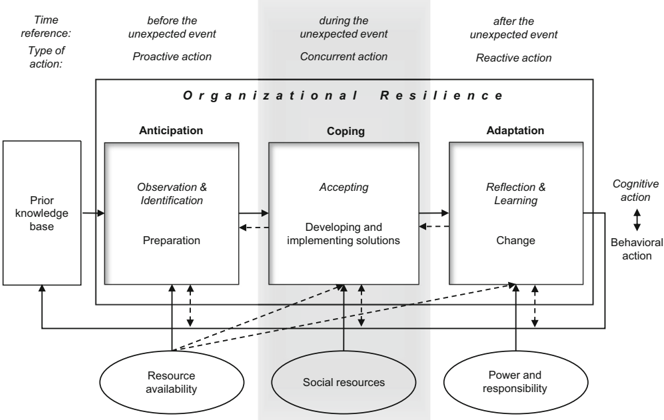
This is a conceptual paper that reframes organizational resilience as a meta-capability made up of three stages: anticipation, coping, and adaptation. It argues that resilience depends on specific underlying capabilities plus antecedents such as knowledge base, resources, social resources, and power/responsibility, and it ends by proposing propositions for future empirical work.
## Key findings
- The paper defines organizational resilience as an organization’s ability to anticipate potential threats, cope effectively with adverse events, and adapt to changing conditions.
- It decomposes resilience into three successive stages: anticipation, coping, and adaptation, and argues these stages overlap and build on each other; for example, anticipation influences coping and coping influences adaptation.
- The paper identifies capability clusters for each stage:
- anticipation: observation and identification, preparation
- coping: accepting, developing and implementing solutions
- adaptation: reflection and learning, organizational change
- It argues that resilience is a meta-capability requiring a combination of capabilities across all three stages; anticipation creates “resilience potential,” but coping and adaptation are needed to realize and improve it.
## Methods
- Conceptual/theoretical review paper, not an empirical study.
- Synthesizes literature from organizational resilience and related areas such as business continuity management, crisis management, innovation management, public administration, and organizational learning.
- Builds a conceptual framework and formulates propositions about antecedents and drivers, including:
- Proposition 1: knowledge base as an antecedent
- Proposition 2: resource availability
- Proposition 3: social resources
- Proposition 4: power based on expertise and shared responsibilities
## Limitations
- The paper explicitly notes that future research is needed to test the framework empirically and develop questionnaires; it says the framework is a first step toward a resilience theory rather than a final one.
- It states that much of the prior literature is fragmented, prescriptive/normative, and often retrospective, and that there is little knowledge about how resilience works in practice; this is the gap the paper tries to address.
- Evident from the text: the paper is entirely conceptual and does not present new data, sample, or statistical tests.
Model-written summary. Check it against the paper before relying on it.
Integrity signals
Registry
Cites
Statistics
Figures
Verification
Claims the paper makes
0 Valid · 4 Not valid · 58 Not checked · 67 Own results and interpretations
A conclusion the paper draws from its own results — it cites no other source for it, so there is none to check. The quote shows it is in the paper.
In the paper
“we suggest three successive stages of the resilience process (see Fig. 1) and argue that resilient organizations respond not only to the past (reactive action) or to current issues (concurrent action), but also to the future (anticipatory action).”
§ Organizational resilience: a capability-based conceptualization > 3.1 Fundamentals of the framework
hedgedstates a cause- Asserted: passes — The authors put it forward as true.
- Checkable: passes — It can be checked against evidence.
- Load-bearing: passes — The paper’s conclusions depend on it.
- Based: passes — The paper gives a reason why it holds.
None of the sources cited for this claim have been checked yet.
In the paper
“Most studies just point to organizational characteristics, resources, or processes that seem to be significant for resilience (e.g., Weick 1993;Kendra and Wachtendorf 2003;Gittell et al. 2006).This means that resilience is simply treated as an outcome-when organizations perform well during crisis or bounce back from interruptions (e.g., Horne and Orr 1998).”
- Also stated in: § 2.2 Previous conceptualizations of organizational resilience · plain
“Most studies treat resilience as an outcome-when organizations perform well during crisis or bounce back from interruptions (e.g., Horne and Orr 1998).”
§ Organizational resilience: a capability-based conceptualization > 1 Introduction
What the sources say
- Not matchedcites Horne and Orr 1998
An author–year citation the paper’s reference list doesn’t settle. We don’t search these by name.
- Not checked — no full text of the sourcecites Boin and van Eeten 2013 matched to “The Resilient Organization” (2013) source
- Not checked — no full text of the sourcecites Duit 2016 matched to “RESILIENCE THINKING: LESSONS FOR PUBLIC ADMINISTRATION” (2016) source
plain- Asserted: passes — The authors put it forward as true.
- Checkable: passes — It can be checked against evidence.
- Load-bearing: passes — The paper’s conclusions depend on it.
- Based: passes — The paper gives a reason why it holds.
- Also stated in: § 2.2 Previous conceptualizations of organizational resilience · plain
None of the sources cited for this claim could be matched to a paper, so there is nothing to check it against.
In the paper
“Depending on its specific configuration, resilience can be a source of sustainable competitive advantage (Hamel and Vaelikangas 2003;Sheffi 2007) and, thus, explain why some firms are more successful than others.”
§ Organizational resilience: a capability-based conceptualization > 2.1 Definitions of organizational resilience
What the sources say
- Not matchedcites Hamel and Vaelikangas 2003
An author–year citation the paper’s reference list doesn’t settle. We don’t search these by name.
- Not matchedcites Sheffi 2007
An author–year citation the paper’s reference list doesn’t settle. We don’t search these by name.
plainstates a possible cause- Asserted: passes — The authors put it forward as true.
- Checkable: passes — It can be checked against evidence.
- Load-bearing: passes — The paper’s conclusions depend on it.
- Based: passes — The paper gives a reason why it holds.
- Not matched
In the paper
“Organizational resilience capabilities develop over time and emerge from the process of coping with threatening situations and unexpected events (Linnenluecke et al. 2012).”
§ Organizational resilience: a capability-based conceptualization > 3.1 Fundamentals of the framework
What the sources say
- Not checked — no full text of the sourcecites Linnenluecke et al. 2012 matched to “Extreme Weather Events and the Critical Importance of Anticipatory Adaptation and Organizational Resilience in Responding to Impacts” (2012) source
plainstates a cause- Asserted: passes — The authors put it forward as true.
- Checkable: passes — It can be checked against evidence.
- Load-bearing: passes — The paper’s conclusions depend on it.
- Based: passes — The paper gives a reason why it holds.
A claim is checked only against the cited paper’s full text, never its abstract, and none is available for its sources.
In the paper
“research shows that newly developed solutions-regardless of how carefully they are designed-do not automatically lead to changes in the organizational patterns of action (Feldman 2003;Howard-Grenville 2005;Pentland and Feldman 2008).”
§ Organizational resilience: a capability-based conceptualization > 3.2.2 Coping capabilities
What the sources say
- Not checked — no full text of the sourcecites Feldman 2003 matched to “A performative perspective on stability and change in organizational routines” (2003) source
- Not checked — no full text of the sourcecites Howard-Grenville 2005 matched to “The Persistence of Flexible Organizational Routines: The Role of Agency and Organizational Context” (2005) source
- Not checked — no full text of the sourcecites Pentland and Feldman 2008 matched to “Designing routines: On the folly of designing artifacts, while hoping for patterns of action” (2008) source
plain- Asserted: passes — The authors put it forward as true.
- Checkable: passes — It can be checked against evidence.
- Load-bearing: passes — The paper’s conclusions depend on it.
- Based: passes — The paper gives a reason why it holds.
54 more claims
Create a free account to see all 129 claims and to verify the 7 references still open.
- Probably not a substantial claim. 48
- It may state two separate claims as one. 35
- The quote only partly states this claim. 2
Claims other papers make about this one
Each is checked against this paper’s own text: does it say what the citing paper says it does?
The cited source doesn’t support the claim as written.
In the citing paper
“The capacity conception, increasingly dominant in organizational and strategic management scholarship”
From Organizational Resilience and Crisis Management in Public Administration: Building Adaptive Governance Capacity in an Age of Compounding Disruptions (2026) · cites this paper as Duchek, 2020
Checked by a reasoning model — may be wrong.
Experimental — accuracy not yet measuredThe cited source says what the claim attributes to it.
In the citing paper
“The capacity conception, increasingly dominant in organizational and strategic management scholarship, treats resilience as a developable, manageable organizational asset the conceptualization adopted in this article (Duchek, 2020).”
From Organizational Resilience and Crisis Management in Public Administration: Building Adaptive Governance Capacity in an Age of Compounding Disruptions (2026) · cites this paper as Duchek, 2020
The cited source says what the claim attributes to it.
In the citing paper
“More recently, Duchek (2020) proposed a process model of organizational resilience comprising three sequential phases - anticipation, coping, and adaptation - each requiring distinct organizational capabilities. The AGRF builds on this process model while extending it to incorporate the distinctive institutional and governance features of public organizations.”
From Organizational Resilience and Crisis Management in Public Administration: Building Adaptive Governance Capacity in an Age of Compounding Disruptions (2026) · cites this paper as Duchek (2020)
Self-check
Percentages, sums and reported differences re-computed from the paper’s own numbers.
Each contradiction between two passages listed here was confirmed by an independent check.
Rated minor: it would not touch a result — a value no result rests on, a p-value that stays on the same side of the significance level, or a conflict that is clerical, resolved elsewhere in the paper, or outside its own findings.
In the paper
§ Organizational resilience: a capability-based conceptualization > 3.4.2 Resource availability
“Analyzing airline industry responses to September 2011, Gittell et al. (2006) found that airlines with greater financial resources”
§ Organizational resilience: a capability-based conceptualization > References
“Gittell, Jody H., Kim Cameron, Sandy Lim, and Victor Rivas. 2006. Relationships, layoffs, and organizational resilience airline industry responses to September 11.”
Citations
Cites
Absorptive Capacity: A New Perspective on Learning and Innovation
Cohen, W. M., & Levinthal, D. A. (1990) · Administrative Science Quarterly · doi:10.2307/2393553 · Cited by 35,728
An Evolutionary Theory of Economic Change.
Loasby, B. J., Nelson, R. R., & Winter, S. G. (1983) · The Economic Journal · doi:10.2307/2232409 · Cited by 21,366
Psychological Safety and Learning Behavior in Work Teams
Edmondson, A. (1999) · Administrative Science Quarterly · doi:10.2307/2666999 · Cited by 12,026 · cited 1×
“Learning can be described as ‘‘ongoing process of reflection and action characterized by asking questions, seeking feedback, experimenting, reflecting on results, and discussing errors or unexpected outcomes of actions’’ (Edmondson 1999, p. 353).”
Background(1993) · Journal of the American Dietetic Association · doi:10.1016/0002-8223(93)92196-5 · Cited by 11,976
Research in Organizational Behavior
Hammer, E. R., Cummings, L. L., & Staw, B. M. (1984) · The Academy of Management Review · doi:10.2307/258300 · Cited by 11,175
Hutchins, E. (1995) · doi:10.7551/mitpress/1881.001.0001 · Cited by 10,801 · cited 1×
“Social resources may be achieved through supportive mental processes that have been discussed as situated cognition (Suchman 1987), distributed cognition (Hutchins 1995), or joint cognitive systems (Hollnagel and Woods 2005).”
Background(1969) · Virtual Defense Library (Ministerio de Defensa) · Cited by 10,735
An Evolutionary Theory of Economic Change
Berkowitz, M. K., Nelson, R. R., & Winter, S. G. (1983) · Southern Economic Journal · doi:10.2307/1058233 · Cited by 10,549
Academy of Management Executive
(2010) · The Academy of Management executive/Academy of Management executive · doi:10.5465/ame · Cited by 8,844
A Behavioral Theory of the Firm
Day, R. H., Cyert, R. M., March, J. G., Clarkson, Cohen, Feigenbaum, D., Greenberg, Moore, Soelberg, Starbuck, et al. (1964) · Econometrica · doi:10.2307/1913056 · Cited by 7,791
Research works printed but not linked: 12
- 39. John W. Reich, Alex J. Zautra, and John Stuart Hall, 333-349. New York: The Guilford Press.
- 71. Hiltunen, Elina. 2008. Good Sources of Weak Signals: A Global Study of Where Futurists Look For Weak Signals. Journal of Futures Studies 12: 21-44.
- 74. Horne, John F. 1997. The coming of age of organizational resilience. Business Forum 22: 24-28.
- 116. March, James G., and Herbert A. Simon. 1958. Organizations. New York: Wiley.
- 135. Rerup, Claus. 2001. Houston, we have a problem: Anticipation and improvisation as sources of organizational resilience. Comportamento Organizacional E Gestao 7: 27-44.
- 138. Robert, Benoı ˆt. 2010. Organizational Resilience-Concepts and evaluation Method. Montre ´al: Presse de l'E ´cole Polytechnique de Montre ´al.
- 140. Roberts, Karlene H., Peter M. Madsen, and Vinit M. Desait. 2005. The space between in space transportation: A relational analysis of the failure of STS-107. In Organization at the limit-NASA and the Columbia Disaster, ed.
- 141. William H. Starbuck and Moshe Farjoun, 81-98. Oxford: Blackwell.
- 146. Ryle, Gilbert. 1979. On thinking. Oxford: Blackwell.
- 176. Vaughan, Diane. 2005. System effects: On slippery slopes, repeating negative patterns, and learning from mistake? In Organization at the limit-NASA and the Columbia Disaster, ed.
- 177. William H. Starbuck and Moshe Farjoun, 41-59. Oxford: Blackwell.
- 189. Westrum, Ron. 1988. Organizational and inter-organizational thought. Paper presented at the World Bank Conference on Safety Control and Risk Management.
Cited by
Items 401–500 of 1,969
Hazudin, S. F., Sabri, M. F., Kader, M. A. R. A., Saripin, M. S., & Ridzuan, M. R. (2022) · Knowledge and Performance Management · doi:10.21511/kpm.06(1).2022.07 · Cited by 12
Ding, J., Lee, E.-S., & Lee, T. (2025) · Asia Pacific Business Review · doi:10.1080/13602381.2025.2452865 · Cited by 13
Leading in times of disruption – preparedness, problems, and possibilities (Part 1)
Campbell, P., Klein, E. D., & Sawalhi, R. (2023) · School Leadership and Management · doi:10.1080/13632434.2023.2217499 · Cited by 11
Pierre, O. K., Descotes, R. M., & Barber, J. P. (2025) · Global Strategy Journal · doi:10.1002/gsj.1523 · Cited by 30
Critical Entities Resilience Assessment (CERA) to small-scale disasters
Řehák, D., Šplíchalová, A., Janeckova, H., Oulehlová, A., Hromada, M., Kontogeorgos, M., & Ristvej, J. (2024) · International Journal of Disaster Risk Reduction · doi:10.1016/j.ijdrr.2024.104748 · Cited by 20
Leaders’ Resilience: What Leaders Can Learn from the COVID-19 Crisis
Förster, C., & Duchek, S. (2022) · Future of business and finance · doi:10.1007/978-3-030-84867-5_2 · Cited by 12
Self-citationEnhancing organisational resilience through systems thinking
Manzini, D., Oosthuizen, R., & Chikwanda, H. K. (2025) · Social Sciences & Humanities Open · doi:10.1016/j.ssaho.2025.101783 · Cited by 23
Yao, C., & Wang, L.-Y. (2024) · Heliyon · doi:10.1016/j.heliyon.2024.e24674 · Cited by 22
The role of Project managers in navigating digitalization in a supply chain for resilience
Jerome, J. J. J., Sonwaney, V. P., & Arunkumar, O. N. (2023) · Production & Manufacturing Research · doi:10.1080/21693277.2023.2291649 · Cited by 13
Hajipour, V., Aminian, M., Gharaei, A., & Jalali, S. (2021) · Healthcare Analytics · doi:10.1016/j.health.2021.100004 · Cited by 13
Tran, M., & Thai, H. V. (2025) · Business Ethics the Environment & Responsibility · doi:10.1111/beer.70007 · Cited by 20
Kaczmarski, K., Pasha, A., Inusah, A. S., Li, X., & Qiao, S. (2024) · medRxiv · doi:10.1101/2024.10.10.24315244 · Cited by 17
“…colleagues and leadership (Juvet et al., 2021; Shanafelt et al., 2020; Sull et al., 2015), effective leadership, confidence and trust in public health authorities (Akgün et al., 2023; Balay-Odao et al., 2021), and organizational agility and crisis management (Duchek, 2020; Yağmur & Myrvang, 2023).”
BackgroundAsamoah, M. K., & Ansong, J. D. (2025) · SN Social Sciences · doi:10.1007/s43545-025-01110-z · Cited by 23
“Duchek ( 2020 ) outlines a useful model of resilience relevant to organizations, which is divided into three stages: anticipation, coping, and adaptation.”
Is it just me? The organizational implications of individual and collective burnout in schools
Kruse, S. D., & Edge, K. (2023) · Journal of Educational Administration · doi:10.1108/jea-10-2022-0187 · Cited by 20
Hamzah, M. I. (2025) · SAGE Open · doi:10.1177/21582440251390323 · Cited by 17
“Organizational resilience typically focuses on a firm’s capacity to absorb shocks and return to a stable state (Duchek, 2020), while agility centers on rapid decision-making and reconfiguration of resources in dynamic environments (D. Teece et al., 2016).”
From latest buzzword to conceptual framework: Unraveling the complexities of democratic resilience
Walz, K., Merten, L., Rosenthal, M., Niedringhaus, J., & Helgest, J. (2025) · Zeitschrift für Vergleichende Politikwissenschaft · doi:10.1007/s12286-024-00618-7 · Cited by 23
“Reviewing existing understandings reveals (3) three possible readings of resilience (Southwick et al. 2014, p. 2): First, resilience is thought of as a dispo-sitional feature or capacity that enables or helps a system to deal with upcoming stress (Duchek 2020; Pan and Chan 2007, p. 164f.).”
A conceptual framework for measuring and improving the resilience of biosecurity systems
Arndt, E., Schneider, K. G., Bland, L. M., Robinson, A. P., Gibert, A., Camac, J., & Kompas, T. (2024) · Journal of Applied Ecology · doi:10.1111/1365-2664.14707 · Cited by 14
Organizational Resilience: 30 years of intellectual structure and future perspectives
López-López, Y. Y. G., Martínez, N. G. P., García, V. H. B., & Martínez, F. D. M. G. (2022) · Iberoamerican Journal of Science Measurement and Communication · doi:10.47909/ijsmc.37 · Cited by 13
Neacșu, M., & Georgescu, I. (2024) · Journal of risk and financial management · doi:10.3390/jrfm17020080 · Cited by 24
Dayagbil, F. T. (2023) · International Journal of Education and Practice · doi:10.18488/61.v11i1.3267 · Cited by 20
Transformational Leadership and Dynamic Capabilities in Businesses: A Review
Sezer, A. Y. A. Z. (2022) · Uluslararası Yönetim Akademisi Dergisi · doi:10.33712/mana.1171297 · Cited by 12
Factors influencing enterprise organizational resilience: Evidence based on machine learning
Meng, T., Zhang, T., Chen, M., & Cao, J. (2023) · Managerial and Decision Economics · doi:10.1002/mde.4020 · Cited by 13
Ahmed, E., Kilika, J. M., & Gakenia, C. (2021) · International Journal of Research in Business and Social Science (2147-4478) · doi:10.20525/ijrbs.v10i7.1419 · Cited by 23
Gillberg, N., Åhlström, L., Andersson, A. E., Fällman, S. L., Degl’Innocenti, A., Jónsdóttir, I. H., Wijk, H., & Wikström, E. (2023) · Journal of Nursing Management · doi:10.1155/2023/6418267 · Cited by 10
Aroca, P. A., Kourtit, K., Nijkamp, P. J., & Stough, R. R. (2021) · Eastern Journal of European Studies · doi:10.47743/ejes-2021-si04 · Cited by 17
Strengthening U.S. Politicians’ Reputation
Antoniades, N., & Mohr, I. (2020) · Society · doi:10.1007/s12115-019-00439-5 · Cited by 10
Public service resilience post-Covid: Introduction to the special issue
Dudau, A. I., Masou, R., Murdock, A., & Hunter, P. R. (2023) · Public Management Review · doi:10.1080/14719037.2023.2219690 · Cited by 21
Lundin, K., Engström, M., Skytt, B., Strömberg, A., & Silén, M. (2024) · BMC Health Services Research · doi:10.1186/s12913-024-11945-6 · Cited by 18
Carbonara, N., Pellegrino, R., & Luca, C. D. (2024) · Health Systems · doi:10.1080/20476965.2024.2365144 · Cited by 30
“…disruptive events, to adapt and withstanding disruptions, to respond quickly to disruptions, to recover from disruptions, returning to steady-state conditions, and to learn from what has been done and anticipate future failures (A. Ali et al., 2017; Duchek, 2020; Lundberg & Johansson, 2015).”
Rickli, J.-M., & Vllasi, G. (2025) · Connections The Quarterly Journal · doi:10.11610/connections.24.1.07 · Cited by 18
Conceptual Considerations for Understanding Resilience in Healthcare Students
Donnellan, C., Chakkittakandy, D., & Lydon, C. A. (2024) · Nursing Open · doi:10.1002/nop2.70061 · Cited by 11
“Understanding resilience at the organisational compared to the individual level is deemed a more complex and broader construct with various interpretations that include anticipation, adjustment, resistance and recovery (Duchek 2020).”
BackgroundSaezow, K., & Sukhabot, S. (2025) · Cogent Business & Management · doi:10.1080/23311975.2025.2512823 · Cited by 20
“…such as experiential learning (lang et al., 2022), strategic capabilities (Gianiodis et al., 2022), and adaptive structures (Zhou et al., 2023; duchek, 2020), embedding Eo as both a strategy and a mindset. leadership is also central: visionary leaders who align actions with organizational…”
Nonprofit organisational resilience: Proposing a conceptual adaptive capacity framework
Singh, S., Martins, A., & Tefera, O. (2022) · Acta Commercii · doi:10.4102/ac.v22i1.1077 · Cited by 23
Mitigating the “Cobra Effect” when pursuing organizational resilience
Zighan, S. M. (2023) · Journal of Contingencies and Crisis Management · doi:10.1111/1468-5973.12467 · Cited by 21
Hald, E. J., Gillespie, A., & Reader, T. W. (2024) · British Journal of Management · doi:10.1111/1467-8551.12828 · Cited by 18
Laguir, I., Jabbour, A. B. L. D. S., Stekelorum, R., & Seles, B. M. R. P. (2023) · IEEE Transactions on Engineering Management · doi:10.1109/tem.2022.3171348 · Cited by 11
YahiaMarzouk, Y., & Jin, J. (2022) · Frontiers in Psychology · doi:10.3389/fpsyg.2022.1033837 · Cited by 25
Nurturing Positive Organizational Climates to Enhance Work Success
Singha, S. (2024) · Advances in human resources management and organizational development book series · doi:10.4018/979-8-3693-1524-8.ch004 · Cited by 10
Strategic Management of Organizational Resilience (SMOR): a Framework Proposition
de Moura, D., & Tomei, P. A. (2021) · Review of Business Management · doi:10.7819/rbgn.v.23i3.4118 · Cited by 50
Improving Organizational Resilience in Businesses: A Qualitative Study on the Effect of COVID-19
Aksay, K., & ŞENDOĞDU, A. A. (2022) · Journal of Economy Culture and Society · doi:10.26650/jecs2021-1040786 · Cited by 17
Hussain, T., Edgeman, R. L., & Alnajem, M. (2023) · Sustainability · doi:10.3390/su151712980 · Cited by 13
Yordudom, T., Boonkaew, S., Imjai, N., Moghadas, S., Khuadthong, B., & Aujirapongpan, S. (2025) · Journal of Hospitality Leisure Sport & Tourism Education · doi:10.1016/j.jhlste.2025.100560 · Cited by 18
Salwan, P., Ajgaonkar, S., Neelam, N. G., & Venkatachalam, R. (2025) · Cogent Social Sciences · doi:10.1080/23311886.2025.2493777 · Cited by 19
“…seek to gain resilience and business sustainability. organizational resilience is an impetus to sustainable competitive advantage for organizations (Duchek, 2020) because it offers the ability to sense and rectify maladjustments and help organizations show positivity in unexpected outcomes…”
Qualitative assessment of resilience in construction projects
Hilu, K. A., & Hiyassat, M. (2023) · Construction Innovation · doi:10.1108/ci-10-2022-0265 · Cited by 13
Chai, M., Jin, C., Liu, P., & Foster, W. (2025) · Sustainability · doi:10.3390/su17083325 · Cited by 16
Visualization Analysis of Organizational Resilience Research Based on CiteSpace From 1990–2022
Ma, T., Liu, Y., & Han, M. H. (2022) · IEEE Access · doi:10.1109/access.2022.3184686 · Cited by 14
SMEs Facing Crisis: Ideal Response or Equifinal Reactions?
Campagnolo, D., Gianecchini, M., Gubitta, P., Leonelli, S., & Tognazzo, A. (2022) · Palgrave studies in cross-disciplinary business research, in association with EuroMed Academy of Business · doi:10.1007/978-3-030-76567-5_4 · Cited by 13
Advice in Crisis: Principles of Organizational and Entrepreneurial Resilience
Levine, S. S., Prietula, M. J., & Majchrzak, A. (2023) · Journal of Organization Design · doi:10.1007/s41469-022-00128-4 · Cited by 12
Abdullahi, U., Mohamed, A. M., & Senasi, V. (2023) · Journal International Studies · doi:10.32890/jis2023.19.2.2 · Cited by 17
Zhao, N., Li, X., & Sun, N. (2024) · Annals of Operations Research · doi:10.1007/s10479-024-06027-z · Cited by 11
Yesuf, Y. M., Fields, Z., & Belay, W. C. (2025) · Journal of the International Council for Small Business · doi:10.1080/26437015.2025.2457155 · Cited by 11
“It describes how employees can recover and succeed despite difficulties, with individual actions and interactions contributing to organizational resilience (Duchek, 2020; Korber & McNaughton, 2018; Santoro et al., 2021).”
Digital orientation and organizational resilience: the contingent effect of dynamic capabilities
Abdullahi, U., Mohamed, A. M., & Senasi, V. (2024) · Sustainable and Resilient Infrastructure · doi:10.1080/23789689.2024.2403897 · Cited by 15
“Based on existing works (Duchek, 2020; Kahn et al., 2018; Ortiz de Mandojana & Bansal, 2016), we describe ORES as an organization’s ability to perceive, mitigate, and absorb jolts while maintaining, adapting, and enhancing its operations in the face of adversity.”
Response of travel agencies in China to COVID-19: disaster sensemaking, adaptation, and resilience
Chen, S. X., Feng, Y., Li, X., & Liu, J. (2022) · Current Issues in Tourism · doi:10.1080/13683500.2022.2126748 · Cited by 10
Digitalization as a resilience strategy for women owned SMEs during crises
Gergely, O., Oborni, K., & Popović-Pantić, S. (2024) · Society and Economy · doi:10.1556/204.2024.00013 · Cited by 17
“In other conceptualizations, resilience is viewed as an outcome of a developmental process, implying that fi rms must undergo different phases of recovery (Duchek 2020; Fares et al. 2022).”
Akmal, N. H., & Arifa, C. (2023) · ABIS Accounting and Business Information Systems Journal · doi:10.22146/abis.v11i1.82078 · Cited by 28
Kassar, G. (2023) · ARPHA Conference Abstracts · doi:10.3897/aca.6.e107358 · Cited by 13
Overcoming social and ethical challenges of AI through organizational resilience. A PLS-SEM approach
Sienkiewicz-Małyjurek, K., & Zyzak, B. (2024) · Telematics and Informatics · doi:10.1016/j.tele.2024.102210 · Cited by 17
Zhang, J., Shen, L., Liu, L., Qi, X., & Liang, C. (2022) · Land · doi:10.3390/land11101652 · Cited by 15
Ragmoun, W. (2024) · Journal of Information & Knowledge Management · doi:10.1142/s0219649224500011 · Cited by 19
Innovation Network Reconfiguration Makes Infrastructure Megaprojects More Resilient
Sun, R., Liu, Y., & Zhao, J. (2022) · Computational Intelligence and Neuroscience · doi:10.1155/2022/1727030 · Cited by 14
Liu, X., & Zhang, D. (2024) · Sustainability · doi:10.3390/su16166954 · Cited by 19
Modeling Stakeholder Resilience in Relationship Management in a Changing Environment of Megaprojects
Xue, J., Ekanayake, E. M. A. C., & Wang, Q.-C. (2025) · IEEE Transactions on Engineering Management · doi:10.1109/tem.2025.3538073 · Cited by 11
Entrapment Between Narratives: The Millennial Voice and Degendering Organizational Resilience
Witmer, H. (2021) · Frontiers in Sustainability · doi:10.3389/frsus.2020.620903 · Cited by 12
Taylor, J., Brewer, G. A., & Ripoll, G. (2022) · Asia Pacific Journal of Public Administration · doi:10.1080/23276665.2022.2085125 · Cited by 14
Srivastava, S., & Rao, M. K. (2025) · Discover Psychology · doi:10.1007/s44202-025-00496-4 · Cited by 33
Is Organizational Resilience a Competitive Advantage?
Mondragón, I. J. G., Trejo, A. R., & Alquicira, A. M. (2022) · Mercados y Negocios · doi:10.32870/myn.vi46.7670.g6738 · Cited by 8
Resilience Reimagined: Advancing a Gender-Sensitive Framework in Entrepreneurship Studies
Shamieh, S., & Bastian, B. L. (2025) · Journal of Small Business Strategy · doi:10.53703/001c.142292 · Cited by 18
Tucker, B. P., & Alewine, H. C. (2024) · Abacus · doi:10.1111/abac.12325 · Cited by 14
Bhat, Z. H., & Saba, N. (2025) · International journal of organizational analysis · doi:10.1108/ijoa-02-2024-4254 · Cited by 15
Resiliency-based adaptations used by primary care physicians during the COVID-19 pandemic
Hoff, T. J., & Neff, L. (2023) · Health Care Management Review · doi:10.1097/hmr.0000000000000357 · Cited by 8
Wei, W., He, Z., & Xiang, G. (2024) · Journal of Innovation & Knowledge · doi:10.1016/j.jik.2024.100508 · Cited by 10
Emrizal, E., & Primadona, P. (2023) · International Journal Of Science Technology & Management · doi:10.46729/ijstm.v4i1.752 · Cited by 8
Zeid, M. B., & Abouchedid, K. (2025) · International Journal of Educational Research · doi:10.1016/j.ijer.2025.102751 · Cited by 13
Business resilience in the Sustainable Development Goals (SDGs) era: A conceptual review
Ford, S., ElAlfy, A., Wilson, J., & Weber, O. (2021) · Corporate Governance and Sustainability Review · doi:10.22495/cgsrv5i4p1 · Cited by 12
Universitas Sebelas Maret, I., & Rahmanto, A. N. (2021) · Jurnal Komunikasi Malaysian Journal of Communication · doi:10.17576/jkmjc-2021-3703-14 · Cited by 8
Organizational Resilience: A Paradox-Based Conceptualization
Karunaratne, D. (2022) · Vidyodaya Journal of Management · doi:10.31357/vjm.v8ii.5606 · Cited by 9
Navigating team resilience: A video observation of an elite yacht racing crew
King, E., Branicki, L. J., Norbury, K., & Badham, R. J. (2023) · Applied Psychology · doi:10.1111/apps.12474 · Cited by 9
The discourse of organizational resilience before and after the global pandemic
Harsanto, B., & Firmansyah, E. A. (2023) · F1000Research · doi:10.12688/f1000research.133601.1 · Cited by 9
Business Analytics Capabilities for Organisational Resilience
Al-Ghattas, H. F., & Marjanovic, O. (2021) · Hawaii International Conference on System Sciences (HICSS) · doi:10.24251/hicss.2021.026 · Cited by 9
Behind the scenes of COVID-19 response: a social network analysis of policy actors in Bandung City
Miftah, A. Z., Widianingsih, I., Muhtar, E. A., & Sutriadi, R. (2024) · Cogent Social Sciences · doi:10.1080/23311886.2024.2356351 · Cited by 11
“…programs for families during the coViD-19 pandemic (harini et al., 2022). local governments are tasked not only with adapting and fulfilling their duties but also with cultivating organizational resilience characterized by ‘immune’ or ‘strong’ characters in crisis management (Duchek, 2020).”
Sadia, U. H., Liu, D., & Irfan, M. F. (2024) · Business Strategy & Development · doi:10.1002/bsd2.70019 · Cited by 12
Ahmed, E., Kilika, J. M., & Gakenia, C. (2021) · International Journal of Organizational Leadership · doi:10.33844/ijol.2021.60599 · Cited by 16
Sedky, A. (2023) · Advances in logistics, operations, and management science book series · doi:10.4018/978-1-6684-7298-9.ch009 · Cited by 11
Huang, X., Yang, H., & Yang, P. (2024) · Sustainability · doi:10.3390/su16062242 · Cited by 14
Startup growth in pandemic: organizational resilience in an extreme crisis situation
Álvarez-Salazar, J., & Bazán, M. M. M. (2024) · Management Research The Journal of the Iberoamerican Academy of Management · doi:10.1108/mrjiam-05-2023-1422 · Cited by 12
Prayag, G., & MANCI, A. R. (2024) · International Journal of Disaster Risk Reduction · doi:10.1016/j.ijdrr.2024.105132 · Cited by 11
Jabeen, F., Santoro, G., Ključnikov, A., & Jose, S. (2025) · Review of Managerial Science · doi:10.1007/s11846-025-00957-z · Cited by 14
“Despite the growing attention on the organizational dimension of resilience (Duchek 2020; Linnenluecke 2017), few studies have connected these capabilities with the experimental, iterative, and data-centric processes typical of digital ventures.”
InfluentialResilience and Sustainability of the Water Sector during the COVID-19 Pandemic
Goldin, J. A., Nhamo, L., Ncube, B., Zvimba, J. N., Petja, B. M., Mpandeli, S., Nomquphu, W., Hlophe-Ginindza, S. N., Greeff-Laubscher, M. R., Molose, V., et al. (2022) · Sustainability · doi:10.3390/su14031482 · Cited by 7
Khan, T., & Emon, M. M. H. (2025) · IGI Global eBooks · doi:10.4018/979-8-3373-2175-2.ch011 · Cited by 10
How does the COVID-19 economic crisis impact resilience? A configurational analysis of the spinoffs
Sirvent, F. C., Peris‐Ortiz, M., Amorós, M. P. L., & Pinazo-Dallenbach, P. (2023) · International Entrepreneurship and Management Journal · doi:10.1007/s11365-023-00935-5 · Cited by 7
Kyambade, M., & Namatovu, A. (2025) · Leadership in health services · doi:10.1108/lhs-02-2025-0021 · Cited by 15
León-González, J. E., Martínez, E. E. V., & Cruz, A. D. (2023) · Estudios Sociales Revista de Alimentación Contemporánea y Desarrollo Regional · doi:10.24836/es.v33i61.1296 · Cited by 19
Jiang, L., Sun, Y., & Zhao, H. (2023) · Kybernetes · doi:10.1108/k-03-2023-0386 · Cited by 15
Fernández, S. F. (2021) · Journal of Management History · doi:10.1108/jmh-01-2021-0010 · Cited by 9
Bucovețchi, Ö., Voipan, A. E., Voipan, D., & Stanciu, R. D. (2025) · Systems · doi:10.3390/systems13110999 · Cited by 16
“Integrating these views allows for a more comprehensive understanding of how resilience contributes to sustainable organizational performance in a volatile environment [10].”
Convergence of safety and security within process plants
Řehák, D., Šplíchalová, A., Loveček, T., et al. (2025) · Journal of Loss Prevention in the Process Industries · doi:10.1016/j.jlp.2025.105579 · Cited by 7
The impact of digital-real integration on corporate default risk: Evidence from China
Qian, Y. (2025) · Environment Development and Sustainability · doi:10.1007/s10668-025-06384-0 · Cited by 10
Hotel Employee Engagement During the Pandemic: A Mixed-Method Approach
Xu, S. T., Ashton, M., Li, Y., Staunton, G., & Li, Y. (. (2024) · Cornell Hospitality Quarterly · doi:10.1177/19389655241276511 · Cited by 18
“…which are adapted from existing literature on employee engagement (e.g., Kaushik & Guleria, 2019; Marchington & Kynighou, 2012; Teague & Roche, 2014; Van Rooy et al., 2011; Yang et al., 2010), crisis management and resilience (e.g., Cartier & Taylor, 2020; Duchek, 2020; Williams et al., 2017).”
Zhu, Y., & Li, C. (2023) · Language Culture and Curriculum · doi:10.1080/07908318.2023.2240348 · Cited by 9
Karlina, N., Miftah, A. Z., Widianingsih, I., & Gill, S. S. (2025) · Cogent Social Sciences · doi:10.1080/23311886.2025.2563038 · Cited by 11
“…and completing their tasks but also with fostering organizational resilience, typified by ‘immune’ or ‘strong’ qualities in crisis management (duchek, 2020). therefore, the covid-19 task force issued 3 M Behavior change Guidelines (Wearing Masks, Maintaining distance, Washing hands), which…”
Metadata
- Authors
- Duchek, S.
- Affiliations
- Technische Universität Dresden (DE)
- Corresponding author
- Duchek, Stephanie
- ORCID
- Duchek, Stephanie
- Venue
- Business Research
- Published
- 2019-01-14
- Volume
- 13
- Issue
- 1
- Pages
- 215-246
- ISSN
- 1866-8658 (ISSN-L)
- 2198-3402
- 2198-2627
- OpenAlex
- W2910462204
- Cited by
- 2,027
- References
- 209
- Citations by year
- 2026: 640 · 2025: 398 · 2024: 311 · 2023: 280 · 2022: 213 · 2021: 131 · 2020: 50 · 2019: 3
- FWCI
- 152.43
- Type
- journal article
- Language
- en
- Open access
- gold
- doi.org
- Licence
- cc-by
- creativecommons.org/licenses/by/4.0 (tdm)
- creativecommons.org/licenses/by/4.0 (vor)
- Locations
- BuR - Business Research (publishedVersion, cc-by)
- RePEc: Research Papers in Economics (submittedVersion)
- Econstor (Econstor) (submittedVersion, cc-by)
- Topics
- Social Sciences › Business, Management and Accounting › Strategy and Management › Supply Chain Resilience and Risk Management
- Social Sciences › Business, Management and Accounting › Strategy and Management › Innovation and Knowledge Management
- Social Sciences › Sociology and Political Science › Disaster Management and Resilience
- Keywords
- organizational resilience, organizational capabilities, meta-capability, anticipation, coping, adaptation, crisis management, uncertainty, antecedents of resilience
About these checks
Registry, retraction, Cites and statistics results are computed, not judged, with one exception: a printed reference that no index lists is read once by a model before it counts as a citation error. Claims are extracted by a model and kept only when their quote appears verbatim in the text; each cited source is then checked, with a model’s help, for whether it says what the claim relies on. Those verdicts can be wrong — read the claim’s quote and the cited source before relying on one.
A language model drew the claims from the paper on 2026-10-10, under version 3 of the claim definition (model deepseek-v4.1-flash, prompt extract-v3).
A second model labelled each claim on 2026-10-10 (model jev-1.13-20260917, definition revision gold-guideline-v0.2).
Statistics and arithmetic are recomputed, not judged.
Confidence bands are shown only for fields calibrated on our annotated test set. None is calibrated yet, so no band is shown.
What counts as a claim ›How we measure confidence ›How we check this ›
Are you an author, or do you see a problem with this page? Request a review
Data sources
Bibliographic data: Semantic Scholar, OpenAlex, Crossref.
Contains information from the Semantic Scholar Academic Graph Datasets, made available under the ODC Attribution License (ODC-BY 1.0).
Semantic Scholar’s data is described in: Kinney, R., et al. (2023). The Semantic Scholar Open Data Platform. arXiv:2301.10140.
