

Organizational resilience: a capability-based conceptualization
Open accessThe DOI matches its Crossref record; 206 of the 209 references it cites were found in a registry or an index, and 2 are not checked yet; none of the 106 sources its claims cite is checked for support yet.
Abstract
In highly volatile and uncertain times, organizations need to develop a resilience capacity which enables them to cope effectively with unexpected events, bounce back from crises, and even foster future success. Although academic interest in organizational resilience has steadily grown in recent years, there is little consensus about what resilience actually means and how it is composed. More knowledge is particularly needed about organizational capabilities that constitute resilience, as well as conditions for their development. This paper aims to make a contribution to this heterogeneous research field by deepening the understanding of the complex and embedded construct of organizational resilience. We conceptualize resilience as a meta-capability and decompose the construct into its individual parts. Inspired by process-based studies, we suggest three successive resilience stages (anticipation, coping, and adaptation) and give an overview of underlying capabilities that together form organizational resilience. Based on this outline, we discuss relationships and interactions of the different resilience stages as well as main antecedents and drivers. We formulate propositions that can act as a foundation for future empirical work.
Checked 2026-11-22 · 2 references not checked yet
Overview
CoChat Summary
## TL;DR
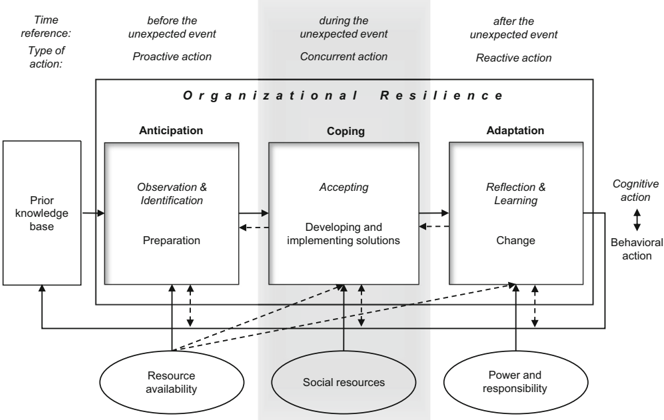
This is a conceptual paper that reframes organizational resilience as a meta-capability made up of three stages: anticipation, coping, and adaptation. It argues that resilience depends on specific underlying capabilities plus antecedents such as knowledge base, resources, social resources, and power/responsibility, and it ends by proposing propositions for future empirical work.
## Key findings
- The paper defines organizational resilience as an organization’s ability to anticipate potential threats, cope effectively with adverse events, and adapt to changing conditions.
- It decomposes resilience into three successive stages: anticipation, coping, and adaptation, and argues these stages overlap and build on each other; for example, anticipation influences coping and coping influences adaptation.
- The paper identifies capability clusters for each stage:
- anticipation: observation and identification, preparation
- coping: accepting, developing and implementing solutions
- adaptation: reflection and learning, organizational change
- It argues that resilience is a meta-capability requiring a combination of capabilities across all three stages; anticipation creates “resilience potential,” but coping and adaptation are needed to realize and improve it.
## Methods
- Conceptual/theoretical review paper, not an empirical study.
- Synthesizes literature from organizational resilience and related areas such as business continuity management, crisis management, innovation management, public administration, and organizational learning.
- Builds a conceptual framework and formulates propositions about antecedents and drivers, including:
- Proposition 1: knowledge base as an antecedent
- Proposition 2: resource availability
- Proposition 3: social resources
- Proposition 4: power based on expertise and shared responsibilities
## Limitations
- The paper explicitly notes that future research is needed to test the framework empirically and develop questionnaires; it says the framework is a first step toward a resilience theory rather than a final one.
- It states that much of the prior literature is fragmented, prescriptive/normative, and often retrospective, and that there is little knowledge about how resilience works in practice; this is the gap the paper tries to address.
- Evident from the text: the paper is entirely conceptual and does not present new data, sample, or statistical tests.
Model-written summary. Check it against the paper before relying on it.
Integrity signals
Registry
Cites
Statistics
Figures
Verification
Claims the paper makes
0 Valid · 4 Not valid · 58 Not checked · 67 Own results and interpretations
A conclusion the paper draws from its own results — it cites no other source for it, so there is none to check. The quote shows it is in the paper.
In the paper
“we suggest three successive stages of the resilience process (see Fig. 1) and argue that resilient organizations respond not only to the past (reactive action) or to current issues (concurrent action), but also to the future (anticipatory action).”
§ Organizational resilience: a capability-based conceptualization > 3.1 Fundamentals of the framework
hedgedstates a cause- Asserted: passes — The authors put it forward as true.
- Checkable: passes — It can be checked against evidence.
- Load-bearing: passes — The paper’s conclusions depend on it.
- Based: passes — The paper gives a reason why it holds.
None of the sources cited for this claim have been checked yet.
In the paper
“Most studies just point to organizational characteristics, resources, or processes that seem to be significant for resilience (e.g., Weick 1993;Kendra and Wachtendorf 2003;Gittell et al. 2006).This means that resilience is simply treated as an outcome-when organizations perform well during crisis or bounce back from interruptions (e.g., Horne and Orr 1998).”
- Also stated in: § 2.2 Previous conceptualizations of organizational resilience · plain
“Most studies treat resilience as an outcome-when organizations perform well during crisis or bounce back from interruptions (e.g., Horne and Orr 1998).”
§ Organizational resilience: a capability-based conceptualization > 1 Introduction
What the sources say
- Not matchedcites Horne and Orr 1998
An author–year citation the paper’s reference list doesn’t settle. We don’t search these by name.
- Not checked — no full text of the sourcecites Boin and van Eeten 2013 matched to “The Resilient Organization” (2013) source
- Not checked — no full text of the sourcecites Duit 2016 matched to “RESILIENCE THINKING: LESSONS FOR PUBLIC ADMINISTRATION” (2016) source
plain- Asserted: passes — The authors put it forward as true.
- Checkable: passes — It can be checked against evidence.
- Load-bearing: passes — The paper’s conclusions depend on it.
- Based: passes — The paper gives a reason why it holds.
- Also stated in: § 2.2 Previous conceptualizations of organizational resilience · plain
None of the sources cited for this claim could be matched to a paper, so there is nothing to check it against.
In the paper
“Depending on its specific configuration, resilience can be a source of sustainable competitive advantage (Hamel and Vaelikangas 2003;Sheffi 2007) and, thus, explain why some firms are more successful than others.”
§ Organizational resilience: a capability-based conceptualization > 2.1 Definitions of organizational resilience
What the sources say
- Not matchedcites Hamel and Vaelikangas 2003
An author–year citation the paper’s reference list doesn’t settle. We don’t search these by name.
- Not matchedcites Sheffi 2007
An author–year citation the paper’s reference list doesn’t settle. We don’t search these by name.
plainstates a possible cause- Asserted: passes — The authors put it forward as true.
- Checkable: passes — It can be checked against evidence.
- Load-bearing: passes — The paper’s conclusions depend on it.
- Based: passes — The paper gives a reason why it holds.
- Not matched
In the paper
“Organizational resilience capabilities develop over time and emerge from the process of coping with threatening situations and unexpected events (Linnenluecke et al. 2012).”
§ Organizational resilience: a capability-based conceptualization > 3.1 Fundamentals of the framework
What the sources say
- Not checked — no full text of the sourcecites Linnenluecke et al. 2012 matched to “Extreme Weather Events and the Critical Importance of Anticipatory Adaptation and Organizational Resilience in Responding to Impacts” (2012) source
plainstates a cause- Asserted: passes — The authors put it forward as true.
- Checkable: passes — It can be checked against evidence.
- Load-bearing: passes — The paper’s conclusions depend on it.
- Based: passes — The paper gives a reason why it holds.
A claim is checked only against the cited paper’s full text, never its abstract, and none is available for its sources.
In the paper
“research shows that newly developed solutions-regardless of how carefully they are designed-do not automatically lead to changes in the organizational patterns of action (Feldman 2003;Howard-Grenville 2005;Pentland and Feldman 2008).”
§ Organizational resilience: a capability-based conceptualization > 3.2.2 Coping capabilities
What the sources say
- Not checked — no full text of the sourcecites Feldman 2003 matched to “A performative perspective on stability and change in organizational routines” (2003) source
- Not checked — no full text of the sourcecites Howard-Grenville 2005 matched to “The Persistence of Flexible Organizational Routines: The Role of Agency and Organizational Context” (2005) source
- Not checked — no full text of the sourcecites Pentland and Feldman 2008 matched to “Designing routines: On the folly of designing artifacts, while hoping for patterns of action” (2008) source
plain- Asserted: passes — The authors put it forward as true.
- Checkable: passes — It can be checked against evidence.
- Load-bearing: passes — The paper’s conclusions depend on it.
- Based: passes — The paper gives a reason why it holds.
54 more claims
Create a free account to see all 129 claims and to verify the 7 references still open.
- Probably not a substantial claim. 48
- It may state two separate claims as one. 35
- The quote only partly states this claim. 2
Claims other papers make about this one
Each is checked against this paper’s own text: does it say what the citing paper says it does?
The cited source doesn’t support the claim as written.
In the citing paper
“The capacity conception, increasingly dominant in organizational and strategic management scholarship”
From Organizational Resilience and Crisis Management in Public Administration: Building Adaptive Governance Capacity in an Age of Compounding Disruptions (2026) · cites this paper as Duchek, 2020
Checked by a reasoning model — may be wrong.
Experimental — accuracy not yet measuredThe cited source says what the claim attributes to it.
In the citing paper
“The capacity conception, increasingly dominant in organizational and strategic management scholarship, treats resilience as a developable, manageable organizational asset the conceptualization adopted in this article (Duchek, 2020).”
From Organizational Resilience and Crisis Management in Public Administration: Building Adaptive Governance Capacity in an Age of Compounding Disruptions (2026) · cites this paper as Duchek, 2020
The cited source says what the claim attributes to it.
In the citing paper
“More recently, Duchek (2020) proposed a process model of organizational resilience comprising three sequential phases - anticipation, coping, and adaptation - each requiring distinct organizational capabilities. The AGRF builds on this process model while extending it to incorporate the distinctive institutional and governance features of public organizations.”
From Organizational Resilience and Crisis Management in Public Administration: Building Adaptive Governance Capacity in an Age of Compounding Disruptions (2026) · cites this paper as Duchek (2020)
Self-check
Percentages, sums and reported differences re-computed from the paper’s own numbers.
Each contradiction between two passages listed here was confirmed by an independent check.
Rated minor: it would not touch a result — a value no result rests on, a p-value that stays on the same side of the significance level, or a conflict that is clerical, resolved elsewhere in the paper, or outside its own findings.
In the paper
§ Organizational resilience: a capability-based conceptualization > 3.4.2 Resource availability
“Analyzing airline industry responses to September 2011, Gittell et al. (2006) found that airlines with greater financial resources”
§ Organizational resilience: a capability-based conceptualization > References
“Gittell, Jody H., Kim Cameron, Sandy Lim, and Victor Rivas. 2006. Relationships, layoffs, and organizational resilience airline industry responses to September 11.”
Citations
Cites
Absorptive Capacity: A New Perspective on Learning and Innovation
Cohen, W. M., & Levinthal, D. A. (1990) · Administrative Science Quarterly · doi:10.2307/2393553 · Cited by 35,728
An Evolutionary Theory of Economic Change.
Loasby, B. J., Nelson, R. R., & Winter, S. G. (1983) · The Economic Journal · doi:10.2307/2232409 · Cited by 21,366
Psychological Safety and Learning Behavior in Work Teams
Edmondson, A. (1999) · Administrative Science Quarterly · doi:10.2307/2666999 · Cited by 12,026 · cited 1×
“Learning can be described as ‘‘ongoing process of reflection and action characterized by asking questions, seeking feedback, experimenting, reflecting on results, and discussing errors or unexpected outcomes of actions’’ (Edmondson 1999, p. 353).”
Background(1993) · Journal of the American Dietetic Association · doi:10.1016/0002-8223(93)92196-5 · Cited by 11,976
Research in Organizational Behavior
Hammer, E. R., Cummings, L. L., & Staw, B. M. (1984) · The Academy of Management Review · doi:10.2307/258300 · Cited by 11,175
Hutchins, E. (1995) · doi:10.7551/mitpress/1881.001.0001 · Cited by 10,801 · cited 1×
“Social resources may be achieved through supportive mental processes that have been discussed as situated cognition (Suchman 1987), distributed cognition (Hutchins 1995), or joint cognitive systems (Hollnagel and Woods 2005).”
Background(1969) · Virtual Defense Library (Ministerio de Defensa) · Cited by 10,735
An Evolutionary Theory of Economic Change
Berkowitz, M. K., Nelson, R. R., & Winter, S. G. (1983) · Southern Economic Journal · doi:10.2307/1058233 · Cited by 10,549
Academy of Management Executive
(2010) · The Academy of Management executive/Academy of Management executive · doi:10.5465/ame · Cited by 8,844
A Behavioral Theory of the Firm
Day, R. H., Cyert, R. M., March, J. G., Clarkson, Cohen, Feigenbaum, D., Greenberg, Moore, Soelberg, Starbuck, et al. (1964) · Econometrica · doi:10.2307/1913056 · Cited by 7,791
Research works printed but not linked: 12
- 39. John W. Reich, Alex J. Zautra, and John Stuart Hall, 333-349. New York: The Guilford Press.
- 71. Hiltunen, Elina. 2008. Good Sources of Weak Signals: A Global Study of Where Futurists Look For Weak Signals. Journal of Futures Studies 12: 21-44.
- 74. Horne, John F. 1997. The coming of age of organizational resilience. Business Forum 22: 24-28.
- 116. March, James G., and Herbert A. Simon. 1958. Organizations. New York: Wiley.
- 135. Rerup, Claus. 2001. Houston, we have a problem: Anticipation and improvisation as sources of organizational resilience. Comportamento Organizacional E Gestao 7: 27-44.
- 138. Robert, Benoı ˆt. 2010. Organizational Resilience-Concepts and evaluation Method. Montre ´al: Presse de l'E ´cole Polytechnique de Montre ´al.
- 140. Roberts, Karlene H., Peter M. Madsen, and Vinit M. Desait. 2005. The space between in space transportation: A relational analysis of the failure of STS-107. In Organization at the limit-NASA and the Columbia Disaster, ed.
- 141. William H. Starbuck and Moshe Farjoun, 81-98. Oxford: Blackwell.
- 146. Ryle, Gilbert. 1979. On thinking. Oxford: Blackwell.
- 176. Vaughan, Diane. 2005. System effects: On slippery slopes, repeating negative patterns, and learning from mistake? In Organization at the limit-NASA and the Columbia Disaster, ed.
- 177. William H. Starbuck and Moshe Farjoun, 41-59. Oxford: Blackwell.
- 189. Westrum, Ron. 1988. Organizational and inter-organizational thought. Paper presented at the World Bank Conference on Safety Control and Risk Management.
Cited by
Items 501–600 of 1,969
Modeling the resilience of startups in the COVID-19 pandemic using the system dynamics approach
Homayounfar, M., Chirani, F. K., Chobar, A. P., & Daneshvar, A. (2025) · Journal of Safety Science and Resilience · doi:10.1016/j.jnlssr.2024.10.004 · Cited by 13
Ma, T., & Zhao, K. (2025) · Engineering Construction & Architectural Management · doi:10.1108/ecam-01-2024-0042 · Cited by 11
Optimal Base-Stock Inventory-Management Policies of Cement Retailers under Supply-Side Disruptions
Debnath, M., Mazumder, S. K., Hossain, M. B., et al. (2023) · Mathematics · doi:10.3390/math11183971 · Cited by 7
Kampmann, A., & Pedell, B. (2022) · Schmalenbach Journal of Business Research · doi:10.1007/s41471-022-00143-x · Cited by 13
Enasta, S. S., Muhafidin, D., & Setiawan, T. (2022) · JANE - Jurnal Administrasi Negara · doi:10.24198/jane.v14i1.41374 · Cited by 10
Zarghami, S. A. (2024) · International Journal of Production Research · doi:10.1080/00207543.2024.2359044 · Cited by 12
Fazzi, L., & Elsen, S. (2020) · Sustainability · doi:10.3390/su12219257 · Cited by 7
ABORDAGEM TERRITORIAL DO DESENVOLVIMENTO: CATEGORIAS CONCEITUAIS E PRESSUPOSTOS METODOLÓGICOS
Dallabrida, V. R., Rotta, E., Büttenbender, P. L., et al. (2021) · Guaju · doi:10.5380/guaju.v7i1.80437 · Cited by 7
Bataineh, A. Q., Alhur, M., Qasim, D., & Shuhaiber, A. (2025) · Problems and Perspectives in Management · doi:10.21511/ppm.23(3).2025.07 · Cited by 7
Toro-Gallego, C., Sapena, J., Plaza-Navas, M. À., & Torres-Pruñonosa, J. (2025) · Administrative Sciences · doi:10.3390/admsci15100404 · Cited by 14
“However, since our aim was to examine the intellectual structure of the field before the pandemic, this date ensured that the analysis would not be disproportionately dominated by COVID-19 literature.”
InfluentialAdopting the Enhanced Crafting Strategy to Predict Hotel Resilience
(2023) · Quality - Access to Success · doi:10.47750/qas/24.192.46 · Cited by 8
Organizational Resilience and Family Firm Performance: The Role of Socioemotional Wealth
Ingram, T., & Bratnicka, K. (2021) · EUROPEAN RESEARCH STUDIES JOURNAL · doi:10.35808/ersj/2369 · Cited by 9
Bryant, P., Lanclos, D., & Phipps, L. (2025) · Postdigital science and education · doi:10.1007/978-3-031-99247-6_8 · Cited by 7
Adıgüzel, Z., Çakır, F. S., & Özbay, F. (2024) · Kybernetes · doi:10.1108/k-01-2024-0046 · Cited by 12
Pastier, K. (2022) · Management & Avenir · doi:10.3917/mav.127.0155 · Cited by 8
A Resilience Framework for Digital Transformation in the Banking Sector: A Systems Thinking Approach
Manzini, D., Oosthuizen, R., & Chikwanda, H. K. (2022) · IEEE International Conference on Engineering, Technology and Innovation (ICE/ITMC) · doi:10.1109/ice/itmc-iamot55089.2022.10033305 · Cited by 12
Incorporating resilience into HAZOP to enhance process safety in industrial facilities
Almousa, A. A., Hoseyni, S. M., & Cordiner, J. (2025) · Journal of Loss Prevention in the Process Industries · doi:10.1016/j.jlp.2025.105630 · Cited by 11
Bending, not breaking: Digital resilience as a pathway to transformative renewal
Park, M. J., & Choi, H. (2025) · Technology in Society · doi:10.1016/j.techsoc.2025.103138 · Cited by 20
Aldea, A., & Sarkar, A. (2022) · Hawaii International Conference on System Sciences (HICSS) · doi:10.24251/hicss.2022.864 · Cited by 7
Risk, Uncertainty, and Ignorance in Engineering Systems Design
Oehmen, J., & Kwakkel, J. H. (2021) · Springer eBooks · doi:10.1007/978-3-030-46054-9_10-1 · Cited by 9
Abdullahi, U., Mohamed, A. M., Senasi, V., & Dhahi, A.-A. K. A. (2023) · E3S Web of Conferences · doi:10.1051/e3sconf/202344001011 · Cited by 19
Dinh, H. T. T., Nguyen, Q. L. H. T. T., & Nguyen, P. T. (2024) · Journal of Eastern European and Central Asian Research (JEECAR) · doi:10.15549/jeecar.v11i3.1590 · Cited by 16
Lorenzoni, N., de Almeida, R. S., Wimmer, D., Simbrig, I., Moscon, V., Carnelli, F., Sulkowski, N., Malaka, E. P., Schober, P., Michel, K., et al. (2025) · International Journal of Environmental Research and Public Health · doi:10.3390/ijerph22050712 · Cited by 8
SMEs’ resilience and cross-industry innovation before and after a crisis
Faeroevik, K. H. (2024) · The International Journal of Entrepreneurship and Innovation · doi:10.1177/14657503241248285 · Cited by 11
Sun, H., Song, Y., & Zhang, R. (2026) · International Journal of Information Management · doi:10.1016/j.ijinfomgt.2026.103040 · Cited by 14
Crespo, J. D. O., Domínguez, J. M. F., & Cordero, D. (2025) · Decision Analytics Journal · doi:10.1016/j.dajour.2025.100575 · Cited by 27
Kim, C. H., Scullion, H., Avvari, M. V., Jooss, S., & Uddin, H. (2024) · Critical Perspectives on International Business · doi:10.1108/cpoib-02-2024-0016 · Cited by 10
Organisational resilience management model: a case study of joint stock companies operating in Spain
Marquez-Tejon, J., Partearroyo, M. J., & Benito‐Osorio, D. (2024) · International Entrepreneurship and Management Journal · doi:10.1007/s11365-024-00967-5 · Cited by 6
Transformation: Challenges, Impact, and Consequences
Fiedler, M., Hutzschenreuter, T., Klarmann, M., & Weißenberger, B. E. (2023) · Schmalenbach Journal of Business Research · doi:10.1007/s41471-023-00172-0 · Cited by 12
Mukyala, V., & Namono, R. (2023) · International Journal of Innovation Science · doi:10.1108/ijis-01-2023-0014 · Cited by 13
Ibidunni, A. S., Ayeni, A., & Otokiti, B. (2024) · Sustainable development goals series · doi:10.1007/978-3-031-46293-1_14 · Cited by 6
Harnessing technological innovation and digital capabilities for resilience in developing economies
Hanif, R., Pierotti, M., & Khalique, M. (2025) · Sustainable Technology and Entrepreneurship · doi:10.1016/j.stae.2025.100124 · Cited by 15
Philosophy and Leadership: An Evolution of Leadership from Ancient Times to the Digital Age
Sułkowski, Ł., Dacko-Pikiewicz, Z., & Szczepańska‐Woszczyna, K. (2024) · Routledge eBooks · doi:10.4324/9781003490470 · Cited by 16
Xue, C., Wang, J., & de Oliveira, R. T. (2025) · Corporate Social Responsibility and Environmental Management · doi:10.1002/csr.70196 · Cited by 19
Valionienė, E., & Kalvaitiene, G. (2023) · Business and management · doi:10.3846/bm.2023.1073 · Cited by 6
Chinese firms’ resilience after financial crisis in the context of local economic growth targets
Guo, Q., Zhou, Y., Feng, H., & Hewings, G. J. D. (2024) · Regional Studies · doi:10.1080/00343404.2024.2354367 · Cited by 7
“Especially during crises, proactive government interventions can provide support in various forms, including financial assistance, regulatory relief and technical support (Duchek, 2020); this assistance enables firms to weather storms and bounce back more quickly (Brown & Rocha, 2020).”
Building and sustaining resilient luxury service ecosystems
Taishoff, M. N., Mühlbacher, H., & Kauppinen‐Räisänen, H. (2022) · Journal of Business Research · doi:10.1016/j.jbusres.2022.03.033 · Cited by 10
Intersections of small business mobility, adaptive capacity, and resilience during crises
Pierel, E. D., HELGESON, J. F., & Dow, K. M. (2023) · International Journal of Mass Emergencies & Disasters · doi:10.1177/02807270231173650 · Cited by 8
Business Resilience in the Digital Transformation Era
Akib, H., Furkan, N., Sumarno, S., Budidarma, A., Salam, R., & Hadi, S. (2022) · PINISI Discretion Review · doi:10.26858/pdr.v6i1.37708 · Cited by 22
Sustainable-oriented management come fattore di resilienza organizzativa. Un caso di studio
Fadda, N., Pischedda, G., Marinò, L., & Corsi, K. (2021) · MANAGEMENT CONTROL · doi:10.3280/maco2021-002003 · Cited by 6
Bertoni, V. B., Saurin, T. A., & Fogliatto, F. S. (2022) · Safety Science · doi:10.1016/j.ssci.2022.105895 · Cited by 9
Donelan, J., Douglas, S. R., Willson, A., Lester, T., & Daly, S. (2024) · Administration and Policy in Mental Health and Mental Health Services Research · doi:10.1007/s10488-024-01358-2 · Cited by 8
Elhamma, A., & El-Moumane, R. (2025) · Advances in logistics, operations, and management science book series · doi:10.4018/979-8-3693-8809-9.ch015 · Cited by 6
Laufer, M., Schäfer, L. O., Kuper, F., & Deacon, B. (2025) · Discover Education · doi:10.1007/s44217-025-00580-w · Cited by 11
Xie, Y., Feng, Z., Yan, S., Liu, J., Li, M., & Li, X. (2025) · Operations Management Research · doi:10.1007/s12063-025-00566-9 · Cited by 8
“…crises, which organizations have to accumulate in the noncrisis state and show in the crisis state, which includes predicting crises and making emergency plans, actively responding to crises and restoring the status quo, and accumulating coping experience to soar against the odds (Duchek 2020).”
Ethical leadership and organizational resilience: exploring the interconnected dynamics
Onsori, M. R., Nagy, N. G., & Szabó-Szentgróti, G. (2025) · International Journal of Ethics and Systems · doi:10.1108/ijoes-08-2024-0260 · Cited by 32
Public Accountability in an Unpredictable World: Tales of the Unexpected
Ferry, L., Hyndman, N. S., Liguori, M., & Midgley, H. (2024) · Abacus · doi:10.1111/abac.12354 · Cited by 8
Putra, R. E., Neswardi, S., Primadona, P., Jumyetti, J., & Yuanita, I. (2023) · AMAR (Andalas Management Review) · doi:10.25077/amar.7.1.35-61.2023 · Cited by 26
Danso, H., Akomea, S. Y., & Agyapong, A. (2024) · Engineering Management Journal · doi:10.1080/10429247.2023.2295649 · Cited by 8
Adoption of Blockchain in Critical Minerals Supply Chain Risk Management
Kudrenko, I. (2024) · International Journal of Information Systems and Supply Chain Management · doi:10.4018/ijisscm.342118 · Cited by 12
Organizational Culture - Cultural Change and Technology
Sarfraz, M., & Ul, W. (2023) · Business, management and economics · doi:10.5772/intechopen.111316 · Cited by 14
Agile Leadership and Labor Dynamics
Kayyali, M. (2025) · IGI Global eBooks · doi:10.4018/979-8-3373-5127-8.ch001 · Cited by 6
Zahari, A. I., Manan, D. I. A., Mohamed, N., & Said, J. (2023) · SAGE Open · doi:10.1177/21582440231212042 · Cited by 10
Themes of resilience in the economics literature: A topic modeling approach
Riepponen, T., Moilanen, M., & Simonen, J. (2022) · Regional Science Policy & Practice · doi:10.1111/rsp3.12612 · Cited by 9
Dubruc, N., & Khawaja, D. (2023) · Revue internationale P M E Économie et gestion de la petite et moyenne entreprise · doi:10.7202/1101645ar · Cited by 10
Zhang, B., Zheng, Y., Xie, D., & Zheng, Y. (2026) · Mathematics · doi:10.3390/math14060987 · Cited by 7
Nixon, M., & Davis, L. (2023) · Cultural Trends · doi:10.1080/09548963.2023.2240254 · Cited by 7
Kwiotkowska, A. (2023) · Scientific Papers of Silesian University of Technology Organization and Management Series · doi:10.29119/1641-3466.2022.166.30 · Cited by 13
Shan, T., & Tian, X. (2022) · Frontiers in Psychology · doi:10.3389/fpsyg.2022.948708 · Cited by 7
Krsmanovic, B., Weissbrodt, R., Bürki, F., Fournier, C.-A., Glassey-Previdoli, D., Imboden, S., Pillet, L., Repetti, M., & Mella, A. S. (2024) · Safety Science · doi:10.1016/j.ssci.2024.106626 · Cited by 28
Tortorella, G. L., Fogliatto, F. S., Galeazzo, A., Furlan, A., & Nascimento, D. L. D. M. (2025) · IEEE Transactions on Engineering Management · doi:10.1109/tem.2025.3532742 · Cited by 10
Linking workplace incivility to turnover outcomes in nursing
Ajaiyeoba, I. O., & Aplin-Houtz, M. J. (2025) · Journal of Health Organization and Management · doi:10.1108/jhom-06-2024-0246 · Cited by 8
The Relationship Between Empowering Leadership, Self-Efficacy and Organizational Resilience
Karagözoğlu, A. A., & Özan, M. B. (2022) · International Online Journal of Educational Sciences · doi:10.15345/iojes.2022.05.008 · Cited by 17
Social media usage for service innovation: a resilience perspective
Chen, J., & Liu, L. (2024) · Service Industries Journal · doi:10.1080/02642069.2024.2335653 · Cited by 8
Designing a comprehensive model of organizational resilience in the banking industry of Iran
Khajehpour, M., Sedaghatparast, E., & Rabieh, M. (2021) · Asian Journal of Economics and Banking · doi:10.1108/ajeb-01-2021-0011 · Cited by 6
Mmadubuko, M., Sousa, C., Sadraei, R., & Kaufmann, H. R. (2025) · International Marketing Review · doi:10.1108/imr-04-2025-0173 · Cited by 15
Applying the Ottawa Charter to guide resilience‐building programs for health care organizations
Wu, C.-J. J., & Oprescu, F. (2021) · Nursing and Health Sciences · doi:10.1111/nhs.12868 · Cited by 7
Guardo-Martinez, E., Onggo, S., Kunc, M. H., Padrón, S., & Tomasella, M. (2025) · Transportation Research Part E Logistics and Transportation Review · doi:10.1016/j.tre.2025.104440 · Cited by 8
Building project resilience: A critical systems practice approach
Zarghami, S. A., & Zwikael, O. (2024) · Systems Research and Behavioral Science · doi:10.1002/sres.3010 · Cited by 11
Wu, W. (2021) · Lecture notes in computer science · doi:10.1007/978-3-030-77750-0_28 · Cited by 6
Zhang, Z., & Chen, M. (2025) · Sustainability · doi:10.3390/su17125486 · Cited by 7
Enacting project resilience: Insights from Uruguayan air force flight 571′s crash in the Andes
Vakilzadeh, K., & Raetze, S. (2025) · International Journal of Project Management · doi:10.1016/j.ijproman.2025.102677 · Cited by 5
Xie, Y., Chen, R., & Yan, S. (2024) · Renewable and Sustainable Energy Reviews · doi:10.1016/j.rser.2024.115180 · Cited by 7
Lobaton, J. R. G. (2023) · Technium Business and Management · doi:10.47577/business.v3i.9002 · Cited by 8
ODPORNOŚĆ ORGANIZACYJNA PRZEDSIĘBIORSTW RODZINNYCH
Ingram, T. (2023) · doi:10.22367/uekat.9788378758341 · Cited by 23
Developing resilience through sustainability: Qualitative insights from family businesses
Mörth, T. R., & Küttner, M. (2024) · Journal of the International Council for Small Business · doi:10.1080/26437015.2024.2417015 · Cited by 8
“Resilience involves proactively anticipating threats, coping with adverse events, and adapting dynamically to changing conditions (Duchek, 2020).”
Pfaff, H. (2022) · IntechOpen eBooks · doi:10.5772/intechopen.101786 · Cited by 8
Critical entities resilience strengthening tools to small-scale disasters
Řehák, D., Šplíchalová, A., Janeckova, H., Ryska, O., Oulehlová, A., Michalcová, L., Hromada, M., Kontogeorgos, M., & Ristvej, J. (2025) · International Journal of Critical Infrastructure Protection · doi:10.1016/j.ijcip.2025.100766 · Cited by 11
Building resilience amidst geopolitical tensions: The case of U.S. MNE subsidiaries in China
Yu, J. S., Fang, Y., Bai, Y., & Chen, F. (2025) · Journal of International Management · doi:10.1016/j.intman.2025.101260 · Cited by 12
The Relationship Between Management Competence and Organizational Resilience
Zheng, Y., & Dong, X. (2025) · Sustainability · doi:10.3390/su17094118 · Cited by 10
Transformational Resilience and Future-Ready Cooperative Governance Systems
Miner, K. (2023) · Humanism in business series · doi:10.1007/978-3-031-17403-2_13 · Cited by 7
Hallinnan informaatioresilienssiä etsimässä – Tutkimusmatka käsitteen juurille
Rantamäki, A., & Jalonen, H. (2022) · Hallinnon Tutkimus · doi:10.37450/ht.107861 · Cited by 20
Bernardi, C. D., & Annesi, N. (2025) · Utilities Policy · doi:10.1016/j.jup.2025.101931 · Cited by 9
Huy, P. Q., & Vu, K. P. (2025) · Cogent Social Sciences · doi:10.1080/23311886.2024.2444473 · Cited by 24
“In the face of such challenges, organizational resilience (OR) has emerged as a new area of study in management (Duchek, 2020).”
Risk, Uncertainty, and Ignorance in Engineering Systems Design
Oehmen, J., & Kwakkel, J. H. (2022) · Springer eBooks · doi:10.1007/978-3-030-81159-4_10 · Cited by 7
Savage, C., Tragl, L., Castillo, M. M., Azizi, L., Hasson, H., Sundberg, C. J., & Mazzocato, P. (2024) · BMC Health Services Research · doi:10.1186/s12913-024-10886-4 · Cited by 6
Mousa, S., & Bouraoui, T. (2025) · International journal of organizational analysis · doi:10.1108/ijoa-07-2025-5797 · Cited by 9
School leadership during times of crisis: a qualitative meta-synthesis
Bellibaş, M. Ş., & Karaferye, F. (2025) · International Journal of Educational Management · doi:10.1108/ijem-06-2025-0450 · Cited by 19
Leadership and Mediation Approaches for Social Cohesion in the Greek Public Sector
Aravidou, K., Triantari, S., & Zervas, I. M. (2025) · Administrative Sciences · doi:10.3390/admsci15070248 · Cited by 9
Sustainable Behaviour Management in the Strategic Development of Circular Economy Businesses
Koval, V. V., Kichuk, Y., Kornieieva, T., Metil, T., Udovychenko, V. V., & Soloviova, O. (2025) · International Journal of Mathematical Engineering and Management Sciences · doi:10.33889/ijmems.2025.10.1.007 · Cited by 6
Building Resilience in Organizations: Navigating Change and Challenges
Lestari, R., Windarwati, H. D., & Hariyanti, T. (2025) · Advances in human resources management and organizational development book series · doi:10.4018/979-8-3693-8457-2.ch006 · Cited by 10
Sheng, X., & Shao, J. (2026) · Humanities and Social Sciences Communications · doi:10.1057/s41599-026-07163-6 · Cited by 10
“Therefore, whether an enterprise can effectively absorb, adapt to and recover from shocks, that is, the strength of “ enterprise resilience ” , has become a key ability for enterprises to achieve sustainable development (Duchek 2020).”
Situm, M. (2024) · Corporate and Business Strategy Review · doi:10.22495/cbsrv5i4editorial · Cited by 5
Abdelwahed, Y., & Basly, S. (2023) · Journal of Enterprising Culture · doi:10.1142/s0218495823500061 · Cited by 13
Davey, H., Krisjanous, J., & Ashill, N. J. (2024) · Journal of Services Marketing · doi:10.1108/jsm-03-2024-0122 · Cited by 7
COVID-19 adversities: setting an agenda for research on SME resilience
Ojöng, N., & Simba, A. (2025) · International Journal of Entrepreneurial Behaviour & Research · doi:10.1108/ijebr-10-2024-1065 · Cited by 8
Bridging Organizational Resilience and Management Control Systems - A Systematic ReviewPreprint
Weber, M. M., & Rötzel, P. G. (2021) · SSRN Electronic Journal · doi:10.2139/ssrn.3785416 · Cited by 6
Demystifying Symbiotic Rationality in Tourism SMEs: Conceptualization and Scale Development
Liu, J., Nie, K., Liu, J., & Wu, J. S. (2024) · Journal of Travel Research · doi:10.1177/00472875241307567 · Cited by 7
How perceived uncertainty shapes corporate resilience: Evidence from China
Huang, C., Mirza, S. S., & Zhang, C. (2026) · Economic Modelling · doi:10.1016/j.econmod.2026.107514 · Cited by 7
Metadata
- Authors
- Duchek, S.
- Affiliations
- Technische Universität Dresden (DE)
- Corresponding author
- Duchek, Stephanie
- ORCID
- Duchek, Stephanie
- Venue
- Business Research
- Published
- 2019-01-14
- Volume
- 13
- Issue
- 1
- Pages
- 215-246
- ISSN
- 1866-8658 (ISSN-L)
- 2198-3402
- 2198-2627
- OpenAlex
- W2910462204
- Cited by
- 2,027
- References
- 209
- Citations by year
- 2026: 640 · 2025: 398 · 2024: 311 · 2023: 280 · 2022: 213 · 2021: 131 · 2020: 50 · 2019: 3
- FWCI
- 152.43
- Type
- journal article
- Language
- en
- Open access
- gold
- doi.org
- Licence
- cc-by
- creativecommons.org/licenses/by/4.0 (tdm)
- creativecommons.org/licenses/by/4.0 (vor)
- Locations
- BuR - Business Research (publishedVersion, cc-by)
- RePEc: Research Papers in Economics (submittedVersion)
- Econstor (Econstor) (submittedVersion, cc-by)
- Topics
- Social Sciences › Business, Management and Accounting › Strategy and Management › Supply Chain Resilience and Risk Management
- Social Sciences › Business, Management and Accounting › Strategy and Management › Innovation and Knowledge Management
- Social Sciences › Sociology and Political Science › Disaster Management and Resilience
- Keywords
- organizational resilience, organizational capabilities, meta-capability, anticipation, coping, adaptation, crisis management, uncertainty, antecedents of resilience
About these checks
Registry, retraction, Cites and statistics results are computed, not judged, with one exception: a printed reference that no index lists is read once by a model before it counts as a citation error. Claims are extracted by a model and kept only when their quote appears verbatim in the text; each cited source is then checked, with a model’s help, for whether it says what the claim relies on. Those verdicts can be wrong — read the claim’s quote and the cited source before relying on one.
A language model drew the claims from the paper on 2026-10-10, under version 3 of the claim definition (model deepseek-v4.1-flash, prompt extract-v3).
A second model labelled each claim on 2026-10-10 (model jev-1.13-20260917, definition revision gold-guideline-v0.2).
Statistics and arithmetic are recomputed, not judged.
Confidence bands are shown only for fields calibrated on our annotated test set. None is calibrated yet, so no band is shown.
What counts as a claim ›How we measure confidence ›How we check this ›
Are you an author, or do you see a problem with this page? Request a review
Data sources
Bibliographic data: Semantic Scholar, OpenAlex, Crossref.
Contains information from the Semantic Scholar Academic Graph Datasets, made available under the ODC Attribution License (ODC-BY 1.0).
Semantic Scholar’s data is described in: Kinney, R., et al. (2023). The Semantic Scholar Open Data Platform. arXiv:2301.10140.
