

Organizational resilience: a capability-based conceptualization
Open accessThe DOI matches its Crossref record; 206 of the 209 references it cites were found in a registry or an index, and 2 are not checked yet; none of the 106 sources its claims cite is checked for support yet.
Abstract
In highly volatile and uncertain times, organizations need to develop a resilience capacity which enables them to cope effectively with unexpected events, bounce back from crises, and even foster future success. Although academic interest in organizational resilience has steadily grown in recent years, there is little consensus about what resilience actually means and how it is composed. More knowledge is particularly needed about organizational capabilities that constitute resilience, as well as conditions for their development. This paper aims to make a contribution to this heterogeneous research field by deepening the understanding of the complex and embedded construct of organizational resilience. We conceptualize resilience as a meta-capability and decompose the construct into its individual parts. Inspired by process-based studies, we suggest three successive resilience stages (anticipation, coping, and adaptation) and give an overview of underlying capabilities that together form organizational resilience. Based on this outline, we discuss relationships and interactions of the different resilience stages as well as main antecedents and drivers. We formulate propositions that can act as a foundation for future empirical work.
Checked 2026-11-22 · 2 references not checked yet
Overview
CoChat Summary
## TL;DR
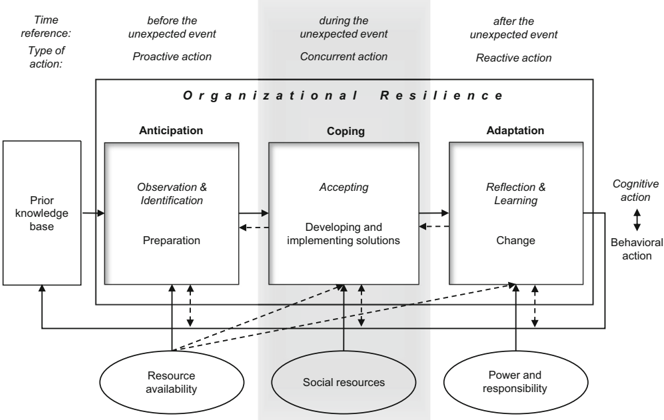
This is a conceptual paper that reframes organizational resilience as a meta-capability made up of three stages: anticipation, coping, and adaptation. It argues that resilience depends on specific underlying capabilities plus antecedents such as knowledge base, resources, social resources, and power/responsibility, and it ends by proposing propositions for future empirical work.
## Key findings
- The paper defines organizational resilience as an organization’s ability to anticipate potential threats, cope effectively with adverse events, and adapt to changing conditions.
- It decomposes resilience into three successive stages: anticipation, coping, and adaptation, and argues these stages overlap and build on each other; for example, anticipation influences coping and coping influences adaptation.
- The paper identifies capability clusters for each stage:
- anticipation: observation and identification, preparation
- coping: accepting, developing and implementing solutions
- adaptation: reflection and learning, organizational change
- It argues that resilience is a meta-capability requiring a combination of capabilities across all three stages; anticipation creates “resilience potential,” but coping and adaptation are needed to realize and improve it.
## Methods
- Conceptual/theoretical review paper, not an empirical study.
- Synthesizes literature from organizational resilience and related areas such as business continuity management, crisis management, innovation management, public administration, and organizational learning.
- Builds a conceptual framework and formulates propositions about antecedents and drivers, including:
- Proposition 1: knowledge base as an antecedent
- Proposition 2: resource availability
- Proposition 3: social resources
- Proposition 4: power based on expertise and shared responsibilities
## Limitations
- The paper explicitly notes that future research is needed to test the framework empirically and develop questionnaires; it says the framework is a first step toward a resilience theory rather than a final one.
- It states that much of the prior literature is fragmented, prescriptive/normative, and often retrospective, and that there is little knowledge about how resilience works in practice; this is the gap the paper tries to address.
- Evident from the text: the paper is entirely conceptual and does not present new data, sample, or statistical tests.
Model-written summary. Check it against the paper before relying on it.
Integrity signals
Registry
Cites
Statistics
Figures
Verification
Claims the paper makes
0 Valid · 4 Not valid · 58 Not checked · 67 Own results and interpretations
A conclusion the paper draws from its own results — it cites no other source for it, so there is none to check. The quote shows it is in the paper.
In the paper
“we suggest three successive stages of the resilience process (see Fig. 1) and argue that resilient organizations respond not only to the past (reactive action) or to current issues (concurrent action), but also to the future (anticipatory action).”
§ Organizational resilience: a capability-based conceptualization > 3.1 Fundamentals of the framework
hedgedstates a cause- Asserted: passes — The authors put it forward as true.
- Checkable: passes — It can be checked against evidence.
- Load-bearing: passes — The paper’s conclusions depend on it.
- Based: passes — The paper gives a reason why it holds.
None of the sources cited for this claim have been checked yet.
In the paper
“Most studies just point to organizational characteristics, resources, or processes that seem to be significant for resilience (e.g., Weick 1993;Kendra and Wachtendorf 2003;Gittell et al. 2006).This means that resilience is simply treated as an outcome-when organizations perform well during crisis or bounce back from interruptions (e.g., Horne and Orr 1998).”
- Also stated in: § 2.2 Previous conceptualizations of organizational resilience · plain
“Most studies treat resilience as an outcome-when organizations perform well during crisis or bounce back from interruptions (e.g., Horne and Orr 1998).”
§ Organizational resilience: a capability-based conceptualization > 1 Introduction
What the sources say
- Not matchedcites Horne and Orr 1998
An author–year citation the paper’s reference list doesn’t settle. We don’t search these by name.
- Not checked — no full text of the sourcecites Boin and van Eeten 2013 matched to “The Resilient Organization” (2013) source
- Not checked — no full text of the sourcecites Duit 2016 matched to “RESILIENCE THINKING: LESSONS FOR PUBLIC ADMINISTRATION” (2016) source
plain- Asserted: passes — The authors put it forward as true.
- Checkable: passes — It can be checked against evidence.
- Load-bearing: passes — The paper’s conclusions depend on it.
- Based: passes — The paper gives a reason why it holds.
- Also stated in: § 2.2 Previous conceptualizations of organizational resilience · plain
None of the sources cited for this claim could be matched to a paper, so there is nothing to check it against.
In the paper
“Depending on its specific configuration, resilience can be a source of sustainable competitive advantage (Hamel and Vaelikangas 2003;Sheffi 2007) and, thus, explain why some firms are more successful than others.”
§ Organizational resilience: a capability-based conceptualization > 2.1 Definitions of organizational resilience
What the sources say
- Not matchedcites Hamel and Vaelikangas 2003
An author–year citation the paper’s reference list doesn’t settle. We don’t search these by name.
- Not matchedcites Sheffi 2007
An author–year citation the paper’s reference list doesn’t settle. We don’t search these by name.
plainstates a possible cause- Asserted: passes — The authors put it forward as true.
- Checkable: passes — It can be checked against evidence.
- Load-bearing: passes — The paper’s conclusions depend on it.
- Based: passes — The paper gives a reason why it holds.
- Not matched
In the paper
“Organizational resilience capabilities develop over time and emerge from the process of coping with threatening situations and unexpected events (Linnenluecke et al. 2012).”
§ Organizational resilience: a capability-based conceptualization > 3.1 Fundamentals of the framework
What the sources say
- Not checked — no full text of the sourcecites Linnenluecke et al. 2012 matched to “Extreme Weather Events and the Critical Importance of Anticipatory Adaptation and Organizational Resilience in Responding to Impacts” (2012) source
plainstates a cause- Asserted: passes — The authors put it forward as true.
- Checkable: passes — It can be checked against evidence.
- Load-bearing: passes — The paper’s conclusions depend on it.
- Based: passes — The paper gives a reason why it holds.
A claim is checked only against the cited paper’s full text, never its abstract, and none is available for its sources.
In the paper
“research shows that newly developed solutions-regardless of how carefully they are designed-do not automatically lead to changes in the organizational patterns of action (Feldman 2003;Howard-Grenville 2005;Pentland and Feldman 2008).”
§ Organizational resilience: a capability-based conceptualization > 3.2.2 Coping capabilities
What the sources say
- Not checked — no full text of the sourcecites Feldman 2003 matched to “A performative perspective on stability and change in organizational routines” (2003) source
- Not checked — no full text of the sourcecites Howard-Grenville 2005 matched to “The Persistence of Flexible Organizational Routines: The Role of Agency and Organizational Context” (2005) source
- Not checked — no full text of the sourcecites Pentland and Feldman 2008 matched to “Designing routines: On the folly of designing artifacts, while hoping for patterns of action” (2008) source
plain- Asserted: passes — The authors put it forward as true.
- Checkable: passes — It can be checked against evidence.
- Load-bearing: passes — The paper’s conclusions depend on it.
- Based: passes — The paper gives a reason why it holds.
54 more claims
Create a free account to see all 129 claims and to verify the 7 references still open.
- Probably not a substantial claim. 48
- It may state two separate claims as one. 35
- The quote only partly states this claim. 2
Claims other papers make about this one
Each is checked against this paper’s own text: does it say what the citing paper says it does?
The cited source doesn’t support the claim as written.
In the citing paper
“The capacity conception, increasingly dominant in organizational and strategic management scholarship”
From Organizational Resilience and Crisis Management in Public Administration: Building Adaptive Governance Capacity in an Age of Compounding Disruptions (2026) · cites this paper as Duchek, 2020
Checked by a reasoning model — may be wrong.
Experimental — accuracy not yet measuredThe cited source says what the claim attributes to it.
In the citing paper
“The capacity conception, increasingly dominant in organizational and strategic management scholarship, treats resilience as a developable, manageable organizational asset the conceptualization adopted in this article (Duchek, 2020).”
From Organizational Resilience and Crisis Management in Public Administration: Building Adaptive Governance Capacity in an Age of Compounding Disruptions (2026) · cites this paper as Duchek, 2020
The cited source says what the claim attributes to it.
In the citing paper
“More recently, Duchek (2020) proposed a process model of organizational resilience comprising three sequential phases - anticipation, coping, and adaptation - each requiring distinct organizational capabilities. The AGRF builds on this process model while extending it to incorporate the distinctive institutional and governance features of public organizations.”
From Organizational Resilience and Crisis Management in Public Administration: Building Adaptive Governance Capacity in an Age of Compounding Disruptions (2026) · cites this paper as Duchek (2020)
Self-check
Percentages, sums and reported differences re-computed from the paper’s own numbers.
Each contradiction between two passages listed here was confirmed by an independent check.
Rated minor: it would not touch a result — a value no result rests on, a p-value that stays on the same side of the significance level, or a conflict that is clerical, resolved elsewhere in the paper, or outside its own findings.
In the paper
§ Organizational resilience: a capability-based conceptualization > 3.4.2 Resource availability
“Analyzing airline industry responses to September 2011, Gittell et al. (2006) found that airlines with greater financial resources”
§ Organizational resilience: a capability-based conceptualization > References
“Gittell, Jody H., Kim Cameron, Sandy Lim, and Victor Rivas. 2006. Relationships, layoffs, and organizational resilience airline industry responses to September 11.”
Citations
Cites
Absorptive Capacity: A New Perspective on Learning and Innovation
Cohen, W. M., & Levinthal, D. A. (1990) · Administrative Science Quarterly · doi:10.2307/2393553 · Cited by 35,728
An Evolutionary Theory of Economic Change.
Loasby, B. J., Nelson, R. R., & Winter, S. G. (1983) · The Economic Journal · doi:10.2307/2232409 · Cited by 21,366
Psychological Safety and Learning Behavior in Work Teams
Edmondson, A. (1999) · Administrative Science Quarterly · doi:10.2307/2666999 · Cited by 12,026 · cited 1×
“Learning can be described as ‘‘ongoing process of reflection and action characterized by asking questions, seeking feedback, experimenting, reflecting on results, and discussing errors or unexpected outcomes of actions’’ (Edmondson 1999, p. 353).”
Background(1993) · Journal of the American Dietetic Association · doi:10.1016/0002-8223(93)92196-5 · Cited by 11,976
Research in Organizational Behavior
Hammer, E. R., Cummings, L. L., & Staw, B. M. (1984) · The Academy of Management Review · doi:10.2307/258300 · Cited by 11,175
Hutchins, E. (1995) · doi:10.7551/mitpress/1881.001.0001 · Cited by 10,801 · cited 1×
“Social resources may be achieved through supportive mental processes that have been discussed as situated cognition (Suchman 1987), distributed cognition (Hutchins 1995), or joint cognitive systems (Hollnagel and Woods 2005).”
Background(1969) · Virtual Defense Library (Ministerio de Defensa) · Cited by 10,735
An Evolutionary Theory of Economic Change
Berkowitz, M. K., Nelson, R. R., & Winter, S. G. (1983) · Southern Economic Journal · doi:10.2307/1058233 · Cited by 10,549
Academy of Management Executive
(2010) · The Academy of Management executive/Academy of Management executive · doi:10.5465/ame · Cited by 8,844
A Behavioral Theory of the Firm
Day, R. H., Cyert, R. M., March, J. G., Clarkson, Cohen, Feigenbaum, D., Greenberg, Moore, Soelberg, Starbuck, et al. (1964) · Econometrica · doi:10.2307/1913056 · Cited by 7,791
Research works printed but not linked: 12
- 39. John W. Reich, Alex J. Zautra, and John Stuart Hall, 333-349. New York: The Guilford Press.
- 71. Hiltunen, Elina. 2008. Good Sources of Weak Signals: A Global Study of Where Futurists Look For Weak Signals. Journal of Futures Studies 12: 21-44.
- 74. Horne, John F. 1997. The coming of age of organizational resilience. Business Forum 22: 24-28.
- 116. March, James G., and Herbert A. Simon. 1958. Organizations. New York: Wiley.
- 135. Rerup, Claus. 2001. Houston, we have a problem: Anticipation and improvisation as sources of organizational resilience. Comportamento Organizacional E Gestao 7: 27-44.
- 138. Robert, Benoı ˆt. 2010. Organizational Resilience-Concepts and evaluation Method. Montre ´al: Presse de l'E ´cole Polytechnique de Montre ´al.
- 140. Roberts, Karlene H., Peter M. Madsen, and Vinit M. Desait. 2005. The space between in space transportation: A relational analysis of the failure of STS-107. In Organization at the limit-NASA and the Columbia Disaster, ed.
- 141. William H. Starbuck and Moshe Farjoun, 81-98. Oxford: Blackwell.
- 146. Ryle, Gilbert. 1979. On thinking. Oxford: Blackwell.
- 176. Vaughan, Diane. 2005. System effects: On slippery slopes, repeating negative patterns, and learning from mistake? In Organization at the limit-NASA and the Columbia Disaster, ed.
- 177. William H. Starbuck and Moshe Farjoun, 41-59. Oxford: Blackwell.
- 189. Westrum, Ron. 1988. Organizational and inter-organizational thought. Paper presented at the World Bank Conference on Safety Control and Risk Management.
Cited by
Items 801–900 of 1,969
The Role of Family Ownership in Survival and Bouncing Back: Good and Bad News?
Iborra, M., Safón, V., & Dolz, C. (2019) · Advances in business strategy and competitive advantage book series · doi:10.4018/978-1-7998-1655-3.ch011 · Cited by 3
Khan, M. Z., & Batool, I. (2022) · International Journal of Organizational Leadership · doi:10.33844/ijol.2022.60345 · Cited by 6
Thompson, E. K. (2025) · Corporate Social Responsibility and Environmental Management · doi:10.1002/csr.70184 · Cited by 6
Shymanovska-Dianych, L., Lozova, O. V., Shymanovska, V. L., Molko, R. V., & Yastreba, V. (2026) · Ukrainian Journal of Applied Economics and Technology · doi:10.36887/2415-8453-2026-1-19 · Cited by 6
Wang, J., Wan, J., & Wu, Z. (2025) · Frontiers in Sustainable Food Systems · doi:10.3389/fsufs.2025.1554308 · Cited by 7
Assessment of Resilient Governance Capacity toward COVID-19 in Chinese Cities
Peng, Y. M., Zhang, Y., & Gu, X. (2024) · Natural Hazards Review · doi:10.1061/nhrefo.nheng-2013 · Cited by 3
Recovery or deterioration: a financial distress prognostic model
Wu, Z., Zhu, W., Zhang, C., Wu, Y., Zhang, T., & Li, Z. (2025) · Information Processing & Management · doi:10.1016/j.ipm.2025.104503 · Cited by 5
Eneanya, A. N., Bello, M. A., Oladoyin, A. M., Fasanmade, O. O., & Chukwudi, C. E. (2025) · Journal of Lifestyle and SDGs Review · doi:10.47172/2965-730x.sdgsreview.v5.n02.pe04742 · Cited by 4
Symbiotic Use of Digital Twin, Simulation and Design Thinking Approach for Resilient Enterprise
Barat, S., Lobo, S., Korabu, R., Thogaru, H., & Mahamuni, R. (2023) · Winter Simulation Conference · doi:10.1109/wsc60868.2023.10408559 · Cited by 3
Hafnidah, N., Gustomo, A., Prasetio, E. A., & Abdurrahman, A. (2025) · Project Leadership and Society · doi:10.1016/j.plas.2025.100192 · Cited by 16
Blioumi, T. (2025) · Social Sciences & Humanities Open · doi:10.1016/j.ssaho.2025.102339 · Cited by 2
Yang, J., ZHANG, J., & Wang, S. (2025) · Emerging Markets Finance and Trade · doi:10.1080/1540496x.2025.2601346 · Cited by 3
“Organizational Resilience refers to the corporate’s adaptability, recovery capabilities, and continuous operational ability when confronted with external shocks (Duchek 2020).”
Klein, E. D., Jesacher-Rößler, L., Bremm, N., & Racherbäumer, K. (2023) · Leadership and Policy in Schools · doi:10.1080/15700763.2023.2277268 · Cited by 3
Shahzad, F., Poudel, D., & Ferreira, J. J. (2026) · The International Journal of Entrepreneurship and Innovation · doi:10.1177/14657503261421099 · Cited by 13
Gregorius Agung, W. D., Basri, Y. Z., & Anggiani, S. (2023) · International Journal of Management Studies and Social Science Research · doi:10.56293/ijmsssr.2022.4610 · Cited by 4
Characterizing player responses to surprising events in 2D platform games
Chakraborttii, C., & Osborne, A. (2022) · Entertainment Computing · doi:10.1016/j.entcom.2022.100542 · Cited by 2
OTPORNOST POTROŠAČA NA NARUŠAVANJE ONLINE PRIVATNOSTI: TESTIRANJE MJERNE LJESTVICE
Ekonomski institut, Z., Rajh, E., Škrinjarić, B., & Budak, J. (2021) · Ekonomska misao i praksa · doi:10.17818/emip/2021/2.11 · Cited by 2
Fostering a Resilient Organisational Culture Through Digital Transformation
Chauhan, R., Kapoor, A. D., Kapoor, S., & Sijoria, C. (2025) · Emerald Group Publishing Limited eBooks · doi:10.1108/978-1-83662-046-420251006 · Cited by 3
Safarpour, F., & Ashori, M. (2022) · Exceptionality · doi:10.1080/09362835.2022.2130321 · Cited by 3
Yang, Q., Wei, L., & Lu, Y. (2026) · Journal of Business Research · doi:10.1016/j.jbusres.2026.116117 · Cited by 3
Strategic resilience: linking social control to product innovation performance in startups
Luiz, T. T., Beuren, I. M., Mannes, S., & Freitas, S. (2025) · Management Decision · doi:10.1108/md-09-2023-1693 · Cited by 4
Furiak, K., Bugánová, K., Prievozník, P., Hudáková, M., & Slepecký, J. (2024) · Systems · doi:10.3390/systems12070234 · Cited by 10
Resilence: As a Coping Weapon of Stress for Working Indian Women
Midha, S. (2024) · Springer eBooks · doi:10.1007/978-981-96-0986-4_2 · Cited by 3
Non-profit crisis leadership during the COVID-19 pandemic in India and the United States
Rosenbusch, K. H., Gajjar, K., Chatterjee, A., & Soni, S. (2023) · Human Resource Development International · doi:10.1080/13678868.2023.2202143 · Cited by 3
Gichuhi, J. M., Oginde, D. A., & Wambua, P. (2023) · Journal of Economics and Business · doi:10.31014/aior.1992.06.01.490 · Cited by 7
Jiao, Y., Cheng, H., Huang, X., Ouyang, J., Li, Q., & Wang, R. (2026) · Frontiers in Psychology · doi:10.3389/fpsyg.2026.1729200 · Cited by 2
“Research has demonstrated that organizational resilience serves as a critical mediating mechanism linking individual-level resources to organizational outcomes (Duchek, 2020; Celestin and Vanitha, 2020).”
Hail, C. E., Dahmane, A., & Koraichi, M. E. (2025) · International Colloquium on Logistics and Supply Chain Management (LOGISTIQUA) · doi:10.1109/logistiqua66323.2025.11122776 · Cited by 2
“Given these circumstances, cultivating SC resilience — understood as the capacity to foresee, withstand, and rebound from disturbances — is now an essential strategic aim [4],[5].”
The manufacturing resilience dashboard – compass and radar navigation through uncertainty
Chari, A., Stahre, J., Despeisse, M., et al. (2025) · Manufacturing Letters · doi:10.1016/j.mfglet.2025.07.006 · Cited by 2
Danquah, F., Nuertey, D., Agbemude, S., Poku, E., & Owusu, F. (2025) · Benchmarking An International Journal · doi:10.1108/bij-09-2024-0757 · Cited by 4
The post-crisis non-learning loop: failing to sustain crisis-induced learning
Atay, E., & Nicholson, G. J. (2026) · Management Decision · doi:10.1108/md-10-2025-3128 · Cited by 2
Cheggag, M., & Mokhlis, C. E. (2023) · SHS Web of Conferences · doi:10.1051/shsconf/202317501023 · Cited by 8
Digital transformation and supply chain risk: Evidence from Chinese manufacturing firms
Li, X., Yang, Z., & Yu, D. (2026) · Economic Modelling · doi:10.1016/j.econmod.2026.107577 · Cited by 11
O'Leary, C. N., Mafeld, S. C., Hilario, K., et al. (2024) · Canadian Association of Radiologists Journal · doi:10.1177/08465371241298615 · Cited by 2
Crisis Preparation, Capacity Building, and Community Resilience: Lessons From Maui
Azevedo, L., Witkowski, K. G. K., Okhai, R., & Remington, C. L. (2026) · Nonprofit Management and Leadership · doi:10.1002/nml.70037 · Cited by 3
From fragmentation to integration: reframing adaptive leadership through an integrative review
Rahman, S., Beamish, A., & Althaus, C. (2026) · Management Review Quarterly · doi:10.1007/s11301-026-00593-1 · Cited by 11
Iborra, M., López-Muñoz, J. F., & Safón, V. (2025) · Journal of Family Business Management · doi:10.1108/jfbm-03-2025-0075 · Cited by 2
Max, M., Krüger, M., Windsheimer, P., & Brejora, M. (2023) · International Journal of Disaster Risk Reduction · doi:10.1016/j.ijdrr.2023.104178 · Cited by 4
Ramezani, J., Gomes, L., & Graça, P. (2025) · Mathematics · doi:10.3390/math13152421 · Cited by 6
AUTOCRATIC LEADERSHIP STYLE AND ORGANIZATIONAL CHANGE ON PERFORMANCe DURING PANDEMIC
Asno, S., & Sary, F. P. (2023) · TRIKONOMIKA · doi:10.23969/trikonomika.v22i1.5223 · Cited by 12
The Effect of Global Value Chain Governance on Organizational Resilience: A Configurational Approach
Song, Y., Sun, H., & Zhang, R. (2025) · Thunderbird International Business Review · doi:10.1002/tie.22439 · Cited by 2
Dan, Y. (2023) · International Journal of Research Studies in Management · doi:10.5861/ijrsm.2023.1051 · Cited by 10
Oliveira, J. M., Pereira, C., & Oliveira, A. (2025) · International journal of organizational analysis · doi:10.1108/ijoa-08-2024-4706 · Cited by 6
Vadil, C. F., Castriciones, S. O., Anduyan, D., Zulueta, D., & Quimzon, L. L. (2025) · International Journal of Research Studies in Education · doi:10.5861/ijrse.2025.25096 · Cited by 2
Strengthening Crisis Response with Organizational Resilience Strategies to Achieve Sustainability
Tomar, P., & Srivastava, S. (2024) · Lecture notes in networks and systems · doi:10.1007/978-981-97-8537-7_16 · Cited by 3
Does Resilient Leadership Affect Business Performance? A view of Malaysian SMEs
Arham, A. F., Norizan, N. S., Roni, M., Mazalan, M. I., & Mazalan, M. I. (2025) · Environment-Behaviour Proceedings Journal · doi:10.21834/e-bpj.v10isi26.6786 · Cited by 4
Merrien, A.-M., Charbonneau, J., Jankovic, I., Novković, S., Duguid, F., Guillotte, C.-A., & Fouquet, É. (2023) · Journal of Entrpreneurial and Organizational Diversity · doi:10.5947/jeod.2023.010 · Cited by 4
Strategic Orientations and Organizational Resilience: The Moderating Role of Digital Technology
Feng, X., & Wu, X. (2026) · Systems · doi:10.3390/systems14020159 · Cited by 5
Conceptualizing resilience in public health: a philosophical approach
Jishnu Pawan, K., & Ramanathan, M. (2025) · Philosophy Ethics and Humanities in Medicine · doi:10.1186/s13010-025-00173-3 · Cited by 6
“For instance, resilience could be a cyclic process when the system is able to resist or absorb the impact of a perturbation [12].”
Westover, J. (2025) · Preprints.org · doi:10.20944/preprints202507.0799.v1 · Cited by 1
Cotter, J. J., O’Brien, F., & Kelly, É. V. (2026) · Buildings · doi:10.3390/buildings16030511 · Cited by 4
Warmbier, P. (2024) · Lecture notes in logistics · doi:10.1007/978-3-031-56826-8_27 · Cited by 2
Füreder, N., Herber, G., & Stadlmayr, E. (2024) · Das Gesundheitswesen · doi:10.1055/a-2389-8453 · Cited by 6
Organizational resilience: a promising concept for organizational strategy or just a new buzzword?
Oliveira, L. M. D., Barbosa, A. P. P. L., & Marx, R. (2026) · Multinational Business Review · doi:10.1108/mbr-08-2024-0158 · Cited by 4
Karimzadeh, K., Tehrani, G. M., Khaloo, S. S., Vaziri, M. H., Amirkhani-Ardeh, S., & Saeedi, R. (2023) · Environmental Health Engineering and Management · doi:10.34172/ehem.2023.27 · Cited by 4
From adoption to impact: how digital hiring shapes organizational resilience in women-led SMEs
Tran, Q. N., Juneja, D., Han, J. W., & Dang, C.-M. (2026) · Journal of Management Development · doi:10.1108/jmd-08-2025-0470 · Cited by 3
Ren, X., Yuan, F., Li, Y., Lin, F., & Xie, J. (2026) · Engineering Construction & Architectural Management · doi:10.1108/ecam-05-2025-0748 · Cited by 2
Resilience measurement in socio-technical systems: A systematic review
Karimi, M. H., Smith, D., & Salehi, V. (2026) · Reliability Engineering & System Safety · doi:10.1016/j.ress.2026.112816 · Cited by 3
REMOVED DUE TO POLICY VIOLATIONS
(2023) · doi:10.31219/osf.io/a4ydh · Cited by 2
ODNOVOLYKOVA, O. V., & Hlavcheva, Y. (2024) · UNIVERSITY LIBRARY AT A NEW STAGE OF SOCIAL COMMUNICATIONS DEVELOPMENT CONFERENCE PROCEEDINGS · doi:10.15802/unilib/2024_316629 · Cited by 2
A reference model for auditing organisational resilience
van Maaren, I. (2022) · Maandblad Voor Accountancy en Bedrijfseconomie · doi:10.5117/mab.96.89573 · Cited by 3
Research on Digital Transformation and the Innovation Model of SMMEs: The Case Study of PAYA
Xu, Y., Zhang, Y., Li, X., Wang, Z., & Zhang, Q. (2025) · Sustainability · doi:10.3390/su17083458 · Cited by 6
Analysis of Organizational Resilience Capacity in Accommodation Service Business in Semarang
Setiaji, M. A., & Dewi, Y. E. P. (2022) · Jurnal Manajemen dan Organisasi · doi:10.29244/jmo.v13i1.38336 · Cited by 3
Zhou, C., Cao, W., Huang, Q., Lin, X., Chen, J., Zheng, Y., Li, W., Wang, Z., & Jiang, M. (2025) · Scientific Reports · doi:10.1038/s41598-025-11994-9 · Cited by 7
Organizational Resilience: Toward a Universally Accepted Definition
Alsaidi, H., Crowther, D., & Badri, F. A. (2024) · Approaches to global sustainability, markets, and governance · doi:10.1007/978-981-97-4795-5_3 · Cited by 6
Navigating uncertainty: Conceptualizing resilience in startups through a systematic review
Shehzad, N., Santoro, G., Ključnikov, A., & Jabeen, F. (2026) · International Entrepreneurship and Management Journal · doi:10.1007/s11365-026-01190-0 · Cited by 5
“In management and entrepreneurship, resilience has been increasingly viewed as a multifaceted construct applicable to individual, organizational, and systemic levels (Linnenluecke, 2017); Duchek, 2020 ; Baroncelli et al., 2024 ).”
A Comprehensive Approach to Understanding E-resilience in Education – A Review of the Literature
van de Laar, M., Marotta, J., & de Graaf, L. (2023) · Proceedings · doi:10.54808/icsit2023.01.78 · Cited by 4
Strategies for humanizing technology in health profession education
Yusoff, M. S. (2024) · Advances in Biomedical and Health Sciences · doi:10.4103/abhs.abhs_90_23 · Cited by 2
Designing for Banking Resilience: A DeFi E-Learning Solution
Zeiß, C., Straub, L., Hahn, V., Lang, K., Schaschek, M., Tomitza, C., & Winkelmann, A. (2024) · Lecture notes in computer science · doi:10.1007/978-3-031-61175-9_22 · Cited by 2
THE IMPACT OF ECONOMIC AND ENVIRONMENTAL SHOCKS ON POLISH FARMS IN 2010-2019
Jurek, K. A. (2023) · Annals of the Polish Association of Agricultural and Agribusiness Economists · doi:10.5604/01.3001.0054.0860 · Cited by 2
Students’ Perspectives on Social Sustainability: Developing an Integrated Higher Education Framework
Gheorghe, I.-R., Drakou, A., Ioachim, M. F., & Gheorghe, C.-M. (2025) · Education Sciences · doi:10.3390/educsci15101332 · Cited by 4
Human capital development as an instrument of cultural transformation
Petrova, I. L., & Taghikilanidamavandi, L. (2026) · Social and Labour Relations Theory and Practice · doi:10.21511/slrtp.15(2).2025.03 · Cited by 2
Behavioural Insights, Organizational Resilience, and Disaster Preparedness
Seah, Y. Z., & Ha, H. (2023) · International Handbook of Disaster Research · doi:10.1007/978-981-19-8388-7_201 · Cited by 2
Rantamäki, A. (2023) · Hallinnon Tutkimus · doi:10.37450/ht.127936 · Cited by 5
Garrido, G. B. G. (2022) · Revista EDUCA UMCH · doi:10.35756/educaumch.202220.243 · Cited by 2
Parast, M. M., Lavassani, K. M., Boyd, Z. M., & Azadegan, A. (2026) · International Journal of Physical Distribution & Logistics Management · doi:10.1108/ijpdlm-06-2025-0309 · Cited by 4
Green human resource management and Sustainable Development Goals in non-profit organisations
Singh, S., Martins, A., & Tefera, O. (2025) · SA Journal of Human Resource Management · doi:10.4102/sajhrm.v23i0.2780 · Cited by 24
Riesener, M., Kuhn, M., Tittel, J., et al. (2021) · doi:10.1109/ieem50564.2021.9672979 · Cited by 2
Antifragility in leadership: framework and cases from the developing world
Ivașcenco, I. (2024) · Virgil Madgearu Review of Economic Studies and Research · doi:10.24193/rvm.2024.17.117 · Cited by 2
Family Capital for Business Resilience during the COVID-19 Crisis
Novita, D., Handriana, T., & Purnamasari, W. (2025) · European Journal of Family Business · doi:10.24310/ejfb.15.2.2025.20433 · Cited by 2
Dolev, N., & Ireni‐Saban, L. (2025) · Administrative Sciences · doi:10.3390/admsci15030101 · Cited by 6
Cognitive and artificial intelligence evaluation framework
Putnoki, A. M., & Orosz, T. (2026) · Artificial Intelligence Review · doi:10.1007/s10462-026-11493-x · Cited by 5
Dupin, J.-J., Pascal, A., & Godé, C. (2025) · Advances in business information systems and analytics book series · doi:10.4018/979-8-3693-6045-3.ch005 · Cited by 4
Policy confidence in crises: an examination across waves of the COVID-19 pandemic
Suh, J., Kim, H., & Han, A. (2023) · International Review of Public Administration · doi:10.1080/12294659.2023.2225911 · Cited by 2
Lean and organizational resilience: A discussion
Tortorella, G. L., Kumar, M., Thürer, M., Browning, T. R., Hines, P., Romero, D., & Furlan, A. (2025) · International Journal of Production Economics · doi:10.1016/j.ijpe.2025.109897 · Cited by 6
Entrepreneurial financial resilience and financial innovation in a turbulent era
Scott, J. M., Hussain, J., Salia, S., et al. (2023) · Edward Elgar Publishing eBooks · doi:10.4337/9781802203929.00008 · Cited by 2
Asante, M. O., Liyanapathiranage, S. W. S., & Pinheiro, R. M. (2023) · Springer eBooks · doi:10.1007/978-3-031-26393-4_10 · Cited by 5
O IMPACTO DA COVID-19 MEDIADO PELA RESILIÊNCIA HUMANA EM MICROEMPREENDORES DO RAMO DA BELEZA
do Vale, A. F. N., de Sousa, J. C., de Oliveira, A. M. B., et al. (2020) · Revista Gestão Organizacional · doi:10.22277/rgo.v14i1.5488 · Cited by 2
The Role of Entrepreneurship in Economic Resilience
Khuan, H. (2024) · Economics Studies and Banking Journal (DEMAND) · doi:10.62207/5rcdcs18 · Cited by 7
Pusparini, E. S., Peranginangin, Y. A., Gayatri, G., Hadiprawoto, T. R., & Syaebani, M. I. (2026) · Asia Pacific Management Review · doi:10.1016/j.apmrv.2026.100433 · Cited by 11
Navigating sustainability in Arctic tourism: Business models resilience during the COVID-19 pandemic
Zamani, S. S. (2025) · International Journal of Disaster Risk Reduction · doi:10.1016/j.ijdrr.2025.105488 · Cited by 7
Resilience capability for the circular economy: a conceptual framework
Santos, J. E. A., & Gohr, C. F. (2026) · Environment Systems & Decisions · doi:10.1007/s10669-026-10079-w · Cited by 8
Enhancing team resilience through team knowledge dynamics: a mediated approach
Yang, H. M., & Suntrayuth, S. (2025) · Frontiers in Psychology · doi:10.3389/fpsyg.2025.1615909 · Cited by 7
“” According to Duchek (2020), resilience depends on the interplay between cognitive and behavioral capabilities and concrete actions.”
A knowledge map of agility and innovation: trends and insights using bibliometric analysis
Saeed, S., Díaz‐Pichardo, R., & Sánchez-Medina, P. S. (2025) · Strategy and Leadership · doi:10.1108/sl-04-2025-0065 · Cited by 3
Enhancing Resilience in Logistics: The Role of HR-SCM Practices and AI Technology Readiness
Li, Y., & Ndiaye, A. (2026) · International Journal of Information Systems and Supply Chain Management · doi:10.4018/ijisscm.401244 · Cited by 4
Resilienz und resiliente Stadt: Eine Begriffsbestimmung
Wink, R. (2022) · Historische Resilienz-Forschung · doi:10.1007/978-3-658-37302-3_2 · Cited by 2
The Role of Essential Businesses in Whole-of-Society Resilience to Disruption
Jordan, R., & Shaw, D. (2024) · Academy of Management Perspectives · doi:10.5465/amp.2023.0079 · Cited by 5
Uncovering the Mechanisms of Organisational Resilience: A Critical Realist Systematic Review
Mahmoud, M., Chan, K. C., & Ally, M. (2026) · Sustainability · doi:10.3390/su18105003 · Cited by 3
Bibliometric Mapping of Organizational Resilience Research
Khan, N., Khalique, F., & Saini, K. (2025) · Advances in logistics, operations, and management science book series · doi:10.4018/979-8-3693-8809-9.ch006 · Cited by 2
Ru, D., Ramakrishnan, S., & Hishan, S. S. (2023) · MIGRATION LETTERS · doi:10.59670/ml.v20i6.4554 · Cited by 2
Tourism developmente policy and the use of scenario analisis: a synthesis model
Martins, M., Guerra, R. J. D. C., & Santos, L. (2022) · PASOS Revista de Turismo y Patrimonio Cultural · doi:10.25145/j.pasos.2022.20.074 · Cited by 2
Metadata
- Authors
- Duchek, S.
- Affiliations
- Technische Universität Dresden (DE)
- Corresponding author
- Duchek, Stephanie
- ORCID
- Duchek, Stephanie
- Venue
- Business Research
- Published
- 2019-01-14
- Volume
- 13
- Issue
- 1
- Pages
- 215-246
- ISSN
- 1866-8658 (ISSN-L)
- 2198-3402
- 2198-2627
- OpenAlex
- W2910462204
- Cited by
- 2,027
- References
- 209
- Citations by year
- 2026: 640 · 2025: 398 · 2024: 311 · 2023: 280 · 2022: 213 · 2021: 131 · 2020: 50 · 2019: 3
- FWCI
- 152.43
- Type
- journal article
- Language
- en
- Open access
- gold
- doi.org
- Licence
- cc-by
- creativecommons.org/licenses/by/4.0 (tdm)
- creativecommons.org/licenses/by/4.0 (vor)
- Locations
- BuR - Business Research (publishedVersion, cc-by)
- RePEc: Research Papers in Economics (submittedVersion)
- Econstor (Econstor) (submittedVersion, cc-by)
- Topics
- Social Sciences › Business, Management and Accounting › Strategy and Management › Supply Chain Resilience and Risk Management
- Social Sciences › Business, Management and Accounting › Strategy and Management › Innovation and Knowledge Management
- Social Sciences › Sociology and Political Science › Disaster Management and Resilience
- Keywords
- organizational resilience, organizational capabilities, meta-capability, anticipation, coping, adaptation, crisis management, uncertainty, antecedents of resilience
About these checks
Registry, retraction, Cites and statistics results are computed, not judged, with one exception: a printed reference that no index lists is read once by a model before it counts as a citation error. Claims are extracted by a model and kept only when their quote appears verbatim in the text; each cited source is then checked, with a model’s help, for whether it says what the claim relies on. Those verdicts can be wrong — read the claim’s quote and the cited source before relying on one.
A language model drew the claims from the paper on 2026-10-10, under version 3 of the claim definition (model deepseek-v4.1-flash, prompt extract-v3).
A second model labelled each claim on 2026-10-10 (model jev-1.13-20260917, definition revision gold-guideline-v0.2).
Statistics and arithmetic are recomputed, not judged.
Confidence bands are shown only for fields calibrated on our annotated test set. None is calibrated yet, so no band is shown.
What counts as a claim ›How we measure confidence ›How we check this ›
Are you an author, or do you see a problem with this page? Request a review
Data sources
Bibliographic data: Semantic Scholar, OpenAlex, Crossref.
Contains information from the Semantic Scholar Academic Graph Datasets, made available under the ODC Attribution License (ODC-BY 1.0).
Semantic Scholar’s data is described in: Kinney, R., et al. (2023). The Semantic Scholar Open Data Platform. arXiv:2301.10140.
