

Adolescent Social Media Use and Emotional Intelligence: A Systematic Review
Open accessThe DOI matches its Crossref record; 86 of the 87 references it cites were found in a registry or an index, and 1 are not checked yet; 18 of the 73 sources its claims cite were checked for support.
Abstract
This work aimed to provide a review that examines the association between adolescents’ emotional intelligence, including its dimensions (self-esteem, emotion regulation, empathy), and social media use.
Verified 2026-11-22 · 1 reference not checked yet
Overview
CoChat Summary
## TL;DR
This systematic review synthesized 25 studies on adolescents’ emotional intelligence and social media use, covering 41,624 participants. Overall, lower emotional intelligence was linked to more problematic social media use, while self-esteem and emotion regulation were negatively associated with social media use and empathy was positively correlated.
## Key findings
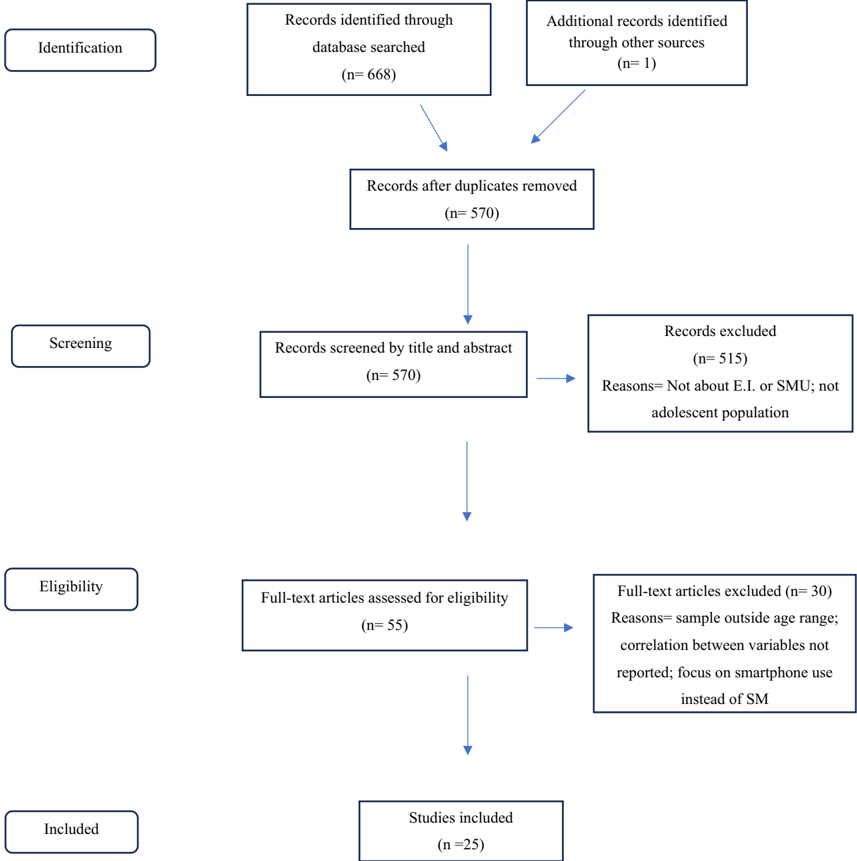
- The review included 25 studies with 41,624 participants; across studies, 49.3% were boys and the mean age was 14.6 years.
- Lower emotional intelligence was consistently associated with increased problematic social media use; the review says all included studies found a negative relationship between emotional intelligence and dysfunctional social media use.
- For emotion regulation, several specific difficulties were positively correlated with problematic social media use, including limited access to strategies (r = 0.38), nonacceptance of emotional responses (r = 0.32), impulse control difficulties (r = 0.37), goal-directed behavior difficulties (r = 0.40), lack of emotional awareness (r = 0.13), and lack of emotional clarity (r = 0.34).
- Self-esteem showed a negative association with social media use; the review reports weak-to-moderate negative associations between time on social media and self-esteem, including r = -0.188 (p < 0.001), and negative correlations with Facebook use frequency (r = -0.124, p < 0.05) and Twitter use/emotional expression on Twitter (r = -0.151 and r = -0.187, both p < 0.01).
- Empathy was positively related to social media use in the reviewed studies, including a longitudinal association where pathological social media use and empathy were inversely related (r = -0.19, p < 0.001), while social media activity and empathic interaction were described as positively correlated with empathy.
## Methods
- Systematic review of adolescent social media use and emotional intelligence, including dimensions such as self-esteem, emotion regulation, and empathy.
- Searches were conducted in Web of Science Core Collection and PubMed between January 2023 and August 2023, with reference-list screening adding one additional study.
- Inclusion criteria: peer-reviewed articles in English or Spanish, published 2001-2023, with participants aged 10-19 and studies using established emotional intelligence models/facets and social media measures; studies were synthesized qualitatively because of heterogeneity.
## Limitations
- The paper states that no meta-analysis was conducted because of high heterogeneity in measures across studies, which prevented estimation of effect sizes.
- It states that almost all included studies were cross-sectional, limiting causal inference, and that few studies were available for some emotional intelligence dimensions.
- It states that publication bias and the lack of gray literature searches may have limited the review; it also notes limited generalizability because most studies were from Western cultural contexts.
- Evident from the text: many included studies relied on self-report questionnaires and convenience samples, which the paper says can introduce recall/perception error, social desirability bias, and limited generalizability.
Model-written summary. Check it against the paper before relying on it.
Integrity signals
Registry
Cites
Statistics
Figures
Verification
Claims the paper makes
9 Valid · 6 Not valid · 48 Not checked · 54 Own results and interpretations
The cited sources support only part of this claim — read each source’s verdict below.
In the paper
“A small number of studies have shown that lower levels of emotional intelligence may be correlated with higher levels of problematic use of technological communication media such as smartphones, the Internet, and video games (Alshakhsi etal., 2022; Che etal., 2017; Gisbert-Pérez etal., 2024).”
What the sources say
- Partly supportedcites Alshakhsi et al., 2022 matched to “Problematic internet usage: the impact of objectively Recorded and categorized usage time, emotional intelligence components and subjective happiness about usage” (2022) sourceExperimental — accuracy not yet measured
The Introduction reports that a few studies found a significant negative relationship between emotional intelligence and problematic internet use, supporting the claim’s central point. The Discussion addresses smartphone use, but says its measurement is not representative of gaming-app overuse; this source does not establish the claimed relationship for problematic video-game use. (LLM, conf=0.85)
- Supportedcites Che et al., 2017 matched to “Dimensions of Emotional Intelligence and Online Gaming Addiction in Adolescence: The Indirect Effects of Two Facets of Perceived Stress” (2017) source
The Discussion reports that three dimensions of emotional intelligence were negatively correlated with online gaming addiction in the adolescents studied. The Introduction also reports earlier findings of negative associations between specific emotional-intelligence dimensions and internet addiction. Che et al. thus supports the citing sentence’s hedged claim for gaming and internet use; the sentence’s other citations need not each support every example. (LLM, conf=0.90)
- Partly supportedcites Gisbert-Pérez et al., 2024 matched to “Emotional Intelligence and Gaming Disorder Symptomatology: A Systematic Review and Meta-Analysis” (2024) sourceExperimental — accuracy not yet measured
The 'The Role of Emotional Intelligence in Addictions' section states that emotional intelligence is negatively correlated with mobile phone addiction (Arrivillaga et al., 2020; Beranuy et al., 2009), Internet addiction (Ranjbar & Bakhshi, 2018; Hamissi et al., 2013; Saraiva et al., 2018) and video-game/gaming addiction (Kircaburun et al., 2019; Parker et al., 2008, 2013; Bender et al., 2020), and the Discussion (p. n/a) reports pooled inverse correlations between trait, ability and emotional-regulation EI and Internet gaming disorder symptomatology (r = -0.276, -0.249, -0.237) — so the association across smartphones, Internet and video games is supported. However, the claim's quantifier 'a small number of studies' is not what the source says: it opens the same section with 'Many studies have found a negative association between emotional intelligence and addictions' and synthesises 49 published articles / 54 independent samples; the only 'small number of studies' remark (k = 2, and the inability to run moderators for trait/ability/social-emotional EI) concerns specific subgroup analyses, not the evidence base for problematic technology use. (LLM, conf=0.75)
hedgedstates an association- Asserted: passes — The authors put it forward as true.
- Checkable: passes — It can be checked against evidence.
- Load-bearing: unclear — It is unclear whether the paper’s conclusions depend on it.
- Based: passes — The paper gives a reason why it holds.
- Partly supported
The cited sources that could be checked couldn’t confirm or dispute this claim.
In the paper
“Despite its significance, the relationship between emotional intelligence and social media use among adolescents remains largely unexplored in the literature.”
What the sources say
- Could not verifycites Gisbert-Pérez et al., 2024 matched to “Emotional Intelligence and Gaming Disorder Symptomatology: A Systematic Review and Meta-Analysis” (2024) sourceExperimental — accuracy not yet measured
Our copy is a meta-analysis of emotional intelligence and Internet gaming disorder symptomatology; its stated gaps concern gaming disorder only (Current Study: 'its specific relationship with internet gaming disorder has not yet been explored'; The Role of Emotional Intelligence in Addictions: the EI–IGD relation 'across different social contexts ... has not been systematically examined to date by a meta-analysis technique'). Searches for 'social media use adolescents emotional intelligence unexplored' and 'social networking sites problematic use gap in the literature' returned no passage treating social media use as a studied outcome — social media appears only as a recruitment channel in Appendix A (e.g., Lin et al., 2023; Marchica et al., 2020; Hollett & Harris, 2020) and inside a cited reference title (van den Eijnden et al., 2018). Nothing in our copy therefore supports or contradicts the claim that EI–social media use in adolescents is largely unexplored. (LLM, conf=0.70)
- Could not verifycites Leite et al., 2019 matched to “A critical literature review on emotional intelligence in addiction” (2019) sourceExperimental — accuracy not yet measured
The Introduction says emotional intelligence remains virtually unexplored within psychiatry, and the Results review substance-use disorders and impulsive buying. Neither section addresses whether research on emotional intelligence and social media use among adolescents is scarce; searches for social media use among adolescents and internet addiction or social networking found no relevant passage. Page numbers were not available in our copy. (LLM, conf=0.76)
- Could not verifycites Yang et al., 2022 matched to “The relationship between adolescent emotion dysregulation and problematic technology use: Systematic review of the empirical literature” (2022) sourceExperimental — accuracy not yet measured
The Discussion reports research on adolescent emotion dysregulation and problematic social media use, while the Strengths and limitations section calls for more work on causality. Neither addresses whether the relationship between emotional intelligence and social media use generally remains largely unexplored; a search for “emotional intelligence” found no relevant passage. (LLM, conf=0.76)
plain- Asserted: passes — The authors put it forward as true.
- Checkable: passes — It can be checked against evidence.
- Load-bearing: passes — The paper’s conclusions depend on it.
- Based: unclear — It is unclear why the paper says it holds.
- Rests on an assumption not shown here.
- Could not verify
The cited sources support only part of this claim — read each source’s verdict below.
In the paper
“Research suggests that time spent on social media daily is a risk factor for developing dysfunctional mechanisms of social media use (Schivinski etal., 2020).”
What the sources say
- Partly supportedcites Schivinski et al., 2020 matched to “Exploring the Role of Social Media Use Motives, Psychological Well-Being, Self-Esteem, and Affect in Problematic Social Media Use” (2020) sourceExperimental — accuracy not yet measured
The Discussion (page unavailable) identifies daily social media use as a predictor of problematic social media use. However, the Measures section describes usage frequency and minutes per session, not total time spent daily, and the survey does not establish that daily use causes later development of problematic use. (LLM, conf=0.86)
hedgedstates a possible cause- Asserted: passes — The authors put it forward as true.
- Checkable: passes — It can be checked against evidence.
- Load-bearing: unclear — It is unclear whether the paper’s conclusions depend on it.
- Based: passes — The paper gives a reason why it holds.
- Partly supported
Every source the paper cites for this claim was checked and supports it.
In the paper
“A recent review found a positive correlation between adolescent emotion dysregulation and the severity of problematic technology use, including problematic smartphone use, problematic Internet use and Internet Gaming Disorder (Yang etal., 2022).”
What the sources say
- Supportedcites Yang et al., 2022 matched to “The relationship between adolescent emotion dysregulation and problematic technology use: Systematic review of the empirical literature” (2022) source
The Abstract’s Discussion explicitly reports a positive correlation between adolescent emotion dysregulation and problematic technology use severity. The paper’s Discussion identifies problematic Internet use, Internet Gaming Disorder, and problematic smartphone use among the forms covered. (LLM, conf=0.94)
plainstates an association- Asserted: passes — The authors put it forward as true.
- Checkable: passes — It can be checked against evidence.
- Load-bearing: unclear — It is unclear whether the paper’s conclusions depend on it.
- Based: passes — The paper gives a reason why it holds.
- Supported
The cited sources that could be checked couldn’t confirm or dispute this claim.
In the paper
“no review has focused specifically on the correlation between social media use and emotional intelligence”
What the sources say
- Could not verifycites Gisbert-Pérez et al., 2024 matched to “Emotional Intelligence and Gaming Disorder Symptomatology: A Systematic Review and Meta-Analysis” (2024) sourceExperimental — accuracy not yet measured
Our copy's gap statements concern emotional intelligence and Internet gaming disorder only: the Methods section reports a PROSPERO/Cochrane search confirming 'no previous SR or meta-analysis that had already investigated this relationship,' and the Introduction (The Role of Emotional Intelligence in Addictions) states the emotional intelligence–Internet gaming disorder link 'has not been systematically examined to date by a meta-analysis technique.' Nothing in our copy addresses whether a review has focused on social media use and emotional intelligence; 'social media' appears only incidentally (a convenience sample recruited via social media advertisements and one reference title on games and social media, plus the GSMQ instrument in Appendix A). Since the source neither supports nor contradicts the social-media-specific claim, the attribution cannot be verified from our copy. (LLM, conf=0.72)
- Could not verifycites Leite et al., 2019 matched to “A critical literature review on emotional intelligence in addiction” (2019) sourceExperimental — accuracy not yet measured
The Introduction says this review concerns emotional intelligence in addiction disorders, and the Results discuss previous reviews on that subject. Searches for social media use, its correlation with emotional intelligence, and the claimed absence of a review found no passage addressing that claim. Page numbers were not available in our copy. (LLM, conf=0.76)
- Could not verifycites Yang et al., 2022 matched to “The relationship between adolescent emotion dysregulation and problematic technology use: Systematic review of the empirical literature” (2022) sourceExperimental — accuracy not yet measured
The Background and aims and Method sections describe a review of adolescent emotion dysregulation and problematic technology use, not reviews of social media use and emotional intelligence. A search of our copy for emotional intelligence and for a claim that no review has focused on that relationship found no passage addressing it. The source therefore does not establish the claimed gap in the review literature. (LLM, conf=0.73)
plain- Asserted: passes — The authors put it forward as true.
- Checkable: passes — It can be checked against evidence.
- Load-bearing: passes — The paper’s conclusions depend on it.
- Based: passes — The paper gives a reason why it holds.
- Rests on an assumption not shown here.
- Could not verify
63 more claims · 3 with their cited sources checked
Create a free account to see all 117 claims and to verify the 7 references still open.
- Probably not a substantial claim. 26
- It may state two separate claims as one. 28
- The quote only partly states this claim. 1
Claims other papers make about this one
Each is checked against this paper’s own text: does it say what the citing paper says it does?
The source backs part of the claim, not all of it — or backs it for a different population, condition or comparison.
In the citing paper
“Adolescents with high assertiveness demonstrate emotional and social maturity that enables them to maintain personal boundaries, even in risky situations such as unhealthy online interactions (Piccerillo & Digennaro, 2025).”
From Surfing Online Safety: Assertiveness and Parental Involvement in Adolescents’ Attitudes Toward Cyber Grooming (2025) · cites this paper as Piccerillo & Digennaro, 2025
Experimental — accuracy not yet measured
Self-check
Percentages, sums and reported differences re-computed from the paper’s own numbers.
Rated major: it would touch a result — a value a result rests on, reported and recomputed p-values on opposite sides of the significance level, two passages that conflict with no sign which is right, or a cited work retracted before this paper was published.
In the paper
“Based on the OSQE cohort scores, 66.7% (n = 4), 16.7% (n = 1) and 16.7% (n = 2) were rated 9, 10 and 7 stars out of 16 respectively.”
Reported 25 · recomputed 7
Citations
Cites
Frames of Mind: The Theory of Multiple Intelligences
Klitgaard, R., & Gardner, H. (1984) · Journal of Policy Analysis and Management · doi:10.2307/3324560 · Cited by 13,636
Salovey, P., & Mayer, J. D. (1990) · Imagination, Cognition and Personality · doi:10.2190/dugg-p24e-52wk-6cdg · Cited by 10,484
Measuring individual differences in empathy: Evidence for a multidimensional approach.
Davis, M. H. (1983) · Journal of Personality and Social Psychology · doi:10.1037/0022-3514.44.1.113 · Cited by 10,272 · cited 1×
“…experience, resulting in an emotional response that is congruent with a view that others are worthy of compassion and respect and have intrinsic worth” (Barnett & Mann, 2013) Psychology often defined it as a multidimensional construct, encompassing cognitive and behavioral states (Davis, 1983).”
Frames of mind the theory of multiple intelligences
Gardner, H. (1993) · Cited by 2,907
Brand, M., Young, K. S., Laier, C., Wölfling, K., & Potenza, M. N. (2016) · Neuroscience & Biobehavioral Reviews · doi:10.1016/j.neubiorev.2016.08.033 · Cited by 2,416 · cited 1×
“The Interaction of Person-Affect-Cogni-tion-Execution (I-PACE) model developed by Brand et al. (Brand et al., 2016) has been used as a theoretical framework in several studies.”
Petrides, K. V., & Furnham, A. (2001) · European Journal of Personality · doi:10.1002/per.416 · Cited by 1,997 · cited 2×
“Another differentiation was further operated by Petrides and Furnham (2001), who distinguished Trait emotional intelligence (TEI) from Ability emotional intelligence (AEI) and claimed that the nature of the model is determined by the type of measurement.”
Emotional intelligence: An integrative meta-analysis and cascading model
Joseph, D. L., & Newman, D. A. (2010) · Journal of Applied Psychology · doi:10.1037/a0017286 · Cited by 1,722 · cited 1×
“Nevertheless, gender differences in emotional intelligence scores may depend on the instruments and theoretical approaches used (Joseph & Newman, 2010).”
Development and validation of the Basic Empathy Scale
Jolliffe, D., & Farrington, D. P. (2006) · Journal of Adolescence · doi:10.1016/j.adolescence.2005.08.010 · Cited by 1,620 · cited 2×
“Standardized questionnaires, such as the Basic Scale of Empathy (Jolliffe & Farrington, 2006) and Adolescent Measure of Empathy and Sympathy (Vossen et al., 2015), were utilized in two studies (Errasti et al., 2017; Vossen & Valkenburg, 2016).”
Andreassen, C. S., Pallesen, S., & Griffiths, M. D. (2017) · Addictive Behaviors · doi:10.1016/j.addbeh.2016.03.006 · Cited by 1,504 · cited 2×
“The SMAQ is composed of eight items scored on a 7-point Likert scale that ranges from strongly disagree strongly agree, with higher scores indicating dysfunctional mechanisms of social media use.”
Thorndike, E. L. (1920) · Cited by 1,409
Law, K. S., Wong, C.-S., & Song, L. J. (2004) · Journal of Applied Psychology · doi:10.1037/0021-9010.89.3.483 · Cited by 1,404 · cited 2×
“The WLEIS is often used to measure a range of basic emotional skills and consists of a 16-item scale divided into four subscales: self-evaluation of emotions, evaluation of others' emotions, use of emotions, and regulation of emotions.”
Woods, H. C., & Scott, H. (2016) · Journal of Adolescence · doi:10.1016/j.adolescence.2016.05.008 · Cited by 1,302
A critical evaluation of the emotional intelligence construct
Ciarrochi, J. V., Chan, A. Y. C., & Caputi, P. (2000) · Personality and Individual Differences · doi:10.1016/s0191-8869(99)00119-1 · Cited by 1,029 · cited 1×
“However, the different “definitions’’ of emotional intelligence tend to be complementary rather than contradictory (Ciarrochi et al., 2000).”
Kaufman, E. A., Xia, M., Fosco, G., Yaptangco, M., Skidmore, C. R., & Crowell, S. E. (2016) · Journal of Psychopathology and Behavioral Assessment · doi:10.1007/s10862-015-9529-3 · Cited by 960 · cited 1×
“In assessing emotional regulation in these transversal studies, validated scales have been utilized, such as the "Difficulties in Emotion Regulation" (Kaufman et al., 2016).”
Latkin, C. A., Edwards, C., Davey-Rothwell, M. A., & Tobin, K. E. (2017) · Addictive Behaviors · doi:10.1016/j.addbeh.2017.05.005 · Cited by 865 · cited 1×
“Social desirability response bias may lead to inaccurate self-reports and erroneous study conclusions (Latkin et al., 2017).”
Social network site addiction - An overview
Andreassen, C., & Pallesen, S. (2014) · Current Pharmaceutical Design · doi:10.2174/13816128113199990616 · Cited by 840 · cited 1×
“Sometimes adolescents use these platforms as a maladaptive strategy to cope with difficult emotional states, attempting to find distraction and escape from emotional experiences (C. Andreassen & Pallesen, 2014).”
Social media use and adolescent mental health: Findings from the UK Millennium Cohort Study
Kelly, Y., Zilanawala, A., Booker, C., & Sacker, A. (2018) · EClinicalMedicine · doi:10.1016/j.eclinm.2018.12.005 · Cited by 740 · cited 3×
“…included in this review found significant weak to moderate negative associations between time of social media use and self-esteem (Ciacchini et al., 2023; Cingel & Olsen, 2018; Kelly et al., 2018; Livet et al., 2022; Thorisdottir et al., 2019; Valk-enburg, Beyens, Pouwels, van Driel, et al., 2021).”
The Oxford Handbook of Prosocial Behavior
(2015) · Oxford University Press eBooks · doi:10.1093/oxfordhb/9780195399813.001.0001 · Cited by 648
Emotional regulation and emotional development
Thompson, R. A. (1991) · Educational Psychology Review · doi:10.1007/bf01319934 · Cited by 641 · cited 1×
“Emotional regulation may be defined as the processes, both intrinsic and extrinsic, responsible for monitoring, evaluating, and modifying emotional reactions (Thompson, 1991).”
Hawi, N. S., & Samaha, M. (2017) · Social Science Computer Review · doi:10.1177/0894439316660340 · Cited by 618 · cited 1×
“All studies examined social media use from a problematic standpoint, with three utilizing the Bergen Social Media Addiction Scale (BSMAS) and the remaining one employing the Social Media Addiction Questionnaire (SMAQ) (Andreassen et al., 2017; Hawi & Samaha, 2017).”
Society and the Adolescent Self-Image. Rev. ed.
Rosenberg, M. (1989) · Cited by 611
Measuring emotional intelligence in adolescents
Ciarrochi, J., Chan, A. Y. C., & Bajgar, J. (2001) · Personality and Individual Differences · doi:10.1016/s0191-8869(00)00207-5 · Cited by 591 · cited 1×
“The decision to limit the study to this specific period was motivated by the notable development of social media, coinciding with the introduction of tools for assessing emotional intelligence in 2001, e.g. Ciarrochi et al., (2001).”
Measuring Emotional Contagion in Social Media
Ferrara, E., & Yang, Z. (2015) · PLOS ONE · doi:10.1371/journal.pone.0142390 · Cited by 532 · cited 1×
“Social media experience has cognitive, emotional, behavioral and social dimensions (Ferrara & Yang, 2015; Korte, 2020) .”
(2015) · Springer eBooks · doi:10.1007/978-3-319-04093-6 · Cited by 483
Nelis, D., Kotsou, I., Quoidbach, J., Hansenne, M., Weytens, F., Dupuis, P., & Mikolajczak, M. (2011) · Emotion · doi:10.1037/a0021554 · Cited by 472 · cited 1×
“According to a number of studies, emotional intelligence can be learned and improved through the implementation of intervention programs (Gilar-Corbi et al., 2019; Nelis et al., 2011).”
Monacis, L., de Palo, V., Griffiths, M. D., & Sinatra, M. (2017) · Journal of Behavioral Addictions · doi:10.1556/2006.6.2017.023 · Cited by 446 · cited 3×
“The BSMAS assesses with 6 items the characteristic symptoms of addiction (i.e., salience, conflict, mood modification, withdrawal, tolerance, and relapse), without making a diagnosis of addiction, but suggesting a level of risk of problematic social media use.”
Adolescents’ Intense and Problematic Social Media Use and Their Well-Being in 29 Countries
Boer, M., van den Eijnden, R. J. J. M., Boniel-Nissim, M., Wong, S.-L., Inchley, J. C., Badura, P., Craig, W. M., Gobina, I., Kleszczewska, D., Klanšček, H. J., et al. (2020) · Journal of Adolescent Health · doi:10.1016/j.jadohealth.2020.02.014 · Cited by 434 · cited 1×
“Adolescents with problematic social media use typically have a diminished ability to regulate their social media use impulses and feel uncomfortable when social media use is restricted (Boer et al., 2020).”
Thorisdottir, I. E., Sigurvinsdottir, R., Asgeirsdottir, B. B., Allegrante, J. P., & Sigfusdottir, I. D. (2019) · Cyberpsychology, Behavior, and Social Networking · doi:10.1089/cyber.2019.0079 · Cited by 347 · cited 3×
“A negative correlation was found between usage time and self-esteem (r = -0.188, p 0.001), and a slight negative correlation between active and passive social media use was also noted in a study (Thorisdottir et al., 2019).”
InfluentialCoping intelligently: Emotional intelligence and the coping process
Salovey, P., Bedell, B. T., Detweiler, J. B., & Mayer, J. D. (1999) · University of New Hampshire Scholars Repository (University of New Hampshire at Manchester) · Cited by 336
Emotional intelligence in sport and exercise: a systematic review
Laborde, S., Dosseville, F., & Allen, M. S. (2016) · Scandinavian Journal of Medicine & Science in Sports · doi:10.1111/sms.12510 · Cited by 335 · cited 1×
“…has resulted in numerous emotional intelligence-related findings, such as correlations between higher emotional intelligence scores and well-being, prosocial behavior, and physical activity (Laborde et al., 2016; Llamas ‐ Díaz et al., 2022; Mavroveli et al., 2009; Sanchez-Alvarez et al., 2015).”
Trait Emotional Intelligence and Children's Peer Relations at School
Petrides, K. V., Sangareau, Y., Furnham, A., & Frederickson, N. (2006) · Social Development · doi:10.1111/j.1467-9507.2006.00355.x · Cited by 326 · cited 1×
“During adolescence, emotional intelligence is particularly relevant, as it affects the quality of relationships with peers, family, and teachers (Petrides et al., 2006).”
Rodgers, R. F., Slater, A., Gordon, C. S., McLean, S. A., Jarman, H. K., & Paxton, S. J. (2020) · Journal of Youth and Adolescence · doi:10.1007/s10964-019-01190-0 · Cited by 296 · cited 1×
“However, two studies (Rodgers et al., 2020; Valkenburg, Beyens, Pouwels, van Driel, et al., 2021), employed a single-item measure of self-esteem (“How satisfied do you feel about your-self right now?””
Stockdale, L. A., & Coyne, S. M. (2020) · Journal of Adolescence · doi:10.1016/j.adolescence.2020.01.010 · Cited by 274 · cited 4×
“Furthermore, if excessive use is motivated primarily by boredom rather than meaningful interactions or specific goals, it could contribute to some sort of harmful addiction (Stockdale & Coyne, 2020) .”
InfluentialDevelopment of the Adolescent Measure of Empathy and Sympathy (AMES)
Vossen, H. G. M., Piotrowski, J. T., & Valkenburg, P. M. (2015) · Personality and Individual Differences · doi:10.1016/j.paid.2014.09.040 · Cited by 259 · cited 1×
“Standardized questionnaires, such as the Basic Scale of Empathy (Jolliffe & Farrington, 2006) and Adolescent Measure of Empathy and Sympathy (Vossen et al., 2015), were utilized in two studies (Errasti et al., 2017; Vossen & Valkenburg, 2016).”
Social Media Use and Adolescents' Self-Esteem: Heading for a Person-Specific Media Effects Paradigm
Valkenburg, P., Beyens, I., Pouwels, J. L., van Driel, I. I., & Keijsers, L. (2021) · Journal of Communication · doi:10.1093/joc/jqaa039 · Cited by 258
Emotional Intelligence and Addictions: A Systematic Review
Kun, B., & Demetrovics, Z. (2010) · Substance Use & Misuse · doi:10.3109/10826080903567855 · Cited by 248 · cited 1×
“In fact, several studies indicate that higher emotional intelligence correlates with more adaptive coping and fewer dysfunctional strategies (Alshakhsi et al., 2022; Kun & Demetrovics, 2010).”
Blomfield neira, C. J., & Barber, B. L. (2014) · Australian Journal of Psychology · doi:10.1111/ajpy.12034 · Cited by 247
Digital Media, Anxiety, and Depression in Children
Hoge, E., Bickham, D., & Cantor, J. (2017) · Pediatrics · doi:10.1542/peds.2016-1758g · Cited by 237 · cited 1×
“Yet, contrary to their intended relief, this behavior tends to result in a negative shift in mood (Hoge et al., 2017).”
Mavroveli, S., Petrides, K. V., Sangareau, Y., & Furnham, A. (2009) · British Journal of Educational Psychology · doi:10.1348/000709908x368848 · Cited by 198 · cited 2×
“…has resulted in numerous emotional intelligence-related findings, such as correlations between higher emotional intelligence scores and well-being, prosocial behavior, and physical activity (Laborde et al., 2016; Llamas ‐ Díaz et al., 2022; Mavroveli et al., 2009; Sanchez-Alvarez et al., 2015).”
Llamas‐Díaz, D., Cabello, R., Megías‐Robles, A., & Fernández‐Berrocal, P. (2022) · Journal of Adolescence · doi:10.1002/jad.12075 · Cited by 196
Trait emotional intelligence: moving forward in the field of EI
Petrides, K. V., Furnham, A., & Mavrveli, S. (2008) · The Science of Emotional IntelligenceKnowns and Unknowns · doi:10.1093/acprof:oso/9780195181890.003.0006 · Cited by 193 · cited 1×
“…located at the lower levels of personality hierarchies and measured via the trait emotional intelligence questionnaire (TEI-Que), while Ability emotional intelligence concerns emotion-related cognitive abilities that ought to be measured via maximum-performance tests (Petrides et al., 2007).”
Do social media foster or curtail adolescents’ empathy? A longitudinal study
Vossen, H. G. M., & Valkenburg, P. M. (2016) · Computers in Human Behavior · doi:10.1016/j.chb.2016.05.040 · Cited by 170 · cited 2×
“Standardized questionnaires, such as the Basic Scale of Empathy (Jolliffe & Farrington, 2006) and Adolescent Measure of Empathy and Sympathy (Vossen et al., 2015), were utilized in two studies (Errasti et al., 2017; Vossen & Valkenburg, 2016).”
Empathy deficits and sexual offending: A model of obstacles to empathy
Barnett, G. D., & Mann, R. E. (2012) · Aggression and Violent Behavior · doi:10.1016/j.avb.2012.11.010 · Cited by 158 · cited 1×
“…experience, resulting in an emotional response that is congruent with a view that others are worthy of compassion and respect and have intrinsic worth” (Barnett & Mann, 2013) Psychology often defined it as a multidimensional construct, encompassing cognitive and behavioral states (Davis, 1983).”
Krause, H.-V., Baum, K., Baumann, A., & Krasnova, H. (2021) · Media Psychology · doi:10.1080/15213269.2019.1656646 · Cited by 142 · cited 1×
“Self-esteem is mainly driven by three processes: social comparison, social feedback processing, and self-reflection, and all of these processes are influenced by social media use (Krause et al., 2021).”
The impact of the digital revolution on human brain and behavior: where do we stand?
Korte, M. (2020) · Dialogues in Clinical Neuroscience · doi:10.31887/dcns.2020.22.2/mkorte · Cited by 137 · cited 1×
“Social media experience has cognitive, emotional, behavioral and social dimensions (Ferrara & Yang, 2015; Korte, 2020) .”
Social norms and e-motions in problematic social media use among adolescents
Marino, C., Gini, G., Angelini, F., Vieno, A., & Spada, M. M. (2020) · Addictive Behaviors Reports · doi:10.1016/j.abrep.2020.100250 · Cited by 135 · cited 1×
“Another study, confirms that both social context characteristics and emotion regulation contribute to explaining the frequency of social media use and problematic social media use among adolescents (Marino et al., 2020) .”
Wartberg, L., Thomasius, R., & Paschke, K. (2021) · Computers in Human Behavior · doi:10.1016/j.chb.2021.106788 · Cited by 123 · cited 2×
“…difficulties (r = 0.37, p < 0.01); difficulties engaging in goal-directed behavior (r = 0.40, p < 0.01), lack of emotional awareness (r = 0.13, p < 0.01) and lack of emotional clarity (r = 0.34, p < 0.01) were all positively correlated with problematic social media use (Wartberg et al., 2021).”
InfluentialHughes, D. J., & Evans, T. R. (2018) · Frontiers in Psychology · doi:10.3389/fpsyg.2018.02155 · Cited by 119 · cited 1×
“Hughes and Evans (2018) identified several limitations in existing models of emotional intelligence, including the lack of clear and concise definitions that provide boundaries for each emotional intelligence-related construct and the absence of a theoretical framework.”
Sánchez‐Álvarez, N., Extremera, N., & Fernández‐Berrocal, P. (2015) · Frontiers in Psychology · doi:10.3389/fpsyg.2015.01892 · Cited by 118 · cited 1×
“…has resulted in numerous emotional intelligence-related findings, such as correlations between higher emotional intelligence scores and well-being, prosocial behavior, and physical activity (Laborde et al., 2016; Llamas ‐ Díaz et al., 2022; Mavroveli et al., 2009; Sanchez-Alvarez et al., 2015).”
Schivinski, B., Brzozowska-Woś, M., Stansbury, E., Satel, J., Montag, C., & Pontes, H. M. (2020) · Frontiers in Psychology · doi:10.3389/fpsyg.2020.617140 · Cited by 103 · cited 2×
“Furthermore, 71% of adolescents access more than one platform and nearly a quarter admit to being online all the time due to increased mobile accessibility via smartphones (Schivinski et al., 2020).”
Gilar-Corbi, R., Pozo-Rico, T., Sánchez, B., & Castejón, J.-L. (2019) · PLOS ONE · doi:10.1371/journal.pone.0224254 · Cited by 102 · cited 1×
“According to a number of studies, emotional intelligence can be learned and improved through the implementation of intervention programs (Gilar-Corbi et al., 2019; Nelis et al., 2011).”
Kircaburun, K., Griffiths, M. D., & Billieux, J. (2019) · Personality and Individual Differences · doi:10.1016/j.paid.2018.11.024 · Cited by 100
The Effect of Social-Emotional Competency on Child Development in Western China
Wang, Y., Yang, Z., Zhang, Y., Wang, F., Liu, T., & Xin, T. (2019) · Frontiers in Psychology · doi:10.3389/fpsyg.2019.01282 · Cited by 99 · cited 1×
“Adolescents with high emotional competencies tend to have some relationship skills, such as the ability to both communicate and listen clearly and to manage conflict constructively, which can help them maintain interpersonal relationships (Wang et al., 2019).”
Like me (please?): Connecting online self-presentation to pre- and early adolescents’ self-esteem
Meeus, A., Beullens, K., & Eggermont, S. (2019) · New Media & Society · doi:10.1177/1461444819847447 · Cited by 98 · cited 2×
“…posting selfies, posting videos of oneself with others, and posting videos of oneself alone) were related to self-esteem and the results showed an indirect positive effect of self-presentation online on self-esteem via perceived online popularity (e.g. receiving “likes”) (Meeus et al., 2019).”
Empathy and Emotional Intelligence in Adolescent Cyberaggressors and Cybervictims
Segura, L., Estévez-García, J. F., & Estévez, E. (2020) · International Journal of Environmental Research and Public Health · doi:10.3390/ijerph17134681 · Cited by 90 · cited 1×
“Empathic ability is a construct closely related to emotional intelligence, since empathy is a skill closely related to understanding and using emotions (Segura et al., 2020).”
Likes and Problematic Instagram Use: The Moderating Role of Self-Esteem
Martinez-Pecino, R., & Garcia-Gavilán, M. (2019) · Cyberpsychology, Behavior, and Social Networking · doi:10.1089/cyber.2018.0701 · Cited by 89 · cited 4×
“Specifically, it identified a negative direct effect of self-esteem on problematic Instagram use, indicating that individuals with higher self-esteem tend to exhibit lower levels of problematic Ins-tagram use (Martinez-Pecino & Garcia-Gavilán, 2019).”
InfluentialArrivillaga, C., Rey, L., & Extremera, N. (2022) · Addictive Behaviors · doi:10.1016/j.addbeh.2021.107095 · Cited by 85 · cited 3×
“The correlational analyses of the Kirkaburun (2019) and Arrivillaga (2022a) study show a significant negative association between dysfunctional mechanisms of social media use and emotional intelligence, while the Arrillaga (2022b) study shows a negative and significant association only in the female sample.…”
Süral, I., Griffiths, M. D., Kircaburun, K., & Emirtekin, E. (2019) · International Journal of Mental Health and Addiction · doi:10.1007/s11469-018-0022-6 · Cited by 82 · cited 1×
“Research suggests that emotional intelligence is an important construct in preventing health and behavioral problems, including problematic Internet and technology use (Sural et al., 2019).”
Errasti, J., Amigo, I., & Villadangos, M. (2017) · Psychological Reports · doi:10.1177/0033294117713496 · Cited by 75 · cited 6×
“…SOCIAL MEDIA USE and self-esteem in this review used Rosenberg’s self-esteem scale (Acar et al., 2022; Ciacchini et al., 2023; Cingel & Olsen, 2018; Errasti et al., 2017; Kelly et al., 2018; Livet et al., 2022; Martinez-Pecino & Garcia-Gavilán, 2019; Thorisdot-tir et al., 2019; Valkenburg,…”
InfluentialDrukker, M., Weltens, I., van Hooijdonk, C. F. M., Vandenberk, E., & Bak, M. (2021) · Frontiers in Research Metrics and Analytics · doi:10.3389/frma.2021.675071 · Cited by 75 · cited 6×
“The OSQE cohort includes 14 obligatory items and 2 optional items, while the OSQE cross-sectional includes 7 obligatory items and 3 optional items (a higher score represents a better quality).”
InfluentialFactorial validity of the Problematic Facebook Use Scale for adolescents and young adults
Marino, C., Vieno, A., Altoè, G., & Spada, M. M. (2017) · Journal of Behavioral Addictions · doi:10.1556/2006.6.2017.004 · Cited by 71 · cited 1×
“These tools include the Problem-atic Instagram Use (Marino et al., 2017), the Social Media Addiction Scale (Sahin, C., 2018), the Mobile Social Addiction Scale (Liu et al., 2023) and the BSMAS (Monacis et al., 2017).”
Social Media Use Among Young People in China: A Systematic Literature Review
Tang, L., Omar, S. Z., Bolong, J., & Zawawi, J. W. M. (2021) · SAGE Open · doi:10.1177/21582440211016421 · Cited by 71 · cited 1×
“Eligibility is the process by which the author manually includes or excludes literature items in light of particular criteria in accordance with the research question and the study objectives (Tang et al., 2021).”
Carvalho, C. B., Arroz, A. M. M., Martins, R., Costa, R., Cordeiro, F., & Cabral, J. M. (2023) · Journal of Youth and Adolescence · doi:10.1007/s10964-023-01837-z · Cited by 66 · cited 1×
“This exponential and constant growth in the use of social platforms raises significant concerns, especially for adolescents who are known to be more susceptible to impulsivity and emotional challenges (Carvalho et al., 2023).”
Che, D., Hu, J., Zhen, S., Yu, C., Li, B., Chang, X., & Zhang, W. (2017) · Frontiers in Psychology · doi:10.3389/fpsyg.2017.01206 · Cited by 61 · cited 1×
“A small number of studies have shown that lower levels of emotional intelligence may be correlated with higher levels of problematic use of technological communication media such as smartphones, the Internet, and video games (Alshakhsi et al., 2022; Che et al., 2017; Gisbert-Pérez et al., 2024).”
Instagrowth: A Longitudinal Growth Mixture Model of Social Media Time Use Across Adolescence
Coyne, S. M., Padilla‐Walker, L. M., Holmgren, H. G., & Stockdale, L. A. (2019) · Journal of Research on Adolescence · doi:10.1111/jora.12424 · Cited by 61 · cited 1×
“A study of a sample of 457 adolescents over six years aimed to understand the predictors and outcomes associated with different patterns of social media time use (Coyne et al., 2019).”
Xu, X., Han, W., & Liu, Q. (2023) · Frontiers in Public Health · doi:10.3389/fpubh.2023.1115661 · Cited by 57 · cited 3×
“A consistent pattern of negative correlations has been found in the research carried out by other studies on addiction to social media and self-esteem (Acar et al., 2022; Ciacchini et al., 2023; Xu et al., 2023).”
(2017) · Research Publications (Maastricht University) · Cited by 56
The roles of adolescents’ emotional problems and social media addiction on their self-esteem
Acar, I. H., Avcılar, G., Yazıcı, G., & Bostancı, S. (2022) · Current Psychology · doi:10.1007/s12144-020-01174-5 · Cited by 54 · cited 4×
“This effect is notably significant during adolescence, a developmental stage where individuals shape their identities and evaluate themselves based on both internal and external perceptions (Acar et al., 2022).”
InfluentialThe Role of Subjective Construals on Reporting and Reasoning about Social Media Use
Lee, A. Y., Katz, R., & Hancock, J. T. (2021) · Social Media + Society · doi:10.1177/20563051211035350 · Cited by 54 · cited 1×
“It is important to underline that the findings of such studies are based on participants' estimates and subjective perceptions of their social media behavior, so there may variations and limitations related to participants' memory or perception of time (Lee et al., 2021).”
Arrivillaga, C., Rey, L., & Extremera, N. (2022) · European Journal of Education and Psychology · doi:10.32457/ejep.v15i1.1748 · Cited by 52 · cited 2×
“…in this review highlight a negative relationship between emotional intelligence and dysfunctional social media use In the majority of studies (Arrivillaga et al., 2022b; Kircaburun, et al., 2019; Pino & Mastromarino, 2023), gender differences in problematic social media use were observed and…”
Yang, H., Wang, Z., Elhai, J. D., & Montag, C. (2022) · Journal of Behavioral Addictions · doi:10.1556/2006.2022.00038 · Cited by 50 · cited 2×
“A recent review found a positive correlation between adolescent emotion dysregulation and the severity of problematic technology use, including problematic smartphone use, problematic Internet use and Internet Gaming Disorder (Yang et al., 2022).”
Social Media in Adolescents: A Retrospective Correlational Study on Addiction
Ciacchini, R., Orrù, G., Cucurnia, E., Sabbatini, S., Scafuto, F., Lazzarelli, A., Miccoli, M., Gemignani, A., & Conversano, C. (2023) · Children · doi:10.3390/children10020278 · Cited by 44 · cited 4×
“All studies included in this review found significant weak to moderate negative associations between time of social media use and self-esteem (Ciacchini et al., 2023; Cingel & Olsen, 2018; Kelly et al., 2018; Livet et al., 2022; Thorisdottir et al., 2019; Valk-enburg, Beyens, Pouwels, van Driel, et…”
InfluentialLiu, Q., Yang, X., & Nie, Y. (2022) · Current Psychology · doi:10.1007/s12144-022-02899-1 · Cited by 43 · cited 1×
“These tools include the Problem-atic Instagram Use (Marino et al., 2017), the Social Media Addiction Scale (Sahin, C., 2018), the Mobile Social Addiction Scale (Liu et al., 2023) and the BSMAS (Monacis et al., 2017).”
Social Media Addiction Scale--Student Form
Şahin, C. (2018) · PsycTESTS Dataset · doi:10.1037/t72756-000 · Cited by 33
Alshakhsi, S., Chemnad, K., Almourad, M. B., Altuwairiqi, M., McAlaney, J., & Ali, R. (2022) · Heliyon · doi:10.1016/j.heliyon.2022.e11055 · Cited by 28 · cited 2×
“In fact, several studies indicate that higher emotional intelligence correlates with more adaptive coping and fewer dysfunctional strategies (Alshakhsi et al., 2022; Kun & Demetrovics, 2010).”
A critical literature review on emotional intelligence in addiction
Leite, K. P., Martins, F. D. M. P., Trevizol, A. P., Noto, J. R. D. S., & Brietzke, E. (2019) · Trends in Psychiatry and Psychotherapy · doi:10.1590/2237-6089-2018-0002 · Cited by 25 · cited 1×
“…problematic technology use, including problematic Internet use and Internet gaming disorder, and emotional intelligence, (Gisbert-Pérez et al., 2024; Leite et al., 2019; Yang et al., 2022), no review has focused specifically on the correlation between social media use and emotional intelligence.”
Livet, A., Boers, E., Laroque, F., Afzali, M. H., McVey, G. L., & Conrod, P. (2022) · Psychology and Health · doi:10.1080/08870446.2022.2141239 · Cited by 25 · cited 3×
“…included in this review found significant weak to moderate negative associations between time of social media use and self-esteem (Ciacchini et al., 2023; Cingel & Olsen, 2018; Kelly et al., 2018; Livet et al., 2022; Thorisdottir et al., 2019; Valk-enburg, Beyens, Pouwels, van Driel, et al., 2021).”
Gracia Granados, B., Quintana-Orts, C. L., & Rey Peña, L. (2020) · Health and Addictions/Salud y Drogas · doi:10.21134/haaj.v20i1.473 · Cited by 24 · cited 1×
“Multiple studies found a negative correlation between problematic social media use and emotional regulation abilities (Gracia Granados et al., 2020; Peker & Nebi ̇ Oğlu Yildiz, 2022; Wartberg et al., 2021).”
Altered markers of stress in depressed adolescents after acute social media use
Shafi, R. M. A., Nakonezny, P. A., Miller, K. A., Desai, J., Almorsy, A. G., Ligezka, A. N., Morath, B. A., Romanowicz, M., & Croarkin, P. E. (2021) · Journal of Psychiatric Research · doi:10.1016/j.jpsychires.2021.01.055 · Cited by 19 · cited 1×
“According to experts, problematic social media use resembles addiction with associated compulsivity, tolerance, withdrawal, motivation, and dysfunction (Shafi et al., 2021).”
Cingel, D. P., & Olsen, M. K. (2018) · Journal of Broadcasting & Electronic Media · doi:10.1080/08838151.2018.1451860 · Cited by 18 · cited 2×
“…included in this review found significant weak to moderate negative associations between time of social media use and self-esteem (Ciacchini et al., 2023; Cingel & Olsen, 2018; Kelly et al., 2018; Livet et al., 2022; Thorisdottir et al., 2019; Valk-enburg, Beyens, Pouwels, van Driel, et al., 2021).”
PEKER, A., & NEBİOĞLU YILDIZ, M. (2022) · Clinical and Experimental Health Sciences · doi:10.33808/clinexphealthsci.869465 · Cited by 16 · cited 2×
“Multiple studies found a negative correlation between problematic social media use and emotional regulation abilities (Gracia Granados et al., 2020; Peker & Nebi ̇ Oğlu Yildiz, 2022; Wartberg et al., 2021).”
InfluentialEmotional Intelligence and Gaming Disorder Symptomatology: A Systematic Review and Meta-Analysis
Gisbert-Pérez, J., Badenes-Ribera, L., & Martí-Vilar, M. (2024) · Adolescent Research Review · doi:10.1007/s40894-024-00233-3 · Cited by 12 · cited 2×
“A small number of studies have shown that lower levels of emotional intelligence may be correlated with higher levels of problematic use of technological communication media such as smartphones, the Internet, and video games (Alshakhsi et al., 2022; Che et al., 2017; Gisbert-Pérez et al., 2024).”
Luciano Floridi—Commentary on the Onlife Manifesto
Floridi, L. (2014) · Springer eBooks · doi:10.1007/978-3-319-04093-6_4 · Cited by 9
Pino, O., & Mastromarino, S. (2023) · Acta bio-medica dell'Ateneo parmense/Acta biomedica · doi:10.23750/abm.v94i3.14468 · Cited by 5 · cited 2×
“…fully accounted for the association between trait emotional intelligence and problematic social media use (Kircaburun, et al., 2019) Consistent with Pino and Mastromarino's (2023) findings, increased stress and decreased emotional intelligence emerged as predictive factors associated with an…”
Emotional Intelligence and Well-being in Adolescents: a Systematic Review and Meta-analysis
Llamas‐Díaz, D., Cabello, R., Megías‐Robles, A., et al. (2022) · European Psychiatry · doi:10.1192/j.eurpsy.2022.1770 · Cited by 3
A critical literature review on emotional intelligence in addiction
Leite, K. P., Martins, F. D. M. P., Trevizol, A. P., et al. (2019) · Figshare · doi:10.6084/m9.figshare.7942259
Adolescent Measure of Empathy and Sympathy
Vossen, H. G. M., Piotrowski, J. T., & Valkenburg, P. M. (2015) · PsycTESTS Dataset · doi:10.1037/t38380-000
Research works printed but not linked: 2
- Petrides, K. V. (2009). psychometric properties of the trait emotional intelligence questionnaire (TEIQue). In J. D. A. Parker, D. H. Saklofske, & C. Stough (Eds.), Assessing emotional intelligence springer. US.
- Valkenburg, P., & Peter, J. (2013). The effects of internet communication on adolescents' psychosocial development: An assessment of risks and opportunities . In Media Effects/Media Psychology.
Cited by
Alpha generation’s social media use: sociocultural influences and emotional intelligence
Piccerillo, L., Tescione, A., Iannaccone, A., & Digennaro, S. (2025) · International Journal of Adolescence and Youth · doi:10.1080/02673843.2025.2454992 · Cited by 38
“These platforms affect body image and self-esteem and influence emotional intelligence and interpersonal relationships (Piccerillo & Digennaro, 2024).”
Self-citation‘Brain Rot’ Among University Students in the Digital Age: A Phenomenological Study
Özbay, Ö. (2026) · Current Psychiatry Reports · doi:10.1007/s11920-025-01658-w · Cited by 26
“Participants described decreased empathy, poor listening, and weakened conversational skills, leading to loneliness and disconnection [18, 41].”
Life skills that promote school health in adolescents: a concept analysis
Torres, D. G., Romero, A. M. O., & Fuentes-Ramírez, A. (2025) · BMC Public Health · doi:10.1186/s12889-025-24532-z · Cited by 4
“This result is consistent with the findings of Piccerillo and Digennaro [41], who reported that adolescents with effective communication skills have greater self-esteem and healthier interpersonal relationships.”
Huo, M., & Ning, B. (2025) · British Journal of Developmental Psychology · doi:10.1111/bjdp.70008 · Cited by 5
Hanifah, R., & Wigati, M. (2025) · Bulletin of Counseling and Psychotherapy · doi:10.51214/002025071584000 · Cited by 2
Metadata
- Authors
- Piccerillo, L., & Digennaro, S.
- Affiliations
- Università degli studi di Cassino e del Lazio Meridionale (IT)
- Corresponding author
- Piccerillo, Lidia
- Venue
- Adolescent Research Review
- Published
- 2024-07-21
- Volume
- 10
- Issue
- 2
- Pages
- 201-218
- ISSN
- 2363-8346 (ISSN-L)
- 2363-8354
- OpenAlex
- W4400866133
- Semantic Scholar
- 15ed7e6dfaa34b350028863db45e68b05eb82027
- Cited by
- 55
- References
- 83
- Citations by year
- 2026: 37 · 2025: 18
- FWCI
- 5.73
- Type
- journal article
- Language
- en
- Open access
- hybrid
- doi.org
- Licence
- cc-by
- creativecommons.org/licenses/by/4.0 (tdm)
- creativecommons.org/licenses/by/4.0 (vor)
- Locations
- Adolescent Research Review (publishedVersion, cc-by)
- Archivio Istituzionale della Ricerca - Università degli Studi di Cassino (submittedVersion, public-domain)
- Topics
- Social Sciences › Sociology and Political Science › Impact of Technology on Adolescents
- Social Sciences › Psychology › Clinical Psychology › Child and Adolescent Psychosocial and Emotional Development
- Social Sciences › Education › Child Development and Digital Technology
- Keywords
- emotional intelligence, social media use, adolescents, social media addiction, self-esteem, emotion regulation, empathy, social-emotional development
About these checks
Registry, retraction, Cites and statistics results are computed, not judged, with one exception: a printed reference that no index lists is read once by a model before it counts as a citation error. Claims are extracted by a model and kept only when their quote appears verbatim in the text; each cited source is then checked, with a model’s help, for whether it says what the claim relies on. Those verdicts can be wrong — read the claim’s quote and the cited source before relying on one.
The claim verdicts this report counts are experimental: their accuracy is not yet measured.
A language model drew the claims from the paper on 2026-10-10, under version 3 of the claim definition (model deepseek-v4.1-flash, prompt extract-v3).
A second model labelled each claim on 2026-10-10 (model jev-1.13-20260917, definition revision gold-guideline-v0.2).
Cited sources are checked with a language model’s help (gpt-6-sol and qwen3.8-omni-flash).
Statistics and arithmetic are recomputed, not judged.
Confidence bands are shown only for fields calibrated on our annotated test set. None is calibrated yet, so no band is shown.
What counts as a claim ›How we measure confidence ›How we check this ›
Are you an author, or do you see a problem with this page? Request a review
Data sources
Bibliographic data: Semantic Scholar, OpenAlex, Crossref.
Contains information from the Semantic Scholar Academic Graph Datasets, made available under the ODC Attribution License (ODC-BY 1.0).
Semantic Scholar’s data is described in: Kinney, R., et al. (2023). The Semantic Scholar Open Data Platform. arXiv:2301.10140.
