

Evaluating the efficacy of AI content detection tools in differentiating between human and AI-generated text
Open accessThe DOI matches its Crossref record; 18 of the 18 references it cites were found in a registry or an index.
Abstract
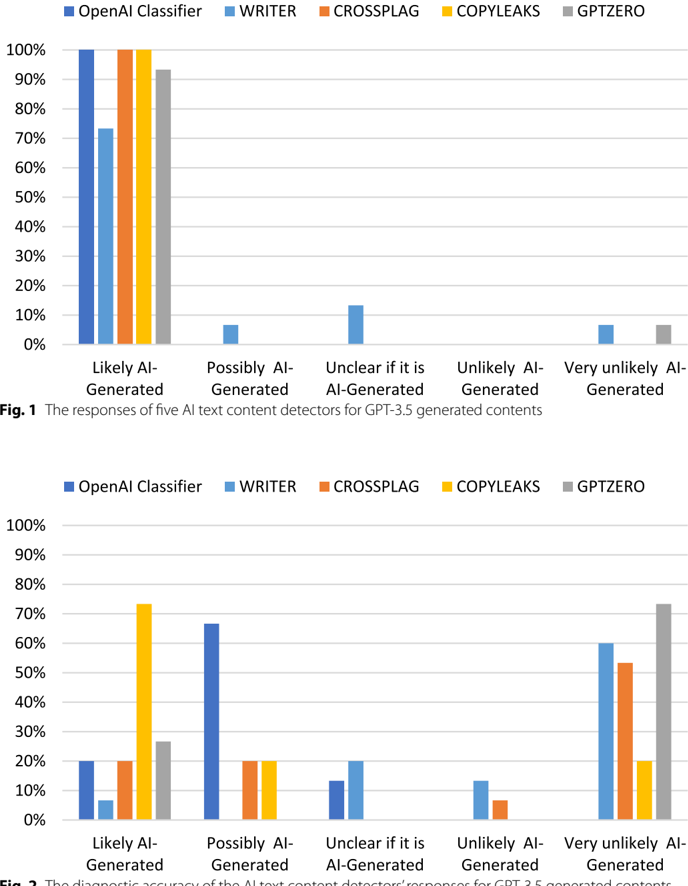
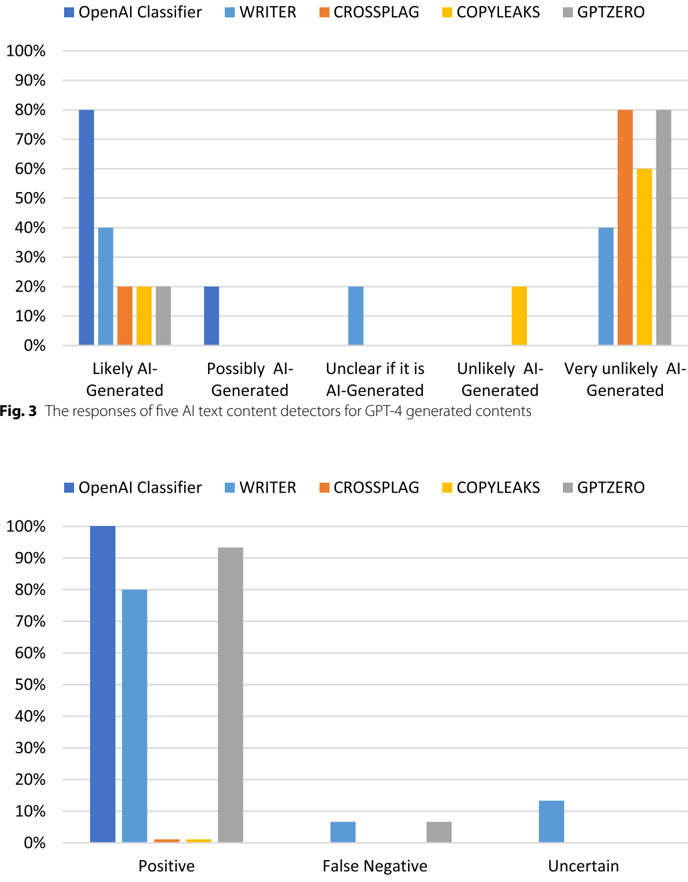
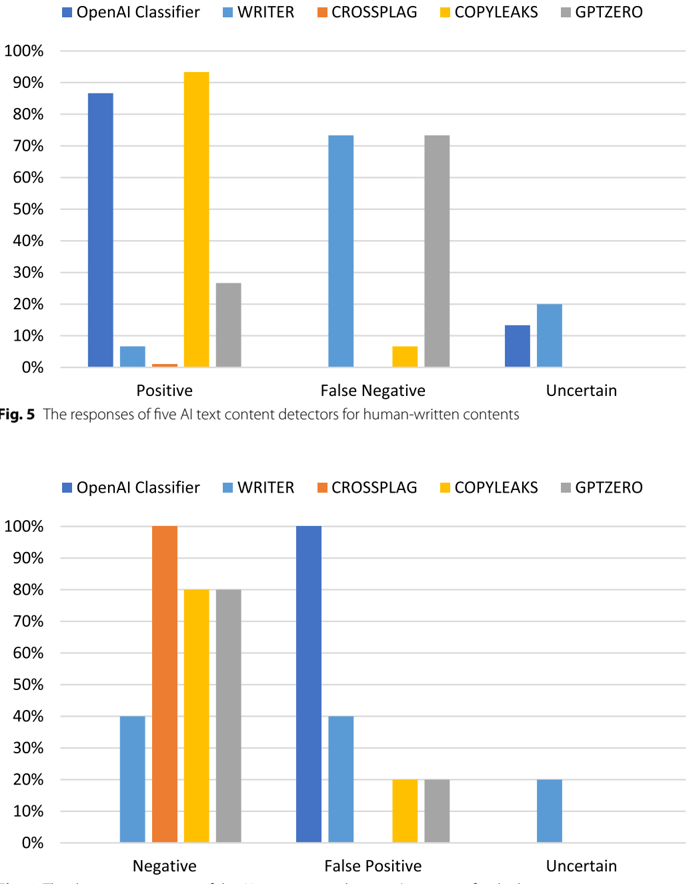
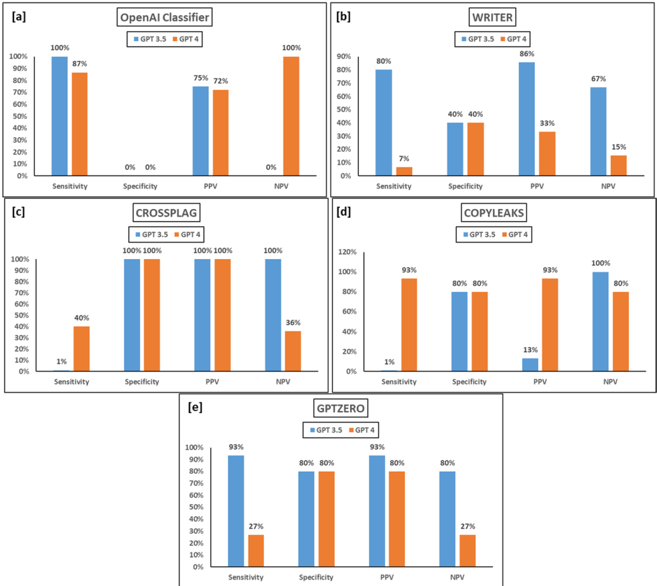
The proliferation of artificial intelligence (AI)-generated content, particularly from models like ChatGPT, presents potential challenges to academic integrity and raises concerns about plagiarism. This study investigates the capabilities of various AI content detection tools in discerning human and AI-authored content. Fifteen paragraphs each from ChatGPT Models 3.5 and 4 on the topic of cooling towers in the engineering process and five human-witten control responses were generated for evaluation. AI content detection tools developed by OpenAI, Writer, Copyleaks, GPTZero, and CrossPlag were used to evaluate these paragraphs. Findings reveal that the AI detection tools were more accurate in identifying content generated by GPT 3.5 than GPT 4. However, when applied to human-written control responses, the tools exhibited inconsistencies, producing false positives and uncertain classifications. This study underscores the need for further development and refinement of AI content detection tools as AI-generated content becomes more sophisticated and harder to distinguish from human-written text.
Overview
The claims and statistics of this paper haven’t been checked yet.
Free: it reads the open-access text and checks the first 5 claims that cite a source we can check. Create a free account to check every claim.
Integrity signals
Registry
Cites
Statistics
Figures
Verification
Claims the paper makes
The claims and statistics of this paper haven’t been checked yet.
Free: it reads the open-access text and checks the first 5 claims that cite a source we can check. Create a free account to check every claim.
Claims other papers make about this one
Each is checked against this paper’s own text: does it say what the citing paper says it does?
The source backs part of the claim, not all of it — or backs it for a different population, condition or comparison.
In the citing paper
“detection accuracy varies across writing styles and languages”
From Designing AI-resilient assessment in higher education: a four-pillar conceptual framework (2026) · cites this paper as Elkhatat et al., 2023
Experimental — accuracy not yet measuredThe source backs part of the claim, not all of it — or backs it for a different population, condition or comparison.
In the citing paper
“vendor accuracy claims routinely exceed observed performance under controlled testing”
From ARE AI DETECTORS FAIR TO EFL LEARNERS? A LIBRARY RESEARCH ON DETECTION BIAS AND ACADEMIC INTEGRITY (2026) · cites this paper as Elkhatat et al., 2023
Experimental — accuracy not yet measuredThe source backs part of the claim, not all of it — or backs it for a different population, condition or comparison.
In the citing paper
“many commercially available tools fail to achieve 80% accuracy despite exceptions among a few premium platforms”
From ARE AI DETECTORS FAIR TO EFL LEARNERS? A LIBRARY RESEARCH ON DETECTION BIAS AND ACADEMIC INTEGRITY (2026) · cites this paper as Elkhatat et al., 2023
Experimental — accuracy not yet measuredThe source backs part of the claim, not all of it — or backs it for a different population, condition or comparison.
In the citing paper
“the nature of Generative AI was such that it would be almost impossible to reliably detect AI-generated writing.”
From Generative Artificial Intelligence: Implications and Considerations for Higher Education Practice (2023) · cites this paper as [13]
Experimental — accuracy not yet measuredThe source backs part of the claim, not all of it — or backs it for a different population, condition or comparison.
In the citing paper
“However, post hoc detection systems can themselves be computationally expensive to run, and their practical usage is limited by their inconsistent performance16.”
From Scalable watermarking for identifying large language model outputs (2024) · cites this paper as [16]
Experimental — accuracy not yet measured
20 more claims about this paper
Create a free account to see every claim other papers make about this one.
Self-check
Percentages, sums and reported differences re-computed from the paper’s own numbers.
The self-check needs the paper’s full text.
Citations
Cites
Gao, C. A., Howard, F. M., Markov, N. S., Dyer, E. C., Ramesh, S., Luo, Y., & Pearson, A. T. (2022) · doi:10.1101/2022.12.23.521610 · Cited by 1,099
Gao, C. A., Howard, F. M., Markov, N. S., Dyer, E. C., Ramesh, S., Luo, Y., & Pearson, A. T. (2023) · npj Digital Medicine · doi:10.1038/s41746-023-00819-6 · Cited by 1,099
ChatGPT in higher education: considerations for academic integrity and student learning
(2023) · Journal of Applied Learning & Teaching · doi:10.37074/jalt.2023.6.1.17 · Cited by 853
Perkins, M. (2023) · Journal of University Teaching and Learning Practice · doi:10.53761/1.20.02.07 · Cited by 839 · cited 2×
“Academic misconduct in undergraduate education using ChatGPT has been widely studied (Crawford et al. 2023; King & chatGpt 2023; Lee 2023; Perkins 2023; Sullivan; et al. 2023).”
A Conversation on Artificial Intelligence, Chatbots, and Plagiarism in Higher Education
King, M. R., & chatGPT (2023) · Cellular and Molecular Bioengineering · doi:10.1007/s12195-022-00754-8 · Cited by 602
The rise of ChatGPT : Exploring its potential in medical education
Lee, H. (2024) · Anatomical Sciences Education · doi:10.1002/ase.2270 · Cited by 596 · cited 1×
“Academic misconduct in undergraduate education using ChatGPT has been widely studied (Crawford et al. 2023; King & chatGpt 2023; Lee 2023; Perkins 2023; Sullivan; et al. 2023).”
MethodCrawford, J., Cowling, M., & Allen, K.-A. (2023) · Journal of University Teaching and Learning Practice · doi:10.53761/1.20.3.02 · Cited by 547
Engineering Education in the Era of ChatGPT: Promise and Pitfalls of Generative AI for Education
Qadir, J. (2022) · doi:10.36227/techrxiv.21789434.v1 · Cited by 264
Academic Plagiarism Detection: A Systematic Literature Review
Foltýnek, T., Meuschke, N., & Gipp, B. (2020) · ACM Computing Surveys · doi:10.1145/3345317 · Cited by 238
Nhu, V.-H., Mohammadi, A., Shahabi, H., Ahmad, B. B., Al-Ansari, N., Shirzadi, A., Clague, J. J., Jaafari, A., Chen, W., & Nguyen, H. (2020) · International Journal of Environmental Research and Public Health · doi:10.3390/ijerph17144933 · Cited by 162
Research works printed but not linked: 6
- 2. Brown T, Mann B, Ryder N, Subbiah M, Kaplan JD, Dhariwal P, Neelakantan A, Shyam P, Sastry G, Askell A (2020) Language models are few-shot learners. Adv Neural Inf Process Syst 33:1877-1901
- 7. Fishman T (2009) "We know it when we see it" is not good enough: toward a standard definition of plagiarism that tran- scends theft, fraud, and copyright 4th Asia Pacific Conference on Educational Integrity, University of Wollongong NSW Australia
- 8. Foltýnek T, Meuschke N, Gipp B (2019) Academic Plagiarism Detection. ACM Comput Surv 52(6):1-42. https:// doi. org/ 10. 1145/ 33453 17 · DOI · Paper page
- 10. Frye BL (2022) Should Using an AI Text Generator to Produce Academic Writing Be Plagiarism? Fordham Intellectual Property, Media & Entertainment Law Journal. https:// ssrn. com/ abstr act= 42922 83
- 21. Radford A, Wu J, Child R, Luan D, Amodei D, Sutskever I (2019) Language models are unsupervised multitask learners. OpenAI Blog 1(8):9
- 22. Radford A, Narasimhan K, Salimans T, Sutskever I (2018) Improving language understanding by generative pre-training
Cited by
Items 201–300 of 403
Ethical Dilemmas in AI-Driven Advertising
Paker, S. (2025) · Özgür Yayınları eBooks · doi:10.58830/ozgur.pub710.c3025 · Cited by 3
Integrating AI in Cybersecurity Higher Education: A Path to Workforce Readiness
Roshanaei, M., & Jachura, M. G. (2025) · Journal of Intelligent Learning Systems and Applications · doi:10.4236/jilsa.2025.172005 · Cited by 7
Nath, V., & Arya, A. (2025) · Approaches to global sustainability, markets, and governance · doi:10.1007/978-981-96-0843-0_18 · Cited by 1
Balahadia, F. F. (2025) · AIP conference proceedings · doi:10.1063/5.0262061 · Cited by 2
Okafor, P.-E., Udosen, A. N., & Igboanugo, B. I. (2025) · AI and Ethics · doi:10.1007/s43681-025-00714-8 · Cited by 3
Detection of AI-Generated Text
Bharadwaj, R., Dugad, R., Gile, A., Patil, G., & Hatyalikar, S. (2024) · International Conference on Progressive Innovations in Intelligent Systems and Data Science (ICPIDS) · doi:10.1109/icpids65698.2024.00032 · Cited by 2
“[ 29] Ziegler et al.’s study suggests that online data collection was essential for achieving optimal summarization results, but fully online methods introduced significant challenges: 1.”
Transformer-Based Approach for Detecting LLM-Generated Scientific Text
Bader, A., & Alhijawi, B. (2025) · International Conference on New Trends in Computing Sciences (ICTCS) · doi:10.1109/ictcs65341.2025.10989343 · Cited by 4
“Elkhatat et al. [17] evaluated the effectiveness of various AI detectors and classifier tools, including OpenAI, Writer, Copyleaks, GPTZero, and CrossPlag, in distinguishing between human-authored content and AI-generated text.”
Detectability Analysis of AI-generated Research Articles
Neeraj, Rahman, M. M., Kabir, M. L., & Kabir, S. (2024) · International Conference on Computer and Information Technology (ICCIT) · doi:10.1109/iccit64611.2024.11021828 · Cited by 1
English Teachers’ Experiences with Artificial Intelligence-Driven Students’ Outputs in the Classroom
Bandao, R. B. (2025) · International Journal of Innovative Science and Research Technology · doi:10.38124/ijisrt/25jul299 · Cited by 2
Defining dangerous AI: existential risk, power-intelligence, and the limits of AGI
Sass, R. (2025) · AI and Ethics · doi:10.1007/s43681-025-00790-w · Cited by 6
Large Language Models in Graduate Information Science Education: Benefits and Challenges
Xiang, S., Deng, H., Liu, J., & Wu, J. (2025) · International Conference on Computer Science and Technologies in Education (CSTE) · doi:10.1109/cste64638.2025.11092151 · Cited by 2
“Recent investigations provide valuable insights into the efficacy of AI content detection tools, focusing on developing reliable mechanisms for differentiating between human and AI-generated text [15].”
Hansen, J. M., Ferrell, O. C., Ferrell, L. K., Levin, M. A., Wilson, P., & Cloud, K. (2025) · Journal of Macromarketing · doi:10.1177/02761467251363569 · Cited by 4
“We have seen similar programs used to detect GenAI usage in student writing incorrectly fl ag original work as AI-generated (e.g., Dalalah & Dalalah, 2023; Elkhatat et al., 2023).”
Terradillos, J. O., Ureta, A. L., & Peña-Fernández, S. (2025) · Revista de Comunicación · doi:10.26441/rc24.2-2025-3891 · Cited by 2
AI-ASSISTED SCHOLARLY WRITING IN EDUCATION: A SCOPING REVIEW (2019–2024)
Jandildinov, M., & Yersultanova, G. (2024) · Habaršy. Pedagogika ġylymdary seriâsy · doi:10.51889/2959-5762.2025.87.3.003 · Cited by 7
Beyond the human pen: The role of artificial intelligence in literary creation
Ali, E. H. F., Kottaparamban, M., Ahmed, F. E. Y., Usmani, S., Hamd, M., Ibrahim, M. K., & Hamed, S. (2025) · Research Journal in Advanced Humanities · doi:10.58256/c0ymkm61 · Cited by 12
“While AI is often framed as a tool for increasing efficiencies in creative activities, risks related to over-reliance and scholarly dishonesty have raised hesitancies about AI within the academic and professional context (Elkhatat et al, 2023).”
Alharthi, R. S., Ojo, S., Nathaniel, T. I., Samee, N. M. A., Umer, M., Jamjoom, M. M., Alsubai, S., & Khan, J. (2025) · International Journal of Computational Intelligence Systems · doi:10.1007/s44196-025-01025-w · Cited by 5
“Similarly, Elkhatat et al. [19] investigated the efficacy of AI detection methods in identifying AI-generated text from human-generated text.”
The Reliability of AI Text Detectors on Filipino Student Essays
Chan, A. L., Chua, R. C., Rio, D. D., Lee, B. C., Ong, R. E., & Tiam-Lee, T. J. (2025) · Lecture notes in networks and systems · doi:10.1007/978-3-032-05070-0_5 · Cited by 2
Eren, S. U. N. A., & Özer, M. (2025) · Advances in computational intelligence and robotics book series · doi:10.4018/979-8-3373-7579-3.ch008 · Cited by 1
AI-generated language in introductory physics lab reports in the first year of ChatGPT
Arvidsson, K. (2025) · Discover Artificial Intelligence · doi:10.1007/s44163-025-00742-7 · Cited by 4
“Elkhatat et al. [20] defined ‘sensitivity’ as true positive rate (AI-generated content correctly identified as AI) and ‘specificity’ as true negative rate (human writing correctly classified as human).”
Afuwape, K. (2025) · Journal of Digital Technologies and Law · doi:10.21202/jdtl.2025.27 · Cited by 2
“To deal with plagiarism involving AI tools, new approaches, such as ChatZero and AI Text Classifier, which can distinguish AI and human writings, have been proposed (Elkhatat et al., 2023).”
McLeod, G. M., Hanks, B., Ashby, H., Nolder, J., Sorenson, B., & Hanson, K. (2026) · Journal of Chemical Education · doi:10.1021/acs.jchemed.5c00979 · Cited by 1
Natural language processing in impact assessment: a review of applications and concerns
Hung, S. F., kumar, P., & Fischer, T. B. (2026) · Impact Assessment and Project Appraisal · doi:10.1080/14615517.2026.2620186 · Cited by 4
“There are also AI-generated text detector tools on the market (e.g. Quillbot and Pangram Labs), despite that the accuracy and reliability of these tools are often found to be inconsistent (Elkhatat et al. 2023; Weber-Wulff et al. 2023).”
On the troubling rise of generative AI suspicion in academic publishing
Ciriello, R. (2026) · Nature Machine Intelligence · doi:10.1038/s42256-026-01178-z · Cited by 4
Peterson, C., Anderson, C., Berdine, G. G., & NUGENT, K. M. (2026) · Journal of Electronic Resources in Medical Libraries · doi:10.1080/15424065.2026.2626575 · Cited by 2
“Artificial intelligence detection software is available, though this software can suffer from low accuracy and widely varying success across iterations of LLMs, as well as a high rate of false positives (Elkhatat et al., 2023; Odri & Ji Yun Yoon, 2023; Weber-Wulff et al., 2023).”
Human versus AI generated text classification using deep learning and transformers
Priyadarshini, I., Chatterjee, J. M., & Rawat, P. (2026) · Neural Computing and Applications · doi:10.1007/s00521-026-11872-z · Cited by 3
AI detectors, student anxiety, and authorial alienation: a qualitative study of affective control
Ardana, S. G., & Christiana, M. (2026) · Teaching in Higher Education · doi:10.1080/13562517.2026.2643825 · Cited by 3
“As a result, these tools generate numerous false positives, while those intent on evading detection can do so with minimal effort (Elkhatat et al. 2023; Giray 2024; Gotoman et al. 2025; Liang et al. 2023).”
Isaeva, R., CANER, H. N., Caner, M., Giray, L., & Karadağ, E. (2026) · Computers and Education Artificial Intelligence · doi:10.1016/j.caeai.2026.100606 · Cited by 18
GPTZero and the challenges of AI detection in assessing writing
Giray, L., Sevnarayan, K., & Maphoto, K. B. (2026) · Assessing Writing · doi:10.1016/j.asw.2026.101078 · Cited by 3
From Planning to Revision: How AI Writing Support at Different Stages Alters Ownership
Gero, K. I., Long, T., Schnitzler, C., & Dhillon, P. S. (2026) · Designing Interactive Systems Conference · doi:10.1145/3800645.3813003 · Cited by 5
“Below are the IELTS band descriptors for bands 9, 6, and 3 – note that the reference document used [29] contains descriptors for all bands 0 to 9; we report three bands here to be representative and readers can reference the source document for complete descriptions.”
Trust the machine or the human? A dynamic neuro-cognitive model of AIGC credibility assessment
Liu, J., Sun, M., & Xu, T. (2026) · Acta Psychologica · doi:10.1016/j.actpsy.2026.107222 · Cited by 2
Automated integrity or automated injustice? Turnitin’s AI detection in multilingual writing contexts
Maphoto, K. B., Giray, L., & Sevnarayan, K. (2026) · Assessing Writing · doi:10.1016/j.asw.2026.101086 · Cited by 2
Hutson, J., Poyer, K., Ogoe, E., & Atologun, K. A. (2026) · Trends in Higher Education · doi:10.3390/higheredu5030059 · Cited by 1
“Elkhatat, Elsaid, and Almeer [22], likewise, found uneven performance across AI detection systems, reinforcing the conclusion that no detector should be treated as a definitive adjudicator of misconduct.”
Mann, J., & Stumpf-Wollersheim, J. (2026) · Journal of Business Economics · doi:10.1007/s11573-026-01268-9 · Cited by 3
“While AI detection software offers swift post hoc assessments, it provides only an indication, can become outdated, and requires profound technical knowledge and validation when developed for task–specific purposes (Elkhatat et al. 2023; Veselovsky et al. 2023).”
Ortopedi ve travmatoloji araştırmalarında yapay zekâ uygulamaları: Doğal dil işleme potansiyeli
Köse, Ö., Yapar, D., & Boz, M. (2024) · Türk Ortopedi ve Travmatoloji Birliği Derneği · doi:10.5578/totbid.dergisi.2024.13 · Cited by 3
“[58,59] Yapay zekâ tarafından oluşturulan içerik daha karmaşık hâle geldikçe ve insan tarafından yazılan metinden ayırt edilmesi zorlaştıkça, YZ içerik tespit araçlarının daha fazla geliştirilmesi ve iyileştirilmesi gerekmektedir.”
The Role of Research Obsession in Shifting ChatGPT into a Plagiarism Tool
Hazaymeh, O. M.-A. A. (2024) · International Journal of Applied Research and Sustainable Sciences · doi:10.59890/ijarss.v2i1.1277 · Cited by 1
The Potential Future With ChatGPT Technology and AI Tools
Israni, R. K. (2024) · Advances in computational intelligence and robotics book series · doi:10.4018/979-8-3693-6824-4.ch013 · Cited by 1
An Academic Librarian’s Experience Using Text-Matching Software as a Teaching Tool
Earp, V. J. (2024) · Ethics and integrity in educational contexts · doi:10.1007/978-3-031-65731-3_4 · Cited by 1
Tools for Enhancing Research Outputs through AI Content Creation: An Analytical Review
Rajesh, A., & Satish, P. (2024) · Journal of Information and Knowledge · doi:10.17821/srels/2024/v61i4/171504 · Cited by 2
Use of AI in family medicine publications: a joint editorial from journal editors
Schrager, S., Seehusen, D. A., Sexton, S. M., Richardson, C. R., Neher, J. O., Pimlott, N., Bowman, M., Rodíguez, J., Morley, C. P., Li, L., et al. (2025) · Evidence-Based Practice · doi:10.1097/ebp.0000000000002338 · Cited by 1
Use of AI in Family Medicine Publications: A Joint Editorial From Journal Editors
Schrager, S., Seehusen, D. A., Sexton, S. M., Richardson, C. R., Neher, J. O., Pimlott, N., Bowman, M. A., Rodríguez, J. E., Morley, C. P., Li, L., et al. (2025) · Family Medicine · doi:10.22454/fammed.2025.466696 · Cited by 6
Improving Term Weight with Normalized Class Mutual Information for Sentiment Classification
Buatoom, U., Rojanavasu, P., Cheawahan, K., & Foithong, S. (2024) · International Conference on Business and Industrial Research (ICBIR) · doi:10.1109/icbir61386.2024.10875727 · Cited by 1
“Recently, Elkhatat et al. (2023) propose a set of parameters for assessing the efficacy of AI text content detectors.”
Enhancing Educational Future by Integrating Artificial Intelligence in Language Curriculum
Arya, L., Bhatnagar, M., Cheekati, V. R., Rastogi, R., & Pradeep Mohan Kumar, K. (2025) · Advances in computational intelligence and robotics book series · doi:10.4018/979-8-3693-9606-3.ch006 · Cited by 1
Detecting LLM-Generated Short Answers and Effects on Learner Performance
Bhushan, S., Thomas, D. R., Borchers, C., Raghuvanshi, I., Abboud, R., Gatz, E., Gupta, S., & Koedinger, K. R. (2025) · Lecture notes in computer science · doi:10.1007/978-3-032-03870-8_4 · Cited by 7
Yin, Z., Wang, Z., Palikhe, A., & Zhang, W. (2025) · ACM International Conference on Information and Knowledge Management (CIKM) · doi:10.1145/3746252.3761450 · Cited by 9
Embedding Generative AI as a digital capability into a year-long MSc skills programPreprint
Smith, D. P., Sokoya, D., Moore, S., Okonkwo, C., Boyd, C., Lacey, M. M., & Francis, N. (2024) · Research Square · doi:10.21203/rs.3.rs-5204546/v1 · Cited by 1
AI in research and publication: prioritizing content over language
Mondal, H. (2024) · European Archives of Oto-Rhino-Laryngology · doi:10.1007/s00405-024-09028-7 · Cited by 1
Use of AI in Family Medicine Publications: A Joint Editorial From Journal Editors
Schrager, S., Seehusen, D. A., Sexton, S. M., Richardson, C. R., Neher, J. O., Pimlott, N., Bowman, M. A., Rodríguez, J. E., Morley, C. P., Li, L., et al. (2025) · PRiMER · doi:10.22454/primer.2025.889328 · Cited by 1
Being Sceptical: Book Reviewing, Artificial Intelligence and Intellectual Integrity
Tomaselli, K. G., & Wu, Y. (2026) · Critical Arts · doi:10.1080/02560046.2026.2663111 · Cited by 1
Designing AI-resilient assessment in higher education: a four-pillar conceptual framework
Nikolić, D., & Basta Nikolić, M. (2026) · Frontiers in Artificial Intelligence · doi:10.3389/frai.2026.1841682 · Cited by 1
ARE AI DETECTORS FAIR TO EFL LEARNERS? A LIBRARY RESEARCH ON DETECTION BIAS AND ACADEMIC INTEGRITY
Patty, J., & Matatula, M. Y. (2026) · J-Shelves of Indragiri (JSI) · doi:10.61672/jsi.v8i1.3557
“…verdicts, that many commercially available tools fail to achieve 80% accuracy despite exceptions among a few premium platforms, and that vendor accuracy claims routinely exceed observed performance under controlled testing (Elkhatat et al., 2023; Walters, 2023; Weber-Wulff et al., 2023).”
GİRAY, L., CANER, H. N., & AMOOZEGAR, A. (2026) · Journal of Narrative and Language Studies · doi:10.59045/nalans.2026.109
The Due Process Deficit: Auditing AI Governance in U.S. Higher Education
Teleki, M., Choi, A. S. G., Duray, A., Liu, H., Zhang, J., Dong, X., Da Silva, D., Koenecke, A., & Caverlee, J. (2026) · Proceedings of the 2026 ACM Conference on Fairness, Accountability, and Transparency · doi:10.1145/3805689.3812328
Chatbot, fictitious authoring, and pre- and post-publication quality control
Daungsupawong, H., & Wiwanitkit, V. (2024) · Medical Journal Armed Forces India · doi:10.1016/j.mjafi.2023.11.006
The Effects of ChatGPT on Economic Development
Wu, M. (2024) · Highlights in Business Economics and Management · doi:10.54097/tymwwt88 · Cited by 3
“This can be used as a reference that ChatGPT can be implacable in education which brings to business revenue for the company [20].”
MethodChatGPT Innovation in Higher Education
Hajjaj, N. A. (2024) · Advances in educational technologies and instructional design book series · doi:10.4018/979-8-3693-0831-8.ch004
Ren, D., & Roland, D. (2024) · Pediatric Research · doi:10.1038/s41390-024-03217-0
Lee, Y., & Kim, N. (2024) · Journal of Korean society of Dental Hygiene · doi:10.13065/jksdh.20240018
CREATIVE BUSINESS MANAGEMENT AND IMPLEMENTATION OF NEW IDEAS
International Science Group, & Vladlenov, D. (2024) · doi:10.46299/isg.p.2024.1.19
Hamid, A. R. A. H. (2024) · Medical Journal of Indonesia · doi:10.13181/mji.ed.247530
Exploring Research Trends and Potential in Conjunction With ChatGPT and Other AI Tools
Israni, R. K. (2024) · Advances in computational intelligence and robotics book series · doi:10.4018/979-8-3693-6824-4.ch001
Atieku-Boateng, H., Osei, R. D., Aryee, V., Essien, L., & Atieku-Boateng, B. (2024) · Research Square · doi:10.21203/rs.3.rs-4550887/v1 · Cited by 1
Determining Whether a Turkish Text is Produced by Artificial Intelligence or Human
Er, R. N., & ÇOĞALMIŞ, K. N. (2024) · IEEE International Conference on Computing and Machine Intelligence (ICMI) · doi:10.1109/icmi60790.2024.10585770
“The proliferation of AI-generated content, particularly from models such as ChatGPT, raises concerns about plagiarism, posing potential challenges to academic integrity [4].”
Background6th International Conference on Advanced Research Methods and Analytics - CARMA 2024
Conference, C., Domenech, J., Vicente, M. R., & de Pedraza, P. (2024) · doi:10.4995/carma2024.2024.19017
West, H., Gillin, M. S. J., de Viggiani, J., Sedghi, G., & Luzyanin, K. V. (2024) · Developing Academic Practice · doi:10.3828/dap.2024.8
Jovanović, S., Bukumira, A., Vojinović, O., Ilkovski, P., Ristić, J., & Milentijcvić, I. (2024) · International Conference on Electrical, Electronic and Computing Engineering (IcETRAN) · doi:10.1109/icetran62308.2024.10645093 · Cited by 1
“Related studies use precision and recall [5], or accuracy [6] to evaluate the performance of detectors.”
BackgroundNavigating the Role of Artificial Intelligence in Post-Secondary Educational Spaces
Sommer, T. J. (2024) · Advances in higher education and professional development book series · doi:10.4018/979-8-3693-3904-6.ch002
Estimating the Prevalence of Generative AI Use in Medical School Application EssaysPreprint
Spies, N. C., Ratts, V. S., & Hagemann, I. S. (2024) · medRxiv · doi:10.1101/2024.10.21.24315868
Use of AI in Family Medicine Publications: A Joint Editorial From Journal Editors
Schrager, S., Seehusen, D. A., Sexton, S. M., Richardson, C. R., Neher, J. O., Pimlott, N., Bowman, M. A., Rodríguez, J. E., Morley, C. P., Li, L., et al. (2025) · The Annals of Family Medicine · doi:10.1370/afm.240575
The Role of AI in Enhancing Professional Performance Among Bahraini Journalists
Juma, M., Badran, S. A., Falamarzi, A., & Alabd, A. M. (2025) · Studies in systems, decision and control · doi:10.1007/978-3-031-84636-6_23
Perceptions of Students and Teachers about Hindrances of ChatGPT in Foreign Language Education
Küçük, T. (2025) · Arab World English Journal · doi:10.24093/awej/ai.12 · Cited by 2
“As a result of many studies, many students have stated that the information and outputs they obtain through artificial intelligence are far from depth and originality (Elkhatat, et al., 2023; Kucuk, 2024).”
AI Guarded Code Editor: Verifying Authentic Human Input
Raghunandan, A., Aishwarya, A. G., Khan, M. A., Nishant, S., & Panimozhi, K. (2025) · International Conference on Computing for Sustainability and Intelligent Future (COMP-SIF) · doi:10.1109/comp-sif65618.2025.10969913
Language Course Writing Task and AI-Generated Writing Detection: An Ethical Concern
Lau, Y. L., Bakar, A. L. A., Chau, S. K., Sik, R. Y., Yap, J. T. K., Yong, H. W., Tan, J. C., & Ambikapathy, A. (2025) · Advances in computational intelligence and robotics book series · doi:10.4018/979-8-3693-7260-9.ch012 · Cited by 1
Unveiling the Source: Differentiating Human and Machine-Generated Texts in a Multilingual Setting
Chhatwal, G. S., & Zhao, J. (2024) · IEEE/WIC/ACM International Conference on Web Intelligence and Intelligent Agent Technology (WI-IAT) · doi:10.1109/wi-iat62293.2024.00029
“One such study comparing content detection tools developed by OpenAI, Writer, Copyleaks, GPTZero, and CrossPlag showed that the tools were generally more successful in identifying GPT 3.5-generated content compared to GPT 4-generated content and human-written content [30].”
InfluentialHuman vs AI: Evaluating the Effectiveness of Deep Learning in AI Text Detection
Rahman, T., Mizan, M. M. R., Mahmud, T., Roy, S., Uddin, M. K., Redhi, H. H. K., Priya, S. R., Hanip, A., & Hossain, M. S. (2024) · International Conference on Computer and Information Technology (ICCIT) · doi:10.1109/iccit64611.2024.11021749 · Cited by 1
“Studies like Elkhatat et al. (2023) [20] revealed inconsistencies in detection tools, particularly with false positives in human-written control responses.”
Transforming Education: The Potential of Generative AI Tools for Improving Learning Experience
Finco, M. D., Dantas, V. R., Queiroz, L. R. D. C., & Calado, M. D. L. (2025) · Springer series on cultural computing · doi:10.1007/978-3-031-86551-0_5
Latsabidze, N. (2025) · Advances in computational intelligence and robotics book series · doi:10.4018/979-8-3373-1952-0.ch006
Willingness of Users to Accept AI Content Creation
Kubovics, M. (2025) · European Business & Management · doi:10.11648/j.ebm.20251102.12
Evaluating the Accuracy of AI Content DetectorsPreprint
YILDIZ, F. E., Karaarslan, E., & Aydın, Ö. (2025) · SSRN Electronic Journal · doi:10.2139/ssrn.5364392
Utilizing AI Text Checkers: Case Studies and Implications
Shawe, R. (2025) · International Journal of Intelligence Science · doi:10.4236/ijis.2025.153007 · Cited by 2
Herrera, P. D. P. (2025) · Advances in computational intelligence and robotics book series · doi:10.4018/979-8-3373-1057-2.ch011 · Cited by 1
Анатольевич, С. А. (2025) · ACM Joint European Software Engineering Conference and Symposium on the Foundations of Software Engineering (ESEC/FSE) · doi:10.1145/3696630.3727230
“These advanced tools generate highly coherent, contextually appropriate responses that often escape detection by traditional plagiarism systems like Turnitin [2, 8].”
The Power of Patterns in Detecting News Articles Written by AI
Sicard-Noel, L., Wu, E., & Wu, C. (2025) · IEEE International Conference on Artificial Intelligence Testing (AITest) · doi:10.1109/aitest66680.2025.00010
“Several studies have evaluated the capacities of existing detection tools: 1) Tool Comparison Studies: Elkhatat et al. [5] evaluated five AI text detectors (OpenAI, Writer, Copyleaks, GPTZero, and CrossPlag) using fifteen paragraphs generated by Chat-GPT Models 3.5 and 4, along with five…”
InfluentialTextGuardian—AI-Generated Text Detector
Shaik, M. A. A., Shaik, M. S., & Behera, N. K. (2025) · Lecture notes in networks and systems · doi:10.1007/978-981-96-4151-2_34
Identification of AIGC and human-generated implicitly toxic content on social media
Deng, S., Wang, F., Pan, M., Yao, S., & Lei, X. (2025) · Journal of Information Science · doi:10.1177/01655515251365575
Detecting AI-Generated Filipino Text: A Synthetic Data Approach with Pre-Trained LLMs
Ong, C., & Cheng, C. K. (2025) · International Conference on Asian Language Processing · doi:10.1109/ialp68296.2024.11156751
“This could also be due to the entire task itself being difficult, as found in [4]–[6].”
Almulla, N. (2025) · Open Journal of Modern Linguistics · doi:10.4236/ojml.2025.155044 · Cited by 3
Evaluating the Reliability of Generative AI in Distinguishing Machine from Human Text
Yuhefizar, Y., Watrianthos, R., & Marzuki, D. (2025) · Data & Metadata · doi:10.56294/dm20251181 · Cited by 1
A Literature Review on AI Detection: Investigating the Potential of Authorship Attribution Methods
van Rensburg, Z. J. (2025) · Ethics and integrity in educational contexts · doi:10.1007/978-3-031-98157-9_1
Ensemble Approach for Detection of AI-Generated Text Using Machine Learning Models
Pardey, M. A., & Ghode, S. D. (2025) · Springer eBooks · doi:10.1007/978-3-031-92854-3_14
Merino, M., & Duarte, S. R. (2025) · Advances in computational intelligence and robotics book series · doi:10.4018/979-8-3373-7574-8.ch004
Miskell, C., Slhoub, K., & Mensi, N. (2025) · Lecture notes in networks and systems · doi:10.1007/978-3-032-07992-3_17
Algorithms Evaluation and Challenges in Automated Hate Speech Detection for Generative AI
Jain, R., Sharma, A., Pulipati, V., Khilji, N., & Saxena, R. (2025) · Advances in computational intelligence and robotics book series · doi:10.4018/979-8-3373-3063-1.ch004
Khaleel, F., Harte, P., & Avdukić, A. (2025) · Emerald Group Publishing Limited eBooks · doi:10.1108/978-1-83549-788-320251030
AI Generated Text Detection using LORA based fine-tuning of LLM Models
Akhilesh, P., Chennupati, A., Prahas, B., Jasvitha, B. D., & Venugopalan, M. (2025) · World Conference on Communication & Computing (WCONF) · doi:10.1109/wconf64849.2025.11233554 · Cited by 3
“Elkhatat et al. [13] investigated the effectiveness of a number of AI content detection tools.”
Generative AI's impact on creativity and equity: Another great equalizer or the rich get richer?
Wang, S., Ness, I. J., Greiff, S., & Kaufman, J. C. (2025) · Elsevier eBooks · doi:10.1016/b978-0-443-34073-4.00012-5 · Cited by 1
Redefining academic integrity: patterns of assignment cheating with generative AI tools
Erdoğmuş, Y. K., & Uygur, S. S. (2025) · AI and Ethics · doi:10.1007/s43681-025-00863-w · Cited by 1
“Elkhatat et al. [38] emphasized that the performance and sensitivity of AI detection tools should be re-evaluated to ensure academic honesty.”
Strengthening authorship transparency for letters to the editor
Marsden, J., Jarvis, M., & Humphreys, K. N. (2025) · Addiction · doi:10.1111/add.70270
Väkevä, L., & Partti, H. (2025) · Springer eBooks · doi:10.1007/978-3-031-99804-1_9 · Cited by 4
Morales, Ó. A. (2025) · Revista Ciencias y Artes · doi:10.37211/2789.1216.v3.n2.181
Detection of AI-Generated texts with BERT variants
Balara, V., & Machová, K. (2025) · International Conference on Emerging eLearning Technologies and Applications (ICETA) · doi:10.1109/iceta67772.2025.11280096
“Numerous online providers with high self-proclaimed accuracy, such as GPTZero, CopyLeaks and CrossPlag [18] offer their services for this task, however in research environment [19] the results do deviate significantly from these claims, pointing out the large space for improvement in order to…”
Metadata
- Authors
- Elkhatat, A. M., Elsaid, K., & Almeer, S.
- Affiliations
- Qatar University (QA)
- Texas A&M University at Qatar (QA)
- Corresponding author
- Elkhatat, Ahmed M.
- Venue
- International Journal for Educational Integrity
- Published
- 2023-09-01
- Volume
- 19
- Issue
- 1
- ISSN
- 1833-2595 (ISSN-L)
- OpenAlex
- W4386317922
- Cited by
- 392
- References
- 17
- Citations by year
- 2026: 130 · 2025: 132 · 2024: 119 · 2023: 10
- FWCI
- 98.09
- Type
- journal article
- Language
- en
- Open access
- gold
- doi.org
- Licence
- cc-by
- creativecommons.org/licenses/by/4.0 (tdm)
- creativecommons.org/licenses/by/4.0 (vor)
- Locations
- International Journal for Educational Integrity (publishedVersion, cc-by)
- Qatar University QSpace (Qatar University) (submittedVersion, other-oa)
- DOAJ (DOAJ: Directory of Open Access Journals) (submittedVersion, cc-by-sa)
- Funders
- Qatar National Library
- Topics
- Social Sciences › Education › Academic integrity and plagiarism
- Social Sciences › Education › Artificial Intelligence in Education
- Physical Sciences › Computer Science › Artificial Intelligence › Authorship Attribution and Profiling
- Keywords
- AI-generated text detection, ChatGPT, GPT-3.5, GPT-4, academic integrity, plagiarism, human vs AI text classification, false positives, GPTZero, cooling towers
About these checks
Registry, retraction, Cites and statistics results are computed, not judged, with one exception: a printed reference that no index lists is read once by a model before it counts as a citation error. Claims are extracted by a model and kept only when their quote appears verbatim in the text; each cited source is then checked, with a model’s help, for whether it says what the claim relies on. Those verdicts can be wrong — read the claim’s quote and the cited source before relying on one.
Statistics and arithmetic are recomputed, not judged.
Confidence bands are shown only for fields calibrated on our annotated test set. None is calibrated yet, so no band is shown.
What counts as a claim ›How we measure confidence ›How we check this ›
Are you an author, or do you see a problem with this page? Request a review
Data sources
Bibliographic data: Semantic Scholar, OpenAlex, Crossref.
Contains information from the Semantic Scholar Academic Graph Datasets, made available under the ODC Attribution License (ODC-BY 1.0).
Semantic Scholar’s data is described in: Kinney, R., et al. (2023). The Semantic Scholar Open Data Platform. arXiv:2301.10140.
