

Evaluating the efficacy of AI content detection tools in differentiating between human and AI-generated text
Open accessThe DOI matches its Crossref record; 18 of the 18 references it cites were found in a registry or an index.
Abstract
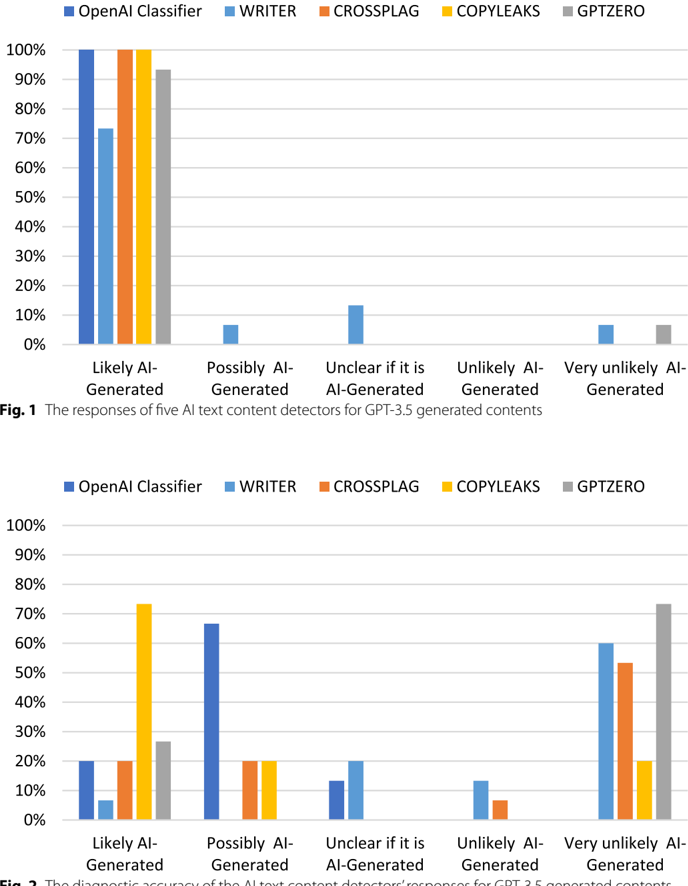
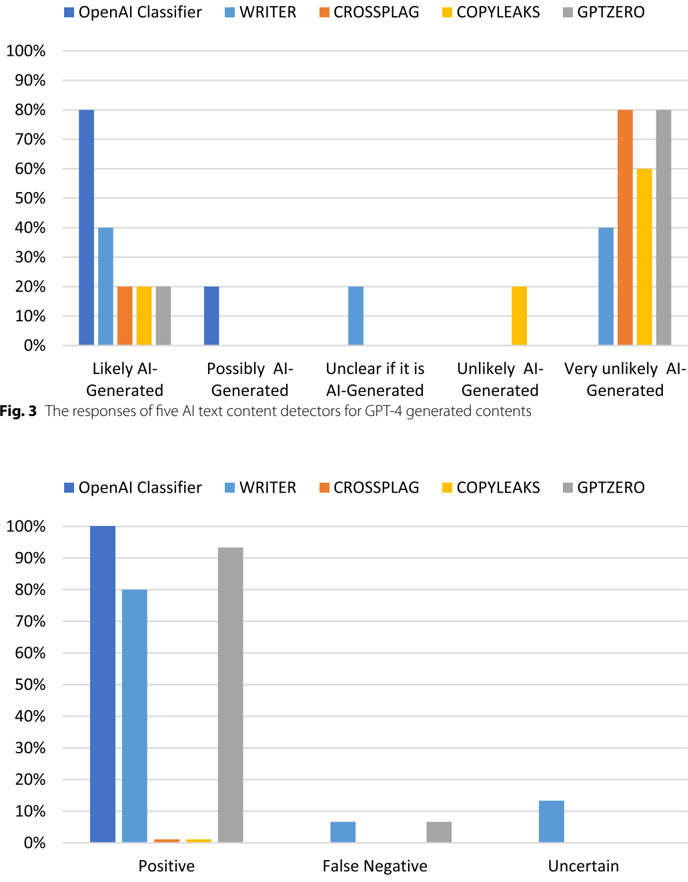
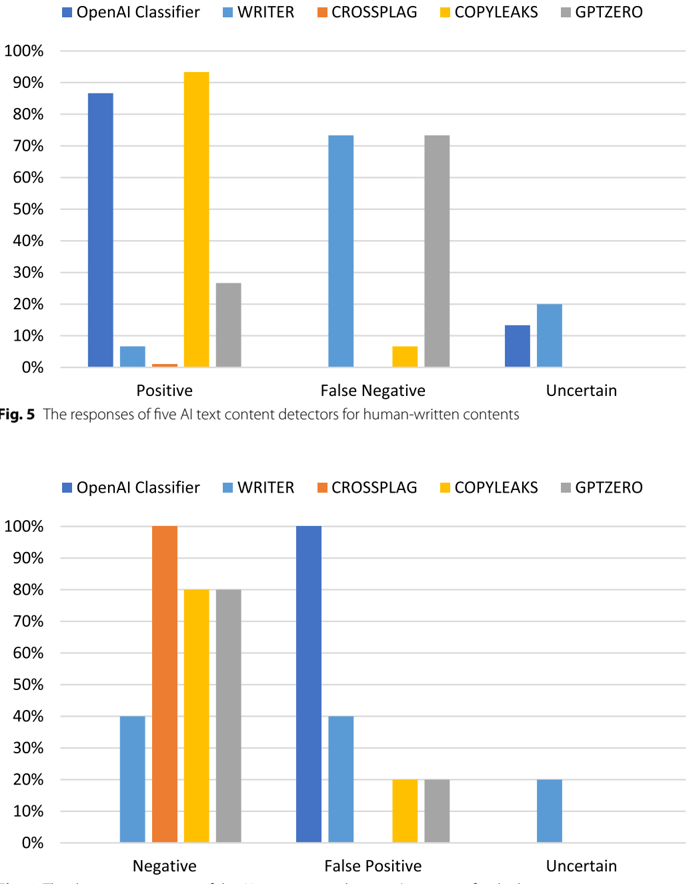
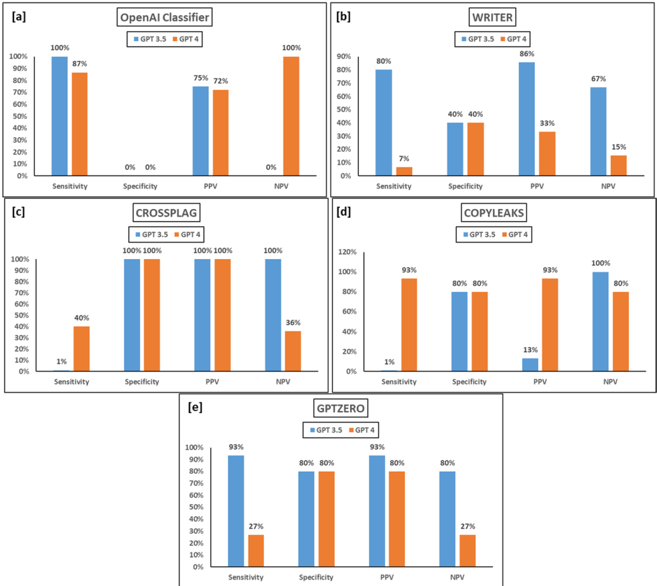
The proliferation of artificial intelligence (AI)-generated content, particularly from models like ChatGPT, presents potential challenges to academic integrity and raises concerns about plagiarism. This study investigates the capabilities of various AI content detection tools in discerning human and AI-authored content. Fifteen paragraphs each from ChatGPT Models 3.5 and 4 on the topic of cooling towers in the engineering process and five human-witten control responses were generated for evaluation. AI content detection tools developed by OpenAI, Writer, Copyleaks, GPTZero, and CrossPlag were used to evaluate these paragraphs. Findings reveal that the AI detection tools were more accurate in identifying content generated by GPT 3.5 than GPT 4. However, when applied to human-written control responses, the tools exhibited inconsistencies, producing false positives and uncertain classifications. This study underscores the need for further development and refinement of AI content detection tools as AI-generated content becomes more sophisticated and harder to distinguish from human-written text.
Overview
The claims and statistics of this paper haven’t been checked yet.
Free: it reads the open-access text and checks the first 5 claims that cite a source we can check. Create a free account to check every claim.
Integrity signals
Registry
Cites
Statistics
Figures
Verification
Claims the paper makes
The claims and statistics of this paper haven’t been checked yet.
Free: it reads the open-access text and checks the first 5 claims that cite a source we can check. Create a free account to check every claim.
Claims other papers make about this one
Each is checked against this paper’s own text: does it say what the citing paper says it does?
The source backs part of the claim, not all of it — or backs it for a different population, condition or comparison.
In the citing paper
“detection accuracy varies across writing styles and languages”
From Designing AI-resilient assessment in higher education: a four-pillar conceptual framework (2026) · cites this paper as Elkhatat et al., 2023
Experimental — accuracy not yet measuredThe source backs part of the claim, not all of it — or backs it for a different population, condition or comparison.
In the citing paper
“vendor accuracy claims routinely exceed observed performance under controlled testing”
From ARE AI DETECTORS FAIR TO EFL LEARNERS? A LIBRARY RESEARCH ON DETECTION BIAS AND ACADEMIC INTEGRITY (2026) · cites this paper as Elkhatat et al., 2023
Experimental — accuracy not yet measuredThe source backs part of the claim, not all of it — or backs it for a different population, condition or comparison.
In the citing paper
“many commercially available tools fail to achieve 80% accuracy despite exceptions among a few premium platforms”
From ARE AI DETECTORS FAIR TO EFL LEARNERS? A LIBRARY RESEARCH ON DETECTION BIAS AND ACADEMIC INTEGRITY (2026) · cites this paper as Elkhatat et al., 2023
Experimental — accuracy not yet measuredThe source backs part of the claim, not all of it — or backs it for a different population, condition or comparison.
In the citing paper
“the nature of Generative AI was such that it would be almost impossible to reliably detect AI-generated writing.”
From Generative Artificial Intelligence: Implications and Considerations for Higher Education Practice (2023) · cites this paper as [13]
Experimental — accuracy not yet measuredThe source backs part of the claim, not all of it — or backs it for a different population, condition or comparison.
In the citing paper
“However, post hoc detection systems can themselves be computationally expensive to run, and their practical usage is limited by their inconsistent performance16.”
From Scalable watermarking for identifying large language model outputs (2024) · cites this paper as [16]
Experimental — accuracy not yet measured
20 more claims about this paper
Create a free account to see every claim other papers make about this one.
Self-check
Percentages, sums and reported differences re-computed from the paper’s own numbers.
The self-check needs the paper’s full text.
Citations
Cites
Gao, C. A., Howard, F. M., Markov, N. S., Dyer, E. C., Ramesh, S., Luo, Y., & Pearson, A. T. (2022) · doi:10.1101/2022.12.23.521610 · Cited by 1,099
Gao, C. A., Howard, F. M., Markov, N. S., Dyer, E. C., Ramesh, S., Luo, Y., & Pearson, A. T. (2023) · npj Digital Medicine · doi:10.1038/s41746-023-00819-6 · Cited by 1,099
ChatGPT in higher education: considerations for academic integrity and student learning
(2023) · Journal of Applied Learning & Teaching · doi:10.37074/jalt.2023.6.1.17 · Cited by 853
Perkins, M. (2023) · Journal of University Teaching and Learning Practice · doi:10.53761/1.20.02.07 · Cited by 839 · cited 2×
“Academic misconduct in undergraduate education using ChatGPT has been widely studied (Crawford et al. 2023; King & chatGpt 2023; Lee 2023; Perkins 2023; Sullivan; et al. 2023).”
A Conversation on Artificial Intelligence, Chatbots, and Plagiarism in Higher Education
King, M. R., & chatGPT (2023) · Cellular and Molecular Bioengineering · doi:10.1007/s12195-022-00754-8 · Cited by 602
The rise of ChatGPT : Exploring its potential in medical education
Lee, H. (2024) · Anatomical Sciences Education · doi:10.1002/ase.2270 · Cited by 596 · cited 1×
“Academic misconduct in undergraduate education using ChatGPT has been widely studied (Crawford et al. 2023; King & chatGpt 2023; Lee 2023; Perkins 2023; Sullivan; et al. 2023).”
MethodCrawford, J., Cowling, M., & Allen, K.-A. (2023) · Journal of University Teaching and Learning Practice · doi:10.53761/1.20.3.02 · Cited by 547
Engineering Education in the Era of ChatGPT: Promise and Pitfalls of Generative AI for Education
Qadir, J. (2022) · doi:10.36227/techrxiv.21789434.v1 · Cited by 264
Academic Plagiarism Detection: A Systematic Literature Review
Foltýnek, T., Meuschke, N., & Gipp, B. (2020) · ACM Computing Surveys · doi:10.1145/3345317 · Cited by 238
Nhu, V.-H., Mohammadi, A., Shahabi, H., Ahmad, B. B., Al-Ansari, N., Shirzadi, A., Clague, J. J., Jaafari, A., Chen, W., & Nguyen, H. (2020) · International Journal of Environmental Research and Public Health · doi:10.3390/ijerph17144933 · Cited by 162
Research works printed but not linked: 6
- 2. Brown T, Mann B, Ryder N, Subbiah M, Kaplan JD, Dhariwal P, Neelakantan A, Shyam P, Sastry G, Askell A (2020) Language models are few-shot learners. Adv Neural Inf Process Syst 33:1877-1901
- 7. Fishman T (2009) "We know it when we see it" is not good enough: toward a standard definition of plagiarism that tran- scends theft, fraud, and copyright 4th Asia Pacific Conference on Educational Integrity, University of Wollongong NSW Australia
- 8. Foltýnek T, Meuschke N, Gipp B (2019) Academic Plagiarism Detection. ACM Comput Surv 52(6):1-42. https:// doi. org/ 10. 1145/ 33453 17 · DOI · Paper page
- 10. Frye BL (2022) Should Using an AI Text Generator to Produce Academic Writing Be Plagiarism? Fordham Intellectual Property, Media & Entertainment Law Journal. https:// ssrn. com/ abstr act= 42922 83
- 21. Radford A, Wu J, Child R, Luan D, Amodei D, Sutskever I (2019) Language models are unsupervised multitask learners. OpenAI Blog 1(8):9
- 22. Radford A, Narasimhan K, Salimans T, Sutskever I (2018) Improving language understanding by generative pre-training
Cited by
Testing of detection tools for AI-generated text
Weber-Wulff, D., Anohina-Naumeca, A., Bjelobaba, S., Foltýnek, T., Guerrero-Dib, J., Popoola, O., Šigut, P., & Waddington, L. (2023) · International Journal for Educational Integrity · doi:10.1007/s40979-023-00146-z · Cited by 582
“In the tests conducted by Compilatio, the detection tools for AI-generated text detected human-written text with reliability in the range of 78–98% and AI-generated text in the range of 56–88%.”
MethodGenerative Artificial Intelligence: Implications and Considerations for Higher Education Practice
Farrelly, T., & Baker, N. (2023) · Education Sciences · doi:10.3390/educsci13111109 · Cited by 414
“Research on the efficacy of a wide range of GAI detection tools is now beginning to become available (although most are still in pre-print or as yet not peer-reviewed at the time of writing, e.g., [13–18]).”
BackgroundGenerative AI in Higher Education: Balancing Innovation and Integrity
Francis, N. J., Jones, S., & Smith, D. P. (2025) · British Journal of Biomedical Science · doi:10.3389/bjbs.2024.14048 · Cited by 295
“Such concerns regarding academic integrity in the context of GenAI are supported by more recent data highlighting challenges in distinguishing between student-generated and AI-generated work [11].”
Wang, H., Dang, A., Wu, Z., & Mac, S. (2024) · Computers and Education: Artificial Intelligence · doi:10.1016/j.caeai.2024.100326 · Cited by 272
“Last but not least, considering the current GenAI detection tools are not reliable and supported to determine plagia-rism by most universities (Elkhatat et al., 2023; Weber-Wulff et al., 2023), teachers should adopt multifaceted evaluation strategies to assess students’ work.”
BackgroundPerkins, M., Furze, L., Roe, J., & MacVaugh, J. (2024) · Journal of University Teaching and Learning Practice · doi:10.53761/q3azde36 · Cited by 291
Perkins, M., Roe, J., Postma, D., McGaughran, J., & Hickerson, D. (2024) · Journal of Academic Ethics · doi:10.1007/s10805-023-09492-6 · Cited by 234
“Recent studies have identified the challenges that these software tools face in accurately identifying AI-generated content (Elkhatat et al., 2023; Weber-Wulff et al., 2023), especially as more advanced LLMs are used to develop the text (Elkhatat et al., 2021) or when tech - niques are used to…”
Game of Tones: Faculty detection of GPT-4 generated content in university assessments
Perkins, M., Roe, J., Postma, D., McGaughran, J., & Hickerson, D. (2023) · arXiv · doi:10.48550/arxiv.2305.18081 · Cited by 233
Eaton, S. E. (2023) · International Journal for Educational Integrity · doi:10.1007/s40979-023-00144-1 · Cited by 190
Good models borrow, great models steal: intellectual property rights and generative AI
Chesterman, S. (2025) · Policy and Society · doi:10.1093/polsoc/puae006 · Cited by 156
ChatGPT in Teaching and Learning: A Systematic Review
Ali, D., Fatemi, Y., Boskabadi, E., Nikfar, M., Ugwuoke, J., & Ali, H. (2024) · Education Sciences · doi:10.3390/educsci14060643 · Cited by 146
Scalable watermarking for identifying large language model outputs
Dathathri, S., See, A., Ghaisas, S., Huang, P.-S., McAdam, R., Welbl, J., Bachani, V., Kaskasoli, A., Stanforth, R., Matejovicova, T., et al. (2024) · Nature · doi:10.1038/s41586-024-08025-4 · Cited by 132
“However, post hoc detection systems can themselves be computationally expensive to run, and their practical usage is limited by their inconsistent performance 16 .”
BackgroundGenAI Detection Tools, Adversarial Techniques and Implications for Inclusivity in Higher Education
Perkins, M., Roe, J., Vu, B. H., Postma, D., Hickerson, D., McGaughran, J., & Khuat, H. Q. (2024) · arXiv · doi:10.48550/arxiv.2403.19148 · Cited by 116
Simple techniques to bypass GenAI text detectors: implications for inclusive education
Perkins, M., Roe, J., Vu, B. H., Postma, D., Hickerson, D., McGaughran, J., & Khuat, H. Q. (2024) · International Journal of Educational Technology in Higher Education · doi:10.1186/s41239-024-00487-w · Cited by 117
“…to a lack of holistic understanding of the interplay between AI text detectors, GenAI models, and adversarial techniques (Anderson et al., 2023; Chaka, 2023b; Elali & Rachid, 2023; Elkhatat et al., 2023; Liang et al., 2023; Orenstrakh et al., 2023; Perkins et al., 2023; Weber-Wulff et al., 2023).”
InfluentialThe AI Assessment Scale (AIAS) in action: A pilot implementation of GenAI supported assessment
Furze, L., Perkins, M., Roe, J., & MacVaugh, J. (2024) · Australasian Journal of Educational Technology · doi:10.14742/ajet.9434 · Cited by 92
“…these claims are not entirely accurate and that detection tools can be easily evaded (Anderson et al., 2023; Chaka, 2023; Chakraborty et al., 2023; Elkhatat et al., 2023; Perkins, Roe, et al., 2023; Weber-Wulff et al., 2023), with additional concerns regarding potential false positives among…”
Academic Integrity in Higher Education: Understanding and Addressing Plagiarism
Mulenga, R., & Shilongo, H. (2024) · Acta Pedagogia Asiana · doi:10.53623/apga.v3i1.337 · Cited by 68
“Notable examples of such AI-driven plagiarism detection platforms include Turnitin, Grammarly, and Copyscape, which have become integral to preserving academic integrity by aiding educators and students in the prevention and detection of plagiarism [30]”
BackgroundXu, T., Liu, Y., Jin, Y., Qu, Y., Bai, J., Zhang, W., & Zhou, Y. (2025) · British Journal of Educational Technology · doi:10.1111/bjet.13530 · Cited by 67
Kong, S.-C., Lee, J. C.-K., & Tsang, O. (2024) · Research and Practice in Technology Enhanced Learning · doi:10.58459/rptel.2024.19030 · Cited by 69
“While there have been a number of tools developed to detect AI-generated content (Elkhatat et al., 2023) and some successes in differentiating that from human-generated content (Desaire et al., 2023; Li et al., 2023), it remains challenging to consistently accurately perform this differentiation…”
BackgroundDuah, J. E., & McGivern, P. (2024) · The International Journal of Information and Learning Technology · doi:10.1108/ijilt-11-2023-0213 · Cited by 67
Kolade, O., Owoseni, A., & Egbetokun, A. (2024) · Heliyon · doi:10.1016/j.heliyon.2024.e25953 · Cited by 66
“Instead, it only reflects the fact that detection tools are getting better although they continue to lag the latest LLMs [38] helping the global south.”
BackgroundMethodBeyond Discrimination: Generative AI Applications and Ethical Challenges in Forensic Psychiatry
Tortora, L. (2024) · Frontiers in Psychiatry · doi:10.3389/fpsyt.2024.1346059 · Cited by 91
“At present, AI-generated content detectors are insuf fi ciently accurate and show notable inconsistency in categorising content as either AI-generated or human-written (125).”
BackgroundCong-Lem, N., Tran, T. N., & Nguyen, T. T. (2024) · Teaching English With Technology · doi:10.56297/fsyb3031/mxnb7567 · Cited by 64
Publication ethics in the era of artificial intelligence
Kocak, Z. (2024) · Journal of Korean Medical Science · doi:10.3346/jkms.2024.39.e249 · Cited by 56
“35 The study’s findings show that there is a wide range in the tools’ capacity to distinguish between text that is correctly identified as AI-generated or human-written.”
Background(2024) · Journal of Applied Learning & Teaching · doi:10.37074/jalt.2024.7.1.14 · Cited by 55
Generative AI tools and empowerment in L2 academic writing
Moorhouse, B. L., Wan, Y., Wu, C., Wu, M., & Ho, T. Y. (2025) · System · doi:10.1016/j.system.2025.103779 · Cited by 63
Balancing innovation and integrity: the role of AI in research and scientific writing
BaHammam, A. (2023) · Nature and Science of Sleep · doi:10.2147/nss.s455765 · Cited by 50
“21”
Kar, S. K., Bansal, T., Modi, S., & Singh, A. (2025) · Indian Journal of Psychological Medicine · doi:10.1177/02537176241247934 · Cited by 49
“8,9 This study also gives insights to the researchers, editors, and other concerned individuals involved in checking the credibility of academic writings about the more sensitive and reliable free AI-detection software programs available.”
Generative AI and educational assessments: a systematic review
Graduate School of Education, T. U. O. W. A., Zhao, J., Chapman, E., Sabet, P. G. P., & Global Curtin, C. U. (2024) · Education Research and Perspectives · doi:10.70953/erpv51.2412006 · Cited by 45
Sahebi, S., & Formosa, P. (2025) · Synthese · doi:10.1007/s11229-025-04963-2 · Cited by 95
“…studies show that their accuracy varies sig - nificantly across different models and contexts, with a particularly concerning issue being high false positive rates—where human-written text is incorrectly flagged as AI-generated (Desaire et al., 2023; Elkhatat et al., 2023; Kumarage et al., 2023).”
A Matthews, J., & Volpe, C. R. (2023) · Australasian Journal of Educational Technology · doi:10.14742/ajet.8896 · Cited by 41
“As commercially available digital AI output detectors have low reliability (Elkhatat et al., 2023; Kirchner et al., 2023), it is particularly important to investigate the capacity of human interrogators to detect AI-generated text.”
BackgroundInfluentialA survey on students’ use of AI at a technical university
Balabdaoui, F., Dittmann-Domenichini, N., Grosse, H., Schlienger, C., & Kortemeyer, G. (2024) · Discover Education · doi:10.1007/s44217-024-00136-4 · Cited by 145
“A strong compounding factor is that there is no reliable way to detect the use of AI [11, 22], and in the end, any attempt would be a probabilistic AI vs. AI arms race [39].”
de Fine Licht, K. (2024) · Philosophy & Technology · doi:10.1007/s13347-024-00799-9 · Cited by 40
“…is that since we cannot prove that students have used generative AI tools—this being due to the absence of reliable classifiers for AI-generated text, code, calculations, etc.— we should not prohibit the use of these tools (Weber-Wulff et al. 2023; Perkins et al., 2024; Elkhatat et al. 2023).”
Human vs. Machine: A Comparative Study on the Detection of AI-Generated Content
Boutadjine, A., Harrag, F., & Shaalan, K. F. (2025) · ACM Transactions on Asian and Low-Resource Language Information Processing · doi:10.1145/3708889 · Cited by 70
Generative AI in Education: Perspectives Through an Academic Lens
Întorsureanu, I., Oprea, S., Bârã, A., & VESPAN, D. M. (2025) · Electronics · doi:10.3390/electronics14051053 · Cited by 76
Students' perceptions of artificial intelligence integration in higher education
Slimi, Z., Benayoune, A., & Alemu, A. E. (2025) · European Journal of Educational Research · doi:10.12973/eu-jer.14.2.471 · Cited by 38
Who Wrote This?: Detecting Artificial Intelligence–Generated Text from Human-Written Text
Kumar, R., & Mindzak, M. (2024) · Canadian Perspectives on Academic Integrity · doi:10.55016/ojs/cpai.v7i1.77675 · Cited by 38
Critical thinking in the age of generative AI: implications for health sciences education
Naqvi, W. M., Ganjoo, R., Rowe, M. D., Pashine, A. A., & Mishra, G. (2025) · Frontiers in Artificial Intelligence · doi:10.3389/frai.2025.1571527 · Cited by 59
“…tools such as PlagiarismCheck, CrossPlag, and Zero GPT often fail to detect genAI content due to the rapid evolution of these models, which progressively enhance their abilities to mimic human written text, making identification more challenging (Weber-Wulff et al., 2023; Elkhatat et al., 2023).”
Sevnarayan, K., & Maphoto, K. B. (2024) · Journal of Academic Ethics · doi:10.1007/s10805-023-09501-8 · Cited by 60
“Recently, Elkhatat et al. (2023 ) compared the performance of AI content detection tools, such as those developed by OpenAI, Writer, Copyleaks, GPTZero, and CrossPlag in distinguishing between human-generated and AI-generated text.”
InfluentialNavigating the Ethical Terrain of AI-Generated Text Tools: A Review
Mohamed, Y. A., Mohamed, A. H. H. M., Khanan, A., Bashir, M., Adiel, M. A. E., & Elsadig, M. A. (2024) · IEEE Access · doi:10.1109/access.2024.3521945 · Cited by 54
AI versus human effectiveness in essay evaluation
Bouziane, K., & Bouziane, A. (2024) · Discover Education · doi:10.1007/s44217-024-00320-6 · Cited by 47
“ChatGPT, developed by OpenAI, represents a significant advancement in NLP, capable of understanding and generating human-like text with a high degree of coherence and contextuality [5].”
AI-Based Digital Cheating At University, and the Case for New Ethical Pedagogies
Gray, S. L., Edsall, D. G., & Parapadakis, D. (2025) · Journal of Academic Ethics · doi:10.1007/s10805-025-09642-y · Cited by 92
“Indeed, some recent studies suggest that AI-generated text can pass as human-authored in up to 80% of cases, making reliable differentiation a significant challenge (Cotton et al., 2023; Eke, 2023; Elkhatat et al., 2023; Liu et al., 2024).”
Fiedler, A., & Döpke, J. (2025) · International Review of Economics Education · doi:10.1016/j.iree.2025.100321 · Cited by 61
Generative AI: Boosting Adaptability and Reducing Workplace Overload
Hessari, H., Bai, A., & Daneshmandi, F. (2024) · Journal of Computer Information Systems · doi:10.1080/08874417.2024.2417672 · Cited by 54
Comparative analysis of text-based plagiarism detection techniques
Sajid, M., Sanaullah, M., Fuzail, M., Malik, T. S., & Shuhidan, S. M. (2025) · PLoS ONE · doi:10.1371/journal.pone.0319551 · Cited by 50
“Additional strategies include reword-ing material via online paraphrasing services, replacing terms with synonyms, and partially rephrasing text through changes to grammatical structures [7].”
Artificial intelligence in higher education, opportunities, and challenges: a review
AlBlooshi, S. (2026) · Frontiers in Education · doi:10.3389/feduc.2025.1683968 · Cited by 79
Howard, F. M., Li, A., Riffon, M., Garrett-Mayer, E. S., & Pearson, A. T. (2024) · JCO Clinical Cancer Informatics · doi:10.1200/cci.24.00077 · Cited by 48
Strzelecki, A. (2024) · Learned Publishing · doi:10.1002/leap.1650 · Cited by 39
“However, this tool was eventually withdrawn because the results were not reliable and often included false positives and false negatives, meaning that text written by a human was assessed as being generated automatically and vice versa (Elkhatat et al., 2023).”
Doru, B., Maier, C., Busse, J. S., Lücke, T., Schönhoff, J., Enax‐Krumova, E., Hessler, S., Berger, M., & Tokic, M. C. (2025) · JMIR Medical Education · doi:10.2196/62779 · Cited by 50
“This suggests that the tools may struggle with the complexity of human writing while also highlighting a key limitation—especially in cases where a lecturer, for example, must evaluate a single piece of writing without comparison [14,31].”
Yeung, R. S. K., Tian, R., Chiu, D. K. W., & Choi, S. P. M. (2025) · The Journal of Academic Librarianship · doi:10.1016/j.acalib.2025.103082 · Cited by 50
Students are using large language models and AI detectors can often detect their use
Paustian, T., & Slinger, B. (2024) · Frontiers in Education · doi:10.3389/feduc.2024.1374889 · Cited by 27
Evaluating the accuracy and reliability of AI content detectors in academic contexts
Hadra, M., Cambridge, K., & Mesbah, M. (2026) · International Journal for Educational Integrity · doi:10.1007/s40979-026-00213-1 · Cited by 27
“In another study reported by Elkhatat et al. (2023), researchers evaluated five publicly available tools, including a tool developed by OpenAI.”
Evaluating the Effectiveness and Ethical Implications of AI Detection Tools in Higher Education
Deep, P. D., Edgington, W. D., Ghosh, N., & Rahaman, M. S. (2025) · doi:10.20944/preprints202507.2233.v1 · Cited by 26
Safeguarding Authenticity in Text with BERT-Powered Detection of AI-Generated Content
Chakraborty, U., Gheewala, J., Degadwala, S., Vyas, D., & Soni, M. (2024) · International Conference on Inventive Computation Technologies (ICICT) · doi:10.1109/icict60155.2024.10544590 · Cited by 27
“Elkhatat et al. [6] evaluate the efficacy of AI content detection tools, particularly in the context of differentiating between human and AI-generated text within the realm of educational integrity.”
BackgroundAI Policies, Equity, and Morality and the Implications for Faculty in Higher Education
Azevedo, L., Mallinson, D. J., Wang, J., Robles, P., & Best, E. (2024) · Public Integrity · doi:10.1080/10999922.2024.2414957 · Cited by 53
“Higher education is permeated by AI technologies, with available tools like advanced speech and facial recognition systems (Alharbi et al., 2021; Oloyede et al., 2020), sophisticated virtual classroom assistants (Chen et al., 2023), and plagiarism detection tools like Turnitin (Elkhatat et al., 2023).”
Kahn, P. E., Carrigan, M., Smith, P. V., Murtagh, L., Liu, R., & Song, F. (2025) · Learning Media and Technology · doi:10.1080/17439884.2025.2575993 · Cited by 59
Ahmed, F. R., Rushdan, E. E., Al‐Yateem, N., Almaazmi, A. N., Subu, M. A., Hijazi, H. H. A., Abdelbasset, W. K., Mottershead, R., Ahmed, A. A., & AbuRuz, M. E. (2024) · Teaching and learning in nursing · doi:10.1016/j.teln.2024.12.002 · Cited by 26
Pratama, A. R. (2025) · PeerJ Computer Science · doi:10.7717/peerj-cs.2953 · Cited by 22
The New Paradigm of Deepfake Detection at the Text Level
Roșca, C.-M., Stancu, A., & Iovanovici, E. M. (2025) · Applied Sciences · doi:10.3390/app15052560 · Cited by 36
Garib, A., & Coffelt, T. A. (2024) · Computers & composition/Computers and composition · doi:10.1016/j.compcom.2024.102869 · Cited by 30
Evaluating the Effectiveness and Ethical Implications of AI Detection Tools in Higher Education
Deep, P. D., Edgington, W. D., Ghosh, N., & Rahaman, M. S. (2025) · Information · doi:10.3390/info16100905 · Cited by 26
Abubakar, U., Falade, A. A., & Ibrahim, H. A. (2024) · Advances in Mobile Learning Educational Research · doi:10.25082/amler.2024.02.009 · Cited by 19
“As Elkhatat et al. (2023) highlighted, AI-generated content can blur the line between original thought and machine-assisted output, making distinguishing genuine student effort from AI-driven generated content difficult.”
BackgroundEmbrace, Don’t Avoid: Reimagining Higher Education with Generative Artificial Intelligence
Noviandy, T. R., Maulana, A., Idroes, G. M., Zahriah, Z., Paristiowati, M., Emran, T. B., Ilyas, M., & Idroes, R. (2024) · Journal of Educational Management and Learning · doi:10.60084/jeml.v2i2.233 · Cited by 34
“This challenges educators in assessing students’ genuine understanding and effort [55, 56].”
Amini, M., Lee, K.-F., Yi-qiu, W., & Ravindran, L. (2025) · Interactive Learning Environments · doi:10.1080/10494820.2025.2523382 · Cited by 48
“Such transparency allows for fair evaluation of students ’ academic work, ultimately helping evaluators differentiate between original content and AI-generated outputs (Elkhatat et al., 2023).”
The future of language education: Teachers’ perceptions about the surge of AI writing tools
Zimotti, G., Frances, C., & Whitaker, L. (2024) · Technology in Language Teaching & Learning · doi:10.29140/tltl.v6n1.1136 · Cited by 39
Ghozali, M. T. (2025) · Journal of Asthma · doi:10.1080/02770903.2025.2450482 · Cited by 25
“Similarly, the importance of reproducibility in AI-generated responses, as highlighted in this study, is supported by research by Elkhatat et al. (28) who also explored the consistency of AI in healthcare applications and deemed AI a trustworthy and dependable healthcare education tool.”
Saha, K., Jain, Y., Liu, C., Kaliappan, S., & Karkar, R. (2026) · ACM Transactions on Computing for Healthcare · doi:10.1145/3709366 · Cited by 53
Zhao, Y., Tang, S., Zhang, H., & Lyu, L. (2025) · Journal of Retailing and Consumer Services · doi:10.1016/j.jretconser.2025.104400 · Cited by 39
AltGen: AI-Driven Alt Text Generation for Enhancing EPUB Accessibility
Shen, Y., Zhang, H., Shen, Y., Wang, L., Shi, C., Du, S., & Tao, Y. (2025) · Proceedings of the 2025 International Conference on Artificial Intelligence and Computational Intelligence · doi:10.1145/3730436.3730449 · Cited by 18
Clorion, F. D. D., Alieto, E. O., Fuentes, J. O., Suicano, D. J. B., Natividad, E.-R. R., Miñoza, M. V., Pil, A. I. O., Aidil-Karanain, F., & Vallejo, R. G. (2024) · Springer eBooks · doi:10.1007/978-3-031-65691-0_16 · Cited by 21
Generative AI in Universities: Practices at UCL and Other Institutions, and the Path Forward
Gupta, V., & Nyamapfene, A. (2025) · Internet Reference Services Quarterly · doi:10.1080/10875301.2025.2453461 · Cited by 27
“However, research indicates that these tools frequently fall short of their promises, lacking the precision and dependability they advertise (Elkhatat et al., 2023; Perkins et al., 2024; Weber-Wulff et al., 2023).”
(2024) · Journal of Applied Learning & Teaching · doi:10.37074/jalt.2024.7.1.33 · Cited by 16
AI or Human? Finding and Responding to Artificial Intelligence in Student Work
Fisk, G. D. (2024) · Teaching of Psychology · doi:10.1177/00986283241251855 · Cited by 29
“Bear in mind that the effectiveness of detection technologies can change when new AI models are released, such as a decrease in effectiveness when ChatGPT upgraded from version 3.5 to version 4 (Elkhatat et al., 2023).”
InfluentialKortemeyer, G., & Bauer, W. (2024) · Physical Review Physics Education Research · doi:10.1103/physrevphyseducres.20.010145 · Cited by 27
Detection of ChatGPT fake science with the xFakeSci learning algorithm
Hamed, A. A., & Wu, X. (2024) · Scientific Reports · doi:10.1038/s41598-024-66784-6 · Cited by 31
Authenticity in authorship: the Writer’s Integrity framework for verifying human-generated text
Aburass, S., & Rumman, M. A. (2024) · Ethics and Information Technology · doi:10.1007/s10676-024-09797-z · Cited by 24
“Elkhatat et al., focused on the diagnostic accuracy of AI content detectors, employing a normalization process to standardize results across different tools.”
New Insights into Valve Hemodynamics
Marom, G., & Einav, S. (2020) · Rambam Maimonides Medical Journal · doi:10.5041/rmmj.10400 · Cited by 22
GenAI in the Context of African Universities: A Crisis of Tertiary Education or Its New Dawn?
Zlotnikova, I., & Hlomani, H. (2025) · Digital Government Research and Practice · doi:10.1145/3689215 · Cited by 27
Assessing attitudes and impact of AI integration in higher education
Baca, G., & Zhushi, G. (2024) · Higher Education Skills and Work-based Learning · doi:10.1108/heswbl-02-2024-0065 · Cited by 34
Ellison, I. E., Oslock, W. M., Abdullah, A., Wood, L. N., Thirumalai, M., English, N. C., Jones, B. A., Hollis, R. H., Rubyan, M. A., & Chu, D. I. (2025) · Surgery · doi:10.1016/j.surg.2024.109024 · Cited by 21
Akiba, D., & Garte, R. (2024) · Journal of Interactive Learning Research · doi:10.70725/355152wkijve · Cited by 15
Dietrich, L. K., & Grassini, S. (2025) · Education and Information Technologies · doi:10.1007/s10639-025-13658-7 · Cited by 24
“Cheating could especially pose a problem (Pudasaini et al., 2024) because current plagiarism checkers often do not detect content created by ChatGPT (Elkhatat et al., 2023).”
Participant Use of Artificial Intelligence in Online Focus Groups: An Experiential Account
Stafford, L., Preston, C., & Pike, A. C. (2024) · International Journal of Qualitative Methods · doi:10.1177/16094069241286417 · Cited by 15
“Further, LLM detection tools have not yet proved robust enough to provide de fi nite evidence of LLM use (Elkhatat et al., 2023).”
Laflamme, A. S., & Bruneault, F. (2025) · Journal of Scholarly Publishing · doi:10.3138/jsp-2024-1125 · Cited by 49
“Although they are somehow accurate enough to recognise human writing, their ability to identify AI productions is far less effective (Sadasivan et al., 2023 ), and the problem is that they also generate a large number of false positives (Elkhatat et al., 2023 ).”
A Deep Learning Approach to Classify AI-Generated and Human-Written Texts
KAYABAŞ, A., Topcu, A. E., Alzoubi, Y. I., & Yıldız, M. (2025) · Applied Sciences · doi:10.3390/app15105541 · Cited by 21
Pimbblet, K. A., & Morrell, L. J. (2024) · European Journal of Physics · doi:10.1088/1361-6404/ad9874 · Cited by 20
“The detection of ChatGPT use has been explored more widely in the literature ( e.g. Chaka 2023, Elkhatat et al 2023, Rashidi et al 2023, Weber-Wolff et al 2023, Zhang et al 2024 ) .”
The citation catastrophe: Propagation of AI-generated counterfeit citations in scholarship
Camp, N. T., Bengtson, J. A., & Sandstrom, J. C. (2025) · The Journal of Academic Librarianship · doi:10.1016/j.acalib.2025.103065 · Cited by 12
Abubakari, M. S. (2024) · Advances in educational technologies and instructional design book series · doi:10.4018/979-8-3693-0884-4.ch013 · Cited by 14
Bordalejo, B., Pafumi, D., Onuh, F., Khalid, A. K. M. I., Pearce, M. S., & O’Donnell, D. P. (2025) · International Journal of Educational Technology in Higher Education · doi:10.1186/s41239-025-00505-5 · Cited by 13
“Current AI detection metrics still struggle to reliably assess texts that have been partially processed or enhanced by tools like ProWritingAid, as the resulting quality differs subtly from that generated entirely by mainstream LLMs like ChatGPT or Llama 2 (Elkhatat et al., 2023).”
Do I Write Like Artificial Intelligence?
Mondal, H. (2024) · Annals of Surgical Oncology · doi:10.1245/s10434-024-16480-6 · Cited by 11
“This argument is supported by Elkhatat et al., 2 who reported that although detectors can easily identify AI-generated content, they are inconsistent when analyzing fully human-generated text.”
Terzi, M., Yavuz, M. C., Bicer, T., & Büyük, S. K. (2025) · Scientific Reports · doi:10.1038/s41598-025-94576-z · Cited by 16
The Challenges of ChatGPT in Healthcare Scientific Writing
SeyedAlinaghi, S., Abbaspour, F., & Mehraeen, E. (2023) · Shiraz E-Medical Journal · doi:10.5812/semj-141861 · Cited by 11
van Rensburg, Z. J., & van der Westhuizen, S. (2024) · Advances in educational technologies and instructional design book series · doi:10.4018/979-8-3693-1054-0.ch002 · Cited by 15
Let’s chat! Integrating ChatGPT in medical student assignments to enhance critical analysis
Antoniou, C., Pavlou, A., & Ikossi, D. G. (2024) · Medical Teacher · doi:10.1080/0142159x.2024.2421997 · Cited by 11
Machine Learning and Watermarking for Accurate Detection of AI-Generated Phishing Emails
Brissett, A., & Wall, J. A. (2025) · Electronics · doi:10.3390/electronics14132611 · Cited by 16
Burke, H. H., Kazinka, R., Gandhi, R., & Murray, A. (2024) · Academic Psychiatry · doi:10.1007/s40596-024-02080-9 · Cited by 10
“Recent investigation suggests it is possible that the results of the current study would not be replicated as AI sophistication progresses [18].”
Examining the Accuracy of AI Detection Software Tools in Education
Halaweh, M., & Refae, G. A. E. (2024) · International Conference on Intelligent Data Science Technologies and Applications (IDSTA) · doi:10.1109/idsta62194.2024.10747004 · Cited by 22
“Elkhatat et al. [16] investigated the capabilities of various AI content detection tools in discriminating between human and AI-authored content.”
BackgroundBorderline Disaster: An Empirical Study on Student Usage of GenAI in a Law Assignment
Alimardani, A. (2025) · IEEE Transactions on Technology and Society · doi:10.1109/tts.2025.3540978 · Cited by 18
“Without reliable tools to detect AI-generated content [9], [10], [11], [12], students who exploit GenAI as a means of cheating [13], [14] may achieve unjus-tified academic success compared to their peers, undermining the principles of academic fairness.”
Taneja, D., Prabagaren, H., & Thomas, M. (2025) · Advances in computational intelligence and robotics book series · doi:10.4018/979-8-3373-0122-8.ch014 · Cited by 9
Liu, Y., & Wang, F. (2025) · Computer Methods and Programs in Biomedicine · doi:10.1016/j.cmpb.2025.108864 · Cited by 12
Artificial Intelligence in Educational Technology: A Systematic Review of Datasets and Applications
Topham, L., Atherton, P., Reynolds, T., Hussain, Y., Hussain, A. J., Kolivand, H., & Khan, W. (2025) · ACM Computing Surveys · doi:10.1145/3768312 · Cited by 20
“Second, we address proactive detection and prevention mechanisms that would help curb such misuse.”
Comparing Digital, Data, and AI Literacy: A Narrative Review
Polomoshnov, J., Masso, A., & Lobanova, K. (2025) · Information Polity · doi:10.1177/15701255251401863 · Cited by 20
“Additionally, as AI becomes more integrated into daily life, it is increasingly difficult to define where the line is between products generated entirely by AI, created solely by humans, or developed with AI assistance (Elkhatat et al., 2023).”
Metadata
- Authors
- Elkhatat, A. M., Elsaid, K., & Almeer, S.
- Affiliations
- Qatar University (QA)
- Texas A&M University at Qatar (QA)
- Corresponding author
- Elkhatat, Ahmed M.
- Venue
- International Journal for Educational Integrity
- Published
- 2023-09-01
- Volume
- 19
- Issue
- 1
- ISSN
- 1833-2595 (ISSN-L)
- OpenAlex
- W4386317922
- Cited by
- 392
- References
- 17
- Citations by year
- 2026: 130 · 2025: 132 · 2024: 119 · 2023: 10
- FWCI
- 98.09
- Type
- journal article
- Language
- en
- Open access
- gold
- doi.org
- Licence
- cc-by
- creativecommons.org/licenses/by/4.0 (tdm)
- creativecommons.org/licenses/by/4.0 (vor)
- Locations
- International Journal for Educational Integrity (publishedVersion, cc-by)
- Qatar University QSpace (Qatar University) (submittedVersion, other-oa)
- DOAJ (DOAJ: Directory of Open Access Journals) (submittedVersion, cc-by-sa)
- Funders
- Qatar National Library
- Topics
- Social Sciences › Education › Academic integrity and plagiarism
- Social Sciences › Education › Artificial Intelligence in Education
- Physical Sciences › Computer Science › Artificial Intelligence › Authorship Attribution and Profiling
- Keywords
- AI-generated text detection, ChatGPT, GPT-3.5, GPT-4, academic integrity, plagiarism, human vs AI text classification, false positives, GPTZero, cooling towers
About these checks
Registry, retraction, Cites and statistics results are computed, not judged, with one exception: a printed reference that no index lists is read once by a model before it counts as a citation error. Claims are extracted by a model and kept only when their quote appears verbatim in the text; each cited source is then checked, with a model’s help, for whether it says what the claim relies on. Those verdicts can be wrong — read the claim’s quote and the cited source before relying on one.
Statistics and arithmetic are recomputed, not judged.
Confidence bands are shown only for fields calibrated on our annotated test set. None is calibrated yet, so no band is shown.
What counts as a claim ›How we measure confidence ›How we check this ›
Are you an author, or do you see a problem with this page? Request a review
Data sources
Bibliographic data: Semantic Scholar, OpenAlex, Crossref.
Contains information from the Semantic Scholar Academic Graph Datasets, made available under the ODC Attribution License (ODC-BY 1.0).
Semantic Scholar’s data is described in: Kinney, R., et al. (2023). The Semantic Scholar Open Data Platform. arXiv:2301.10140.
