

Evaluating the efficacy of AI content detection tools in differentiating between human and AI-generated text
Open accessThe DOI matches its Crossref record; 18 of the 18 references it cites were found in a registry or an index.
Abstract
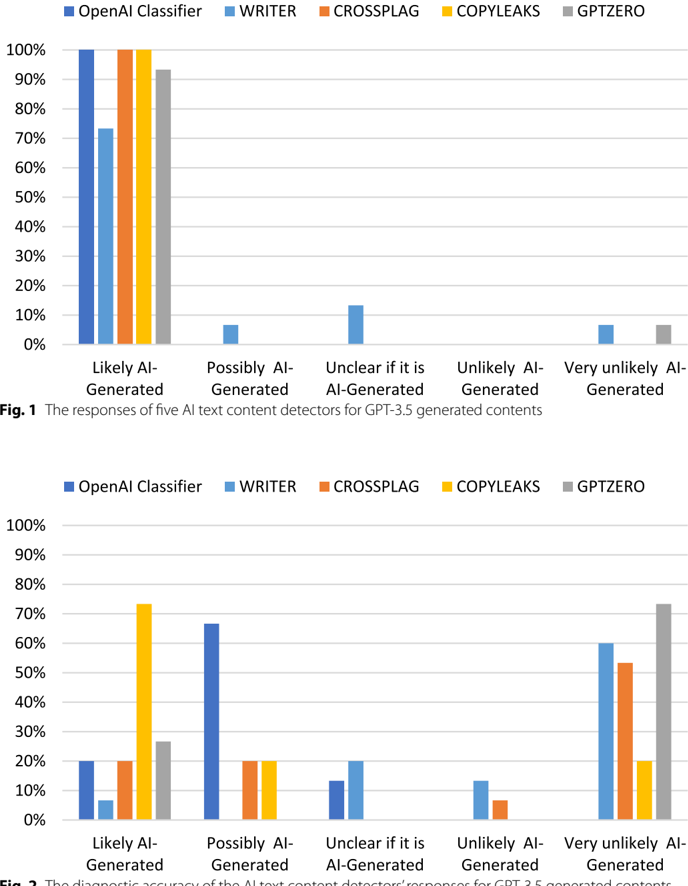
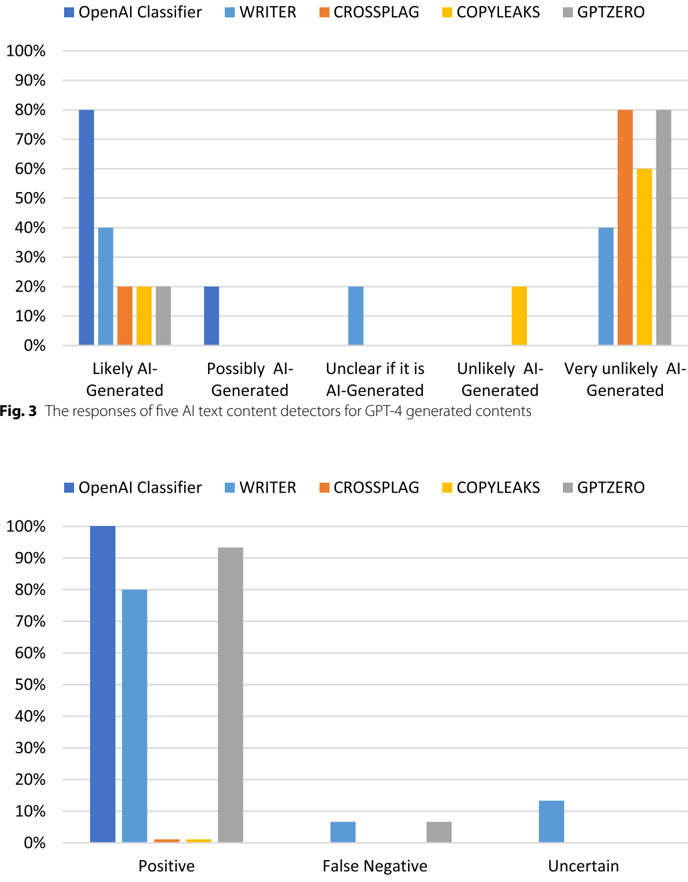
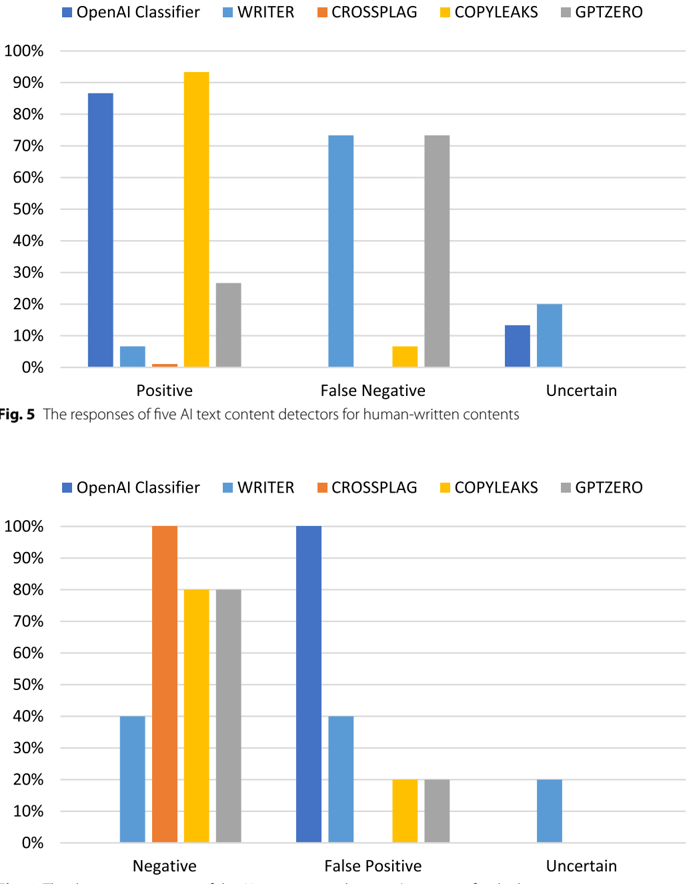
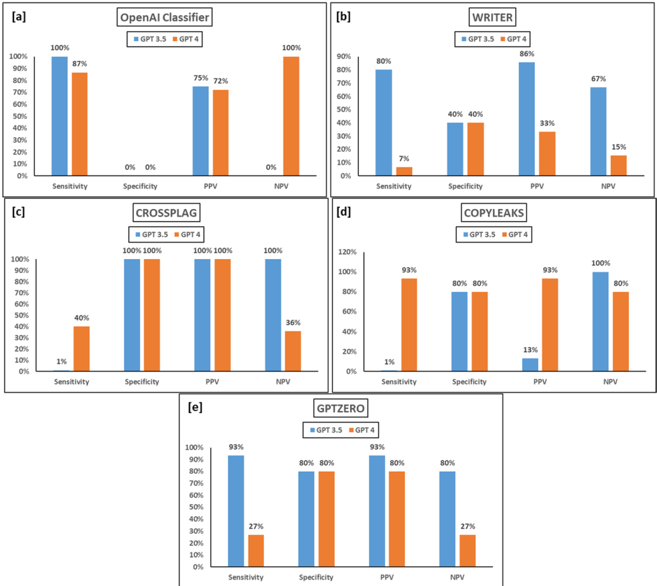
The proliferation of artificial intelligence (AI)-generated content, particularly from models like ChatGPT, presents potential challenges to academic integrity and raises concerns about plagiarism. This study investigates the capabilities of various AI content detection tools in discerning human and AI-authored content. Fifteen paragraphs each from ChatGPT Models 3.5 and 4 on the topic of cooling towers in the engineering process and five human-witten control responses were generated for evaluation. AI content detection tools developed by OpenAI, Writer, Copyleaks, GPTZero, and CrossPlag were used to evaluate these paragraphs. Findings reveal that the AI detection tools were more accurate in identifying content generated by GPT 3.5 than GPT 4. However, when applied to human-written control responses, the tools exhibited inconsistencies, producing false positives and uncertain classifications. This study underscores the need for further development and refinement of AI content detection tools as AI-generated content becomes more sophisticated and harder to distinguish from human-written text.
Overview
The claims and statistics of this paper haven’t been checked yet.
Free: it reads the open-access text and checks the first 5 claims that cite a source we can check. Create a free account to check every claim.
Integrity signals
Registry
Cites
Statistics
Figures
Verification
Claims the paper makes
The claims and statistics of this paper haven’t been checked yet.
Free: it reads the open-access text and checks the first 5 claims that cite a source we can check. Create a free account to check every claim.
Claims other papers make about this one
Each is checked against this paper’s own text: does it say what the citing paper says it does?
The source backs part of the claim, not all of it — or backs it for a different population, condition or comparison.
In the citing paper
“detection accuracy varies across writing styles and languages”
From Designing AI-resilient assessment in higher education: a four-pillar conceptual framework (2026) · cites this paper as Elkhatat et al., 2023
Experimental — accuracy not yet measuredThe source backs part of the claim, not all of it — or backs it for a different population, condition or comparison.
In the citing paper
“vendor accuracy claims routinely exceed observed performance under controlled testing”
From ARE AI DETECTORS FAIR TO EFL LEARNERS? A LIBRARY RESEARCH ON DETECTION BIAS AND ACADEMIC INTEGRITY (2026) · cites this paper as Elkhatat et al., 2023
Experimental — accuracy not yet measuredThe source backs part of the claim, not all of it — or backs it for a different population, condition or comparison.
In the citing paper
“many commercially available tools fail to achieve 80% accuracy despite exceptions among a few premium platforms”
From ARE AI DETECTORS FAIR TO EFL LEARNERS? A LIBRARY RESEARCH ON DETECTION BIAS AND ACADEMIC INTEGRITY (2026) · cites this paper as Elkhatat et al., 2023
Experimental — accuracy not yet measuredThe source backs part of the claim, not all of it — or backs it for a different population, condition or comparison.
In the citing paper
“the nature of Generative AI was such that it would be almost impossible to reliably detect AI-generated writing.”
From Generative Artificial Intelligence: Implications and Considerations for Higher Education Practice (2023) · cites this paper as [13]
Experimental — accuracy not yet measuredThe source backs part of the claim, not all of it — or backs it for a different population, condition or comparison.
In the citing paper
“However, post hoc detection systems can themselves be computationally expensive to run, and their practical usage is limited by their inconsistent performance16.”
From Scalable watermarking for identifying large language model outputs (2024) · cites this paper as [16]
Experimental — accuracy not yet measured
20 more claims about this paper
Create a free account to see every claim other papers make about this one.
Self-check
Percentages, sums and reported differences re-computed from the paper’s own numbers.
The self-check needs the paper’s full text.
Citations
Cites
Gao, C. A., Howard, F. M., Markov, N. S., Dyer, E. C., Ramesh, S., Luo, Y., & Pearson, A. T. (2022) · doi:10.1101/2022.12.23.521610 · Cited by 1,099
Gao, C. A., Howard, F. M., Markov, N. S., Dyer, E. C., Ramesh, S., Luo, Y., & Pearson, A. T. (2023) · npj Digital Medicine · doi:10.1038/s41746-023-00819-6 · Cited by 1,099
ChatGPT in higher education: considerations for academic integrity and student learning
(2023) · Journal of Applied Learning & Teaching · doi:10.37074/jalt.2023.6.1.17 · Cited by 853
Perkins, M. (2023) · Journal of University Teaching and Learning Practice · doi:10.53761/1.20.02.07 · Cited by 839 · cited 2×
“Academic misconduct in undergraduate education using ChatGPT has been widely studied (Crawford et al. 2023; King & chatGpt 2023; Lee 2023; Perkins 2023; Sullivan; et al. 2023).”
A Conversation on Artificial Intelligence, Chatbots, and Plagiarism in Higher Education
King, M. R., & chatGPT (2023) · Cellular and Molecular Bioengineering · doi:10.1007/s12195-022-00754-8 · Cited by 602
The rise of ChatGPT : Exploring its potential in medical education
Lee, H. (2024) · Anatomical Sciences Education · doi:10.1002/ase.2270 · Cited by 596 · cited 1×
“Academic misconduct in undergraduate education using ChatGPT has been widely studied (Crawford et al. 2023; King & chatGpt 2023; Lee 2023; Perkins 2023; Sullivan; et al. 2023).”
MethodCrawford, J., Cowling, M., & Allen, K.-A. (2023) · Journal of University Teaching and Learning Practice · doi:10.53761/1.20.3.02 · Cited by 547
Engineering Education in the Era of ChatGPT: Promise and Pitfalls of Generative AI for Education
Qadir, J. (2022) · doi:10.36227/techrxiv.21789434.v1 · Cited by 264
Academic Plagiarism Detection: A Systematic Literature Review
Foltýnek, T., Meuschke, N., & Gipp, B. (2020) · ACM Computing Surveys · doi:10.1145/3345317 · Cited by 238
Nhu, V.-H., Mohammadi, A., Shahabi, H., Ahmad, B. B., Al-Ansari, N., Shirzadi, A., Clague, J. J., Jaafari, A., Chen, W., & Nguyen, H. (2020) · International Journal of Environmental Research and Public Health · doi:10.3390/ijerph17144933 · Cited by 162
Research works printed but not linked: 6
- 2. Brown T, Mann B, Ryder N, Subbiah M, Kaplan JD, Dhariwal P, Neelakantan A, Shyam P, Sastry G, Askell A (2020) Language models are few-shot learners. Adv Neural Inf Process Syst 33:1877-1901
- 7. Fishman T (2009) "We know it when we see it" is not good enough: toward a standard definition of plagiarism that tran- scends theft, fraud, and copyright 4th Asia Pacific Conference on Educational Integrity, University of Wollongong NSW Australia
- 8. Foltýnek T, Meuschke N, Gipp B (2019) Academic Plagiarism Detection. ACM Comput Surv 52(6):1-42. https:// doi. org/ 10. 1145/ 33453 17 · DOI · Paper page
- 10. Frye BL (2022) Should Using an AI Text Generator to Produce Academic Writing Be Plagiarism? Fordham Intellectual Property, Media & Entertainment Law Journal. https:// ssrn. com/ abstr act= 42922 83
- 21. Radford A, Wu J, Child R, Luan D, Amodei D, Sutskever I (2019) Language models are unsupervised multitask learners. OpenAI Blog 1(8):9
- 22. Radford A, Narasimhan K, Salimans T, Sutskever I (2018) Improving language understanding by generative pre-training
Cited by
Items 301–400 of 403
Additional file 1 of Testing of detection tools for AI-generated text
Weber-Wulff, D., Anohina-Naumeca, A., Bjelobaba, S., Foltýnek, T., Guerrero-Dib, J. G., Popoola, O., Šigut, P., & Waddington, L. (2024) · Figshare · doi:10.6084/m9.figshare.26651427
Artificial Intelligence Implementation for Plagiarism Detection in Arab Scientific Publications
Dashash, M., & Omar, K. (2026) · Springer eBooks · doi:10.1007/978-3-031-99068-7_18
Shafi, T. B., Siddique, T., Tasnim, F., Chowdhury, S. J., Chowdhury, M. S., Mahmud, T., Deb, K., Hossain, M. S., & Hanip, A. (2025) · Communications in computer and information science · doi:10.1007/978-3-032-11355-9_8 · Cited by 1
Trust and Social Robots: How can We Prevent Social Robots from Eroding Trust?
Strasser, A. (2026) · Social and cultural studies of robots and AI · doi:10.1007/978-3-031-99290-2_9
Cultivating Academic Integrity through Islamic Ethical Foundations in Scholarship
Murzaki, L. A. (2025) · Academia Open · doi:10.21070/acopen.10.2025.12726 · Cited by 5
“[13] Therefore, although detection tools can be helpful, ethical education and the development of academic character remain irreplaceable aspects.”
The challenges of developing AI text detectors, and their moral implications
Sharifzadeh, R. (2026) · Journal of Information Communication and Ethics in Society · doi:10.1108/jices-10-2025-0292
Zaripova, R. R., Danilov, A., Salekhova, L., Fazliakhmetov, T. R., & Krylov, E. (2025) · International Conference on Developments in eSystems Engineering (DeSE) · doi:10.1109/dese68208.2025.11367933
The Teacher's Journey to AI: The EFL AI-PACK Framework
Koraishi, O., & Erol, M. (2026) · Advances in computational intelligence and robotics book series · doi:10.4018/979-8-3373-2752-5.ch013
Sciberas, C., & Fournier, M. A. (2026) · Journal of Research in Personality · doi:10.1016/j.jrp.2026.104709
Motylińska, P., & Pieczka-Węgorkiewicz, A. (2026) · Communications in computer and information science · doi:10.1007/978-3-032-17272-3_10
Deconstructing AI Detection Tools: Accuracy Limits, Bias, and Human Consequences
Patra, S. K., Gargya, A., Rana, V., Mahajan, S., & Khera, P. (2025) · International Conference on Intelligent Systems for Cybersecurity (ISCS) · doi:10.1109/iscs69371.2025.11386453
“Larger detector ecosystems have been tested in earlier analyses, such as the Turnitin multi-classifier system [12], the OpenAI classifier that was discontinued [13] , the probability curvature model of DetectGPT [14], or the Perkins et al. study of systematic detection failures [15].”
Redefining Academic Integrity in the Age of AI: Ethics and Security in Academic Content Creation
Reginio, F. N., Marces, R. K. J. G., Lolong, H. M. G., & Niko, N. (2026) · Advances in computational intelligence and robotics book series · doi:10.4018/979-8-3373-5601-3.ch016 · Cited by 1
Students' Perception Of Artificial Intelligence-Based Plagiarism In Academic Writing
Anastasya, Mulyono, B. E., & Murdiono, M. (2026) · JKTP Jurnal Kajian Teknologi Pendidikan · doi:10.17977/um038v9i12026p114-123
Baker-Gardner, R. (2025) · Emerald Group Publishing Limited eBooks · doi:10.1108/978-1-83608-186-920251023
Liu, S., Li, X., & Hao, J. (2026) · Interactive Learning Environments · doi:10.1080/10494820.2026.2635540 · Cited by 2
“This phenomenon can bias instructors’ assessments of students’ true competencies, thereby undermining the accuracy of classroom feedback and instructional adjustment (Elkhatat et al., 2023; Weber-Wulff et al., 2023).”
Elsawah, W. (2026) · Advances in computational intelligence and robotics book series · doi:10.4018/979-8-2600-0328-2.ch008 · Cited by 2
Happonen, H. D. I., Bollard, S. M., & Dolan, R. T. (2026) · Annals of Plastic Surgery · doi:10.1097/sap.0000000000004726
Detecting AI-Generated Content: A Multi-Layered Approach for Web and Document Analysis
Chiman, T., Mehta, K., Panjwani, M. H., Bhandari, K., & Sayyad, S. (2026) · International Conference on AI-Driven Smart Systems and Ubiquitous Computing (ICAUC) · doi:10.1109/icauc68182.2026.11441209
“A. M. Elkhatat et al. [5] evaluate AI content detection tools for differentiating between human-written and AI-generated text.”
Harfe, B. D., & Thomas, A. (2026) · TechTrends · doi:10.1007/s11528-026-01182-5 · Cited by 1
“While some AI detectors perform well at detecting most AI-generated text, none can currently determine with 100% accuracy the source of submitted text (Elkhatat et al., 2023; Weber-Wulff et al., 2023).”
Factors Influencing Students to Use Turnitin Tools
Nangka, T. P. P., & Gui, A. (2026) · Lecture notes in networks and systems · doi:10.1007/978-3-032-14750-9_26
Balancing Innovation and Integrity: Addressing the Use of GAI in Student Assessments
Uden, L., Ching, G. S., & Francis, J. (2026) · Advances in computational intelligence and robotics book series · doi:10.4018/407452
Scholarly Publishing as an Example of Modernity in Translation
Bowker, L. (2026) · Palgrave studies in translating and interpreting · doi:10.1007/978-3-031-92781-2_8
Grade Expectations: Generative AI Use Does Not (Yet) Alter Student AchievementPreprint
Mueller, M., Arnold, R. C. G., & Wagenpfeil, S. (2026) · Research Square · doi:10.21203/rs.3.rs-9053629/v1
Meem, S. J., Samsuddoha, M., Momo, S. J., Erfan, M., & Ahmed, M. M. (2026) · Applied Soft Computing · doi:10.1016/j.asoc.2026.116261
An Intelligent AI-Generated Content Detection Tool and Framework
Annapurna, S., Manjunath, G. V. S., Ram, K. A. S. S., Ashwini, B., & Vardhan, D. H. (2026) · International Conference on Machine Learning and Autonomous Systems (ICMLAS) · doi:10.1109/icmlas67792.2026.11483921
“Elkhatat et al. [11] evaluated the effectiveness of detection tools in distinguishing human-written and AI-generated text, while Chaka [12] analyzed multiple detection systems across different AI platforms.”
Sangwa, S., Ndahayo, C., Dusengumuremyi, F., & Mutabazi, P. (2026) · International Journal of Latest Technology in Engineering Management & Applied Science · doi:10.51583/ijltemas.2026.150400012
ASHA: exploring image authenticity in the era of AI
Rajan, M., Ramteke, S. P., Ramteke, N. S., & Valarmathi, I. R. (2026) · Signal Image and Video Processing · doi:10.1007/s11760-026-05396-1
Stella, F. M., & Logeswari, P. (2026) · International Conference on Augmented Intelligence and Sustainable Systems (ICAISS) · doi:10.1109/icaiss68683.2026.11526710
“Elkhatat et al. [26] explore the ability of multiple AI content classification systems in intelligent human and AI-written content.”
Benchmarking AI-Generated Text Detection Tools in Academic Writing: An Experimental Evaluation
Alaqad, M. H., Alkindi, G., Hussin, M., Sapar, A. A., & Alaggad, L. A. (2026) · International Congress on Human-Computer Interaction, Optimization and Robotic Applications (ICHORA) · doi:10.1109/ichora69329.2026.11537020
Harsono, A. A. H., Oslock, W. M., Brock, B., Hodges, S. C., Wood, L. N., Hernandez-Marquez, G. C., Abbas, A., Chu, D. I., & Rubyan, M. A. (2026) · Journal of Surgical Research · doi:10.1016/j.jss.2026.04.021
Rose, R. (2026) · SSRN Electronic Journal · doi:10.2139/ssrn.6879243
Singh, P., Gupta, P., Shukla, N., Tyagi, P., & Tyagi, P. (2026) · International Conference on Intelligent Systems in Engineering, Secured Systems and Cybersecurity (ICISESSC) · doi:10.1109/icisessc68634.2026.11542606
Atamhenwan, L. (2026) · Education and Information Technologies · doi:10.1007/s10639-026-14049-2 · Cited by 5
“…studies have found that these AI text detection tools are inconsistent in detecting AI-generated texts (Walters, 2023; Weber-Wulff et al., 2023 ; Elkhatat et al., 2023 ; Chaka, 2024; Bordalejo et al., 2025), Turnitin have been repeatedly found to be one of the most accurate in detecting AI…”
InfluentialAI text detection in dentistry: a comparative analysis across generative models
Villa, J., Garcovich, D., Lombardo, L., Siciliani, G., & Martin, M. A. (2026) · Research Integrity and Peer Review · doi:10.1186/s41073-026-00228-9
“For binary classification, we applied a pre-specified 60% cut-off ( ≥ 60% = AI-gener-ated; < 60% = human), following Elkhatat et al. [10], who considered scores ≥ 60% as indicative of AI authorship.”
Cook, J., & Cook, J. (2026) · Artificial Intelligence in Education · doi:10.1108/aiie-06-2025-0129 · Cited by 1
RetractedThe digital facilitator: A multivariate analysis of predictors of academic cheating
Enokela, A. E., Alordiah, C. O., & Aluede, O. O. (2026) · Journal of Interdisciplinary Studies in Education · doi:10.32674/nq9swx67 · Cited by 1
Teng, J., & Cho, S. (2026) · Interactive Learning Environments · doi:10.1080/10494820.2026.2676667
Akçin, D. C. (2026) · SAGE Open · doi:10.1177/21582440261445620 · Cited by 1
“Its strengths are most visible at the sentence level—grammar, lexis, and structural accuracy—areas that are computationally tractable and relatively easy to evaluate with finite rules or probabilistic models (Elkhatat et al., 2023).”
Detección de plagio y autoría en la era de los LLM: precisión y efectos pedagógicos
Salazar, L. M., & Guaña–Moya, J. (2026) · Ethos Scientific Journal · doi:10.63380/esj.v4n1.2026.352
Tanksley, T. (2026) · Oxford University Press eBooks · doi:10.1093/9780198945246.003.0174
Keskin, A., BÖLÜKBAŞI, A., & Kaya, B. (2026) · Buca eğitim fakültesi dergisi (Online)/Buca Eğitim Fakültesi dergisi · doi:10.53444/deubefd.1834610
Sandnes, F. E., Eika, E., & Sandtrø, T. A. (2026) · IEEE Global Engineering Education Conference (EDUCON) · doi:10.1109/educon67543.2026.11574461 · Cited by 1
“Several attempts have been documented to develop technologies for detecting AI use [10, 11, 12].”
Un-AI-ing: Compliance, Evasion, and the Distortion of Research Writing in the Age of AI Detection
Giray, L. (2026) · Annals of Biomedical Engineering · doi:10.1007/s10439-026-04242-2
Layton, S., Medeiros, B. B. P., Butler, K., & Traynor, P. (2026) · IEEE Symposium on Security and Privacy (S&P) · doi:10.1109/sp63933.2026.00088 · Cited by 4
Teachers’ emotions and perceptions related to ChatGPT
Pietarinen, T., Sormunen, K., Mannila, L., & Roos, T. (2026) · Education and Information Technologies · doi:10.1007/s10639-026-14074-1 · Cited by 1
“AI detection software has been proposed to identify AI-generated content, while it has turned out that such systems often generate false positives, leading to unwarranted accusations against students (Dalalah & Dalalah, 2023; Elkhatat et al., 2023).”
Kimogol, S. S., Nachtnebel, D. A., Safari, M. C., & Sanderson, N. C. (2026) · Lecture notes in computer science · doi:10.1007/978-3-032-29653-5_17
Comparative Analysis of Neural Architectures and Hybrid Approach for AI-Generated Text Detection
Assylkhan, A., & Biloshchytska, S. (2026) · IEEE International Conference on Smart Information Systems and Technologies (SIST) · doi:10.1109/sist61674.2026.11596221
“Another direction involves watermarking techniques, which embed statistical signatures directly into generated text to enable post hoc verification [23-25].”
Teacher Training Needs in Artificial Intelligence in Portuguese-Speaking African Countries
Gonçalves, B. F., & Vaz-Rebelo, P. (2026) · Lecture notes in networks and systems · doi:10.1007/978-3-032-32032-2_35
The Invisible Author: Generative AI and the Auditability GapPreprint
Lucchi, N. (2026) · SSRN Electronic Journal · doi:10.2139/ssrn.7024098
Giray, L., Nemeño, J., Jadulos, M. X., Abosejo, M. M., & Fabros, B. G. (2026) · Communications in computer and information science · doi:10.1007/978-3-032-33997-3_11
Li, Q.-Z., Hu, W.-L., & Zhu, C.-Y. (2026) · ACM Trans. Asian Low Resour. Lang. Inf. Process. · doi:10.1145/3828734
“To address this challenge, cats need to enhance their ability to detect short texts.”
Sahhar, M., Lewis, A. M., Achilova, F., Singh, M., Nassar, J. E., Callanan, T. C., Liu, J., Daniels, A. H., & Antoci, V. (2026) · The Journal of Arthroplasty · doi:10.1016/j.arth.2026.07.041
Does AI-generated listing language affect property market outcomes for investors?
Pilat, C., & Leishman, C. (2026) · Journal of Property Investment & Finance · doi:10.1108/jpif-01-2026-0008
Spies, N. C., Ratts, V. S., & Hagemann, I. S. (2026) · JMIR Medical Education · doi:10.2196/96673 · Cited by 1
“Moreover, AI detectors may be more effective in identifying earlier and less advanced iterations of AI chatbots [9], whereas newer models generate more humanlike output and, in some cases have been specifically designed to evade detection.”
Elliott, M. A., McGroarty, A., Anderson, M., Burns, N., Gill, J., McLaughlin, E., Findlay, K., Hamilton, D. E., March, J. J., & Butler, S. H. (2026) · British Journal of Educational Studies · doi:10.1080/00071005.2026.2704595
Multi-modal Transformer-GNN for Phishing Detection
Nguyen, Q. H., Thị, B. V., Thi, C. T. P., Cao, H. N., & Tran, C. C. (2026) · Lecture notes in networks and systems · doi:10.1007/978-3-032-25631-7_6
Namocot, N. S., Viado, H. B. C., Sayon, S. G., Tambis, K. A., Sala, J. S., Alcaria, C. J., Saligan, M., Razonable, S., Estampa, K. G., Alo, J., et al. (2026) · Psychology and Education A Multidisciplinary Journal · doi:10.70838/pemj.600210
Song, L., Liu, Q., Ma, Y., Li, J., Li, Z., & Wang, Z. (2026) · Youth Academic Annual Conference of Chinese Association of Automation (YAC) · doi:10.1109/yac71005.2026.11616270
Peters, M. A., & Yang, Y. (2026) · Educational Philosophy and Theory · doi:10.1080/00131857.2026.2706550
Khan, T. I. (2026) · Research Square · doi:10.21203/rs.3.rs-10547782/v1
Editorial: Research ethics and integrity in the artificial intelligence era
Chigwada, J. P., & Ngulube, P. (2026) · Frontiers in Research Metrics and Analytics · doi:10.3389/frma.2026.1931866 · Cited by 1
Kaushik, P. K., Sahoo, A. K., & Bisht, R. K. (2026) · Lecture notes in networks and systems · doi:10.1007/978-3-032-31526-7_6
Low-resource single-pass paraphrasing attacks on AI-generated text detection
Rydell, F., Hansen, P., Kanestad, L., Ljungar, A., & Öberg, S. (2026) · Intelligent Systems with Applications · doi:10.1016/j.iswa.2026.200710
Srinivasan, R., Caube, F. D. M., Punt, C., Bolander, S., Bowker, B., Brownlee, L., Forest, C. P., Juárez, L., Kenney, A., King, M. R., et al. (2026) · The Journal of Physician Assistant Education · doi:10.1097/jpa.0000000000000784
The Perceived Gains of the Writing Tutor Experience
Cofer, R., & Hendrix, B. (2026) · Journal of College Reading and Learning · doi:10.1080/10790195.2026.2714755
“Elkhatat et al. (2023) found that such tools can produce inconsistent coding and data analysis errors.”
Generative AI and Authentic Assessment in Higher Education: Evidence from Ghanaian Universities
Obeng-Appiah, Y. (2026) · International Social Sciences and Education Journal · doi:10.61424/issej.v4i3.993 · Cited by 1
Bindra, J. S., Chaturvedi, H., Singh, S., & Singh, S. K. (2026) · International Conference on NextGen Data Science and Analytics (ICNDSA) · doi:10.1109/icndsa68777.2026.11652307
“That is, they can produce outputs that are credible sounding but are in actuality incorrect and potentially devastatingly damaging in the high stakes environment of Indian civil litigation if they are provided as a basis for interpreting controlling precedent(s) [14, 3].”
Acceptable English, Vanishing Voice: AI Polishing and the South- North Politics of Academic Style
Rahmatullah, M. (2026) · Critical Arts · doi:10.1080/02560046.2026.2714805
Large Language Models in Ophthalmic Publishing: From Detection to Accountable Disclosure
Grzybowski, A. E., & Jin, K. (2026) · Ophthalmology · doi:10.1016/j.ophtha.2026.06.015
Wright, C. (2026) · International Journal for Educational Integrity · doi:10.1007/s40979-026-00234-w · Cited by 3
“Elkhatat et al. (2023) evaluate the efficacy of multiple AI content detection tools and report significant variability in accuracy across tools and text types, concluding that no single tool in their sample could serve as definitive evidence for or against AI generation.”
Who wrote this? An EAP think-aloud study on AI detection
Teraif, Z. (2026) · Language learning & technology · doi:10.64152/10125/73709 · Cited by 2
“…awareness of the accuracy limitations when it comes to detecting AI-content using the ‘human eye’, and this has been acknowledged previously in the literature (Elkhatat et al., 2023), particularly in EAP contexts where writing proficiency varies and misclassification can have serious consequences.”
Susoy, Z. (2026) · Pamukkale University Journal of Education · doi:10.9779/pauefd.1847553
Mental Models and Artificial Systems
Jabarian, B. (2026) · Oxford University Press eBooks · doi:10.1093/9780197851418.003.0993
Tools for Detecting and Humanizing AI in Academic Work: An Exploratory Study
Gonçalves, B. F., & Gonçalves, V. (2026) · Lecture notes in networks and systems · doi:10.1007/978-3-032-25652-2_48
Teaching What the Machine Told Us: Critical Agency and Epistemic Trust in the Algorithmic Classroom
Genç, L. G., & Uygun, E. (2026) · Advances in computational intelligence and robotics book series · doi:10.4018/979-8-2600-1232-1.ch014
Munoz, A., Hinchcliff, M., Langfield, C. T., & Rogerson, A. M. (2026) · International Journal for Educational Integrity · doi:10.1007/s40979-026-00235-9 · Cited by 1
“Empirical testing of dedicated AI detection tools confirmed their inaccuracy and lack of reliability (Elkhatat et al. 2023; Weber-Wulff et al. 2023), diverging from vendor claims of accuracy that persist despite this evidence; independent evaluations report no material improvement in detector…”
A Score-Based Framework for AI Text Detection with Adaptive Thresholding
Xu, R. (2026) · International Conference on Machine Intelligence and Digital Applications (MIDA) · doi:10.1145/3801438.3806963
“Differences in text domain, preprocessing pipelines, or sequence length shift the probability distributions so significantly that static thresholding becomes computationally obsolete [9].”
ScholarGuard-AI An Intelligent Framework for Research Paper Generation and Authenticity Detection
Karthik, S., Kumar, T., Kumari, S., & Kumar, P. (2026) · ITM Web of Conferences · doi:10.1051/itmconf/20269002013
“Research integrity tools have been enhanced to include resilience detection signals [11].”
LLM-generated scientific content detection method
Bader, A., & Alhijawi, B. (2026) · Neural Computing and Applications · doi:10.1007/s00521-026-12465-6
Still emerging: understanding Generative AI use in Higher Education
Kahn, P. E., Carrigan, M., Wyman, I., Liu, R., Smith, P. V., Andonegui, A. R., Murtagh, L., & Song, F. (2026) · Frontiers in Education · doi:10.3389/feduc.2026.1885253
Paklina, S. N., Паршаков, П. А., & Shakina, E. A. (2026) · Scientometrics · doi:10.1007/s11192-026-05805-9 · Cited by 1
“Similar conclusions are reached by Elkhatat et al. (2023) and Cotton et al. (2024), who evaluate AI-content detection tools and find substantial rates of misclassification.”
InfluentialGenerative AI and education in the information fields: a futures workshop report
Proferes, N., Newell, B. C., Arsenault, M., Archambault, S. G., Dowell, M. L., Egan, K., Kizhakkethil, P., Mann, J., Reynolds, R. B., & Sweeney, M. E. (2026) · Information and Learning Sciences · doi:10.1108/ils-11-2025-0211
Le-Dinh, T., Tan, T. B., & Nguyen, A. T. T. (2026) · Social Sciences & Humanities Open · doi:10.1016/j.ssaho.2026.103674
AI-Driven Assessment: Balancing Innovation With Validity and Authenticity of Assessment Evidence
Junias, K. (2026) · Advances in computational intelligence and robotics book series · doi:10.4018/979-8-3373-9089-5.ch008
Tüker, M., Sinecen, M., & Eser, M. (2026) · Scientific journal of Mehmet Akif Ersoy University · doi:10.70030/sjmakeu.2033004
Angelier, V. A. (2026) · AI and Ethics · doi:10.1007/s43681-026-01376-w · Cited by 2
“The accuracy–fairness trade-off documented by Elkhatat, Elsaid and Almeer [ 12 ] and Pratama [ 29] is the practical expression of this statistical constraint.”
Alakraa, E. M., & Farhat, A. A. E. R. (2026) · Egyptian Journal of Bronchology · doi:10.1186/s43168-026-00676-3
“– Copyleaks : Provides plagiarism-detection and AI-content detection capabilities for identifying potentially copied, paraphrased, or AI-generated text [81].”
LLMS AND THEIR BENEFIT IN EDUCATION
Oliver, W. (2026) · Journal of ExoTechnology and Education · doi:10.36615/cywsbj56
“However, this tool and all the other tools like it are still inconsistent (Elkhatat et al., 2023).”
Vergun, A., Parashchuk, B., & Кіт, З. (2026) · Professional Pedagogics · doi:10.32835/2707-3092.2026.33.124-134
Füzesi, I., Lengyel, P., & Pancsira, J. (2026) · International Review of Applied Sciences and Engineering · doi:10.1556/1848.2026.01535
Pocheshkhova, E., Popova, N. G., Nurbaev, S. D., & Pocheshkhov, N. A. (2026) · Science Editor and Publisher · doi:10.24069/sep.26.11.49
Entre Bytes y Palabras: El Impacto de la Inteligencia Artificial en la Producción Académica
Ferigato, G. C., de Almeida, S. D. C. D., & Fernandes, Á. M. (2026) · Etic net Revista científica electrónica de Educación y Comunicación en la Sociedad del Conocimiento · doi:10.30827/eticanet.v26i2.32861
“Levantamento realizado por Elkhatat et al. (2023) a responsabilidade de decisões que deveriam ser orientadas por políticas institucionais claras, criando insegurança jurídica e ética (Cotton et al., 2023).”
Thakkar, S., Bhatt, P., & Parekh, H. (2026) · Counselling and Psychotherapy Research · doi:10.1002/capr.70237
Mirzayev, A., Kamal, S. S. L. A., Turdiyeva, G., kizi, T. M. S., & Irgasheva, N. (2026) · Cogent Education · doi:10.1080/2331186x.2026.2742806
Rachiotis, T., Tassi, A., Papanikolaou, I., & Adamakis, M. (2026) · Encyclopedia · doi:10.3390/encyclopedia6100224
Detecting AI-Generated Vietnamese Essays with Calibrated Uncertainty and Explainable AI
Nguyen, H., Hoang, N.-T., Huynh, M.-P., & Le, A.-C. (2026) · Lecture notes in computer science · doi:10.1007/978-981-92-5641-9_36
AI content detection in student text assignments, false positive rates, and academic integrity
Maghami, M. R., Ho, C. K., & Patrick, C. (2026) · Discover Education · doi:10.1007/s44217-026-02307-x · Cited by 1
“Existing studies also show these concerns [14–16].”
Robust Essay Detection: Small Language Models Adversarial Parameter-Efficient Fine-Tuning
Herman, A., Cristin, P., Aryati, P., Purwitasari, D., Anggraini, R. N. E., & Faizin, M. '. (2026) · International Seminar on Application for Technology of Information and Communication (iSemantic) · doi:10.1109/isemantic71495.2026.11742641
“Another prevalent approach utilizes specialized classification models (e.g., fine-tuned RoBERTa) and commercial tools like GPTZero, Turnitin [17], and Originality.AI [11], [12].”
Kholifah, L. R. K., & Jariyah, I. A. (2026) · Punggawa Global Research Jurnal Multidisiplin · doi:10.67707/pgr.v1i5.339
Metadata
- Authors
- Elkhatat, A. M., Elsaid, K., & Almeer, S.
- Affiliations
- Qatar University (QA)
- Texas A&M University at Qatar (QA)
- Corresponding author
- Elkhatat, Ahmed M.
- Venue
- International Journal for Educational Integrity
- Published
- 2023-09-01
- Volume
- 19
- Issue
- 1
- ISSN
- 1833-2595 (ISSN-L)
- OpenAlex
- W4386317922
- Cited by
- 392
- References
- 17
- Citations by year
- 2026: 130 · 2025: 132 · 2024: 119 · 2023: 10
- FWCI
- 98.09
- Type
- journal article
- Language
- en
- Open access
- gold
- doi.org
- Licence
- cc-by
- creativecommons.org/licenses/by/4.0 (tdm)
- creativecommons.org/licenses/by/4.0 (vor)
- Locations
- International Journal for Educational Integrity (publishedVersion, cc-by)
- Qatar University QSpace (Qatar University) (submittedVersion, other-oa)
- DOAJ (DOAJ: Directory of Open Access Journals) (submittedVersion, cc-by-sa)
- Funders
- Qatar National Library
- Topics
- Social Sciences › Education › Academic integrity and plagiarism
- Social Sciences › Education › Artificial Intelligence in Education
- Physical Sciences › Computer Science › Artificial Intelligence › Authorship Attribution and Profiling
- Keywords
- AI-generated text detection, ChatGPT, GPT-3.5, GPT-4, academic integrity, plagiarism, human vs AI text classification, false positives, GPTZero, cooling towers
About these checks
Registry, retraction, Cites and statistics results are computed, not judged, with one exception: a printed reference that no index lists is read once by a model before it counts as a citation error. Claims are extracted by a model and kept only when their quote appears verbatim in the text; each cited source is then checked, with a model’s help, for whether it says what the claim relies on. Those verdicts can be wrong — read the claim’s quote and the cited source before relying on one.
Statistics and arithmetic are recomputed, not judged.
Confidence bands are shown only for fields calibrated on our annotated test set. None is calibrated yet, so no band is shown.
What counts as a claim ›How we measure confidence ›How we check this ›
Are you an author, or do you see a problem with this page? Request a review
Data sources
Bibliographic data: Semantic Scholar, OpenAlex, Crossref.
Contains information from the Semantic Scholar Academic Graph Datasets, made available under the ODC Attribution License (ODC-BY 1.0).
Semantic Scholar’s data is described in: Kinney, R., et al. (2023). The Semantic Scholar Open Data Platform. arXiv:2301.10140.
