

Evaluating the efficacy of AI content detection tools in differentiating between human and AI-generated text
Open accessThe DOI matches its Crossref record; 18 of the 18 references it cites were found in a registry or an index.
Abstract
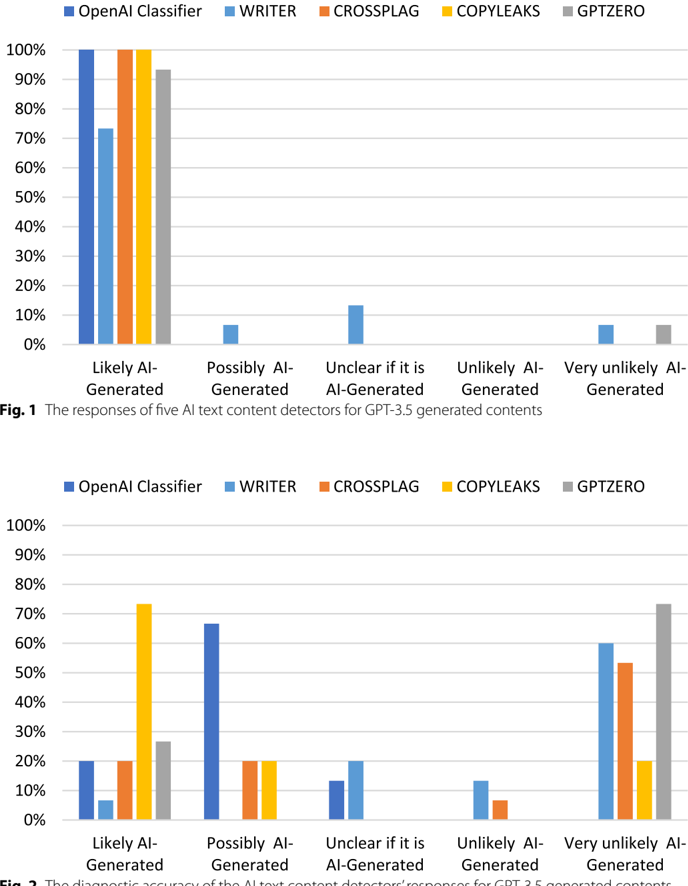
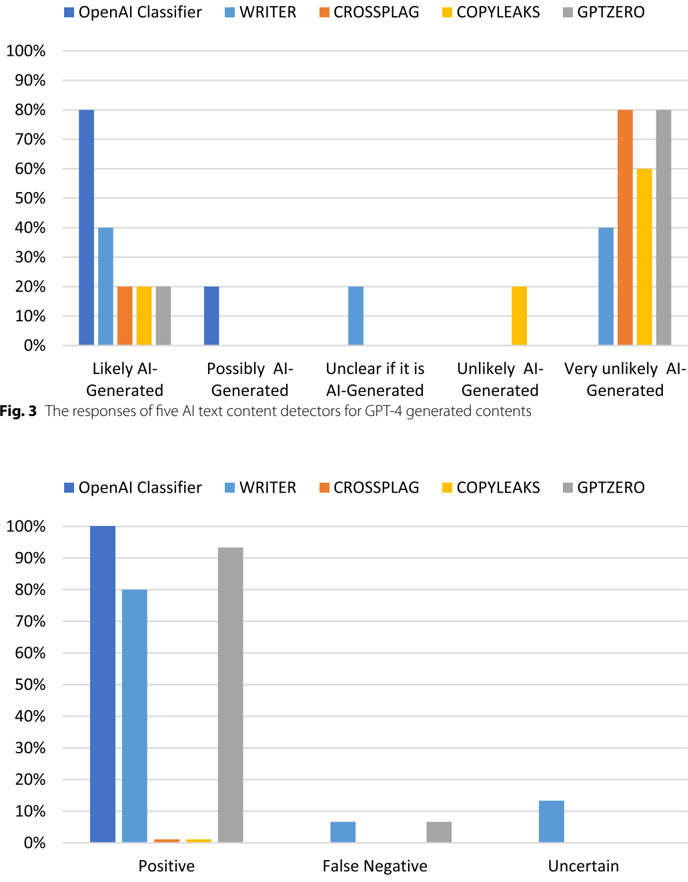
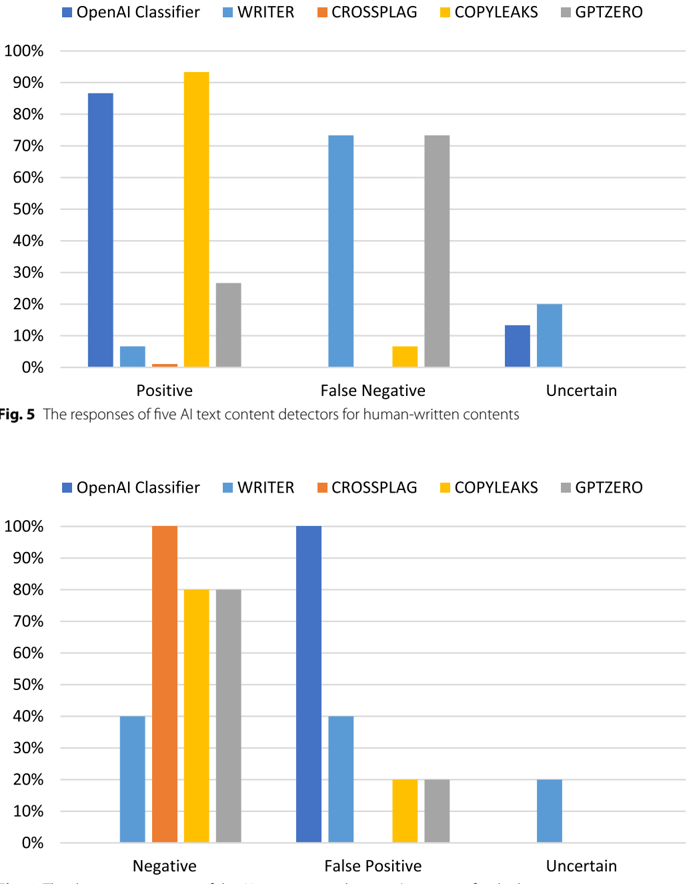
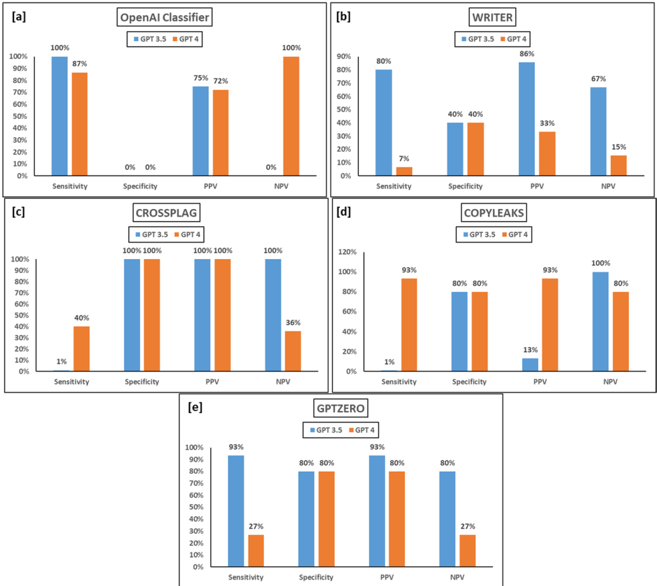
The proliferation of artificial intelligence (AI)-generated content, particularly from models like ChatGPT, presents potential challenges to academic integrity and raises concerns about plagiarism. This study investigates the capabilities of various AI content detection tools in discerning human and AI-authored content. Fifteen paragraphs each from ChatGPT Models 3.5 and 4 on the topic of cooling towers in the engineering process and five human-witten control responses were generated for evaluation. AI content detection tools developed by OpenAI, Writer, Copyleaks, GPTZero, and CrossPlag were used to evaluate these paragraphs. Findings reveal that the AI detection tools were more accurate in identifying content generated by GPT 3.5 than GPT 4. However, when applied to human-written control responses, the tools exhibited inconsistencies, producing false positives and uncertain classifications. This study underscores the need for further development and refinement of AI content detection tools as AI-generated content becomes more sophisticated and harder to distinguish from human-written text.
Overview
The claims and statistics of this paper haven’t been checked yet.
Free: it reads the open-access text and checks the first 5 claims that cite a source we can check. Create a free account to check every claim.
Integrity signals
Registry
Cites
Statistics
Figures
Verification
Claims the paper makes
The claims and statistics of this paper haven’t been checked yet.
Free: it reads the open-access text and checks the first 5 claims that cite a source we can check. Create a free account to check every claim.
Claims other papers make about this one
Each is checked against this paper’s own text: does it say what the citing paper says it does?
The source backs part of the claim, not all of it — or backs it for a different population, condition or comparison.
In the citing paper
“detection accuracy varies across writing styles and languages”
From Designing AI-resilient assessment in higher education: a four-pillar conceptual framework (2026) · cites this paper as Elkhatat et al., 2023
Experimental — accuracy not yet measuredThe source backs part of the claim, not all of it — or backs it for a different population, condition or comparison.
In the citing paper
“vendor accuracy claims routinely exceed observed performance under controlled testing”
From ARE AI DETECTORS FAIR TO EFL LEARNERS? A LIBRARY RESEARCH ON DETECTION BIAS AND ACADEMIC INTEGRITY (2026) · cites this paper as Elkhatat et al., 2023
Experimental — accuracy not yet measuredThe source backs part of the claim, not all of it — or backs it for a different population, condition or comparison.
In the citing paper
“many commercially available tools fail to achieve 80% accuracy despite exceptions among a few premium platforms”
From ARE AI DETECTORS FAIR TO EFL LEARNERS? A LIBRARY RESEARCH ON DETECTION BIAS AND ACADEMIC INTEGRITY (2026) · cites this paper as Elkhatat et al., 2023
Experimental — accuracy not yet measuredThe source backs part of the claim, not all of it — or backs it for a different population, condition or comparison.
In the citing paper
“the nature of Generative AI was such that it would be almost impossible to reliably detect AI-generated writing.”
From Generative Artificial Intelligence: Implications and Considerations for Higher Education Practice (2023) · cites this paper as [13]
Experimental — accuracy not yet measuredThe source backs part of the claim, not all of it — or backs it for a different population, condition or comparison.
In the citing paper
“However, post hoc detection systems can themselves be computationally expensive to run, and their practical usage is limited by their inconsistent performance16.”
From Scalable watermarking for identifying large language model outputs (2024) · cites this paper as [16]
Experimental — accuracy not yet measured
20 more claims about this paper
Create a free account to see every claim other papers make about this one.
Self-check
Percentages, sums and reported differences re-computed from the paper’s own numbers.
The self-check needs the paper’s full text.
Citations
Cites
Gao, C. A., Howard, F. M., Markov, N. S., Dyer, E. C., Ramesh, S., Luo, Y., & Pearson, A. T. (2022) · doi:10.1101/2022.12.23.521610 · Cited by 1,099
Gao, C. A., Howard, F. M., Markov, N. S., Dyer, E. C., Ramesh, S., Luo, Y., & Pearson, A. T. (2023) · npj Digital Medicine · doi:10.1038/s41746-023-00819-6 · Cited by 1,099
ChatGPT in higher education: considerations for academic integrity and student learning
(2023) · Journal of Applied Learning & Teaching · doi:10.37074/jalt.2023.6.1.17 · Cited by 853
Perkins, M. (2023) · Journal of University Teaching and Learning Practice · doi:10.53761/1.20.02.07 · Cited by 839 · cited 2×
“Academic misconduct in undergraduate education using ChatGPT has been widely studied (Crawford et al. 2023; King & chatGpt 2023; Lee 2023; Perkins 2023; Sullivan; et al. 2023).”
A Conversation on Artificial Intelligence, Chatbots, and Plagiarism in Higher Education
King, M. R., & chatGPT (2023) · Cellular and Molecular Bioengineering · doi:10.1007/s12195-022-00754-8 · Cited by 602
The rise of ChatGPT : Exploring its potential in medical education
Lee, H. (2024) · Anatomical Sciences Education · doi:10.1002/ase.2270 · Cited by 596 · cited 1×
“Academic misconduct in undergraduate education using ChatGPT has been widely studied (Crawford et al. 2023; King & chatGpt 2023; Lee 2023; Perkins 2023; Sullivan; et al. 2023).”
MethodCrawford, J., Cowling, M., & Allen, K.-A. (2023) · Journal of University Teaching and Learning Practice · doi:10.53761/1.20.3.02 · Cited by 547
Engineering Education in the Era of ChatGPT: Promise and Pitfalls of Generative AI for Education
Qadir, J. (2022) · doi:10.36227/techrxiv.21789434.v1 · Cited by 264
Academic Plagiarism Detection: A Systematic Literature Review
Foltýnek, T., Meuschke, N., & Gipp, B. (2020) · ACM Computing Surveys · doi:10.1145/3345317 · Cited by 238
Nhu, V.-H., Mohammadi, A., Shahabi, H., Ahmad, B. B., Al-Ansari, N., Shirzadi, A., Clague, J. J., Jaafari, A., Chen, W., & Nguyen, H. (2020) · International Journal of Environmental Research and Public Health · doi:10.3390/ijerph17144933 · Cited by 162
Research works printed but not linked: 6
- 2. Brown T, Mann B, Ryder N, Subbiah M, Kaplan JD, Dhariwal P, Neelakantan A, Shyam P, Sastry G, Askell A (2020) Language models are few-shot learners. Adv Neural Inf Process Syst 33:1877-1901
- 7. Fishman T (2009) "We know it when we see it" is not good enough: toward a standard definition of plagiarism that tran- scends theft, fraud, and copyright 4th Asia Pacific Conference on Educational Integrity, University of Wollongong NSW Australia
- 8. Foltýnek T, Meuschke N, Gipp B (2019) Academic Plagiarism Detection. ACM Comput Surv 52(6):1-42. https:// doi. org/ 10. 1145/ 33453 17 · DOI · Paper page
- 10. Frye BL (2022) Should Using an AI Text Generator to Produce Academic Writing Be Plagiarism? Fordham Intellectual Property, Media & Entertainment Law Journal. https:// ssrn. com/ abstr act= 42922 83
- 21. Radford A, Wu J, Child R, Luan D, Amodei D, Sutskever I (2019) Language models are unsupervised multitask learners. OpenAI Blog 1(8):9
- 22. Radford A, Narasimhan K, Salimans T, Sutskever I (2018) Improving language understanding by generative pre-training
Cited by
Items 101–200 of 403
AI tools vs AI text: Detecting AI-generated writing in foot and ankle surgery
Cooperman, S. R., & Brandão, R. A. (2024) · Foot & Ankle Surgery Techniques Reports & Cases · doi:10.1016/j.fastrc.2024.100367 · Cited by 17
Chen, J., Tao, B. K.-L., Park, S., & Bovill, E. S. (2024) · Plastic Surgery · doi:10.1177/22925503241264832 · Cited by 15
The art of deception: humanizing AI to outsmart detection
Ayub, T., Malla, R. A., Khan, M. Y., & Ganaie, S. A. (2024) · Global Knowledge, Memory and Communication · doi:10.1108/gkmc-03-2024-0133 · Cited by 15
Gupta, V., & Gupta, C. (2024) · Computer · doi:10.1109/mc.2024.3445068 · Cited by 10
DeLuca, C., Volante, L., & Holden, M. (2025) · Educational Researcher · doi:10.3102/0013189x251385537 · Cited by 16
“Just as it is ethi-cally indefensible for teachers to rely on AI tools to prove academic misconduct (Elkhatat et al., 2023; Weber-Wulff et al., 2023), student work needs to be distinct from the outputs of AI applications for it to be ethically considered representative of actual student learning.”
Artificial intelligence in academic practices and policy discourses across ‘Big 5’ publishers
Lendvai, G. F., & Petra, A. (2026) · Research Evaluation · doi:10.1093/reseval/rvag004 · Cited by 13
Su, Y., Wang, Q., Qiu, L., & Chen, R. (2024) · SSRN Electronic Journal · doi:10.2139/ssrn.4872205 · Cited by 8
Robustness of generative AI detection: adversarial attacks on black-box neural text detectors
Fishchuk, V., & Braun, D. (2024) · International Journal of Speech Technology · doi:10.1007/s10772-024-10144-2 · Cited by 7
“In the study by Elkhatat et al. (2023), the best-performing detector achieves a recall of 93% and a precision of 80%, significantly higher than the results reported by Weber-Wulff et al. (2023).”
The impact of using DeepL Translator on Chinese EFL students’ story writing
Liang, L. (2024) · Journal of China Computer-Assisted Language Learning · doi:10.1515/jccall-2024-0009 · Cited by 7
Detecting AI Generated Content: A Study of Methods and Applications
Tiwari, S. N., Sharma, R., Sikarwar, R. S., Dubey, G. P., Bajpai, N., & Singhatia, S. (2024) · Lecture notes in networks and systems · doi:10.1007/978-981-97-7423-4_13 · Cited by 10
Barrot, J. S., & Aranda, M. R. R. (2025) · Technology Knowledge and Learning · doi:10.1007/s10758-025-09884-0 · Cited by 20
AI in Higher Education: Opportunities and Challenges
Torrisi‐Steele, G. (2025) · Advances in computational intelligence and robotics book series · doi:10.4018/979-8-3373-2397-8.ch007 · Cited by 9
Developing students’ agency and voice by using generative AI in an online EAP module
Smirnova, L. Y. (2025) · Innovation in Language Learning and Teaching · doi:10.1080/17501229.2025.2538781 · Cited by 13
Comparison of algorithms for the recognition of ChatGPT paraphrased texts
Kartelj, A., Mladenović, M., & Stanković, S. V. (2025) · Journal Of Big Data · doi:10.1186/s40537-025-01082-0 · Cited by 13
Qorich, M., & El Ouazzani, R. (2025) · Expert Systems with Applications · doi:10.1016/j.eswa.2025.128405 · Cited by 6
When the Robotic Maths Tutor is Wrong - Can Children Identify Mistakes Generated by ChatGPT?
Helal, M., Holthaus, P., Wood, L., Velmurugan, V., Lakatos, G., Moros, S., & Amirabdollahian, F. (2024) · 2024 5th International Conference on Artificial Intelligence, Robotics and Control (AIRC) · doi:10.1109/airc61399.2024.10672220 · Cited by 6
“Some other studies evaluated meth-ods to detect AI generated vs Human content such as Writer, Copyleaks, GPTZero, and CrossPlag [8].”
BackgroundWalgern, J., Beckh, K., Hannes, N., Horn, M., Lutz, M., Fischer, K., & Kolios, A. (2024) · IET Renewable Power Generation · doi:10.1049/rpg2.13151 · Cited by 8
Bridging the Skills Gap: The Design Education Landscape with AI and Experiential Learning
Napier, P., & Wada, T. (2024) · Design Management Journal (Former Series) · doi:10.1111/dmj.12094 · Cited by 6
Figure plagiarism and manipulation, an under-recognised problem in academia
Saliba, T., & Rotzinger, D. C. (2025) · European Radiology · doi:10.1007/s00330-025-11426-2 · Cited by 8
“To combat the rise of AI, similar software has been developed to detect AI-generated manuscripts in order to police their proliferation, with varying levels of ef fi cacy [2].”
Levkovich, I., Rabin, E., Farraj, R. H., & Elyoseph, Z. (2025) · Research in Developmental Disabilities · doi:10.1016/j.ridd.2025.104970 · Cited by 9
Han, J., Yang, Y., & Liu, G. (2025) · European Journal of Education · doi:10.1111/ejed.70240 · Cited by 13
Uncertain Boundaries: Multidisciplinary Approaches to Copyright Issues in Generative AI
Amon, A., Yin, Z., Wang, Z., Palikhe, A., Yu, T., & Zhang, W. (2025) · ACM SIGKDD Explorations Newsletter · doi:10.1145/3787470.3787472 · Cited by 31
“A wide variety of methods have been developed to detect AI generated content across text [117, 35], image [86], video [43], and multi-modal [47, 124] content.”
AIGC Fusion Exploration: The Intersecting Path of Digital Humanities and Artificial Intelligence
Sun, J. (2024) · Journal of Electrical Systems · doi:10.52783/jes.1181 · Cited by 13
“[7] Assessing the effectiveness of AI content detection tools in distinguishing between human and AI-generated text.”
BackgroundRevolutionising Essay Evaluation: A Cutting-Edge Rubric for AI-Assisted Writing
Mahdi, H. S., & Al-Khateeb, A. (2025) · International Journal of Computer-Assisted Language Learning and Teaching · doi:10.4018/ijcallt.368226 · Cited by 14
The Analysis of Neural Network Models to Distinguish AI generated faces from Real faces
Malla, J., Vemuri, H., Nagalli, S., Abhishek, S., & Anjali, T. (2024) · Procedia Computer Science · doi:10.1016/j.procs.2024.03.219 · Cited by 6
Generative AI and Human Knowledge Sharing: Evidence from A Natural ExperimentPreprint
Su, Y., Zhang, K., Wang, Q., & Qiu, L. (2023) · SSRN Electronic Journal · doi:10.2139/ssrn.4628786 · Cited by 15
Wang, C., Fang, Y., & Wang, R. (2024) · International Journal of Surgery · doi:10.1097/js9.0000000000001412 · Cited by 8
Pan, H., de Oliveira, E. A., & Mello, R. F. (2025) · International Conference on Learning Analytics and Knowledge (LAK) · doi:10.1145/3706468.3706536 · Cited by 10
“These results support the need for more transparent and sophisticated detection systems, as called for by recent studies, to better reflect the diverse ways in which students interact with AI tools [4, 5, 7].”
InfluentialDetecting AI-Generated Writing Using GPTZero
Paullet, K., Pinchot, J., Kinney, E., & Stewart, T. (2025) · Information Systems Education Journal · doi:10.62273/pzww7741 · Cited by 7
“This can clearly be observed as some of the text searching tools to check for AI-generation in writing cannot detect it (Elkhatat et al., 2023).”
InfluentialIbrahim, K. H. S., Al Otaibi, D., & Sibai, F. N. (2025) · International Journal of Computer-Assisted Language Learning and Teaching · doi:10.4018/ijcallt.375428 · Cited by 5
AI vs Human Text Detector: Identifying AI-Generated Content Using NLP
Reddy, C. R. A., Muthukumar, D., Thogai Rani, B., Ganesh, N., Rafi, S. M., & Vamsi, P. (2025) · International Conference Intelligent Data Communication Technologies and Internet Things · doi:10.1109/icici65870.2025.11069552 · Cited by 6
“These findings demonstrated how crucial it is to use more sophisticated models to improve classification accuracy [12].”
AI-Driven Human-Computer Collaboration in Content Creation: Implications for the Creative Industries
Feng, Y. (2026) · International Journal of Mobile Human Computer Interaction · doi:10.4018/ijmhci.406732 · Cited by 5
Detection of AI Generated Text With BERT Model
Javaji, P., Sreeya, P. S., & Rajesh, S. (2024) · World Conference on Communication & Computing (WCONF) · doi:10.1109/wconf61366.2024.10692072 · Cited by 10
“Ahmed M. Elkhatat et al [4], Evaluating the efficacy of AI content detection tools in differentiating between human and AI-generated text The aim of the study by Ahmed M. Elkhatat, which was published in 2023 as Article number 17, was to assess how well AI content detection technologies could…”
BackgroundTyler, D. H. F., George, S. S., Gagnon, A., & Howard, J. (2025) · Journal of Criminal Justice Education · doi:10.1080/10511253.2025.2506435 · Cited by 7
GPT-4 Attempting to Attack AI-Text Detectors
Nojoud, A., & Yuhao, L. (2024) · Lecture notes in computer science · doi:10.1007/978-981-96-0348-0_12 · Cited by 8
Shu, J., Kou, H., Zhang, J., Zhang, T., Zhang, H., Xu, T., & Zhou, Y. (2025) · International Conference on Computer Science and Technologies in Education (CSTE) · doi:10.1109/cste64638.2025.11091997 · Cited by 7
“[28][29].”
AI for Academic Integrity: GPU-Free Pose Estimation Framework for Automated Invigilation
Haider, S. M. S., Zubair, M., Waleed, A., Shahid, M., Asghar, F., & Khan, M. O. (2025) · Automation · doi:10.3390/automation6040082 · Cited by 7
“As an example, YOLOv4 was applied to classroom engagement detection [6], machine learning was applied to detect AI-generated content [7], YOLO-based models were applied to online examination surveillance [8], and face-recognition and eye-tracking systems were studied to identify identity and track…”
Wani, T. A., Liem, M. K., Prasad, N., Robinson, K. M., Nexhip, A., Tassos, M., Gjorgioski, S., Khan, U. R., Boyd, J., & Riley, M. M. (2026) · JMIR Medical Education · doi:10.2196/82988 · Cited by 5
“Educators, therefore, face challenges in maintaining the integrity of assessments and ensuring educational quality [16,30].”
Makhmutova, A., Sharimbayev, B., Amirzhanov, A., & Shalkarbay-uly, A. (2026) · Journal of Advances in Information Technology · doi:10.12720/jait.17.3.438-449 · Cited by 9
“…et al. [8] emphasized percentage-based detection outcomes, and Bhattacharjee and Liu [10] focused on misclassification rates, while Elkhatat et al. [14] highlighted inconsistencies across five commercial detectors, cautioning that no single metric or tool is sufficient for academic decision-making.”
Universities are relying on AI-detection software to catch cheating. How well do the programs work?
McKie, A. (2026) · Nature · doi:10.1038/d41586-026-01358-2 · Cited by 4
Reducing AI plagiarism through assessment of higher-order cognitive skills
Toker, Ş., & Akgun, M. (2025) · Innovations in Education and Teaching International · doi:10.1080/14703297.2025.2514242 · Cited by 9
“Our results affirm that similarity percentages alone are insufficient for detecting plagiarism – particularly in the age of AI (Cotton et al., 2023; Elkhatat et al., 2023).”
InfluentialTrinovita, D., Nurchurifiani, E., Hastomo, T., Andewi, W., & Hasbi, M. (2025) · JURNAL IQRA · doi:10.25217/ji.v10i2.6389 · Cited by 30
“This finding empirically supports the conceptual concern that these tools may foster dependency on external evaluation instead of promoting internal judgment (Elkhatat et al., 2023).”
Haidar, A. (2024) · Advances in educational marketing, administration, and leadership book series · doi:10.4018/979-8-3693-1536-1.ch004 · Cited by 8
Varshney, A. K., & Gaur, R. K. S. D. M. P. (2024) · European Economic Letters (EEL) · doi:10.52783/eel.v14i1.1128 · Cited by 7
Scientific Peer Review in an Era of Artificial Intelligence
Kadri, S., Dorri, N., Osaiweran, M., Garyali, P., & Petković, M. (2024) · Springer eBooks · doi:10.1007/978-981-97-4060-4_23 · Cited by 6
Weather classification using meta-based random forest fusion of transfer learning models
Gdeeb, R. T. (2024) · International Journal of Advances in Intelligent Informatics · doi:10.26555/ijain.v10i2.1264 · Cited by 6
“In terms of true negatives, the specificity metric is calculated as the ratio of true negatives to the sum of the true negatives and false positives [29].”
BackgroundAngeles, C. N., Samson, B. D., Mama, B. R. Z. I., Luriaga, R. L., Delizo, J. P. D., & Ching, M. R. D. (2024) · Proceedings of the 2024 8th International Conference on E-Commerce, E-Business, and E-Government · doi:10.1145/3675585.3675587 · Cited by 4
Lazarte, E. G. F., Paccotaipe, M. T. J., Heredia, R. C. R., & Loyola, T. M. V. (2025) · Journal of Educational and Social Research · doi:10.36941/jesr-2025-0001 · Cited by 4
Application of Artificial Intelligence in Periodontology-Related Studies
Firincioglulari, M., & Özmeriç, N. (2025) · Current Oral Health Reports · doi:10.1007/s40496-025-00399-2 · Cited by 6
Em, S., Mok, S., Sam, R., Pen, D., & Serey, M. (2025) · Advances in computational intelligence and robotics book series · doi:10.4018/979-8-3693-7873-1.ch011 · Cited by 4
GenAI as scholarly ally: patterns, pedagogy, and policies in graduate writing research
Гаманюк, В. А., Semerikov, S. O., & Shramko, Y. (2025) · Educational Technology Quarterly · doi:10.55056/etq.965 · Cited by 7
Hajji, R. (2024) · Telehealth and Medicine Today · doi:10.30953/thmt.v9.459 · Cited by 4
Miller, A. S., Tyagi, A., Sudah, S. Y., Rompala, A., Nicholson, A. D., Srikumaran, U., & Menendez, M. E. (2025) · JSES International · doi:10.1016/j.jseint.2025.05.027 · Cited by 4
Case Studies on the Use of AI in Literary Research and Academic Studies
Rani, J., Guru, R., & Santhanam, S. (2025) · Advances in computational intelligence and robotics book series · doi:10.4018/979-8-3373-6330-1.ch001 · Cited by 4
Embracing Generative AI in Education: A Global View on AI Anxiety Through Digital Literacy
Kristandl, G. (2025) · Springer eBooks · doi:10.1007/978-3-031-97999-6_5 · Cited by 4
Portuguese secondary school students’ perceptions regarding the use of ChatGPT
Callado, A., Saúde, I., & Araújo, J. L. (2025) · Contemporary Educational Technology · doi:10.30935/cedtech/17516 · Cited by 10
MacIntosh, A., Roulin, N., Amiri, L., & Koutroulis, I. (2025) · Medical Science Educator · doi:10.1007/s40670-025-02607-1 · Cited by 4
Shamsi, A., Wang, T., Amraei, M., & Raju, N. V. (2025) · Acta Informatica Pragensia · doi:10.18267/j.aip.293 · Cited by 5
Assessing GPT-Zero’s Accuracy in Identifying AI vs. Human-Written Essays
Dik, S., & Erdem, O. (2026) · Proceedings of International Mathematical Sciences · doi:10.47086/pims.1762132 · Cited by 9
Rethinking the personal statement in the AI era
Cournoyea, M., Freeman, E., Kurtyka, F., & Samuels, B. M. (2025) · Academic Medicine · doi:10.1093/acamed/wvaf038 · Cited by 3
Elkersh, N. M., Saif, N., Samir, W., Hussein, G. B. A., & Mohamed, H. (2026) · European Journal Of Dental Education · doi:10.1111/eje.70104 · Cited by 3
AI writing detectors are ineffective, unreliable and harmful
Giray, L., Roe, J., & Espiritu, J. D. (2026) · English Teaching Practice & Critique · doi:10.1108/etpc-07-2025-0155 · Cited by 8
Opriş, D. (2024) · Education Sciences · doi:10.3390/educsci14070701 · Cited by 3
Candido, L. S., Barbosa, C. A. D. M., & Costa, E. J. H. (2024) · doi:10.5753/wics.2024.2929 · Cited by 7
“…como propriedade intelectual de alguma pessoa, tendo em vista que o manuscrito teria sido gerado por IA. Diante desta problemática, pesquisadores como [Elkhatat e et al. 2023] e [Weber-Wulff e et al. 2023] investigam ferramentas para identificar textos gerados por máquina (TGM) na língua inglesa.”
BackgroundArtificial Intelligence–Generated Editorials in Radiology: Can Expert Editors Detect Them?
Ozkara, B. B., Boutet, A., Comstock, B. A., Goethem, J. W. V., Huisman, T. A. G. M., Ross, J. S., Saba, L., Shah, L. M., Wintermark, M., & Castillo, M. (2024) · American Journal of Neuroradiology · doi:10.3174/ajnr.a8505 · Cited by 5
Coccoli, M., & Patanè, G. (2024) · IEEE International Forum on Research and Technology for Society and Industry (RTSI) · doi:10.1109/rtsi61910.2024.10761124 · Cited by 8
“For a wider panoramic on the variety of tools, one can make reference to [4] where five AI text content detectors, i.e., OpenAI, Writer, Copyleaks, GPTZero, and CrossPlag, were evaluated for their ability to differentiate between human and AI-generated content.”
AI-Generated and Human-Written Text Detection Using DistilBERT
Gakpetor, J. M., Doe, M., Damoah, M. Y.-S., Damoah, D. D., Arthur, J. K., & Asare, M. T. (2024) · IEEE SmartBlock4Africa · doi:10.1109/smartblock4africa61928.2024.10779494 · Cited by 5
Use of AI in family medicine publications: a joint editorial from journal editors
Schrager, S., Seehusen, D. A., Sexton, S. M., Richardson, C. R., Neher, J. O., Pimlott, N., Bowman, M. A., Rodríguez, J. E., Morley, C. P., Li, L., et al. (2025) · Family Medicine and Community Health · doi:10.1136/fmch-2024-003238 · Cited by 5
Mehta, S., Haddad, E. N., Bhavsar‐Burke, I., Majors, A. K., Maeda, R. K., Burke, S. M., Deshpande, A., Nowacki, A. S., Lindenmeyer, C. C., & Mehta, N. (2025) · JMIR Medical Education · doi:10.2196/72034 · Cited by 4
“Consistent with other studies, 1 assessor who used AI detection tools did not have much success [5] (Table 1).”
Byrne, M. D. (2023) · Nursing Education Perspectives · doi:10.1097/01.nep.0000000000001225 · Cited by 4
“To add to the complexity, detectors do not test findings in a consistent way (Elkhatat et al., 2023), with some using measures like likelihood of AI generation versus percentage of content that was AI generated.”
BackgroundChimata, S., Bollimuntha, A. R., Devagiri, D., Puligadda, S., Venkatrama Phani Kumar, S., & Venkata Krishna Kishore, K. (2024) · 2024 International Conference on Smart Systems for Electrical, Electronics, Communication and Computer Engineering (ICSSEECC) · doi:10.1109/icsseecc61126.2024.10649514 · Cited by 1
Wang, F., Wang, A., Pan, M., Deng, S., Qian, Q., Jia, R., & Zheng, R. (2024) · Proceedings of the Association for Information Science and Technology · doi:10.1002/pra2.1079 · Cited by 4
“4 shows the comparison experiment with other methods such as GPTZero.”
InfluentialEducators' Adoption and Perceptions of Generative AI Tools in Higher Education
Iatrellis, O., Kosmopoulou, I., Samaras, N., & Kokkinos, K. (2025) · 2025 6th International Conference of the Portuguese Society for Engineering Education (CISPEE) · doi:10.1109/cispee64787.2025.11124027 · Cited by 2
“However, ensuring the accuracy and reliability of AI-generated content is critical, as errors in technical fields can lead to significant misconceptions [9].”
Miron, J., & Facciolo, L. (2025) · Canadian Perspectives on Academic Integrity · doi:10.55016/ojs/cpai.v8i5.81779 · Cited by 3
Candido, L. S., Barbosa, C. A. D. M., Martins, L. G., & Costa, E. J. H. (2025) · Anais do Workshop sobre as Implicações da Computação na Sociedade (WICS) · doi:10.5753/wics.2025.8692 · Cited by 2
Reimagining academic writing in higher education in the age of artificial intelligence
Mhlongo, P. S. (2025) · South African Journal of Education · doi:10.15700/saje.v45n4a2689 · Cited by 4
Oh, J. (2026) · Journal of Korean Medical Association · doi:10.5124/jkma.25.0157 · Cited by 2
The New Editorial Gatekeepers: Understanding LLM-Based Interfaces, Their Benefits, Risks and Design
Floridi, L. (2026) · Philosophy & Technology · doi:10.1007/s13347-026-01068-7 · Cited by 5
“%) still misclassify significant numbers of submissions (Elkhatat, Elsaid, and Almeer 2023).”
Iram, T., Bilal, A. R., & Shahzad, M. F. (2026) · International Journal of Entrepreneurial Behaviour & Research · doi:10.1108/ijebr-12-2024-1359 · Cited by 2
Stylometry Analyzis of Human and Machine Text for Academic Integrity
Albaqami, H., Ayub, M. A., Ahmad, N., Ahmad, Y., Alqahtani, M., Algamdi, A. M., Owaidah, A. A., & Ahmad, K. (2026) · Computers · doi:10.3390/computers15040217 · Cited by 3
Large Language Model Authorship in Ophthalmic Publications
Fortenbach, C. R., Wu, Y. S., Mungra, P. M., & Gelder, R. N. V. (2026) · Ophthalmology · doi:10.1016/j.ophtha.2026.05.037 · Cited by 2
Gruszczyński, D., Nijakowski, K., Halupczok-Żyła, J., Ruchała, M., Walkowiak, J., & Sawicka‐Gutaj, N. (2026) · Journal of Medical Science · doi:10.20883/medical.e1571 · Cited by 3
Du, P., Tingting, L., & Xian, X. (2026) · Frontiers in Psychology · doi:10.3389/fpsyg.2026.1889402 · Cited by 3
Schramm, M. (2023) · Journal of Musical Arts in Africa · doi:10.2989/18121004.2023.2297325 · Cited by 2
Sable, R. Y., Baviskar, V., Gupta, S., Pagare, D., Kasliwal, E., Bhosale, D. S., & Jade, P. (2024) · Communications in computer and information science · doi:10.1007/978-3-031-56700-1_22 · Cited by 3
Exploring undergraduate students' usage and perceptions of AI writing tools
Bensalem, E., Harizi, R., & Boujlida, A. (2024) · Global Journal of Foreign Language Teaching · doi:10.18844/gjflt.v14i2.9344 · Cited by 19
Prihantini, P., Iqbal, M., Judijanto, L., Fauzi, M. S., Andiopenta, A., & Prananda, G. (2024) · Jurnal Penelitian Pendidikan IPA · doi:10.29303/jppipa.v10ispecialissue.8853 · Cited by 7
“Based on the analysis of the differentiating power of manually searched questions, the results of the differentiating power analysis of test questions were obtained which can be seen in the following picture (Hansen & Świderska, 2023 ; Dwivedi et al., 2021; Elkhatat et al., 2023).”
ResultEducation in the Era of Generative AI: Understanding the Benefits, Ethics, and Challenges
Agarwal, S., & Sivaraman, P. R. (2024) · Advances in computational intelligence and robotics book series · doi:10.4018/979-8-3693-9173-0.ch008 · Cited by 4
A Dual-Approach for AI-Generated Text Detection
Grecu, C.-S., & Breaban, M. E. (2024) · International Symposium on Symbolic and Numeric Algorithms for Scientific Computing (SYNASC) · doi:10.1109/synasc65383.2024.00043 · Cited by 4
“Challenges in detection include the rapid evolution of LLMs [11], limited understanding of text generation nuances [12], data imbalances [13], and adversarial evasion techniques [14].”
Artificial Intelligence in Personal Statements Within Orthopaedic Surgery Residency Applications
Ozdag, Y., Mahmoud, M., Klena, J. C., & Grandizio, L. C. (2025) · Journal of the American Academy of Orthopaedic Surgeons · doi:10.5435/jaaos-d-24-01285 · Cited by 4
“investigations involving AI detection 22,23 applicant names and human identifiers were removed GPTZero provides results in three categories and assesses percentages of “ human, ” “ mixed, ” and “ AI ” origin probabilities that compositely add up to 100% for any given text.”
Awareness and Familiarity with AI Writing Tools Among Media Students
Narayan, S. (2024) · LinguaEducare Journal of English and Linguistic Studies · doi:10.63324/lec.1v.1i.5 · Cited by 7
“This reflects a broader ethical debate about the role of AI in education, as discussed by Elkhatat et al. (2023), who argue for a balanced approach to integrating AI tools into academic environments to avoid misuse or overdependence.”
Is AI-assisted paraphrase the new tool for fake review creation? Challenges and remedies
Xylogiannopoulos, K. F., Xanthopoulos, P., Karampelas, P., & Bakamitsos, G. A. (2025) · Knowledge-Based Systems · doi:10.1016/j.knosys.2025.114151 · Cited by 7
For any disease a human can imagine, ChatGPT can generate a fake report
Yokokawa, D., Yanagita, Y., Li, Y., Yamashita, S., Shikino, K., Noda, K., Tsukamoto, T., Uehara, T., & Ikusaka, M. (2024) · Diagnosis · doi:10.1515/dx-2024-0007 · Cited by 2
Authenticity in Authorship: The Writer's Integrity Framework for Verifying Human-Generated TextPreprint
Aburass, S., & Rumman, M. A. (2024) · Research Square · doi:10.21203/rs.3.rs-4259560/v1 · Cited by 4
How ChatGPT affects Scientific Publication: an Empirical study on EFL authorsPreprint
Liang, Y., Yang, T., & Zhu, F. (2024) · SSRN Electronic Journal · doi:10.2139/ssrn.4992755 · Cited by 3
AI Detection Tools: A Systematic Review of Empirical Evidence and Their Implications for Education
CANER, H. N. (2025) · Khazar Journal of Humanities and Social Sciences · doi:10.5782/2223-2621.1580 · Cited by 2
A widely used Generative-AI detector yields zero false positives
Gosling, S. D., Ybarra, K., & Angulo, S. K. (2024) · Aloma: Revista de Psicologia, Ciències de l'Educació i de l'Esport · doi:10.51698/aloma.2024.42.2.31-43 · Cited by 1
“Most detectors could distinguish between GPT 3.5 papers and human papers but were generally ineffective at distinguishing between GPT-4 papers and those written by undergraduate students (Walters, 2023; also see Elkhatat, et al., 2023).”
InfluentialRevising Australian Academic Integrity Policy for the Age of Artificial Intelligence
Morgan, D. (2024) · Advances in educational marketing, administration, and leadership book series · doi:10.4018/979-8-3693-0240-8.ch003 · Cited by 3
Linden, K. C., Teakel, S. L., & Clatworthy, D. (2024) · Journal of Applied Learning & Teaching · doi:10.37074/jalt.2024.7.s1.4 · Cited by 5
AI in Educational Assessment, Applications, and Implications: A Survey
Ali, R., & Bahrami, M. R. (2025) · Smart innovation, systems and technologies · doi:10.1007/978-981-97-6469-3_33 · Cited by 3
Metadata
- Authors
- Elkhatat, A. M., Elsaid, K., & Almeer, S.
- Affiliations
- Qatar University (QA)
- Texas A&M University at Qatar (QA)
- Corresponding author
- Elkhatat, Ahmed M.
- Venue
- International Journal for Educational Integrity
- Published
- 2023-09-01
- Volume
- 19
- Issue
- 1
- ISSN
- 1833-2595 (ISSN-L)
- OpenAlex
- W4386317922
- Cited by
- 392
- References
- 17
- Citations by year
- 2026: 130 · 2025: 132 · 2024: 119 · 2023: 10
- FWCI
- 98.09
- Type
- journal article
- Language
- en
- Open access
- gold
- doi.org
- Licence
- cc-by
- creativecommons.org/licenses/by/4.0 (tdm)
- creativecommons.org/licenses/by/4.0 (vor)
- Locations
- International Journal for Educational Integrity (publishedVersion, cc-by)
- Qatar University QSpace (Qatar University) (submittedVersion, other-oa)
- DOAJ (DOAJ: Directory of Open Access Journals) (submittedVersion, cc-by-sa)
- Funders
- Qatar National Library
- Topics
- Social Sciences › Education › Academic integrity and plagiarism
- Social Sciences › Education › Artificial Intelligence in Education
- Physical Sciences › Computer Science › Artificial Intelligence › Authorship Attribution and Profiling
- Keywords
- AI-generated text detection, ChatGPT, GPT-3.5, GPT-4, academic integrity, plagiarism, human vs AI text classification, false positives, GPTZero, cooling towers
About these checks
Registry, retraction, Cites and statistics results are computed, not judged, with one exception: a printed reference that no index lists is read once by a model before it counts as a citation error. Claims are extracted by a model and kept only when their quote appears verbatim in the text; each cited source is then checked, with a model’s help, for whether it says what the claim relies on. Those verdicts can be wrong — read the claim’s quote and the cited source before relying on one.
Statistics and arithmetic are recomputed, not judged.
Confidence bands are shown only for fields calibrated on our annotated test set. None is calibrated yet, so no band is shown.
What counts as a claim ›How we measure confidence ›How we check this ›
Are you an author, or do you see a problem with this page? Request a review
Data sources
Bibliographic data: Semantic Scholar, OpenAlex, Crossref.
Contains information from the Semantic Scholar Academic Graph Datasets, made available under the ODC Attribution License (ODC-BY 1.0).
Semantic Scholar’s data is described in: Kinney, R., et al. (2023). The Semantic Scholar Open Data Platform. arXiv:2301.10140.
