

Online University Teaching During and After the Covid-19 Crisis: Refocusing Teacher Presence and Learning Activity
Open accessThe DOI matches its Crossref record; 71 of the 75 references it cites were found in a registry or an index; 6 of the 42 sources its claims cite were checked for support.
Abstract
The Covid-19 pandemic has raised significant challenges for the higher education community worldwide. A particular challenge has been the urgent and unexpected request for previously face-to-face university courses to be taught online. Online teaching and learning imply a certain pedagogical content knowledge (PCK), mainly related to designing and organising for better learning experiences and creating distinctive learning environments, with the help of digital technologies.
Overview
CoChat Summary
TL;DR
This article is an expert-interview piece offering pedagogical guidance for university teachers suddenly moving online during Covid-19. Its central message is that effective online teaching depends less on tools or materials alone and more on careful learning design, multiple forms of teacher presence, and continuous assessment.
Key findings
- The four experts argue that online learning should be built around carefully designed learning activities, with a mix of synchronous, asynchronous, online, and offline tasks that are clear, appropriately difficult, authentic, and accessible to students.
- They propose a tripartite teaching presence for online courses: cognitive presence, social presence, and facilitatory presence.
- Successful online learning requires students not to feel alone, and it benefits from timely feedback, peer collaboration, and student co-design/co-configuration of activities.
- The paper states that continuous assessment is needed in online learning, and suggests self-reflections, portfolios, self-paced asynchronous activities, and use of learning analytics as part of evaluation.
Methods
- Exploratory qualitative study using expert interviews administered by e-mail.
- Sample: 4 online pedagogy experts/co-authors, selected for research expertise, more than a decade of online teaching experience, and experience across different national education systems; they worked in Switzerland, Australia, Spain, and Canada.
- Main analysis: the first author organized the responses into a panel-like article, then the authors jointly revised and synthesized the material; the discussion summarizes themes under learning design, teacher presence, and assessment.
Limitations
- The paper states that all four experts came from “rich parts of the world” (Switzerland, Canada, Australia, and North of Spain), which limits the lens to a “monofocal” view of educational reality.
- The paper itself says the study used a heuristic method based on expert viewpoints and “by no means can replace rigorous, systematic research” following the scientific method.
- Evident from the text: the sample is very small (4 experts) and highly selected, so the findings are expert-opinion guidance rather than generalizable empirical results.
Model-written summary. Check it against the paper before relying on it.
Integrity signals
Registry
Cites
Statistics
Figures
Verification
Claims the paper makes
5 Valid · 0 Not valid · 32 Not checked · 24 Own results and interpretations
The sources with a verdict support this claim; the rest weren’t checked yet, have no full text we could read, or their verdicts aren’t rated yet.
In the paper
“On top of that, a significant challenge for university teachers has been their lack of the pedagogical content knowledge (PCK) (Shulman 1987) needed for teaching online (Angeli and Valanides 2005; Kali, Goodyear and Markauskaite 2011; Ching, Hsu and Baldwin 2018).”
§ Springer Nature Switzerland AG 2020 Published online: 7 July 2020 > Introduction
What the sources say
- Supportedcites Shulman 1987 matched to “Knowledge and teaching: Foundations of the new reform” (1987) source
The parenthetical (Shulman 1987) is attached to the term 'pedagogical content knowledge (PCK)' — an identification citation — while the online-teaching studies are credited to Angeli & Valanides, Kali et al. and Ching et al. Our copy (the Portuguese edition of Shulman's 1987 Harvard Educational Review article) establishes exactly that concept: the 'Categorias da base de conhecimento' section lists 'conhecimento pedagógico do conteúdo' as one of the categories of the knowledge base for teaching, 'esse amálgama especial de conteúdo e pedagogia que é o terreno exclusivo dos professores', and the 'Novas compreensões' section calls it 'a categoria que melhor distingue a compreensão de um especialista em conteúdo daquela de um pedagogo'. The paper itself says nothing about online teaching or about university teachers lacking PCK, but that part of the sentence is not attributed to this source. (LLM, conf=0.85)
- Not checked — no full text of the sourcecites Angeli and Valanides 2005 matched to “Preservice elementary teachers as information and communication technology designers: an instructional systems design model based on an expanded view of pedagogical content knowledge” (2005) source
- Could not verifycites Ching, Hsu and Baldwin 2018 matched to “Online Course Design and Development among College and University Instructors: An Analysis using Grounded Theory” (2018) sourceExperimental — accuracy not yet measured
Our copy of Baldwin, Ching & Friesen (2018) never mentions pedagogical content knowledge, PCK, Shulman, or TPACK; searches for 'pedagogical content knowledge PCK online teaching', 'TPACK technological pedagogical content knowledge', 'Shulman pedagogical content knowledge Angeli Valanides' and 'challenge lack of knowledge training online instructors pedagogy' returned only the References list and design-process passages. The paper's content is a grounded-theory account of how 14 four-year-institution instructors design online courses (Abstract; Results themes; Discussion mapping to ADDIE), and its nearest statements — that instructors 'must develop new curriculum with instructional strategies effective for online learning' (Discussion) and 'rarely use formal instructional design models' (Results) — concern design practice, not a PCK deficiency framed as a significant challenge. Nothing in our copy either states or contradicts the attributed claim. (LLM, conf=0.72)
plain- Asserted: passes — The authors put it forward as true.
- Checkable: passes — It can be checked against evidence.
- Load-bearing: passes — The paper’s conclusions depend on it.
- Based: passes — The paper gives a reason why it holds.
- Supported
The cited sources support only part of this claim — read each source’s verdict below.
In the paper
“Assessment can possibly be considered the most challenging part of the transition to distance learning for an institution used to face-to-face oral or written exam, as the control shift towards the students makes it hardly possible to ensure that students are not cheating (Munoz and Mackay 2019).”
§ Springer Nature Switzerland AG 2020 Published online: 7 July 2020 > Assessment
What the sources say
- Partly supportedcites Munoz and Mackay 2019 matched to “An online testing design choice typology towards cheating threat minimisation” (2019) sourceExperimental — accuracy not yet measured
Split into 2 atoms — 0 confirmed, 2 partially supported, 0 disputed, 0 misattributed, 0 unverifiable. Expand the claim to see per-atom verdicts.
hedgedstates a possible cause- Asserted: passes — The authors put it forward as true.
- Checkable: passes — It can be checked against evidence.
- Load-bearing: unclear — It is unclear whether the paper’s conclusions depend on it.
- Based: passes — The paper gives a reason why it holds.
- Partly supported
A result the paper reports from its own data — it cites no other source for it, so there is none to check. The quote shows it is in the paper.
In the paper
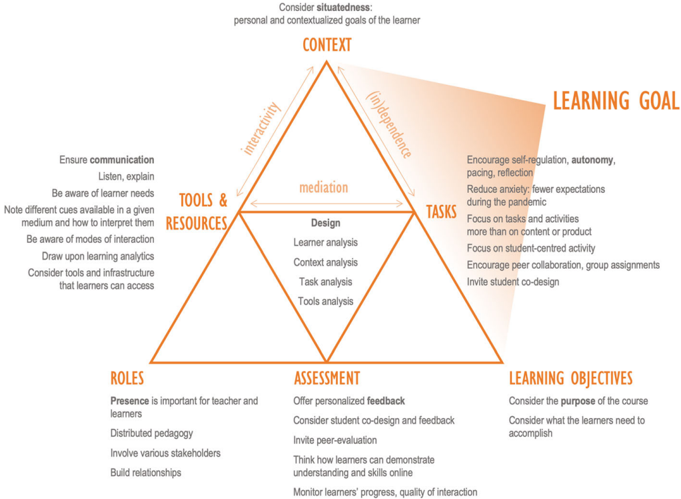
“Our findings point at the design of learning activities with certain characteristics, the combination of three types of presence (social, cognitive and facilitatory) and the need for adapting assessment to the new learning requirements.”
§ Springer Nature Switzerland AG 2020 Published online: 7 July 2020 > Abstract
plainstates an association- Asserted: passes — The authors put it forward as true.
- Checkable: passes — It can be checked against evidence.
- Load-bearing: passes — The paper’s conclusions depend on it.
- Based: passes — The paper gives a reason why it holds.
None of the sources cited for this claim have been checked yet.
In the paper
“What all four experts focus on as a prime ' piece ' of pedagogical knowledge (Kali et al. 2011) is the careful design of activities.”
§ Springer Nature Switzerland AG 2020 Published online: 7 July 2020 > Learning Design
plain- Asserted: passes — The authors put it forward as true.
- Checkable: passes — It can be checked against evidence.
- Load-bearing: unclear — It is unclear whether the paper’s conclusions depend on it.
- Based: passes — The paper gives a reason why it holds.
A result the paper reports from its own data — it cites no other source for it, so there is none to check. The quote shows it is in the paper.
In the paper
“Inspired by Anderson et al. ' s (2001) understanding of teaching presence and how it can be re-conceived in the current Covid-19 situation in which educators are the designers, the tutors and the evaluators of the learning experience, a tripartite framework emerges from the interviews, with three main sub-presences of the teaching presence, namely:”
§ Springer Nature Switzerland AG 2020 Published online: 7 July 2020 > Teacher Presence
plain- Asserted: passes — The authors put it forward as true.
- Checkable: passes — It can be checked against evidence.
- Load-bearing: passes — The paper’s conclusions depend on it.
- Based: passes — The paper gives a reason why it holds.
5 more claims
Create a free account to see all 61 claims and to verify the 9 references still open.
- Probably not a substantial claim. 50
- It may state two separate claims as one. 18
Claims other papers make about this one
Each is checked against this paper’s own text: does it say what the citing paper says it does?
The source backs part of the claim, not all of it — or backs it for a different population, condition or comparison.
In the citing paper
“while it is known that for learning success, input formats usually depend on both attention and interest from the students (Rapanta et al., 2020).”
From Impact of Synchronous and Asynchronous Settings of Online Teaching and Learning in Higher Education on Students' Learning Experience During COVID-19 (2021) · cites this paper as Rapanta et al., 2020
Experimental — accuracy not yet measuredIn the citing paper
“Evaluating AI applications could be beneficial for enhancing their motivation and interest in teaching with AI [40].”
From Developing AI Literacy for Primary and Middle School Teachers in China: Based on a Structural Equation Modeling Analysis (2022) · cites this paper as [40]
Citations
Cites
The Reflective Practitioner: How Professionals Think in Action
Checkoway, B., & Schon, D. A. (1985) · Journal of Policy Analysis and Management · doi:10.2307/3324262 · Cited by 21,268
The reflective practitioner: How professionals think in action
Stewart, C. J. (1984) · Patient Education and Counseling · doi:10.1016/0738-3991(84)90022-3 · Cited by 19,752
Knowledge and teaching: Foundations of the new reform
Shulman, L. (1987) · Harvard Educational Review · doi:10.17763/haer.57.1.j463w79r56455411 · Cited by 16,787
Phenomenological research methods
Moustakas, C. (1994) · doi:10.4135/9781412995658 · Cited by 13,919 · cited 1×
“’ This study ’ s participants, i.e. the four online pedagogy experts, also functioned as co-researchers, following Moustakas ’ (1994) idea (l).”
BackgroundDetermining Validity in Qualitative Inquiry
Creswell, J. W., & Miller, D. L. (2000) · Theory Into Practice · doi:10.1207/s15430421tip3903_2 · Cited by 9,184
Speech Genres and Other Late Essays
Bakhtin, M. M. (1986) · University of Texas Press eBooks · doi:10.7560/720466 · Cited by 8,470
The Difference between Emergency Remote Teaching and Online Learning
Hodges, C. B., Moore, S., Lockee, B. B., Trust, T., & Bond, M. A. (2024) · Handbook of Research in Online Learning · doi:10.1163/9789004702813_021 · Cited by 6,253
Blended learning: Uncovering its transformative potential in higher education
Garrison, D. R., & Kanuka, H. (2004) · The Internet and Higher Education · doi:10.1016/j.iheduc.2004.02.001 · Cited by 4,849
Speech Genres and Other Late Essays
Melaver, M., Bakhtin, M. M., McGee, V. W., Emerson, C., & Holquist, M. (1987) · Poetics Today · doi:10.2307/1772598 · Cited by 3,185
ASSESSING TEACHING PRESENCE IN A COMPUTER CONFERENCING CONTEXT
Anderson, T., Rourke, L., Garrison, R., & Archer, W. (2001) · Online Learning · doi:10.24059/olj.v5i2.1875 · Cited by 1,885
Kirkwood, A., & Price, L. (2014) · Learning, Media and Technology · doi:10.1080/17439884.2013.770404 · Cited by 997
(2009) · doi:10.1057/9780230244276 · Cited by 672
Theories and Frameworks for Online Education: Seeking an Integrated Model
Picciano, A. G. (2017) · Online Learning · doi:10.24059/olj.v21i3.1225 · Cited by 551 · cited 1×
“However, due to the lack of a common, widely understood, pedagogical framework for online teaching and learning (Picciano 2017), it is not clear what additional pedagogical dimensions need to be considered in an online situation.”
BackgroundAcademic Staff Workloads and Job Satisfaction: Expectations and values in academe
Houston, D., Meyer, L. H., & Paewai, S. (2006) · Journal of Higher Education Policy and Management · doi:10.1080/13600800500283734 · Cited by 466
Modes of Interaction in Distance Education: Recent Developments and Research Questions
Anderson, T. D. (2003) · AUSpace (Athabasca University) · Cited by 453
Self-regulation in online learning
Cho, M.-H., & Shen, D. (2013) · Distance Education · doi:10.1080/01587919.2013.835770 · Cited by 380
Editorial: Distance education theory
Moore, M. G. (1991) · American Journal of Distance Education · doi:10.1080/08923649109526758 · Cited by 367 · cited 1×
“As per Moore (1991), the main forms of interaction in distance learning include teacher-student, student-student, and student-content.”
BackgroundPostdigital Education in Design and Practice
Fawns, T. (2019) · Postdigital Science and Education · doi:10.1007/s42438-018-0021-8 · Cited by 365 · cited 2×
“From a postdigital point of view, online education has blurred boundaries between material, digital and human experience (Fawns 2019).”
BackgroundAngeli, C., & Valanides, N. (2005) · Journal of Computer Assisted Learning · doi:10.1111/j.1365-2729.2005.00135.x · Cited by 361
Introduction: Expert Interviews — An Introduction to a New Methodological Debate
Bogner, A., Littig, B., & Menz, W. (2009) · Interviewing Experts · doi:10.1057/9780230244276_1 · Cited by 334
What's the matter with ‘technology-enhanced learning’?
Bayne, S. (2015) · Learning, Media and Technology · doi:10.1080/17439884.2014.915851 · Cited by 326 · cited 1×
“In addition, online learning does not have the in-built claim to improvement that makes ‘ technology-enhanced learning ’ (TEL) (Laurillard and Masterman 2010; Kirkwood and Price 2014) a problematic phrase (Bayne 2015).”
BackgroundHandbook of distance education
Deeson, E. (2004) · British Journal of Educational Technology · doi:10.1111/j.1467-8535.2004.00409_10.x · Cited by 295
Carr‐Chellman, A., & Duchastel, P. (2000) · British Journal of Educational Technology · doi:10.1111/1467-8535.00154 · Cited by 277
14. Teaching in an Online Learning Context
Anderson, T. (2008) · The Theory and Practice of Online Learning · doi:10.15215/aupress/9781897425084.016 · Cited by 270
Jandrić, P., Ryberg, T., Knox, J., Lacković, N., Hayes, S., Suoranta, J., Smith, M., Steketee, A., Peters, M., McLaren, P., et al. (2019) · Postdigital Science and Education · doi:10.1007/s42438-018-0011-x · Cited by 256 · cited 1×
“…’ s (1987) Pedagogy for liberation , Matusov, Marjanonic-Shane and Gradovski ’ s (2019) Dialogic pedagogy and polyphonic research art , Jandri ć ’ s (2017) Learning in the age of digital reason and the polyphonic article published as a continuation of Jandri ć ’ s book (Jandri ć et al. 2019).”
Background(2010) · Cited by 254
Henderson, S., & Gilding, M. (2004) · New Media & Society · doi:10.1177/146144804044331 · Cited by 228 · cited 1×
“Once the learners know what to expect and feel comfortable, it is possible to facilitate the development of strong, positive relationships with others in online settings (Henderson and Gilding 2004).”
BackgroundWhy are faculty members not teaching blended courses? Insights from faculty members
Ocak, M. A. (2011) · Computers & Education · doi:10.1016/j.compedu.2010.10.011 · Cited by 225 · cited 1×
“As recent studies have shown (e.g. Ocak 2011; Ching et al. 2018), some of the main difficulties reported by university teachers with respect to web-based courses arise from the complexity of the instructional situation and shortcomings in planning and organisation.”
ResultEffective Teaching with Technology in Higher Education
MATHEOS, K. (2004) · Teachers College Record: The Voice of Scholarship in Education · doi:10.1177/01614681200410605938 · Cited by 221 · cited 2×
“…involve a diverse array of tools, resources, pedagogical approaches, roles, organizational arrangements and forms of interaction, monitoring and support — with many possible combinations of substitu-tion and integration (Bates and Poole, 2003; Bullen and Janes 2007; Bach, Haynes and Smith 2007).”
BackgroundGonzález, C. (2008) · Higher Education · doi:10.1007/s10734-008-9145-1 · Cited by 185 · cited 1×
“Experientially, online teaching is a recognisable category of working practices for many teachers (Goodyear 2002; Gonzalez 2009; Nilson and Goodson 2017).”
BackgroundLearning in the Age of Digital Reason
Jandric, P. (2017) · Educational Futures · doi:10.1007/978-94-6351-077-6 · Cited by 174
Laat, M. D., Lally, V., Lipponen, L., & Simons, R.-J. (2007) · Instructional Science · doi:10.1007/s11251-006-9007-0 · Cited by 173 · cited 1×
“It is wider than ‘ networked learning ’ ; while networked learning focuses on human-human connections (Banks et al. 2003; De Laat et al. 2007), online learning lacks such specificity.”
BackgroundDo we need teachers as designers of technology enhanced learning?
Kirschner, P. A. (2015) · Instructional Science · doi:10.1007/s11251-015-9346-9 · Cited by 170 · cited 2×
“By claiming that we should not be talking about ‘ new ’ learning, ‘ what we should be talking about is effective, efficient and enjoyable learning that is facilitated and/or enhanced by the technologies available to the teacher, the learner and the school ’ (Kirschner 2015: 313).”
Background(2006) · Cited by 162
McKenney, S., Kali, Y., Markauskaite, L., & Voogt, J. (2015) · Instructional Science · doi:10.1007/s11251-014-9337-2 · Cited by 161 · cited 1×
“On the one hand, the design of effective learning environments and embedding online technologies can serve as catalysts for teachers to experiment new things, explore creative alternatives and reflect on their own practices (Goodyear and Markauskaite 2009; McKenney et al. 2015).”
BackgroundPostdigital Research in the Time of Covid-19
Jandrić, P. (2020) · Postdigital Science and Education · doi:10.1007/s42438-020-00113-8 · Cited by 161 · cited 1×
“The forced digitalisation of teaching and learning during the Covid-19 pandemic is clearly one of those emerging topics (Jandri ć 2020).”
BackgroundIn medias res: reframing design for learning
Goodyear, P., & Dimitriadis, Y. (2013) · Research in Learning Technology · doi:10.3402/rlt.v21i0.19909 · Cited by 134 · cited 2×
“Under this teaching as ‘ design for learning ’ perspective (Goodyear and Dimitriadis 2013), teachers act as both constructors and actors.”
BackgroundSelf-citationThe Instructional Design Knowledge Base
Richey, R. C., Klein, J. D., & Tracey, M. W. (2010) · Routledge eBooks · doi:10.4324/9780203840986 · Cited by 110
Kali, Y., Goodyear, P., & Markauskaitė, L. (2011) · Learning Media and Technology · doi:10.1080/17439884.2011.553621 · Cited by 103 · cited 2×
“What all four experts focus on as a prime ‘piece’ of pedagogical knowledge (Kali et al. 2011) is the careful design of activities.”
BackgroundSelf-citationMoallem, M. (1998) · Educational Technology Research and Development · doi:10.1007/bf02299788 · Cited by 90 · cited 1×
“In face-to-face teaching, ID and LD theories and models are usually implicit in the decision-making processes used by expert teachers (Moallem 1998).”
MethodDialogic Pedagogy and Polyphonic Research Art: Bakhtin by and for Educators
Matusov, E., Marjanović-Shane, A., & Gradovski, M. (2019) · Palgrave Macmillan US eBooks · doi:10.1057/978-1-137-58057-3 · Cited by 90
Making the Transition to E-Learning: Strategies and Issues
(2007) · doi:10.4018/978-1-59140-950-2 · Cited by 89
IDR: A participatory methodology for interdisciplinary design in technology enhanced learning
Winters, N., & Mor, Y. (2007) · Computers & Education · doi:10.1016/j.compedu.2007.09.015 · Cited by 89
Duoethnography: Dialogic Methods for Social, Health, and Educational Research
Norris, J., Sawyer, R. D., & Lund, D. E. (2012) · Left Coast Press eBooks · doi:10.13140/2.1.2184.8644 · Cited by 79
Instructional Design: International Perspectives
Dijkstra, S., Schott, F., Seel, N. M., et al. (2012) · Routledge eBooks · doi:10.4324/9780203052778 · Cited by 76
Online teaching at its best: Merging instructional design with teaching and learning research
Miller, D. R. H. (2018) · Journal of Public Affairs Education · doi:10.1080/15236803.2018.1490617 · Cited by 74 · cited 1×
“Experientially, online teaching is a recognisable category of working practices for many teachers (Goodyear 2002; Gonzalez 2009; Nilson and Goodson 2017).”
BackgroundBaldwin, S. J., Ching, Y.-H., & Friesen, N. (2018) · Online Learning · doi:10.24059/olj.v22i2.1212 · Cited by 70
(2016) · Routledge eBooks · doi:10.4324/9781315430058 · Cited by 70
Online Teaching at Its Best: Merging Instructional Design with Teaching and Learning Research
Nilson, L. B., & Goodson, L. A. (2017) · Medical Entomology and Zoology · Cited by 55
An online testing design choice typology towards cheating threat minimisation
Munoz, A., & Mackay, J. (2019) · Journal of University Teaching and Learning Practice · doi:10.53761/1.16.3.5 · Cited by 51 · cited 2×
“Assessment can possibly be considered the most challenging part of the transition to distance learning for an institution used to face-to-face oral or written exam, as the control shift towards the students makes it hardly possible to ensure that students are not cheating (Munoz and Mackay 2019).”
BackgroundIntroduction to the special issue on Advances in Research on Networked Learning
Banks, S., Goodyear, P., Hodgson, V., & McConnell, D. (2003) · Instructional Science · doi:10.1023/a:1022583918064 · Cited by 50
Coronavirus pushes universities to switch to online classes — but are they ready?
Houlden, S., & Veletsianos, G. (2020) · doi:10.64628/aam.kskm67rt7 · Cited by 47
(2020) · Bibliothèque et Archives nationales du Québec (Québec government) · Cited by 46
(2020) · International Higher Education (Boston College) · Cited by 45
TPD as Online Collaborative Learning for Innovation in Teaching
Laurillard, D., & Masterman, E. (2010) · IGI Global eBooks · doi:10.4018/978-1-60566-780-5.ch013 · Cited by 40
Teachers' design knowledge, epistemic fluency and reflections on students' experiences
Goodyear, P. (2009) · Cited by 36
Self-citationUsing e-Assessment to enhance student learning and evidence learning outcomes
Crisp, G. T., Ortiz, L. G., & Hillier, M. (2016) · International Journal of Educational Technology in Higher Education · doi:10.1186/s41239-016-0020-3 · Cited by 34
Self-citationBecoming an Online Teacher: An Analysis of Prospective Online Instructors’ Reflections
Ching, Y., Hsu, Y., & Baldwin, S. (2017) · The Journal of Interactive Learning Research · Cited by 32
Introduction to the Special Issue on "Advances in Research on Networked Learning."
Banks, S., Goodyear, P., Hodgson, V., et al. (2003) · Cited by 29
Self-citationDialogic Pedagogy and Polyphonic Research Art: Bakhtin by and for Educators
Matusov, E., Marjanović-Shane, A., & Gradovski, M. (2019) · Cited by 28
Goodyear, P. (2002) · Springer eBooks · doi:10.1007/978-94-010-0593-7_5 · Cited by 25
Self-citationInstructional Design for Teachers: Improving Classroom Practice
Carr‐Chellman, A. A. (2010) · Cited by 24
Parchoma, G., Koole, M., Morrison, D., Nelson, D., & Dreaver-Charles, K. (2020) · Higher Education Research & Development · doi:10.1080/07294360.2019.1704693 · Cited by 21 · cited 1×
“Regardless of the approach (ID, LD, or techno-pedagogical), what is important, in the end, is that instructors work towards ‘ designing conditions under which learners have a better chance to learn ’ (Parchoma et al. 2019: 13).”
BackgroundSelf-citationPsychological Foundations for Instructional Design Theory
Dijkstra, S., Schott, F., Seel, N., Tennyson, R. D., & Seel, N. M. (2013) · Routledge eBooks · doi:10.4324/9780203062920-12 · Cited by 21
Instructional Design Theory, Research, and Models
Dijkstra, S., Schott, F., Seel, N., et al. (2013) · Routledge eBooks · doi:10.4324/9780203062920-5 · Cited by 14
Instructional Design for Teachers
Carr‐Chellman, A. A. (2015) · Routledge eBooks · doi:10.4324/9781315773032 · Cited by 12
Revisiting “Beyond Instructional Design”
Sims, R. (2015) · Journal of Learning Design · doi:10.5204/jld.v8i3.252 · Cited by 6 · cited 1×
“…with the language of ID currently being used when the focus is on instruction and when a high degree of normativity applies, and the language of LD (Sims 2015) or techno-pedagogical design (e.g., Winters and Mor 2008) being used when the focus is more on learner activities and responsiveness to…”
Background(2015) · Higher Education Abstracts · doi:10.1111/hea.12037_26 · Cited by 6
Haythornthwaite, C., & Andrews, R. (2011) · SAGE Publications Ltd eBooks · doi:10.4135/9781446288566.n4 · Cited by 5
Anderson, W. (2015) · Routledge eBooks · doi:10.4324/9780203803738.ch6 · Cited by 5
Involvement, Institutional Roles and Design Models in E‐Learning
Botturi, L. (2013) · Wiley eBooks · doi:10.1002/9781118557686.ch43 · Cited by 1 · cited 1×
“This is especially the case when a team is involved in developing and implementing an online course: coordinated action between different professionals needs a shared design approach (Botturi and Del Percio 2007).”
BackgroundSelf-citationBarbero (2014) · doi:10.1016/j · Cited by 1
(2015) · Higher Education Abstracts · doi:10.1111/hea.12037
Research works printed but not linked: 2
- Bates, A. W. (2019). Teaching in a digital age. 2nd Edition. Vancouver: Tony Bates Associates. https://pressbooks.bccampus.ca/teachinginadigitalagev2/. Accessed 15 June 2020.
- Shor, I., & Freire, P. (1987). A pedagogy for deliberation: dialogues on transforming education . Westport: Bergin & Garvey Publishers.
Cited by
Singh, J., Steele, K., & Singh, L. (2021) · Journal of Educational Technology Systems · doi:10.1177/00472395211047865 · Cited by 739
“More speci fi cally, lack of awareness of basic principles needed to design and facilitate meaningful learning experiences in online format created additional challenges for faculty (Rapanta et al., 2020).”
BackgroundIglesias-Pradas, S., Hernández-García, Á., Chaparro-Peláez, J., & Prieto, J. L. (2021) · Computers in Human Behavior · doi:10.1016/j.chb.2021.106713 · Cited by 693
Profiling teachers' readiness for online teaching and learning in higher education: Who's ready?
Scherer, R., Howard, S. K., Tondeur, J., & Siddiq, F. (2021) · Computers in Human Behavior · doi:10.1016/j.chb.2020.106675 · Cited by 543
Emergency remote teaching in higher education: mapping the first global online semester
Bond, M., Bedenlier, S., Marín, V. I., & Händel, M. (2021) · International Journal of Educational Technology in Higher Education · doi:10.1186/s41239-021-00282-x · Cited by 527
Balancing Technology, Pedagogy and the New Normal: Post-pandemic Challenges for Higher Education
Rapanta, C., Botturi, L., Goodyear, P., Guàrdia, L., & Koole, M. (2021) · Postdigital Science and Education · doi:10.1007/s42438-021-00249-1 · Cited by 525
Self-citation
Metadata
- Authors
- Rapanta, C., Botturi, L., Goodyear, P., Guàrdia, L., & Koole, M.
- Affiliations
- Universidade Nova de Lisboa (PT)
- University of Applied Sciences and Arts of Southern Switzerland (CH)
- The University of Sydney (AU)
- University of Saskatchewan (CA)
- Corresponding author
- Rapanta, Chrysi
- ORCID
- Rapanta, Chrysi
- Venue
- Postdigital Science and Education
- Published
- 2020-07-07
- Volume
- 2
- Issue
- 3
- Pages
- 923-945
- ISSN
- 2524-485X (ISSN-L)
- 2524-4868
- PMC
- PMC7339092
- OpenAlex
- W3042009104
- Semantic Scholar
- fed495af71b417de8d60cf16b6da44926faf24a0
- Cited by
- 2,130
- References
- 75
- Citations by year
- 2026: 134 · 2025: 158 · 2024: 261 · 2023: 426 · 2022: 556 · 2021: 509 · 2020: 73
- FWCI
- 454.18
- Type
- journal article
- Language
- en
- Open access
- hybrid
- doi.org
- Licence
- other-oa
- www.springer.com/tdm (tdm)
- www.springer.com/tdm (vor)
- Locations
- Postdigital Science and Education (publishedVersion, other-oa)
- PubMed (publishedVersion)
- PubMed Central (submittedVersion)
- The Sydney eScholarship Repository (The University of Sydney) (submittedVersion)
- Funders
- Fundação para a Ciência e a Tecnologia (DL 57/2016/CP1453/CT0066)
- Australian Research Council (DP150104163)
- Topics
- Social Sciences › Education › Digital Education and Society
- Social Sciences › Education › Higher Education Practises and Engagement
- Social Sciences › Education › Educational Innovations and Technology
- Keywords
- online learning, COVID-19 pandemic, higher education, teacher presence, pedagogical content knowledge, learning activities, social presence, cognitive presence
About these checks
Registry, retraction, Cites and statistics results are computed, not judged, with one exception: a printed reference that no index lists is read once by a model before it counts as a citation error. Claims are extracted by a model and kept only when their quote appears verbatim in the text; each cited source is then checked, with a model’s help, for whether it says what the claim relies on. Those verdicts can be wrong — read the claim’s quote and the cited source before relying on one.
The claim verdicts this report counts are experimental: their accuracy is not yet measured.
A language model drew the claims from the paper on 2026-10-10, under version 3 of the claim definition (model deepseek-v4.1-flash, prompt extract-v3).
A second model labelled each claim on 2026-10-10 (model jev-1.13-20260917, definition revision gold-guideline-v0.2).
Cited sources are checked with a language model’s help (qwen3.8-omni-flash).
Statistics and arithmetic are recomputed, not judged.
Confidence bands are shown only for fields calibrated on our annotated test set. None is calibrated yet, so no band is shown.
What counts as a claim ›How we measure confidence ›How we check this ›
Are you an author, or do you see a problem with this page? Request a review
Data sources
Bibliographic data: Semantic Scholar, OpenAlex, Crossref.
Contains information from the Semantic Scholar Academic Graph Datasets, made available under the ODC Attribution License (ODC-BY 1.0).
Semantic Scholar’s data is described in: Kinney, R., et al. (2023). The Semantic Scholar Open Data Platform. arXiv:2301.10140.
