

Facial emotion discrimination: II. Behavioral findings in depression
Open accessThe DOI matches its Crossref record; 17 of the 18 references it cites were found in a registry or an index.
Abstract
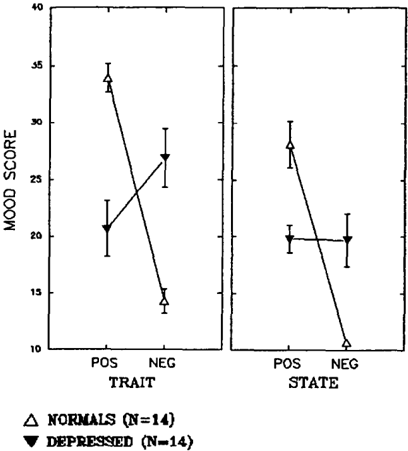
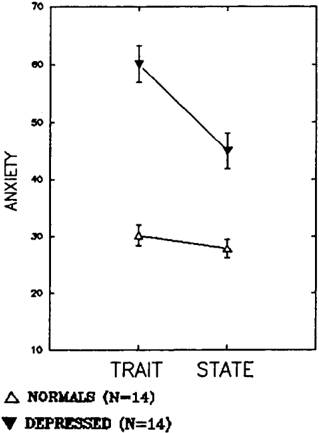
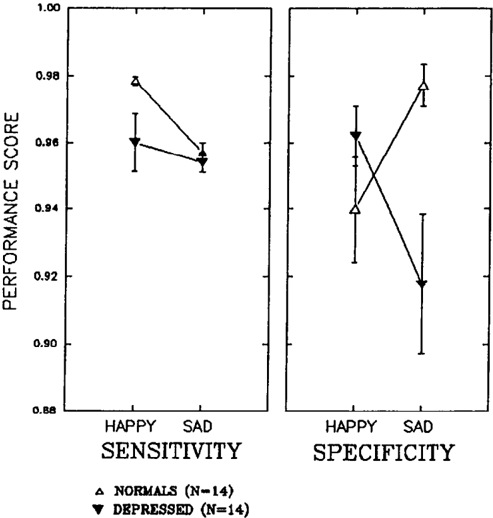
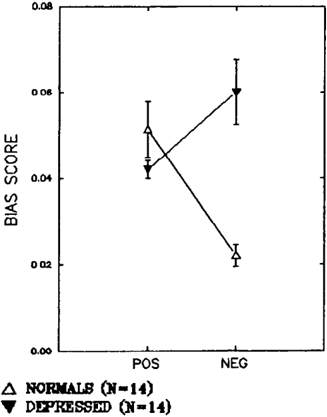
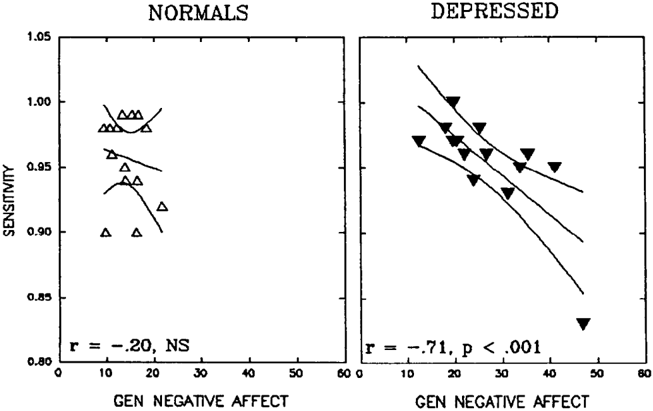
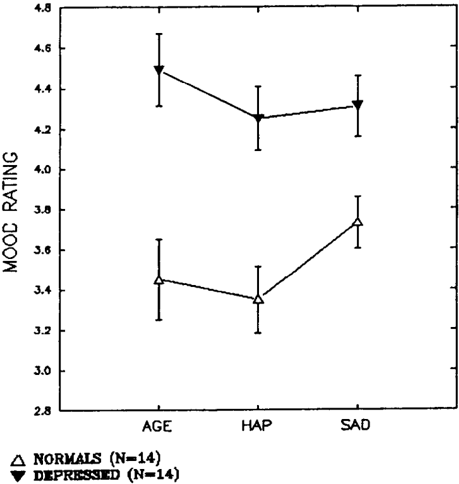
The facial discrimination tasks described in part I (Erwin et al., 1992) were administered to a sample of 14 patients with depression and 14 normal controls matched for sex (12 women, 2 men) and balanced for age and sociodemographic characteristics. Patients performed more poorly on measures of sensitivity for happy discrimination and specificity for sad discrimination, and had a higher negative bias across tasks. Severity of negative affect was correlated with poorer performance for patients. The results suggest that depression is associated with an impaired ability to recognize facial displays of emotion.
Overview
The claims and statistics of this paper haven’t been checked yet.
Free: it reads the open-access text and checks the first 5 claims that cite a source we can check. Create a free account to check every claim.
Integrity signals
Registry
Cites
Statistics
Figures
Verification
Claims the paper makes
The claims and statistics of this paper haven’t been checked yet.
Free: it reads the open-access text and checks the first 5 claims that cite a source we can check. Create a free account to check every claim.
Claims other papers make about this one
Each is checked against this paper’s own text: does it say what the citing paper says it does?
The cited source doesn’t support the claim as written.
In the citing paper
“Enhanced recognition of sad facial expressions has also been consistently reported in acutely depressed patients.73,[143][144][145][146][147][148]”
From Systematic review of the neural basis of social cognition in patients with mood disorders (2012) · cites this paper as [144]
Checked by a reasoning model — may be wrong.
Experimental — accuracy not yet measuredThe source backs part of the claim, not all of it — or backs it for a different population, condition or comparison.
In the citing paper
“studies examining patients with bipolar disorder in a depressed phase of illness reveal a mood congruent bias in emotion perception tasks, including difficulties labelling happy faces 97,102 and a tendency to misinterpret neutral facial stimuli as sad 144,183 and happy faces as angry.”
From Systematic review of the neural basis of social cognition in patients with mood disorders (2012) · cites this paper as [144]
Experimental — accuracy not yet measuredIn the citing paper
“others have argued that depressed patients exhibit negative biases in identifying facial emotions; patients are more likely to interpret neutral faces as sad and happy faces as neutral, resulting in an overall negative bias compared to controls (Gur et al., 1992;Surguladze et al. 2004).”
From Affective Cognition and its Disruption in Mood Disorders (2011) · cites this paper as Gur et al., 1992
In the citing paper
“Depression has long been associated with a pattern of cognition biased towards negative information, with depressed individuals showing a tendency to remember negative items and to rate experiences or stimuli as more negative than do controls (e.g.Gur et al., 1992;Mogg et al., 1995).”
From Affective Cognition and its Disruption in Mood Disorders (2011) · cites this paper as Gur et al., 1992
Self-check
Percentages, sums and reported differences re-computed from the paper’s own numbers.
The self-check needs the paper’s full text.
Citations
Cites
Statistical Power Analysis for the Behavioral Sciences
Muller, K. (1989) · Technometrics · doi:10.1080/00401706.1989.10488618 · Cited by 99,167
Statistical power analysis for the behavioral sciences
(1990) · Computers, Environment and Urban Systems · doi:10.1016/0198-9715(90)90050-4 · Cited by 65,269
An inventory for measuring depression
BECK, A. T. (1961) · Archives of General Psychiatry · doi:10.1001/archpsyc.1961.01710120031004 · Cited by 38,032
Statistical Power Analysis for the Behavioral Sciences (2nd ed.).
Lachenbruch, P. A., & Cohen, J. (1989) · Journal of the American Statistical Association · doi:10.2307/2290095 · Cited by 37,395
Hamilton, M. (1960) · Journal of Neurology, Neurosurgery & Psychiatry · doi:10.1136/jnnp.23.1.56 · Cited by 32,817
(1970) · Cited by 24,983
The structure of mood change: An idiographic/nomothetic analysis.
Zevon, M. A., & Tellegen, A. (1982) · Journal of Personality and Social Psychology · doi:10.1037//0022-3514.43.1.111 · Cited by 740
Facial Discrimination and Emotional Recognition in Schizophrenia and Affective Disorders
Feinberg, T. E. (1986) · Archives of General Psychiatry · doi:10.1001/archpsyc.1986.01800030094010 · Cited by 363 · cited 1×
“Patients with affective illness have often been used as a psychiatric control group (Cutting, 1981; Feinberg et al., 1986; Zuroff and Colussy, 1986; Gessler et al., 1989).”
MethodFacial emotion discrimination: I. Task construction and behavioral findings in normal subjects
Erwin, R. J., Gur, R. C., Gur, R. E., Skolnick, B., Mawhinney-Hee, M., & Smailis, J. (1992) · Psychiatry Research · doi:10.1016/0165-1781(92)90115-j · Cited by 275
Self-citationDeficits in Facial-affect Recognition and Schizophrenia
Morrison, R. L., Bellack, A. S., & Mueser, K. T. (1988) · Schizophrenia Bulletin · doi:10.1093/schbul/14.1.67 · Cited by 202
Research works printed but not linked: 1
- American Psychiatric Association. DSM-III-R: Diagnostic and Statistical Manual of Mental Disorders. 3rd ed., revised. Washington, DC: American Psychiatric Press, 1987.
Cited by
Items 201–300 of 592
Neural correlates of effective and ineffective mood induction
Kohn, N., Falkenberg, I., Kellermann, T., Eickhoff, S. B., Gur, R. C., & Habel, U. (2014) · Social Cognitive and Affective Neuroscience · doi:10.1093/scan/nst055 · Cited by 45
Self-citationEmotional Processing and Antidepressant Action
Harmer, C. J. (2012) · Current topics in behavioral neurosciences · doi:10.1007/7854_2012_210 · Cited by 54
Schepman, K., Taylor, E. A., Collishaw, S., & Fombonne, E. J. (2011) · Research on Child and Adolescent Psychopathology · doi:10.1007/s10802-011-9587-2 · Cited by 52
Ridout, N., O’Carroll, R. E., Dritschel, B., Christmas, D. M. B., Eljamel, S., & Matthews, K. (2007) · Neuropsychologia · doi:10.1016/j.neuropsychologia.2006.12.022 · Cited by 51
Antidepressant drug action--From rapid changes on network function to network rewiring
Rantamäki, T., & Yalcin, I. (2016) · Progress in Neuro-Psychopharmacology and Biological Psychiatry · doi:10.1016/j.pnpbp.2015.06.001 · Cited by 50
Neural basis of emotion recognition deficits in first-episode major depression
van Wingen, G. A., van Eijndhoven, P., Tendolkar, I., Buitelaar, J., Verkes, R. J., & Fernández, G. (2011) · Psychological Medicine · doi:10.1017/s0033291710002084 · Cited by 50
Filkowski, M. M., & Haas, B. W. (2016) · Journal of Neuroimaging · doi:10.1111/jon.12403 · Cited by 51
Gilboa‐Schechtman, E., Foa, E. B., Vaknin, Y., Marom, S., & Hermesh, H. (2008) · Cognitive Therapy and Research · doi:10.1007/s10608-008-9208-8 · Cited by 50
Merens, W., Booij, L., Haffmans, P. J., & van der Does, A. (2008) · Journal of Psychopharmacology · doi:10.1177/0269881107081531 · Cited by 49
Effect of chronotype on emotional processing and risk taking
Berdynaj, D., Boudissa, S. N., Grieg, M. S., Hope, C., Mahamed, S. H., & Norbury, R. (2016) · Chronobiology International · doi:10.3109/07420528.2016.1146739 · Cited by 45
Jaworska, N., Blier, P., Fusee, W., & Knott, V. (2011) · Journal of Affective Disorders · doi:10.1016/j.jad.2011.10.047 · Cited by 50
Horder, J., Browning, M., Di Simplicio, M., Cowen, P. J., & Harmer, C. J. (2012) · Journal of Psychopharmacology · doi:10.1177/0269881111400649 · Cited by 48
“Also, depressed patients are more likely to perceive ambiguous facial expressions as negative compared with controls (Bouhuys et al., 1999; Gur et al., 1992).”
BackgroundKerestes, R., Labuschagne, I., Croft, R. J., O’Neill, B. V., Bhagwagar, Z., Phan, K. L., & Nathan, P. J. (2008) · Psychopharmacology · doi:10.1007/s00213-008-1340-3 · Cited by 48
Impaired recognition of prosody and subtle emotional facial expressions in Parkinson's disease.
Buxton, S. L., Macdonald, L., & Tippett, L. J. (2013) · Behavioral Neuroscience · doi:10.1037/a0032013 · Cited by 48
Kerestes, R., Bhagwagar, Z., Nathan, P. J., Meda, S. A., Ladouceur, C. D., Maloney, K., Matuskey, D., Ruf, B., Saricicek, A., Wang, F., et al. (2012) · Psychiatry Research: Neuroimaging · doi:10.1016/j.pscychresns.2011.11.004 · Cited by 45
Cognitive, physiological, and personality correlates of recurrence of depression
Bos, E. H., Bouhuys, A. L., Geerts, E., Os, T. W. D. P. V., der Spoel, I. D. V., Brouwer, W., & Ormel, J. (2005) · Journal of Affective Disorders · doi:10.1016/j.jad.2005.04.001 · Cited by 48
Do Depressed Patients Lose Their Sense of Humor
Falkenberg, I., Jarmuzek, J., Bartels, M., & Wild, B. (2011) · Psychopathology · doi:10.1159/000317778 · Cited by 40
Suzuki, A., Poon, L., Kumari, V., & Cleare, A. J. (2015) · Child Maltreatment · doi:10.1177/1077559515600781 · Cited by 47
Walsh, A. E. L., Browning, M. D., Drevets, W. C., Furey, M., & Harmer, C. J. (2018) · Philosophical Transactions of the Royal Society B Biological Sciences · doi:10.1098/rstb.2017.0030 · Cited by 50
Computerized measurement of facial expression of emotions in schizophrenia
Alvino, C. V., Kohler, C. G., Barrett, F. S., Gur, R. E., Gur, R. C., & Verma, R. (2007) · Journal of Neuroscience Methods · doi:10.1016/j.jneumeth.2007.03.002 · Cited by 47
Self-citationRisk for depression is associated with neural biases in emotional categorisation
Chan, S. W. Y., Harmer, C. J., Goodwin, G. M., & Norbury, R. (2008) · Neuropsychologia · doi:10.1016/j.neuropsychologia.2008.05.030 · Cited by 46
“Previous studies have implicated the role of a fronto-parietal network in the processes involved in this categorisation and memory for positive and negative personality-trait words in healthy volunteers (e.g. Gusnard et al 2001, Keenan et al 2001, Stuss 1991, Moran et al 2006).”
Gil, S., Teissèdre, F., Chambres, P., & Droit‐Volet, S. (2010) · Psychiatry Research · doi:10.1016/j.psychres.2010.06.015 · Cited by 47
Jehna, M., Neuper, C., Petrovic, K. E., Wallner-Blazek, M., Schmidt, R., Fuchs, S., Fazekas, F., & Enzinger, C. (2010) · Clinical Neurology and Neurosurgery · doi:10.1016/j.clineuro.2010.03.020 · Cited by 46
The Influence of Dysphoria and Depression on Mental State Decoding
Manstead, A. S. R., Dosmukhambetova, D., Shearn, J., & Clifton, A. (2013) · Journal of Social and Clinical Psychology · doi:10.1521/jscp.2013.32.1.116 · Cited by 45
Leppänen, J. M., Niehaus, D. J. H., Koen, L., Toit, E. D., Schoeman, R., & Emsley, R. A. (2006) · Schizophrenia Research · doi:10.1016/j.schres.2006.02.007 · Cited by 44
Genetic algorithms reveal profound individual differences in emotion recognition
Binetti, N., Roubtsova, N. S., Carlisi, C. O., Cosker, D. P., Viding, E. M., & Mareschal, I. (2022) · Proceedings of the National Academy of Sciences · doi:10.1073/pnas.2201380119 · Cited by 44
Recognition of emotion from body language among patients with unipolar depression
Loi, F., Vaidya, J. G., & Paradiso, S. (2013) · Psychiatry Research · doi:10.1016/j.psychres.2013.03.001 · Cited by 42
“Their symptom severity was comparable to other studies' samples that used facial expressions to measure emotion perception in depression and showed significant findings (Gur et al., 1992; Surguladze et al., 2004).”
BackgroundResultMiller, S. A. (2022) · doi:10.1093/oso/9780197573174.001.0001 · Cited by 41
Improvisational music therapy and perception of emotions in music by people with depression
Punkanen, M. (2011) · Jyväskylä University Digital Archive (University of Jyväskylä) · Cited by 42
Miskowiak, K. W., Favaron, E., Hafizi, S., Inkster, B., Goodwin, G. M., Cowen, P. J., & Harmer, C. J. (2010) · Psychopharmacology · doi:10.1007/s00213-010-1842-7 · Cited by 40
“In particular, depressed patients display enhanced processing of negative facial expressions of fear and anger (Gur et al. 1992) and reduced recognition of happiness (Harmer et al.”
BackgroundThe Power of Smiling: The Adult Brain Networks Underlying Learned Infant Emotionality
Stark, E. A., Cabral, J., Riem, M. M. E., van IJzendoorn, M. H., Stein, A. L., & Kringelbach, M. L. (2019) · Cerebral Cortex · doi:10.1093/cercor/bhz219 · Cited by 39
Ende, G., Demirakça, T., & Tost, H. (2006) · Progress in brain research · doi:10.1016/s0079-6123(06)56027-3 · Cited by 40
Healy, S. J., Lewin, J., Butler, S., Vaillancourt, K., & Seth-Smith, F. (2015) · Archives of Women s Mental Health · doi:10.1007/s00737-015-0530-3 · Cited by 39
Koschack, J., Höschel, K., & Irle, E. (2003) · The Journal of Nervous and Mental Disease · doi:10.1097/01.nmd.0000054934.26031.33 · Cited by 40
Effects of sad mood on facial emotion recognition in Chinese people
Lee, T. M. C., Ng, E. H. H., Tang, S. W., & Chan, C. C. H. (2008) · Psychiatry Research · doi:10.1016/j.psychres.2007.04.022 · Cited by 39
Genetic modulation of the response bias towards facial displays of anger and happiness
Gohier, B., Senior, C., Raduà, J., El‐Hage, W., Reichenberg, A., Proitsi, P., Phillips, M. L., & Surguladze, S. A. (2014) · European Psychiatry · doi:10.1016/j.eurpsy.2013.03.003 · Cited by 38
Lin, C.-Y., Tien, Y.-M., Huang, J.-T., Tsai, C., & Hsu, L.-C. (2016) · Behavioural Neurology · doi:10.1155/2016/9287092 · Cited by 38
Peters, A. T., Meter, A. V., Pruitt, P. J., Briceño, E. M., Ryan, K. A., Hagan, M. J., Weldon, A. L., Kassel, M. T., Vederman, A. C., Zubieta, J., et al. (2016) · Psychoneuroendocrinology · doi:10.1016/j.psyneuen.2016.07.215 · Cited by 38
Pringle, A., McCabe, C., Cowen, P., & Harmer, C. (2013) · Journal of Psychopharmacology · doi:10.1177/0269881112474523 · Cited by 37
Brain mechanisms underlying the emotion processing bias in treatment-resistant depression
Fan, X., Mocchi, M. M., Pascuzzi, B., Xiao, J., Metzger, B. A., Mathura, R. K., Hacker, C. D., Adkinson, J. A., Bartoli, E., Elhassa, S., et al. (2024) · Nature Mental Health · doi:10.1038/s44220-024-00238-w · Cited by 37
Garrido‐Vásquez, P., Jessen, S., & Kotz, S. A. (2011) · Social Neuroscience · doi:10.1080/17470919.2011.620771 · Cited by 40
Briceño, E. M., Weisenbach, S. L., Rapport, L. J., Hazlett, K. E., Bieliauskas, L. A., Haase, B. D., Ransom, M. T., Brinkman, M. L., Peciña, M., Schteingart, D. E., et al. (2013) · Psychological Medicine · doi:10.1017/s0033291712002176 · Cited by 36
Reliability and validity studies of the Facial Discrimination Task for emotion research
Rojahn, J., Gerhards, F., Matlock, S. T., & Kroeger, T. L. (2000) · Psychiatry Research · doi:10.1016/s0165-1781(00)00169-4 · Cited by 37
Ehlers, C. L., Wall, T. L., Garcia‐Andrade, C., & Phillips, E. (2001) · Psychiatry Research · doi:10.1016/s0165-1781(01)00313-4 · Cited by 37
The major-minor mode dichotomy in music perception
Carraturo, G., Pando‐Naude, V., Costa, M., Vuust, P., Bonetti, L., & Brattico, E. (2024) · Physics of Life Reviews · doi:10.1016/j.plrev.2024.11.017 · Cited by 35
Stupart, O., Robbins, T. W., & Dalley, J. W. (2022) · Psychopharmacology · doi:10.1007/s00213-022-06275-6 · Cited by 35
Paradiso, S., Ostedgaard, K. L., Vaidya, J. G., Ponto, L. L. B., & Robinson, R. (2012) · Psychiatry Research Neuroimaging · doi:10.1016/j.pscychresns.2012.05.008 · Cited by 35
Mueller, S. C., Mandell, D., Leschek, E., Pine, D. S., Merke, D. P., & Ernst, M. (2009) · Journal of Child and Adolescent Psychopharmacology · doi:10.1089/cap.2008.031 · Cited by 35
Quantification of facial expressions using high-dimensional shape transformations
Verma, R., Davatzikos, C. A., Loughead, J., Indersmitten, T., Hu, R., Kohler, C. G., Gur, R. E., & Gur, R. C. (2004) · Journal of Neuroscience Methods · doi:10.1016/j.jneumeth.2004.05.016 · Cited by 35
Self-citationDannlowski, U., Domschke, K., Birosova, E., Lawford, B. R., Young, R. M., Voisey, J., Morris, C. P., Suslow, T., Konrad, C., Kugel, H., et al. (2013) · The International Journal of Neuropsychopharmacology · doi:10.1017/s1461145711001659 · Cited by 34
Recognition of emotional facial expressions in anxious and nonanxious depression
Berg, H. E., Ballard, E. D., Luckenbaugh, D. A., Nugent, A. C., Ionescu, D. F., & Zarate, C. A. (2016) · Comprehensive Psychiatry · doi:10.1016/j.comppsych.2016.06.007 · Cited by 34
Emotion recognition from faces with in- and out-group features in patients with depression
Liedtke, C., Kohl, W., Kret, M. E., & Koelkebeck, K. (2017) · Journal of Affective Disorders · doi:10.1016/j.jad.2017.11.085 · Cited by 35
Functional MRI of emotional memory in adolescent depression
Holt, R., Graham, J. M., Whitaker, K. J., Hagan, C. C., Ooi, C., Wilkinson, P. O., van Nieuwenhuizen, A. O., Lennox, B., Sahakian, B. J., Goodyer, I. M., et al. (2015) · Developmental Cognitive Neuroscience · doi:10.1016/j.dcn.2015.12.013 · Cited by 34
Exploring the concept of alexithymia in the lives of people with learning disabilities
Mellor, K., & Dagnan, D. (2005) · Journal of Intellectual Disabilities · doi:10.1177/1744629505056696 · Cited by 33
Oliveira, L., Ladouceur, C. D., Phillips, M. L., Brammer, M. J., & Mourão-Miranda, J. (2013) · PLoS ONE · doi:10.1371/journal.pone.0060121 · Cited by 33
IS THE NEUTRAL CONDITION RELEVANT TO STUDY MUSICAL EMOTION IN PATIENTS?
Dellacherie, D., Ehrlé, N., & Samson, S. (2008) · Music Perception An Interdisciplinary Journal · doi:10.1525/mp.2008.25.4.285 · Cited by 33
The Comprehensive Affect Testing System-Abbreviated: Effects of Age on Performance
Schaffer, S. G., Wisniewski, A., Dahdah, M. N., & Froming, K. B. (2009) · Archives of Clinical Neuropsychology · doi:10.1093/arclin/acp012 · Cited by 34
Crossmodal emotional integration in major depression
Müller, V. I., Cieslik, E. C., Kellermann, T. S., & Eickhoff, S. B. (2014) · Social Cognitive and Affective Neuroscience · doi:10.1093/scan/nst057 · Cited by 30
Schlipf, S., Batra, A., Walter, G., Zeep, C., Wildgruber, D., Fallgatter, A. J., & Ethofer, T. (2013) · Frontiers in Psychology · doi:10.3389/fpsyg.2013.00461 · Cited by 33
Acute fluoxetine modulates emotional processing in young adult volunteers
Capitão, L. P., Murphy, S. E., Browning, M. D., Cowen, P. J., & Harmer, C. J. (2015) · Psychological Medicine · doi:10.1017/s0033291715000240 · Cited by 34
Cognitive control over emotional information in current and remitted depression
Quigley, L., Wen, A., & Dobson, K. S. (2020) · Behaviour Research and Therapy · doi:10.1016/j.brat.2020.103658 · Cited by 31
Adolescent recognition of parental affect: Influence of depressive symptoms.
Ehrmantrout, N., Allen, N. B., Leve, C. S., Davis, B., & Sheeber, L. (2011) · Journal of Abnormal Psychology · doi:10.1037/a0022500 · Cited by 31
Effect of specific psychotherapy for chronic depression on neural Responses to emotional faces
Klein, J. P., Becker, B., Hurlemann, R., Scheibe, C., Colla, M., & Heuser, I. (2014) · Journal of Affective Disorders · doi:10.1016/j.jad.2014.04.055 · Cited by 31
Relationships among 5-HTT genotype, life events and gender in the recognition of facial emotions
Antypa, N., Cerit, H., Kruijt, A., Verhoeven, F. E. A., & van der Does, W. A. J. (2010) · Neuroscience · doi:10.1016/j.neuroscience.2010.10.042 · Cited by 34
Csukly, G., Czobor, P., Simon, L., & Takács, B. (2007) · Comprehensive Psychiatry · doi:10.1016/j.comppsych.2007.09.001 · Cited by 31
Executive Functioning at Baseline Prospectively Predicts Depression Treatment Response
Dawson, E. L., Caveney, A. F., Meyers, K. K., Weisenbach, S. L., Giordani, B., Avery, E. T., Schallmo, M.-P., Bahadori, A., Bieliauskas, L. A., Mordhorst, M., et al. (2017) · The Primary Care Companion For CNS Disorders · doi:10.4088/pcc.16m01949 · Cited by 29
Yawning Detection Sensitivity and Yawning Contagion
Chan, M. H.-M., & Tseng, C. (2017) · i-Perception · doi:10.1177/2041669517726797 · Cited by 31
Neural correlates of processing emotional prosody in unipolar depression
Koch, K., Stegmaier, S., Schwarz, L., Erb, M., Reinl, M., Scheffler, K., Wildgruber, D., & Ethofer, T. (2018) · Human Brain Mapping · doi:10.1002/hbm.24185 · Cited by 30
Visual scanning behavior during processing of emotional faces in older adults with major depression
Noiret, N., Carvalho, N., Laurent, É., Vulliez‐Coady, L., Bennabi, D., Chopard, G., Haffen, É., Nicolier, M., Monnin, J., & Vandel, P. (2014) · Aging & Mental Health · doi:10.1080/13607863.2014.926473 · Cited by 30
Partner-expected affect: How you feel now is predicted by how your partner thought you felt before.
Sels, L., Ceulemans, E., & Kuppens, P. (2017) · Emotion · doi:10.1037/emo0000304 · Cited by 31
Negative interpretation of social cue in depression: Evidence from reading mind from eyes test
Nejati, V. (2017) · Neurology Psychiatry and Brain Research · doi:10.1016/j.npbr.2017.11.001 · Cited by 29
Sokhadze, E. M., Tasman, A., Tamas, R. L., & El‐Mallakh, R. S. (2010) · Applied Psychophysiology and Biofeedback · doi:10.1007/s10484-010-9140-z · Cited by 29
Moore, T. M., Gur, R. C., Thomas, M. L., Brown, G. G., Nock, M. K., Savitt, A. P., Keilp, J. G., Heeringa, S. G., Ursano, R. J., Stein, M. B., et al. (2017) · Assessment · doi:10.1177/1073191116689820 · Cited by 31
Self-citationSocial cognition in early course of schizophrenia: Exploratory factor analysis
Mike, L., Guimond, S., Kelly, S., Thermenos, H. W., Mesholam‐Gately, R. I., Eack, S. M., & Keshavan, M. S. (2019) · Psychiatry Research · doi:10.1016/j.psychres.2018.12.152 · Cited by 29
Winker, C., Rehbein, M. A., Sabatinelli, D., Dohn, M., Maitzen, J., Roesmann, K., Wolters, C. H., Arolt, V., & Junghoefer, M. (2019) · Frontiers in Behavioral Neuroscience · doi:10.3389/fnbeh.2019.00083 · Cited by 29
Ehlers, C. L., Gilder, D. A., & Phillips, E. (2008) · Addiction Biology · doi:10.1111/j.1369-1600.2007.00091.x · Cited by 29
Recognition and Interpretation of Facial Expressions in Dysphoric Women
Frewen, P., & Dozois, D. J. A. (2005) · Journal of Psychopathology and Behavioral Assessment · doi:10.1007/s10862-005-2410-z · Cited by 29
Irwin, M. R. (2025) · Biological Psychiatry · doi:10.1016/j.biopsych.2025.04.018 · Cited by 28
Negative ion treatment increases positive emotional processing in seasonal affective disorder
Harmer, C. J., Charles, M., McTavish, S. F. B., Favaron, E., & Cowen, P. J. (2011) · Psychological Medicine · doi:10.1017/s0033291711002820 · Cited by 28
Niu, M., Tao, J., & Liu, B. (2021) · IEEE International Conference on Acoustics Speech and Signal Processing · doi:10.1109/icassp39728.2021.9413504 · Cited by 28
Quantifying facial expression signal and intensity use during development
Rodger, H., Lao, J., & Caldara, R. (2018) · Journal of Experimental Child Psychology · doi:10.1016/j.jecp.2018.05.005 · Cited by 28
Bouhuys, A. L., Bos, E. H., Geerts, E., van Os, T. W. D. P., & Ormel, J. (2006) · Journal of Nervous & Mental Disease · doi:10.1097/01.nmd.0000228502.52864.ce · Cited by 22
NK1 receptor antagonism and the neural processing of emotional information in healthy volunteers
McCabe, C., Cowen, P. J., & Harmer, C. J. (2009) · The International Journal of Neuropsychopharmacology · doi:10.1017/s1461145709990150 · Cited by 27
Liu, C., & Gershon, E. S. (2024) · Translational Psychiatry · doi:10.1038/s41398-024-03195-1 · Cited by 28
Case Report: Stimulation of the Right Amygdala Induces Transient Changes in Affective Bias
Bijanki, K. R., Kovach, C. K., McCormick, L. M., Kawasaki, H., Dlouhy, B. J., Feinstein, J. S., Jones, R., & Howard, M. A. (2014) · Brain stimulation · doi:10.1016/j.brs.2014.05.005 · Cited by 27
Weldon, A. L., Hagan, M. J., Meter, A. V., Jacobs, R. H., Kassel, M. T., Hazlett, K. E., Haase, B. D., Vederman, A. C., Avery, E. T., Briceño, E. M., et al. (2015) · Neuropsychobiology · doi:10.1159/000369027 · Cited by 28
Niu, M., Wang, X., Gong, J., Liu, B., Tao, J., & Schuller, B. W. (2025) · IEEE Transactions on Circuits and Systems for Video Technology · doi:10.1109/tcsvt.2025.3533480 · Cited by 26
Influence of age of onset on limbic and paralimbic structures in depression
Jaworska, N., MacMaster, F. P., Yang, X., Courtright, A., Pradhan, S., Gaxiola‐Valdez, I., Cortese, F., Goodyear, B. G., & Ramasubbu, R. (2014) · Psychiatry and Clinical Neurosciences · doi:10.1111/pcn.12197 · Cited by 26
Audiovisual emotional processing and neurocognitive functioning in patients with depression
nefeld, S. D.-G. ⁄., Eickhoff, S. B., & Mueller, V. I. (2015) · Frontiers in Integrative Neuroscience · doi:10.3389/fnint.2015.00003 · Cited by 27
How Major Depressive Disorder Affects the Ability to Decode Multimodal Dynamic Emotional Stimuli
Scibelli, F., Troncone, A., Likforman-Sulem, L., Vinciarelli, A., & Esposito, A. A. (2016) · Frontiers in ICT · doi:10.3389/fict.2016.00016 · Cited by 26
Wu, Z., Zhong, X., Peng, Q., Chen, B., Mai, N., & Ning, Y. (2017) · Journal of Psychiatric Research · doi:10.1016/j.jpsychires.2017.08.019 · Cited by 27
Wolfensberger, S. P. A., Veltman, D. J., Hoogendijk, W. J. G., de Ruiter, M. B., Boomsma, D. I., & de Geus, E. J. C. (2008) · Biological Psychology · doi:10.1016/j.biopsycho.2008.01.002 · Cited by 27
Fisher, J. E., Miller, G. A., Sass, S. M., Silton, R. L., Edgar, J. C., Stewart, J. L., Zhou, J. W., & Heller, W. (2014) · Frontiers in Psychology · doi:10.3389/fpsyg.2014.00596 · Cited by 26
Transgenerational effects of maternal depression on affect recognition in children
Kluczniok, D., Attar, C. H., Fydrich, T., Fuehrer, D., Jaite, C., Domes, G., Winter, S., Herpertz, S. C., Brunner, R. M., Boedeker, K., et al. (2015) · Journal of Affective Disorders · doi:10.1016/j.jad.2015.09.051 · Cited by 25
Amygdala and dorsomedial hyperactivity to emotional faces in youth with remitted Major Depression
Jenkins, L. M., Kassel, M. T., Gabriel, L. B., Gowins, J. R., Hymen, E. A., Verges, A. J., Calamia, M. R., Crane, N. A., Jacobs, R. H., Ajilore, O., et al. (2015) · Social Cognitive and Affective Neuroscience · doi:10.1093/scan/nsv152 · Cited by 25
Perception of dyadic relationship and emotional states in patients with affective disorder
Levkovitz, Y., Lamy, D., Ternochiano, P., Treves, I., & Fennig, S. (2003) · Journal of Affective Disorders · doi:10.1016/s0165-0327(02)00024-1 · Cited by 24
Ehlers, C. L., Wills, D. N., Phillips, E., & Havstad, J. W. (2015) · International Journal of Psychophysiology · doi:10.1016/j.ijpsycho.2015.07.002 · Cited by 24
Emotion recognition in Multiple Sclerosis
Pinto, C. A., Gomes, F., Moreira, I. P., Rosa, B., Santos, E., & da Silva, A. M. M. (2012) · Portuguese National Funding Agency for Science, Research and Technology (RCAAP Project by FCT) · Cited by 24
Stange, J. P., Jenkins, L. M., Hamlat, E. J., Bessette, K. L., DelDonno, S. R., Kling, L. R., Passarotti, A. M., Phan, K. L., Klumpp, H., Ryan, K. A., et al. (2017) · Journal of Affective Disorders · doi:10.1016/j.jad.2017.10.018 · Cited by 24
Neural systems underlying affective disorders
Surguladze, S., Keedwell, P. A., & Phillips, M. L. (2003) · Advances in Psychiatric Treatment · doi:10.1192/apt.9.6.446 · Cited by 24
Metadata
- Authors
- Gur, R. C., Erwin, R. J., Gur, R. E., Zwil, A. S., Heimberg, C., & Kraemer, H. C.
- Affiliations
- University of Pennsylvania (US)
- Thomas Jefferson University (US)
- Stanford University (US)
- Corresponding author
- Gur, Ruben C.
- Venue
- Psychiatry Research
- Publisher
- Elsevier BV
- Published
- 1992-06
- Volume
- 42
- Issue
- 3
- Pages
- 241-251
- ISSN
- 0165-1781 (ISSN-L)
- OpenAlex
- W2091936017
- Semantic Scholar
- 5b9df7fb4f352fac01a9362e9de58fe0dca4160b
- Cited by
- 500
- References
- 18
- Citations by year
- 2026: 3 · 2025: 11 · 2024: 17 · 2023: 14 · 2022: 9 · 2021: 12 · 2020: 8 · 2019: 16 · 2018: 14 · 2017: 15 · 2016: 21 · 2015: 27 · 2014: 19 · 2013: 35 · 2012: 25
- FWCI
- 2.33
- Type
- journal article
- Language
- en
- Open access
- hybrid
- doi.org
- Licence
- cc-by-nc-nd
- www.elsevier.com/tdm/userlicense/1.0/ (tdm)
- www.elsevier.com/legal/tdmrep-license (tdm)
- creativecommons.org/licenses/by-nc-nd/4.0/ (vor, 4013 d)
- Locations
- Psychiatry Research (publishedVersion, cc-by-nc-nd)
- PubMed (publishedVersion)
- Funders
- John D. and Catherine T. MacArthur Foundation
- National Institutes of Health (5r29mh045113-03, 2k02mh000586-06)
- National Institute of Mental Health (MH 00586, MH45113, MH 43880)
- Topics
- Life Sciences › Neuroscience › Cognitive Neuroscience › Face Recognition and Perception
- Social Sciences › Psychology › Experimental and Cognitive Psychology › Anxiety, Depression, Psychometrics, Treatment, Cognitive Processes
- Life Sciences › Neuroscience › Cognitive Neuroscience › Neural and Behavioral Psychology Studies
- Keywords
- facial emotion recognition, depression, emotion discrimination, negative affect, negative bias, facial expression perception
- MeSH terms
- Adult, Aged, Attention, Bipolar Disorder, Brain Mapping, Depressive Disorder, Discrimination Learning, Emotions, Facial Expression, Female, Humans, Male, Middle Aged, Pattern Recognition, Visual, Personality Assessment
About these checks
Registry, retraction, Cites and statistics results are computed, not judged, with one exception: a printed reference that no index lists is read once by a model before it counts as a citation error. Claims are extracted by a model and kept only when their quote appears verbatim in the text; each cited source is then checked, with a model’s help, for whether it says what the claim relies on. Those verdicts can be wrong — read the claim’s quote and the cited source before relying on one.
Statistics and arithmetic are recomputed, not judged.
Confidence bands are shown only for fields calibrated on our annotated test set. None is calibrated yet, so no band is shown.
What counts as a claim ›How we measure confidence ›How we check this ›
Are you an author, or do you see a problem with this page? Request a review
Data sources
Bibliographic data: Semantic Scholar, OpenAlex, Crossref.
Contains information from the Semantic Scholar Academic Graph Datasets, made available under the ODC Attribution License (ODC-BY 1.0).
Semantic Scholar’s data is described in: Kinney, R., et al. (2023). The Semantic Scholar Open Data Platform. arXiv:2301.10140.
